Type · persia-achaemenid-siglos-type-ii
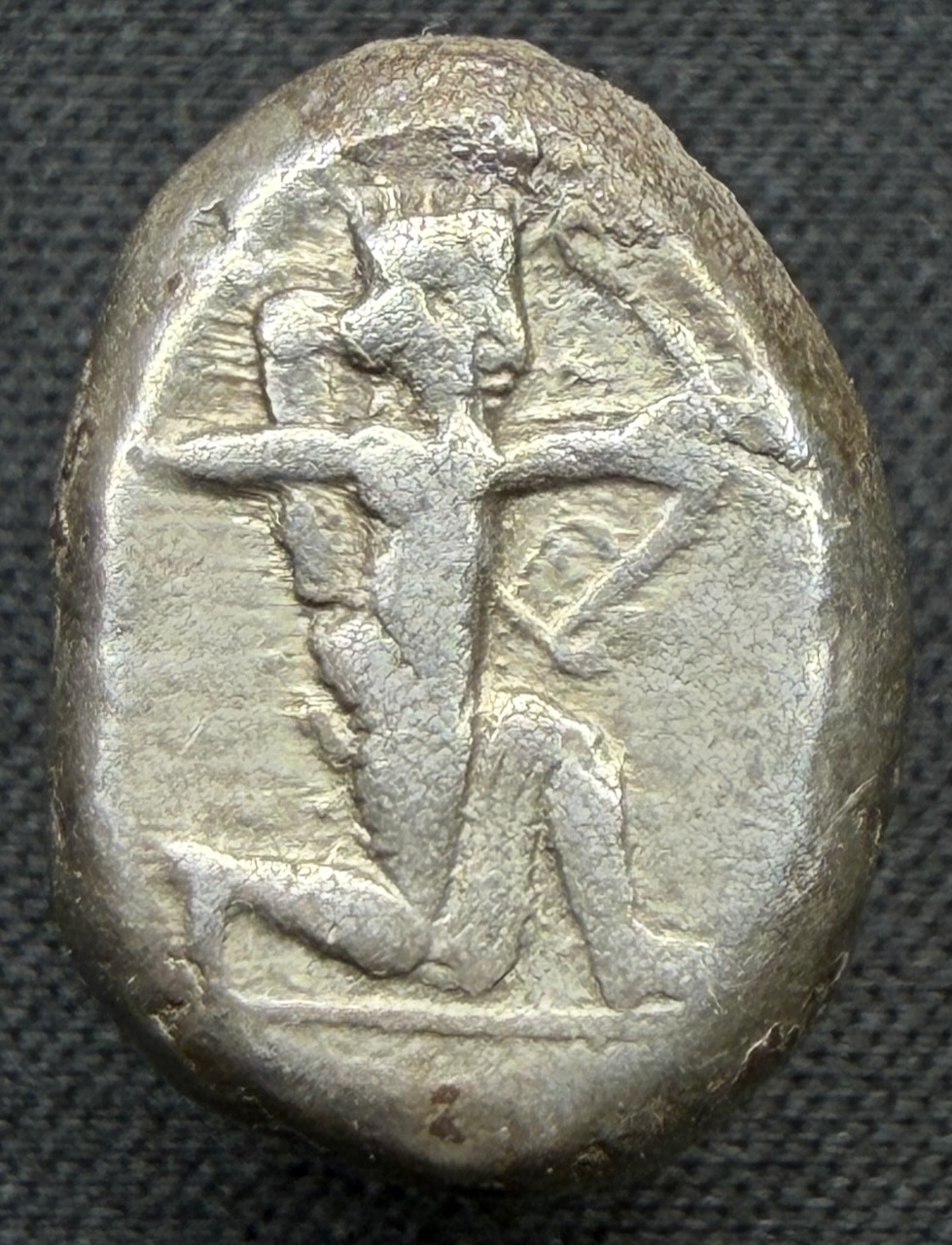
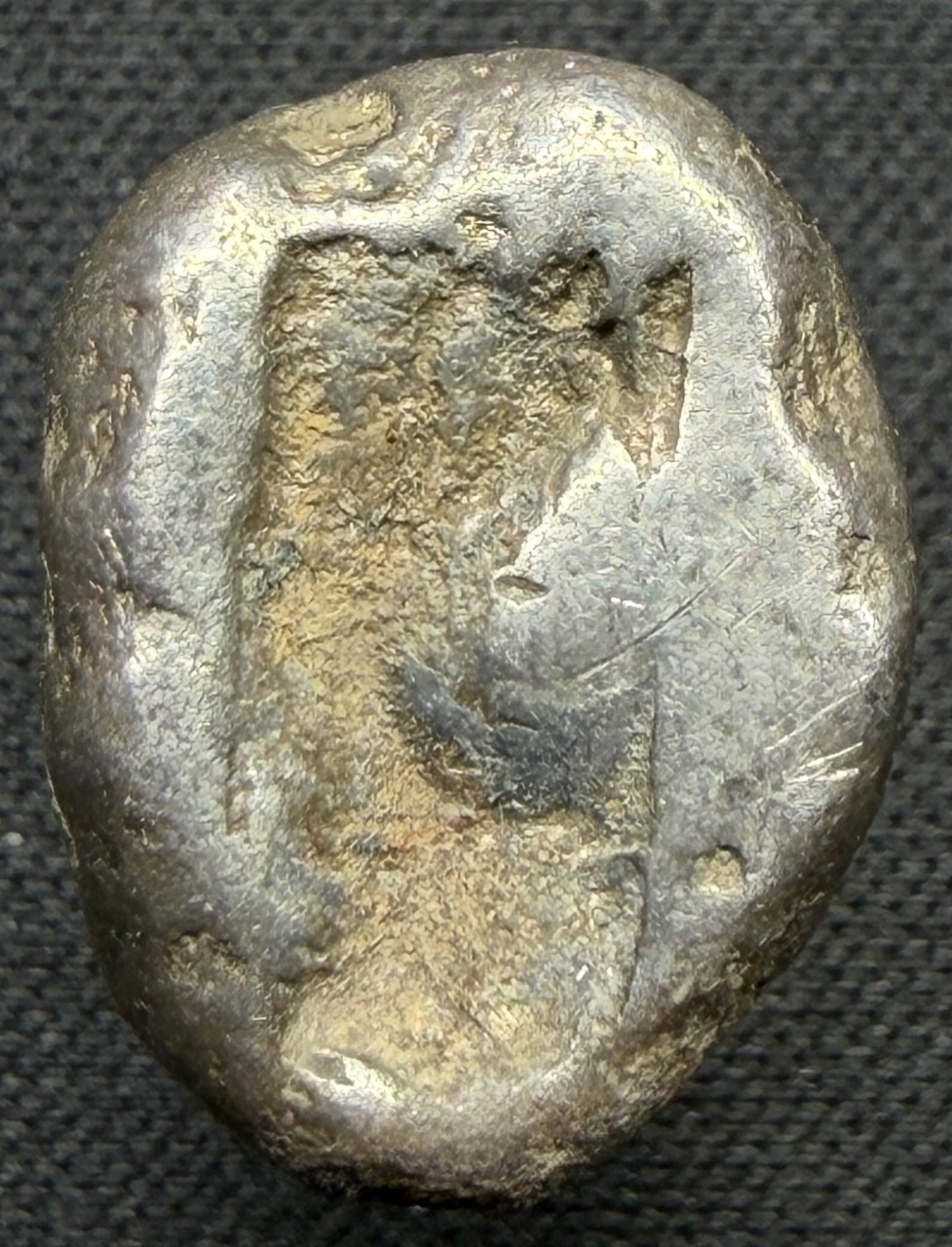
Current: Achaemenid Empire, temp. Darius I to Xerxes I, AR siglos, Sardes mint, c. 505–480 BC. Persian Great King (royal archer) in kneeling-running stance right, drawing bow / oblong incuse punch. Carradice Type II (pl. XI, 12).
Obverse: The Persian Great King (royal archer) in kneeling-running (Knielauf) stance right, wearing the kidaris and kandys, quiver over the shoulder, drawing a bow held in the extended left hand. Anepigraphic.
Reverse: Irregular oblong incuse punch.
Primary reference: Carradice Type II (pl. XI, 12)
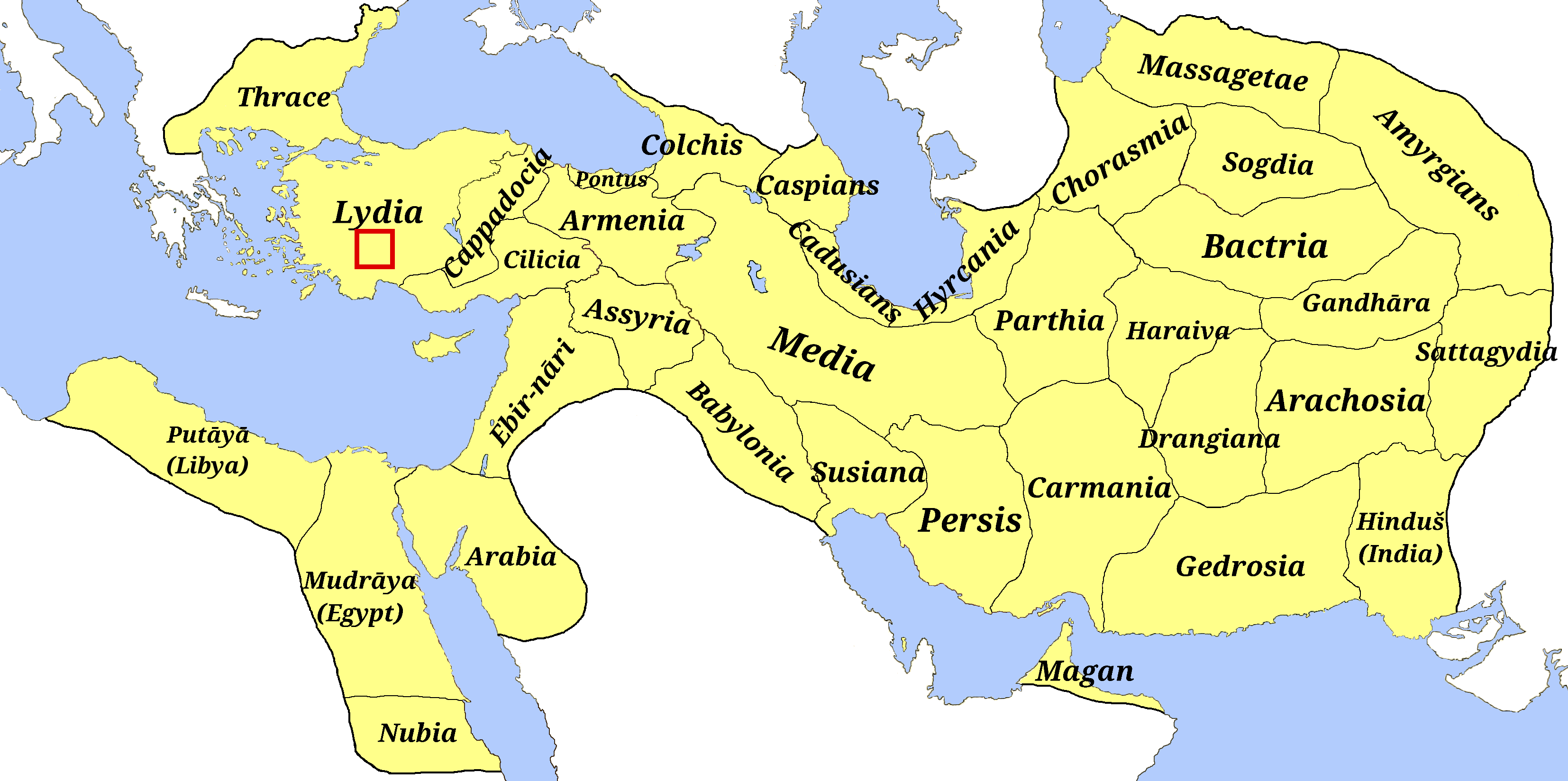
The Achaemenid (Persian) Empire shown as its network of imperial satrapies. The mint that struck this siglos lay in the satrapy of Lydia (Old Persian Sparda), the province at the far western edge of the empire in western Asia Minor. The base map names satrapies but not individual cities; the red square marks the position of Sardes, the Lydian satrapal capital and site of the royal mint that produced the gold daric and this silver siglos. Sardes stood at the western terminus of the Royal Road, the c. 2,500 km highway that linked it to the imperial capital at Susa.
Main map (Achaemenid satrapies): “Map of Achaemenid Imperial Satraps (English Version)” by M.r ebrahim zadeh (Wikimedia Commons), File:Map of Achaemenid Imperial Satraps (English Version).png — released by the author into the public domain and additionally licensed CC BY-SA 4.0 (https://commons.wikimedia.org/wiki/File:Map_of_Achaemenid_Imperial_Satraps_(English_Version).png; license: https://creativecommons.org/licenses/by-sa/4.0/). The base map was compiled from Atlas Antiquus (Justus Perthes, 1909) and the “Achaemenid Satrapies” article in Encyclopaedia Iranica. Modified by JSB Coins: a red square has been added to mark the position of Sardes. This derivative is shared under CC BY-SA 4.0.
Second map (Kingdom of Lydia): “Kingdom of Lydia at its Greatest Extent” by Ennomus (Wikimedia Commons), File:Kingdom of Lydia.png, licensed CC BY-SA 4.0 (https://commons.wikimedia.org/wiki/File:Kingdom_of_Lydia.png; license: https://creativecommons.org/licenses/by-sa/4.0/). Reproduced unmodified.
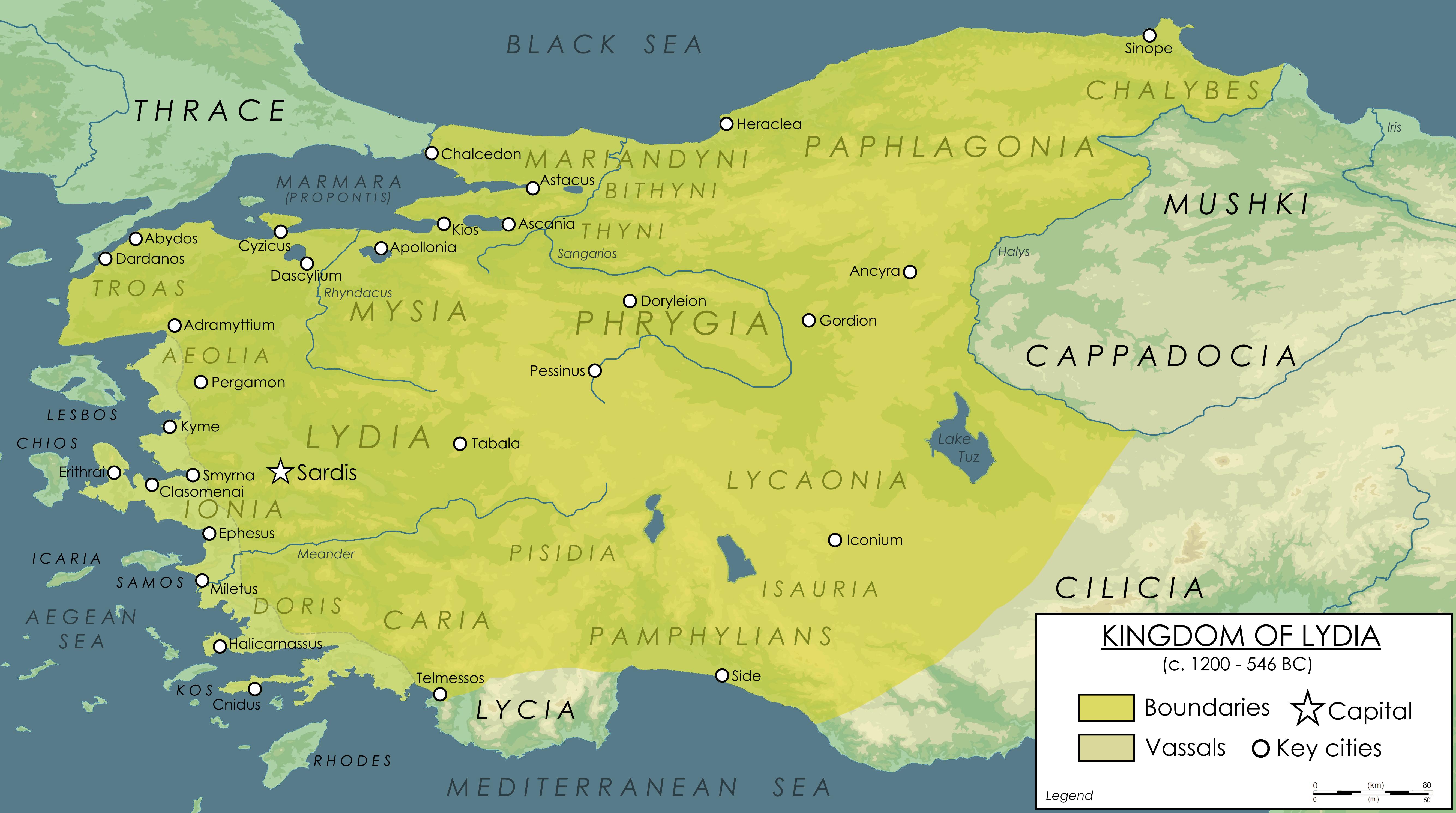
And the kingdom whose mint this coinage inherited — the Kingdom of Lydia at its greatest extent under Kroisos (Croesus), reaching east to the River Halys. Sardes, marked by the capital star (see the map’s legend), is the Lydian capital whose mint, standards, and bimetallic gold-and-silver system passed to the Persians in c. 546 BC and produced this siglos.
The siglos is the silver denomination of the imperial coinage created by the Achaemenid Persian kings, the smaller partner of the gold daric in history’s first deliberately bimetallic state currency. Both denominations carry the same unmistakable image — the crowned royal figure of the Great King as an armed archer — and both were struck at Sardes, the old Lydian capital in western Asia Minor that the Persians inherited, along with its mint and its coining traditions, when Cyrus the Great overthrew Croesus around 547 BC. The type catalogued here is Carradice Type II, the full-figure archer shown in the act of drawing his bow, produced roughly in the last years of Darius I and the opening years of Xerxes I.
Graphic: JSB Coins, 2026 (CC0).
When Darius I (r. 522–486 BC) consolidated the empire after the turmoil following Cambyses’ death, he undertook a sweeping administrative reform: the empire was reorganized into satrapies with fixed tribute assessments, a road and relay system was built, and — most relevant here — a royal coinage was introduced. Coinage itself was a Lydian invention, and the western satrapal capital of Sardes had been minting the electrum and then bimetallic gold-and-silver “Croeseid” coinage of the Lydian kings. The Persian issues grew directly out of that Lydian precedent: the daric and siglos continued the bimetallic system Croesus had established, now stamped with a Persian royal image rather than the Lydian lion-and-bull (the collection’s Croeseid lion-and-bull siglos and third-stater are the coins this one replaced at Sardes; the mint’s next master is here too — after 334 BC the same city struck the drachms of Alexander that in turn replaced the archer). The siglos was thus both an instrument of the new imperial administration and a statement that the King of Kings now controlled the wealth of Lydia and the Greek-facing frontier of the empire.
The obverse presents a bearded royal figure in the archaic “kneeling-running” (German Knielauf) convention — a stylized way of showing rapid, purposeful movement — wearing the kidaris (the crenellated royal crown/tiara) and the kandys robe, with a quiver at the shoulder. In this Type II variant he grasps the bow in his extended forward hand and draws the string, the whole figure reading as an image of martial royal power in action. The bow was a charged emblem in Persian royal ideology: the Great King is repeatedly shown as an archer on his monuments and seals, and archery stood as a defining royal and Persian virtue (Darius’ own tomb inscription at Naqsh-e Rustam boasts of his skill as a bowman). The coin therefore does not depict a specific event so much as embody the person of the King as protector and warrior.
Precisely who the figure is remains a genuinely open question in the scholarship, and it should not be flattened into a single confident answer. The conventional and most common label is “the Great King,” understood as an idealized emblem of kingship rather than a recognizable portrait of any one ruler — the same image spans several reigns without change. Other scholars prefer the more cautious “royal hero” or simply “the archer,” precisely because there is no legend and no individualizing feature to tie the figure to a named king. Both readings appear in the standard literature (see Carradice 1987 and the discussion in the Sunrise catalogue), and this entry follows the majority “Great King / royal archer” usage while flagging that the identification is emblematic, not a portrait.
The coin’s image belongs to a whole royal art of archery, and its grandest surviving statement is in glazed brick: the Frieze of Archers from Darius I’s palace at Susa, now in the Louvre. Life-size guardsmen file past in polychrome relief — robes patterned, beards curled, each man with a spear in both hands and a bow and quiver slung at the shoulder. Whether they represent the “Immortals” of the royal guard or an idealized soldiery is debated; what matters for the coin is the shared language. The siglos compresses that palace imagery into two grams of silver small enough to pay a mercenary: the King’s power, portable.
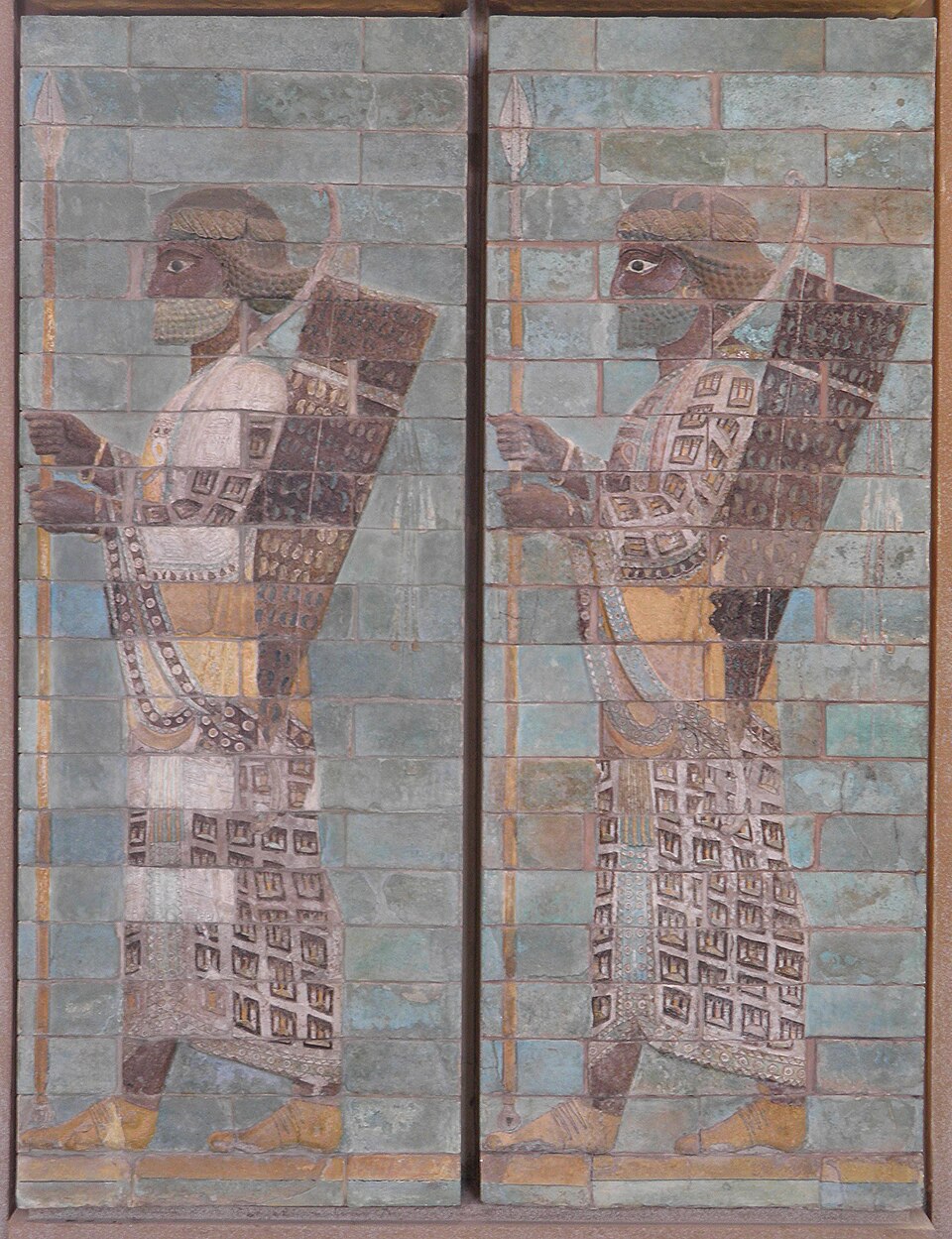
Photo: Carole Raddato, CC BY-SA 2.0 (Wikimedia Commons); reproduced unmodified.
In economic terms the daric and siglos behaved very differently from the great international trade coinages of the age. The gold daric circulated widely and was prized abroad, but the silver siglos was largely a regional currency of the western satrapies and Asia Minor; it rarely traveled far and is scarce in hoards outside its home region, in contrast to the Athenian “owl” tetradrachm, which functioned as a Mediterranean-wide reserve currency. The standard’s gravitational pull shows in the Greek cities of Anatolia’s coasts: even Athenian-refounded Amisos on the Black Sea struck its owl-badged silver as a “heavy siglos” on the Persic weight system rather than on Attic weight, and Byzantion at the Bosporus made the same choice after the King’s Peace returned the Asian shore to Persia. Where the Persian coinage exerted its most famous influence was political rather than commercial. Persian gold, stamped with this same royal archer, was used to subsidize Greek states and buy Greek mercenaries and allies throughout the fifth and fourth centuries. The Spartan king Agesilaos, forced to abandon his campaign in Asia Minor when Persian money stirred up war against Sparta at home, is said to have quipped that he had been driven out of Asia by “ten thousand archers” — meaning not soldiers but the archer-stamped Persian coins (Plutarch, Agesilaos 15). The anecdote concerns the gold daric, but the emblem is the very one carried by these sigloi.
The framework used for these coins is Ian Carradice’s relative sequence (1987), which arranges the royal archer types in four groups: Type I, a half-length figure of the king drawing the bow; Type II, the full figure in kneeling-running stance drawing the bow (this coin); Types IIIa and IIIb, the full figure holding a bow in one hand and a spear in the other, the most abundant of all; and Type IV, the latest, holding a dagger (akinakes) and bow. The absolute dates attached to these types are approximate and should be read as such: the relative order is secure and widely accepted, but the transition points between types are not fixed to precise years, and different catalogues bracket Type II slightly differently within the c. 510–480 BC window. The attribution to Sardes is likewise the standard scholarly consensus — grounded in the Lydian minting precedent and in find distribution — rather than something proven by mint marks, since the coins bear no inscription; a small number of scholars have left open the possibility of other western mints. The reverse never carries a design, only the irregular incuse punch left by the anvil die, an archaic feature these coins retained long after many Greek mints had adopted two-sided types. The siglos also never really left western Asia Minor. For international payments the empire used gold darics and, increasingly, other people’s silver: by the last decades of the fifth century Persian satraps were paying the rowers of the Spartan fleet in Attic drachmas, and the King’s officials had begun striking imitations of the Athenian owl — one series signed discreetly with a tiny crowned royal head at the owl’s feet, another replacing Athena outright with a satrap’s portrait and the letters ΒΑΣ, “king.”
Modest and worn though individual sigloi often are, they are among the most historically resonant coins of antiquity: the everyday silver of the world’s first true superpower, carrying the image by which the Great King projected himself to his subjects and his enemies alike. A Type II example captures a specific, comparatively early moment in that long series — the archer shown drawing his bow, before the spear-bearing form that would dominate the fifth century — and connects a single small coin to Darius’ imperial reform, the Lydian roots of coinage at Sardes, and the Greco-Persian struggles that Persian silver and gold did so much to shape. The royal archer also enjoyed a long afterlife on Iranian silver: two and a half centuries later the Arsacid kings of Parthia, presenting themselves as heirs of Persia, put a seated royal archer on every drachm they struck — see this collection’s Mithradates II tiara drachm from Ekbatana. The same claim runs on through the collection’s later Parthian silver — the eagle drachm of Phraates IV and the Ekbatana drachm of Artabanus II — where the enthroned founder is still testing his bow three centuries after the Great King’s archer went out of use.
Attribution and typology follow Ian Carradice, “The Regal Coinage of the Persian Empire” (1987), with the Type II reference at plate XI, 12; standard cross-references are BMC Arabia/Persia (p. 173, nos. 185 ff.), Sear, Greek Coins and Their Values II 3428, Klein 754, and GRPC Lydia S15. Background on the daric/siglos system and the Sardes mint draws on the “DARIC” article in the Encyclopaedia Iranica, John H. Kroll’s essay “The Coins of Sardis” (Archaeological Exploration of Sardis) — which covers the Sardes mint from the Lydian lion-and-bull coinage through the Achaemenid daric/siglos period — and the introductory essays (Müseler, Assar) in The Numismatic Art of Persia: The Sunrise Collection, Part I (CNG, 2011). The “ten thousand archers” anecdote is from Plutarch, Life of Agesilaos 15. Reference numbers cross-referenced here were corroborated against current dealer and auction descriptions of Carradice Type II sigloi and should be checked against the printed catalogues before publication. Darius’ tribute reform: Herodotus 3.89–95 (Book III linked in the references); Plutarch’s Agesilaos is likewise linked. The Susa archers frieze: Louvre, Paris.
Royal 'archer' silver of the Achaemenid kings, the silver counterpart to the gold daric. A metrological refinement from current cataloguing (CNG): the early Types I–II sigloi are struck on the lighter Lydo-Milesian standard (c. 5.35 g, inherited from the Croeseid half-stater), and the heavier siglos standard of c. 5.55 g comes in with the later Types III–IV — so a full-weight Type II runs c. 5.3–5.4 g, not the 5.55 g of the common later sigloi. The early Types I–II are also notably scarcer in commerce than the abundant Type IIIb. Carradice's relative typology I→IV is the standard framework; Type II (full-figure king drawing the bow) sits between the half-figure Type I and the bow-and-spear Types IIIa/IIIb. All royal sigloi are conventionally attributed to Sardes and are anepigraphic. Reverse is always an irregular incuse punch, so die axis is not meaningful.
John's Ancient Coin Collection · Type · persia-achaemenid-siglos-type-ii
Image credits for this coin — photographs, maps and graphics used on this page
.png)

.jpg)