Type · mithradates-ii-tiara-drachm
Current: Parthian Kingdom, Mithradates II, AR drachm, Ekbatana, c. 121–91 BC, late tiara series (Sellwood 28.3; Shore 97)
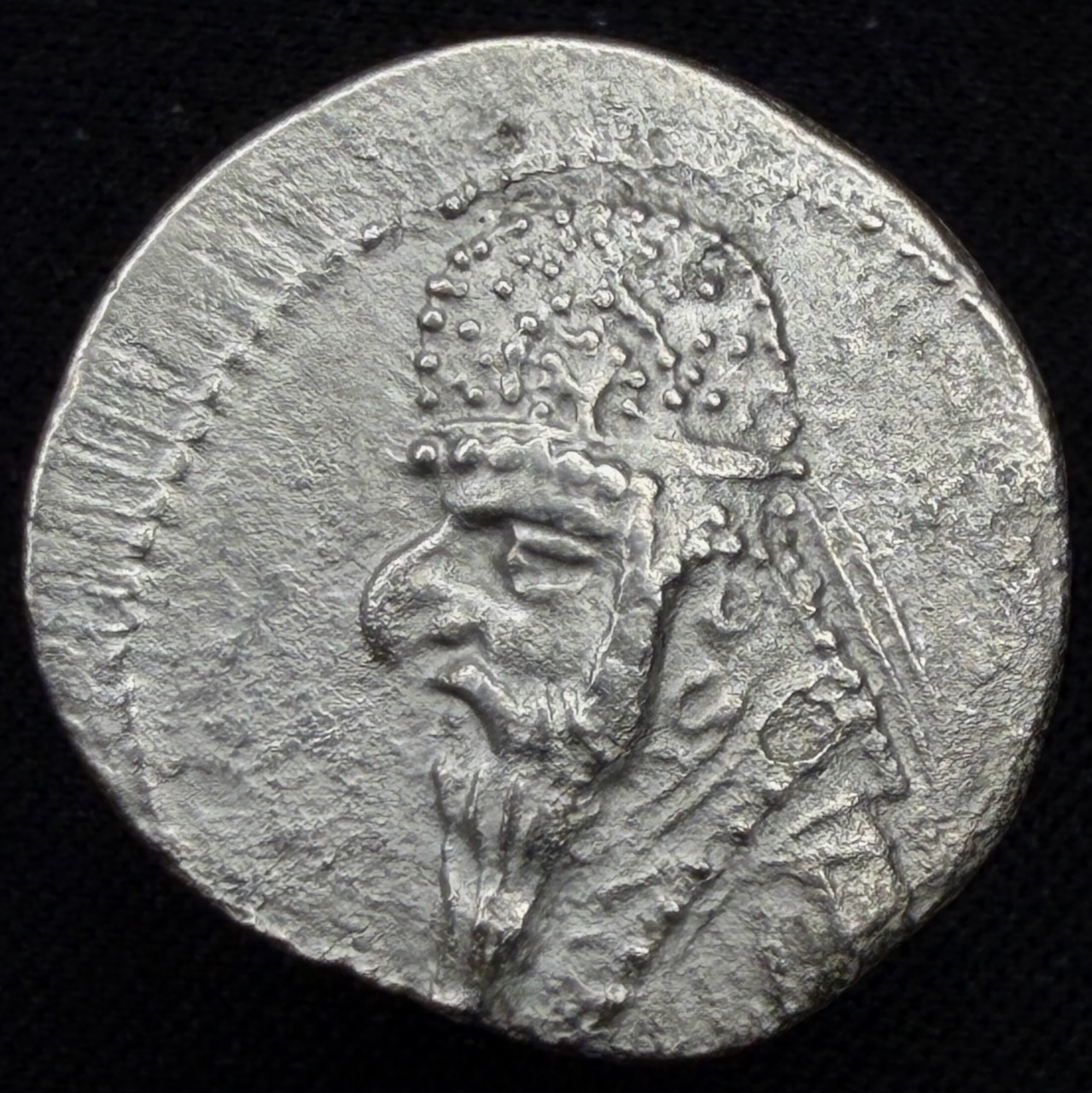
Obverse: Long-bearded draped bust left wearing tall Parthian tiara ornamented with a star of pellets, pellet-decorated earflap, and diadem ties; border of pellets
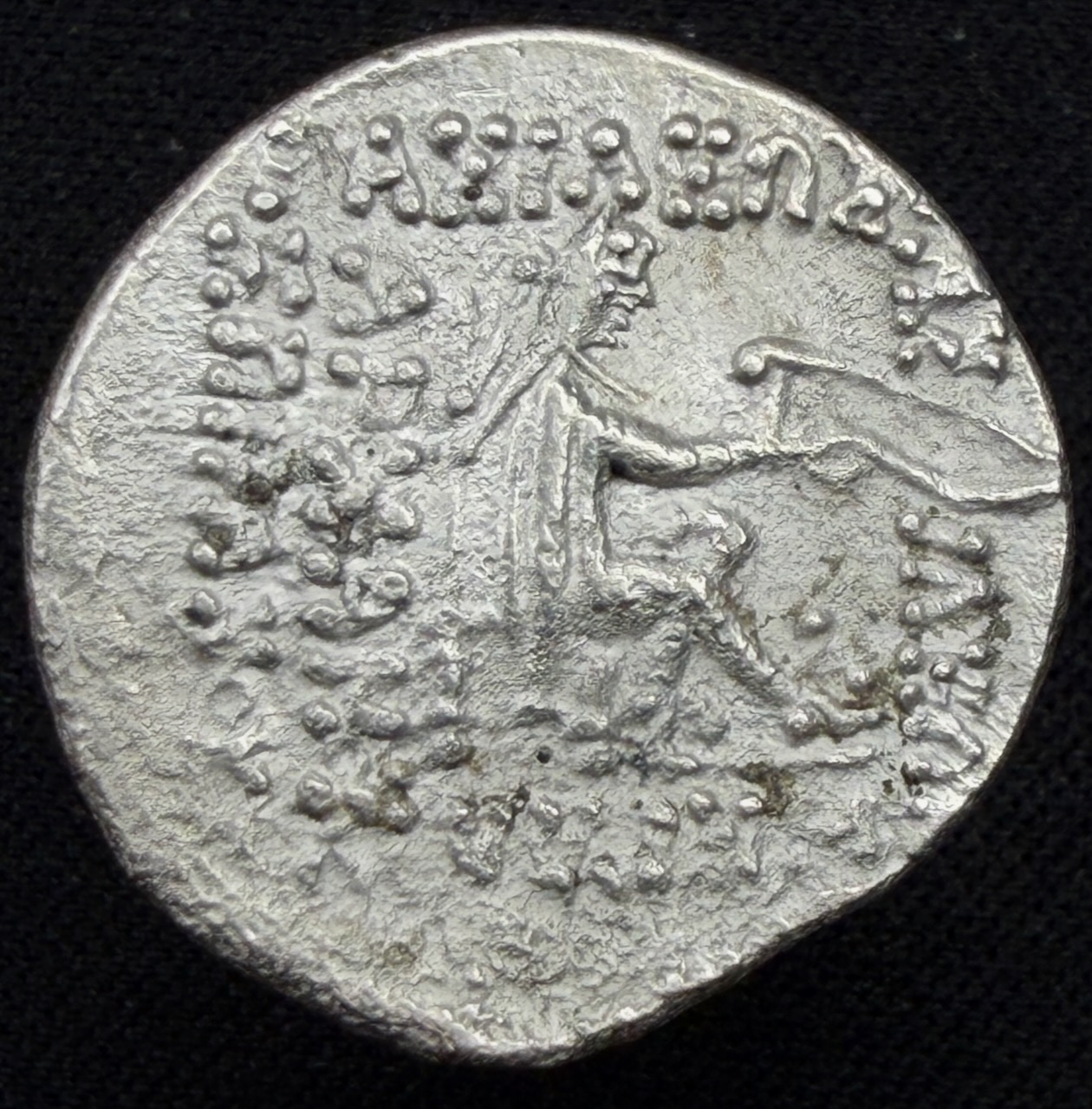
Reverse: Beardless archer (Arsakes I) wearing bashlyk and cloak seated right on throne, holding bow in right hand; five-line Greek legend
Primary reference: Shore 97
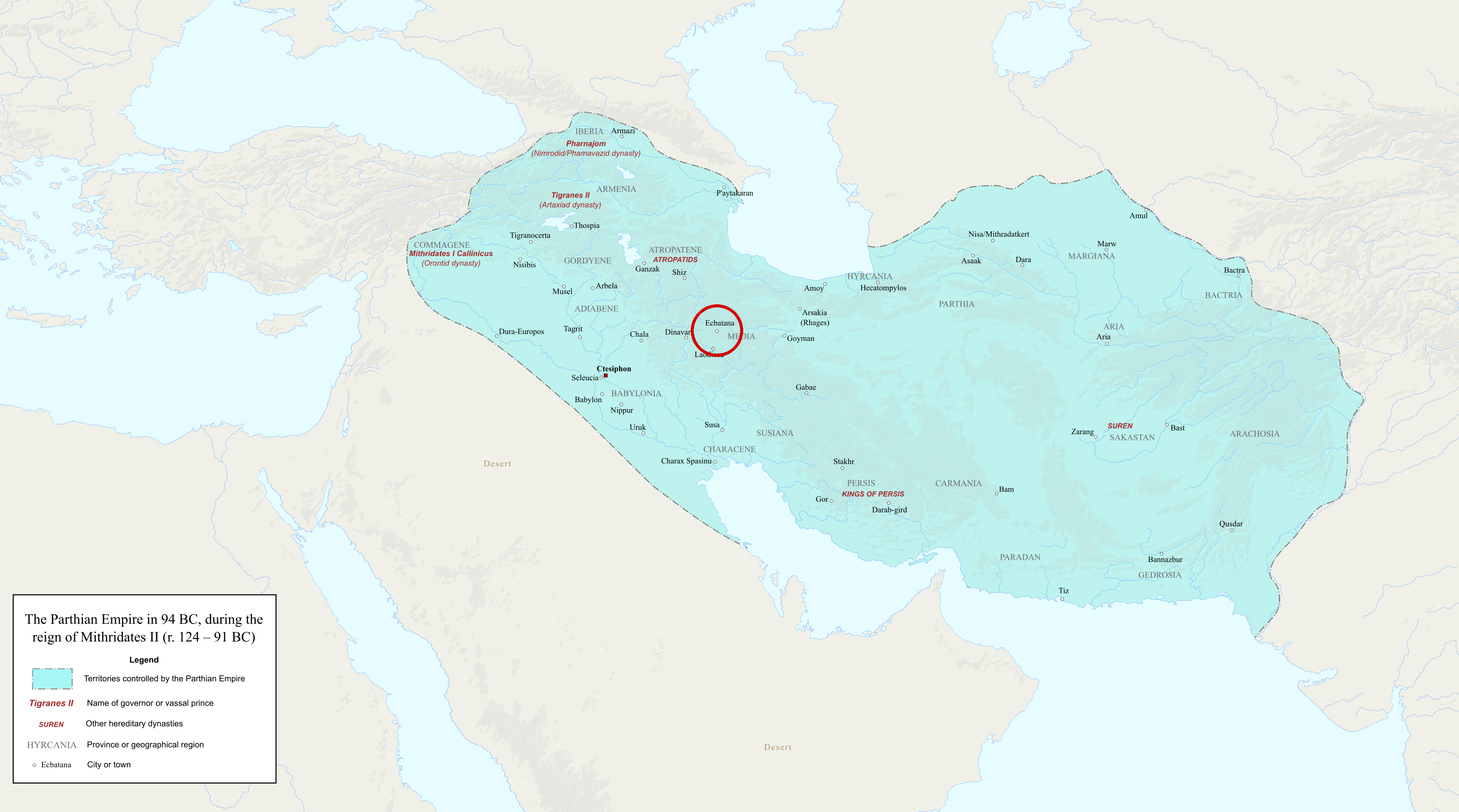
The Parthian Empire in 94 BC, during the reign of Mithradates II — the very years this tiara drachm was struck. Ekbatana (Ecbatana), the mint, is ringed in red in Media, near the empire’s heart; the map also marks Arsakia (Rhagae) and the vassal dynasties of the western frontier.
Main map: “Map of the Parthian Empire under Mithridates II”, by HistoryofIran (after an original by Ro4444), Wikimedia Commons, CC BY-SA 4.0 (https://creativecommons.org/licenses/by-sa/4.0/). https://commons.wikimedia.org/wiki/File:Map_of_the_Parthian_Empire_under_Mithridates_II.svg Modification: red ring added to mark Ekbatana. Second map: “Parthia 001ad.jpg”, by Thomas Lessman (worldhistorymaps.info), Wikimedia Commons, CC BY 3.0 (https://creativecommons.org/licenses/by/3.0/). https://commons.wikimedia.org/wiki/File:Parthia_001ad.jpg Reproduced unmodified.
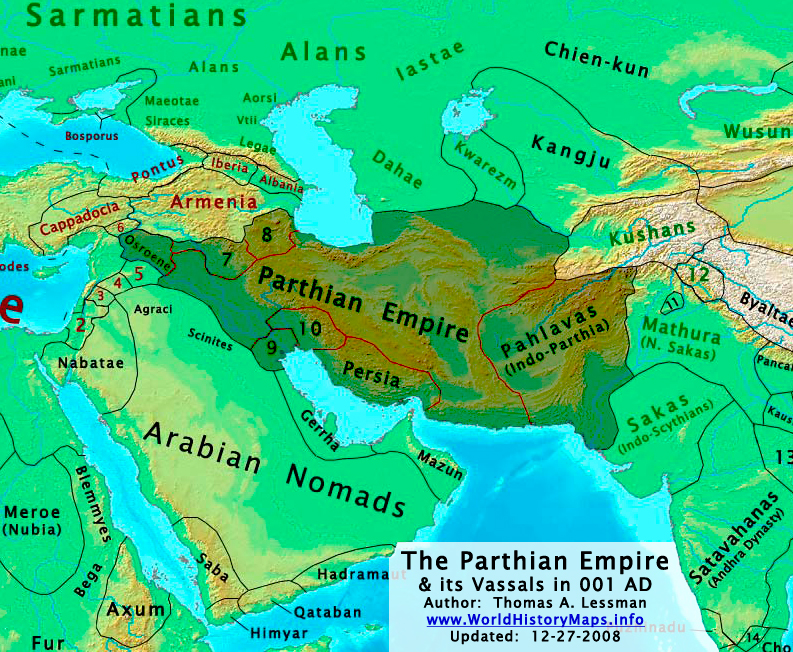
Second map: the Parthian Empire and its vassals in 1 AD, showing the empire much as Mithradates left it, holding the line against Rome a century on.
Mithradates II (c. 121–91 BC) made Parthia a world power. He inherited a kingdom battered by nomad invasions that had killed his two predecessors in battle, and left an empire running from the Euphrates to Central Asia. He was the first Arsacid to strike coins as ΒΑΣΙΛΕΩΣ ΒΑΣΙΛΕΩΝ — “King of Kings” — reviving the old Achaemenid title, and the first to replace the Hellenistic royal diadem with the tall Iranian tiara seen on this drachm, a deliberate statement that the Arsacids were successors of Persia, not epigones of the Seleukids.
Graphic: JSB Coins, 2026 (CC0).
The obverse shows the aged king with a long beard, wearing the stiff jewelled tiara with a star of pellets on its side and a pellet-fringed earflap — regalia adapted, ancient authors noted, from Median court dress. The reverse keeps the dynasty’s badge: the deified founder Arsakes I in nomad dress, seated and testing his bow, an image whose ancestry runs back through the Achaemenid archer sigloi of Asia Minor. Around him the five-line legend proclaims “King of Kings, Great Arsakes, God Manifest.” Within the drachm series the tiara issues (Sellwood types 26–28) form the final phase of the reign; Assar’s chronology places type 28 in roughly the last five years, c. 96–91 BC, struck at Ekbatana — the same mint that produced this collection’s Artabanus II and Phraates IV drachms a couple of generations later.
Coins are nearly the only surviving portraits of Mithradates II — but not quite. On the sacred cliff of Behistun in Media, beside the great road that ran west from the Ekbatana mint, the king commissioned the earliest of all Parthian rock reliefs: Mithradates receiving four of his great officers in a row, each figure once labeled in Greek, the foremost of them Gotarzes, “satrap of satraps.” The choice of place was the point. Darius I had carved his res gestae on that same rock four centuries earlier, and the first Arsacid to call himself King of Kings set his image directly beneath the Achaemenid king’s — the same claim the tiara and the ΒΑΣΙΛΕΩΣ ΒΑΣΙΛΕΩΝ titulature make on this drachm, restated in stone. The relief itself had the worst luck of any Parthian monument: in the 1680s a Safavid grandee had most of the panel cut away to make room for an endowment inscription, and the scene now survives chiefly in the drawing the French artist Guillaume-Joseph Grelot made in 1673/74, a few years before the destruction.
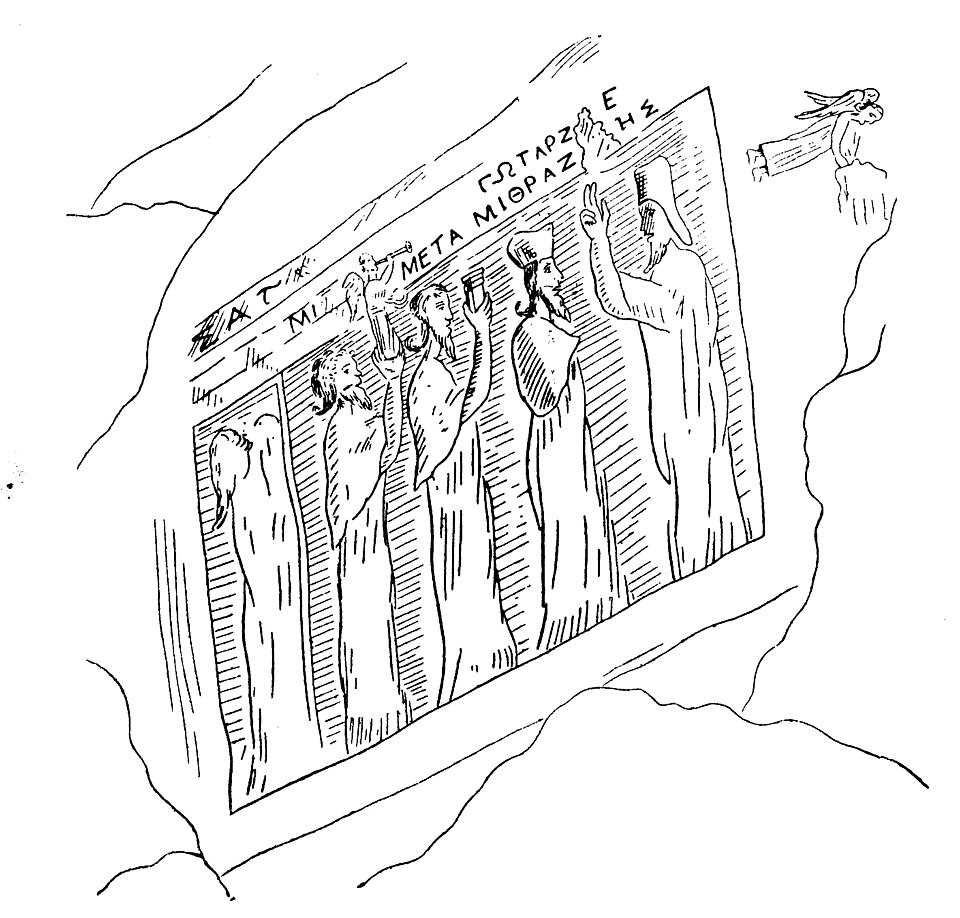
Photo of the engraving by dynamosquito, CC BY-SA 2.0 (Wikimedia Commons); reproduced unmodified.
Two chronological wrinkles are worth recording. First, the reign dates: older references — including both dealer tags accompanying specimen 001 — give 123–88 BC, following Wroth and Sellwood; the cuneiform astronomical diaries have since pinned the accession to c. 121 BC and death to 91 BC, the dates now used by CNG, Heritage and most current cataloguers. Second, the attribution of the long-bearded tiara drachms has been debated: Sellwood himself moved coins between Mithradates II, Gotarzes I and Sinatruces across editions (his type 33, for example, went from Sinatruces to Gotarzes I and back). Type 28 with the star-ornamented tiara remains with Mithradates II in both Sellwood’s arrangement and Assar’s revision, so the attribution here is not seriously contested — but the file of neighboring types is a reminder that Parthian royal portraits without names are slippery ground.
These late drachms were struck while Mithradates II stood at the summit. His armies had recovered the eastern provinces from the Saka nomads and taken Dura-Europos in Mesopotamia; he arbitrated a dynastic quarrel in Armenia and held the young Tigranes as hostage; Chinese envoys of the Han emperor Wu, following Zhang Qian’s reconnaissance, opened the silk trade through his territory; and in 96 BC his ambassador Orobazos met the Roman proconsul Sulla on the Euphrates — the first official contact between Parthia and Rome, at which, Plutarch says, Sulla seated himself between the Parthian envoy and the Cappadocian king as if between subordinates. Mithradates had the envoy executed for accepting the slight. The two empires the meeting introduced would contest the Euphrates frontier for the next three centuries.
Attribution: Fred B. Shore, Parthian Coins and History (1993), no. 97; David Sellwood, An Introduction to the Coinage of Parthia, 2nd ed. (1980), type 28.3; concordance and mint per Parthia.com (Edward C. D. Hopkins) and current dealer cataloguing (e.g. Thirion, CNG). Revised reign dates and phase chronology follow G. R. F. Assar’s studies of the Babylonian astronomical diaries as reflected in current auction cataloguing. Narrative history: Justin 42; Plutarch, Sulla 5 (linked in the references). The Behistun relief and its loss: known from Grelot’s drawing of 1673/74, as recorded in the standard accounts of the Parthian monuments at Behistun.
Shore 97 = Sellwood 28.3 (Ekbatana). The tiara issues are the last phase of Mithradates II's drachm coinage; Assar's phase arrangement puts Sellwood type 28 in c. 96–91 BC. Older references (and both dealer tags on specimen 001) date the reign 123–88 BC; current scholarship prefers c. 121–91 BC. The five-line legend with ΒΑΣΙΛΕΩΣ ΒΑΣΙΛΕΩΝ is the first regular use of the 'King of Kings' title on Parthian coinage.
John's Ancient Coin Collection · Type · mithradates-ii-tiara-drachm
Image credits for this coin — photographs, maps and graphics used on this page


.jpg)