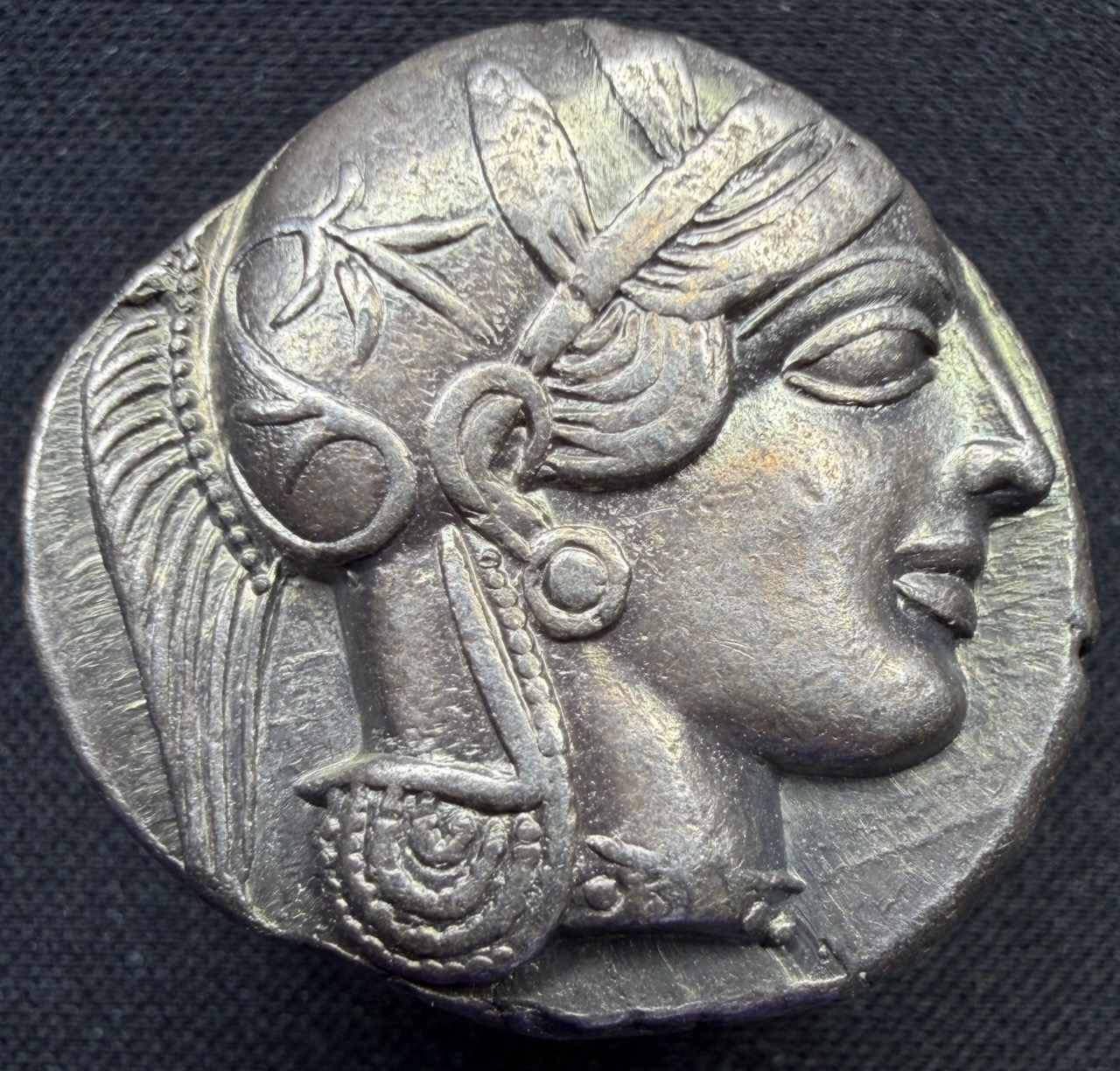
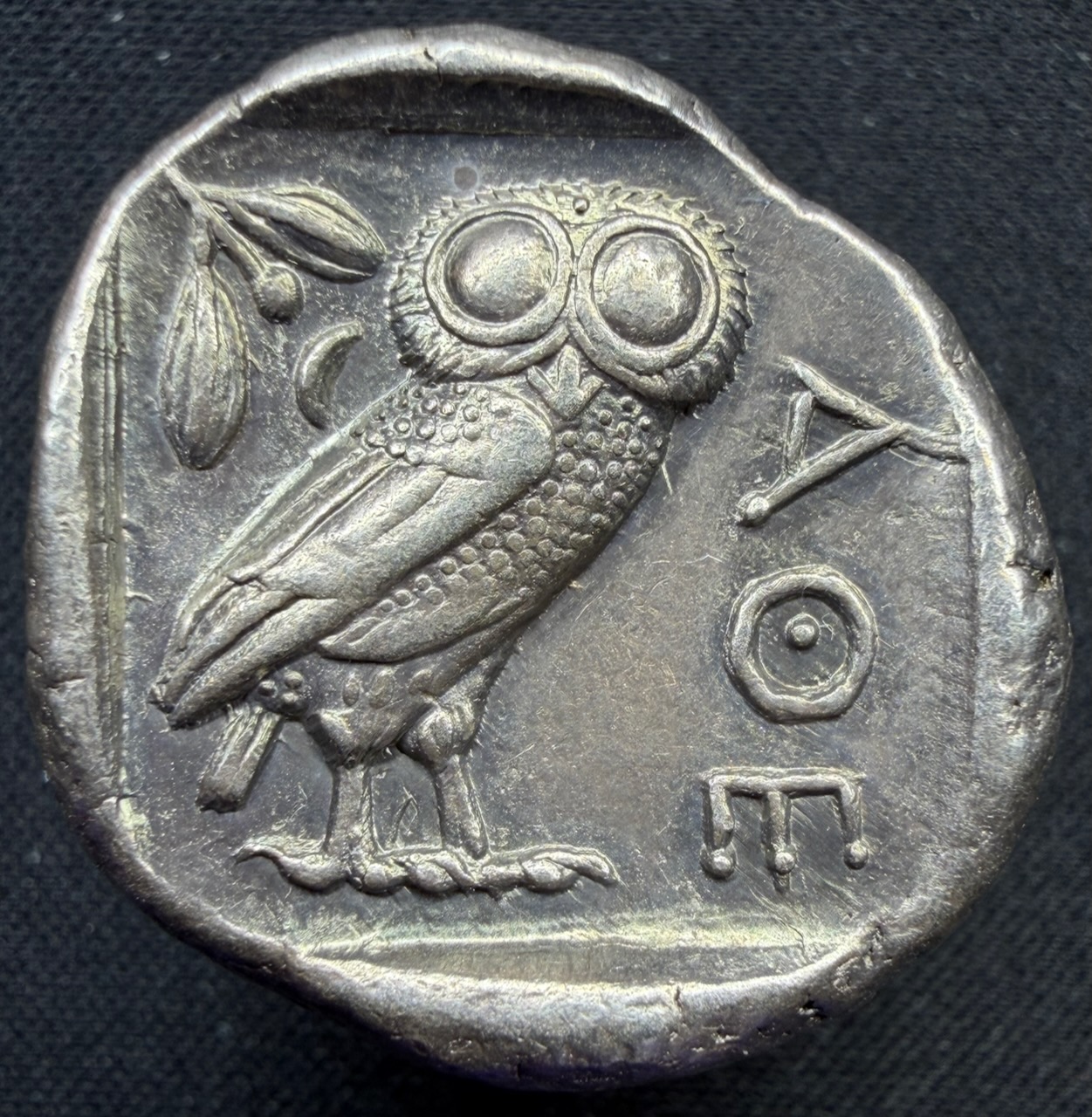
Type · athens-classical-owl-tetradrachm
Current: Attica, Athens, AR tetradrachm, c. 454–404 BC. Helmeted head of Athena right / owl standing right, head facing, olive sprig and crescent, ΑΘΕ. Kroll 8; SNG Copenhagen 31; Sear (Greek) 2526; HGC 4, 1597.
Obverse: Head of Athena right, wearing a crested Attic helmet ornamented with three olive leaves over the visor and a palmette/spiral scroll on the bowl; round earring and beaded necklace. The eye is rendered frontally in the archaizing 'almond' convention retained on this coinage.
Reverse: Owl standing right, head facing the viewer; to upper left an olive sprig with two leaves and a berry, and a crescent moon; all on a broad flan (the incuse square of the earlier issues is largely off-flan).
Primary reference: Kroll 8; SNG Copenhagen 31; Sear (Greek) 2526; HGC 4, 1597
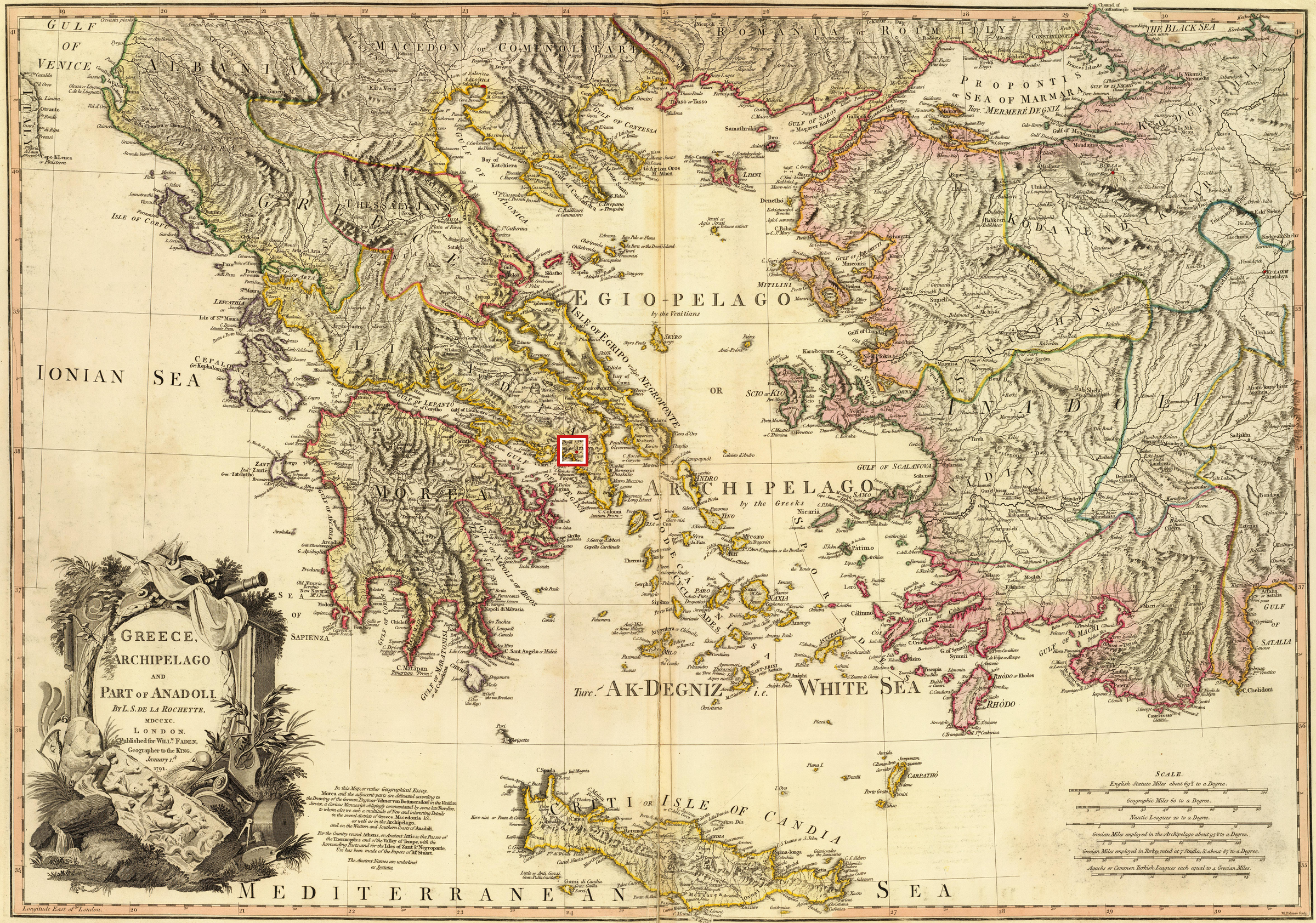
A 1791 map of Greece, the Archipelago (the Aegean), and part of Anadoli (the Anatolian coast); Athens is indicated by the red square. Though drawn in the eighteenth century, the chart shows the same theatre across which the owl circulated — mainland Greece with Attica and Athens at its center, the islands of the Aegean, and the Ionian coast of Asia Minor opposite — the trade world in which Athenian “owls” served as the standard silver currency.
Main map (1791): “Greece, Archipelago and part of Anadoli” by Louis Stanislas d’Arcy Delarochette (engraved by W. Palmer; published for William Faden, Geographer to the King, London, 1791), in the public domain (PD-old-100; published before 1931). File:Map of Greece, Archipelago and part of Anadoli; Louis Stanislas d’Arcy Delarochette 1791.jpg (https://commons.wikimedia.org/wiki/File:Map_of_Greece,_Archipelago_and_part_of_Anadoli;_Louis_Stanislas_d%27Arcy_Delarochette_1791.jpg). Modified by JSB Coins: a red square marks the position of Athens. No attribution is legally required for a public-domain work; the source is credited here as a courtesy.
Second map (431 BC political): “Map of the Peloponnesian War, 431 BC” by Marsyas, English version by Aeonx (Wikimedia Commons), File:Map Peloponnesian War 431 BC-en.svg, licensed CC BY-SA 3.0 (https://commons.wikimedia.org/wiki/File:Map_Peloponnesian_War_431_BC-en.svg; license: https://creativecommons.org/licenses/by-sa/3.0/). Rasterized from SVG to PNG by JSB Coins; no other changes. This derivative is shared under the same CC BY-SA 3.0 license.
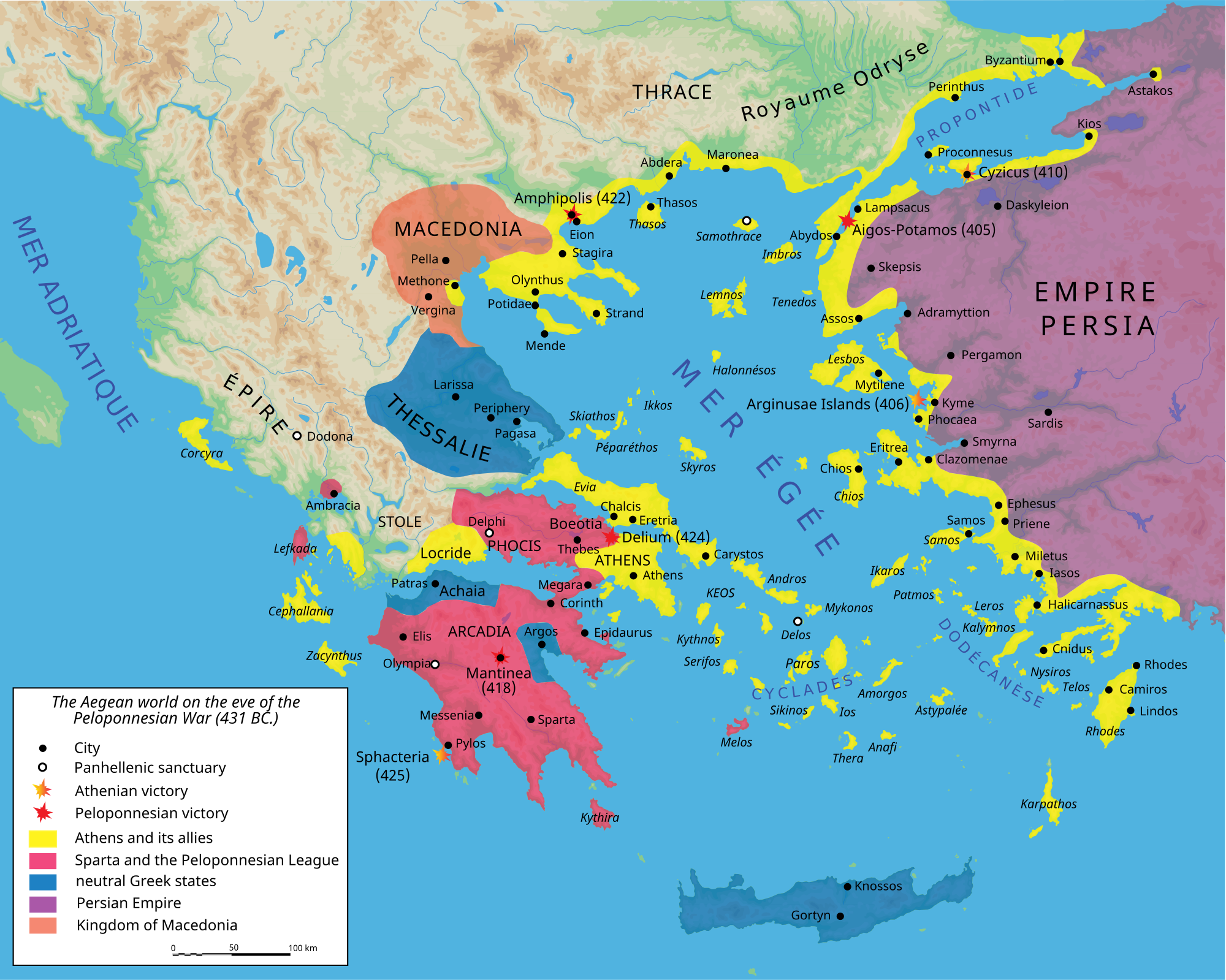
And the same world drawn as a political map — the Aegean on the eve of the Peloponnesian War, 431 BC. Athens and its allies (the Delian League) are shaded yellow, Sparta and the Peloponnesian League pink, neutral Greek states blue, the Persian Empire purple, and Macedonia orange. This yellow bloc is the empire whose tribute and Laurion silver were struck into these “owls”; the star/dot markers trace the battles of the war (431–404 BC), almost exactly the span over which this coinage was produced. (A few labels on the source map — the seas, Épire, Thessalie — remain in French.)
No ancient coin is more famous than the Athenian “owl.” For the better part of a century it was the dominant trade currency of the eastern Mediterranean — struck in staggering quantity, accepted from Italy to the Levant, hoarded across the Near East, and imitated as far away as Egypt and Arabia. The specimen catalogued here belongs to the great standardized issue of c. 454–404 BC, the coinage of imperial Athens at its zenith. It is also, on any reckoning of volume, the most-produced coin of the ancient world before Alexander.
Graphic: JSB Coins, 2026 (CC0).
Athens was among the first Greek cities to strike silver, around the middle of the sixth century BC, but its earliest coins give no hint of what was coming. They are the so-called heraldic didrachms: a device on one face — a horse’s hindquarters, a chariot wheel — a punched square on the other, the type changing with each issue and naming no city at all, because the coins rarely traveled beyond Attica. The metal in them was a mixture from several sources, some of it worked out of shallow, low-grade seams in the Laurion district that had been scratched at since the Bronze Age.
Everything changed in the 510s BC, when Athenian miners struck, at a far deeper level, the extraordinarily rich ore body that geologists call the Third Contact. Athens built an industry to work it and rebuilt its coinage to match: a new and larger denomination, the 17.2 g tetradrachm; a brief experiment with a gorgon’s head as a state badge; and then the design that would outlive the city’s power — Athena helmeted on one face, her owl, her olive sprig and the three letters ΑΘΕ on the other.
The novelty lay less in the imagery than in the format. Greek coins until then carried a picture on one face only, and were either uninscribed or marked with a single letter. A type on both faces plus a legible ethnic meant that however far these coins traveled they would be identifiable at a glance as Athenian — which tells us that the Athenians grasped from the outset that the new silver was going abroad. Why the change came exactly when it did is genuinely disputed: some read it as an expression of the Kleisthenic revolution and the birth of the democracy after 510 BC, others as a hard commercial calculation about recognition in foreign markets. The design change cannot be dated closely enough to decide between them, and it may well predate Kleisthenes altogether.
What is not in doubt is the consequence. Athens had more silver than it could spend at home, and rather than trade it as anonymous bullion it exported it as money — silver carrying the stamped guarantee of the Athenian state, and worth more abroad for that reason.
The obverse bears the head of Athena, patron goddess of the city, helmeted for war in a crested Attic helmet decorated with olive leaves — the olive being her gift to Athens and the foundation of much of its wealth. Those leaves are not original to the type: they were added after the Persian Wars, on the coins struck from 478 BC, in the manner of a victory wreath. The reverse shows her sacred bird, the owl, standing four-square and turning its great round-eyed face to the viewer, with a sprig of olive and a crescent moon behind, and the abbreviated ethnic ΑΘΕ — short for ΑΘΗΝΑΙΩΝ, “of the Athenians.” What the crescent means has never been settled: it has been read as a memorial of a battle (Marathon or Salamis), as a lunar or calendrical mark, and — most economically — as nothing more than the moon that belongs beside a nocturnal bird.
The design is one of the most stable in the history of coinage: once fixed, it was repeated with little change for generations, and the archaic stiffness of Athena’s frontal eye and formal features was deliberately retained long after Greek sculptors had mastered naturalism. The most common explanation is functional — a familiar, unchanging image was a trusted one in the marketplace — though this is an inference rather than a documented policy.
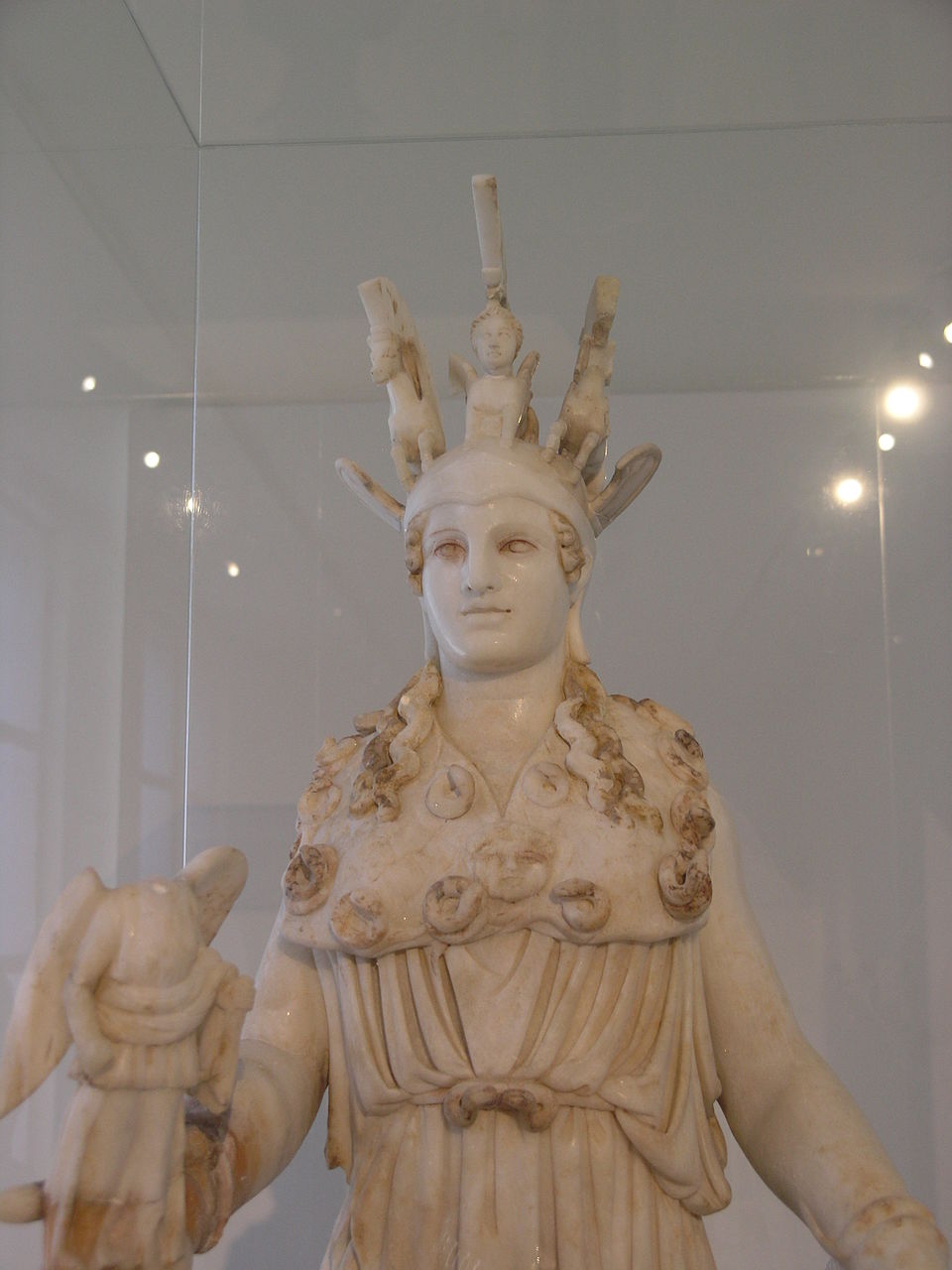
Photo: Marsyas, Wikimedia Commons, licensed CC BY-SA 2.5, reproduced unmodified.
Two things made the owls possible on this scale. The first was the silver of Laurion, the mining district in southern Attica whose ore the Athenians exploited intensively; it was Laurion silver that, on Themistokles’ advice, had built the fleet that won Salamis in 480 BC. From the late sixth century through most of the fourth, Laurion was the largest single supplier of silver in the central and eastern Mediterranean, and the metal was exceptionally pure. Its reach can be measured directly: lead-isotope analysis has found Laurion silver in the late sixth- and fifth-century coinages of Aegina, Chios, Samos and Corinth — including states that were, at the time, Athens’ declared enemies. Silver moved as a commodity, through intermediaries, irrespective of politics.
The second was empire. After the Greek victory over Persia, Athens led the Delian League, an alliance whose treasury was kept at first on the island of Delos. In 454 BC the treasury was moved to Athens, and over the following decades the League’s tribute was effectively converted into an Athenian imperial revenue. The owls of 454–404 BC are the coin of that empire: they paid the rowers of the fleet, financed the building of the Parthenon and the other monuments of Periklean Athens, and bankrolled the long war against Sparta. (The tetradrachm was the export denomination; its stay-at-home sibling, the owl drachm — a day’s skilled wage, and scarcer today than the tetradrachm — is also in this collection.)
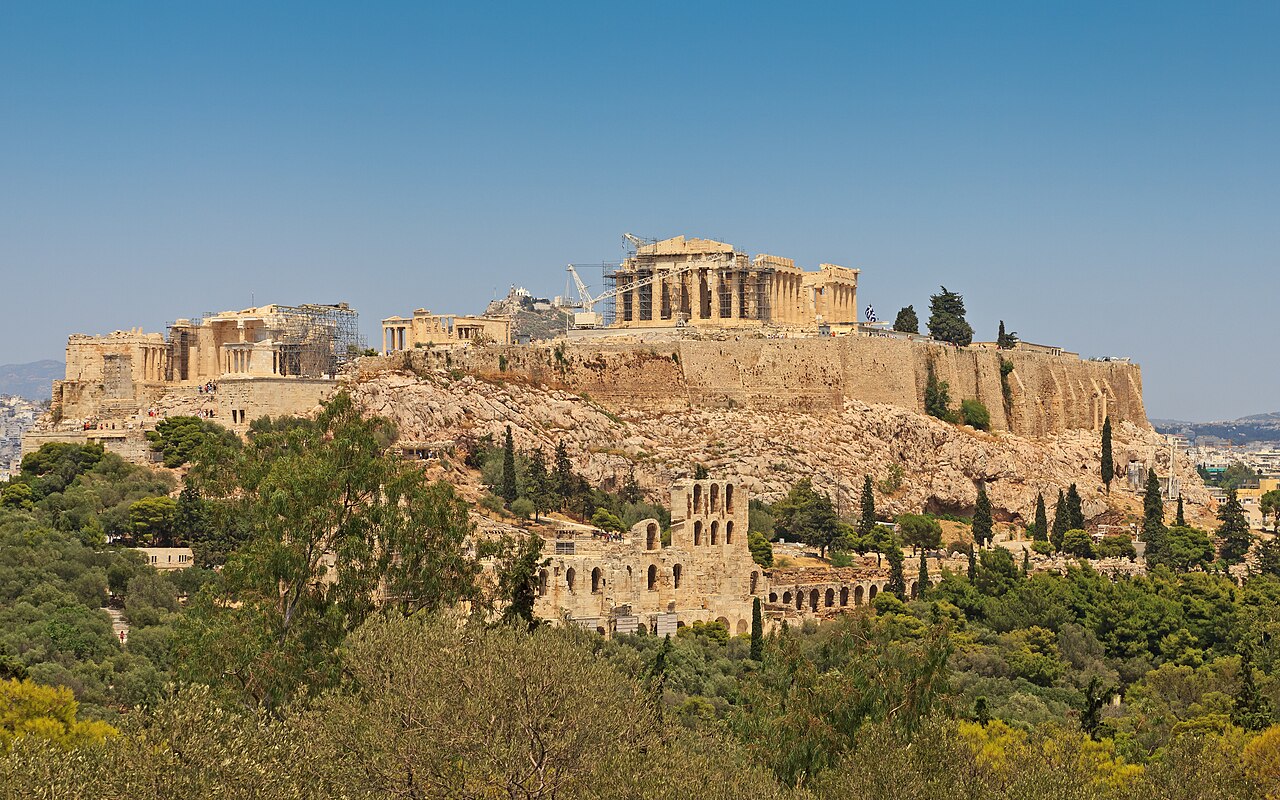
Photo: A.Savin, Wikimedia Commons, Free Art License; reproduced unmodified.
The numbers are the part that is hard to take in. Athens’ archaic owls of the 490s and 480s were struck from more than 325 obverse dies, which on the usual working assumption of some 20,000 coins per die implies over six million tetradrachms — more than 4,000 talents, over a hundred metric tons of silver. The Early Classical coinage that followed the Persian Wars was bigger still, better than 9,000 talents in all denominations down to about 455 BC; in the 460s the mint could even afford a short experiment with 43.5 g decadrachms, struck from at least seventeen obverse dies, once thought to be Persian booty from the Eurymedon but shown by analysis to be Laurion metal like everything else.
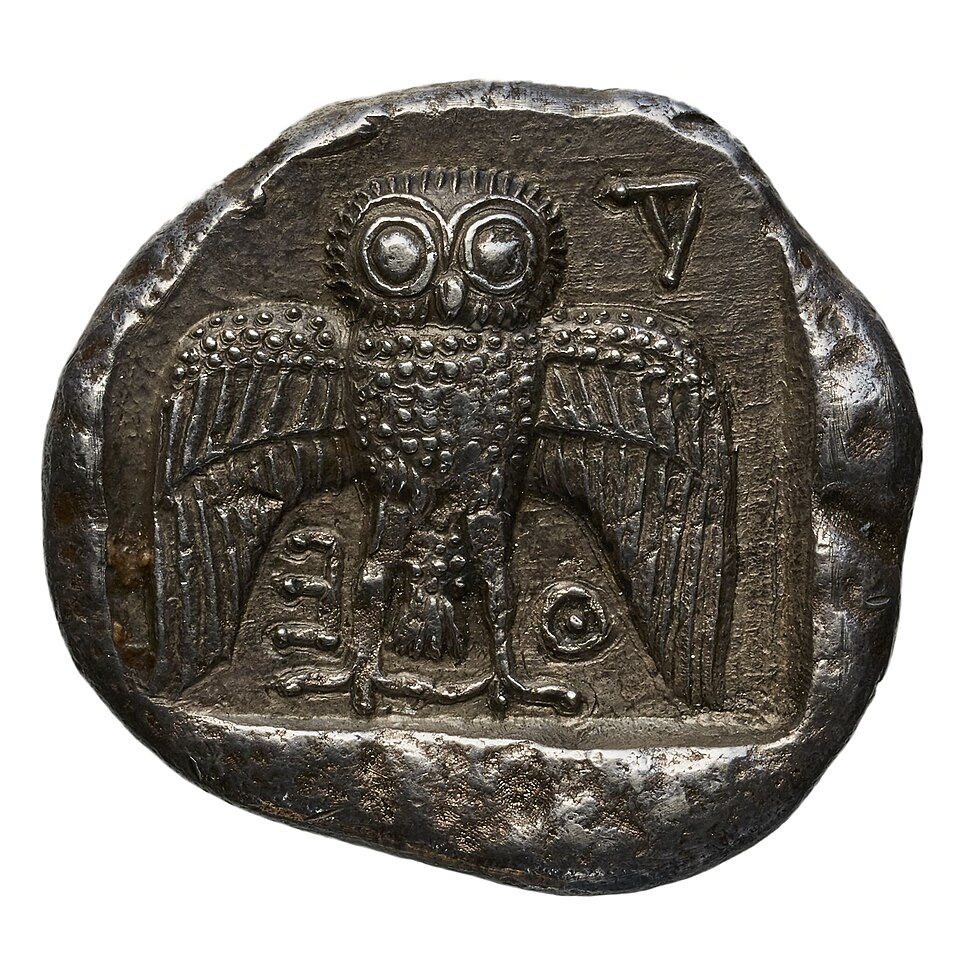
Photo: Bibliothèque nationale de France, via Wikimedia Commons, public domain; reproduced unmodified.
Then, in the mid-450s, production roughly doubled again, and the Standardized coinage of this page began. A projection from the owls in the Malayer hoard, buried in western Iran about 440 BC — 142 tetradrachms struck from 133 different obverse dies, a ratio that implies an enormous parent population — suggests Athens was consuming on the order of a hundred tetradrachm obverse dies a year, something like 1,350 talents of coined silver annually. Independent estimates from the industry side agree on the order of magnitude: from the ancient slag heaps and modern re-working of the district, roughly 20 metric tons of silver a year at the peak (about 1.1 million tetradrachms); from the cost of the workforce implied by Xenophon — more than 10,000 rented slaves at an obol a day — a floor of perhaps 1,000 talents a year, or 1.5 million tetradrachms. However one gets there, Athens was minting over a million tetradrachms a year, and no other coinage in antiquity came close until Alexander.
The comparison that makes this vivid is with everyone else. The best-documented allied mints — Abdera, Maroneia, Samos — each used on average no more than two tetradrachm obverse dies a year. So did Syracuse and Corinth, the wealthiest Greek cities outside the empire, both of which had to buy their silver in. By the third quarter of the fifth century Athens was striking more silver than all of its minting allies put together.
Behind the coinage sat an industry organized to make money for the state twice over. The subsoil belonged to the polis, which “sold” fixed-term leases of the mines to private operators; a newly registered mine paid a low tax of one twenty-fourth on the silver it produced, deliberately modest to encourage prospecting, while a proven mine went to competitive bidding. Whatever share the state took, and whatever the operators kept, essentially all of it came to the mint to be coined — where the city took a further cut, very probably 5 percent, as a minting charge. And the physical cost of the metal is worth holding in mind while looking at the coin: on one estimate it took some 16 kg of ore and 18 kg of firewood to produce a single drachm — four grams — of Laurion silver. A tetradrachm is four of those.
“Standardized” is a modern label for the enormous mid- and late-century mintage to which this coin belongs — perhaps nine out of every ten fifth-century owl tetradrachms in collections today. The changes that define it are small and mostly a matter of the mint working faster:
Some of this simplified the die-cutter’s job, some was minor artistic updating; the frontal eye stayed because the coin’s familiarity was its value. That instinct outlived Athens by centuries: when Rome took over Macedonia it went on striking the First Meris tetradrachm unchanged, and the Roman quaestor’s issue that eventually replaced it froze one man’s name onto the coinage for twenty years because the troops being paid did not want their money to start looking different. As output rose, control loosened. The Athena heads of the later Standardized issues vary widely in proportion and quality, evidence of a great many engravers of very different ability: when huge quantities of silver had to be pushed through the mint, Athens did not hesitate to employ second- and third-rate craftsmen. The same thing had happened once before, in the desperate minting of 480 BC, when the latest archaic dies were cut so crudely that they have been attributed to blacksmiths pressed into service after the mint ran out of engravers.
That coarseness has a scholarly afterlife. Some of the ugliest late-fifth-century dies — the groups numismatists call Styles B and M — were long suspected of being Egyptian imitations, since such coins turn up in quantity in Egypt and Egyptian imitation owls certainly exist in the fourth century. Two things settled it: metallurgy, which showed nearly all of them to be Attic silver, and two pot hoards excavated in coastal Attica in the 1970s (at the Piraeus and at Ano Voula) in which such coins were mixed with owls of perfectly conventional appearance. They are genuine Athenian products; they are simply what a mint in a hurry produces.
The Athenians themselves joked about the coin’s ubiquity. In Aristophanes’ Birds (414 BC), among the blessings promised to the audience is that “owls from Laurion will never fail you: they will nest in your purses and hatch small change” — the coin so identified with the city that a comic poet could treat it as a species of domestic bird. The pun ran deep: γλαύξ meant both the bird and the coin, and “an owl flew” was Athenian slang for money changing hands. No other Greek coinage generated folklore like this, because no other coinage was this universal at home and abroad.
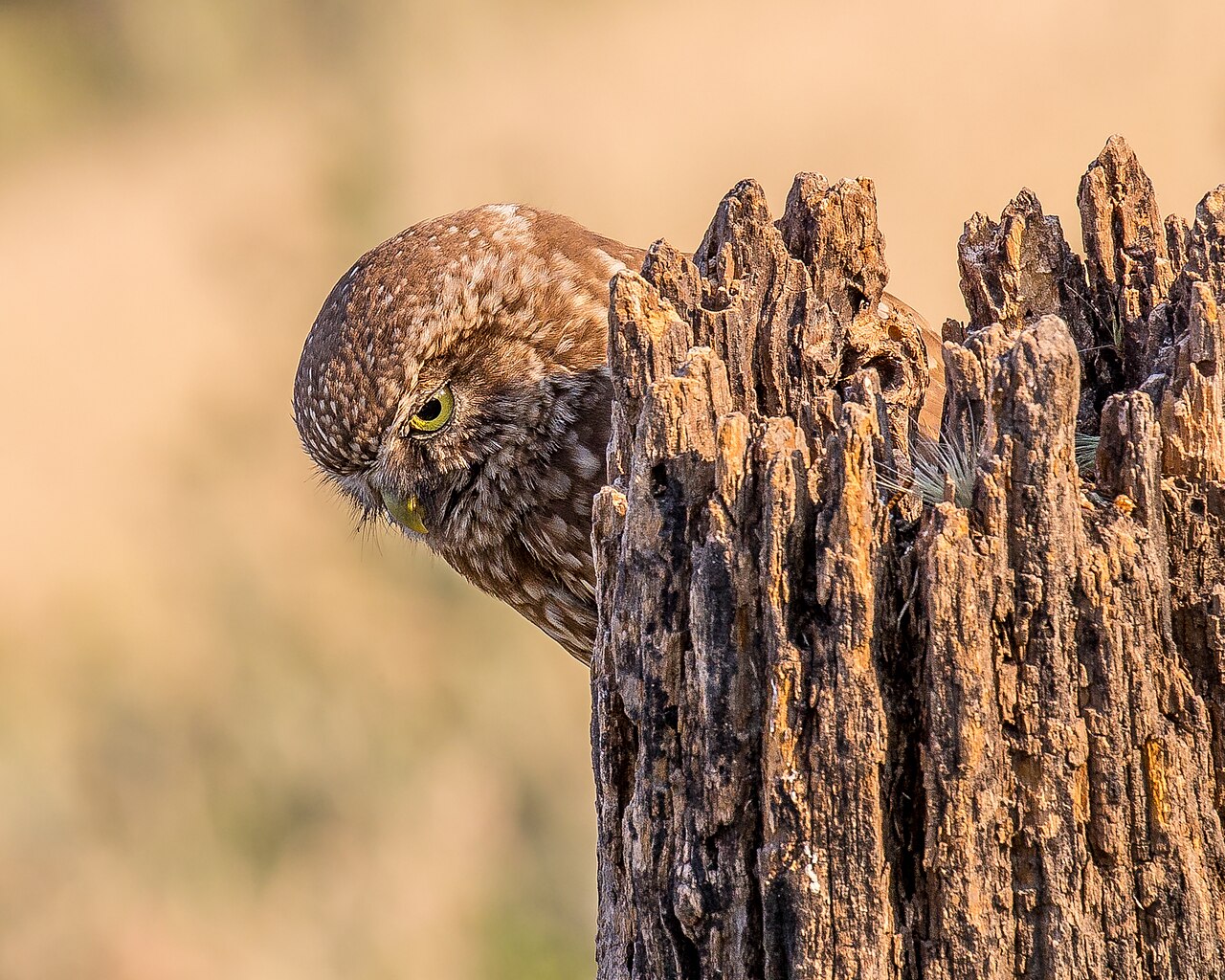
Photo: Andy Morffew, Wikimedia Commons, licensed CC BY 2.0, reproduced unmodified.
It was also, to an extent no earlier Greek state had managed, a payroll. A rower, a hoplite or a skilled workman was paid a drachma a day; a juror drew two obols, raised to three by Kleon in the 420s; manning a single trireme therefore cost about a talent a month. The Aristotelian Constitution of Athens claims more than twenty thousand men were maintained out of tribute and taxes, and in Aristophanes’ Wasps a son totals the city’s income at close to two thousand talents against a hundred and fifty spent on jury pay. Comic arithmetic is not budget accounting, but the mentality is the point: Athenians talked about their empire in cash, and the cash was owls.
Abroad the coin became a unit of account. When Thucydides and Xenophon record what Persian satraps paid the rowers of the Spartan fleet, the sums are given in Attic drachmas and obols — because that is what Aegean naval pay had come to mean. Plutarch preserves the best story about it: when Lysander sent the leftovers of the Persian war-chest home after the war, his courier Gylippos slit the money bags, skimmed silver from each, and hid it under the roof-tiles of his house — and was undone by a servant’s riddle about “many owls sleeping under the tiling,” Plutarch explaining that most of the coinage of the day bore the owl “owing to the supremacy of Athens.” Persian authorities went further and struck imitations themselves, one series discreetly signed with a tiny crowned head of the Great King at the owl’s feet, another replacing Athena outright with a satrap’s portrait and adding the letters ΒΑΣ, “king.” The world of the Achaemenid siglos and the gold daric had adopted the Athenian owl as its working silver.
Around 414 BC Athens turned habit into law. The Coinage, Weights and Measures Decree — known from fragments found in cities scattered across the empire, and from a joke in Aristophanes’ Birds, where a decree-seller offers Cloudcuckooland a law that its people “use the same weights, measures and decrees as the Olophyxians” (the poet’s psephismata standing in for nomismata, coins) — required the allied cities to use Athenian coins, weights and measures. Local silver was to be brought to the Athenian mint and restruck, at least half of it at once, with a fee deducted from every mina coined; the Boule’s annual oath was amended to bind the councillors themselves to enforcement.
Two things about it are worth keeping open. First, the fragments do not all say the same thing: in one version of the oath the ban on striking local silver looks absolute, while in another, pieced together from fragments found at Olbia and near Smyrna, cities appear to be allowed a coinage of their own so long as they also use Athenian money. Whether that is a genuine second, softened version of the law or merely careless copying is still argued. Second, the decree makes much better sense as economics than as symbolism once it is set beside the other great innovation of these years: the replacement of tribute by the eikoste, an empire-wide five percent tax on seaborne cargo. A customs union needs common measures and a common currency far more than a tributary empire does, and a project on that scale must have been conceived during the Peace of Nikias rather than improvised in the crisis of 413 in which Thucydides reports it.
Whether either measure worked, nobody knows; within two years the Sicilian disaster and the revolts that followed made enforcement moot. But there is one piece of physical proof that the decree reached the ground. Two lead balance weights survive from Kyzikos, each a quarter of an Athenian commercial mina, stamped with an Athenian owl and olive sprig standing on the little tunny fish that was the badge of Kyzikos. They were not cast in the normal way but struck from pre-weighed lead blanks — a mass-production method suited to turning out hundreds of new weights in a hurry. A city complying with an imperial standard, and choosing to say so with the imperial city’s own coin-type.
Here the evidence turns strange. Athenian owls should be everywhere in the hoards of the Athenian empire, and they are not. Leaving aside Attica itself and neighboring Euboea, of the twenty-eight recorded hoards from within the arche, exactly two contain any Athenian silver at all — a single drachm at Olynthos and a single fraction in Ionia. Some scholars have taken this as a warning that the owls’ importance inside the empire has been overstated. The likelier reading is that hoards record failure: coins go into the ground and stay there when something goes wrong, and a stable hegemony gives people few reasons to bury money and never come back. Inside the empire the owls were in constant motion — out from Athens in pay and purchases, back to Athens in tribute and rents — and coins in constant use are exactly the coins that do not end up in pots.
Outside the empire the picture inverts completely. The great owl hoards come from Egypt, the Levant and Asia Minor, and the numbers are enormous: more than 6,000 owls from Tell el-Maskhouta in Egypt; a reported 10,000 from a find near Aleppo in 2007; some 1,300 from a hoard in Turkey; and, reported as this book’s sources were going to press, roughly 16,000 owls inside a hoard of 24,000 coins from coastal southeastern Asia Minor — ten talents of Athenian silver in a single deposit. A hoard from Zagazig in the Nile delta shows the transition in miniature: a mass of mixed Greek silver and cut ingots assembled before about 480 BC, to which nothing was added afterwards except eighteen Athenian tetradrachms, dropped in a few at a time across the rest of the century. After the 470s, Egypt stopped wanting Greek silver in general and started wanting owls in particular; by 412 BC Egyptian written accounts were reckoning sums in “Greek staters.”
The most telling detail is the dating. Most of those huge eastern hoards were buried at the very end of the fifth century or in the first decades of the fourth — that is, after Athens fell. While the empire lasted, its own need for owls held them in circulation; when the empire ended in 404, every owl not melted down was free to drift east into markets whose appetite for good silver had no limit.
The coinage died the way the empire did. In 413 BC the Spartans fortified Dekeleia in northern Attica; more than twenty thousand slaves absconded, and the open-air smelting and washing of ore became impossible to protect. Xenophon says flatly that full-scale operations in the silver industry ended then. The mint kept striking from whatever silver could still be found — in 412 the Athenians broke open the thousand-talent emergency reserve that had been sealed since the first year of the war — but by 407 there was almost nothing left.
So Athens coined its dedications. Seven of the eight gold statues of Nike in the Parthenon, each built of two talents of gold over an iron armature precisely so that it could be taken apart, were dismantled and struck into a gold coinage, the last of them in 405/404. About thirty of those coins survive.
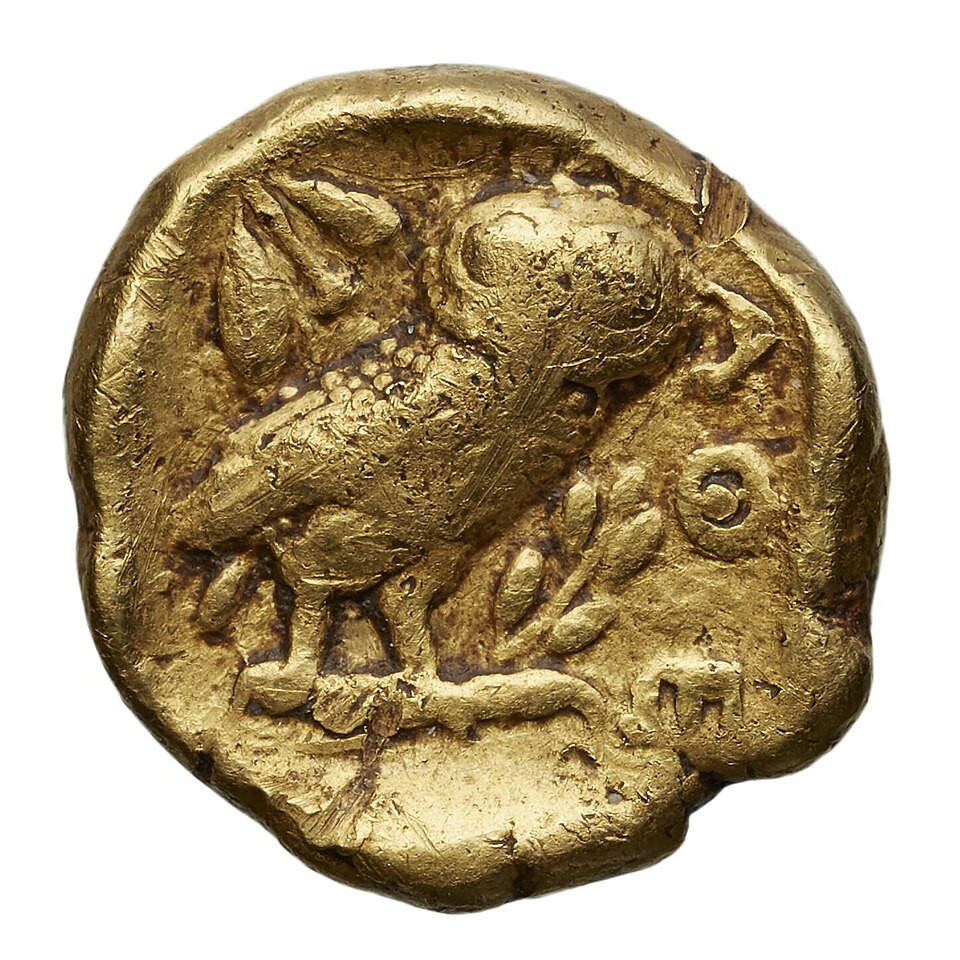
Photo: Bibliothèque nationale de France, via Wikimedia Commons, public domain; reproduced unmodified.
One of the survivors: the reverse of a gold Athenian owl struck in the last years of the war, when the Nikai had gone to the mint. The types are the silver coinage’s own — owl, olive sprig, ΑΘΕ — with one addition that identifies the emergency issue at a glance, the olive branch laid along the bottom of the field for the owl to stand on. This is the drachm, or half-stater, of the series. Bibliothèque nationale de France, ex-collection of the duc de Luynes. Then came the notorious silver-plated bronze: tetradrachms and drachms of bronze under a thin silver skin, fifteen to twenty percent light, authorized by the Assembly and made legal by vote. They were not really meant to deceive anyone — the core showed at the edge and through wear — only to free up real silver for spending abroad, and Aristophanes put them into the Frogs in 405, comparing the city’s treatment of its best citizens to its treatment of its good old silver and new gold, which it had abandoned in favor of “these vile bronze ones that were coined just yesterday or the day before, in a really bad strike.” A hoard of over a thousand of them, found in the Piraeus in 1902, is almost certainly a deposit of that emergency issue.
Athens surrendered in April 404. Aristophanes gives the coinage’s epilogue too, in a play of about 391: a man remembers going to market with a mouthful of bronze coins, only for the herald to cry out that bronze was no longer accepted, “for we are using silver.” The mint was striking fresh owls again by the late 390s, and though the mines never recovered fifth-century scale, Athenian silver remained the most exported coinage in the Aegean for most of the fourth century — culminating in the pi-style owls of c. 353–294 BC, profile-eyed at last, and the final chapter of the old design. The owl returned once more, after a century and a half of silence, as the New Style tetradrachm of the second century — broad, thin, Hellenistic, and signed and dated by the officials who struck it.
Graphic: JSB Coins, 2026 (CC0).
The owl’s prestige outlived Athenian power in another way as well: communities around the eastern Mediterranean produced their own imitation owls to participate in the trade networks that used them — including the pharaonic-Egyptian imitations catalogued elsewhere in this collection, and a Philistian series that marks Athena’s cheek with the Semitic letter shin. The owl’s reach extended even to the Black Sea, where Athens’ colonial refoundation of Amisos — renamed “Peiraieos” after the city’s own port — put a spread-winged owl on its silver, though on the Persian weight standard of its Anatolian hinterland. And the grain road the owls traveled was tolled at its narrowest point by Byzantion, whose bull-on-dolphin silver — Greek badge, Persian weight, like Amisos’s — is in this collection too: the owl and the toll-keeper’s coin met daily at the gate of the grain sea.
This coin is catalogued, with its CNG tag, to the conventional c. 454–404 BC span, and closer dating within that range is genuinely difficult: the Standardized owls are stylistically conservative, were struck continuously, and lack the chronologically anchored hoards that would let the sequence be pinned down. The mid-450s starting point is now generally accepted, but it is a numismatic convention rather than a documented event — nothing says the mint changed its habits in the year the Delian treasury arrived.
The Elmalı hoard (Lycia, found 1984, buried c. 460 BC or a little before) is the fixed point just underneath. Its 161 owl tetradrachms and 13 decadrachms nearly doubled the known material for the Early Classical coinage and raised the attested tetradrachm obverse dies to 234, supporting an estimate of 500–600 dies for the twenty years from 478 to about 460 — an annual average of 25 to 30. In other words, mass production on a scale nobody else in the Greek world approached was already running well before 454; what happened in the mid-450s was that it roughly doubled again. Why it doubled is the open question, taken up below.
(Based on a full reading of Lisa Kallet and John H. Kroll, The Athenian Empire: Using Coins as Sources (Guides to the Coinage of the Ancient World; Cambridge University Press, 2020) — the standard recent treatment, and the source of the figures used above.)
Why did production double in the mid-450s? The authors set out three explanations and decline to choose between them (ch. 2, “The ‘Standardized’ Coinage”). The first is the obvious one: the Delian League treasury was moved from Delos to Athens in 454, and if it still held a large unspent reserve of foreign coin and bullion, reminting it would have produced exactly such a spike. The objection is that a one-off windfall cannot explain a raised level of output sustained for decades. The second looks north: the silver coinages of the Thracian tribes stop around the middle of the century, just as Athens tightens its grip on the Strymon — Eïon taken, Thasos beaten and stripped of its mainland mines, colonists sent “among the Bisaltians,” and finally Amphipolis founded in 437/6. If Athenian middlemen were now exporting Pangaion silver, the increase would be sustained. The third needs no empire at all: improved smelting and new ore-processing installations in Attica let previously uneconomic ore be worked. The decisive evidence would be metallurgical — foreign silver has been detected in some later Standardized coins, but no analyses have yet been published for the earlier Standardized issues, which is precisely the material that matters. The honest answer is that two or all three may be true at once.
What “a million tetradrachms a year” actually rests on. The estimate is a chain of inferences, and it is worth seeing the links. Coin dies are hand-engraved, so no two are identical and a hoard can be sorted by die; from the ratio of coins to dies in a sample, statistics gives an estimate of how many dies the parent coinage used; multiplied by an assumed average die lifetime — conventionally about 20,000 silver coins — that yields a volume. Every step is contestable, and the authors say so: exceptionally large coins wore dies out faster, and the 20,000 figure is a working convention. What makes the conclusion robust is that three independent routes — the Malayer die-count, Conophagos’s estimate from the ancient slag heaps and the modern French re-working of the district, and Flament’s reconstruction of the industry’s wage bill from Xenophon — converge on the same order of magnitude.
Styles B and M, and a lesson about “imitations.” The case that the ugliest late owls were foreign copies was reasonable: the coins are badly proportioned, and they turn up in Egypt, where imitation owls were certainly struck in the fourth century — dies for them have been recovered. It collapsed under two kinds of evidence: elemental analysis showing Attic silver, and, decisively, two small pot hoards excavated in coastal Attica in the 1970s in which these coins circulate side by side with ordinary owls. There is a further, unproven suggestion the authors are careful to flag as such: some of these hasty dies show up in Sicily, including in a hoard from the destruction of Naxos in 403, which Flament connects to the money Athens shipped to its Sicilian expedition (300 talents in spring 414, 150 more in summer 413). If so, the surge in rushed die-cutting sits right on top of the Coinage Decree’s reminting programme — a tempting connection that the silver analyses do not yet support.
The decree as fiscal policy rather than flag-planting. The traditional reading, associated above all with Moses Finley, treats the Coinage, Weights and Measures Decree as a political act: Athens denying its subjects “the traditional symbol of autonomy, their own coins.” Kallet and Kroll’s objection is neat — that reading has nothing to say about the weights and measures, which play no part in paying tribute but are the foundation of taxing trade. Tie the decree to the eikoste and the whole package becomes coherent: a customs union across scores of harbours needs standardized instruments of assessment, and Athens stood to take a substantial one-off profit in minting fees besides. They also note what the decree was not a continuation of. Athens had been strikingly relaxed about allied minting for decades: Aegina went on striking staters after its subjugation in 457 (restriking its own old turtles, apparently to raise revenue from the exchange fee, and changing its sea-turtle to a land tortoise in the process), and Thasos and Samos both resumed coining after failed revolts. The decline of allied minting before 414 was economic, not legislated — Athenian tetradrachms were simply available, convenient and preferred, and once a city let them circulate it lost the monopoly profit that had made minting worthwhile. Small change was the exception, because Athens never supplied it: that is why so many allied cities went on striking obols and hemiobols long after their staters stopped.
A comparison worth carrying forward. The same pattern — a vast imperial currency crowding out local large denominations without anyone ordering it to — recurs on a bigger scale after Alexander, when the flood of Attic-weight royal tetradrachms left “very little locally-produced coinage” in the eastern Greek world for a century or more, and cities like Miletos ran a dual system: a local coinage for the market, Alexanders for taxes and long-distance payments. Athens got there first, with owls.
Kallet and Kroll’s The Athenian Empire (2020) is the way into all of the above and is written for readers without Greek. Behind it stand John Kroll’s own catalogue of the Athenian Agora coins (The Greek Coins, Agora XXVI, 1993) and Chester Starr’s Athenian Coinage 480–449 B.C. (1970) for the Early Classical sequence; Thomas Figueira’s The Power of Money (1998) is the fullest earlier treatment of coinage and the empire. For the ancient narrative, Thucydides Book 1 (linked in the references) carries the growth of the empire and the move of the treasury; Plutarch’s Perikles 12–14 has the building programme and the row about spending the allies’ money; Xenophon’s Revenues 4 is the essential text on the mines and the Dekeleia catastrophe. Aristophanes is a primary source in his own right here — Birds for the decree and the owls in the purse, Frogs for the gold and the plated bronze, Ecclesiazusae for the demonetization.
Historical sources: Thucydides, History of the Peloponnesian War (Book 1 linked in the references — the Pentekontaetia; 1.96 for the Delian treasury; 2.13 for Perikles’ reserves; 7.28 for the eikoste); Herodotos 7.144 (Themistokles and the Laurion windfall); Plutarch, Themistokles 4 and Perikles 12–14 (linked), Lysander 16 (the owls under the roof-tiles); Xenophon, Revenues 3–4 (the exportability of Attic silver; the mines and Dekeleia) and Hellenika 1–2; Aristophanes, Birds 1106–8 and 1037–40, Frogs 718–26, Ecclesiazusae 814–22, Wasps 655–63; Aristotle [attrib.], Athenian Constitution 24, 47.
Numismatic references: J. H. Kroll, The Greek Coins (Athenian Agora XXVI), no. 8; SNG Copenhagen (Attica), 31; D. Sear, Greek Coins and Their Values, no. 2526; O. Hoover, Handbook of Greek Coinage (HGC) 4, 1597; Dewing 1591–8. The die-counts, mint-output estimates, hoard figures, the Standardized diagnostics and the Coinage Decree discussion follow L. Kallet and J. H. Kroll, The Athenian Empire: Using Coins as Sources (Cambridge 2020), chs. 1–8 and Appendices A–B, with the underlying studies cited there (Starr 1970; Fischer-Bossert 2008 on the decadrachms; Conophagos 1980 and Flament 2007 on the mines; Rihll 2001 on ore and fuel; Meadows on the Malayer hoard, in preparation). Claims have been held to what these works support, and the open questions are flagged as open.
Struck on the Attic weight standard, the tetradrachm running c. 17.2 g of high-purity silver from the Athenian mines at Laurion. This is the standardized "mass" owl — the most abundant and widely circulated silver coin of the Classical Greek world, produced in enormous quantity after the Delian League treasury was moved from Delos to Athens in 454 BC and continuing to the end of the Peloponnesian War in 404 BC. Several points should be presented as open rather than settled: (1) the internal chronology of the fifth-century owls (the relation of Starr's earlier groups to the long, stylistically conservative "standardized" series) is debated and individual coins within 454–404 are difficult to date closely; (2) the meaning of the crescent beside the owl is unresolved — it has been read as a commemoration of a battle (Marathon or Salamis), as a lunar/calendrical symbol, and as a purely decorative or space-filling device; (3) the deliberately archaizing profile eye and stiff style were retained long after Greek art had turned to naturalism, most plausibly to keep the coin instantly recognizable and trusted in trade — a functional explanation, not a firmly documented one.
John's Ancient Coin Collection · Type · athens-classical-owl-tetradrachm
Image credits for this coin — photographs, maps and graphics used on this page