Type · byzantion-bull-dolphin-siglos
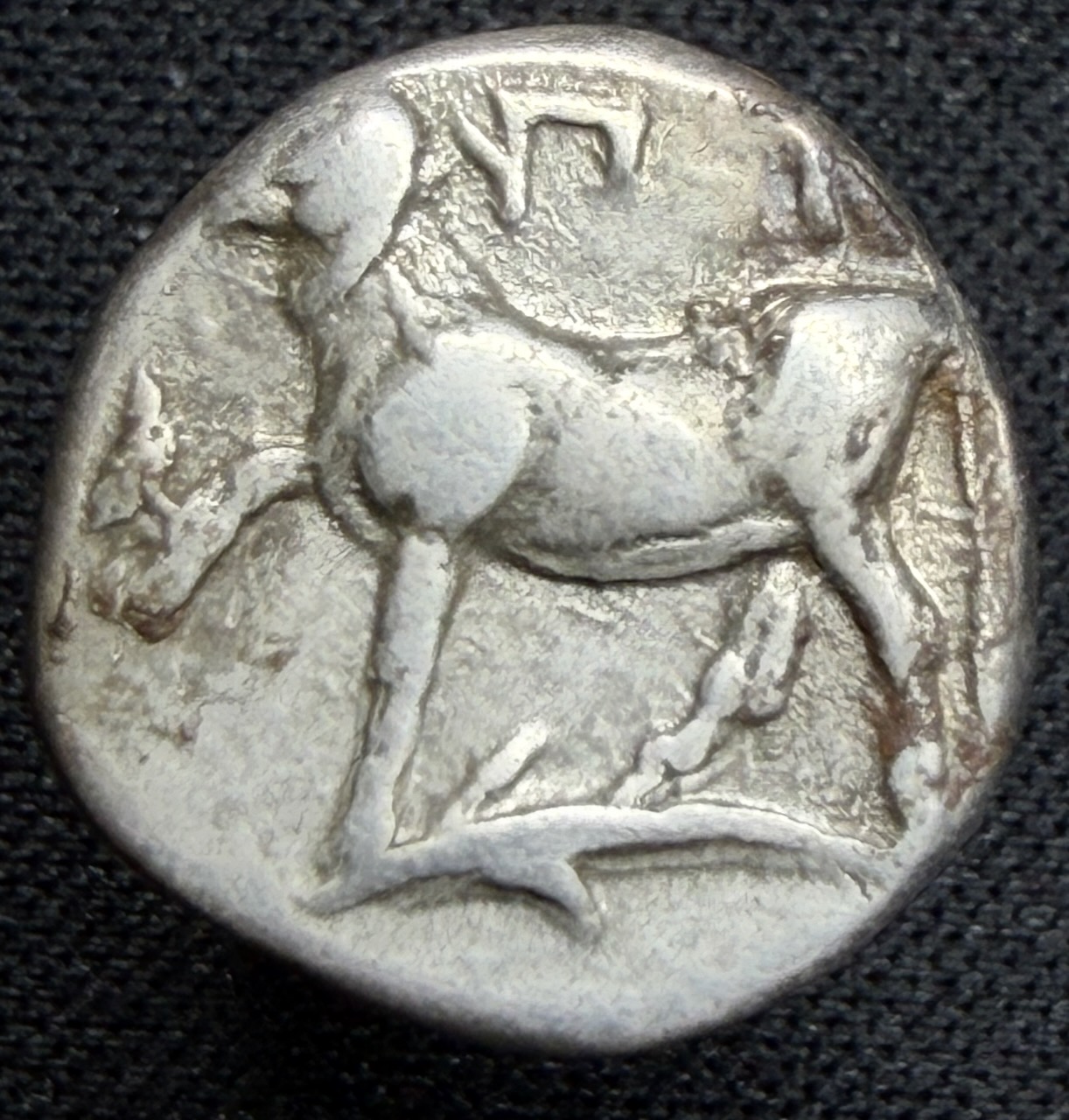
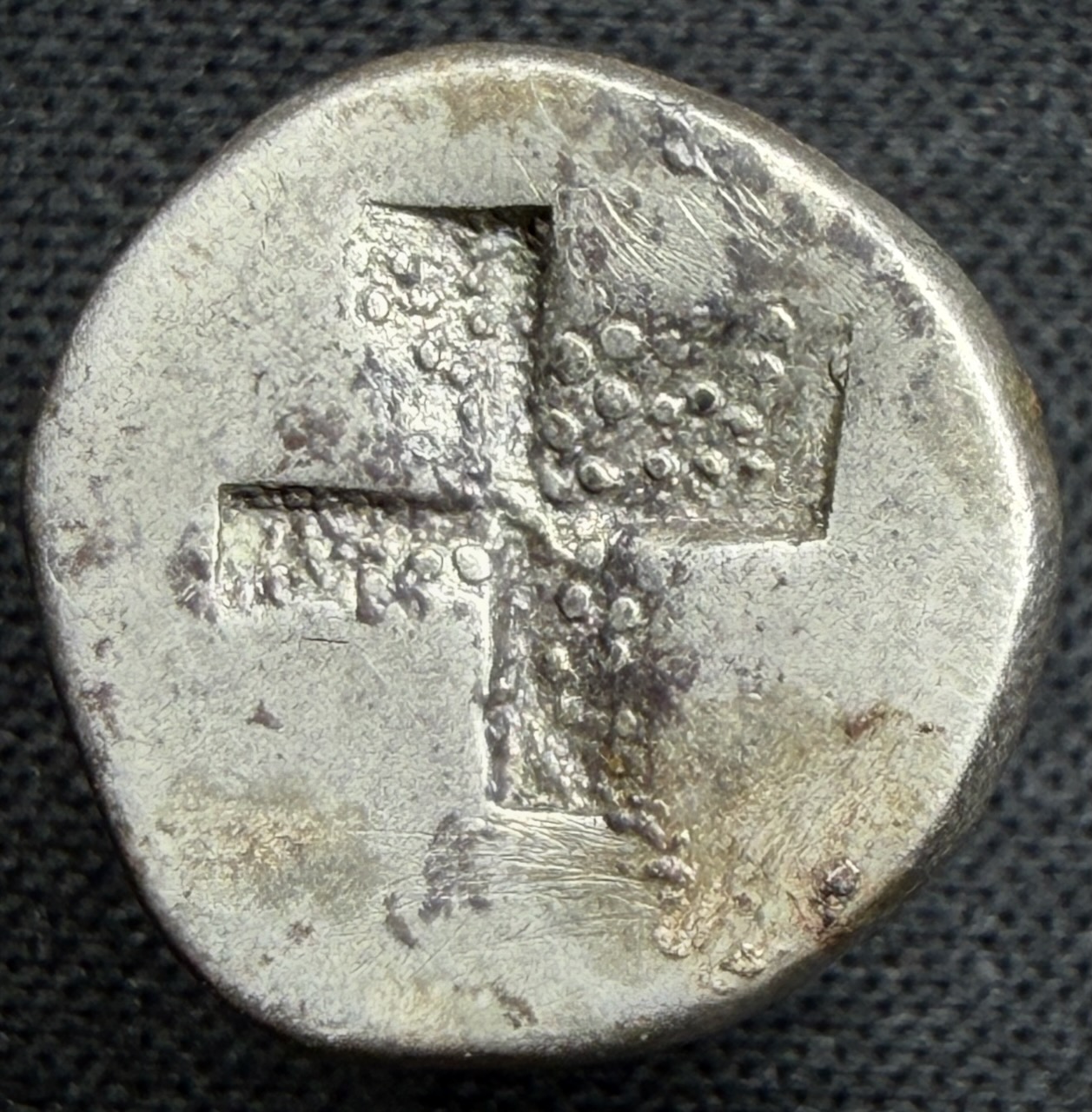
Current: Thrace, Byzantion, AR half siglos (Persic standard, 2.50 g; the Zauche tag calls it a tetrobol after Sear 1582), c. 387/6–340 BC. Bull standing left on dolphin, 'ΠΥ above / quadripartite incuse square of 'mill-sail' pattern
Obverse: Bull (cow) standing left on a dolphin left, right foreleg raised; 'ΠΥ above (the initial letters of the city's name, with the archaic local form of beta)
Reverse: Quadripartite incuse square of 'mill-sail' pattern, the sunken quarters stippled with granulation
Primary reference: SNG BM Black Sea 36 ff.
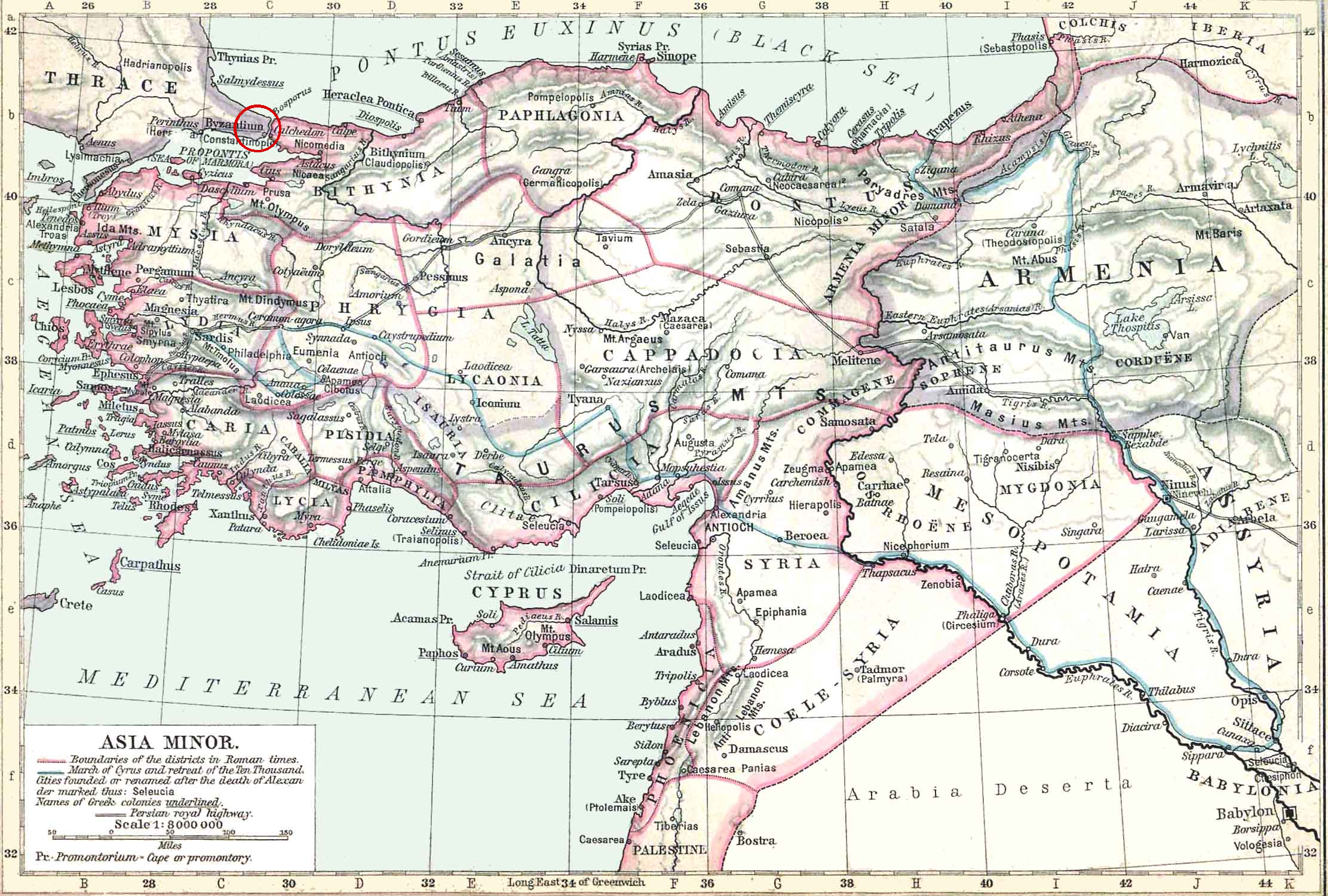
Byzantion on Shepherd’s map of the Greek and Roman East — circled in red at the mouth of the Bosporus, on the European side of the strait, with Chalcedon opposite and the Propontis (Sea of Marmara) opening southwest toward Cyzicus and the Hellespont. Every grain ship from the Black Sea to the Aegean passed under the city’s walls: the chokepoint that made a middling Megarian colony one of the strategic keys of the Greek world — and, a thousand years later, the site of Constantinople.
“Asia Minor under the Greeks and Romans” from William R. Shepherd, The Historical Atlas (1923), via Wikimedia Commons, File:Asia minor-Shepherd 1923.JPG (https://commons.wikimedia.org/wiki/File:Asia_minor-Shepherd_1923.JPG). Public domain (author died 1934); credited as a courtesy. Modified by JSB Coins: a red circle added to mark Byzantium (Byzantion).
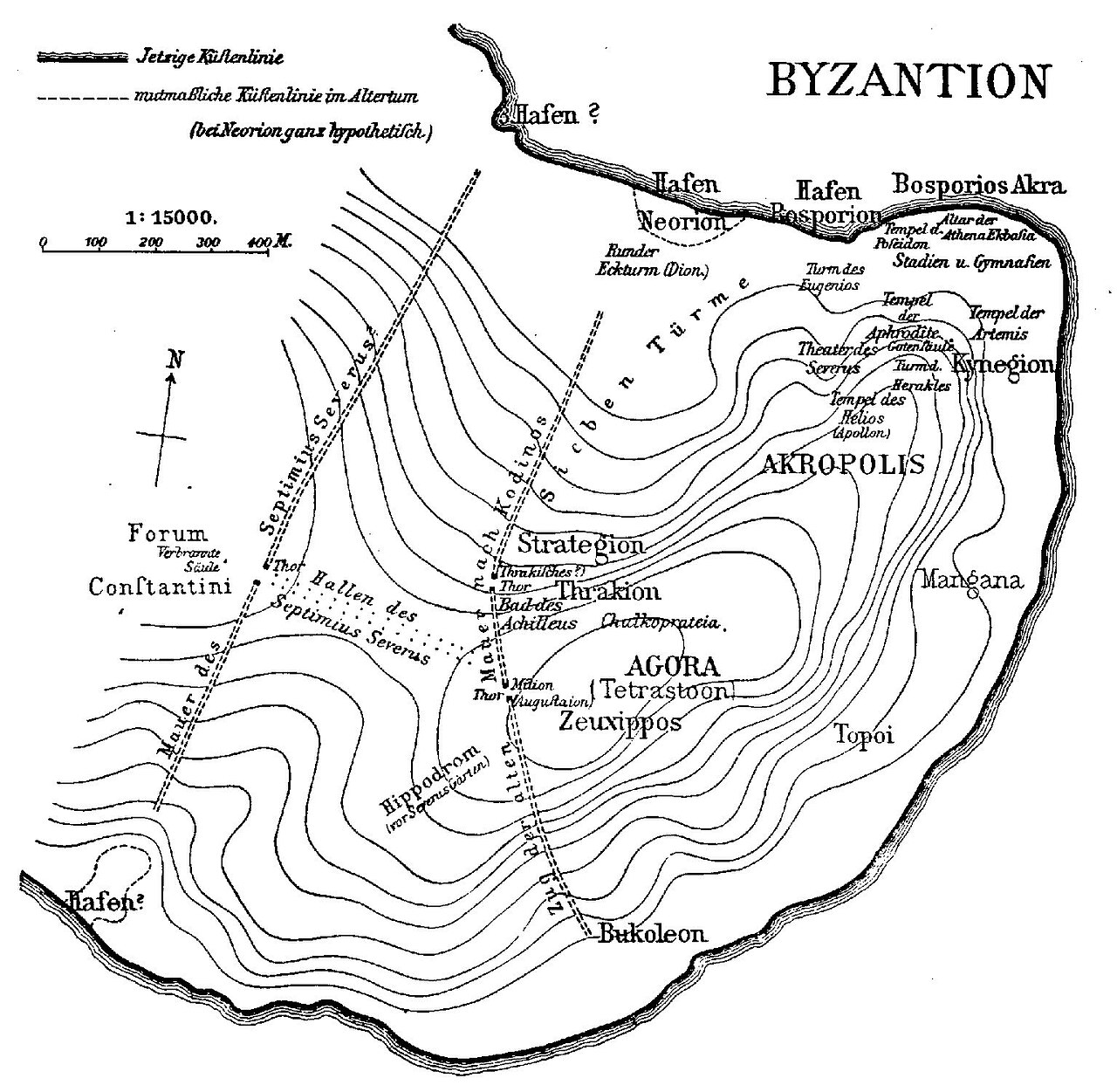
Before it was Constantinople, before it was the second Rome, Byzantion was a Megarian colony living off its position: the last narrows on the sea road between the Black Sea grain country and the hungry cities of the Aegean. Founded in the seventh century BC on the European lip of the Bosporus — tradition held that its founders were told by Delphi to settle “opposite the blind,” mocking the earlier colonists of Chalcedon across the water for missing the better site — the city taxed, provisioned, and sometimes strangled the grain fleets that fed Athens. Its classical silver carries that whole geography in two images: a bull standing on a dolphin.
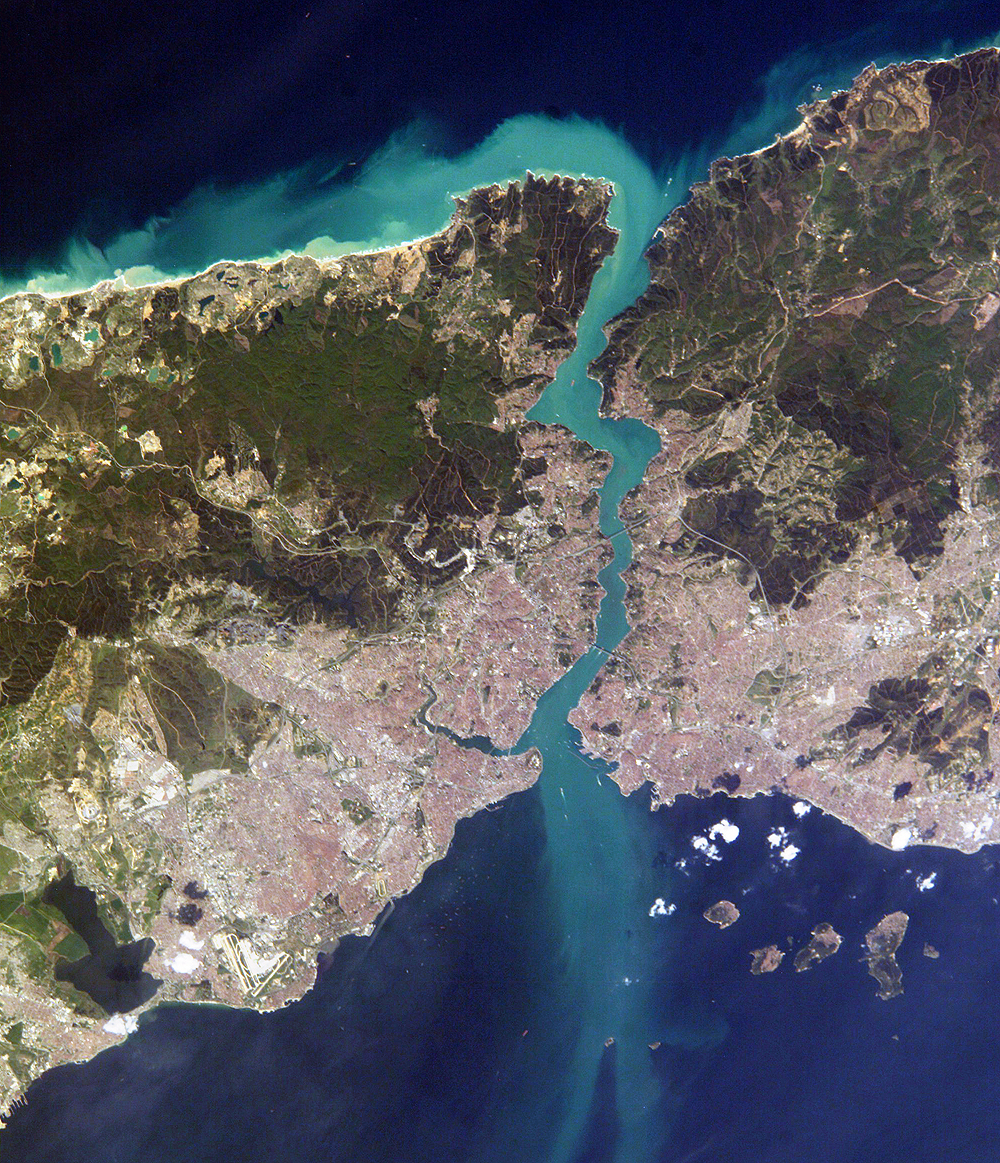
NASA astronaut photograph ISS008-E-21752, public domain (Wikimedia Commons); reproduced unmodified.
Graphic: JSB Coins, 2026 (CC0).
The types are a rebus of place. The dolphin is the strait itself — the Bosporus teemed with dolphins and with the tunny shoals that were the city’s other fortune (its neighbor Kyzikos stamped the tunny on its electrum for the same reason). The bull above it plays on the strait’s name: Bous-poros, the “ox-crossing,” where myth had Io swim the channel as a heifer with Zeus’s gadfly at her back. A cow standing on a dolphin is, in effect, the city’s name and address drawn in pictures. Above, the letters ‘ΠΥ abbreviate the ethnic — the Π-shaped letter is the archaic local form of beta that Byzantion kept as a badge of identity, so the legend reads ΒΥ(ΖΑΝΤΙΩΝ). The reverse never modernized at all: a quadripartite incuse square in the windmill or “mill-sail” arrangement, its sunken quarters stippled with granulation — the look of coinage’s first century, retained here deep into the fourth century BC as deliberate conservatism, the way trusted trade money resists redesign. Compare the collection’s Teos griffin stater, where the same incuse-square reverse is original archaic practice rather than revival.
The weight tells the political story. After the King’s Peace of 387/6 BC handed the Asian shore back to Persia and broke Athens’s second grip on the straits, Byzantion struck its silver on the Persic standard — the siglos system of Achaemenid Anatolia (compare the collection’s Achaemenid siglos and the Amisos owl siglos, another Greek city on the same Persian weight). Grain, not ideology, set the standard: the coin had to work in both the Black Sea and Aegean legs of the trade. The city’s finest hour came at the end of this coinage’s run — in 340–339 BC Philip II of Macedon besieged Byzantion and failed, one of the last checks anyone gave him; Athenian and allied fleets relieved the city that guarded their bread. These sigloi are the money of that Byzantion: stubborn, archaizing, indispensable — the coinage Athens’s own owls met at the gate of the grain sea.
Public domain (Wikimedia Commons).
A fair question about all this: the strait has two banks — how does a city on one of them close it? For Byzantion never straddled the water. The ancient city occupied the European promontory only; the facing Asian shore belonged to other, separate cities — Chalcedon (modern Kadıköy), the “city of the blind” itself, and Chrysopolis (Üsküdar) in Chalcedon’s territory. The answer begins with scale. The Bosporus is a winding channel about 30 km long but never generously wide: roughly 3.7 km at its broadest, near the Black Sea mouth, narrowing to about 700 m at mid-strait — and about 2 km where the city’s point faced Chrysopolis across the southern mouth. There is no far bank out of reach: an oared warship crosses the widest part of the strait in well under half an hour, the narrows in minutes, and a toll squadron based in the Golden Horn could board anything afloat.
The city’s real doorkeeper, though, was the current, and Polybius stops his history for a famous excursus (4.43–44) to explain it. The Black Sea, overfilled by the great rivers of Scythia, pours permanently south through the strait; the outflow caroms from headland to headland, and off the Asian promontory called the Cow — the very spot, legend said, where Io the heifer landed from the swim that named the Bosporus — it is flung diagonally across the channel straight at Byzantion’s point. A southbound ship is delivered to the city, Polybius says, whether the crew wills it or not; Chalcedon, though it looks identically placed on the map, is nearly unreachable on a straight course because the same current stands in the way. What holds for ships held for fish: the stream sweeps the tunny shoals along the European shore into the Golden Horn, the harbor that was also the fishery (Strabo’s “Horn”). Geography thus handed one bank everything — the sheltered harbor, the landing the current enforced, the fish — and the tolls followed. Athens had shown how in 410 BC, when Alcibiades set up a station at Chrysopolis opposite and tithed every cargo out of the Black Sea (Xenophon, Hellenica 1.1.22); when Byzantion later levied passage-dues in its own name, in 220 BC, the grip was strong enough that Rhodes went to war to break it (Polybius 4.46–47). The coin’s own images — the dolphin of the current, the bull of the ox-crossing — are the emblems of exactly this machinery.
The bull-on-dolphin siglos is the classical Bosporus in miniature: a pun on the strait’s name, a fish from its waters, a Persian weight for a Greek city, and an incuse square a century out of fashion — all struck at the site that would one day be the capital of the medieval world. Few coins carry so much future in so provincial a fabric. The other end of the Propontis is here too: the Lysimachos bronze struck at Lysimacheia on the Thracian Chersonese, guarding the Hellespont as Byzantion guarded the Bosporus.
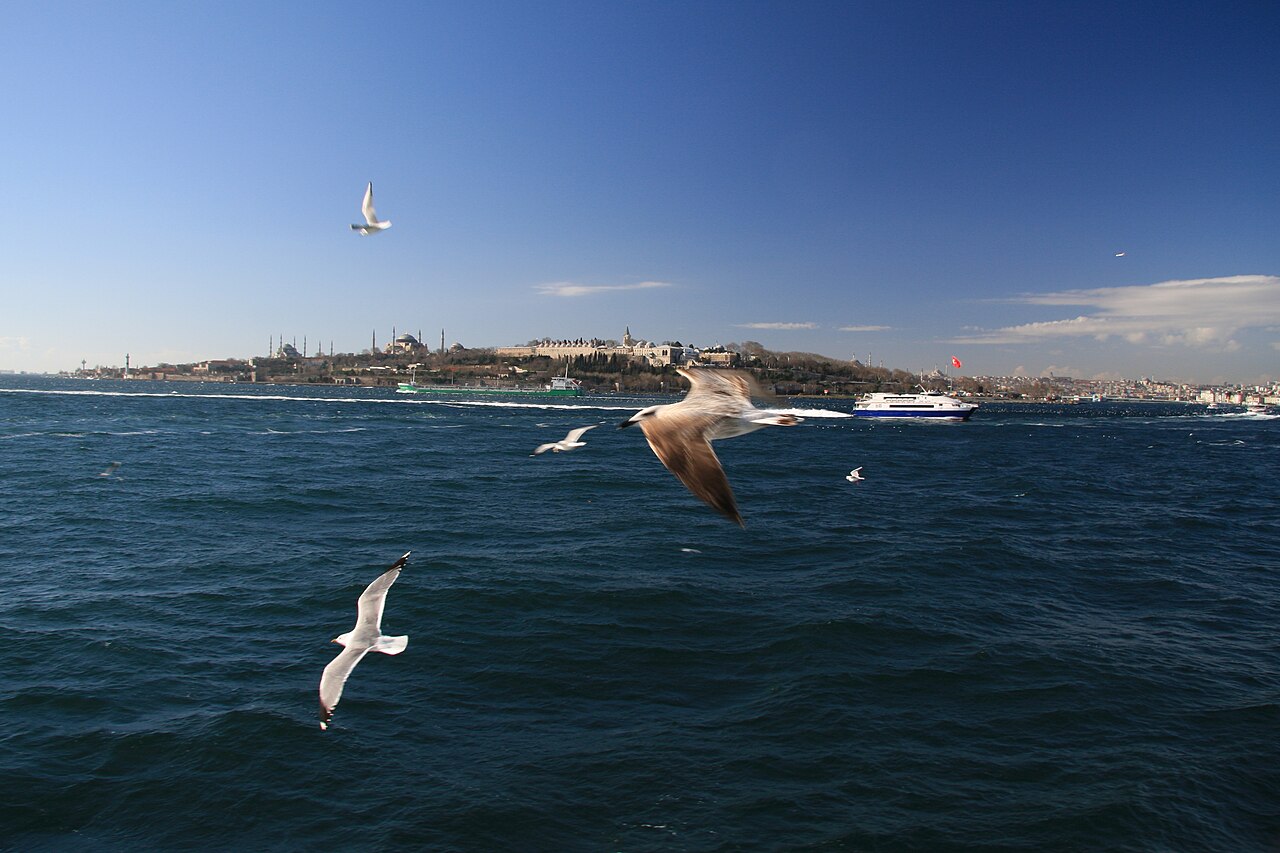
Photo: Grzegorz Jereczek, Wikimedia Commons, licensed CC BY-SA 2.0, reproduced unmodified.
Attribution: SNG IX, The British Museum, Part 1: The Black Sea (1993), nos. 36 ff.; Oliver D. Hoover, HGC 3.2 (2017), no. 1390 (half siglos, dated c. 387/6–340 BC); the corpus is Edith Schönert-Geiss, Die Münzprägung von Byzantion I (Berlin 1970), nos. 236 ff. The denomination was fixed by the specimen’s weight, 2.50 g; the Zauche tag’s Sear 1582 (‘tetrobol’, 357–340 BC) is the same class under Sear’s name for it. The foundation legend and the “city of the blind”: Herodotus 4.144 and Strabo 7.6.2; the Bosporus/Io etymology and the tunny trade: Strabo 7.6.2 with Polybius 4.38–45, the classic ancient analysis of Byzantion’s chokepoint economy (Polybius Book 4 linked in the references); Philip II’s failed siege of 340–339 BC: Diodorus 16.74–77. The mechanics of the chokepoint: Polybius 4.43–44 (the currents; the Cow; Chalcedon unreachable), 4.46–47 (the tolls of 220 BC and the Rhodian war); Xenophon, Hellenica 1.1.22 (Alcibiades’ tithe-station at Chrysopolis, 410 BC; linked in the references); Strabo 7.6.2 (the tunny and the Golden Horn). Modern dimensions of the strait (c. 30 km long, c. 700 m at the narrowest, c. 3.7 km at the widest) follow standard geographical references.
Struck on the Persic standard adopted after the King's Peace of 387/6 BC returned the region to Persian-influenced trade networks (full siglos c. 5.3 g, half siglos c. 2.4 g). The denomination was settled by weighing: at 2.50 g (weighed in hand, 2026-07-12) this is the HALF SIGLOS (SNG BM Black Sea 36 ff.; HGC 3.2, 1390; Schönert-Geiss 236 ff.) — the denomination Sear 1582 calls a tetrobol, so Zauche's 'tetrobol' tag reading was correct for the class. The 'Π in the legend is the archaic local form of beta: 'ΠΥ = ΒΥ(ΖΑΝΤΙΩΝ). The retained incuse-square reverse is a deliberate archaism, kept at Byzantion into the 330s BC long after most mints had adopted two-type coinages.
John's Ancient Coin Collection · Type · byzantion-bull-dolphin-siglos
Image credits for this coin — photographs, maps and graphics used on this page