Type · phraates-iv-eagle-drachm
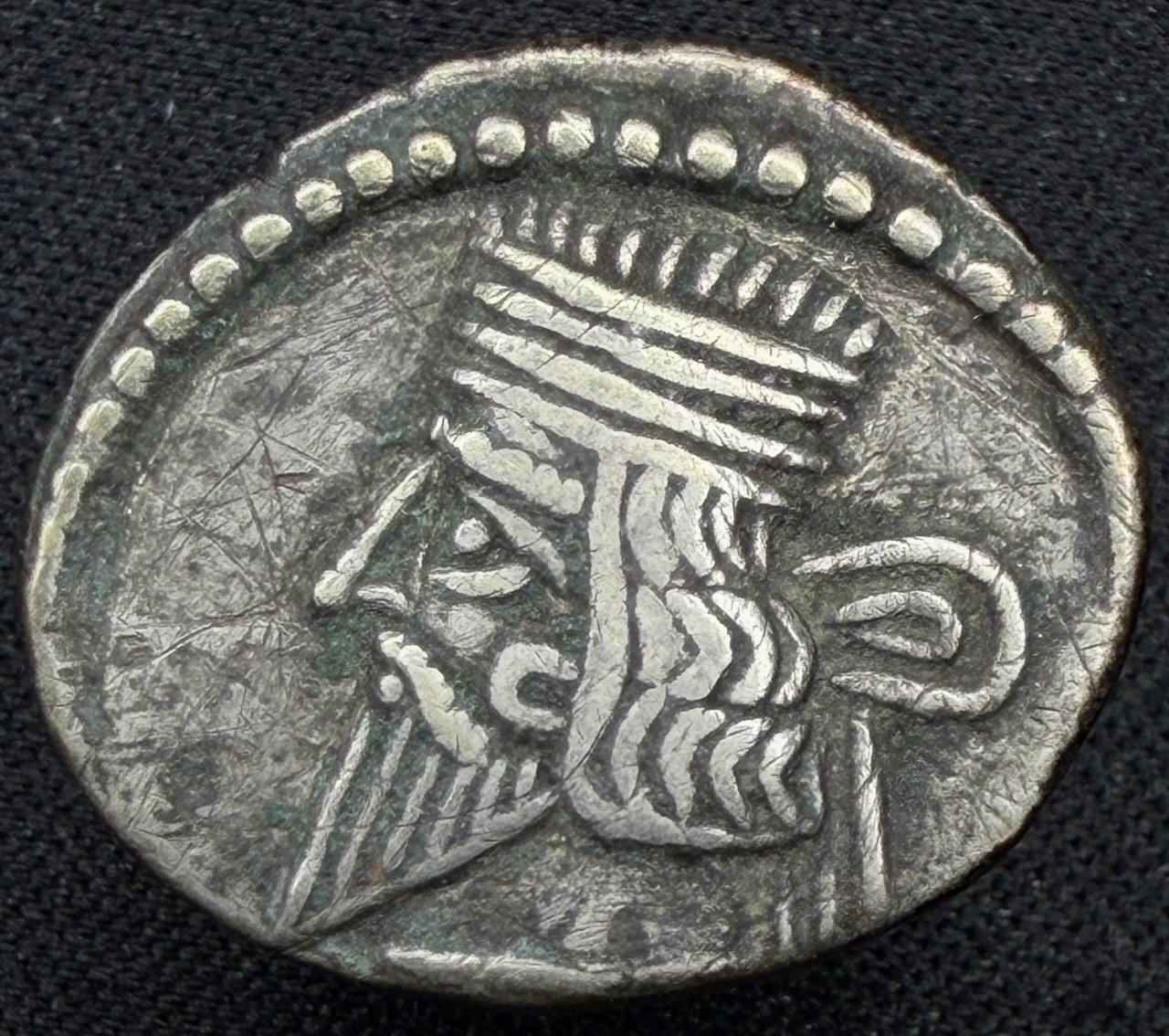
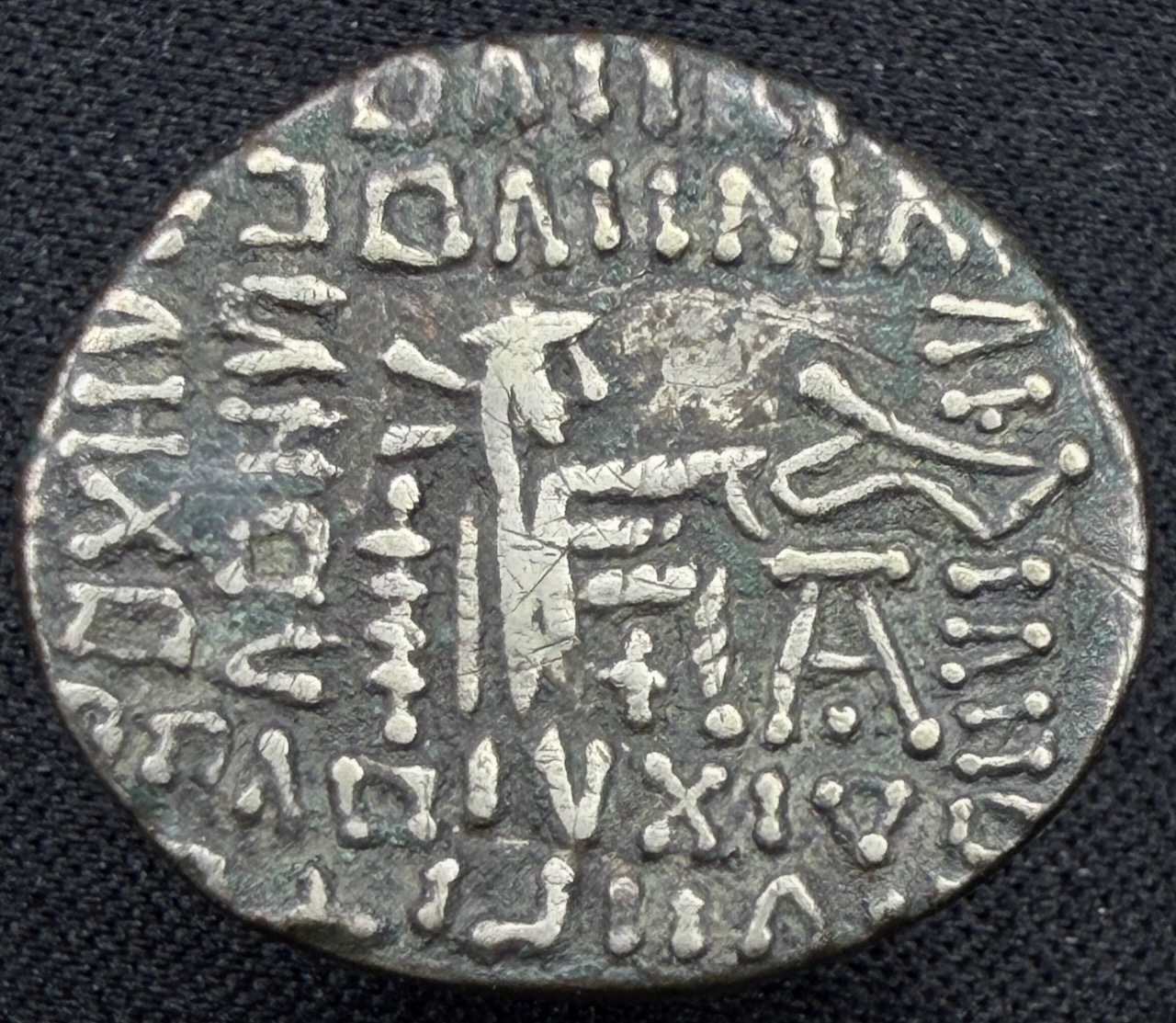
Current: Parthian Kingdom, Phraates IV, AR drachm, Ekbatana, c. 38–2 BC (Sellwood 54.7; Shore 297)
Obverse: Diademed bust left with pointed beard and segmented necklet, wart on forehead; in front, star above crescent; behind, eagle flying left holding wreath (diadem); circular border of pellets
Reverse: Beardless archer (Arsakes I) wearing bashlyk and cloak seated right on throne, holding bow in right hand; monogram below bow (Ekbatana mint); seven-line Greek legend
Primary reference: Sellwood 54.7
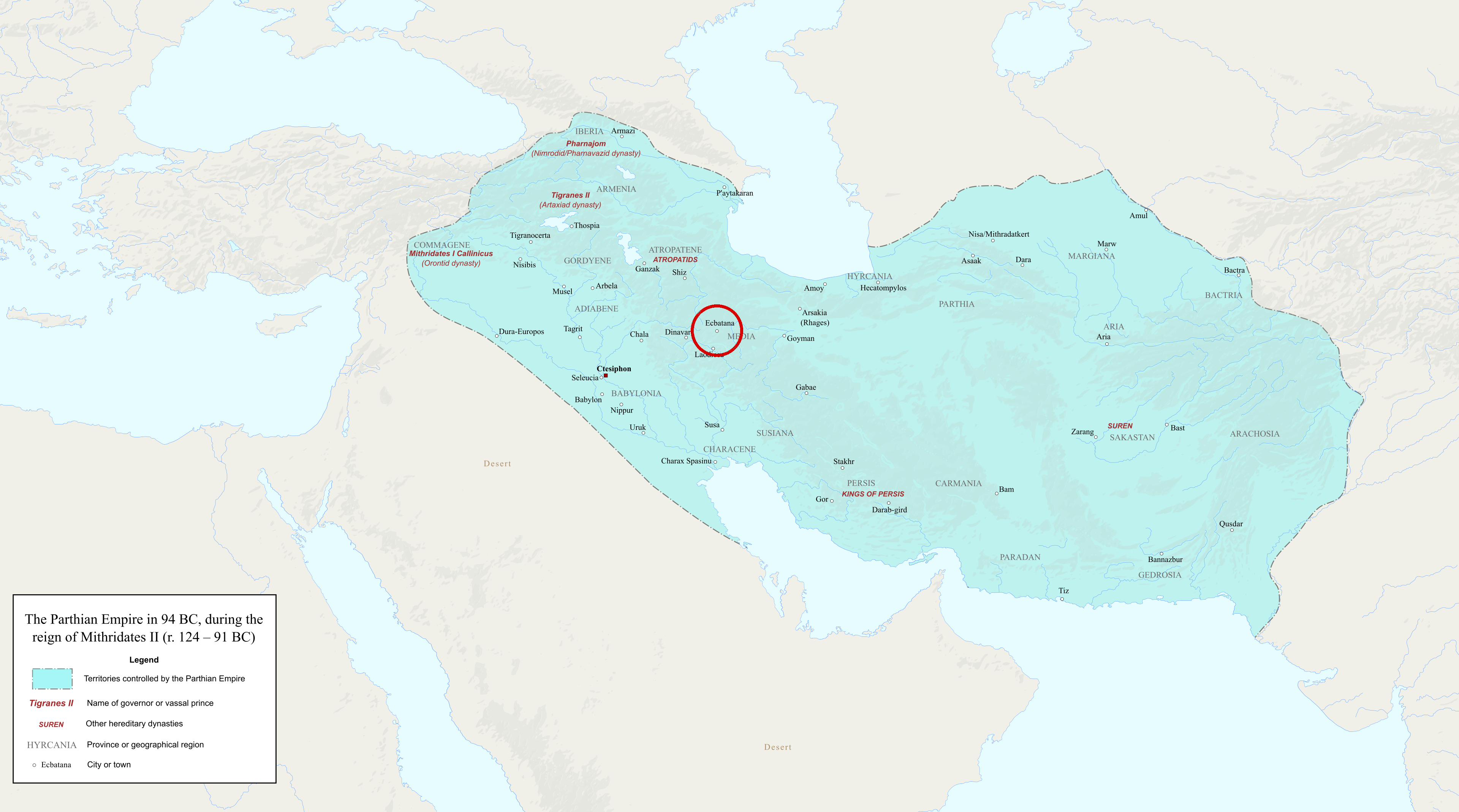
The Parthian Empire in 94 BC, some sixty years before Phraates IV. Ekbatana (Ecbatana), the mint, is ringed in red in Media — the summer capital and principal drachm mint of the Arsacids throughout Phraates’ reign.
Main map: “Map of the Parthian Empire under Mithridates II”, by HistoryofIran (after an original by Ro4444), Wikimedia Commons, CC BY-SA 4.0 (https://creativecommons.org/licenses/by-sa/4.0/). https://commons.wikimedia.org/wiki/File:Map_of_the_Parthian_Empire_under_Mithridates_II.svg Modification: red ring added to mark Ekbatana. Second map: “Parthia 001ad.jpg”, by Thomas Lessman (worldhistorymaps.info), Wikimedia Commons, CC BY 3.0 (https://creativecommons.org/licenses/by/3.0/). https://commons.wikimedia.org/wiki/File:Parthia_001ad.jpg Reproduced unmodified.
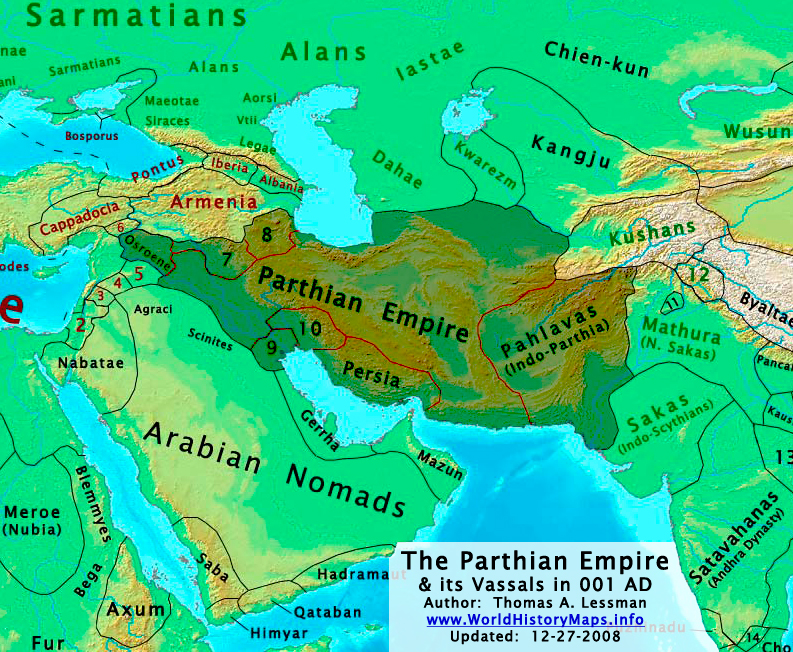
Second map: the Parthian Empire and its vassals in 1 AD — the empire at the very end of Phraates IV’s reign, the year before Musa and Phraataces poisoned him.
Phraates IV (c. 38–2 BC) is the Parthian king Rome knew best and trusted least. He took the throne by murdering his father Orodes II — victor of Carrhae — then purged his own brothers. Within two years he faced Mark Antony’s invasion of 36 BC, the largest Roman army ever sent east: roughly 100,000 men, whom Phraates’ cavalry and the Median terrain wore down to a starving column that lost perhaps a third of its strength on the retreat. The victory made Phraates the second Parthian king in fifteen years to humiliate Rome, and this collection holds the other side of that story: the legionary denarius of Mark Antony, struck for the fleet and legions of the war Phraates broke.
Graphic: JSB Coins, 2026 (CC0).
The obverse carries the king’s diademed bust with the pointed beard and the famous wart on the forehead — a hereditary blemish the die-cutters rendered faithfully, apparently as proof of legitimate Arsacid blood. In front of the face hang a star above a crescent; behind the head an eagle flies left carrying a wreath or diadem to crown the king. Numismatists read the ensemble as an iconography of divine election — the royal khvarenah in Greek dress. The reverse is the dynasty’s unchanging badge, the deified founder Arsakes I enthroned with his bow (an image descended from the Achaemenid archer sigloi), ringed by the stereotyped seven-line titulature and, below the bow, the monogram of Ekbatana — the same mint, a generation on either side, as this collection’s Mithradates II tiara drachm and Artabanus II drachm.
The drachms of Phraates IV are securely his; the scholarly argument in this corner of the series concerns the tetradrachms. François de Callataÿ’s 1994 die study demonstrated that most tetradrachms Sellwood gave to the usurper Tiridates (S55.1–6, 55.10–14) belong to Phraates IV, with only S55.7–9 remaining Tiridates’ — though, as Parthia.com notes, the puzzling absence of the wart on those tetradrachms keeps a question open. None of this touches the drachm type 54; the eagle-and-wart obverse is uncontested. Within type 54, subvarieties are separated by mint: 54.7 is Ekbatana (Shore 297), against Mithradatkart and other issues with different monograms.
After 36 BC Phraates’ reign turned inward: the usurper Tiridates twice drove him from the throne before Phraates recovered it with nomad help. The standoff with Rome ended not in war but in the celebrated diplomatic bargain of 20 BC, when Phraates returned the legionary standards captured from Crassus, Saxa and Antony to Augustus — an event Rome advertised on coins and on the breastplate of the Prima Porta statue as if it were a conquest. Augustus’ gifts included an Italian slave girl, Musa, whom Phraates made queen; in 2 BC she and her son Phraataces poisoned him. The drachms of Ekbatana, struck steadily through these decades, paid the horsemen on whom all of it turned.
The settlement of 20 BC deserves a closer look, because Rome never stopped talking about it. There was no battle. Tiberius marched an army toward Armenia; Augustus held the usurper Tiridates at Rome as a standing threat; and Phraates — secure but careful — chose to buy the peace. What he handed over were the legionary eagles taken from Crassus at Carrhae in 53 BC, from Decidius Saxa in 40, and from Antony’s baggage in 36, together with the surviving prisoners. Augustus treated the transaction as a conquest: the Senate voted honors, the mints advertised SIGNIS RECEPTIS, a temple of Mars Ultor was planned to house the recovered eagles, and in the Res Gestae (29) the old emperor still boasted that he had “compelled the Parthians to restore to me the spoils and standards of three Roman armies.” The most famous statue of the ancient world says the same thing in marble: at the center of the breastplate of the Augustus of Prima Porta, a Parthian in belted coat and trousers — Phraates IV in effigy — holds out the eagle to a Roman soldier.
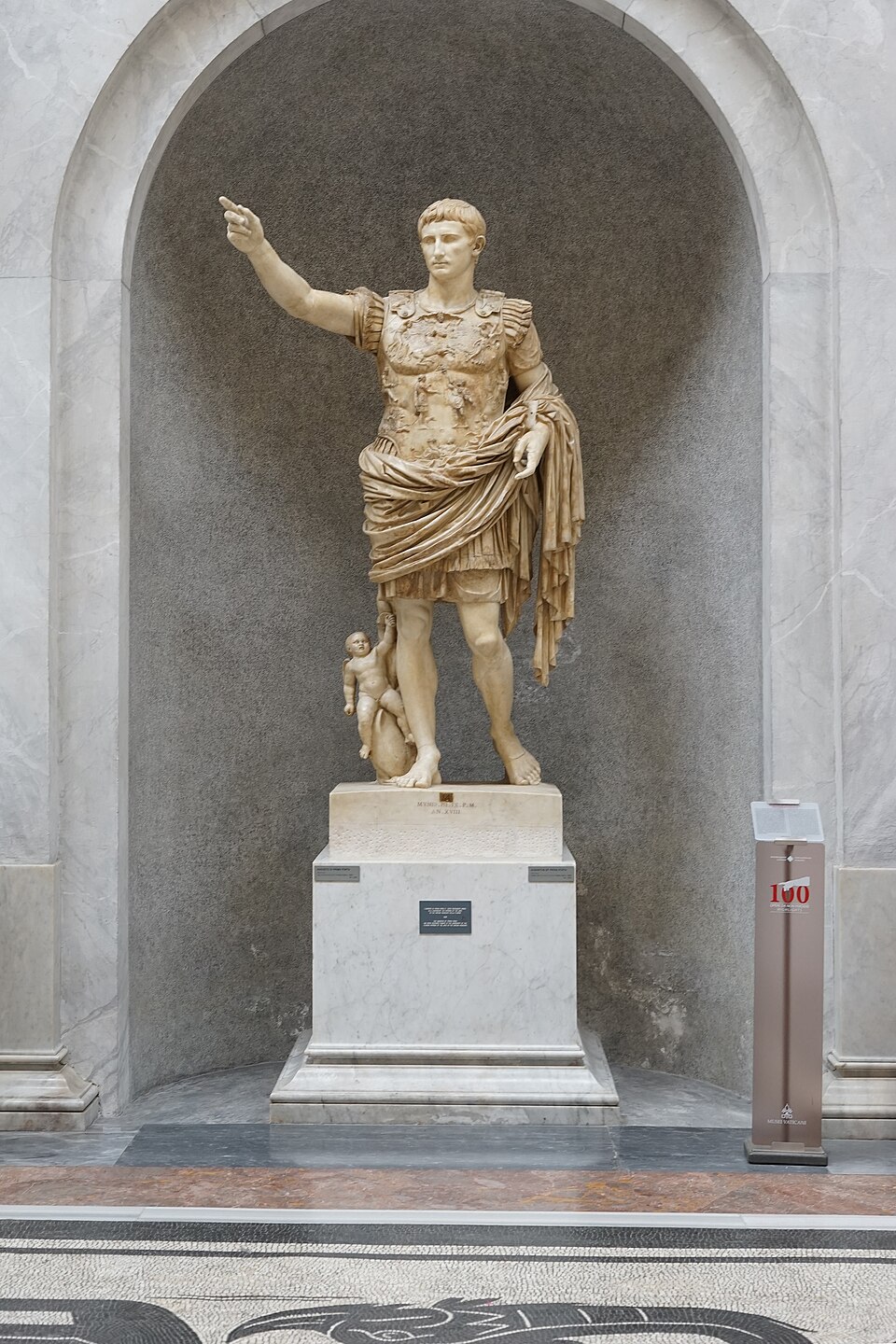
Photo: Fabrizio Garrisi, CC BY-SA 4.0 (Wikimedia Commons); reproduced unmodified.
Attribution: David Sellwood, An Introduction to the Coinage of Parthia, 2nd ed. (1980), type 54.7; Fred B. Shore, Parthian Coins and History (1993), no. 297; obverse symbolism and mint per the Parthia.com corpus (Edward C. D. Hopkins). Tetradrachm reattribution: F. de Callataÿ, Les tétradrachmes d’Orodès II et de Phraate IV (1994), as summarized on Parthia.com. Narrative history: Plutarch, Antony 37–52; Cassius Dio 49 and 54; M. Olbrycht, “Phraates IV,” Encyclopaedia Iranica. Plutarch’s Antony and Crassus are linked in the references; the settlement of 20 BC in Augustus’ own words is Res Gestae 29; the Prima Porta statue is Vatican Museums, Braccio Nuovo, inv. 2290.
Sellwood 54.7 (Shore 297) is the Ekbatana issue with star-above-crescent before the bust and an eagle flying left with a wreath/diadem behind — symbols of divine kingship. The royal wart on the forehead is a deliberate dynastic portrait marker of Phraates IV. De Callataÿ's 1994 die study reassigned most 'Tiridates' tetradrachms (S55) to Phraates IV; it does not affect the drachm series.
John's Ancient Coin Collection · Type · phraates-iv-eagle-drachm
Image credits for this coin — photographs, maps and graphics used on this page