Type · lydia-croeseid-third-stater-lion-bull
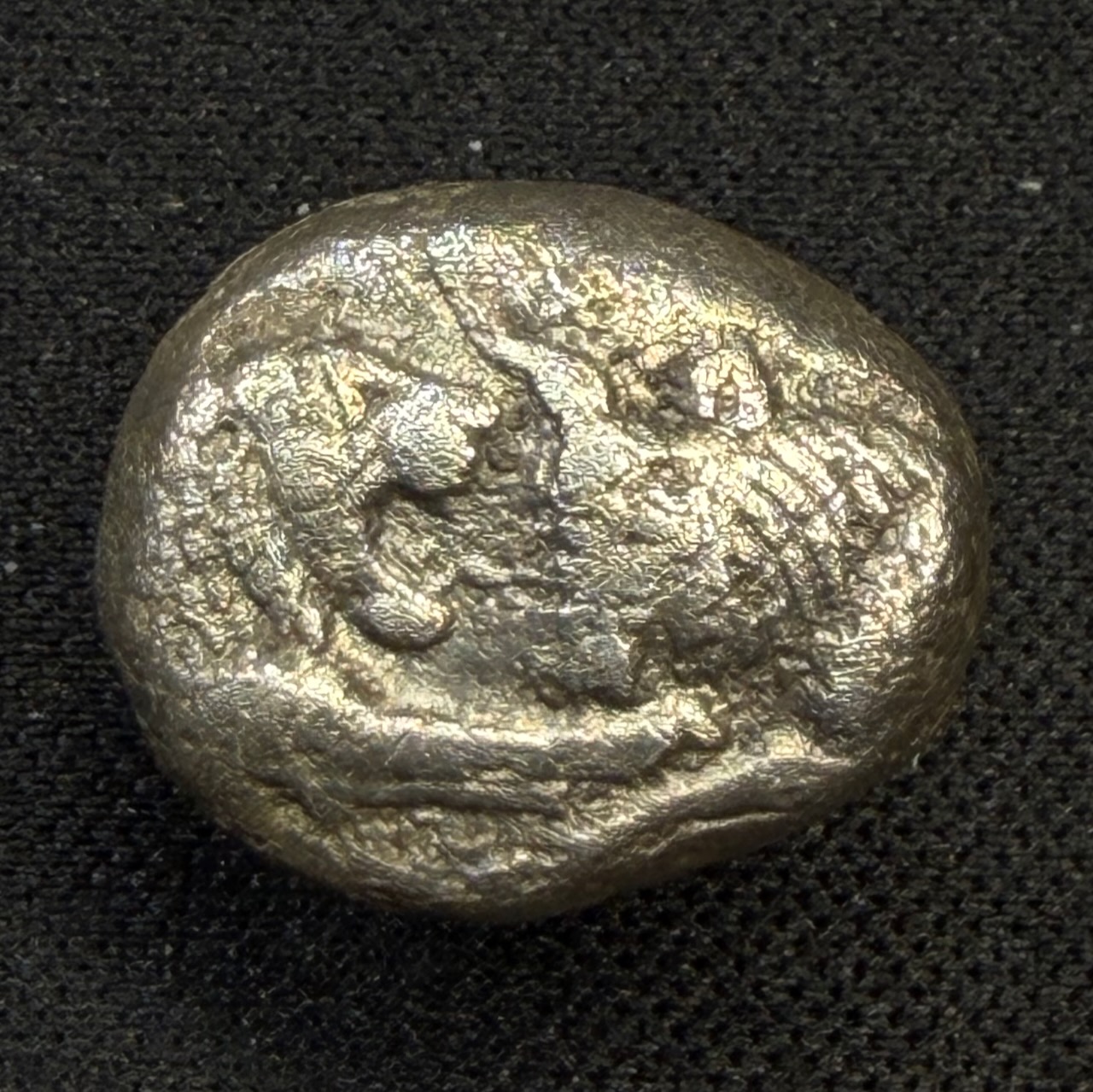
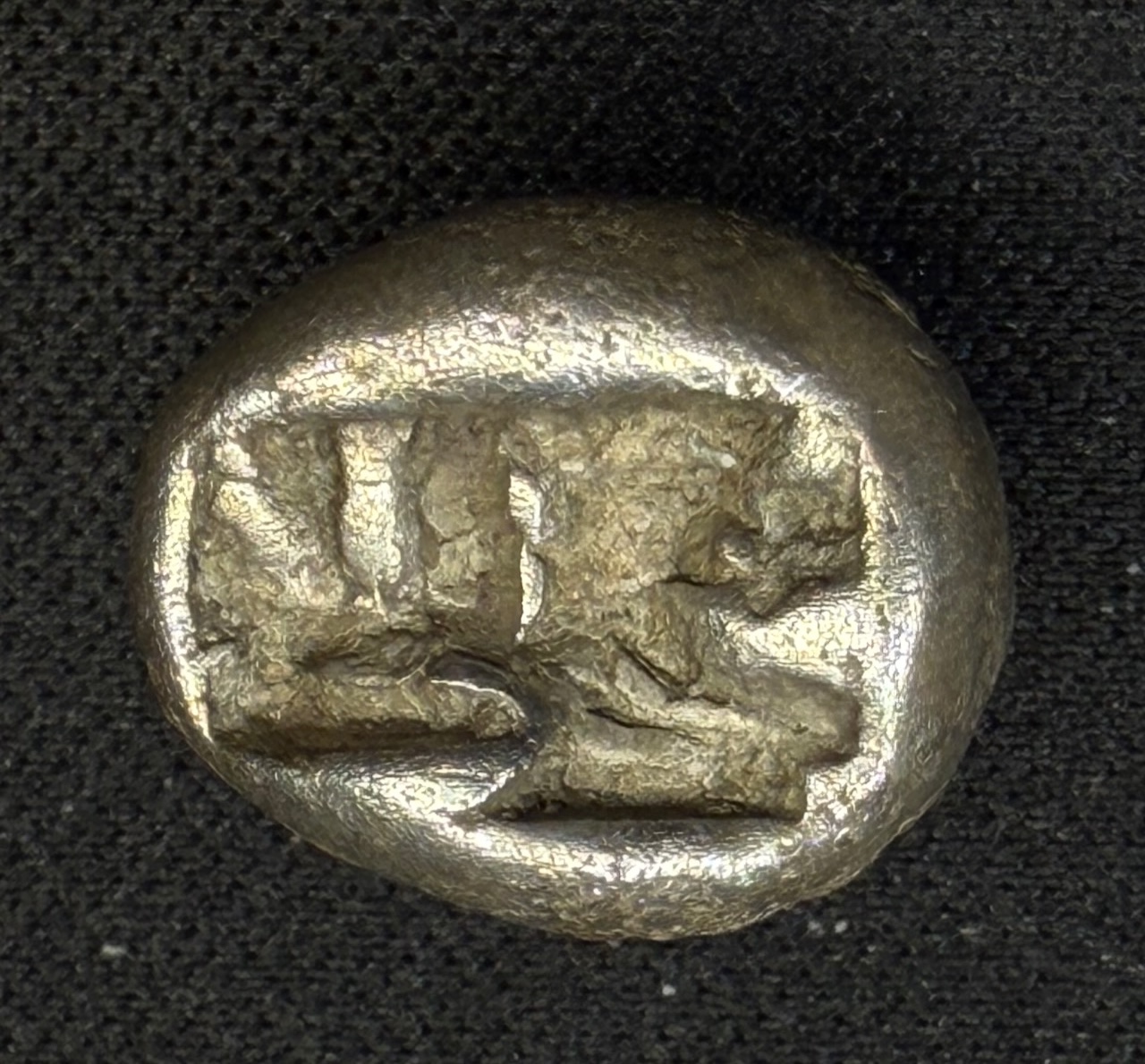
Current: Lydia, Sardes. Kingdom of Lydia, temp. Kroisos (c. 561–546 BC; dealer tag c. 564–539 BC), or possibly the early Persian-period continuation. AR third-stater (trite). Confronted foreparts of lion and bull / two incuse squares (SNG Ashmolean 772).
Obverse: Confronted foreparts of a lion (on the left, head right) and a bull (on the right, head left), facing one another. Anepigraphic.
Reverse: Two incuse (sunken) square punches of unequal size, side by side.
Primary reference: SNG Ashmolean 772
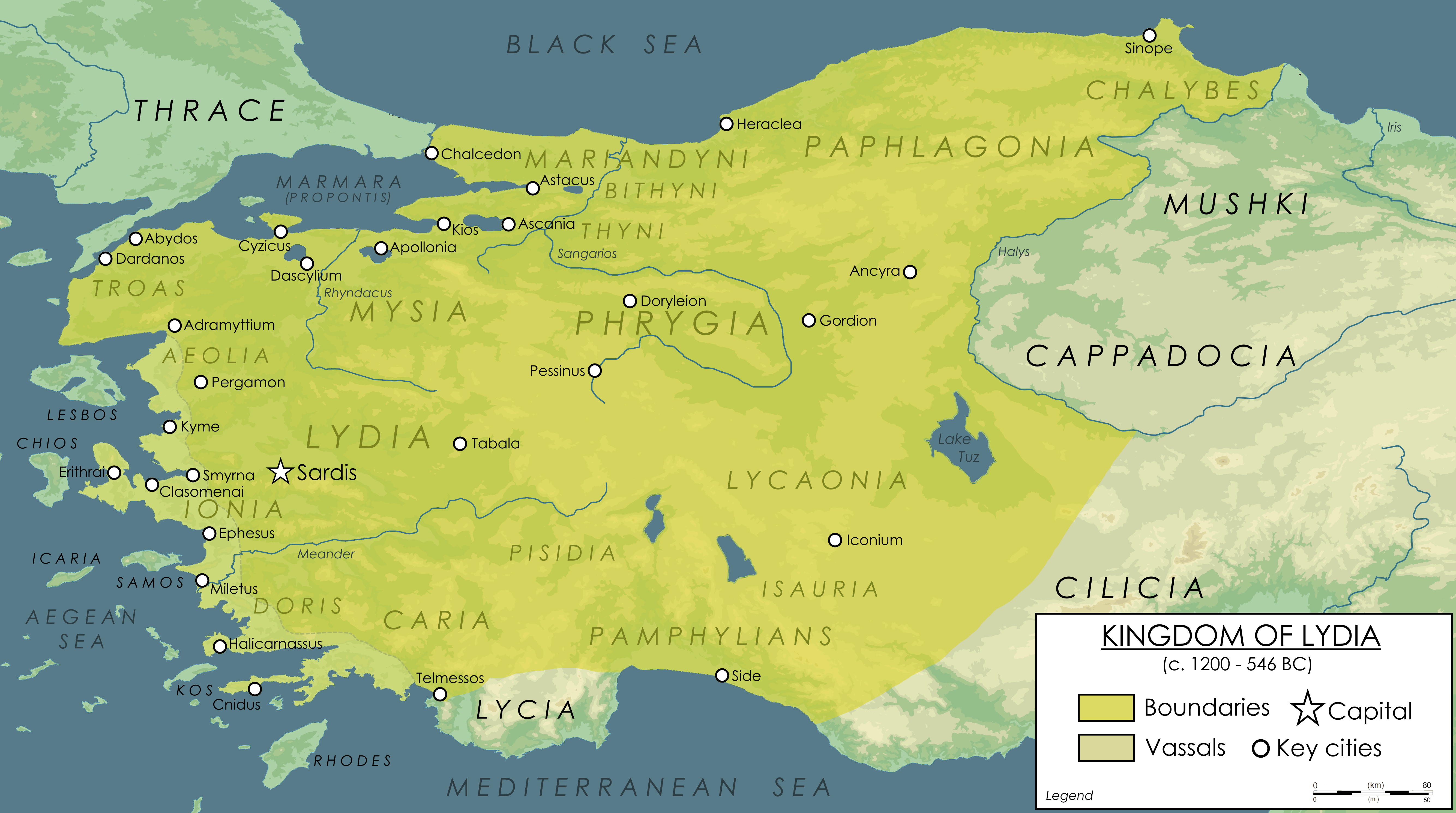
The Kingdom of Lydia at its greatest extent under Kroisos (Croesus), controlling western Asia Minor as far east as the River Halys. Sardes — the capital and the mint that struck this coin — is marked by the capital star (see the map’s legend). This is the realm of the bimetallic gold-and-silver “Croeseid” coinage to which this third-stater belongs.
Main map (Kingdom of Lydia): “Kingdom of Lydia at its Greatest Extent” by Ennomus (Wikimedia Commons), File:Kingdom of Lydia.png, licensed CC BY-SA 4.0 (https://commons.wikimedia.org/wiki/File:Kingdom_of_Lydia.png; license: https://creativecommons.org/licenses/by-sa/4.0/). Reproduced unmodified.
Second map (Achaemenid satrapies): “Map of Achaemenid Imperial Satraps (English Version)” by M.r ebrahim zadeh (Wikimedia Commons), File:Map of Achaemenid Imperial Satraps (English Version).png — released by the author into the public domain and additionally licensed CC BY-SA 4.0 (https://commons.wikimedia.org/wiki/File:Map_of_Achaemenid_Imperial_Satraps_(English_Version).png; license: https://creativecommons.org/licenses/by-sa/4.0/). The base map was compiled from Atlas Antiquus (Justus Perthes, 1909) and the “Achaemenid Satrapies” article in Encyclopaedia Iranica. Modified by JSB Coins: a red square has been added to mark the position of Sardes. This derivative is shared under CC BY-SA 4.0.
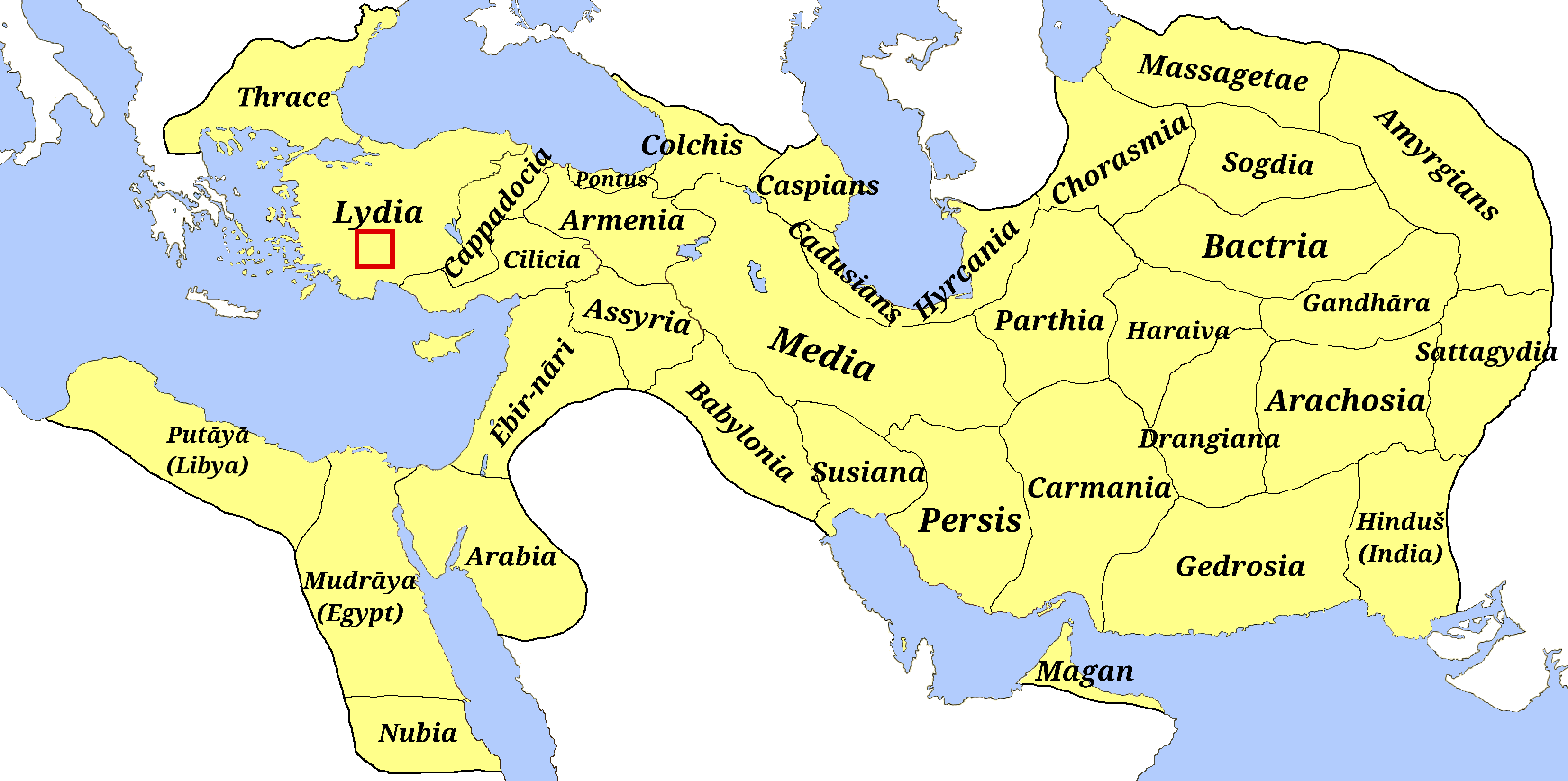
And the world that inherited this coinage — the Achaemenid (Persian) Empire as its network of imperial satrapies. Lydia (Old Persian Sparda) sits at the far western edge; the red square marks Sardes, where the Persians kept striking the lion-and-bull types for a generation after Kroisos’s fall.
This third-stater belongs to the Croeseid coinage — the bimetallic gold-and-silver money of Sardes carrying the confronted foreparts of a lion and a bull — and by its dealer’s attribution it belongs to the lifetime of the king who invented that system: Kroisos of Lydia, the Croesus whose name is still shorthand for wealth. Where the collection’s Croeseid siglos is assigned to the Persian-period continuation of the series, this smaller denomination is placed in the royal phase itself, c. 561–546 BC — which would make it the oldest coin in the collection struck by a named historical ruler.
Graphic: JSB Coins (CC0).
Lydia produced the world’s earliest coins — state-stamped electrum — around the turn of the seventh century BC. Kroisos’s reform replaced that variable natural alloy with separate pure-gold and pure-silver coinages on fixed standards, mutually convertible: the first true bimetallic currency. All of it bore one design, the lion of Lydia facing the bull, and all of it was struck at Sardes. The silver ran in a ladder of denominations — stater, half-stater (siglos), and this third-stater or trite of c. 3.55 g, with sixths and twelfths below — small enough silver that ordinary market exchange, not just state payments, could ride on it.
The honest caveat that attends every Croeseid attends this one. The coins name nobody, and after Cyrus the Great took Sardes (traditionally 546 BC) the Persians went on striking the same types for a generation, until Darius I’s daric-and-siglos reform (c. 515 BC, following Le Rider). Separating Kroisos’s own emissions from the Persian continuation is a matter of style, fabric, weight, and hoard context, and scholars draw the line differently. The dealer’s attribution places this piece in the king’s reign (the tag’s dates, c. 564–539 BC, are one older convention for that reign); a Persian-period origin cannot be strictly excluded — exactly the same uncertainty, in mirror image, that attends the sibling siglos. The two coins may in fact be nearer contemporaries than their catalog lines suggest, and the pairing makes the debate itself visible on facing pages of the collection. The coin that ended the series, the Achaemenid royal-archer siglos, is also here — and so is the Sardes mint’s third act, striking for a third empire: the drachm of Alexander the Great, from the same workshops two centuries on.
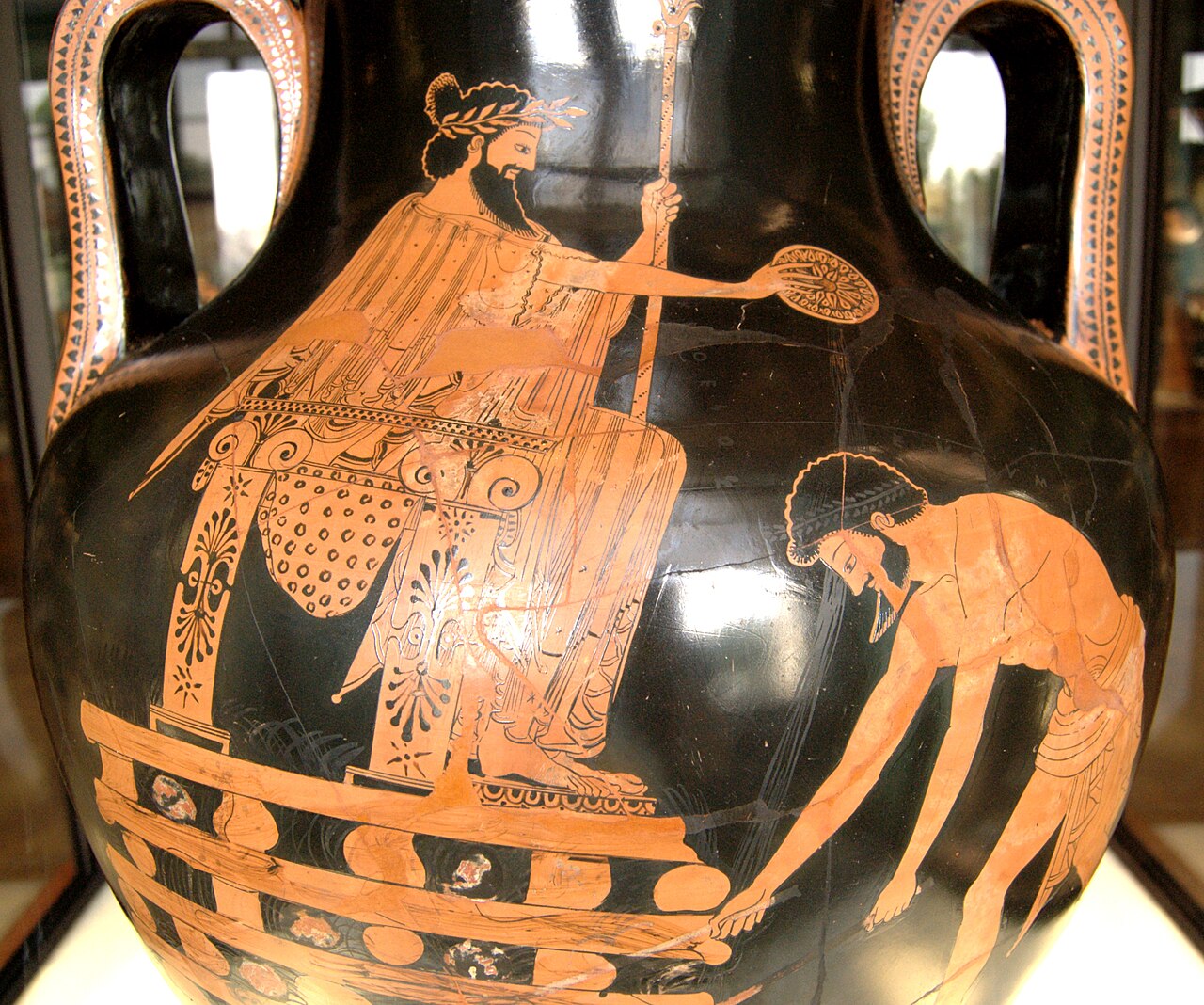
Photo: Bibi Saint-Pol, Wikimedia Commons, released into the public domain.
No ancient king’s end was retold more than Kroisos’s, and the Greeks could not agree on it. In Herodotus (1.86–87) the captive king is set on a pyre by Cyrus, remembers Solon’s warning to count no man happy before his death, and is saved — by Cyrus’s change of heart and a sudden rain sent by Apollo, the god Kroisos had gilded. In Bacchylides’ victory ode (Ode 3, 468 BC) he mounts the pyre himself, a king choosing death over slavery, and Apollo spirits him away to the Hyperboreans. Myson’s amphora, painted within living memory of the events, shows the serene second version. Behind all the tellings stands the historical fact the vase and this coin share: the proverbially richest man of his age — the king who gilded Delphi with talents of gold ingots and a golden lion (Herodotus 1.50–51) — lost kingdom, capital, and mint in a single season, and the lion-and-bull money kept being struck as if nothing had happened. (His Delphi gold had a second numismatic life: two centuries later the Phokians melted the sanctuary’s dedications — Kroisos’s expressly among them, says Diodorus — to coin money for the Third Sacred War, and a piece of that coinage is in this collection as the Phokian triobol.)
Graphic: JSB Coins, 2026 (CC0).
Between them, lion and bull mark the moment money as we understand it took shape: state-guaranteed precious metal in interlocking denominations of gold and silver. A third-stater of the royal phase is a working coin from the treasury system that made Croesus a proverb — the wealth Herodotus has him display to Solon, and lose, with Lydia, in a single campaign season. Herodotus’s verdict on the Lydians (“the first of men we know to strike and use coin of gold and silver,” 1.94) is, on the current understanding of the evidence, very nearly the literal description of this object.
The dealer’s reference is SNG Ashmolean 772 (Sylloge Nummorum Graecorum, Ashmolean Museum — Croeseid third-stater of this type); attribution and system follow Georges Le Rider, La naissance de la monnaie (Paris 2001), and John H. Kroll, “The Coins of Sardis” (Sardis Expedition essay, 2010), both of which discuss the Kroisos-versus-Persian-period question and the c. 515 BC transition to the daric and siglos. Herodotus 1.94 (the Lydian invention of coinage), 1.29–33 and 1.86–91 (Kroisos, Solon, and the fall of Sardes), and 1.50–52 (the Delphi dedications) supply the historical frame — Book I is linked in the references; the alternative fate of the king is Bacchylides, Ode 3. The Myson amphora is Louvre G 197. This specimen’s auction provenance: Classical Numismatic Group, Sale 58 (19 September 2001), lot 609.
Third-stater (trite) of the bimetallic Croeseid silver system (full standard c. 3.55 g; this coin 3.39 g per the dealer tag). The denomination sits below the stater (c. 10.7 g) and siglos/half-stater (c. 5.35 g) — the collection also holds a Croeseid siglos, filed as its own type since denomination distinguishes types. The coins are anepigraphic, so assignment to Kroisos's own reign versus the posthumous Persian-period continuation rests on style, fabric, and hoard evidence; the dealer places this coin in Kroisos's lifetime, the sibling siglos in the Persian continuation, and both attributions carry the same honest uncertainty.
John's Ancient Coin Collection · Type · lydia-croeseid-third-stater-lion-bull
Image credits for this coin — photographs, maps and graphics used on this page

.png)
