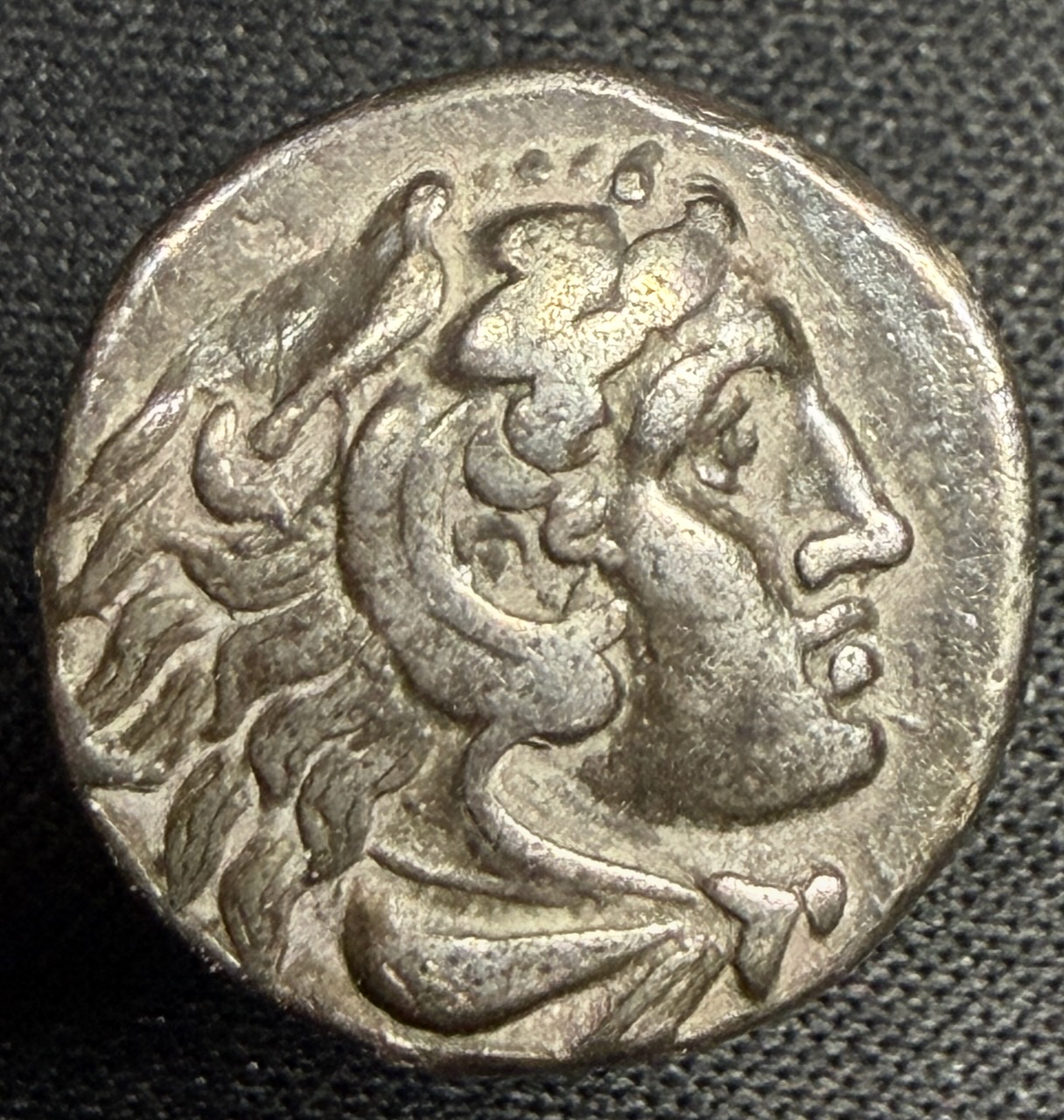
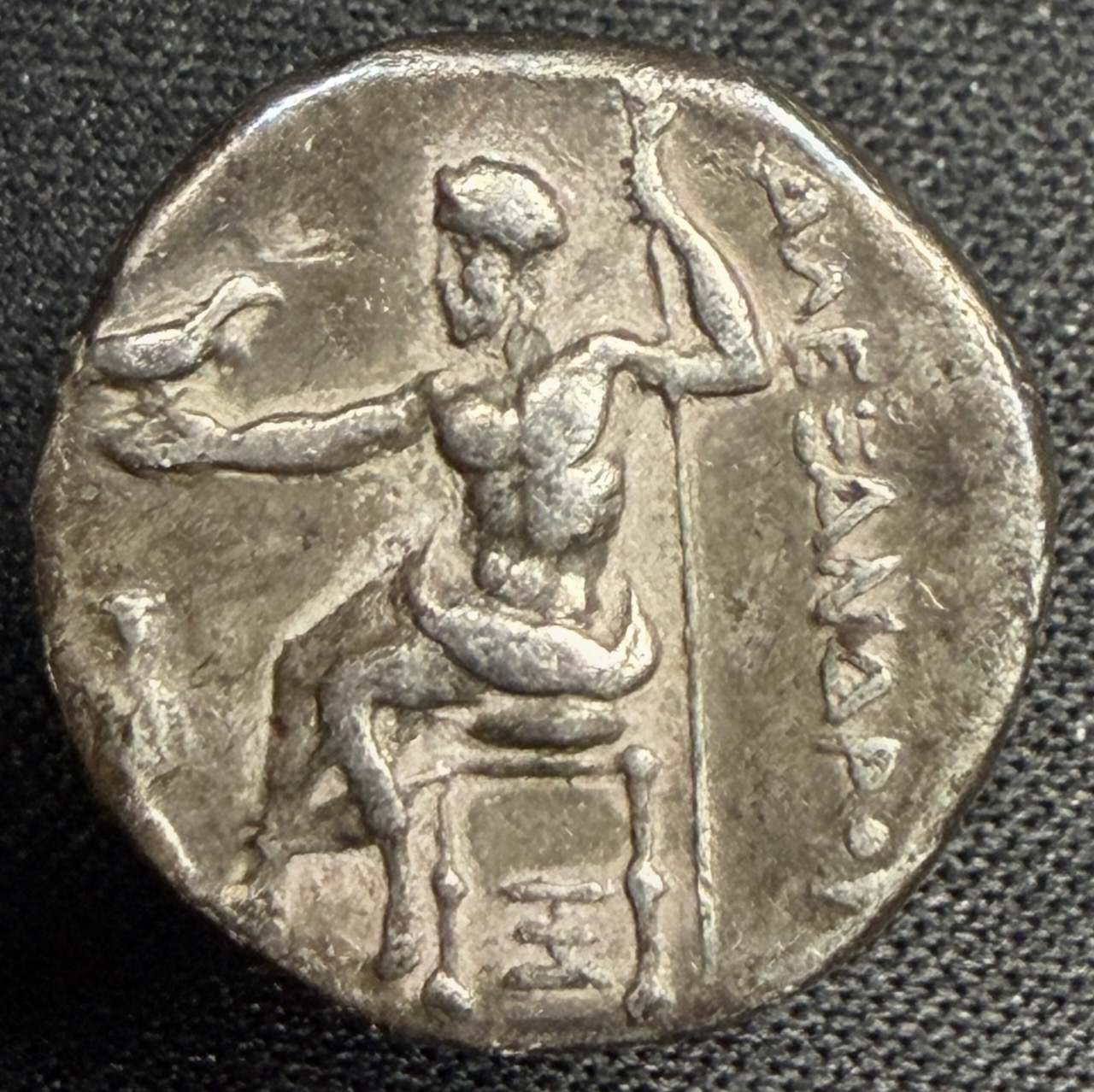
Type · alexander-iii-sardes-drachm
Current: Kingdom of Macedon, Alexander III 'the Great', AR drachm, probably Sardes, c. 334–319 BC (mint and date pending control-mark identification in Price / Thompson ADM I)
Obverse: Head of young Herakles right, wearing lion-skin headdress
Reverse: Zeus Aëtophoros enthroned left, eagle on outstretched right hand, long sceptre in left; in left field, a vertical symbol (probably a torch — see notes); barred monogram beneath the throne
Primary reference: Price — (to be determined from the left-field symbol and throne monogram)
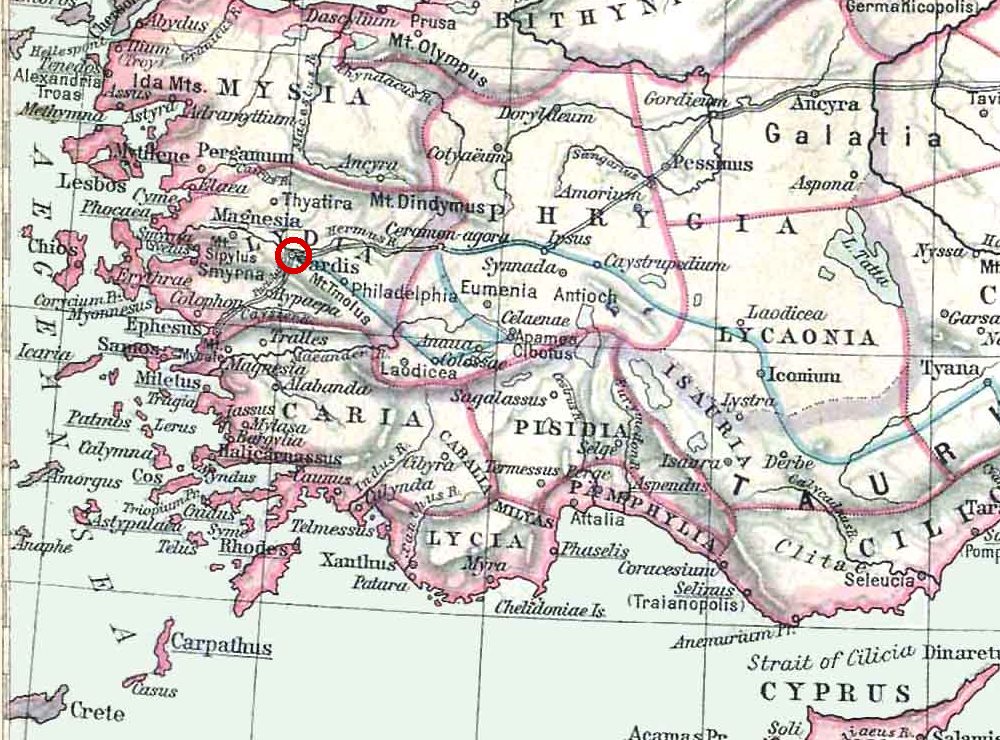
Western Asia Minor on Shepherd’s 1923 map. Sardes — circled in red — sits in the Hermus valley below Mt. Tmolus, the old Lydian royal capital that became a Macedonian mint city after Alexander took it without a fight in 334 BC. The rival drachm mints of the region are all in view: Magnesia and Thyatira to the north and west, Colophon, Ephesus, and Miletus on and near the Ionian coast — the cluster that struck Alexander’s drachms for pay across two decades. Map shows the region in its broader Greco-Roman frame.
“Asia Minor under the Greeks and Romans” from William R. Shepherd, The Historical Atlas (1923). Public domain (author died 1934); house copy of the plate. Modified by JSB Coins: cropped to western Asia Minor, and a red circle added to mark Sardes.
This is the everyday face of the most successful coinage of the ancient world: a silver drachm in the name of Alexander, Herakles in his lion-skin on one side, Zeus enthroned with his eagle on the other. The tetradrachm carried Alexander’s money across the Mediterranean, but the drachm was the denomination a soldier actually spent — roughly a day’s pay for a skilled man — and the mints of western Asia Minor struck them in astonishing quantity from Alexander’s arrival in 334 BC through the wars of his successors. A coin like this one, tagless and anonymous today, was once someone’s wages in the most consequential army in history.
If this drachm is Sardes work, it was struck in the most storied mint city in this collection — the place where coinage itself was born. Under the Mermnad kings of Lydia (Gyges down to Kroisos), Sardes commanded the Hermus valley from its near-impregnable acropolis, and the gold dust the river Pactolus carried down through the town — the legend said King Midas had washed off his golden touch in it — funded the invention, around the late seventh century BC, of the first state-stamped coins, in electrum. Kroisos then rebuilt the system in refined gold and silver — the first bimetallic currency — and this collection holds that revolution twice over: a Croeseid third-stater placed in the king’s own reign and a Croeseid siglos of the series’ continuation. When Cyrus took the city (traditionally 546 BC — Herodotus, Book I, tells the story unforgettably), the Persians kept the mint running: first the old lion-and-bull types, then, from Darius I’s reform, the royal-archer money of the empire — the collection’s Achaemenid Type II siglos is Sardes work of that second empire, struck in the satrapal capital at the western end of the Royal Road. Burned in the Ionian Revolt of 499 BC (the fire that lit the Persian Wars), rebuilt, and surrendered intact to Alexander in 334 BC (Arrian 1.17 — the Persian commander Mithrenes handed over citadel and treasury unasked), Sardes then opened its third imperial coinage: the Alexanders of this page. Few mints anywhere can match that run — Croeseid, siglos, and Alexander drachm, three empires’ money from one workshop, all three represented in this collection.
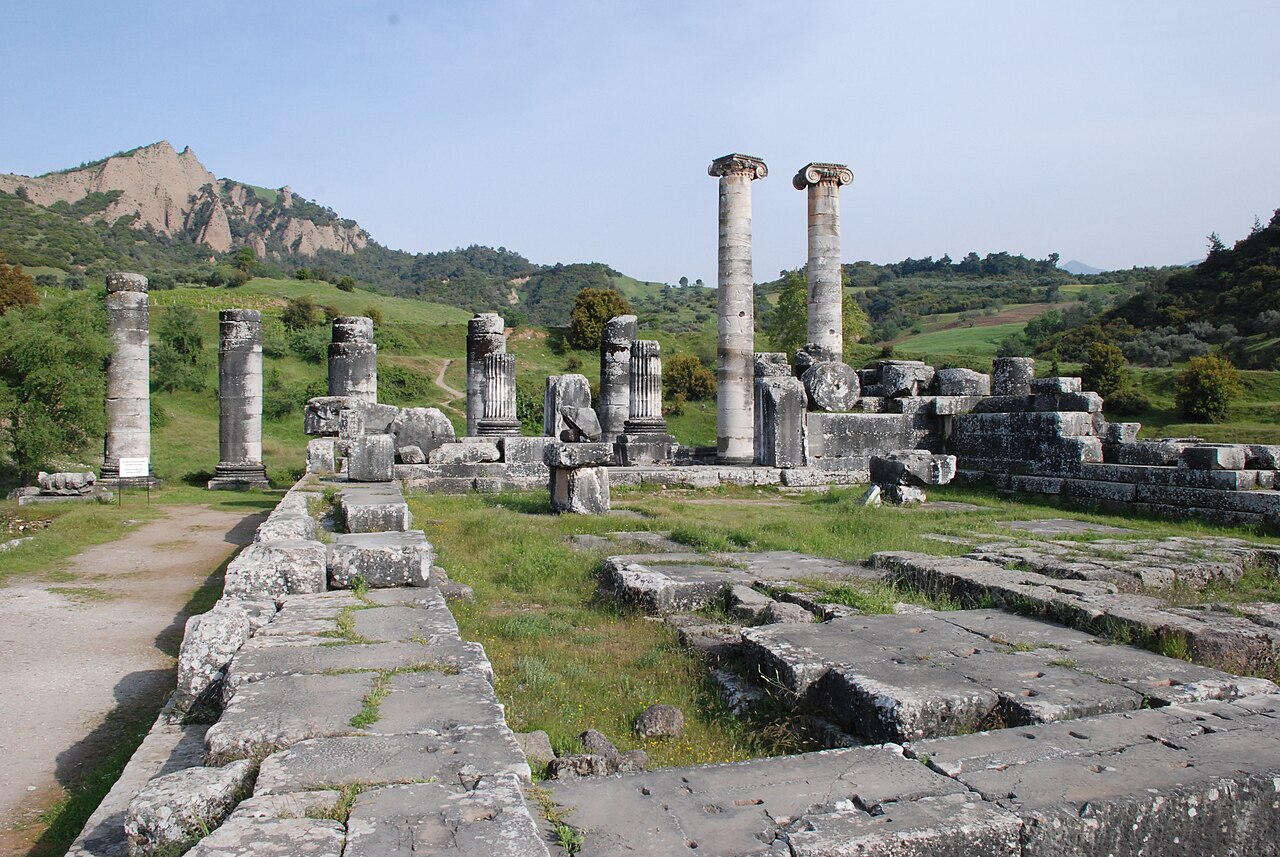
Photo: simonjenkins’ photos, via Wikimedia Commons, licensed CC BY-SA 2.0, reproduced unmodified.
Alexander crossed into Asia in 334 BC, and Sardes — seat of Persian administration in the west — surrendered to him without a siege. The city’s mint was soon striking in the king’s name, and Margaret Thompson’s die study (Alexander’s Drachm Mints I) identified Sardes and Miletus as the two great engines of the drachm coinage, with satellite mints at Colophon, Magnesia, Lampsakos, and Abydos. The drachms stayed in western Asia Minor for good reason: the region had a long habit of fractional silver, dense city markets, and — above all — armies to pay. Production continued in Alexander’s name long after his death in 323 BC, the “immortal” types frozen while the world that issued them fractured; the same phenomenon at tetradrachm scale is this collection’s Kolophon Alexander, and at the home mint of Macedon the Amphipolis tetradrachm of the regency years.
The imagery is a compact statement of the Argead kings’ claims. Herakles, ancestor of the Macedonian royal house, wears the lion-skin of his first labor — a hero-king’s badge that on these coins hovers deliberately close to a portrait without being one (whether some late lifetime and posthumous dies assimilate Alexander’s own features to Herakles is a long-standing debate in the literature — the classic statements are collected in Price’s corpus introduction). Zeus Aëtophoros, “eagle- bearer,” enthroned with his sceptre, is both the father of the gods — and, usefully for a king ruling Greeks, Macedonians, and former Persian subjects alike, a figure with equivalents everywhere: at Tarsos his image on the coinage of the satrap Mazaios (the Baaltars staters of this collection) had prepared exactly this seated-god scheme.
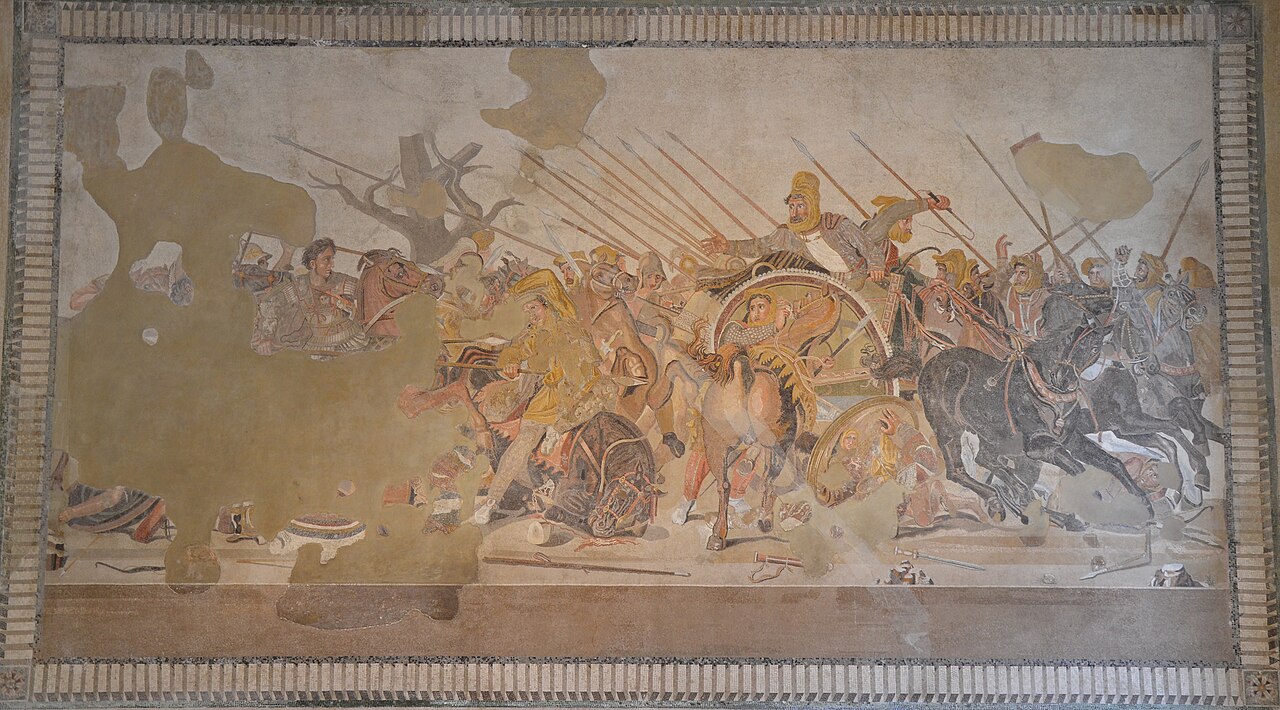
Photo: Carole Raddato, Wikimedia Commons, licensed CC BY-SA 2.0, reproduced unmodified.
Alexander’s mints signed nothing, but they marked everything: small symbols and monograms — here a vertical object in the left field, most plausibly a torch, and a barred monogram beneath the throne — that distinguish issues, magistrates, and mints. Matching this combination in Price’s corpus and Thompson’s Sardes die study is the open thread that will finish this attribution: it will settle the mint (Sardes is the working hypothesis; Magnesia and Miletos remain possible), place the coin before or after Alexander’s death, and perhaps narrow it to a few years. Until then the page keeps the honest label: a drachm of Alexander, probably Sardes, c. 334–319 BC.
Thompson’s Alexander’s Drachm Mints I is the working tool for this coin’s open thread, and it is free to read at the ANS Digital Library (linked in the references) — the torch-symbol issues are the place to start the hunt; Price’s corpus (via the ANS’s PELLA database) supplies the concordance. The Sardis Expedition’s digital portal is the best single resource on the city — Kroll’s “The Coins of Sardis” essay there covers this mint from the birth of coinage through the Alexanders. For the ancient narrative: Herodotus Book I (linked) for Lydian Sardes and its fall; Arrian 1.17 (linked) for the surrender to Alexander.
Mint framework and die study: M. Thompson, Alexander’s Drachm Mints I: Sardes and Miletus (ANS Numismatic Studies 16, 1983; open access at the ANS Digital Library — see references). Corpus: M. J. Price, The Coinage in the Name of Alexander the Great and Philip Arrhidaeus (1991); the torch as a Sardes control appears in the Sardes drachm series there (e.g. the Price 2637 area). City and mint history: J. H. Kroll, “The Coins of Sardis” (Sardis Expedition essay, 2010); Herodotus 1.29–33 and 1.86–94 (Kroisos, the fall of Sardes, the Lydian invention of coinage); 5.99–102 (the burning of 499 BC); Arrian, Anabasis 1.17 (the surrender of Sardes, 334 BC). The attribution’s limits are set out in the notes above; no dealer documentation accompanies this specimen.
MINT IS A BEST GUESS (Sardes): the coin came with no tag or paperwork; the attribution rests on the fabric, the drachm module (4.17 g — Attic standard, c. 4.3 g full weight), and the left-field symbol, which reads most naturally as a torch — a recurring control at Sardes, one of the two great drachm mints of western Asia Minor (Thompson, ADM I). The barred monogram beneath the throne is legible on the photos but not yet matched; the combination symbol + monogram is what will pin the Price number, the exact mint, and the lifetime vs. posthumous date. Until then Magnesia, Miletos, and the other Ionian/Lydian drachm mints cannot be excluded.
John's Ancient Coin Collection · Type · alexander-iii-sardes-drachm
Image credits for this coin — photographs, maps and graphics used on this page