Type · artabanus-ii-ekbatana-drachm
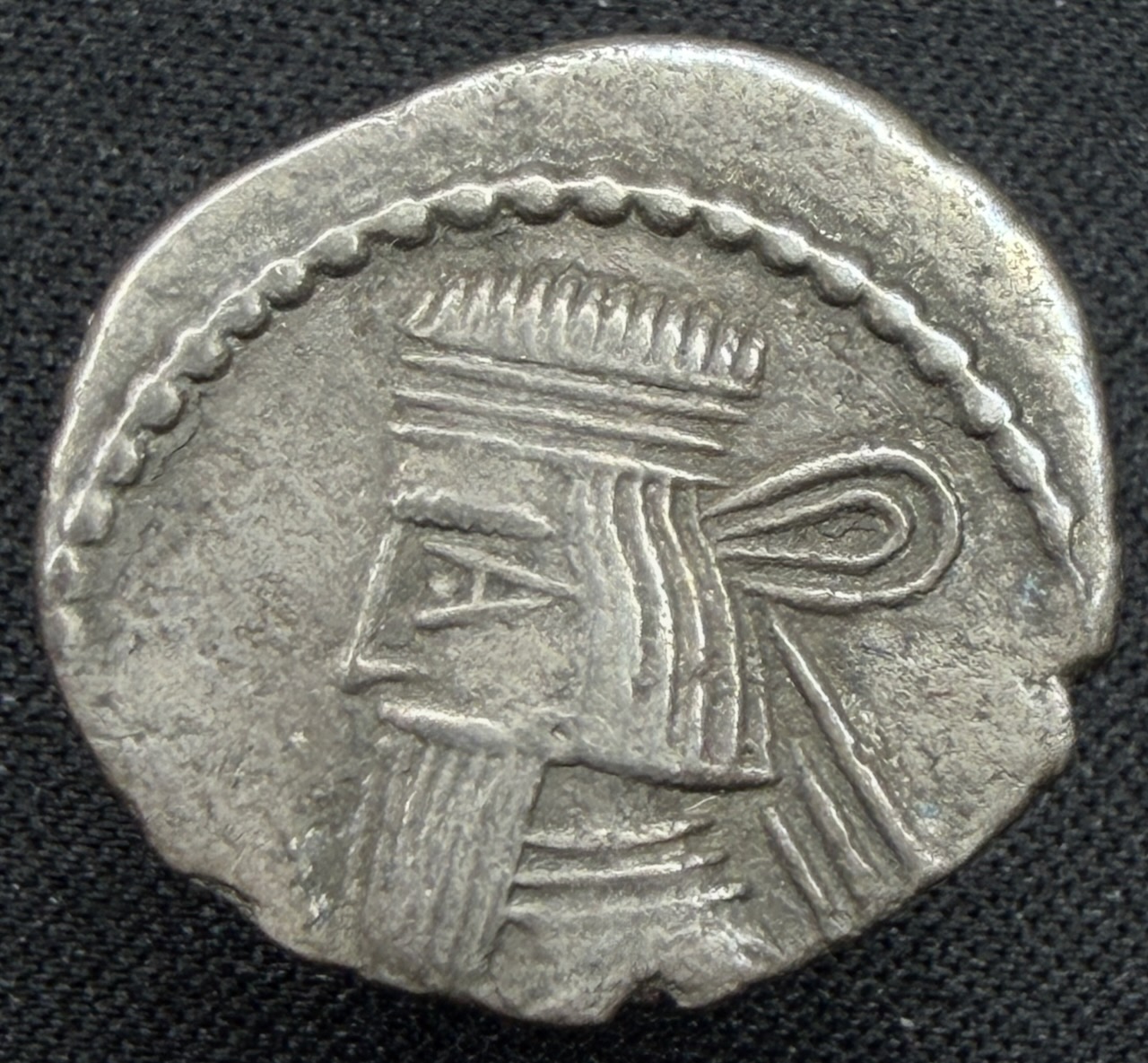
Current: Parthian Kingdom, Artabanus II (Sellwood; Assar: Artabanus IV), AR drachm, Ekbatana, 10–38 AD (Sellwood 63.6)
Obverse: Diademed bust left with long square-cut beard, hair in vertical waves bunched behind, earring visible; diadem with loop and pendant ends; circular border of pellets
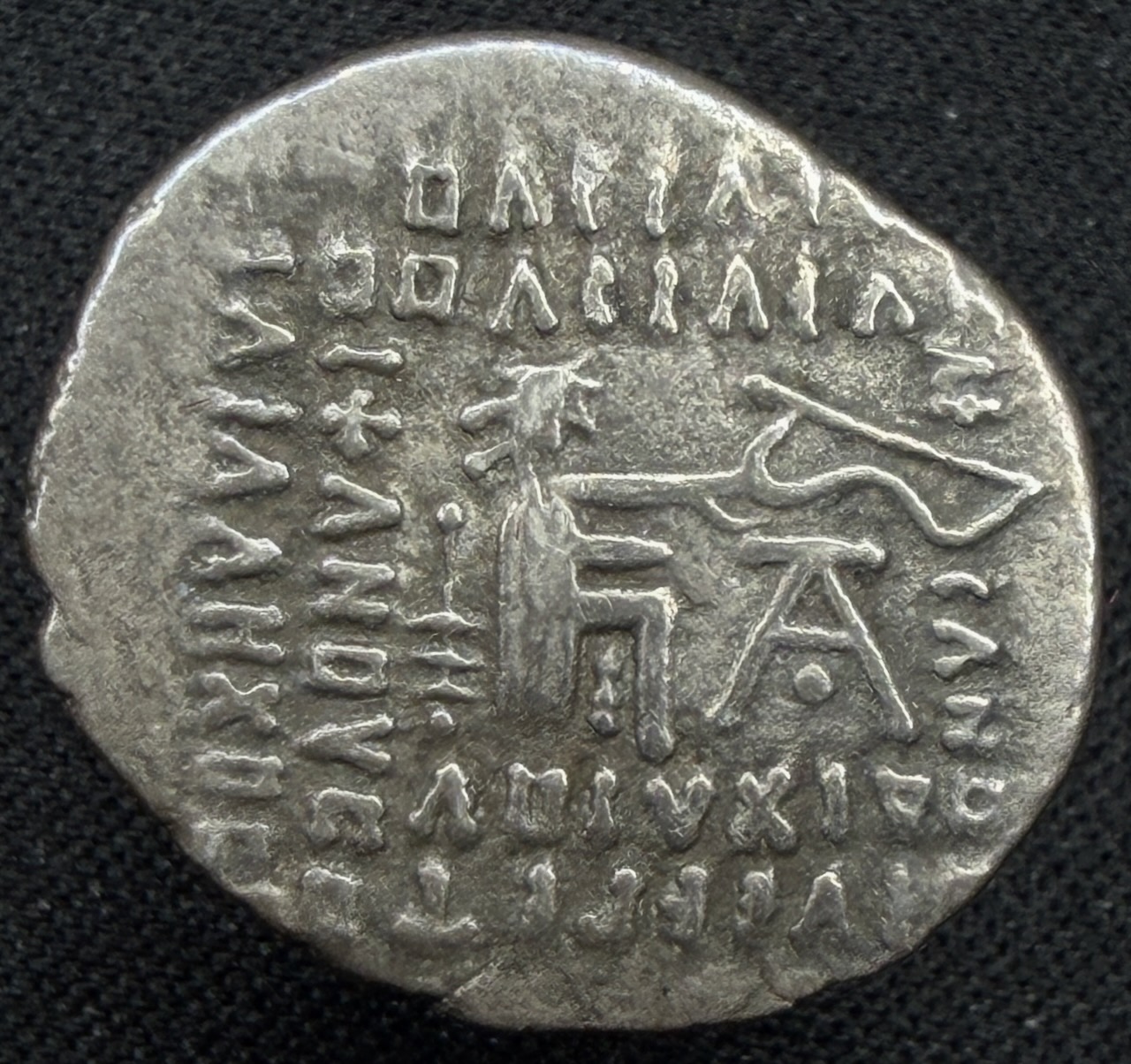
Reverse: Beardless archer (Arsakes I) wearing bashlyk and cloak seated right on throne, holding bow in right hand; monogram below bow (Ekbatana mint); seven-line blundered Greek legend
Primary reference: Sellwood 63.6
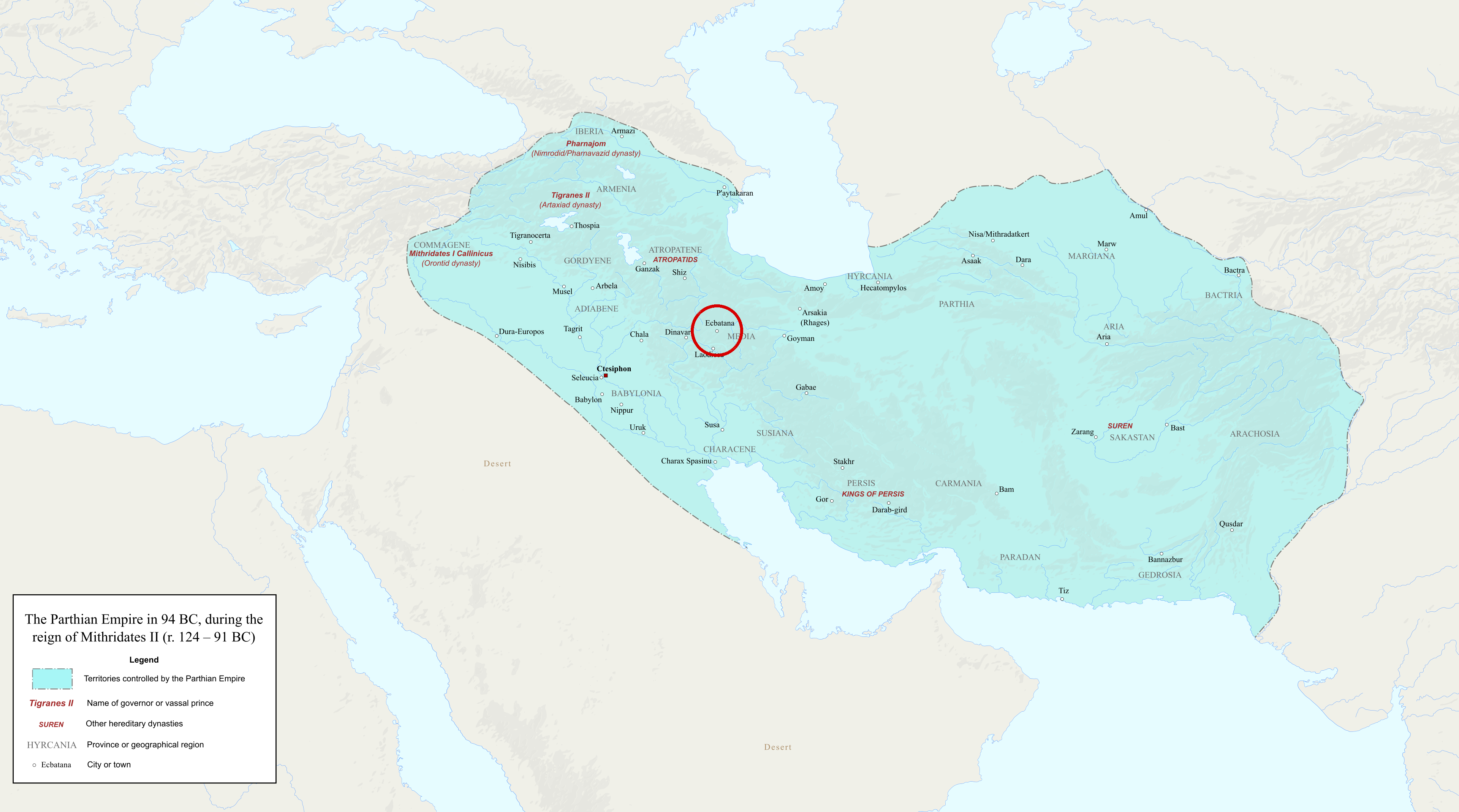
The Parthian Empire at its height in 94 BC, about a century before this drachm. Ekbatana (Ecbatana), the mint, is ringed in red in Media — the old Median capital that served as the Arsacids’ summer residence and principal drachm mint throughout, including under Artabanus II.
Main map: “Map of the Parthian Empire under Mithridates II”, by HistoryofIran (after an original by Ro4444), Wikimedia Commons, CC BY-SA 4.0 (https://creativecommons.org/licenses/by-sa/4.0/). https://commons.wikimedia.org/wiki/File:Map_of_the_Parthian_Empire_under_Mithridates_II.svg Modification: red ring added to mark Ekbatana. Second map: “Parthia 001ad.jpg”, by Thomas Lessman (worldhistorymaps.info), Wikimedia Commons, CC BY 3.0 (https://creativecommons.org/licenses/by/3.0/). https://commons.wikimedia.org/wiki/File:Parthia_001ad.jpg Reproduced unmodified.
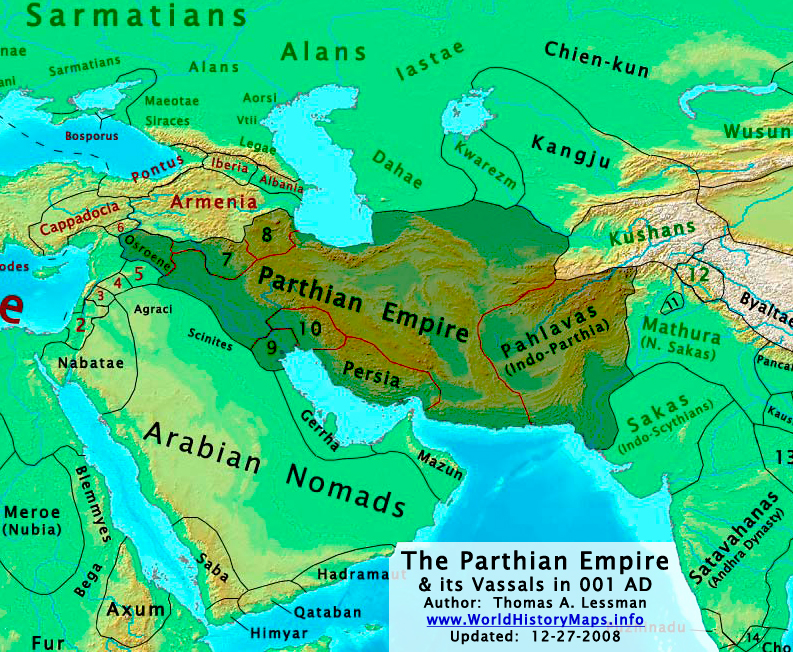
Second map: the Parthian Empire and its vassals in 1 AD — the empire essentially as Artabanus II inherited it a decade later.
This silver drachm was struck at Ekbatana, the old Median summer capital of the Achaemenid kings, by the ruler David Sellwood’s standard catalogue calls Artabanus II (reigned c. 10–38 AD). He came to the Parthian throne from outside the direct royal line — an Arsacid through his mother, raised among the Dahae nomads and ruling Media Atropatene — when the Parthian nobility rejected the Rome-raised Vonones I. Tacitus’ Annals is the principal narrative source for his long, turbulent reign, which was spent fighting rival claimants sponsored by Rome and contesting control of the Armenian throne with the emperor Tiberius.
Graphic: JSB Coins, 2026 (CC0).
The identity of the man is not in doubt, but his regnal number is genuinely contested. Sellwood’s An Introduction to the Coinage of Parthia (2nd ed., 1980), still the universal citation system, calls him Artabanus II. G. R. F. Assar’s revised Arsacid chronology recognizes an additional earlier Artabanus and renumbers this king Artabanus IV; dealers and auction houses now routinely give both (“Sellwood: Artabanus II; Assar: Artabanus IV”), and the Parthia.com corpus retains Sellwood’s numbering for consistency. This entry follows the tag and Sellwood; both numberings refer to the same king, 10–38 AD.
The obverse portrait — long square-cut beard, hair massed in neat vertical waves, diadem with a great looped bow behind — is the mature Parthian royal image, deliberately Iranian rather than Hellenistic. The earring noted on the dealer’s tag is a marker of the type. The reverse continues the design every Parthian king had struck for two and a half centuries: the deified founder Arsakes I seated on a throne in nomad dress (the pointed bashlyk cap), testing his bow. The device descends from the seated-archer sigloi of the Achaemenid tradition — compare the Achaemenid archer siglos in this collection — and made a continuous visual claim: the Arsacids as heirs of Persia. By this period the surrounding seven-line Greek legend (“King of Kings, Arsakes, Benefactor, Just, God Manifest, Friend of the Greeks”) had become a stereotyped frame of increasingly blundered letters, copied by die-cutters who no longer read Greek.
What did the men around Artabanus look like? For once antiquity left an answer in the round. The over-lifesize bronze found at Shami, in the hills of Elymais above the Susiana plain, is the only large Parthian bronze statue to survive: a nobleman standing rigidly frontal in the crossover belted riding-coat and baggy horseman’s trousers of the Iranian aristocracy, dated broadly to c. 50 BC–AD 150 — the world of this drachm. That dress belonged to the great feudal houses — the Surenas, the Karens — whose backing made and unmade Arsacid kings; Tacitus’ account of this reign is a history of exactly that nobility, rejecting Vonones for his Roman table manners, deserting Artabanus when Tiberius produced a rival, then recalling him because the Roman candidate proved worse. The drachm’s profile portrait, with its square-cut beard and massed waves of hair, renders the same court style in miniature.
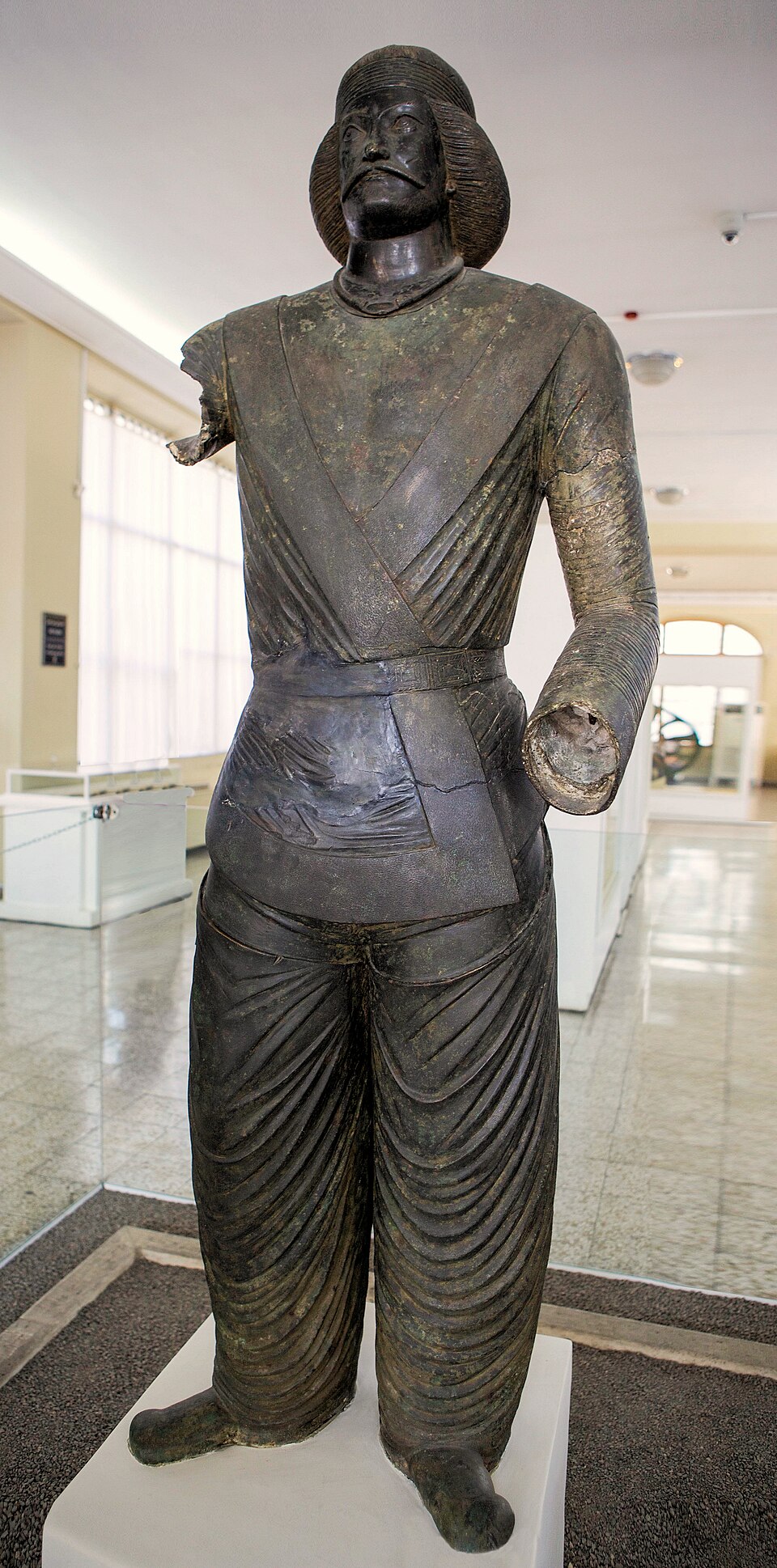
Photo: Ninara, CC BY 2.0 (Wikimedia Commons); reproduced unmodified.
Under the Arsacids, Ekbatana (modern Hamadan, Iran) was the empire’s great drachm mint, identified by the monogram below the bow on the reverse. The drachm, not the tetradrachm, was the workhorse of the Iranian plateau: a light, thin silver coin on the old Attic-derived Parthian standard of about 3.9 g, struck in enormous quantities to pay soldiers and administrators. Drachms of this reign circulated alongside those of his predecessors and successors deep into Central Asia. Two sister coins in this collection show the same mint working a generation apart: the tiara drachm of Mithradates II and the eagle drachm of Phraates IV.
Artabanus spent his reign asserting Parthian independence from Roman interference. He installed his son Arsaces on the Armenian throne (c. 34 AD), provoking Tiberius to back the pretenders Phraates and then Tiridates III; Artabanus was twice driven from his throne and twice recovered it, the second time reportedly returning from exile in the East “in squalid dress” to be re-acclaimed by nobles who found the Roman candidate worse. He died c. 38 AD, and his sons Vardanes and Gotarzes II promptly fought over the succession. Drachms like this one, struck at Ekbatana throughout the reign, funded those wars.
Attribution and cataloguing follow David Sellwood, An Introduction to the Coinage of Parthia, 2nd ed. (1980), type 63.6; cross-references Fred B. Shore, Parthian Coins and History (1993), nos. 341–343, and the Sunrise Collection catalogue (Sunrise 412). The Sellwood/Assar numbering question follows G. R. F. Assar’s revised Arsacid chronology as summarized in current auction cataloguing and on Parthia.com (Edward C. D. Hopkins), whose Artabanus II page also records the Ekbatana mint monogram and legend forms. Narrative history: Tacitus, Annals 2 and 6 (both linked in the references). The Shami bronze: National Museum of Iran, Tehran.
Sellwood's Artabanus II is renumbered Artabanus IV in Assar's revised chronology; auction houses now cite both. The seven-line reverse legend is stereotyped and increasingly blundered on drachms of this period — it is decorative rather than literate. Monogram below bow identifies the Ekbatana mint.
John's Ancient Coin Collection · Type · artabanus-ii-ekbatana-drachm
Image credits for this coin — photographs, maps and graphics used on this page


,_Parthian_School_(250_BC-226_AD)_National_Museum_of_Iran,_Tehran,_Iran.jpg)