Type · carrhae-caracalla-eagle-tetradrachm
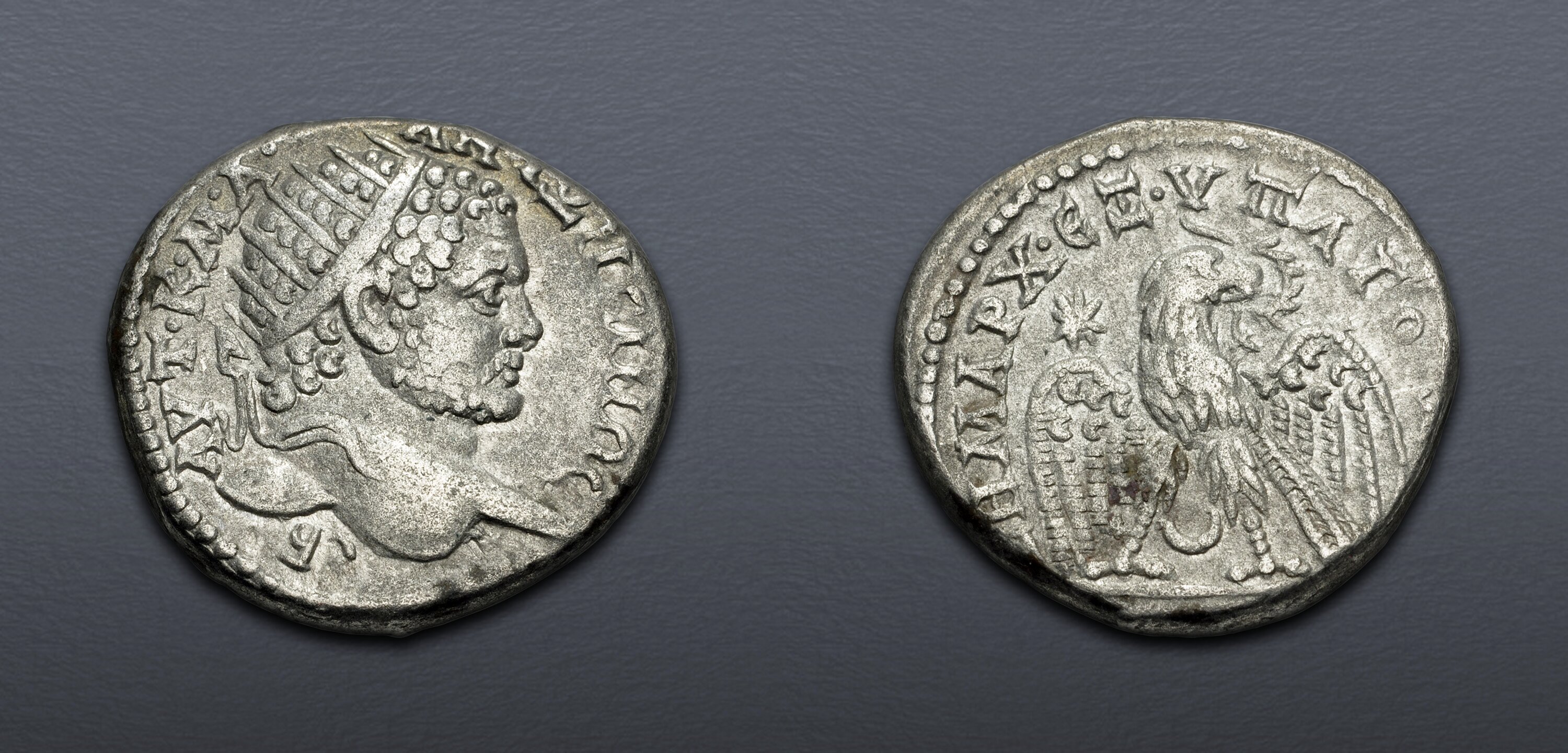
Current: Roman Provincial, Mesopotamia, Carrhae, Caracalla, BI tetradrachm, c. AD 215–217 (Prieur 830; RPC V.3 Online 80001)
Obverse: Radiate head of Caracalla right
Reverse: Eagle standing facing, head and tail to right, wings displayed, a wreath in its beak; star in the upper left field; CRESCENT between the legs; two pellets in exergue
Primary reference: Prieur 830
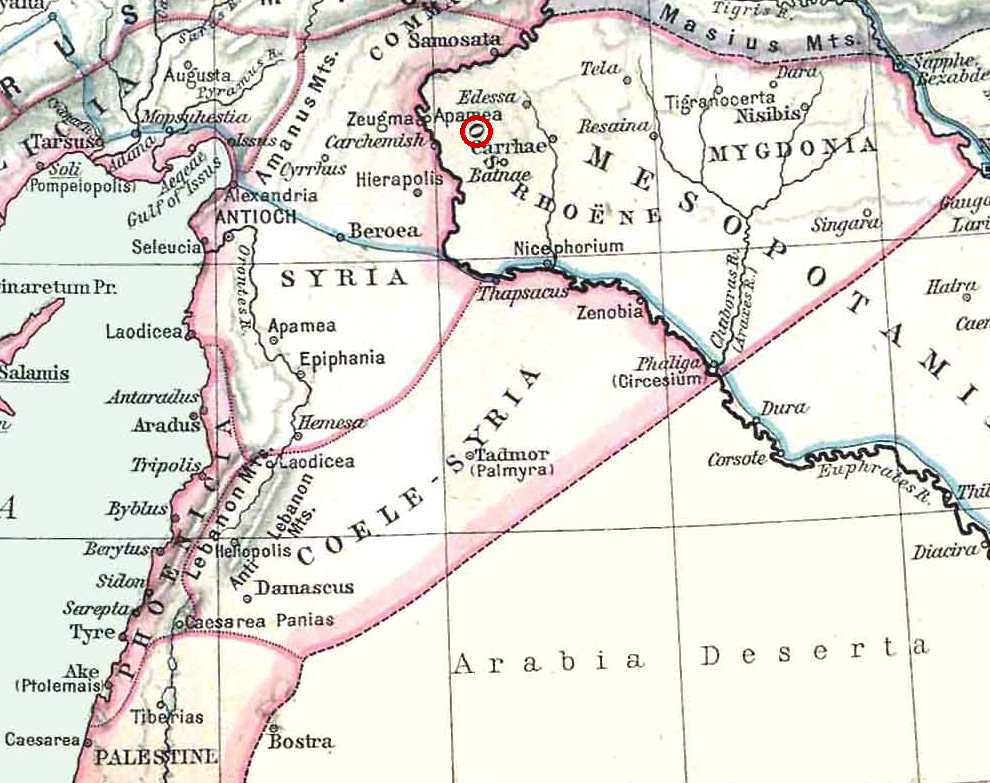
Northern Mesopotamia and Osrhoene, from the Syria inset of Shepherd’s “Asia Minor under the Greeks and Romans” — the same plate the collection uses for the Nero tetradrachm of Antioch, ringed here on a clean copy rather than on that one. Carrhae — Harran — is circled in red, on the plain south of Edessa, east of the Euphrates crossing at Zeugma. This is the ground Caracalla was moving over in AD 216–217, and he was killed on the road just outside this city on 8 April 217, traveling to the temple of the moon god whose crescent is on the reverse of this coin. The same plain is where Crassus lost his army to the Parthians in 53 BC.
“Asia Minor under the Greeks and Romans” (the Syria inset of the plate) from William R. Shepherd, The Historical Atlas (Henry Holt & Co., 1923), via Wikimedia Commons, File:Asia minor-Shepherd 1923.JPG (https://commons.wikimedia.org/wiki/File:Asia_minor-Shepherd_1923.JPG). Public domain (author died 1934); no attribution legally required, credited as a courtesy. Modified by JSB Coins: one red ring added to mark Carrhae, drawn on a clean copy of the inset — house rule is never to add a second marker to a copy already ringed for another type, and this plate is already ringed at Antioch for the Nero tetradrachm. The inset image is a crop of the same file, otherwise unmodified. The unmarked original is kept at maps/Asia_minor-Shepherd_1923_Syria-inset.jpg.
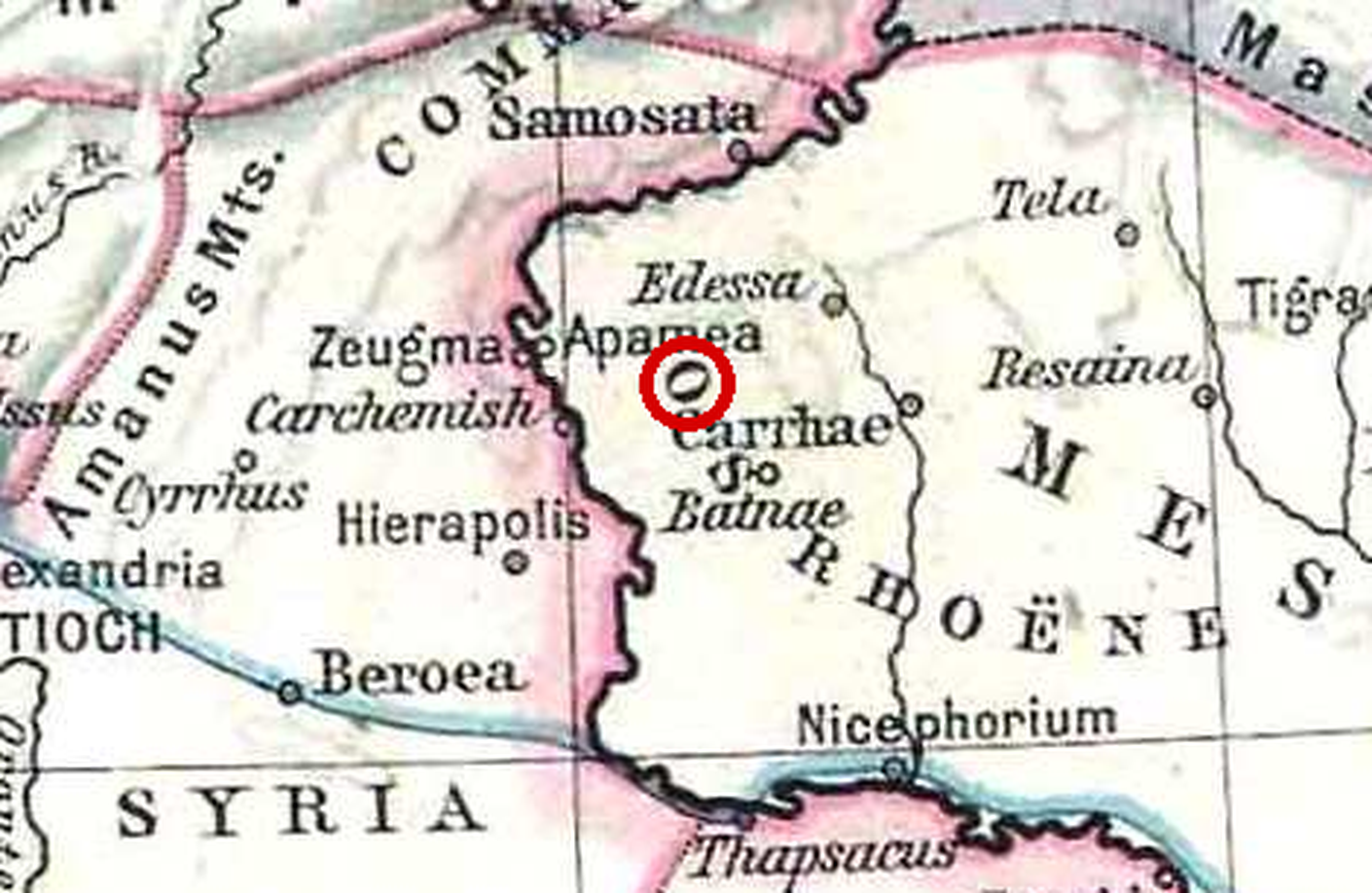
Detail: Carrhae with Edessa to the north, Batnae to the south, and the Euphrates crossing at Zeugma to the west — the road in from Roman Syria.
Two things happened at Carrhae, and this coin sits between them.
In 53 BC Marcus Licinius Crassus led seven legions across the Euphrates and was destroyed there by the Parthians. He lost about twenty thousand men, his son, his own life and — the part Rome could not forget — the legionary eagles. Carrhae entered the Latin language as a synonym for catastrophe, and the recovery of those standards was still being advertised on Roman coinage generations later.
In AD 217 Caracalla, campaigning against Parthia, stopped at Carrhae. On 8 April he left the city to visit the temple of the moon god, dismounted at the roadside to relieve himself, and was killed by a soldier. He was twenty-nine.
This coin was struck in that city, in those two years. And the small crescent between the eagle’s legs is the god he was going to see.
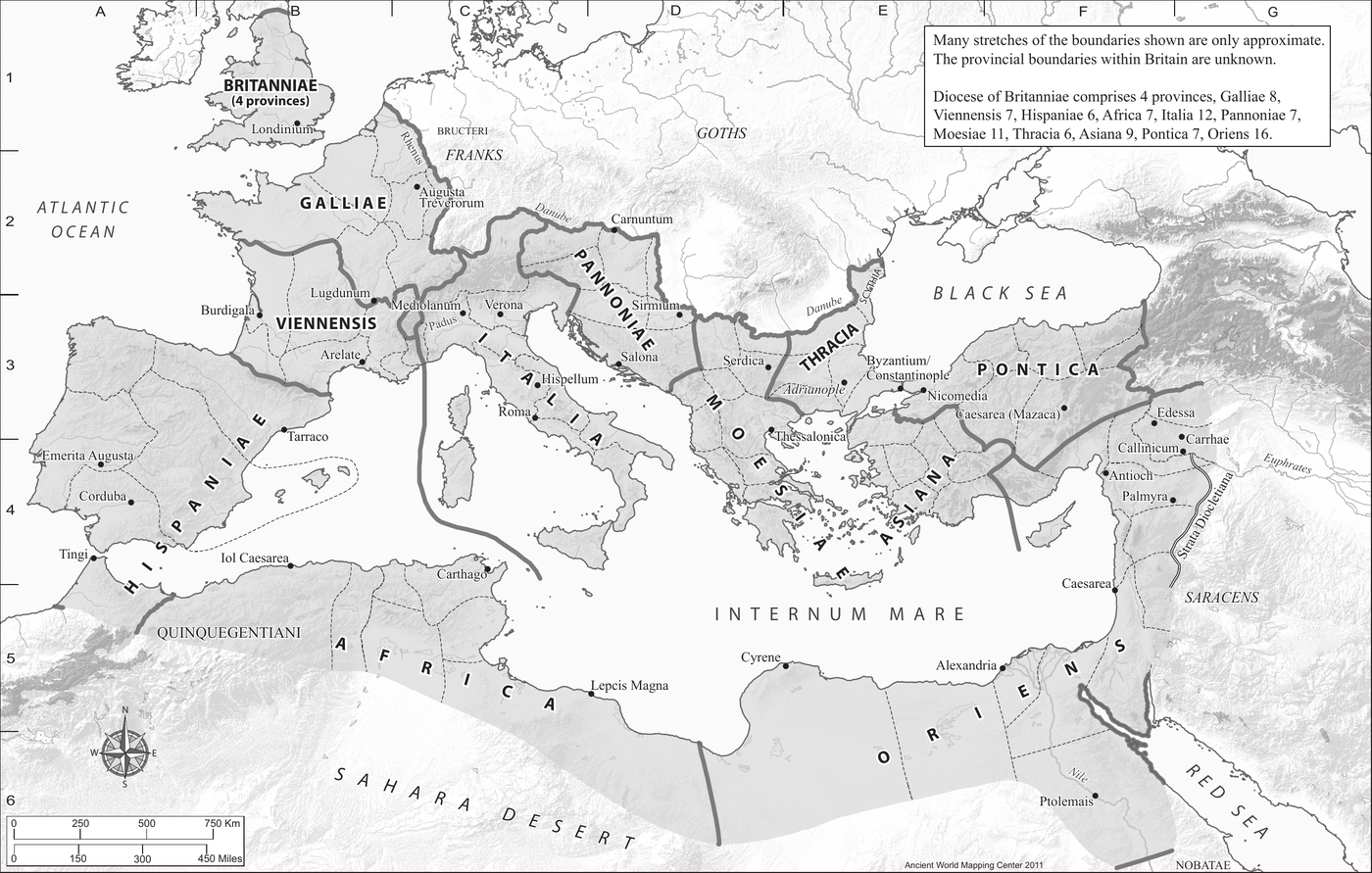
Ancient World Mapping Center, University of North Carolina at Chapel Hill (2011). Trimmed to the plate; licensed CC BY-SA 4.0, via Wikimedia Commons.
Carrhae is Harran, and Harran was one of the oldest and most durable cult centers in the Near East — the sanctuary of Sin, the Mesopotamian moon god, attested from the third millennium BC and still functioning, remarkably, into the Islamic period. Nabonidus, the last king of Babylon, rebuilt the temple there in the 6th century BC and was accused of preferring Sin to Marduk.
The crescent is that god. On this coinage it functions as the mint’s own signature — a device other Prieur mints do not carry — so the emblem identifying where the coin was made is also the emblem of the cult that drew Caracalla to his death a few hundred yards outside the walls.
Whether he was killed because of that pilgrimage is a separate question, and the sources do not agree. Dio (79.5–6) and Herodian (4.13) both describe the murder, differ on the details, and both point at the praetorian prefect Macrinus — who was proclaimed emperor three days later. Dio was a serving senator under both men and disliked both. The episode is well attested and badly agreed, which is the usual condition of Roman palace murders, and it should be left that way.
Graphic: JSB Coins, 2026 (CC0).
Michel Prieur’s corpus gathers the “Syro-Phoenician” billon tetradrachms — a large, sprawling eastern coinage of four-drachm pieces on a debased silver standard, struck from Nero to Gordian III across dozens of cities in Syria, Phoenicia, Commagene and Mesopotamia, almost always with an eagle on the reverse.
It was, in practical terms, money for soldiers. The eastern frontier armies were paid in it, and its volume rises and falls with campaigns. That this issue was struck at Carrhae in 215–217, during Caracalla’s Parthian war, is not a coincidence: an army was there, and it had to be paid.
Carrhae is one of the scarcer mints in the series. The common ones are Antioch, Tyre and Laodicea; Carrhae turns up far less, which is why a toned VF with a clean chain of provenance is worth having.
The coin is one of a linked group, three of which arrived in the same week:
Murder, usurpation, counter-coup and succession — four coins, and the whole sequence runs through a stretch of road outside Carrhae.
For the deeper background to Rome east of the Euphrates, the collection’s Parthian coins are the other side of the frontier: Mithradates II, Phraates IV — whose reverse is also an eagle — and Artabanus II.
Plutarch’s Crassus for 53 BC. Dio 79.5–6 and Herodian 4.13 for the death at Carrhae in 217 — cited together precisely because they disagree. The type is Prieur 830 and RPC V.3 Online 80001; RPC was unreachable when this page was written, so the online record has not been checked directly. Prieur’s corpus, A Type Corpus of the Syro-Phoenician Tetradrachms (2000), is the standard reference for the series and is cited here from the auction attribution.
THE CRESCENT IS THE POINT OF THE COIN. Carrhae — Harran — was the great cult center of the Mesopotamian moon god Sin, and the crescent between the eagle's legs is the city's badge, not a mint control mark. Caracalla was traveling to that god's temple when he was murdered outside the city on 8 April AD 217, so this issue and his death belong to the same two years. THE SERIES: Prieur's corpus covers the 'Syro-Phoenician' billon tetradrachms struck across Syria, Phoenicia and Mesopotamia from Nero to Gordian III - an eagle-reverse coinage on a debased four-drachm standard, minted in dozens of cities and largely for paying troops on the eastern frontier. Carrhae is one of the scarcer mints in it. STRUCK c. AD 215-217, which places it during or immediately after Caracalla's Parthian campaign. THE TWO PELLETS in exergue are bracketed in the cataloguing because they are off the flan or unclear on this specimen; confirm in hand.
John's Ancient Coin Collection · Type · carrhae-caracalla-eagle-tetradrachm
Image credits for this coin — photographs, maps and graphics used on this page