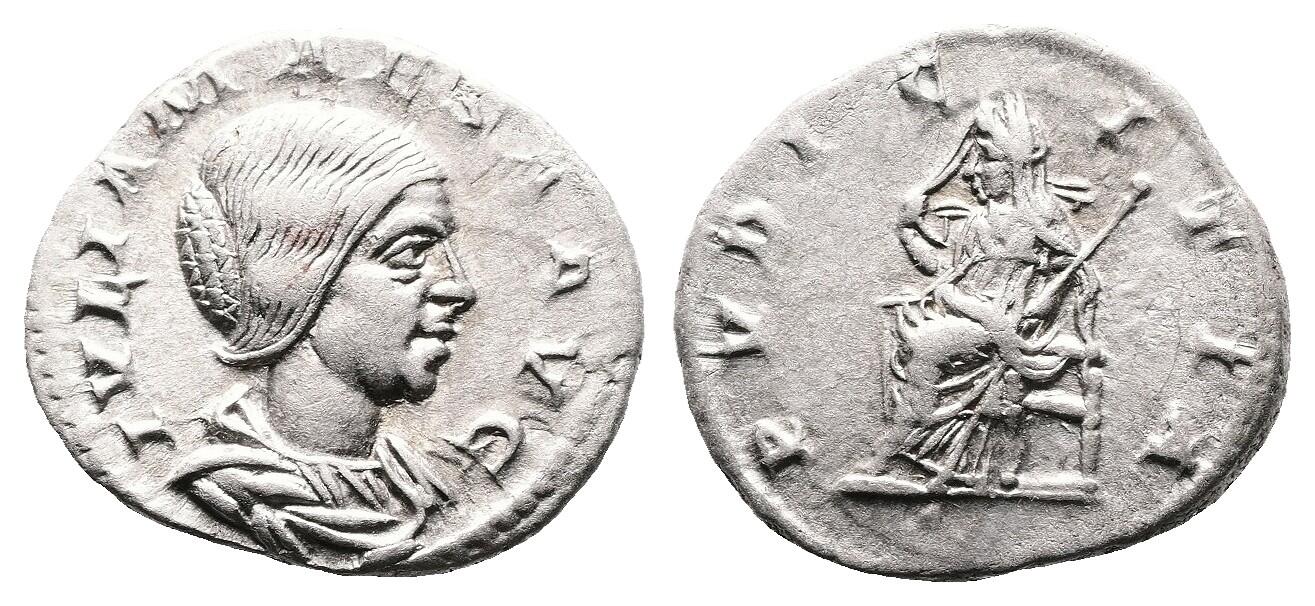
Type · julia-maesa-pudicitia-denarius
Current: Roman Imperial, Julia Maesa (Augusta, under Elagabalus), AR denarius, Rome, struck 221-222 AD (RIC IV 268)
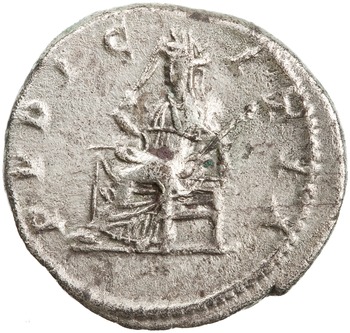
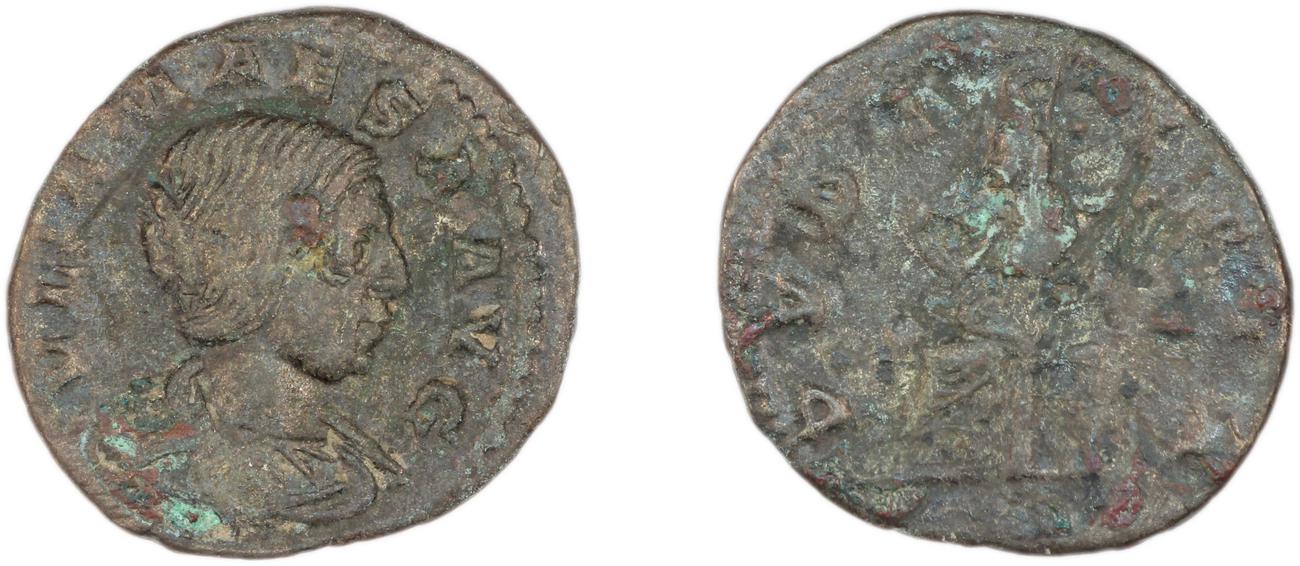
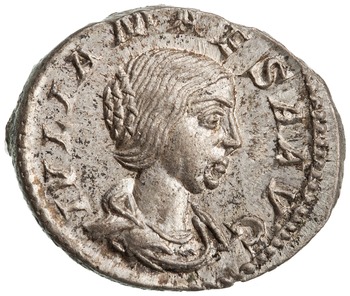
Obverse: Draped bust of Julia Maesa right, hair waved and drawn back into a bun at the nape
Reverse: Pudicitia seated left on a throne, raising her veil with her right hand and holding a long sceptre in her left; footstool below
Primary reference: RIC IV 268 (Elagabalus)
87 specimens in public collections (ANS 18, Göttingen 14, Ashmolean 10, British Museum 9, Freiburg 9); 7 British finds recorded by the Portable Antiquities Scheme; weights 1.45–3.92 g, median 2.9 g across 85 recorded; die axis most often 12h.
This collection's specimen, at 2.89 g (tag), is heavier than 47% of the recorded weights.
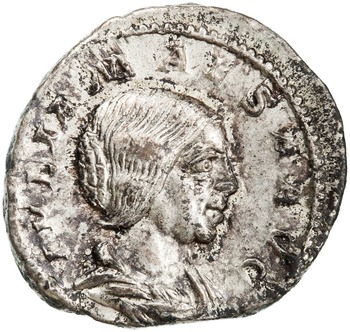
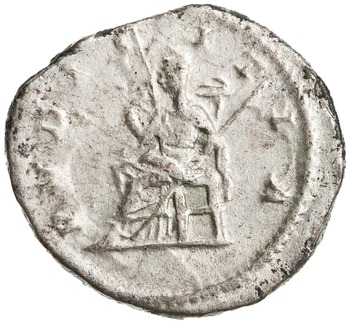
American Numismatic Society, 1905.57.579. CC BY-NC 4.0. https://numismatics.org/collection/1905.57.579
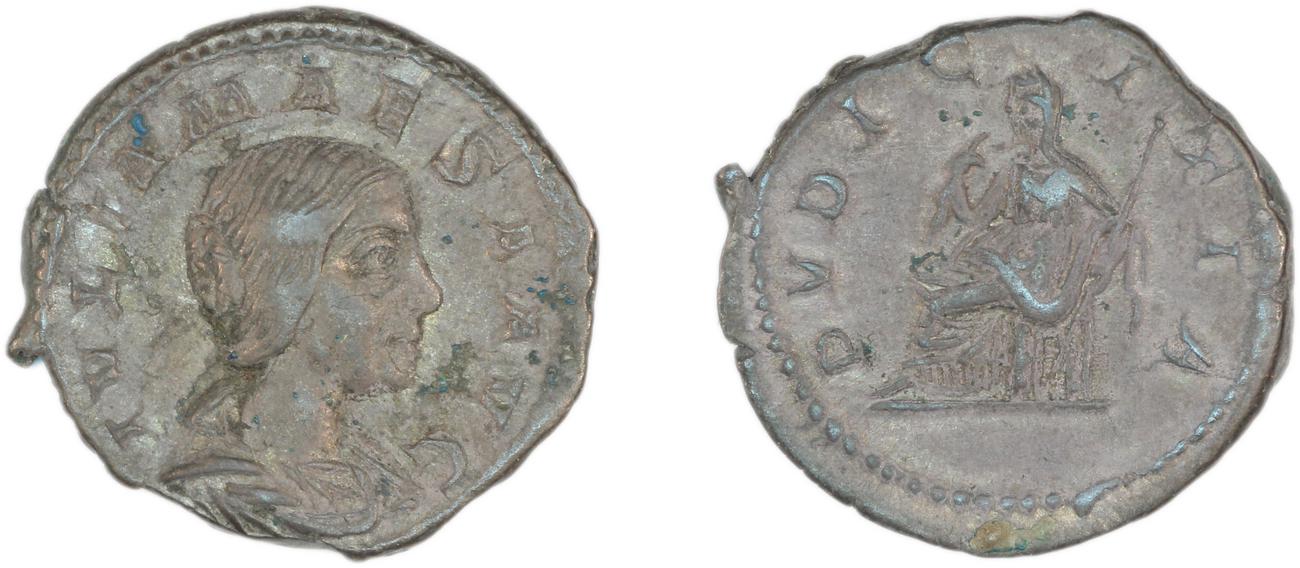
© The Trustees of the British Museum, 1924,0107.42. CC BY-NC-SA 4.0. https://www.britishmuseum.org/collection/object/C_1924-0107-42
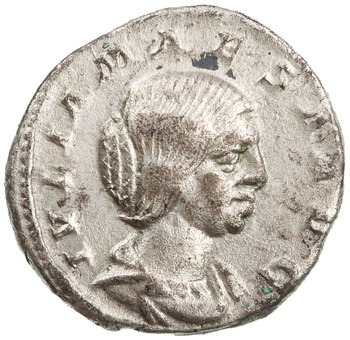
American Numismatic Society, 1923.151.62. CC BY-NC 4.0. https://numismatics.org/collection/1923.151.62
© The Trustees of the British Museum, 1946,1004.1113. CC BY-NC-SA 4.0. https://www.britishmuseum.org/collection/object/C_1946-1004-1113
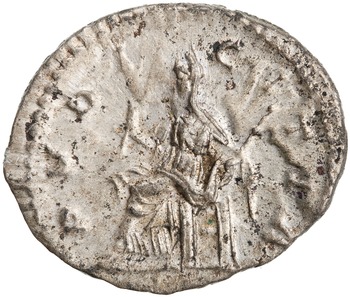
American Numismatic Society, 1935.117.645. CC BY-NC 4.0. https://numismatics.org/collection/1935.117.645
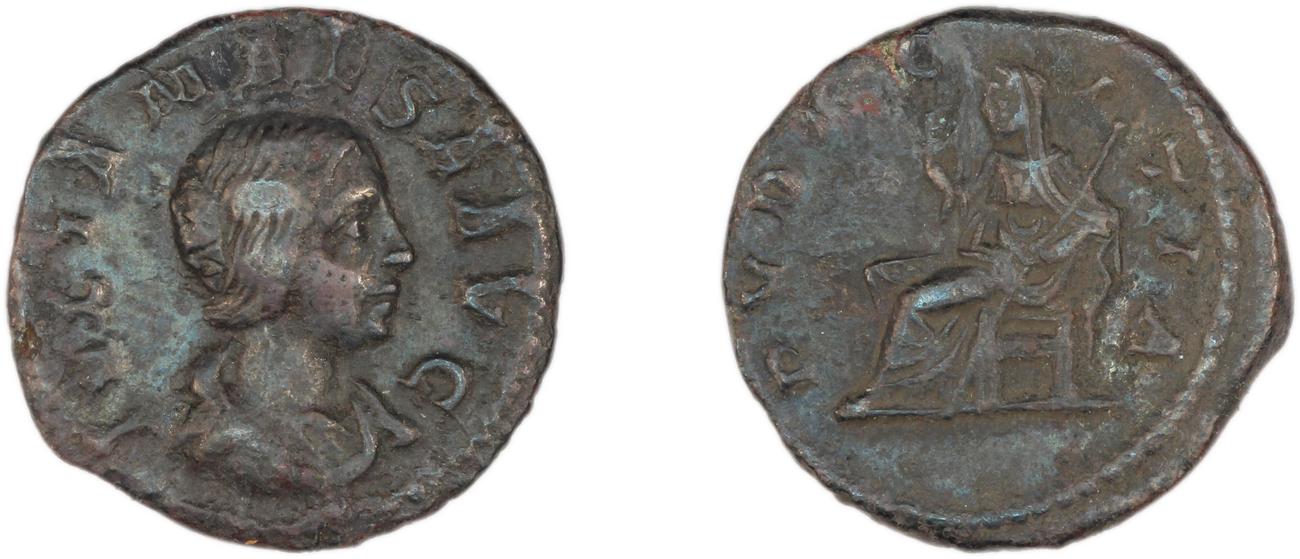
© The Trustees of the British Museum, 1946,1004.1114. CC BY-NC-SA 4.0. https://www.britishmuseum.org/collection/object/C_1946-1004-1114
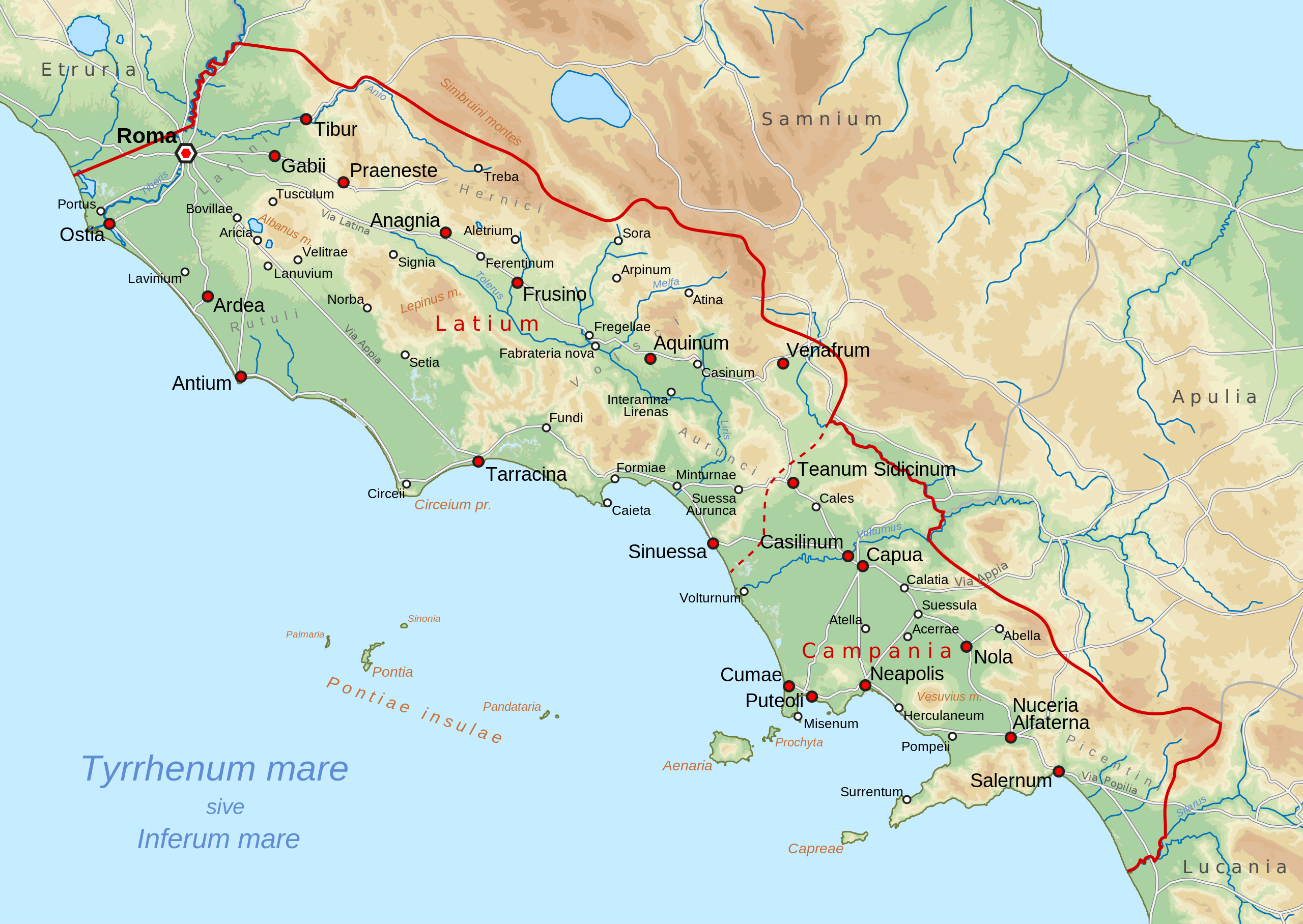
Regio I, Latium et Campania - the heartland of Roman Italy as organized under Augustus. Roma sits at the upper left, marked by the map’s own hexagonal capital symbol and bold label. Maesa’s silver was struck in the city, in the mint she had effectively captured when she put her grandson on the throne; the family itself came from Emesa in Syria, far off this map to the east.
“Map of Augustan Regio I Latium et Campania” by Tomisti (Wikimedia Commons), File:Regio I Latium et Campania map.svg, licensed CC BY-SA 4.0; cities and roads based on the Digital Atlas of the Roman Empire (DARE) and Pleiades; topographic base (c) OpenMapTiles, (c) OpenStreetMap contributors. Reproduced unmodified.
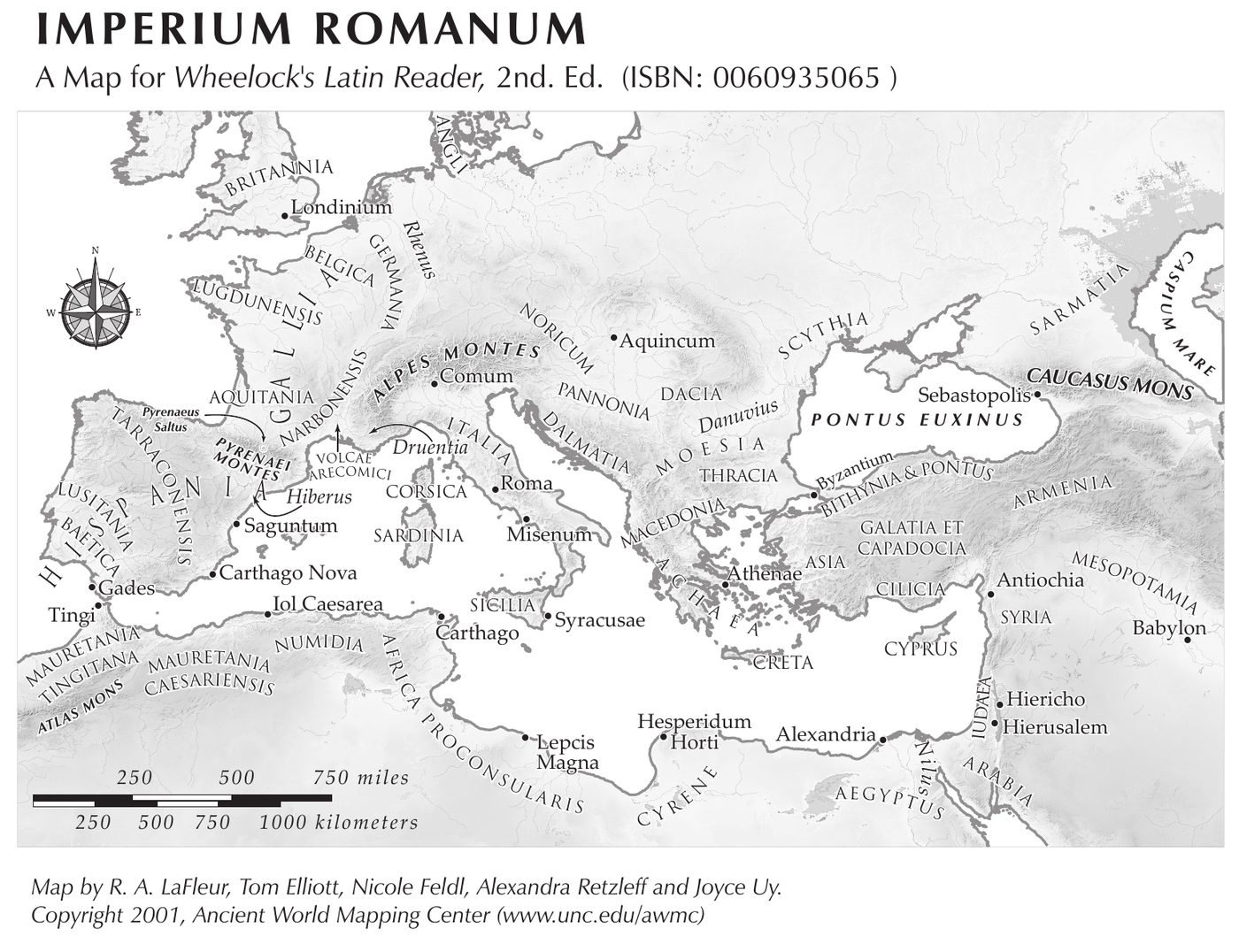
Roma sits at the center of Italia. Maesa engineered two emperors out of Emesa in Syria and installed them at Roma, at the other end of this map. PVDICITIA is the virtue advertised; the achievement was the logistics.
In April 217 the Severan dynasty was finished. Caracalla had been stabbed on the road near Carrhae, his praetorian prefect Macrinus had taken the purple, and the Syrian women who had run the court for a quarter of a century were sent home. Julia Domna starved herself to death at Antioch. Her elder sister Julia Maesa went back to the family’s home city of Emesa with her two widowed daughters, her grandsons, and - the sources agree on this if on little else - an enormous fortune accumulated over twenty-four years at the center of the empire.
Fourteen months later Macrinus was dead and Maesa’s fourteen-year-old grandson was emperor of Rome. Four years after that she disposed of him too, and installed the other grandson. She is the only person in Roman history to have made two emperors, and this quiet, conventional denarius - a veiled matron labelled MODESTY - is what her authority looked like on the coinage.
Graphic: JSB Coins (CC0).
On the night of 15-16 May 218 the boy Varius Avitus Bassianus, hereditary priest of the sun-god of Emesa, was smuggled into the camp of Legio III Gallica at Raphanae and proclaimed Augustus as the natural son of Caracalla. Macrinus was beaten in the field outside Antioch on 8 June and killed shortly after.
Who organized it is genuinely disputed, and the two contemporary sources give different answers. Cassius Dio - a serving senator writing within a few years of the events - makes Gannys, the boy’s tutor and Soaemias’ protector, the mover: it is Gannys who gets the troops into the camp, Gannys who commands in the battle despite having no military experience, and Gannys whom Elagabalus murders soon after for trying to make him behave (Dio 79[80].31, 79[80].38-39, 80.6). Herodian instead makes Maesa the author: it is her money, carried into the camp and spread among the soldiers of III Gallica, that buys the proclamation, and her story of Caracalla’s paternity that legitimises it (Herodian 5.3-5.4). Herodian is the less reliable historian in general but was writing about a court his readers remembered; Dio was closer to the senatorial politics but hostile to the whole Emesene family. The honest position is that the coup needed both the cash and the man on the ground, and that the ancient tradition split on which mattered more.
What is not disputed is the second act. By 221 Elagabalus’ religious programme had made him impossible - see the Fides Exercitus denarius struck to shore up an army that had stopped believing in him - and Maesa engineered the adoption of her other grandson, Severus Alexander, as Caesar in June of that year (Dio 80.19; Herodian 5.7). When Elagabalus tried to undo it, the praetorians killed him and his mother in March 222 and proclaimed the boy she had prepared. Maesa lived on into the new reign as avia Augusti, the emperor’s grandmother, and died around 224 or 225; her grandson consecrated her, and DIVA MAESA AVG / CONSECRATIO coins were struck for her among the last of the Severan silver. Effective power then passed to her daughter Julia Mamaea, who held it for eleven more years.
Pudicitia - modesty, sexual honor, the virtue of the univira - is one of the safest coin types an imperial woman could carry, and it is doing hard work here. Maesa’s regime had been installed on a public lie about her daughter’s adultery with Caracalla; her grandson’s reign was a running scandal; the reverse of her coinage answers all of it with the oldest and dullest respectable claim a Roman matron could make. The goddess pulls back her own veil, a gesture that in Roman visual language means both I am modest and look at me. The full set of Maesa’s reverses - Pudicitia, Pietas, Saeculi Felicitas, Fecunditas, Juno - reads as a conscious programme of ordinary matronly virtue mounted on top of a very disorderly reality, and the same instinct produced the Vesta issues that Mamaea would carry a few years later.
She is also, in the collection, the missing agent. Maesa appears in the prose of the Julia Domna, Elagabalus and Julia Mamaea pages as the person who caused the events those coins commemorate. She now has a coin of her own, struck in the years when she was, on any reading of the sources, the most powerful person in the Roman empire.
Attribution: RIC IV (Elagabalus) 268; BMCRE 76; Cohen 36; RSC 36 - as catalogued by MARS VLTOR, and corroborated for RIC 268 = PVDICITIA / RSC 36 by the WildWinds Julia Maesa index. The 221-222 date is the house’s; RIC’s range for Maesa’s Rome silver is broader. The coup of 218: Cassius Dio 79(80).30-32 and 79(80).38-39 (Gannys as organizer and battlefield commander) against Herodian 5.3-5.4 (Maesa’s money as the decisive factor) - the disagreement is set out above and is not resolved here. The adoption of Alexander in 221: Dio 80.19; Herodian 5.7. Julia Domna’s death at Antioch: Dio 79(80).23-24. Maesa’s consecration and the DIVA MAESA AVG / CONSECRATIO issues under Severus Alexander: RIC IV (Severus Alexander) 712-715. Dio and Herodian are both linked in the references above.
Struck at Rome under Elagabalus for his grandmother. Maesa's reverse types are a small, conventional set - PVDICITIA, PIETAS AVG, SAECVLI FELICITAS, FECVNDITAS AVGVSTAE, IVNO - and all are common; the variable worth paying for on this issue is the portrait, which ranges from flat and mechanical to strongly individual. Denarii of this period run c. 2.3-3.2 g on the debased Severan standard. The 221-222 dating is the auction house's; RIC's own range for Maesa's Rome silver is 218-222/4.
John's Ancient Coin Collection · Type · julia-maesa-pudicitia-denarius
Image credits for this coin — photographs, maps and graphics used on this page