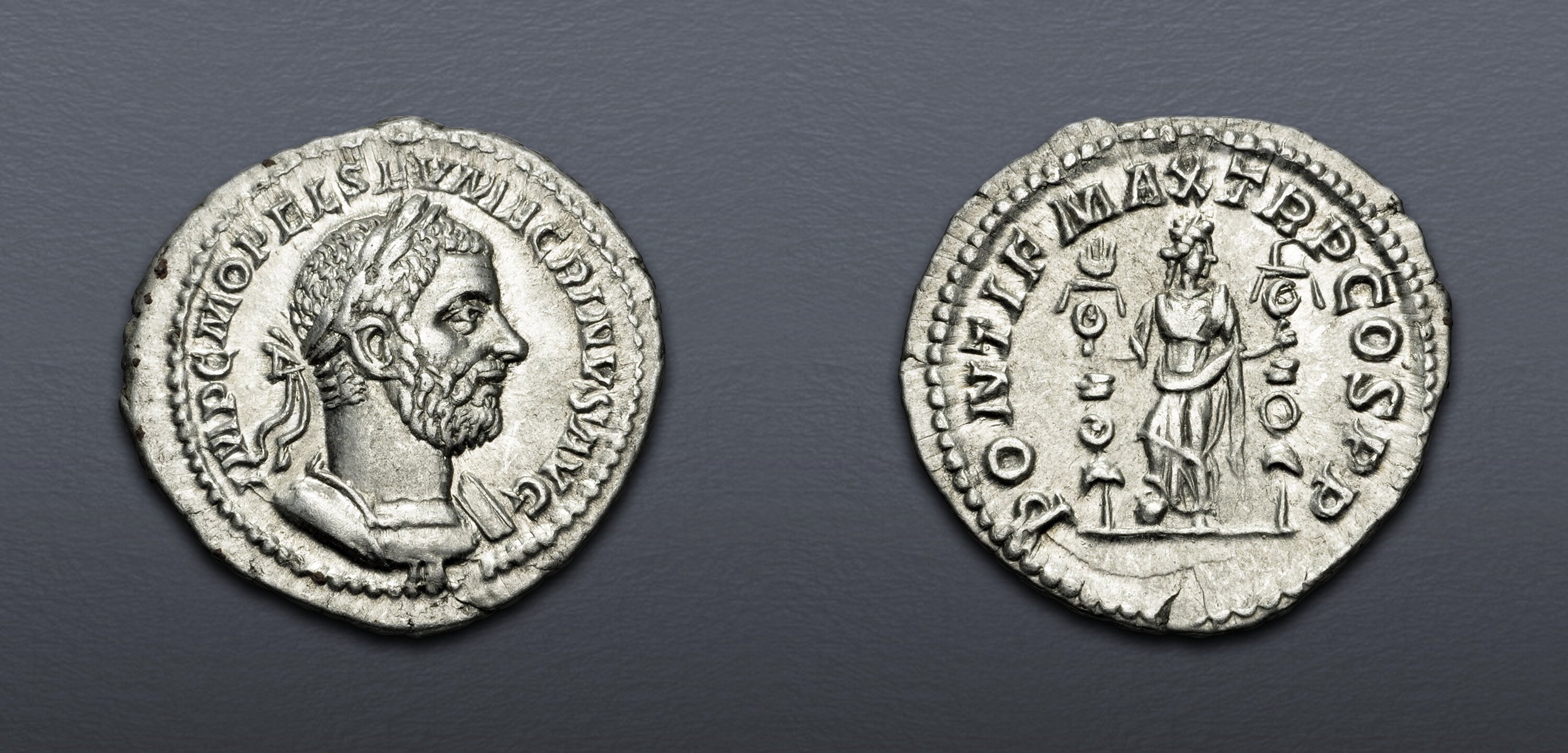
3.32 g (tag) · 20.5 mm · axis 0° · Good Very Fine (CNG's grade), with attractive light toning and no defect declared; in hand as of 5 September 2026, not yet examined against the grade
Type · macrinus-fides-denarius
Current: Roman Imperial, Macrinus, AR denarius, Rome, 2nd officina, 2nd emission, AD 217–218 (RIC IV 22A)
Obverse: Laureate and cuirassed bust of Macrinus right
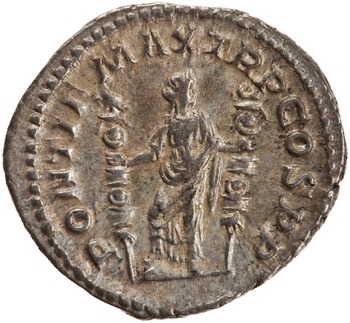
Reverse: Fides standing right, her foot on a helmet, holding a signum (military standard) in each hand
Primary reference: RIC IV 22A
11 specimens in public collections (Ashmolean 4, ANS 3, British Museum 2, Vienna 2); weights 2.36–3.95 g, median 3.28 g across 11 recorded; die axis most often 6h.
This collection's specimen, at 3.32 g (tag), is heavier than 64% of the recorded weights.
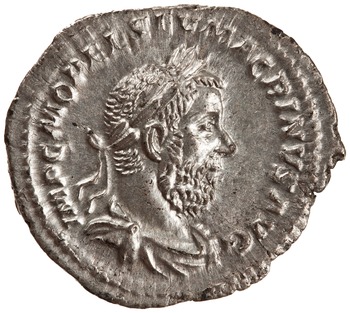
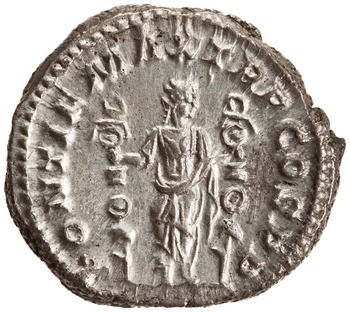
American Numismatic Society, 1944.100.51842. CC BY-NC 4.0. https://numismatics.org/collection/1944.100.51842
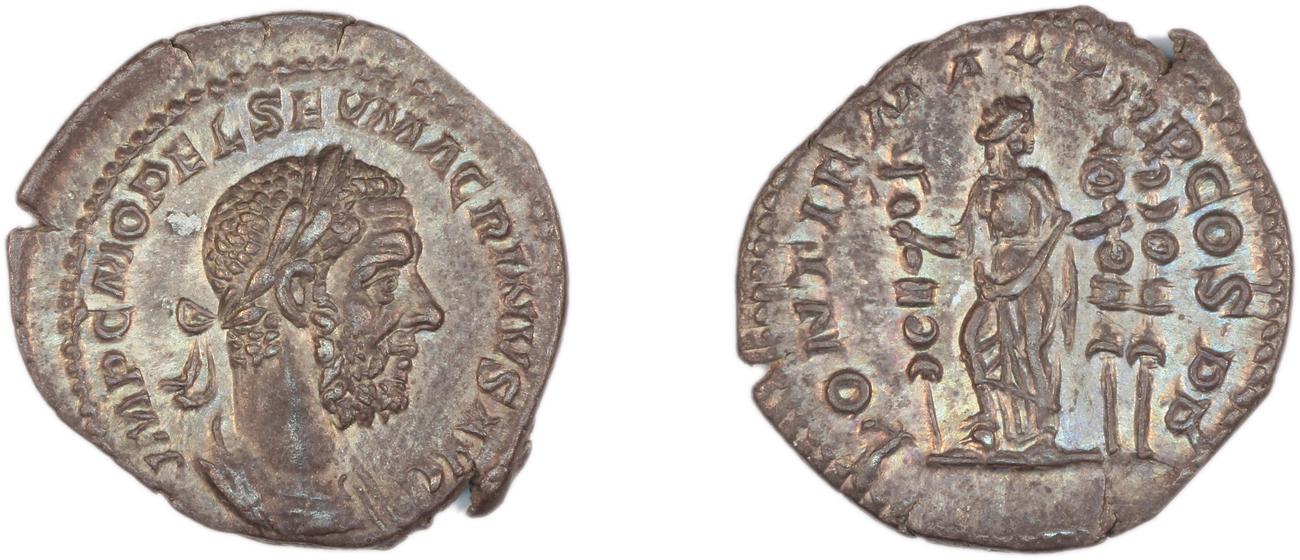
© The Trustees of the British Museum, 1946,1004.973. CC BY-NC-SA 4.0. https://www.britishmuseum.org/collection/object/C_1946-1004-973
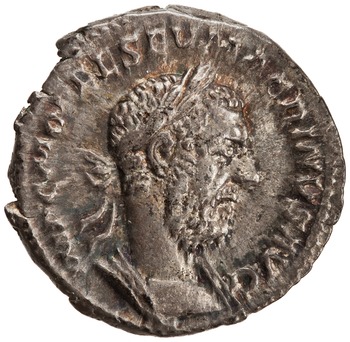
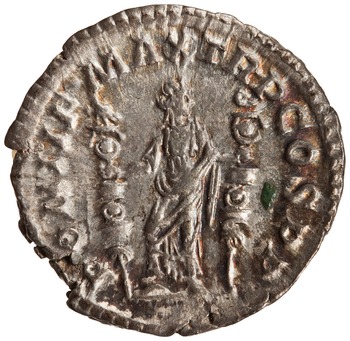
American Numismatic Society, 1948.19.1701. CC BY-NC 4.0. https://numismatics.org/collection/1948.19.1701
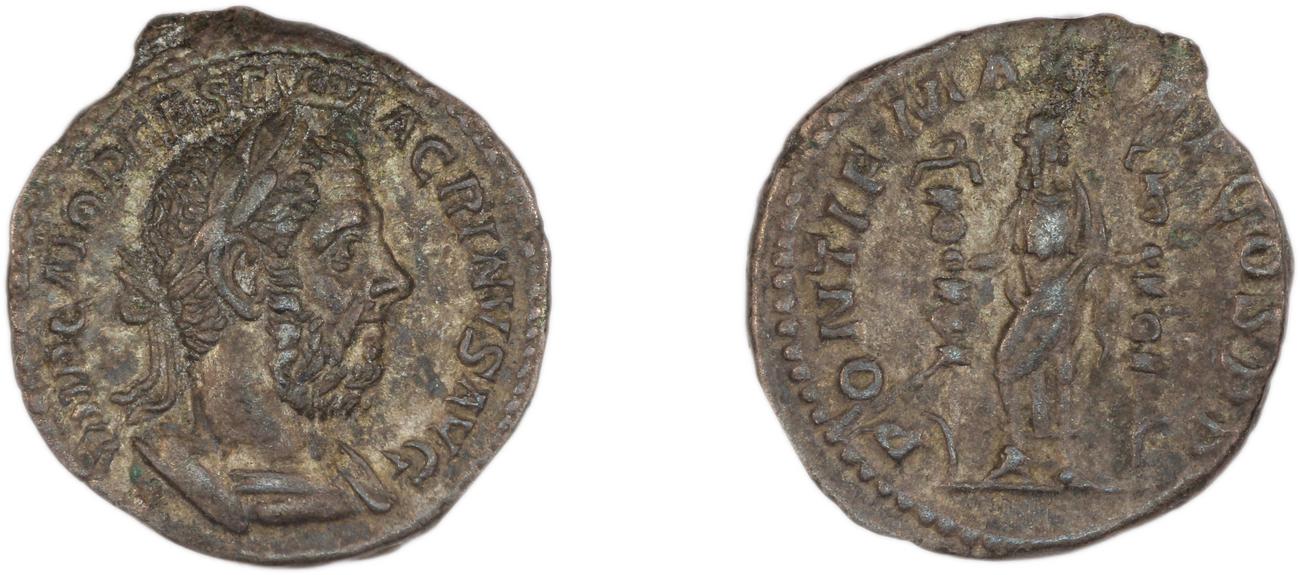
© The Trustees of the British Museum, R.15528. CC BY-NC-SA 4.0. https://www.britishmuseum.org/collection/object/C_R-15528
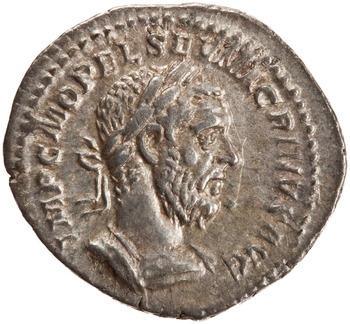
American Numismatic Society, 1985.140.171. CC BY-NC 4.0. https://numismatics.org/collection/1985.140.171
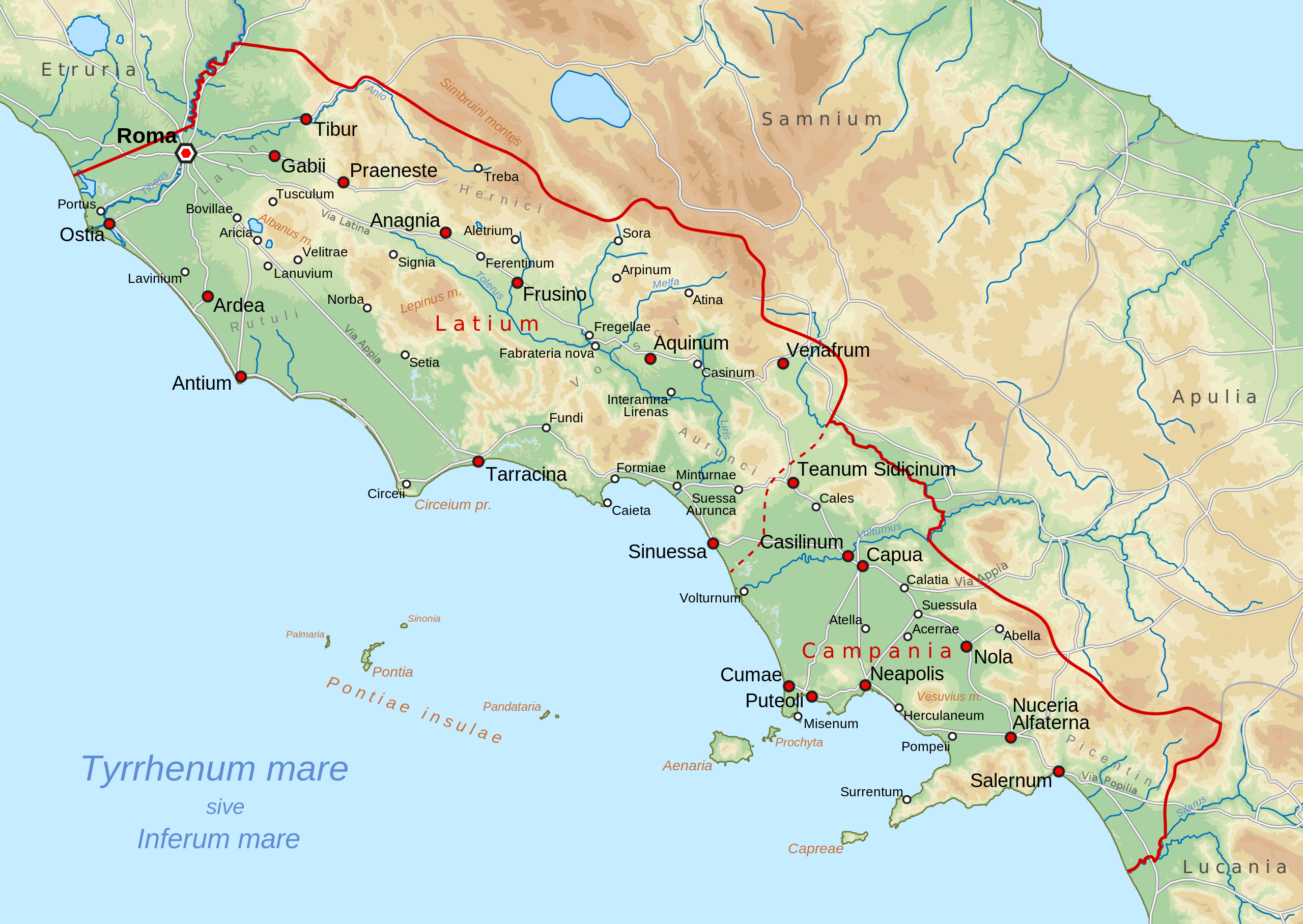
Regio I, Latium et Campania — Roman Italy as Augustus organized it, with Roma at the upper left, marked by the map’s hexagonal capital symbol. This coin was struck in that city for an emperor who never once entered it. Macrinus was proclaimed near Carrhae in April 217 and died near Antioch in June 218, and in fourteen months he got no closer to Rome than the mint that made his money. The same base map serves the collection’s Caracalla, Gordian III and Philip II.
“Map of Augustan Regio I Latium et Campania” by Tomisti (Wikimedia Commons), File:Regio I Latium et Campania map.svg, licensed CC BY-SA 4.0; cities and roads based on the Digital Atlas of the Roman Empire (DARE) and Pleiades; topographic base © OpenMapTiles, © OpenStreetMap contributors. Reproduced unmodified.
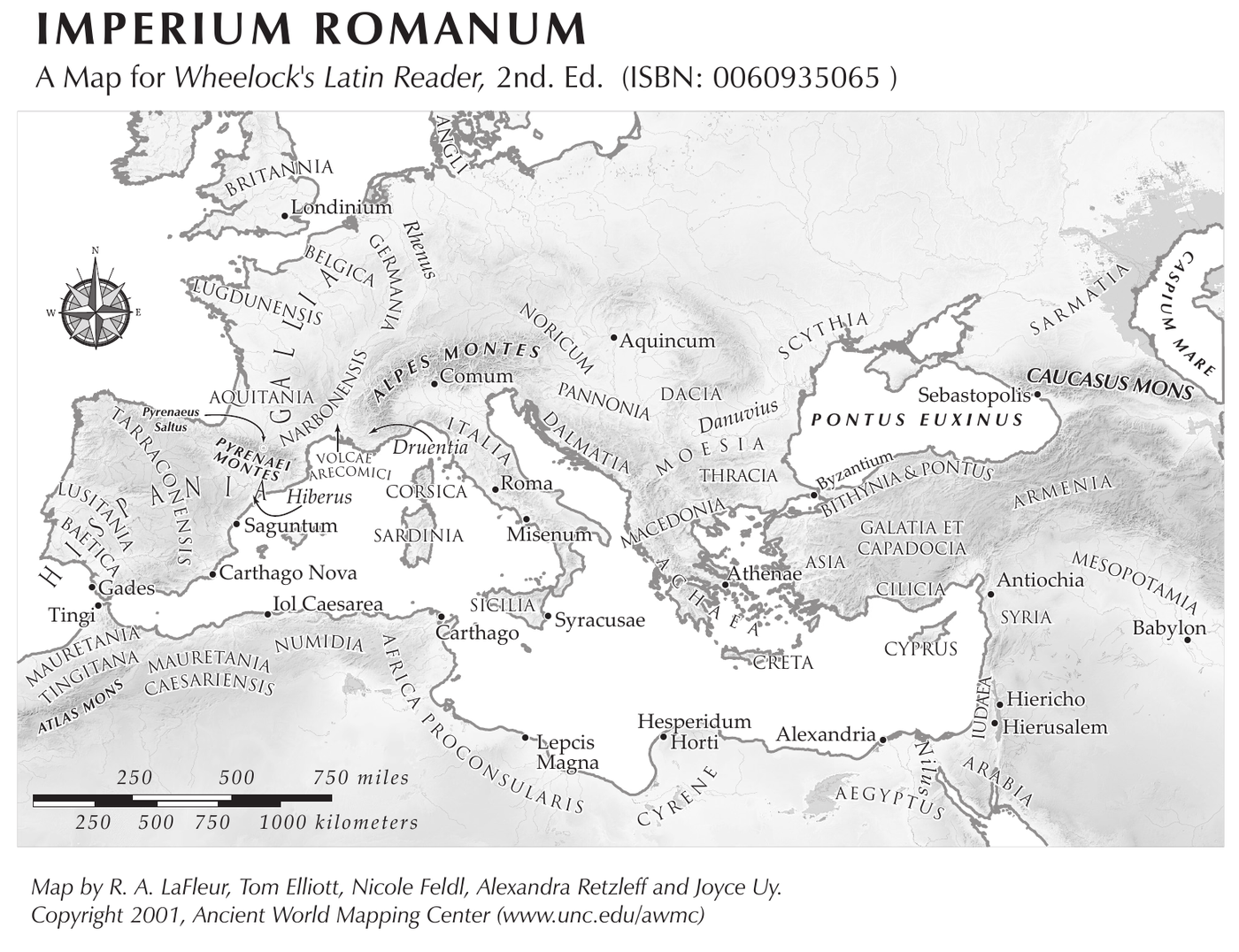
Roma sits at the center of Italia. Macrinus was proclaimed in Mesopotamia and never reached Rome at all: he ruled for fourteen months from Antiochia, on the right of this map, which is exactly why FIDES MILITVM — the loyalty of the army — is the legend he needed.
Marcus Opellius Macrinus was the first man to rule Rome who had never been a senator. He was an equestrian from Caesarea in Mauretania — North African, a lawyer by training, praetorian prefect by career — and in April 217, three days after Caracalla was killed on the road outside Carrhae, the army made him emperor.
He held it for fourteen months. He never entered Rome.
That is the fact this coin is about. It was struck at the Rome mint, in the second officina, for a man the city never saw — and the reverse says FIDES MILITVM, the loyalty of the soldiers, which was the only thing he had and the thing he did not keep.
Fides Militum is the commonest reverse of Macrinus’ coinage, and the reason is structural rather than decorative. Every emperor claimed the army’s loyalty; an emperor who had just had his predecessor murdered needed to claim it loudly, because it was the whole of his title. There was no adoption, no dynastic descent, no senatorial career — only the acclamation of an army on the Parthian frontier.
The figure is the standard military Fides: a woman standing with a signum in each hand, her foot planted on a helmet. The two standards are the legions; the helmet underfoot is war subdued. It is an image of soldiers keeping faith, struck by a man whose soldiers were about to stop.
He also did the thing that guaranteed they would. Caracalla had raised army pay enormously; Macrinus could not sustain it, and rather than cut existing salaries he paid new recruits at the old lower rate — a two-tier army, and every new soldier a man with a grievance. Dio, who was a serving senator through all of this, is clear that the pay settlement is what killed him.
Graphic: JSB Coins, 2026 (CC0).
There is a nice consequence of his never reaching the capital. The Rome die-cutters had never seen him. They engraved his portrait from description, and the image drifts across the reign — the beard shorter on the earliest dies and longer later, which is often read as the mint gradually catching up with reports of what the man actually looked like.
So the face on this coin is, in a real sense, a rumour: an official likeness of someone the engraver could only be told about.
In fourteen months Macrinus lost a battle at Nisibis and bought peace from Parthia expensively, which cost him standing with the army he had just alienated over pay. That was enough of an opening for Julia Maesa — Caracalla’s aunt, sitting on the Severan fortune in Emesa — to spend it on a rumour that her fourteen-year-old grandson was Caracalla’s son. The Third Legion declared for the boy. Macrinus was beaten outside Antioch in June 218, ran, and was caught and killed in Bithynia. His son Diadumenian, sent toward Parthia for safety, was caught and killed too.
This collection now holds the whole sequence, and three of these coins were bought within four days of each other:
There is one further echo worth noticing. Elagabalus’ own denarius in this collection is FIDES EXERCITVS — the loyalty of the army, the same promise in slightly different words, struck by the boy who had just proved it could be bought. Macrinus advertised the army’s faith and was destroyed by its absence; his successor advertised it because he had purchased it. The two coins sit a year apart and say almost the same thing for opposite reasons.
Dio 79.11–41 is the essential account, written by a senator who lived through it; Herodian 4.13–5.4 gives an independent and differing narrative. Both are cited rather than harmonised — they disagree about the murder at Carrhae, about Macrinus’ conduct, and about the Emesene coup. The type is RIC IV 22A, RSC 60; “Clay Issue 2” refers to Curtis Clay’s re-ordering of the Rome mint’s emissions, which the auction cataloguing follows and which is finer-grained than RIC’s own arrangement.
FIDES MILITVM — the loyalty of the soldiers — is the single commonest reverse legend of Macrinus' coinage, and the reason is not subtle: he took the throne by killing an emperor and had no other claim. The foot on the HELMET and the two SIGNA are the standard attributes of the military Fides; the type is not invented for him, but the emphasis is. TWO OFFICINAE AND SEVERAL EMISSIONS ran at Rome across a fourteen-month reign; the '2nd officina, 2nd emission' in the cataloguing follows Curtis Clay's re-ordering of the mint rather than RIC's original arrangement, and RIC 22A is the variety with the CUIRASSED bust. NOTE THE PORTRAIT PROBLEM: Macrinus' Rome coinage was engraved from descriptions rather than from life, because HE NEVER CAME TO ROME. The mint's image of him shifts during the reign - a shorter beard early, a longer one later, sometimes read as the die-cutters catching up with reports of his appearance.
John's Ancient Coin Collection · Type · macrinus-fides-denarius
Image credits for this coin — photographs, maps and graphics used on this page