Type · athens-pi-style-owl-tetradrachm
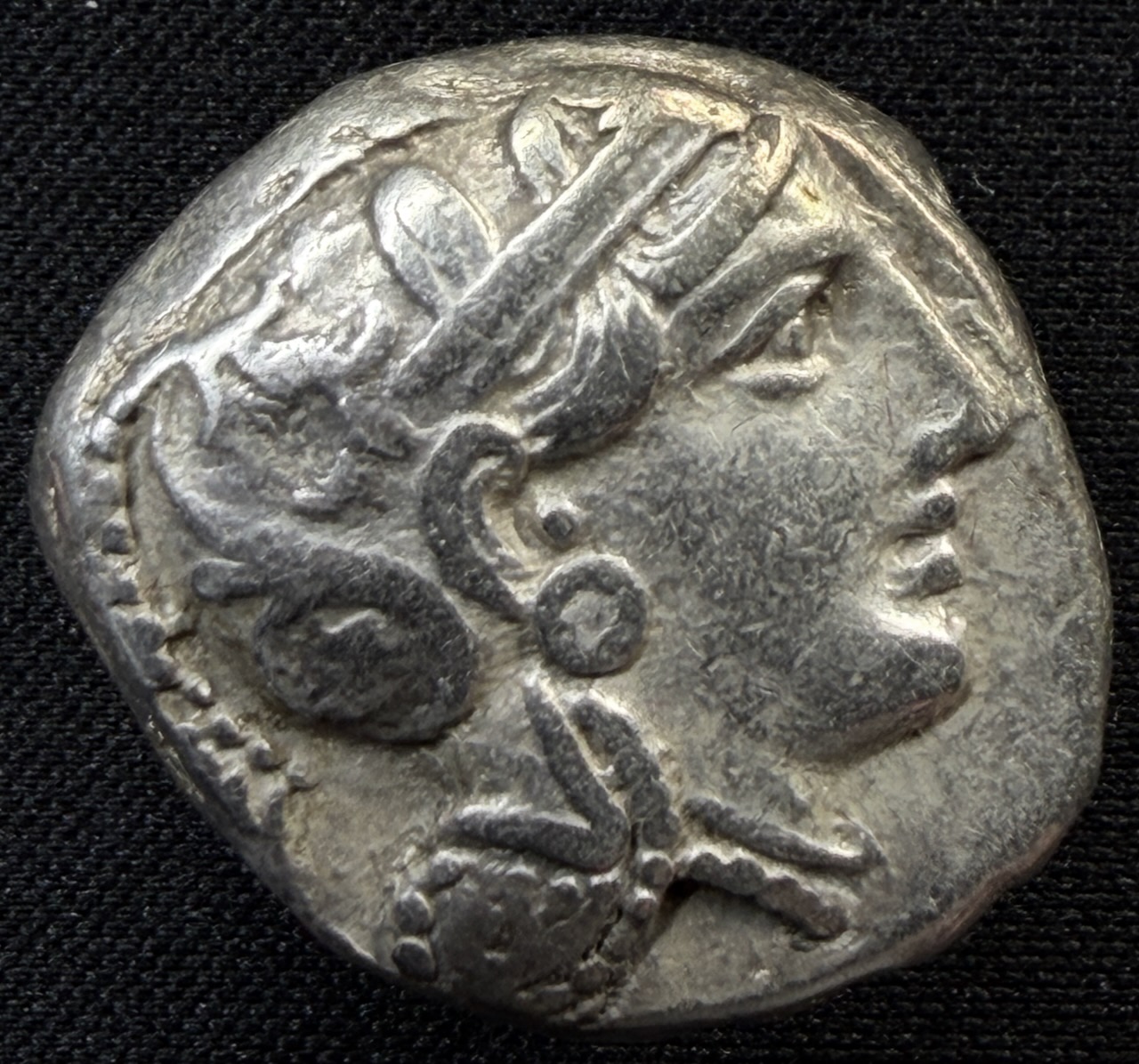
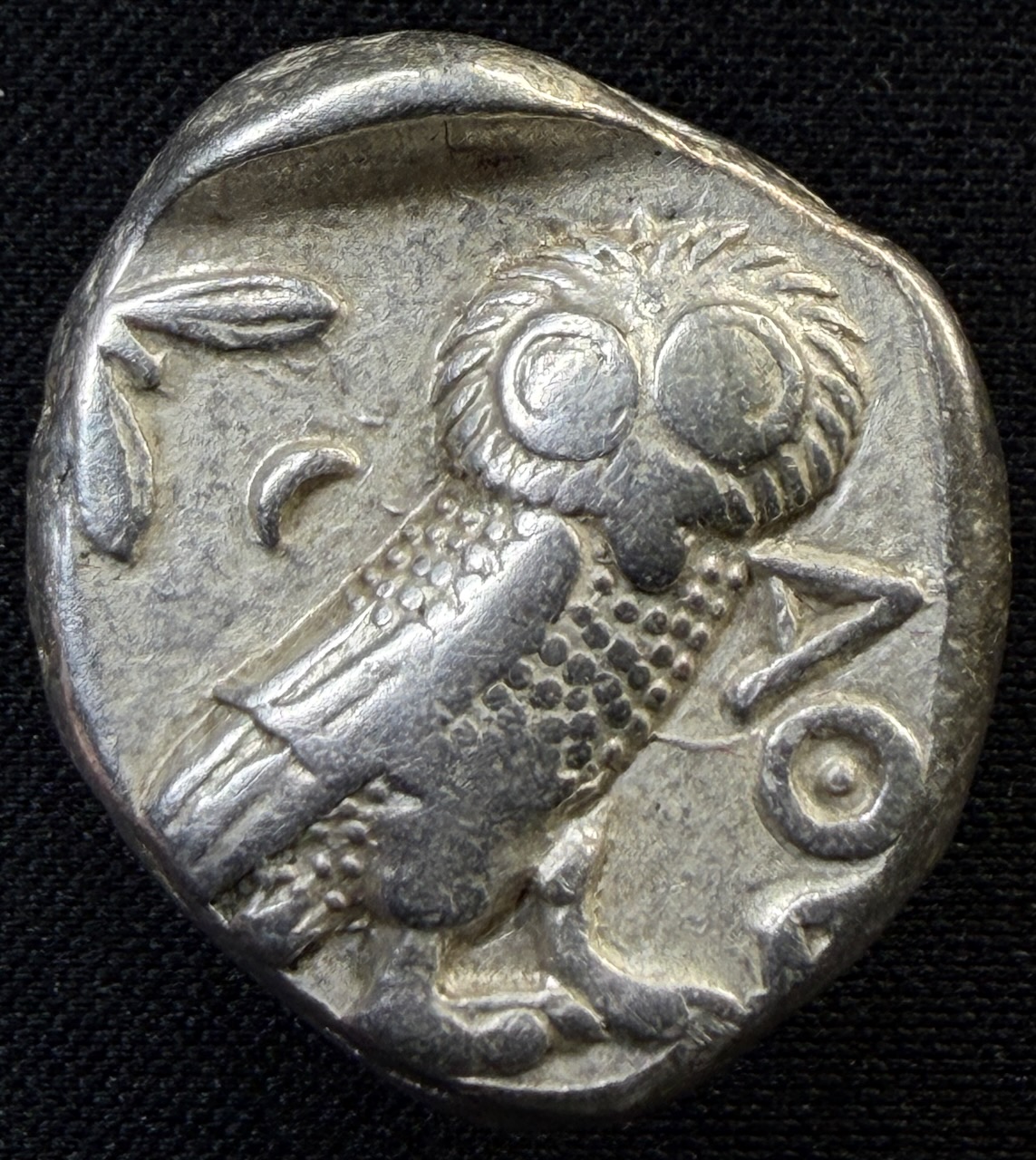
Current: Attica, Athens, AR tetradrachm, c. 353–294 BC. Helmeted head of Athena right, with profile eye and pi-style palmette / owl standing right, head facing, olive sprig and crescent, ΑΘΕ. Bingen Pi-style III; HGC 4, 1599.
Obverse: Head of Athena right, wearing a crested Attic helmet with three olive leaves over the visor and a floral palmette on the bowl whose fronds are configured like the Greek letter Π ('pi-style'); round earring and beaded necklace. The eye is now rendered in true profile, abandoning the archaizing frontal eye of the fifth-century owls.
Reverse: Owl standing right, head facing the viewer; olive sprig and crescent to left; traces of the incuse square. Flans of this series are characteristically compact, thick, and irregular.
Primary reference: HGC 4, 1599
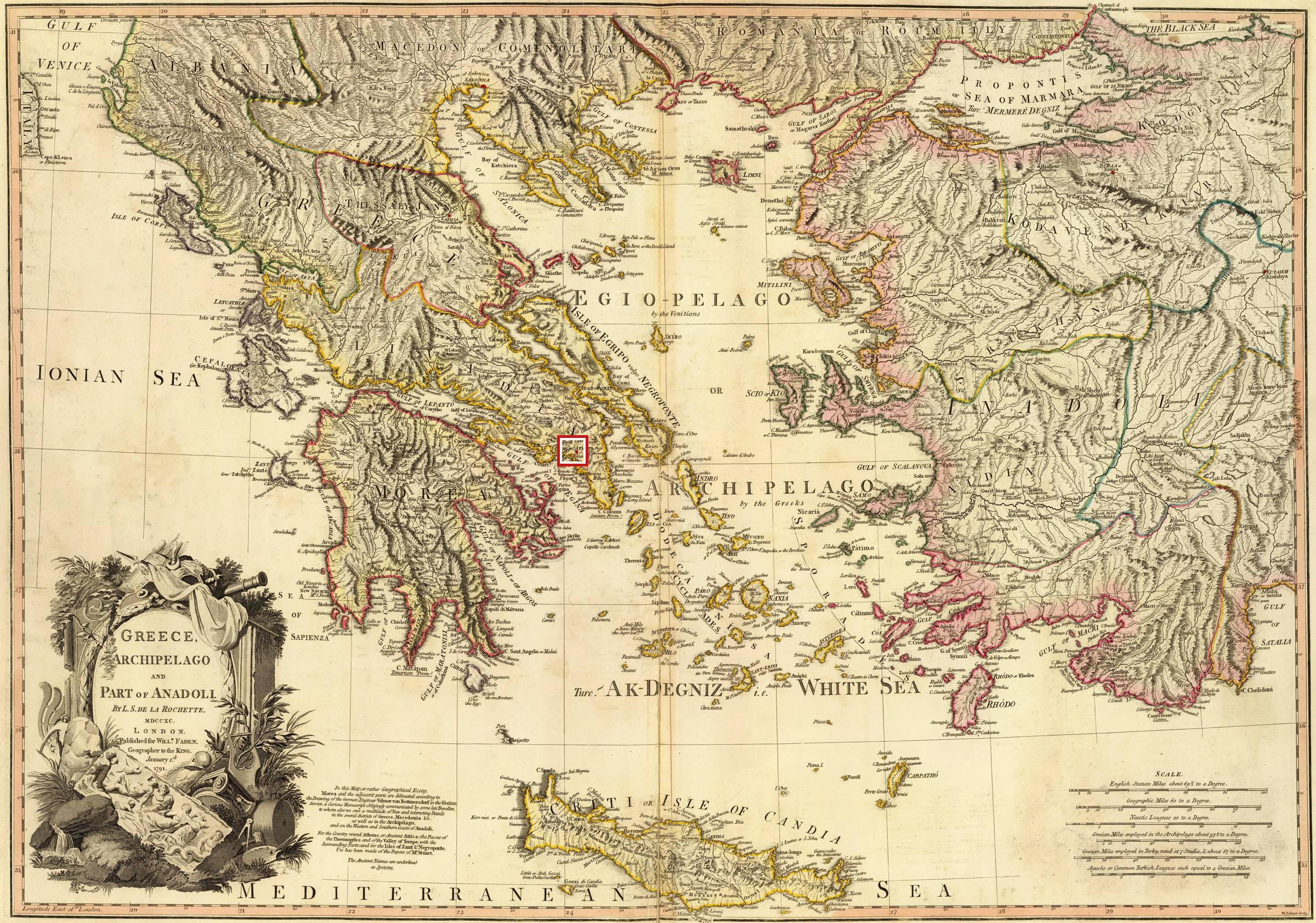
A 1791 map of Greece, the Archipelago (the Aegean), and part of Anadoli (the Anatolian coast); Athens is indicated by the red square. The same house map serves the collection’s fifth-century owl: the world of the pi-style owl was unchanged in geography — mainland Greece with Attica at its center, the Aegean islands, and the coast of Asia Minor — even as its politics passed from the city-states to Macedon and the Successors.
“Greece, Archipelago and part of Anadoli” by Louis Stanislas d’Arcy Delarochette (engraved by W. Palmer; published for William Faden, Geographer to the King, London, 1791), in the public domain (PD-old-100; published before 1931). File:Map of Greece, Archipelago and part of Anadoli; Louis Stanislas d’Arcy Delarochette 1791.jpg (https://commons.wikimedia.org/wiki/File:Map_of_Greece,_Archipelago_and_part_of_Anadoli;_Louis_Stanislas_d%27Arcy_Delarochette_1791.jpg). Modified by JSB Coins: a red square marks the position of Athens (same marked house copy as the classical owl tetradrachm page). No attribution is legally required for a public-domain work; the source is credited here as a courtesy.
By the middle of the fourth century BC the Athenian “owl” was over a hundred and fifty years old, and its famous design had barely changed. The coin catalogued here belongs to the final great issue of that old tradition — the so-called pi-style owls of c. 353–294 BC — struck by an Athens that was no longer an imperial power but was still, for a few more decades, the banking house of the Aegean. When this series ended, so did the owl as Athens’ everyday silver; the type would only be revived, in radically different form, by the “New Style” coinage of the second century BC.
Graphic: JSB Coins, 2026 (CC0).
Athens emerged from the Social War (357–355 BC) financially exhausted. The statesman Euboulos and, later, Lykourgos rebuilt the city’s public finances with almost bookkeeperly discipline — reviving the Laurion silver mines, overhauling revenues, and funding a last great programme of public building. John Kroll has argued (Hesperia 2011) that as part of this recovery Athens recalled and recoined its silver in 353 BC, which would make the pi-style series the product of a single sweeping monetary reform — the start date used by most catalogues. The coinage then ran through the age of Chaironeia (338 BC), the Lamian War, and the decade of Demetrios of Phaleron, ending conventionally around 297–294 BC as Demetrios Poliorketes took the city — the exact endpoint, like the start, is conventional rather than documented.
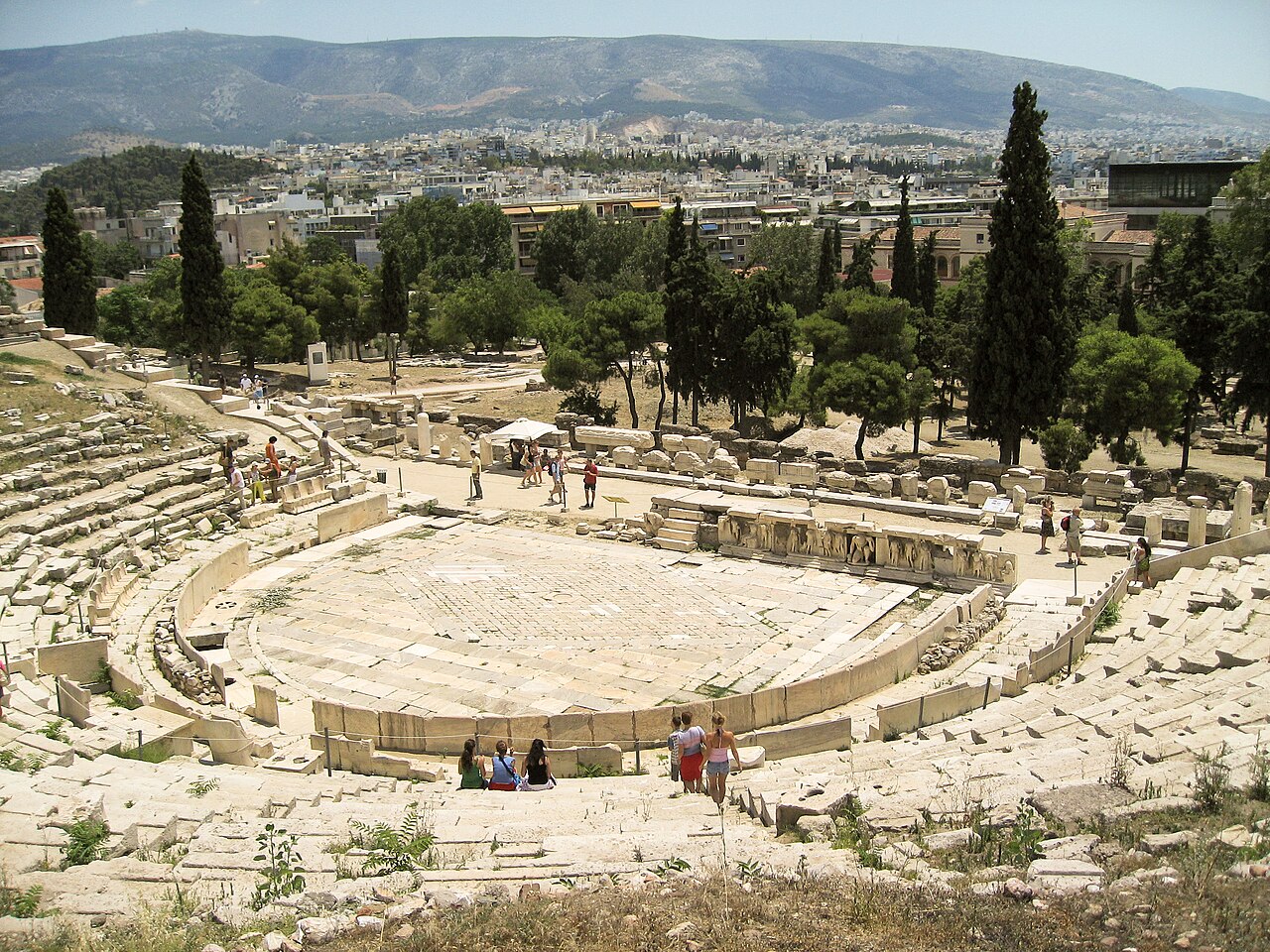
Photo: Nicholas Hartmann, Wikimedia Commons, licensed CC BY-SA 4.0, reproduced unmodified.
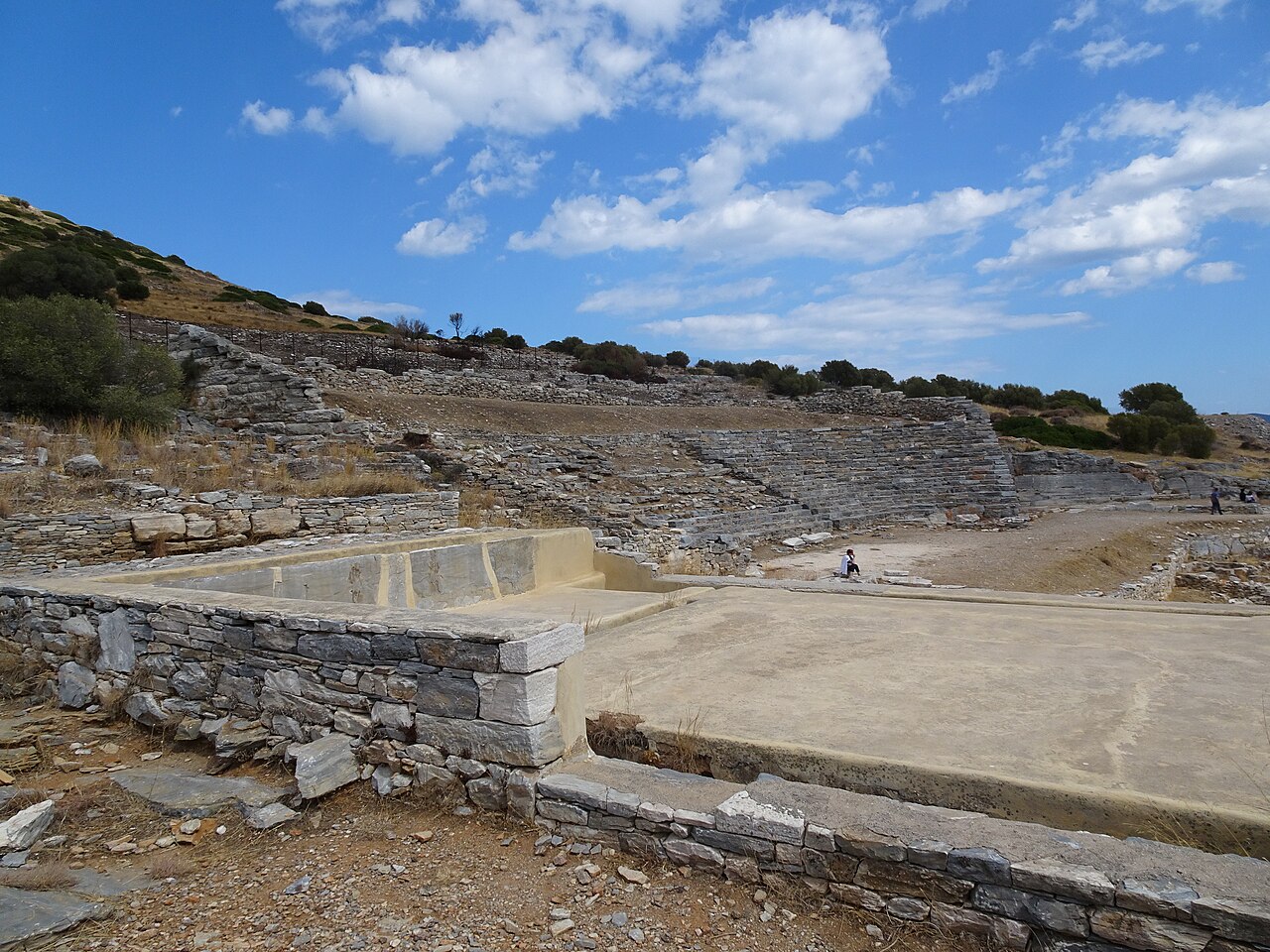
Photo: Dr Peter Tzeferis, Wikimedia Commons, licensed CC BY-SA 4.0, reproduced unmodified.
The name of the series is modern shorthand. In 1969 excavators at Thorikos in the Laurion district found a hoard containing 292 of these tetradrachms buried beneath a house floor; Jean Bingen’s publication of it gave the first stylistic classification, sorting the coins into groups by the form of the floral ornament on Athena’s helmet bowl — on the most numerous dies its fronds are arranged like the Greek letter Π bisected by a long central tendril. CNG assigns this specimen to Bingen’s group III. The other giveaway is Athena’s eye, now drawn in true profile: the fifth-century owls had kept the archaic frontal “almond” eye for generations as a deliberate trademark (see the collection’s classical owl tetradrachm); the fourth-century mint finally let the goddess look where her nose points. The flans, by contrast, got worse — pi-style owls are typically compact, thick, and irregular, with crest and legend crowding off the edge, the product of a mint working fast from recoined metal.
Though Athens’ empire was long gone, the owl remained the most trusted silver in the eastern Mediterranean, and the pi-style issue circulated — and was hoarded — from Attica to the Levant. It was also imitated on a large scale, in Egypt and across the Near East, often so competently that scholars remain genuinely divided over whether individual pieces are Athenian or eastern work; the collection’s pharaonic-Egyptian owl belongs to that wider phenomenon in its earlier phase. Alexander’s conquests began the owl’s displacement — his imperial tetradrachms on the same Attic standard, struck at mints from Macedon to Babylon, took over the international role the owl had held for two centuries.
The pi-style owl is the last chapter of the coin that defined Classical Greece. It documents an Athens rebuilding itself by fiscal discipline rather than tribute, keeping its most famous export alive through the collapse of the city-state world — and it is the owl a citizen of Demosthenes’ or Lykourgos’ Athens would actually have carried. When the series stopped under the Successors, an era of Greek money stopped with it. What eventually replaced it, a century and a half later, was not a continuation but an argument with this coin: the New Style tetradrachm kept the owl and threw away everything else, including the anonymity — its reverse names the officials who struck it and the month they did it in.
J. Bingen, publication of the Thorikos 1969 hoard (Thorikos 1969, 1973) — the pi-style classification and the 292-coin hoard count. J. H. Kroll, “The Reconstruction of Athens’ Silver Coinage,” Hesperia 80.2 (2011) — the 353 BC recoinage argument and series chronology; also Kroll, The Greek Coins (Athenian Agora XXVI, 1993). O. Hoover, Handbook of Greek Coinage (HGC) 4, 1599 (c. 353–294 BC span); SNG Copenhagen 63. On eastern imitations of fourth-century owls, cf. P. van Alfen’s work on imitative owls (see the pharaonic owl page’s references). Chronological endpoints and the Athens-vs-imitation question are presented as open, per these sources.
Struck on the Attic standard (c. 17.2 g), like all owls, from Laurion silver. The "pi-style" label is modern, from Jean Bingen's analysis of the Thorikos 1969 hoard (292 pi-style tetradrachms): on the most numerous dies the helmet-bowl palmette is configured like the letter Π bisected by a long central tendril; Bingen sorted the series into groups I–V, and CNG catalogued our specimen as Pi-style III. Points to keep open: (1) the chronology is conventional — Kroll (Hesperia 2011) argues the series began with a general recoinage of Athens' silver in 353 BC, and the end is variously put c. 297 BC (Bingen) or c. 294 BC (HGC's 353–294 span, followed here per the dealer tag); (2) catalogue numbering is inconsistent — some CNG listings cite "Kroll 15c–d" for profile-eye owls, while this coin's own CNG cataloguing gives "Kroll –"; (3) the pi-style owl was heavily imitated in Egypt and the Near East, and for many individual pieces an Athens-mint vs. eastern-imitation attribution is a genuinely open question (cf. the collection's pharaonic owl); this specimen carries CNG's Athens attribution with a Bingen group, which is as solid as the type allows.
John's Ancient Coin Collection · Type · athens-pi-style-owl-tetradrachm
Image credits for this coin — photographs, maps and graphics used on this page