Type · macedon-first-meris-tetradrachm
Current: Macedon under Rome, First Meris, AR tetradrachm, Amphipolis, c. 167–149 BC (tag: 158–150 BC; S-1386 = Sear 1386; HGC 3.1, 1103)
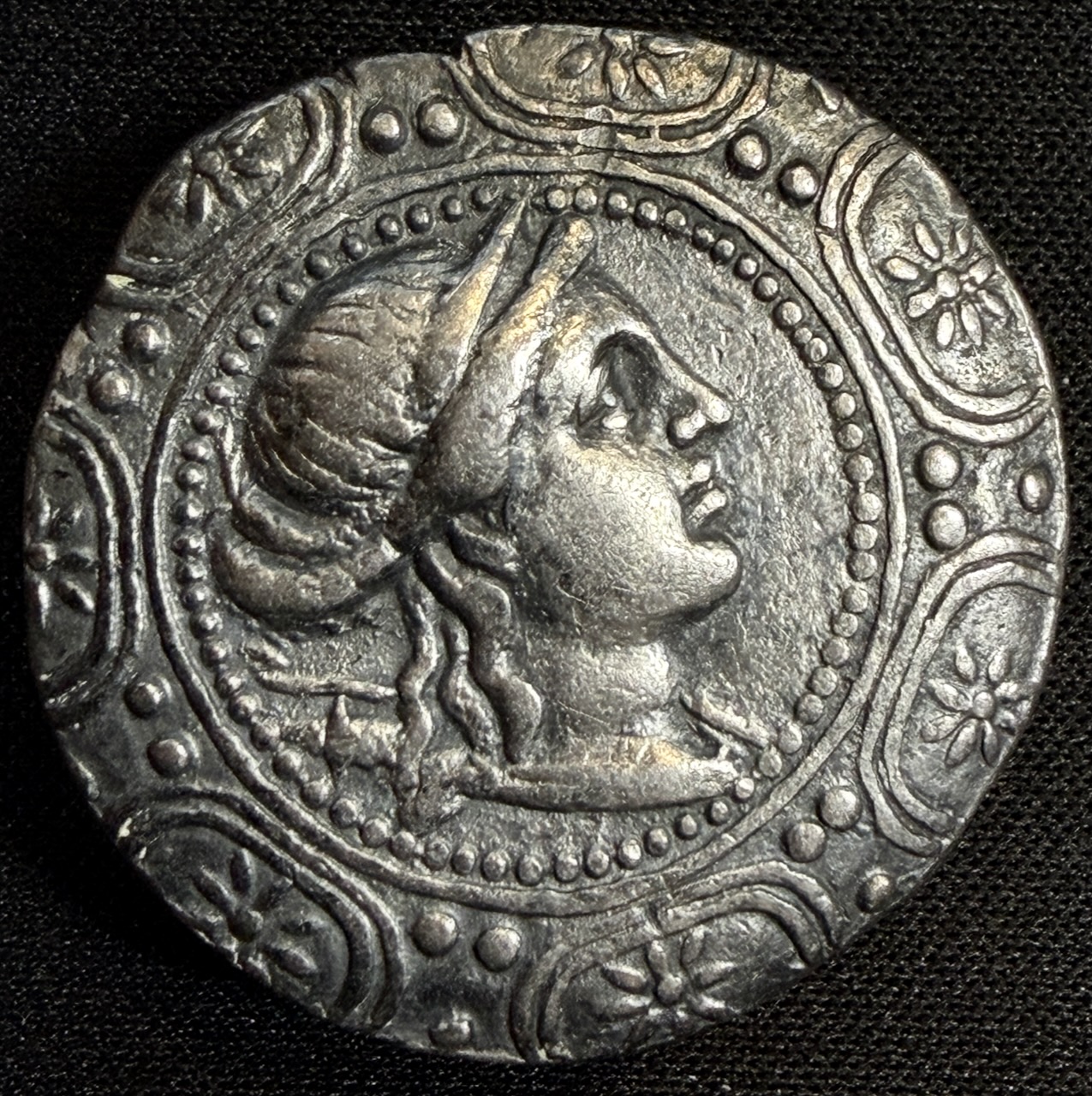
Obverse: Diademed and draped bust of Artemis Tauropolos right, bow and quiver at her shoulder, at the center of a Macedonian shield ornamented with stars in double crescents
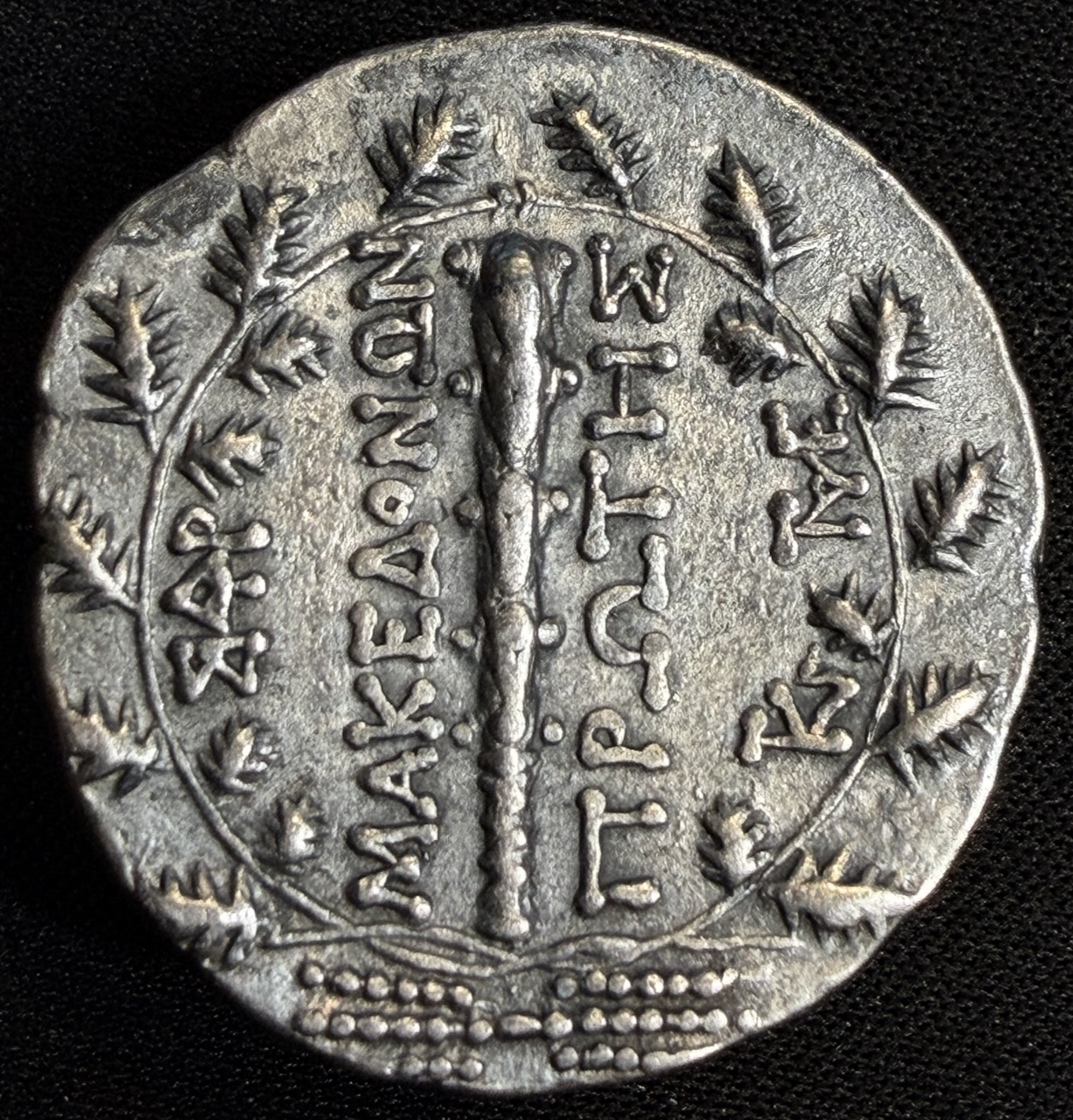
Reverse: Club right; control-monograms in field (partially legible on this specimen); all within oak wreath; thunderbolt outside to left (standard for the issue; weak on this specimen)
Primary reference: HGC 3.1, 1103
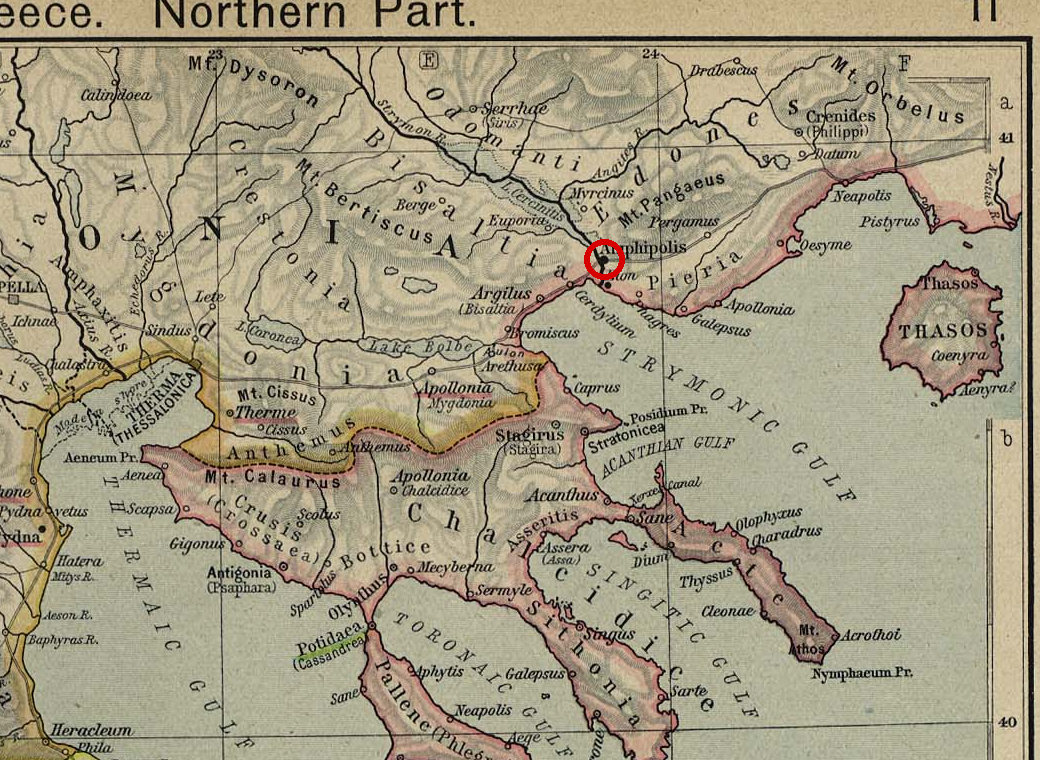
Macedonia and the Chalcidice on Shepherd’s reference map of northern ancient Greece. Amphipolis — circled in red — commands the crossing of the Strymon just above its port Eïon, with the mining district of Mt. Pangaeus immediately to the east: the silver country whose mines figure in the debate over this coinage’s start date. The First Meris ran from the Strymon (here) east to the Nestos; Thessalonica, capital of the Second, lies on the Thermaic Gulf at lower left.
“Reference Map of Ancient Greece, Northern Part,” from William R. Shepherd, Historical Atlas (1926 edition) — public domain; scan from the Perry-Castañeda Library Map Collection. Courtesy of the University of Texas Libraries, The University of Texas at Austin (https://maps.lib.utexas.edu/). Modified by JSB Coins: cropped to Macedonia and the Chalcidice, and a red circle added to mark Amphipolis.
In June 168 BC the Macedonian phalanx broke on the ridge at Pydna, and with it the kingdom of Alexander’s homeland. The settlement announced at Amphipolis the following year was an experiment: Macedonia was not annexed but left standing as four self-governing merides — districts with their own councils and with borders their inhabitants could not cross to marry or to buy land (Livy 45.29–30 preserves the terms). The same settlement disposed of the Aegean as well: Rome took Delos from Rhodes, gave it to Athens and made it a free port, which is why an Athens that had struck no serious silver for a century and a half began pouring out New Style tetradrachms within a couple of years. This tetradrachm is the money of the First Meris, the easternmost district between the Strymon and the Nestos, governed from Amphipolis. It is a coin of a strange political moment: struck in the name “of the Macedonians,” in fine Attic-standard silver, by a Macedonia that no longer had a king, an army, or a unified state. The same city’s mint had once poured out the imperial silver of the kings — see the collection’s posthumous Alexander tetradrachm of Amphipolis, struck there under the regents a century and a half before. And the victor’s own money of this generation is here as well: the anonymous Victory-biga denarius of 157–156 BC, silver of the Rome that had just unmade Macedon.
Graphic: JSB Coins, 2026 (CC0).
The design is a deliberate blend of old and new. The Macedonian shield with its stars-in-crescents ornament was an Antigonid habit of long standing: Antigonos Gonatas had put a miniature shield on his tetradrachms from about 267 BC, using the slight convexity that punch-and-anvil striking gives a flan, with the head of Pan at the boss. What went at the center of that shield was never a king. Alone among the great Hellenistic dynasties, the third-century Antigonids kept their own faces off their coins altogether — Gonatas put a bearded Poseidon there instead, in a pose that borrows the conventions of royal portraiture while making it unmistakable that a god is being shown. Even the last two kings, Philip V and Perseus, who did strike portraits, wore neatly groomed full beards in an age of clean-shaven, divine-looking monarchs, pointing back to Philip II and marking out a “national” Macedonian kingship against the personal monarchies of the East.
So a shield with a deity’s head at its center and no king’s face is not an invention of the districts. What is new is which deity: Artemis Tauropolos, the great goddess of Amphipolis, whose sanctuary made the city a religious capital for the region. The club of Herakles, ancestor of the royal house, fills the reverse inside an oak wreath. The legend says the thing in words — ΜΑΚΕΔΟΝΩΝ ΠΡΩΤΗΣ, “of the Macedonians, of the First” — a people still named, a state now numbered.
Here the coins correct the historian. Livy presents the four merides as a Roman invention, imposed in 167 on a kingdom being taken apart. The numismatic evidence says otherwise. Already in the early second century, probably in the last years of Philip V (c. 187–179 BC), silver and bronze was being struck in various parts of Macedonia in the name of “the Macedonians” — including two handsome tetradrachm coinages. One carries a head of Zeus in an oak wreath and, on the reverse, Artemis riding her bull, with the legend ΜΑΚΕΔΟΝΩΝ ΠΡΩΤΗΣ: the same words as this coin, a generation before Pydna. The other names ΜΑΚΕΔΟΝΩΝ ΑΜΦΑΞΙΩΝ, “of the Macedonians of Amphaxitis” — the land on both banks of the Axios, which is to say the Second or Third district.
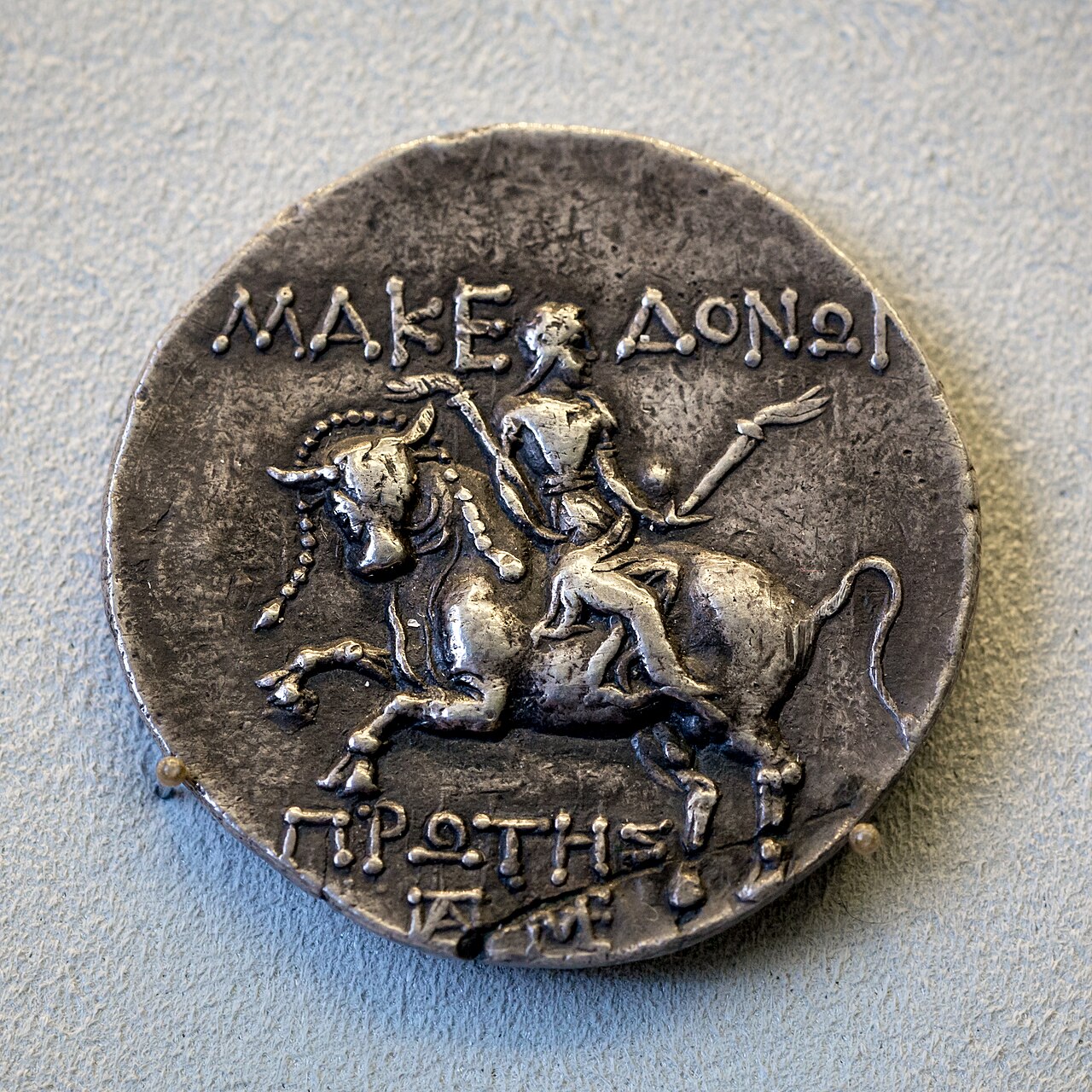
Photo: ArchaiOptix, Wikimedia Commons, licensed CC BY-SA 4.0, reproduced unmodified.
If the early dating holds, the districts were not Rome’s creation at all. Philip V and Perseus would have been presenting their kingdom as something like a voluntary league of Macedonian republics — the same move Eumenes II was making at Pergamon, and an obvious borrowing from the prestige of the mainland Greek koina, the Achaean and Aetolian leagues that were the political success story of the age. That reading fits the deliberately un-charismatic style of those two kings’ portraits: a monarchy presenting itself as a national federation rather than a dynasty. Not everyone accepts it — Juhel has argued the other way, and museum catalogues often keep the later dates — but the case rests on coins that exist and legends that read what they read.
What follows from it changes the meaning of this coin. After 167 the new district silver was not invented; it was adapted, taking the shield and the club-in-oak-wreath from the pre-167 issues and putting Artemis at the shield’s boss. The impression the coinage gives is of seamless continuity in the governance of Macedonia. The official story, if you like, is one of national liberation: Rome has freed the Macedonian republics from their Antigonid overlords.
The start date is genuinely contested, and the two positions differ in what they make of Rome’s intentions. The traditional chronology — 158–150 BC, the dating on both of this coin’s tags and in Sear — rests on the notice that the Macedonian gold and silver mines, closed in the settlement of 167, were reopened a decade later: no mines, the argument runs, no silver. More recent work, represented by Kremydi’s study of the Tauropolos tetradrachms and followed by Hoover (HGC 3.1, 1103), begins the coinage soon after 167 — the districts needed money from the start, and the hoards and overstrikes point earlier. Thonemann brackets the type c. 167–158 BC and notes what the volume implies: these coins were struck in very large quantities, presumably by Roman authorities in Macedonia. This page uses the broader c. 167–149 BC while preserving the tags’ 158–150 BC; the question remains open.
This specimen weighs 16.82 g, and that number is a small piece of evidence about a large change. Through the third century BC the real weight of an “Attic” tetradrachm — Athenian owl, civic Alexander, royal issue — held remarkably steady at about 17.20 g. But by the early second century many of the Alexanders still in circulation had been in hand for over a hundred years, and simple wear had brought much of the circulating pool below standard. From the 170s and 160s onwards, city after city and king after king cut the weight of their fresh tetradrachms by two or three per cent to match the worn money people actually had. Athens’ New Style tetradrachms, struck from the mid-160s at about 16.75–16.80 g, are among the earliest cases; this Macedonian coin at 16.82 g sits in exactly the same band.
The consequence was the slow collapse of the international Attic-weight system that Alexander’s coinage had created. Late in the second century the Delphic Amphictyony had to decree that “all the Greeks” must accept the Athenian New Style tetradrachm as four drachms of silver, with penalties for magistrates and money-changers who refused — a strange thing to have to legislate about a four-drachm coin, unless the coin no longer weighed what its name implied. A coin like this one is a fragment of that argument: Attic in name, sub-Attic on the scale, still perfectly good money at home.
The First Meris tetradrachms were struck in enormous numbers — they are the commonest Macedonian silver of the second century — and they traveled north into the Balkans, where they were imitated long after the mint stopped. In 149 BC Andriskos, a pretender claiming to be the son of Perseus, overran the districts; Q. Caecilius Metellus crushed him, and Macedonia became a Roman province in 148.
And here the coins do something remarkable: they take no notice. The establishment of the province is, quite simply, invisible in the coin evidence — the same types, the same legends, running on through the 140s and beyond. How surprising that is depends on what one thinks a Republican province actually was. These were not sharply defined legal entities whose administration was transformed by “annexation.” Macedonia had been paying annual tribute to Rome since 167 already; the significant change after 148 was the arrival of a standing legion and a proconsul to command it. The silence of the coinage may be an accurate report of how little Roman government there was on the ground.
The same turns out to be true further south. The old view held that the defeat of the Achaean League in 146 BC ended Greek federal and civic silver; it is now clear that Messene, Argos, Sicyon, Patrae, Sparta and others went on striking civic triobols into the first century, that Athens’ New Style tetradrachms ran unbroken from the 160s to the 40s, and that the Achaean League itself revived its federal coinage around 100 BC with its old types. The kingdom whose rise is marked in this collection by the bronze of Philip II thus ends, numismatically, not with a bang but with a legend that simply stops saying “king.”
The settlement that created the merides has a monument, and it stands at Delphi. Perseus had commissioned a tall rectangular pillar beside the temple of Apollo to carry his own gilded statue; after Pydna, Aemilius Paullus took the half-finished pillar for himself — the conquered, Plutarch has him say, must make way for the victors — and crowned it with a bronze equestrian statue. Around the pillar’s top ran a sculpted frieze of the battle, among the earliest of all Roman historical reliefs, and its most famous panel shows a riderless, unsaddled horse: the ancient accounts agree that Pydna began by accident, when a runaway horse bolted toward the enemy lines and the skirmishers chasing it dragged both armies into action. The Latin inscription on the base survives: L. Aimilius L. f. inperator de rege Perse Macedonibusque cepet — “Lucius Aemilius, son of Lucius, commander, took this from King Perseus and the Macedonians” (CIL I² 622).
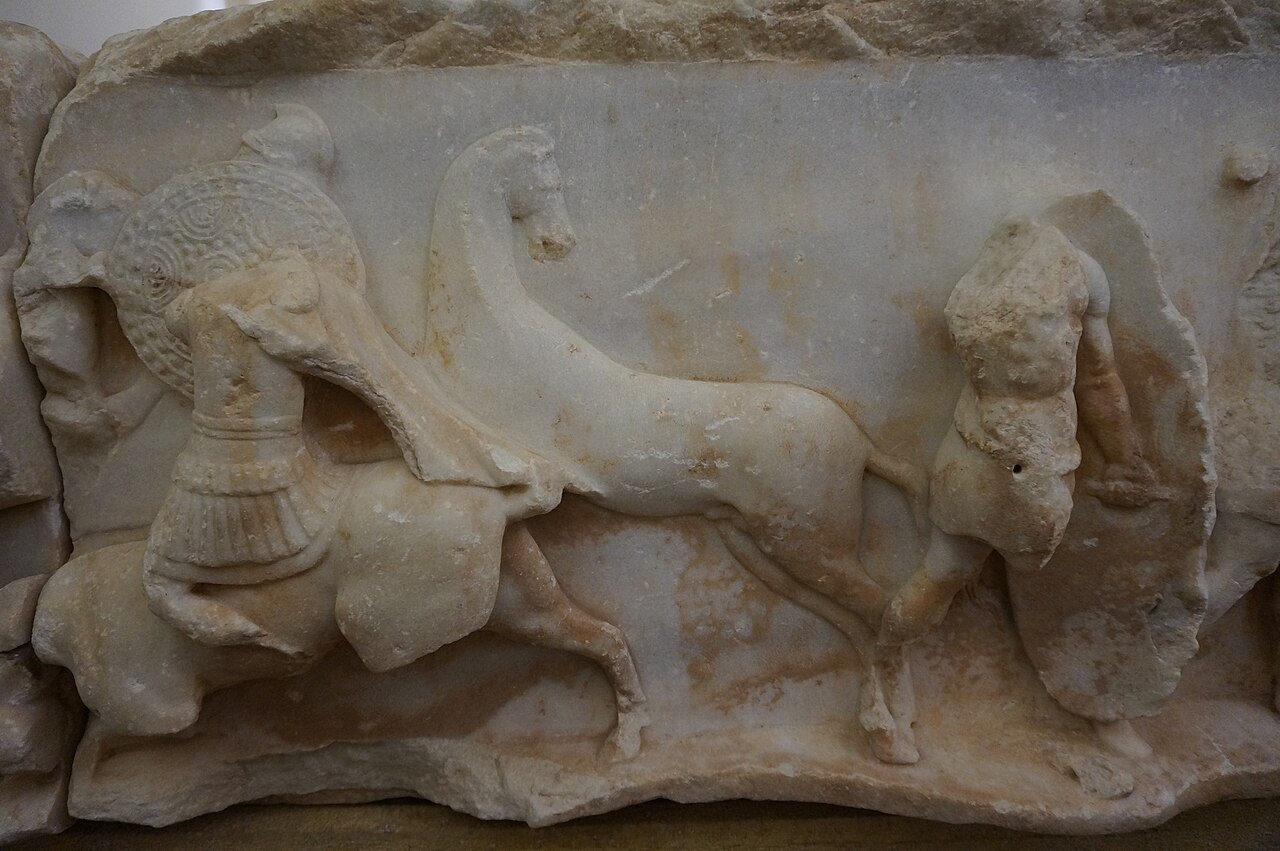
Photo: Colin Whiting, CC BY-SA 4.0 (Wikimedia Commons); reproduced unmodified.
Rome does eventually appear on Macedonian silver, and the sequence is worth following because this coin’s own types survive it. Around 100 BC a small issue keeps the familiar design — Artemis on the shield boss, club in an oak wreath, ΜΑΚΕΔΟΝΩΝ — and adds three Latin letters: LEG, either legati, “of the legate,” or legio, the army in Macedonia. Nobody is sure which. What is certain is that these are the first coins struck on the Greek mainland to carry a Latin inscription since T. Quinctius Flamininus put his name on a gold stater in about 196 BC, a century earlier — and Flamininus’ coin had been an isolated experiment, Hellenistic royal portraiture with a Latin caption, a road Rome did not take.
Then, around 90 BC, a wholly new series drops the pretence. The obverse carries a head of the deified Alexander, wild-haired, with ΜΑΚΕΔΟΝΩΝ in Greek; the reverse keeps this coin’s club and oak wreath and adds, in Latin, AESILLAS Q — Aesillas the quaestor, the province’s chief financial officer — together with the money chest and the magistrate’s stool that are the tools of his office.
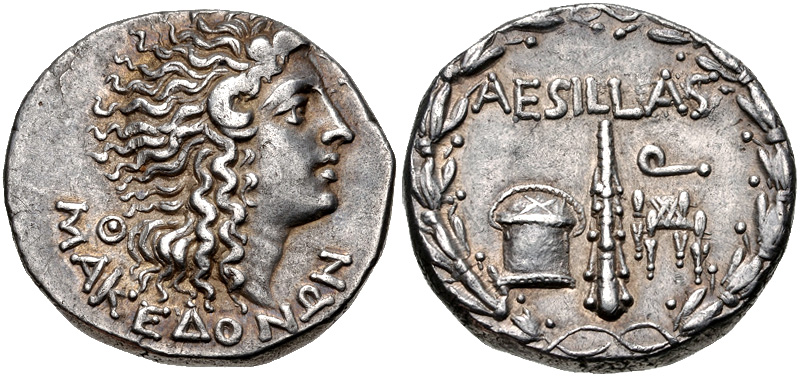
Photo: Wikimedia Commons, licensed CC BY-SA 4.0, reproduced unmodified.
A year or two into the series the name was briefly replaced by SVVRA LEG PRO Q, a legate acting for the quaestor — and then AESILLAS came back and stayed for twenty years. No quaestor held office that long, so what we are seeing is a fossil: a first issue frozen into a permanent type. The hoards suggest why. Much of the Aesillas coinage traveled north into inland Thrace, and it was probably struck to pay Thracian auxiliaries serving with the Roman army in Macedonia. Once those men were used to being paid in a particular-looking coin, nobody had any interest in changing what their pay-packet looked like. It is a small, human explanation for a numismatic oddity, and it is the same instinct that had kept Athens striking archaic-eyed owls for a century.
(Based on a reading of Peter Thonemann, The Hellenistic World: Using Coins as Sources (Guides to the Coinage of the Ancient World; Cambridge University Press, 2015) — chapter 9 in full, with chapters 4, 6 and 8 for the federal, metrological and royal-ideology material used above.)
The thought experiment the chapter opens with. Imagine every written source for Rome’s conquest of the Hellenistic East had been lost — no Polybius, no Livy, no Cicero; no treaty of Apamea, no Pydna. Could the political history be reconstructed from coins alone? The honest answer is: barely. One issue would leap out, Flamininus’ gold stater of c. 196 BC, and then almost nothing. The provinces of Macedonia (146) and Asia (129) are effectively invisible; you would not be able to date them, and might not detect them at all. That is not a gap in the evidence so much as a finding about it: whatever the reality of Roman power, the story the coins tell is continuity, not subjugation.
Continuity as policy, or continuity as indifference? The pattern repeats across the East with a consistency that demands explanation. In Macedonia the meris types run on through the creation of the province. In Asia the Attalid cistophori keep being struck after 129 BC, by the old mints and by new ones. In Syria, most startling of all, Roman governors from 57 BC to 14/13 BC went on striking tetradrachms with the fossilised types of Philip I Philadelphus, a Seleucid king long dead, marked only by discreet monograms — one of them the monogram of Crassus. It is very hard to believe Roman governors wished to advertise continuity with the late Seleucids. Thonemann’s conclusion is that Roman coin policy was driven by practical considerations and that the apparent meaning of the types was simply not all that important: if Philip’s tetradrachms were what circulated in Syria, Rome would strike Philip’s tetradrachms. That is a deflationary reading of coin iconography, and it is worth holding against the opposite instinct — Fergus Millar’s, quoted approvingly in the same book — that coinage was “the most deliberate of all symbols of public identity.” Both can be true at once: deliberate for the issuing community, indifferent for the occupying power.
Where the change does show. The turn comes at different moments in different provinces, and it tracks Roman power rather than Roman annexation. In Macedonia it is around 100 BC (the LEG issue) and then decisively c. 90 BC (Aesillas). In Asia it is a few decades later — the civic cistophori stop abruptly in 67/6 BC, and from 58 BC the coins carry proconsuls’ names, until by 49/8 BC the name of Metellus Pius Scipio occupies the most prominent place on the reverse and there is no doubt left about who is in charge. Both turning points sit against Pompey’s expansion of Rome’s commitments in the East between 66 and 62 BC. The coins register the hardening of power, not the legal fact of a province.
And the contrast with Alexander. Two conquests transformed this world, and in coin they look nothing alike. Alexander’s produced unification: one weight standard from the Balkans to the Hindu Kush, one international style descended from a single tetradrachm. Rome’s produced no such thing. Its governors faithfully preserved local standards and local types — Achaean triobols, light cistophori, Seleucid royal tetradrachms, Macedonian merides — and the homogeneity of the third century never returned. The coin on this page belongs to the start of that second story: a design Rome inherited, kept, and eventually signed.
Thonemann’s The Hellenistic World: Using Coins as Sources (2015) is the readable modern frame for all of the above and assumes no Greek. Kremydi’s study of the Tauropolos tetradrachms (linked in the references) is the specialist treatment of this series and its dating; Prokopov’s corpus is the die-study foundation; Hatzopoulos’s Macedonian Institutions under the Kings (1996) argues the case that the merides predate Rome, with Juhel (2011) on the other side. For the ancient narrative, Livy 44–45 and Plutarch’s Aemilius (both linked) carry Pydna, the settlement at Amphipolis, and the triumph. For where the story goes next, Bauslaugh’s study of the Aesillas coinage is the standard work.
Attribution: the Zauche tag (S-1386 = D. Sear, Greek Coins and Their Values, no. 1386) and the earlier dealer’s printed tag (First Meris, Amphipolis, 16.82 g); O. Hoover, Handbook of Coins of Macedon (HGC 3.1), no. 1103; cf. SNG Copenhagen 1310–1311. The Roman settlement and the four merides: Livy 45.29–30. Dating debate and iconography: S. Kremydi, “The Tauropolos tetradrachms of the first Macedonian meris” (see references), with the traditional mines-based chronology preserved on the tags and in Sear. The pre-167 coinages in the name of the Macedonians, the argument that the merides predate Rome (Hatzopoulos 1996, contra Juhel 2011), the invisibility of the province in the coin record, the sub-Attic weight drift of the 170s onwards, the Delphic Amphictyony decree, and the LEG / Aesillas / Svvra sequence all follow P. Thonemann, The Hellenistic World: Using Coins as Sources (Cambridge 2015), chs. 4, 6, 8 and 9, with the underlying studies cited there (Kremydi-Sicilianou 2007 and 2009; Prokopov 2012; Bauslaugh 2000; Warren 1999; Callataÿ 2011). Antigonid coin iconography and the anti-portrait tradition: Thonemann ch. 8, with Panagopoulou 2001 and Kremydi 2011. Pydna, the settlement, and the triumph: Plutarch, Aemilius 15–34 (linked in the references), with Livy 44–45. The Delphi pillar and its frieze: the base inscription is CIL I² 622.
Attic-standard tetradrachm continuing the reduced Macedonian weight of the late Antigonid issues (this specimen 16.82 g per the earlier dealer's tag). The START DATE IS CONTESTED: the traditional dating (158–150 BC, as on both tags and in Sear) ties the coinage to the reported reopening of the Macedonian mines a decade after Pydna; more recent scholarship (Kremydi; cf. Hoover, HGC 3.1) begins the series soon after the settlement of 167 BC and runs it to the Andriskos revolt (c. 149 BC). Control-monogram identification for this specimen is an open thread (would pin the AMNG/die-study variety). A SEPARATE AND LARGER QUESTION sits behind the dating: coins in the name of the Macedonians, including tetradrachms reading MAKEDONON PROTES, appear to have been struck already under Philip V and Perseus (c. 187-168 BC), which would make the merides an Antigonid institution that Rome inherited rather than invented, against Livy 45.29 (Hatzopoulos 1996 and Kremydi-Sicilianou; contra Juhel 2011). Presented as open on the page.
John's Ancient Coin Collection · Type · macedon-first-meris-tetradrachm
Image credits for this coin — photographs, maps and graphics used on this page