Type · kyzikos-athena-electrum-hekte
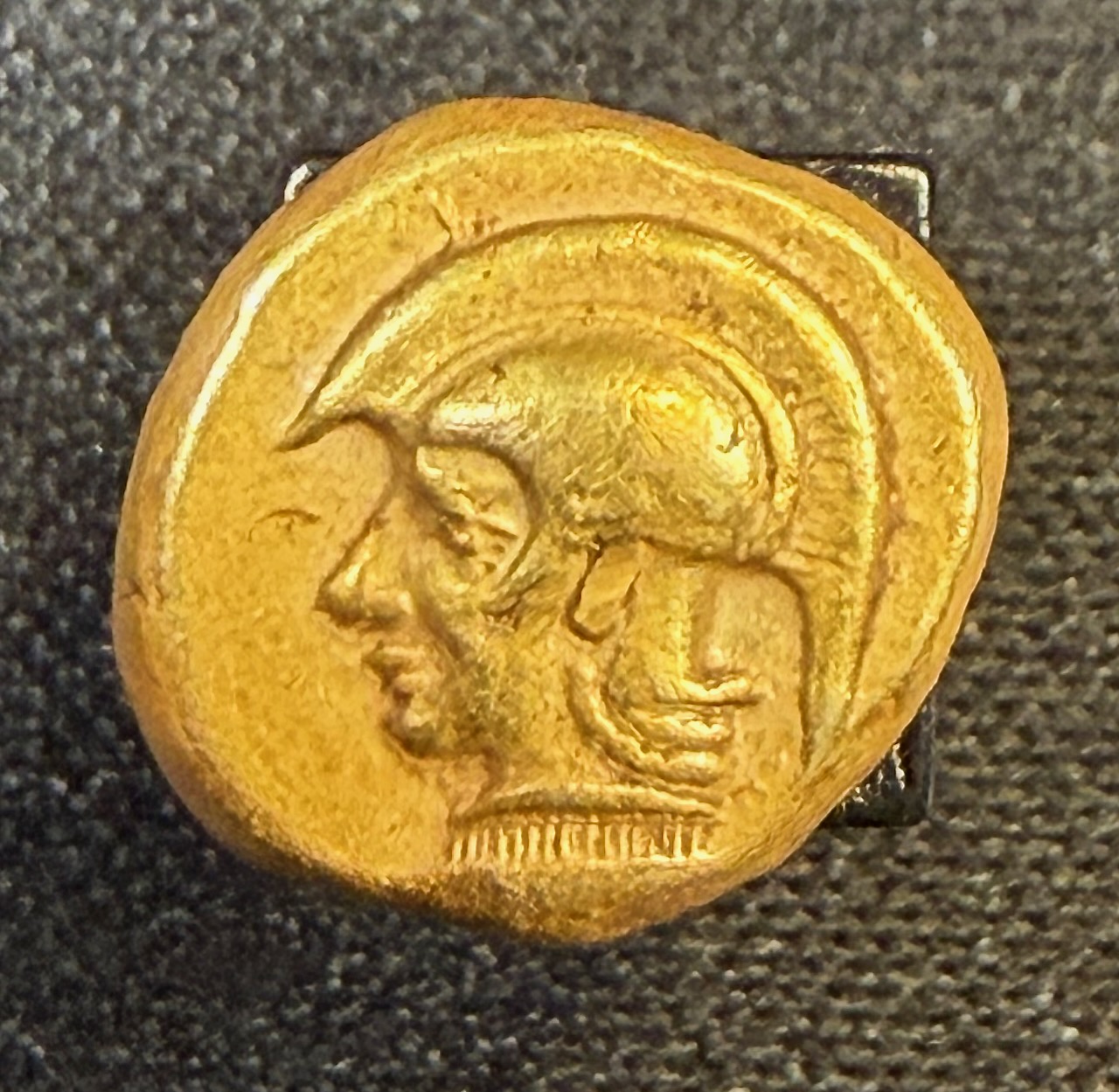
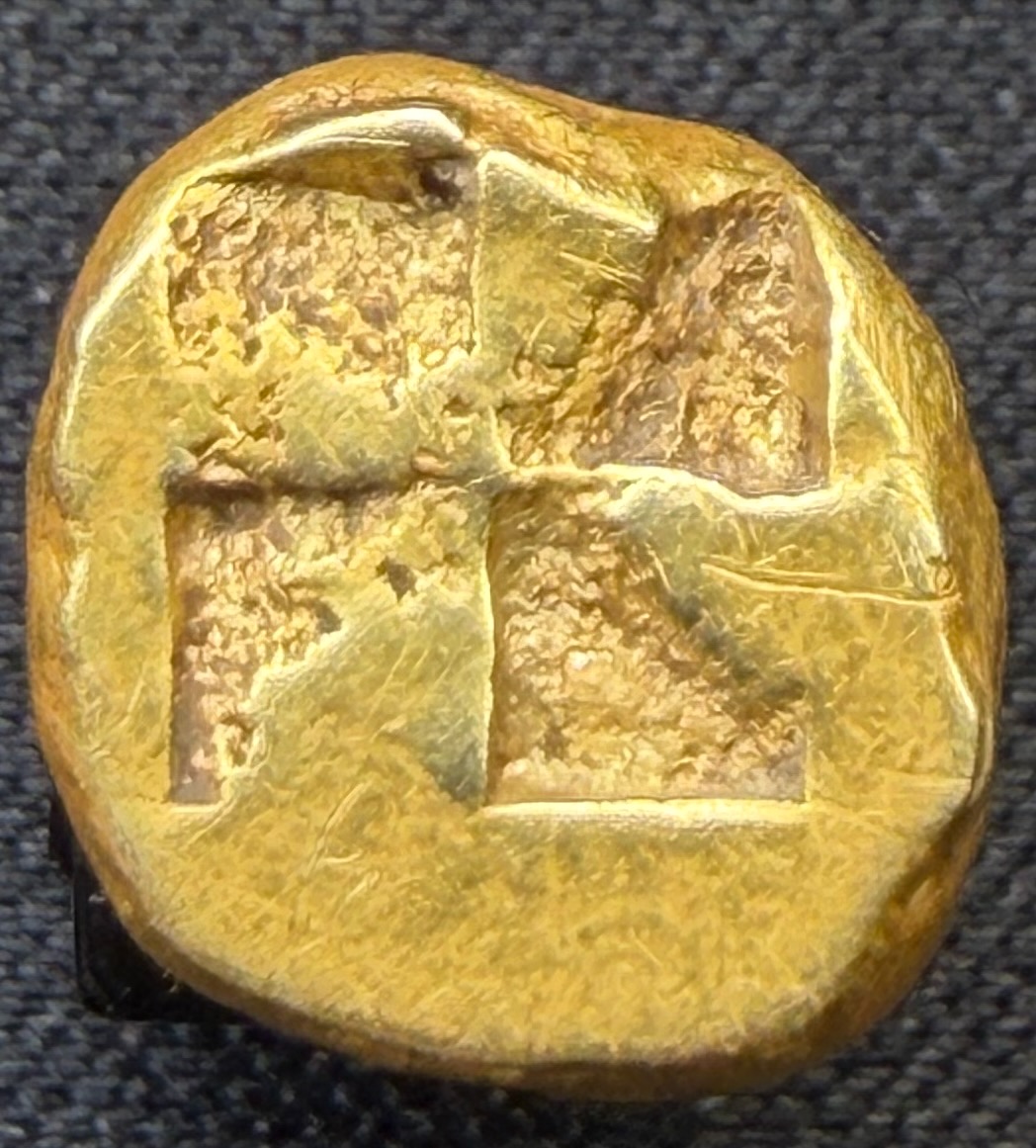
Current: Mysia, Kyzikos. EL hekte (sixth stater), c. 550–490 BC. Helmeted head of Athena left, tunny fish below / quadripartite incuse square. Von Fritze I 67; Boston MFA 1447 = Warren 1444.
Obverse: Head of Athena left, wearing crested helmet; below, tunny fish left — the civic badge of Kyzikos
Reverse: Quadripartite incuse square of archaic 'mill-sail' form
Primary reference: Von Fritze I 67
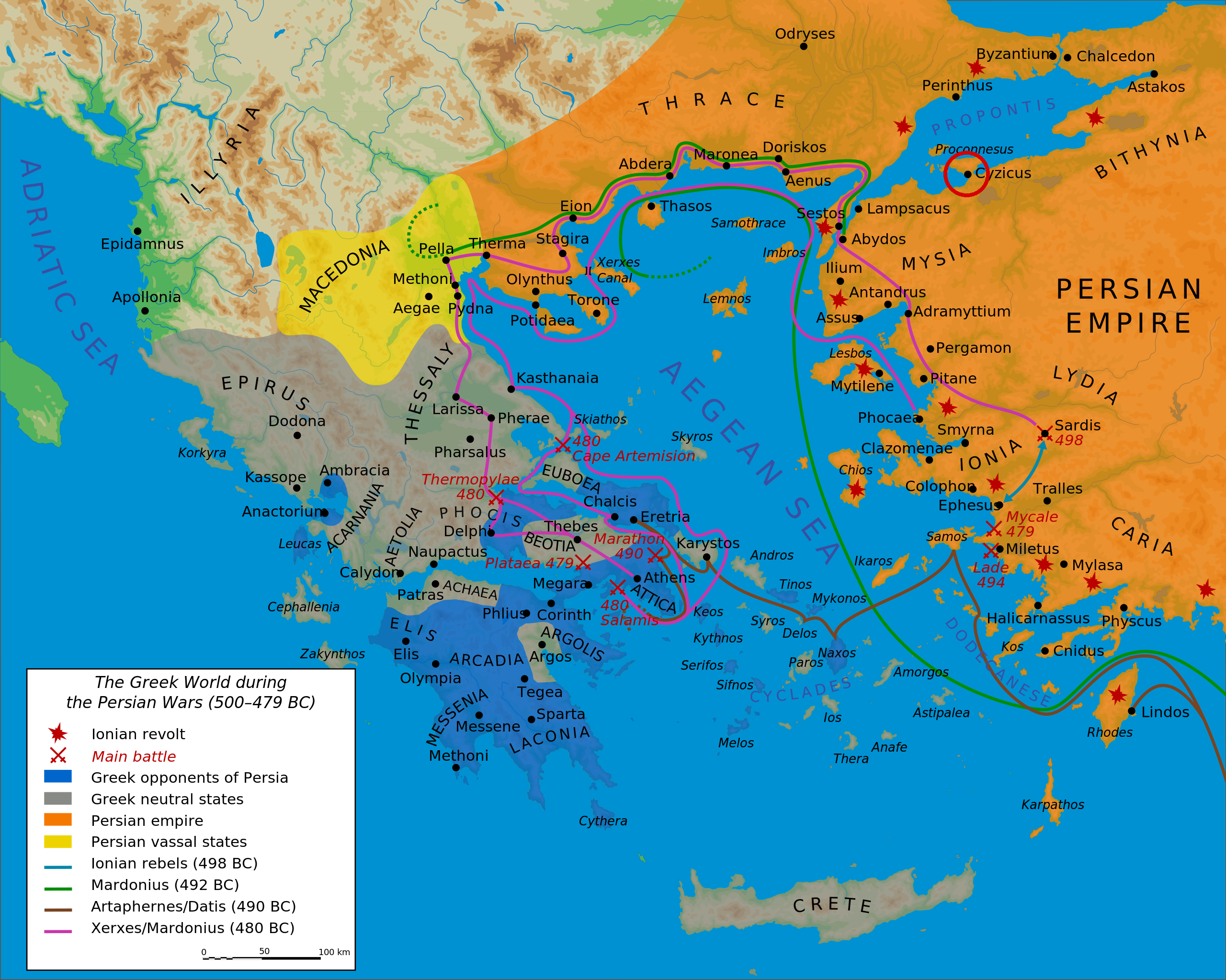
The Greek world during the Greco-Persian Wars (c. 500–479 BC), within this type’s period of issue. Kyzikos — circled in red — sits on the southern shore of the Propontis (the Sea of Marmara), the inland sea joining the Aegean to the Black Sea. Everything that made the city’s electrum a great trade currency is visible here: the straits at Byzantium and at Sestos/Abydos (the Hellespont), through which the Black Sea grain traffic that Kyzikene staters financed had to pass.
“Map showing the Greek world during the Greco-Persian Wars (ca. 500–479 BC)” by Bibi Saint-Pol (Wikimedia Commons), File:Map Greco-Persian Wars-en.svg, licensed CC BY-SA 3.0 (https://commons.wikimedia.org/wiki/File:Map_Greco-Persian_Wars-en.svg; license: https://creativecommons.org/licenses/by-sa/3.0/). Modified by JSB Coins: rasterized from SVG to PNG, and a red circle added to mark Kyzikos (Cyzicus). This derivative is shared under the same CC BY-SA 3.0 license.
Second map (Asia Minor): “Asia Minor under the Greeks and Romans” from William R. Shepherd, The Historical Atlas (1923), via Wikimedia Commons, File:Asia minor-Shepherd 1923.JPG (https://commons.wikimedia.org/wiki/File:Asia_minor-Shepherd_1923.JPG). Public domain (author died 1934); credited as a courtesy. Modified by JSB Coins: a red circle added to mark Cyzicus.
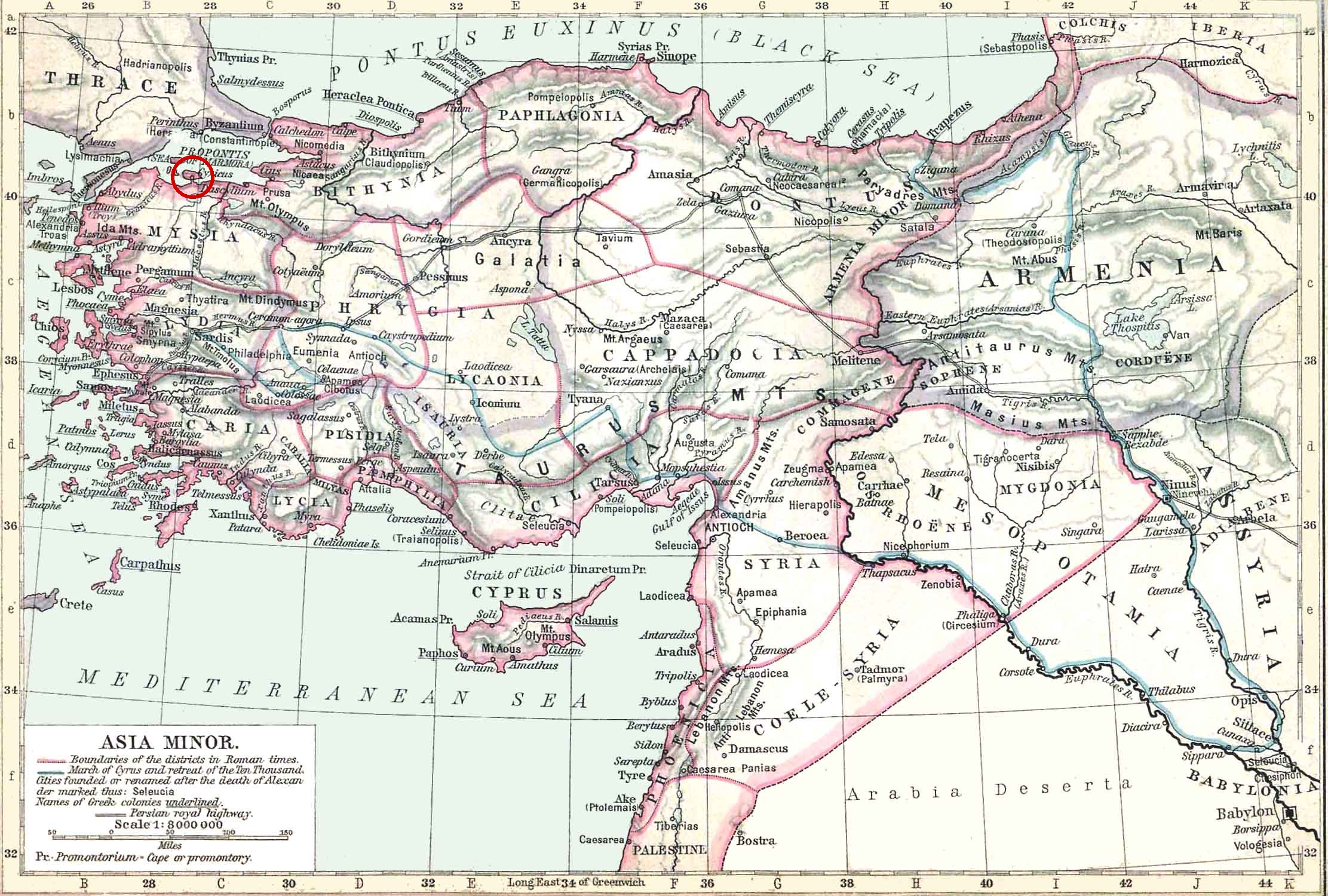
The same region in close detail on William R. Shepherd’s 1923 map of ancient Asia Minor: Cyzicus — circled in red — on its peninsula jutting into the Propontis (Sea of Marmara), on the coast of Mysia, with the Hellespont to the west and Byzantium to the northeast. (The map’s boundaries are those of Roman times, several centuries after this coin.)
This little lump of pale gold is a hekte — a sixth of a stater — of Kyzikos, the city whose electrum coinage became the great trade currency of the straits and the Black Sea. It carries a helmeted head of Athena above the city’s unmistakable signature, the tunny fish, and on its other face the plain sunken square of the oldest coinage tradition, kept by Kyzikos long after most mints had abandoned it.
Kyzikos was an early colony of Miletos, planted on the neck of a peninsula on the southern shore of the Propontis (the Sea of Marmara). Its position was extraordinary: every ship trading between the Aegean and the Black Sea passed its waters — the same traffic that Byzantion, at the Bosporus end of the sea road, taxed under its bull-on-dolphin badge — and the seasonal runs of tunny through the straits made its fisheries proverbial. The tunny became the city’s badge — on this coinage it appears beneath, beside, or entwined with every obverse type the mint ever used, the constant mark that a coin was Kyzikene.

Photo: Danilo Cedrone, UN FAO / NOAA photo library, public domain (Wikimedia Commons); reproduced unmodified.
While most of the Greek world moved to pure silver in the sixth century BC, Kyzikos (with a few Ionian neighbors such as Phokaia and Mytilene) kept striking electrum, the pale gold–silver alloy of the earliest Lydian and Ionian coins. The Kyzikene series ran for roughly three centuries, from the mid-sixth century until the age of Alexander, with a conservatism that was clearly deliberate: the reverse remained the archaic quadripartite incuse square throughout, and the weight standard never moved. On that fixed frame the mint mounted an astonishing parade of obverse types — gods, heroes, animals, monsters, civic images, eventually even portrait-like heads — of which von Fritze’s corpus catalogues well over two hundred. The constant tunny and the constant fabric made any Kyzikene instantly recognizable and trusted; the changing types have been read as issue marks, though their logic remains debated.
The staters — the famous Kyzikenoi — served as an international currency: Athenian inventory inscriptions count them alongside owls, the Black Sea grain trade was financed in them, and Xenophon’s mercenaries bargained to be paid in Kyzikene staters (Anabasis 5.6.23, 7.3.10). The hekte, one-sixth of a stater, was the practical fraction of that system — substantial money (roughly comparable to several days’ skilled wage) in a conveniently small module. Below the electrum, the city ran its daily economy on tiny silver fractions like the boar/lion hemiobol in this collection — the two ends of one civic monetary system.
The obverse head wears a crested helmet and is identified in the standard references as Athena — the identification of von Fritze and of the Warren/Boston catalogues for this type (no. 67). The style is high archaic: the eye rendered frontally, the lips in the faint archaic smile, the helmet bowl smooth above the brow. Below the truncation swims the tunny. The reverse is the four-part incuse square in its windmill (‘mill-sail’) form, the direct descendant of the punch that struck the first coins in nearby Lydia and Ionia a century earlier. The tag’s date of c. 550–490 BC places the coin in the generations when Kyzikos passed from Lydian into Persian suzerainty and the Ionian Revolt swept its neighborhood (499–494 BC) — through all of which the civic electrum went on being struck, a monetary institution more durable than any political master.
Electrum coinage poses a problem the Kyzikenes turned into a strength. The natural alloy varies in gold content, so an electrum coin’s bullion value is uncertain at sight; the mints answered with artificially regulated alloys and, above all, with reputation — the coins passed at a conventional, essentially fiduciary rate guaranteed by the issuing city. How far Kyzikene electrum was fiduciary money and how its rate against silver was fixed are live questions in the scholarship on early coinage; what is not in doubt is that the system worked, for three hundred years, across half the ancient world’s busiest sea lanes. Athens knew it: through the fifth century the city’s tribute quota lists record payments made in Kyzikene electrum alongside Athenian silver, and kyzikenes are by far the most abundant foreign currency in Athens’ own financial accounts — one scholar has called Kyzikos “the second mint of the Athenian empire.” When Athens finally legislated a single imperial currency around 414 BC the decree covered silver, not electrum, so this coinage was untouched; but two lead weights survive from the city, cut to the Athenian trade standard and stamped with the owl of the Athenian tetradrachm standing on the Kyzikene tunny — a city advertising, in its own iconography, whose measures it now kept.
The Kyzikene electrum is one of the monetary institutions of antiquity, and the hektai are its most collectible expression: genuinely archaic coins, in the original coinage metal, from the mint that made electrum an international standard. The mint itself outlived the electrum by centuries — this collection’s tetrarchic radiate of Maximianus, struck at Cyzicus around 295 AD, is the same minting tradition eight hundred years on. An Athena/tunny hekte adds to this collection’s archaic group — the Teos griffin, the Lydian lion-and-bull, the early Corinth colt — the coinage tradition those pieces’ own ancestors began, still alive and trading on the Propontis.
Nearly a thousand years after these hektai, the city’s mint was still at work: the collection’s maiorina of Honorius, signed SMKΓ, came from late Roman Cyzicus in 393–395 AD.
The type is no. 67 in H. von Fritze, “Die Elektronprägung von Kyzikos” (Nomisma VII, 1912), the foundational corpus whose relative arrangement remains standard; the parallel specimen is Warren 1444 (K. Regling, Die griechischen Münzen der Sammlung Warren, 1906) = Boston MFA 1447. Dating of the archaic groups is approximate: the dealer tag gives c. 550–490 BC, current auction catalogues bracket the type as widely as c. 550–450 BC, and refinements to von Fritze’s chronology in the later literature have not produced a single agreed scheme — the range is presented here as it stands. For the Kyzikene stater as trade money: Xenophon, Anabasis 5.6.23 and 7.3.10, with the general accounts in the handbooks; the fiduciary character of regulated electrum is a debated question in the scholarship on early coinage and is flagged as such above.
Struck in electrum (gold–silver alloy) on the Kyzikene (Phokaic-related) standard: stater c. 16 g, hekte c. 2.6–2.7 g (this specimen 2.67 g per tag). Kyzikos kept the archaic quadripartite incuse reverse and its constant civic badge, the tunny, across the coinage's whole three-century life, while the principal obverse types changed continually — von Fritze's corpus arranges well over two hundred of them. His relative arrangement remains the framework, but the absolute dates of the archaic groups are approximate and have been refined by later scholarship; the tag's c. 550–490 BC bracket for this type is conventional, and some catalogues carry it as late as c. 450 BC.
John's Ancient Coin Collection · Type · kyzikos-athena-electrum-hekte
Image credits for this coin — photographs, maps and graphics used on this page