Type · athens-new-style-owl-tetradrachm
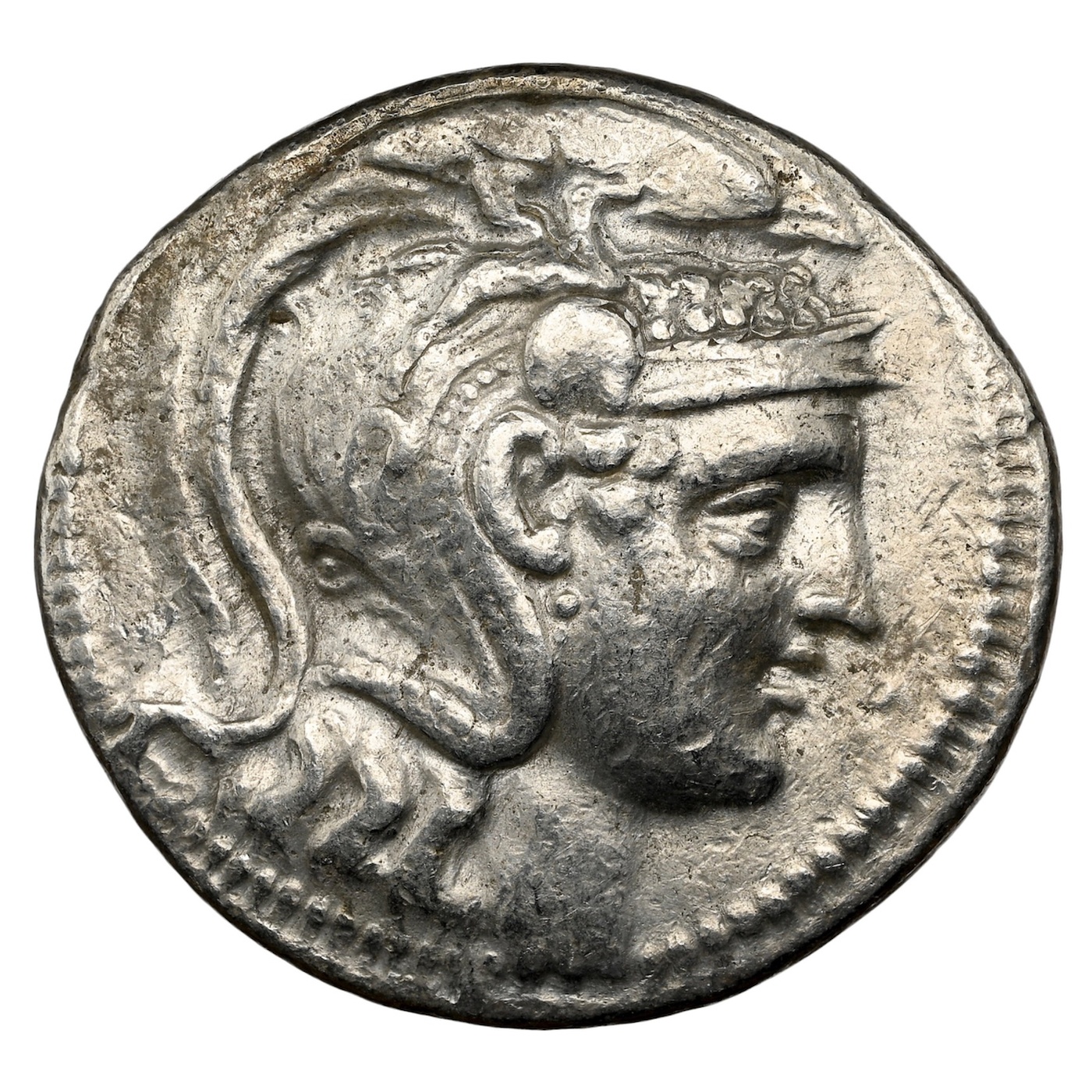
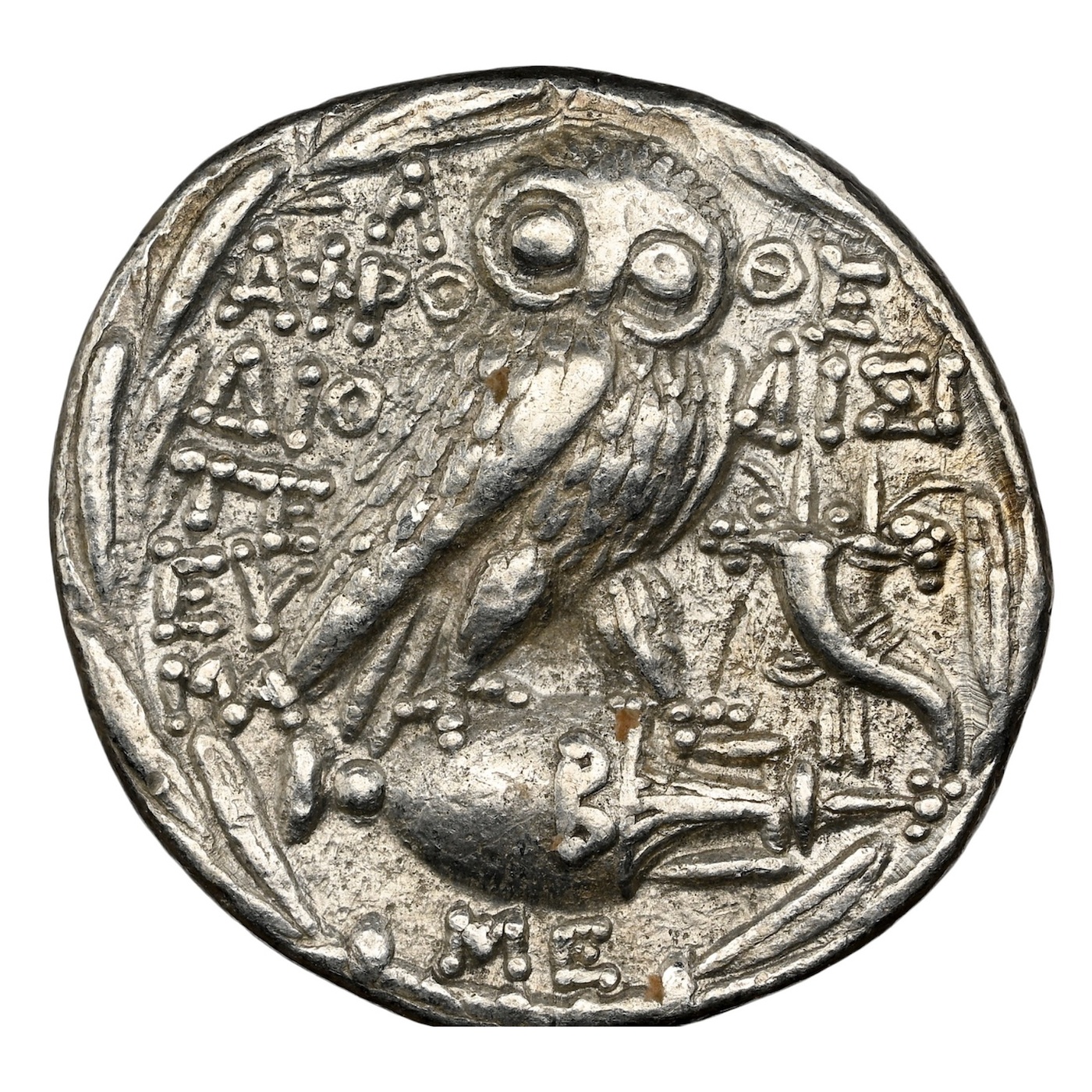
Current: Attica, Athens, AR tetradrachm, New Style (stephanephoric) coinage, c. 120/119 BC. Head of Athena right in a triple-crested Attic helmet / owl standing facing on an overturned Panathenaic amphora within an olive wreath; magistrates ΑΦΡΟΔΙΣΙ, ΔΙΟΓΕ and ΕΥΜΑ, month Β, double cornucopia in the right field. Thompson 545a; HGC 4, 1602.
Obverse: Head of Athena right, wearing a triple-crested Attic helmet: the bowl decorated with a vine scroll, a Pegasos above the raised cheek-piece, and the foreparts of four horses above the visor. The eye is in true profile and the modeling is full and Hellenistic — a head derived from Pheidias' cult statue in the Parthenon rather than from the archaizing face of the fifth-century owls.
Reverse: Owl standing facing on an overturned Panathenaic amphora, the whole within a closed olive wreath. Names in the fields: Α-ΘΕ across the top, then the two annual magistrates ΑΦΡΟ-ΔΙΣΙ and ΔΙΟ-ΓΕ, and below them the monthly official ΕΥ-ΜΑ. The letter Β on the amphora gives the month; a double cornucopia bound with fillets stands in the right field as the year's control symbol; ΜΕ appears in the exergue. The flan is broad and thin, the fabric of a Hellenistic stephanephoros rather than of a classical owl.
Primary reference: Thompson 545a; HGC 4, 1602
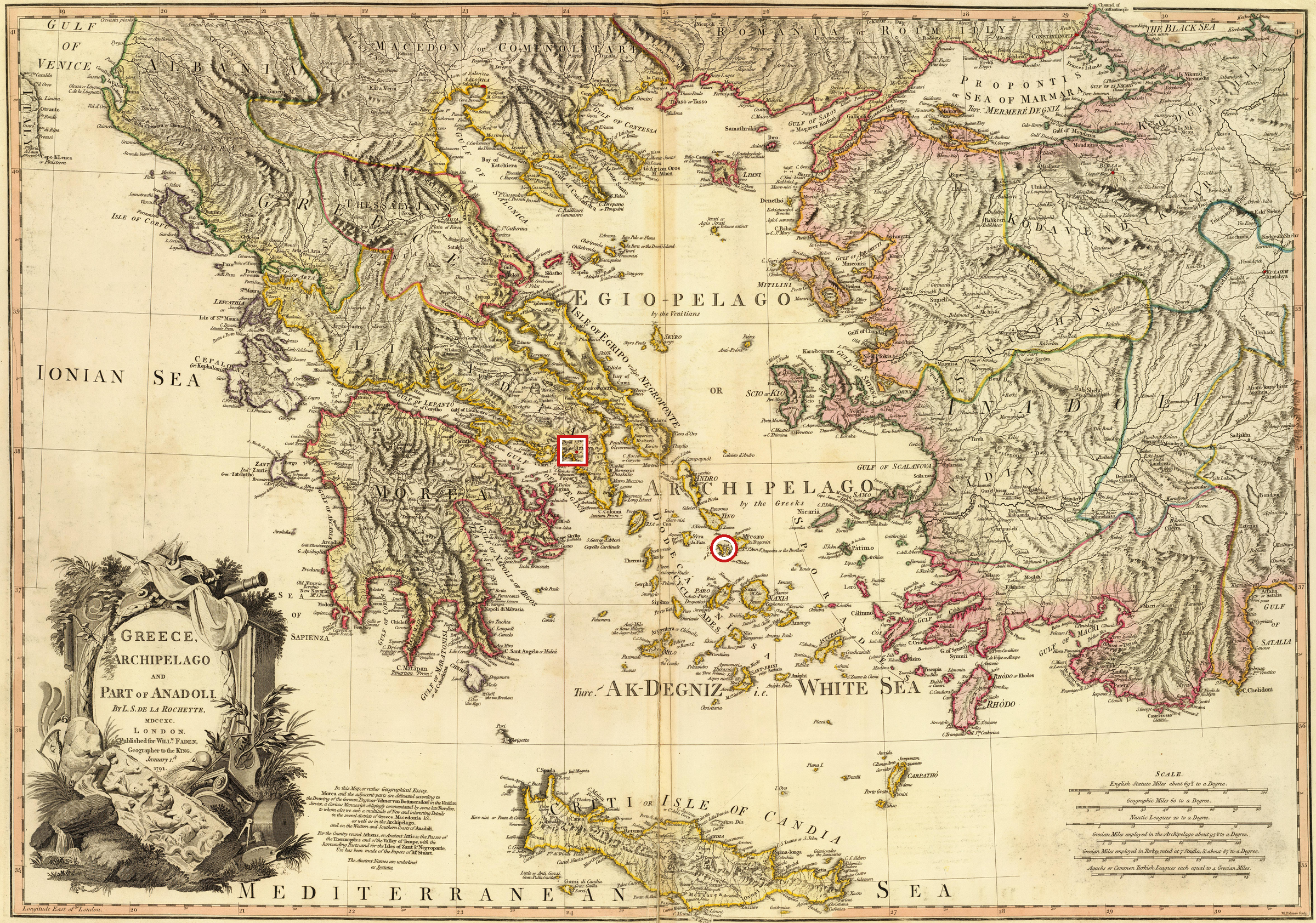
Greece, the Aegean and the coast of Asia Minor on Delarochette’s map of 1791; Athens is marked by the red square, and Delos by the red circle south-east of it in the Cyclades. This is the same house plate the collection uses for its classical owl drachm and its pi-style tetradrachm — the city did not move. What moved was the center of gravity of its economy, out into the Archipelago. The engraved lettering here is hard going, so the same water is shown again below on a modern map.
Main map (the 1791 plate). “Greece, Archipelago and part of Anadoli” by Louis Stanislas d’Arcy Delarochette (engraved by W. Palmer; published for William Faden, Geographer to the King, London, 1791), in the public domain (PD-old-100; published before 1931). File:Map of Greece, Archipelago and part of Anadoli; Louis Stanislas d’Arcy Delarochette 1791.jpg (https://commons.wikimedia.org/wiki/File:Map_of_Greece,_Archipelago_and_part_of_Anadoli;_Louis_Stanislas_d%27Arcy_Delarochette_1791.jpg). Reproduced from the collection’s existing marked copy, in which a red square was added at Athens; a red circle marking Delos was added for this page (2026-09-01), matching the square’s weight and its white inner ring. No other modification. The second map below it is a different work, credited in its own caption.
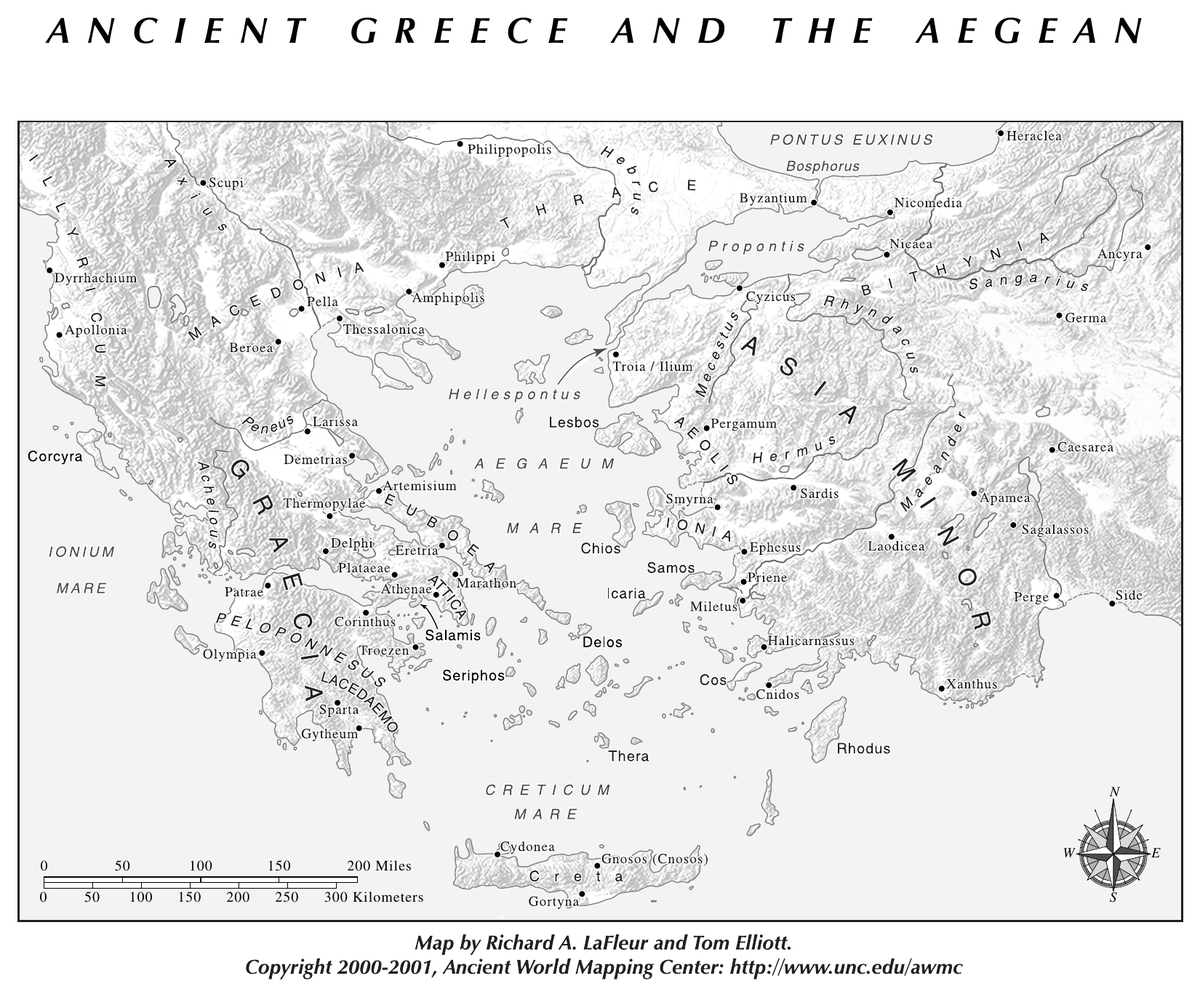
The same geography on a map you can actually read. Athenae sits at the tip of Attica; Delos is the named dot in the middle of the Cyclades, almost exactly halfway between mainland Greece and the coast of Asia Minor — which is precisely why it worked as a clearing-house, and why Rome could destroy Rhodes’ business simply by making it duty-free. In 167/6 BC Rome took Delos from the Rhodians, handed it to Athens and made it a free port. Rhodes told the Senate what that cost: harbour dues down from a million drachmas a year to a hundred and fifty thousand (Polybius 30.31). The silver on this coin is a share of what went to Athens instead. In 167/6 BC Rome took Delos from the Rhodians, handed it to Athens and made it a free port. Rhodes told the Senate what that cost: harbour dues down from a million drachmas a year to a hundred and fifty thousand (Polybius 30.31). The silver on this coin is a share of what went to Athens instead.
For a hundred and fifty years the Athenian owl had been designed not to change. The classical tetradrachm kept an archaic, frontal-eyed Athena long after Athenian sculptors had learned to do better, because sameness was the guarantee: a merchant in Egypt or Syria needed to recognize the coin, not to admire it. The pi-style issues carried that conservatism down to about 294 BC, and then Athens effectively stopped striking silver for a century and a half.
When the owl came back, in the middle of the second century BC, it had changed its mind about what a coin is for. The flan is broad and thin, the Athena is fully Hellenistic, and the reverse — the part that matters — has become a document. Two magistrates’ names stand in the field, a third name below them, a letter on the amphora, a symbol beside it, two more letters in the exergue. Where the classical owl told you only of the Athenians, this one tells you who was answerable and when. It is a coin that dates itself.
Graphic: JSB Coins, 2026 (CC0).
Everything written about these coins rests on Margaret Thompson’s The New Style Silver Coinage of Athens (1961), which sorted the whole series into issues by tracing shared dies. That ORDER has held. Her CALENDAR has not. Thompson began the coinage in 196 BC, the year the Roman general Flamininus proclaimed the freedom of the Greeks at the Isthmian games — a tempting place to start a revived civic silver. Within a year David Lewis had argued in the Numismatic Chronicle that the series began some thirty years later, and the lower dating is what the hoards support: Boehringer worked through the mid-Hellenistic hoard sequence in 1972, Mørkholm restated the case in 1984, Mattingly and Habicht carried the argument on into the 1990s. The start is now put at about 165/164 BC.
The practical consequence sits on this coin’s own ticket. “Thompson 545a” is a number in Thompson’s sequence; “c. 120/119 BC” is a date from the revised chronology. The two authorities are not the same, and NGC’s label prints the date with a question mark to say so. That question mark is honest, and it is worth leaving on the page rather than tidying away: the year is a good modern estimate within a well-established order, not a fact the coin asserts about itself.
The lower dating matters because it attaches the coinage to something that actually happened. In 168 BC Rome destroyed the Macedonian kingdom at Pydna and, in the settlement of 167, broke it into four republics — the coinage of the first of them is in this collection. In the same settlement Rome took the island of Delos away from Rhodes, gave it to Athens, and declared it a free port.
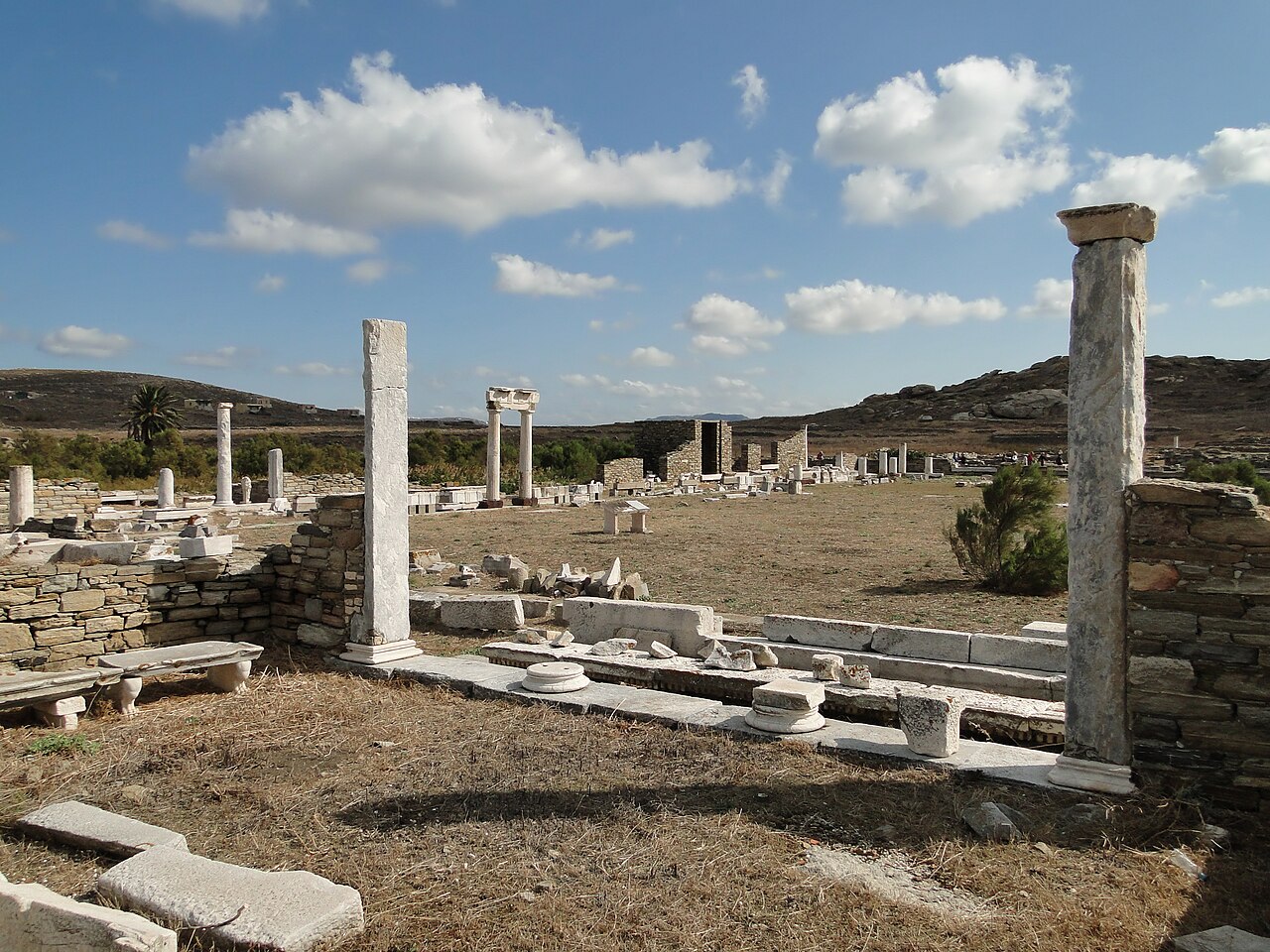
Photo: Bernard Gagnon, Wikimedia Commons, licensed CC BY-SA 3.0; reproduced unmodified.
It was a punishment aimed at Rhodes, which had been insufficiently enthusiastic about Rome’s war, and it worked. A few years later the Rhodian envoy Astymedes stood in front of the Senate and put a figure on it: the harbour dues that used to be farmed for a million drachmas a year were now fetching a hundred and fifty thousand (Polybius 30.31). Rhodes had been the Aegean’s clearing-house, and the collection’s Helios didrachm belongs to the century when that was still true. After 167 the traffic went to Delos, and Delos belonged to Athens.
Dr. Peter van Alfen of the American Numismatic Society tells the whole five-hundred-year story of the owl in a quarter of an hour, and the New Style is where he ends up:
“500 Years of the Athenian ‘Owl’: an Introduction” — Dr. Peter van Alfen, Chief Curator, American Numismatic Society (2021, 14:42). Embedded from YouTube’s no-cookie domain.
An Athens with a free port needs international silver again. That is the best explanation anyone has for why a city that had not struck a serious tetradrachm since the 290s suddenly began striking them by the month.
The reverse system is the reason collectors care about these coins, and it is worth reading this one out in full.
Two names sit in the field as a pair: ΑΦΡΟΔΙΣΙ and ΔΙΟΓΕ. These are the two annual officials, and they hold office together for a year. Below them is a third, shorter name — here ΕΥΜΑ — which changes through the year; a single annual pair can be found with a dozen different third names. Beside the owl, the double cornucopia bound with fillets is the control symbol chosen for that year, and it identifies the ΑΦΡΟΔΙΣΙ–ΔΙΟΓΕ issue at a glance. On the amphora itself is the letter Β.
That Β is the whole trick. The letters running Α to Μ on the amphora were shown by George Macdonald in 1899 to be the months of the Attic lunar year, with Ν added in the intercalary years that carried a thirteenth month. Β is the second month, Metageitnion — late summer. So this coin does not merely belong to a year; it belongs to a month within it, and the monthly official whose name is ΕΥΜΑ is the man who was on duty when it was struck. Coins were not made every month — output followed demand, and only busy years show the full run of letters — which is why a complete month-series is a thing New Style collectors chase.
The names themselves are abbreviated on the die and are left abbreviated here. Christian Habicht’s 1991 study is the attempt to match them against the Athenian prosopography, and the expansions are not all secure; “Aphrodisi-” is where the die stops, and it is where this page stops too.
The two letters in the exergue, ΜΕ, are genuinely unexplained. Three readings are in circulation and none has won. Heritage catalogued this coin with them as the engraver’s initials. An older tradition took them for the mint’s officinae. Svoronos proposed that they name the silver mines of Laurion, or the contractors working them, which would make them a note of where the metal came from — on that reading about six mines were in more or less constant production and another twenty appear only occasionally. It is the most attractive of the three because it would tie the coin to the Laurion workings that had funded Athenian silver since the fifth century, but attractive is not proved, and the question is open.
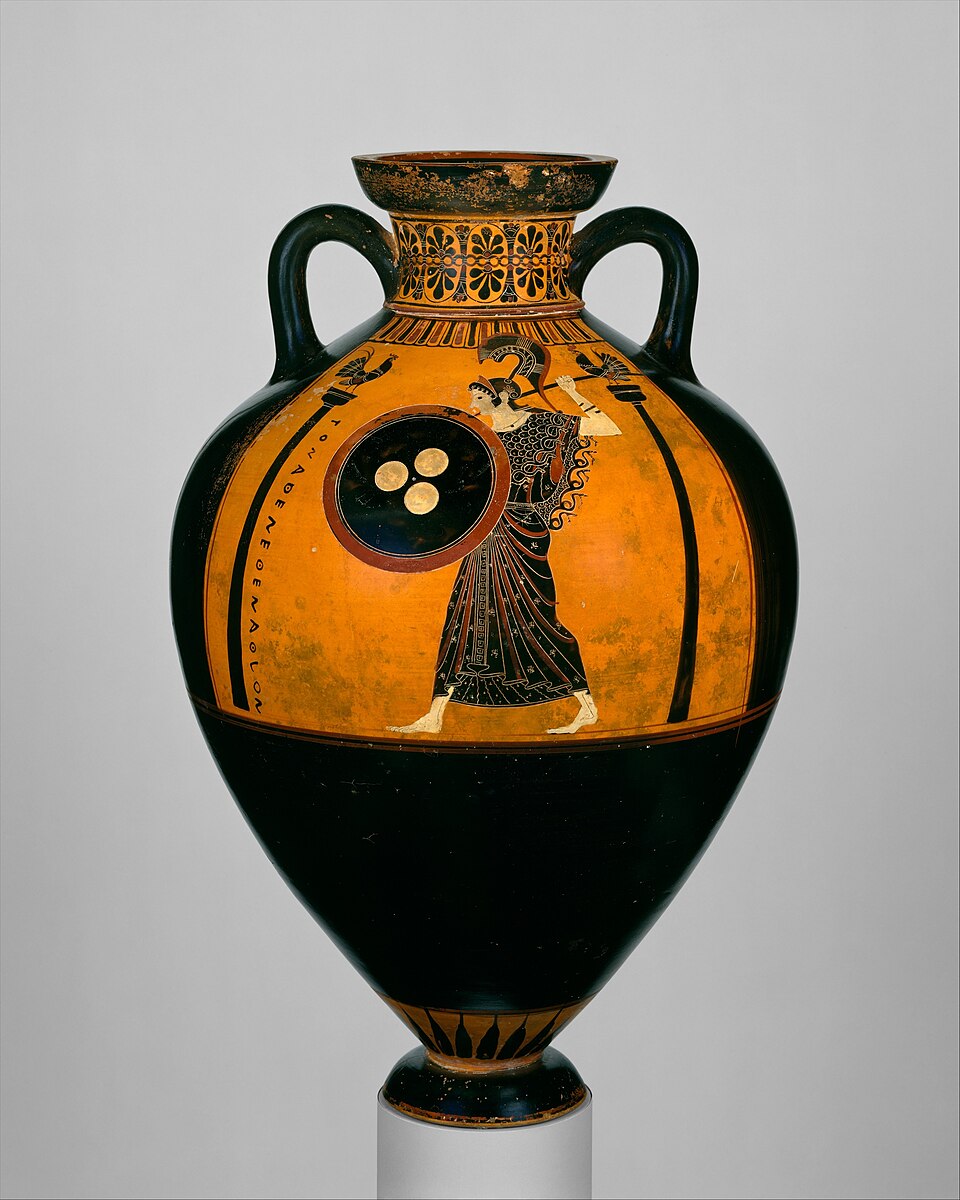
Photo: Metropolitan Museum of Art, CC0, via Wikimedia Commons; reproduced unmodified.
Putting that amphora under the owl was not decoration. The classical owl had a crescent and an olive spray; the New Style owl stands on the prize vessel of the city’s own festival, inside a closed olive wreath. Both are Athenian trademarks, and both say the same thing the coin’s silver said — that this is Athens — but the New Style says it with the confidence of a city advertising an institution rather than simply repeating a design.
There is one piece of hard evidence about where these particular coins went, and it lands very close to this one. François de Callataÿ examined five hoards found in Macedonia and noticed that a short run of consecutive Athenian issues is wildly over-represented in them and scarce almost everywhere else. The issues he names — Epigenes–Sosandros, Polemon–Alketes, Mikion–Eurykleides and Karaichos–Ergokles — are the years immediately preceding this coin’s own. His conclusion is that for four or five years in the late 120s BC most of the Athenian mint’s output was being sent north, and that the people who wanted it there were the Romans, paying for their armies in Macedonia.
The ΑΦΡΟΔΙΣΙ–ΔΙΟΓΕ year, to which this coin belongs, follows directly on that episode. Whether the flow had stopped by then is not something a single coin can settle, and de Callataÿ does not extend his argument this far. But it places the object precisely: struck in the second month of a year at the end of a decade in which Athens’ civic silver had been functioning, in part, as a Roman military payroll. The owl was still an Athenian coin. It was no longer only an Athenian coin.
The obverse deserves a moment because it is the clearest break with everything before it. The classical owl’s Athena is deliberately archaic; the pi-style Athena moved to a profile eye but kept a small, dry helmet. Here the helmet has grown into an object of display — a triple crest, a vine scroll along the bowl, a Pegasos flying above the cheek-piece and the foreparts of four horses ranged above the visor.
That helmet is not invented. Pausanias, describing Pheidias’ great gold and ivory Athena inside the Parthenon, says its helmet carried a sphinx in the middle and a griffin on either side (1.24.5). The coin’s engravers were working from the statue standing a few hundred meters from the mint, substituting a Pegasos for the griffin and adding the horses. After a century and a half in which Athens had struck almost no silver of its own, the city put its most famous possession on the coin — and, unlike the archaizing owl, made no attempt to pretend the intervening centuries had not happened.
The series ran on, month by month, into the first century, and then Athens made the worst decision in its later history. In 88 BC, with Mithradates VI of Pontos presenting himself as the champion of the Greeks against Rome, an Athenian named Aristion seized the city with Pontic backing. The mint kept working — and put the king’s name on the owl.
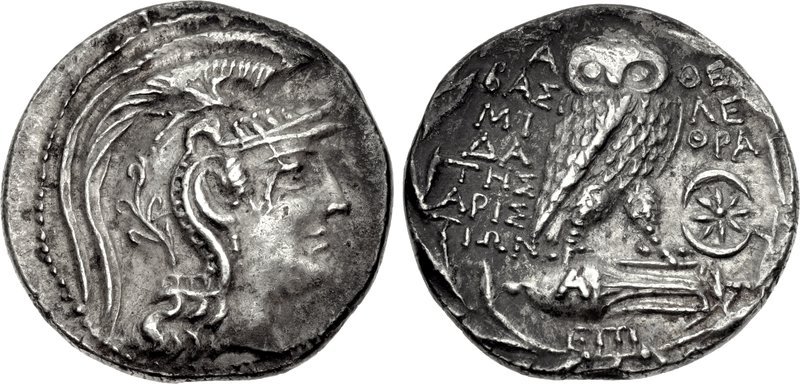
Photo: Classical Numismatic Group, Wikimedia Commons, licensed CC BY-SA 2.5; reproduced unmodified.
Sulla came, besieged Athens through the winter of 87/86 and stormed it in March. Plutarch reports that while wheat inside the walls reached a thousand drachmas the bushel, Aristion was still holding drinking parties; Sulla had him poisoned afterwards (Sulla 12–14, 23). The city was sacked, and the Piraeus burned. Coinage in the New Style continued in a reduced way for another forty years or so, running out around the 40s BC — the same decade in which the Roman Republic that had reshaped the Aegean destroyed itself.
The owl outlived the empire that first made it famous, the Macedonian conquest, and a century and a half of silence. It did not outlive Rome. This coin, struck in the second month of a year near the end of the second century BC, catches the series at its most self-assured: an old design rebuilt, a well-run mint dating its own output to the month, and a city rich again on the traffic of an island Rome had given it — with no way of knowing what that gift had cost, or what it would cost.
Margaret Thompson, The New Style Silver Coinage of Athens (ANSNS 10, 1961) is the corpus and the source of this coin’s number; Oliver Hoover, HGC 4, 1602 for the type. On the chronology: D. M. Lewis, NC 1962, 275–300; C. Boehringer, Zur Chronologie mittelhellenistischer Münzserien 220–160 v. Chr. (AMUGS V, 1972); O. Mørkholm, ANSMN 29 (1984), 29–42; H. B. Mattingly, NC 150 (1990), 67–78. On the magistrates, C. Habicht, Chiron 21 (1991), 1–23. On the month letters, G. Macdonald, “Amphora letters on coins of Athens,” NC 19 (1899), 288–321, with J. Sundwall, Untersuchungen über die attischen Münzen des neueren Stiles (1907) on the third magistrate and the double dating. For the Macedonian hoards and the movement of this silver, F. de Callataÿ, “Athenian ‘New Style’ Tetradrachms in Macedonian Hoards,” AJN 3–4 (1991–1992), 11–20 (PDF available). J. H. Kroll, The Greek Coins (Athenian Agora XXVI, 1993) for the Athenian series as a whole. Ancient sources: Polybius 30.31 for Rhodes and the free port; Pausanias 1.24.5 for the Parthenos helmet; Plutarch, Sulla 12–14 and 23 for the siege and Aristion. The issue-by-issue table on NumisWiki, linked above, is the most convenient free guide to reading a New Style reverse.
THE SEQUENCE IS THOMPSON'S; THE DATE IS NOT. Margaret Thompson's 1961 corpus established the order of the New Style issues by die-linkage, and that order has held; her absolute chronology has not. She began the series in 196 BC, and it is now placed about thirty years lower, from roughly 165/164 BC (Lewis 1962; Boehringer 1972; Mørkholm 1984; Mattingly 1990). Modern tickets therefore carry a Thompson NUMBER beside a date that is not Thompson's — which is why NGC prints this coin's date with a question mark. Attic weight standard, nominally 17.2 g but in practice running near 16.7 g on the New Style flans; broad, thin fabric. THE EXERGUE LETTERS ARE UNRESOLVED: the two letters below the amphora (ΜΕ here) have been read as mint officinae, as the initials of the die-engraver (so the Heritage cataloguing of this coin), and — following Svoronos, and still the commonest view — as the silver mines of Laurion or the contractors working them. No reading is established; the page leaves it open. The abbreviated magistrate names are likewise not expanded with certainty here; Habicht 1991 is the prosopographical treatment.
John's Ancient Coin Collection · Type · athens-new-style-owl-tetradrachm
Image credits for this coin — photographs, maps and graphics used on this page