Type · philip-ii-caesar-principi-ivvent-antoninianus
Current: Roman Imperial, Philip II as Caesar, AR antoninianus, Rome, AD 244–246 (RIC IV.III [Philip I] 218d)
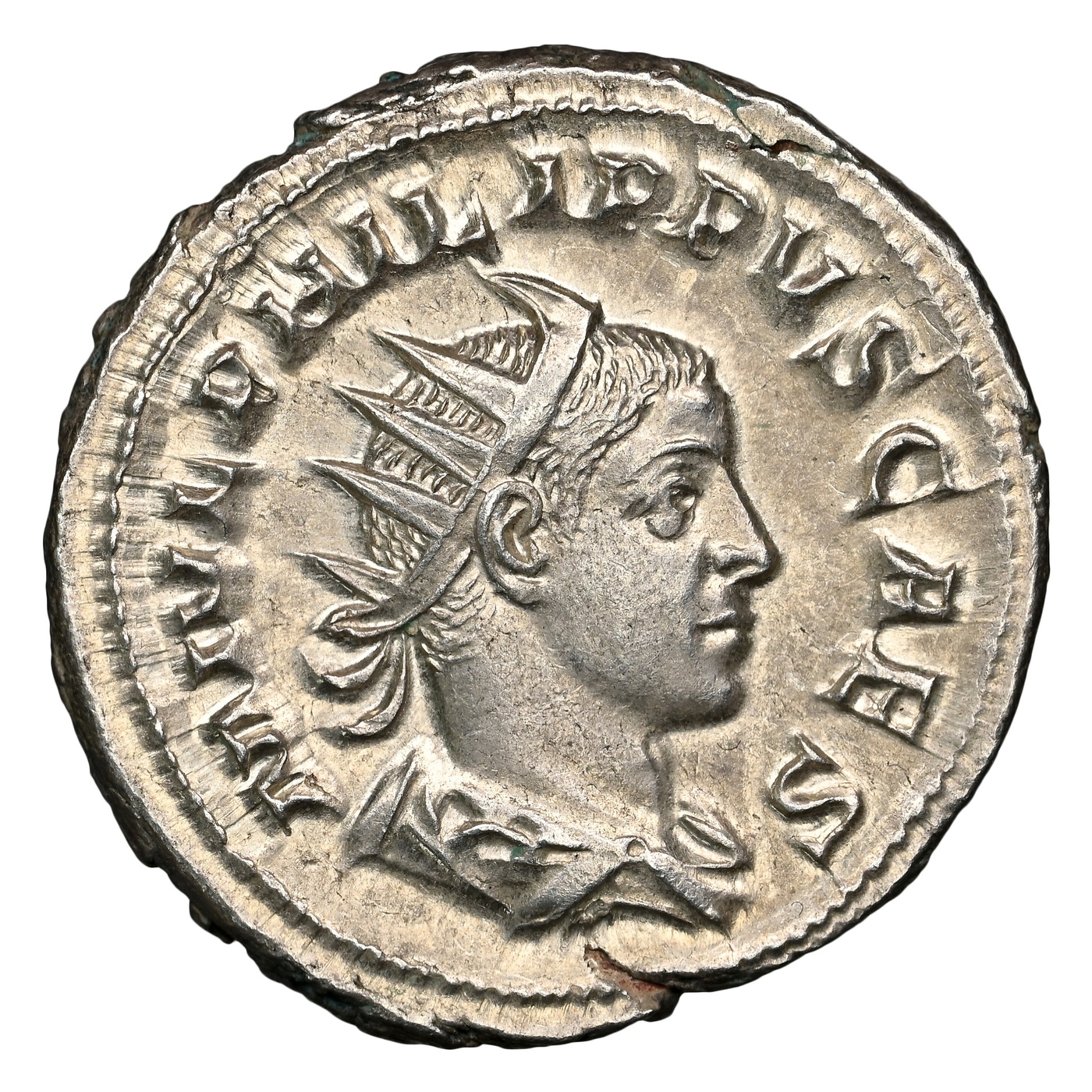
Obverse: Radiate, draped and cuirassed bust of Philip II right, seen from behind
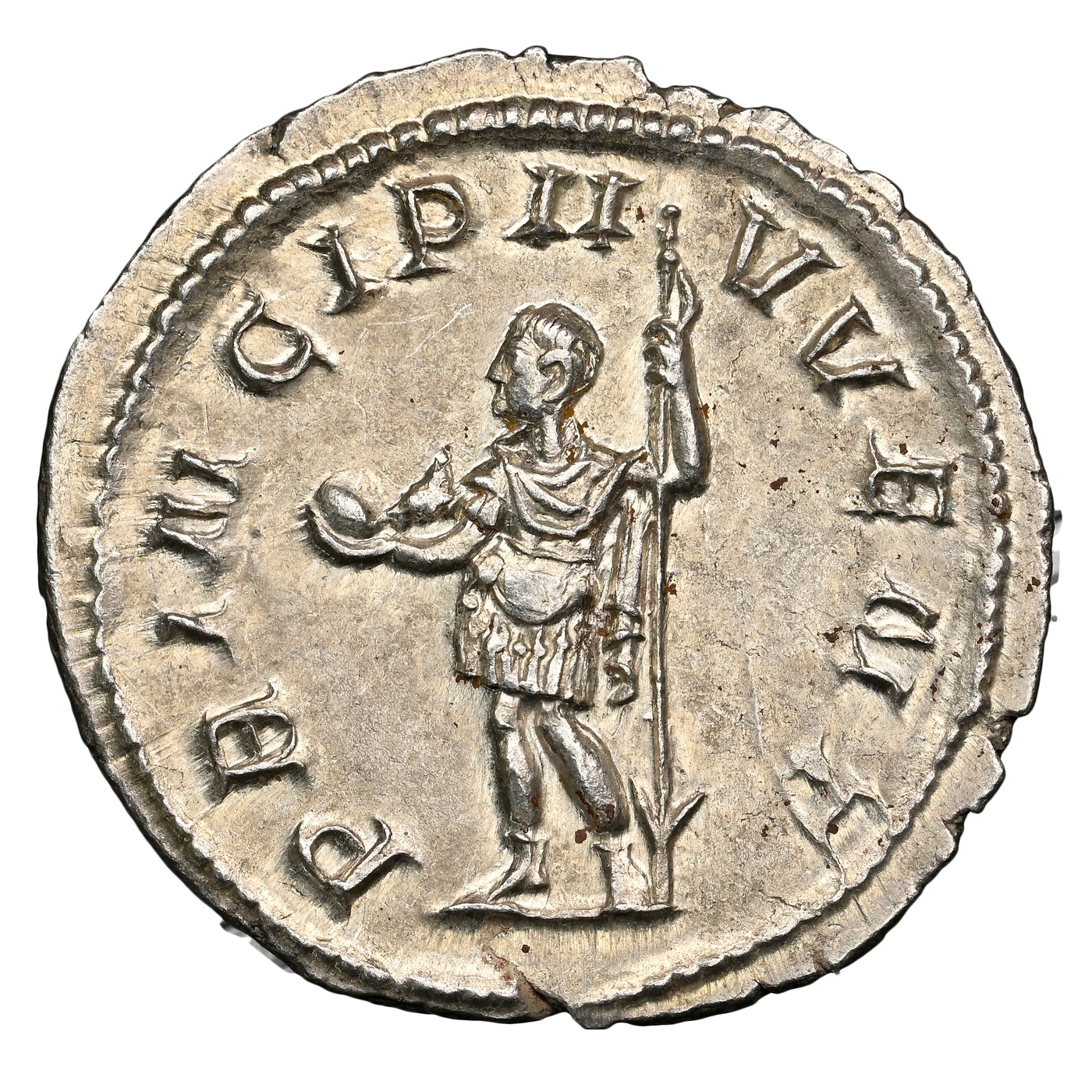
Reverse: Philip II standing facing, head left, globe in outstretched right hand, grounded reversed spear in left
Primary reference: RIC IV.III (Philip I) 218d
34 specimens in public collections (ANS 13, Ashmolean 11, Göttingen 3, Fitzwilliam 2, Getty Museum 1); 3 British finds recorded by the Portable Antiquities Scheme; weights 3.04–5.05 g, median 3.97 g across 34 recorded; die axis most often 12h.
American Numismatic Society, 1924.102.21. CC BY-NC 4.0. https://numismatics.org/collection/1924.102.21
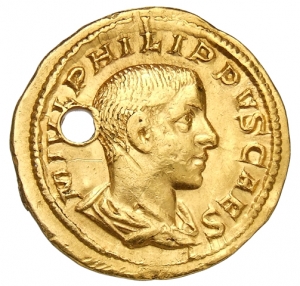
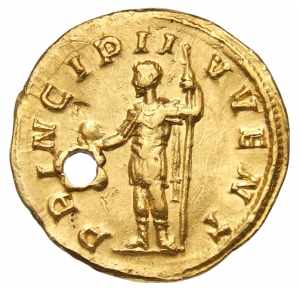
Münzkabinett, Staatliche Museen zu Berlin, 18203384. CC BY-NC-SA 4.0. https://ikmk.smb.museum/object?id=18203384
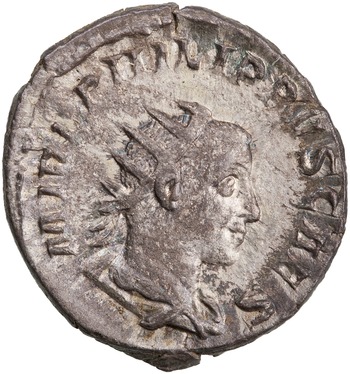
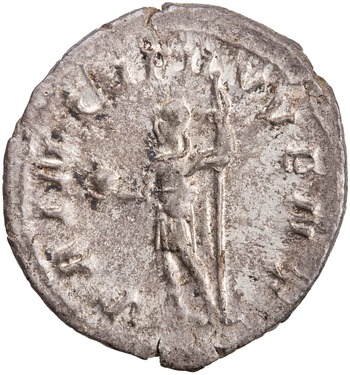
American Numismatic Society, 1944.100.18402. CC BY-NC 4.0. https://numismatics.org/collection/1944.100.18402
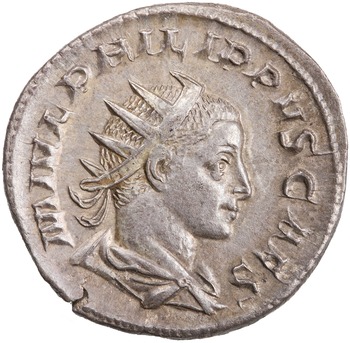
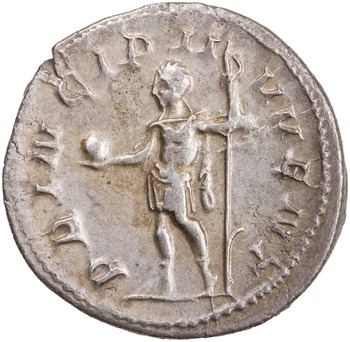
American Numismatic Society, 1944.100.18404. CC BY-NC 4.0. https://numismatics.org/collection/1944.100.18404
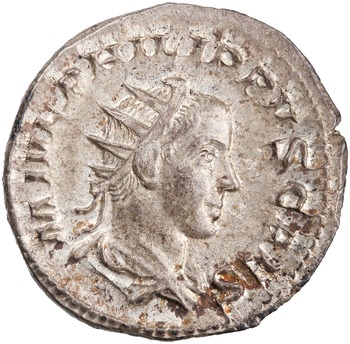
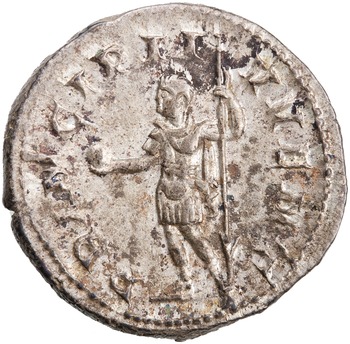
American Numismatic Society, 1947.97.148. CC BY-NC 4.0. https://numismatics.org/collection/1947.97.148
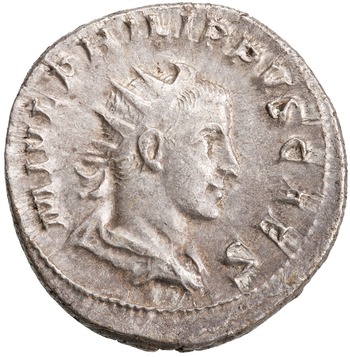
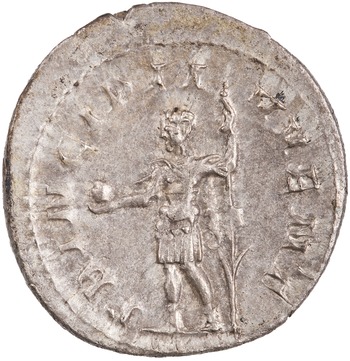
American Numismatic Society, 1948.19.668. CC BY-NC 4.0. https://numismatics.org/collection/1948.19.668
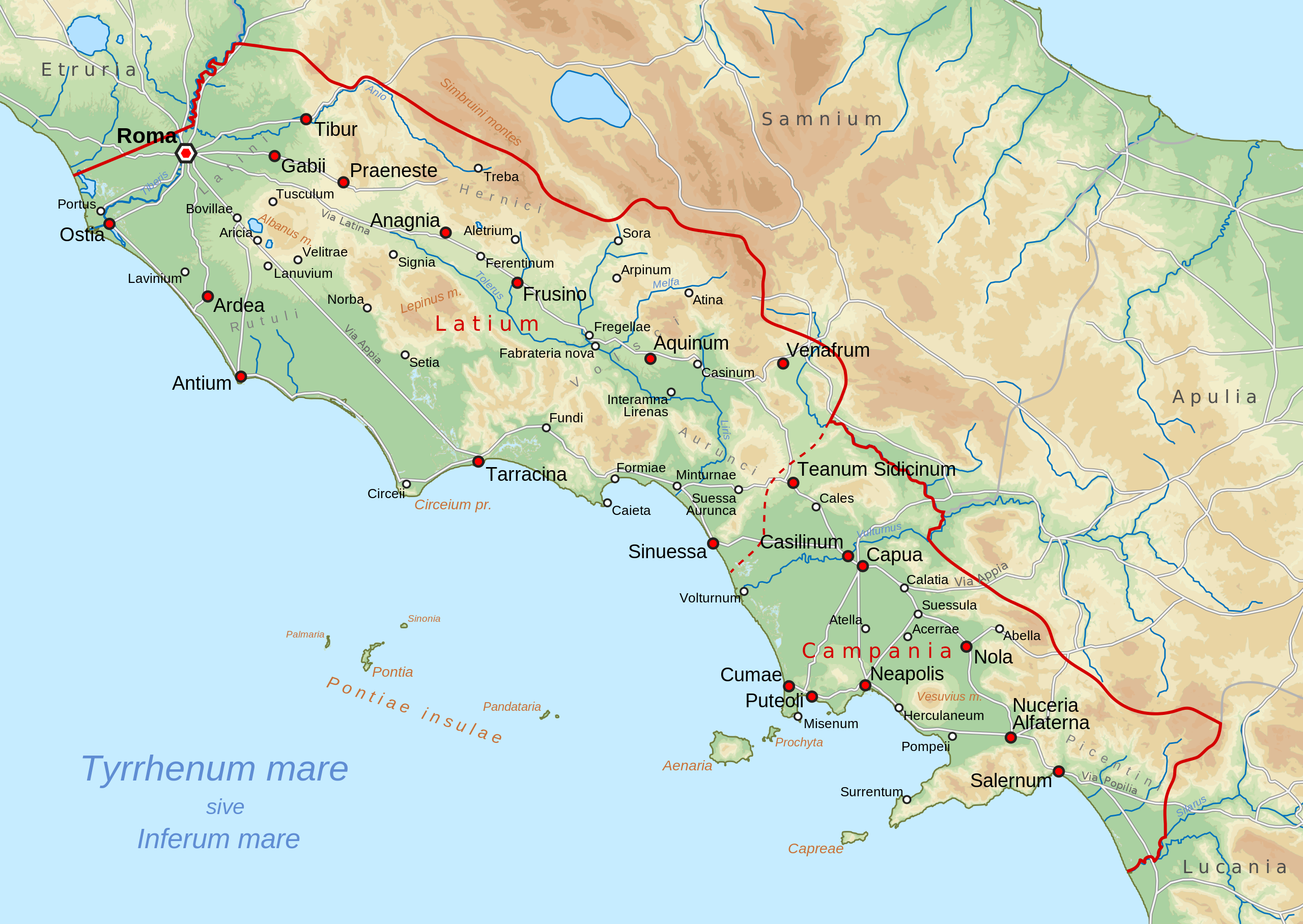
Regio I, Latium et Campania — Roman Italy as Augustus organized it. Roma sits at the upper left, marked by the map’s hexagonal capital symbol. This coin was struck in the city for a boy of six or seven while his father governed an empire he had acquired a thousand miles east of here, on the Euphrates. The same base map serves the collection’s Gordian III antoninianus — the emperor whose death put Philip I on the throne.
“Map of Augustan Regio I Latium et Campania” by Tomisti (Wikimedia Commons), File:Regio I Latium et Campania map.svg, licensed CC BY-SA 4.0; cities and roads based on the Digital Atlas of the Roman Empire (DARE) and Pleiades; topographic base © OpenMapTiles, © OpenStreetMap contributors. Reproduced unmodified.
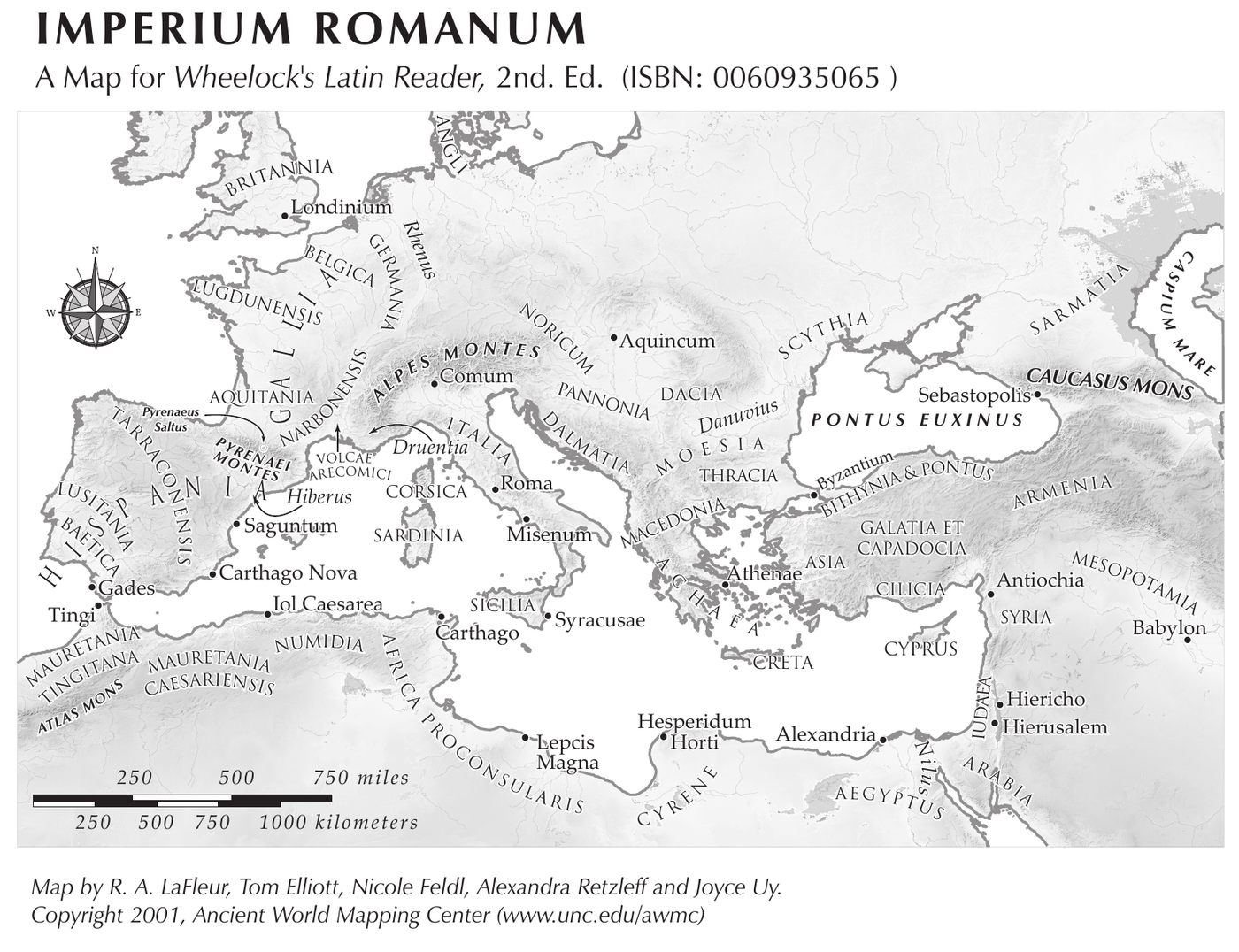
Roma sits at the center of Italia. Philip the Arab came from the province of Arabia, at the right of this map, and made peace with Persia to get to Rome. His son, the Caesar of this coin, was killed in the city at eleven or twelve years old.
The reverse of this coin says PRINCIPI IVVENT — principi iuventutis, “to the leader of the youth” — and shows the leader in question holding a globe. He was about six or seven years old.
Marcus Julius Severus Philippus was born around AD 237 or 238. In the spring of 244 his father became emperor somewhere on the Euphrates, and the boy was made Caesar. In July 247 he was raised to Augustus, co-ruler in name with his father. In the late summer of 249 he was killed. He was eleven, perhaps twelve.
This is his coinage of the middle period — Caesar, not yet Augustus, heir apparent to a dynasty that would last five years.
Philip I came to power in the first months of 244, in the middle of a Persian war, immediately after the death of the young Gordian III. What happened is genuinely disputed, and the dispute is not a matter of emphasis — the two traditions describe different events.
The Roman sources say Gordian’s eastern campaign was going well and that Philip, his praetorian prefect, engineered his death: starving the army of supplies, turning the troops against him, and having him killed. This is the version in the Historia Augusta and, with variations, in Zosimus and Zonaras. It is the version Rome told about itself, and it never concedes a defeat.
The Sasanian source says something else entirely. Shapur I’s trilingual inscription at Naqš-e Rostam — the Res Gestae Divi Saporis, cut around 260 — records a battle at Misiche on the Euphrates in which “Gordian Caesar was killed and the Roman force was destroyed. And the Romans made Philip Caesar. Then Philip Caesar came to us for terms, and to ransom their lives, gave us 500,000 denars, and became tributary to us.” Shapur renamed the site Peroz-Shapur, “Victorious is Shapur.”
Modern scholarship has not settled it. Dignas and Winter accept that Gordian died in the battle. Syvänne and Maksymiuk reconstruct a middle course — that he was injured falling from his horse and died afterwards at Zaitha, possibly at the hands of Philip’s supporters. The battle itself is dated between 13 January and 14 March 244.
The point worth holding on to is that this coin’s issuer was a child whose claim to the empire rested on an event nobody could agree about even at the time. A Roman looking at PRINCIPI IVVENT in 245 and a Persian looking at the inscription at Naqš-e Rostam were being told incompatible things about the same few weeks.
Graphic: JSB Coins, 2026 (CC0).
Princeps iuventutis was not an office. It was an honorific voted by the equestrian order, and it had one meaning on coinage: this is the heir.
Its origin is in this collection already. Augustus’ grandsons Gaius and Lucius Caesar were given the title in 5 and 2 BC, and the denarius struck for them — the Gaius and Lucius Caesares denarius — is the founding statement of the idea: two boys, shields and spears, the succession advertised as settled. Both were dead within eight years, and the succession passed to Tiberius, whom Augustus had not wanted.
Two and a half centuries later the formula was still doing the same work and still failing in the same way. The globe in Philip II’s hand is the world he was to inherit; the reversed spear, grounded, is the peaceful authority he was to inherit it with. He inherited neither.
The 240s did not reward legitimacy, but everybody kept claiming it anyway. In the fifty years between the murder of Severus Alexander in 235 and Diocletian’s accession in 284 the empire ran through more than twenty men who could plausibly be called emperor. Almost none died in bed.
A soldier proclaimed by his troops on a frontier had nothing except the troops. What he could manufacture was the appearance of a dynasty, and the cheapest way to manufacture it was to put a son on the coinage. Philip I did it thoroughly: Philip II as Caesar from 244, as Augustus from 247, his wife Otacilia Severa as Augusta throughout. Three faces, one family, in every pay chest in the empire.
It nearly worked. In April 248 Rome celebrated its thousandth birthday with Secular Games of extraordinary scale, and Philip I and his son presided over them. For a moment the Arab from Shahba who had come to power in a disputed Persian campaign was the emperor who had brought Rome to its millennium.
Within a year the Danube legions proclaimed Decius. Philip I was killed at Verona in the late summer of 249. Zosimus says the boy was killed at Rome, in the praetorian camp. Decius took the throne and died two years later at Abritus, the first Roman emperor to fall in battle against a foreign enemy.
The antoninianus was Caracalla’s invention — introduced in 215, marked as a double denarius by the radiate crown on the emperor’s head (a veiled or diademed bust with a crescent beneath for an empress), but struck at roughly one and a half denarii of silver. It was, from the beginning, a way of paying more with less.
By Philip’s reign it had displaced the denarius almost entirely and its fineness was falling steadily. The collection can watch the whole slide across four reigns: Caracalla at the start, Gordian III immediately before this coin, Aurelian at the bottom of it, when an “antoninianus” was a bronze with a silver wash.
The bust seen from behind — draped and cuirassed, the shoulder turned toward the viewer — is the less common of the two arrangements for this type and the more interesting to look at: it gives the portrait depth that the flat profile does not.
The Sasanian account is Shapur I’s own, in the Res Gestae Divi Saporis at the Ka’ba-ye Zartosht, Naqš-e Rostam. The Roman tradition is in the Historia Augusta, The Three Gordians, and in Zosimus, New History 1.18–22 — the latter also for the deaths of 249. The modern disagreement over Misiche, and the positions of Dignas and Winter against Syvänne and Maksymiuk, is set out with citations in the linked survey. The type is RIC IV.III (Philip I) 218d; OCRE was unreachable when this page was written, so the reference has not been checked against the ANS record.
PRINCIPI IVVENT with globe and reversed spear is Philip II's principal Caesar-period antoninianus at Rome, RIC IV.III (Philip I) 218d, struck AD 244–246. The bust seen from behind (a tergo) is the less common of the two arrangements for the type. NOTE A CHRONOLOGICAL TRAP IN THE SALE CATALOGUING: Heritage's lot title reads 'Philip II, as Caesar (AD 247-249)', which conflates two things — 244–247 is the Caesar period, 247–249 the Augustus period, and this coin's own dating of AD 244–246 belongs to the first. The title is wrong; the description is right. By the mid-240s the antoninianus, introduced by Caracalla in 215 as a radiate double-denarius, was the workhorse silver of the empire and running well under 50 per cent fine.
John's Ancient Coin Collection · Type · philip-ii-caesar-principi-ivvent-antoninianus
Image credits for this coin — photographs, maps and graphics used on this page