Type · lysimachos-athena-lion-ae18
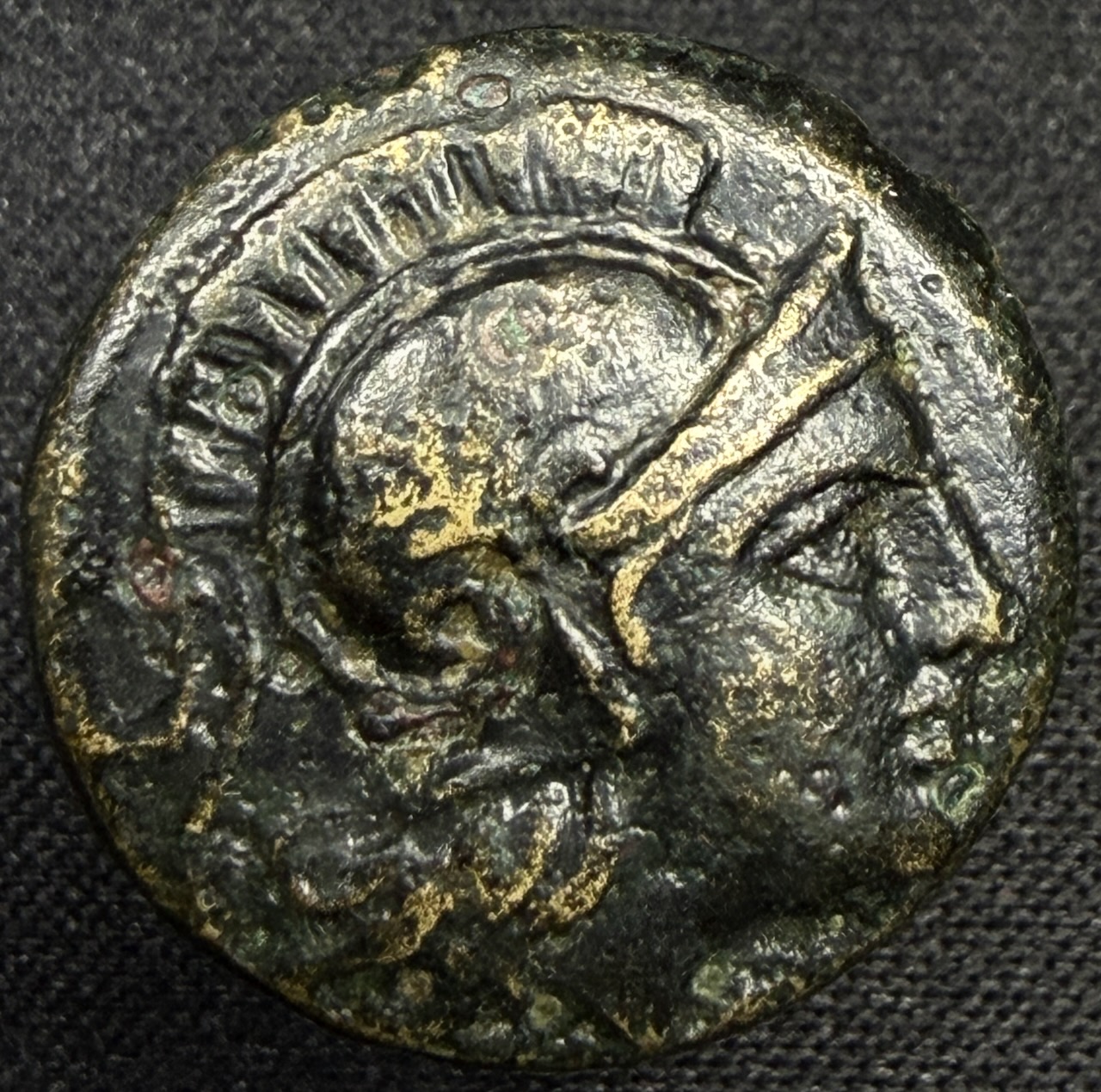
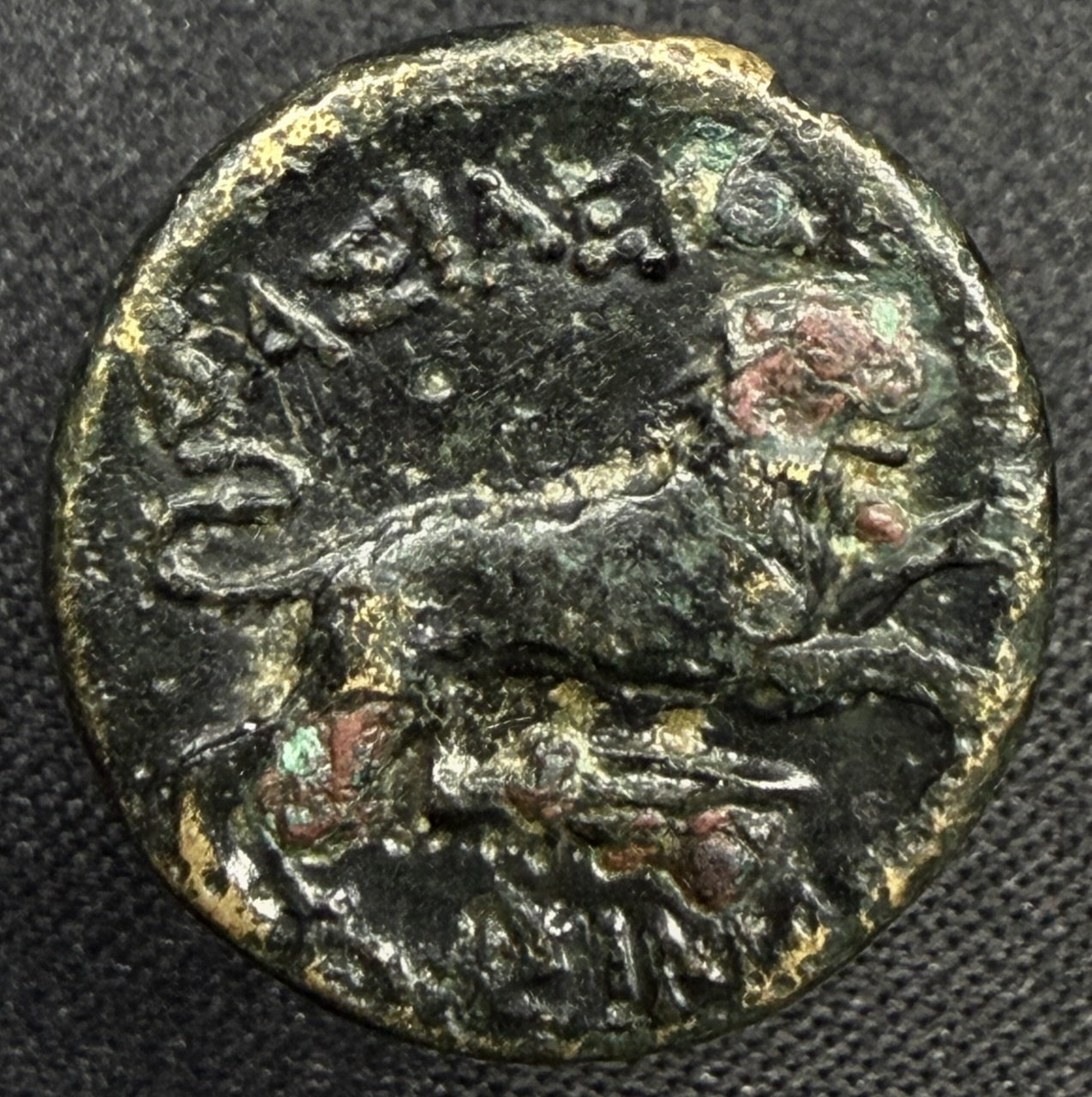
Current: Kings of Thrace, Lysimachos, AE18 unit, Lysimacheia, c. 305–281 BC (SNG Copenhagen 1149)
Obverse: Head of Athena right, wearing crested Attic helmet
Reverse: Lion running (leaping) right; spearhead below
Primary reference: SNG Copenhagen 1149
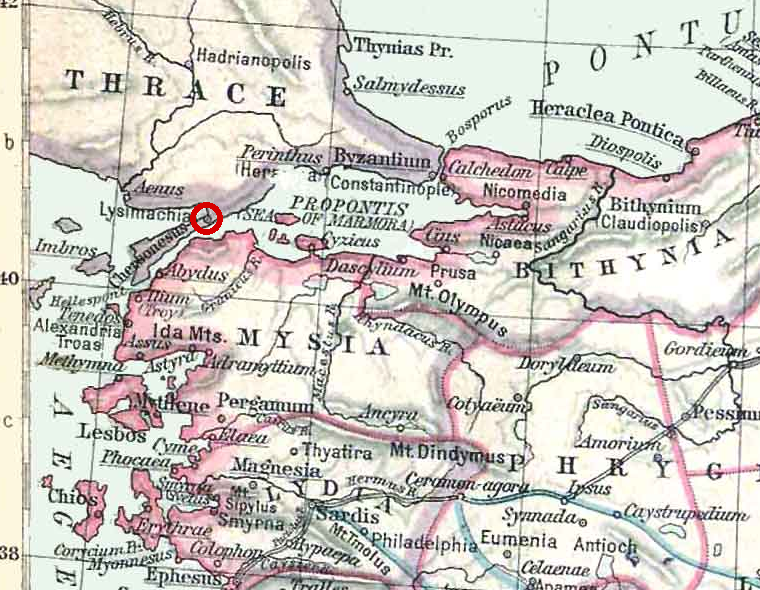
Thrace, the Propontis, and the Hellespont on Shepherd’s map of the Greek and Roman East. Lysimacheia — circled in red — sits on the neck of the Thracian Chersonese (the Gallipoli peninsula), the land bridge between Europe and Asia. Lysimachos founded the city in 309 BC as his capital and named it after himself; from here he controlled both the peninsula and the crossing to Asia Minor. Byzantion, whose bull-on-dolphin silver is also in this collection, guards the other exit of the Propontis to the northeast.
“Asia Minor under the Greeks and Romans” from William R. Shepherd, The Historical Atlas (1923), via Wikimedia Commons, File:Asia minor-Shepherd 1923.JPG (https://commons.wikimedia.org/wiki/File:Asia_minor-Shepherd_1923.JPG). Public domain (author died 1934); credited as a courtesy. Modified by JSB Coins: cropped to Thrace, the Propontis, and the Hellespont, and a red circle added to mark Lysimacheia.
Lysimachos (c. 360–281 BC) was one of the somatophylakes, the seven-man royal bodyguard of Alexander the Great, and he ended his life as king of Thrace, Macedonia, and much of Asia Minor — the last of Alexander’s generation standing but one. This small bronze, struck with his name and royal title around a running lion, is the everyday money of that improbable career: the coin a soldier or market-woman in the Thracian Chersonese would actually have handled, while the famous gold and silver with Alexander’s horned portrait served payrolls and international trade.
His origins were, by the hostile account at least, humble — and they connect this coin to another in this collection. The historian Theopompos (quoted by Athenaeus) sneered that Lysimachos’ father Agathokles began as a penestes — a Thessalian serf — from Krannon who flattered his way into the favor of Philip II. Other sources present the family instead as respectable Thessalian stock naturalized at Pella, where Lysimachos was raised at court; Theopompos is a notorious polemicist, and the serf story should be read as invective rather than fact. Either way, the family was Thessalian, and Lysimachos rose entirely through the Argead court and army.
Graphic: JSB Coins, 2026 (CC0).
At Babylon in 323 BC, when Alexander’s marshals divided the empire, Lysimachos received Thrace — a poor, hard frontier command wedged between the Macedonian homeland and the warlike Thracian and Getic tribes, but one that controlled the straits between Europe and Asia. He spent two decades subduing it. In 309 BC he founded Lysimacheia on the neck of the Thracian Chersonese as his capital and strategic anchor, and in 306/5 BC, after Antigonos Monophthalmos and Demetrios took the royal title, Lysimachos followed suit along with Ptolemy, Seleukos, and Kassandros — the moment the fiction of a unified empire was formally abandoned. The legend on this coin’s reverse, ΒΑΣΙΛΕΩΣ ΛΥΣΙΜΑΧΟΥ, “of King Lysimachos,” dates the type to after that assumption of royal style.
The victory at Ipsos in 301 BC, won with Seleukos against Antigonos, made Lysimachos master of western Asia Minor and one of the richest of the successors. His rule there left a scar on another of this collection’s mint cities: rebuilding Ephesos as his showpiece Arsinoeia around 294 BC, he forcibly transplanted the people of Kolophon into it — the Kolophonians fought the removal, and their old city, an Alexander-tetradrachm mint just a generation earlier, never recovered its rank (Pausanias 7.3.4). His last decades were spent accumulating — Macedonia itself came to him in 285 BC — until dynastic murder (the execution of his own heir Agathokles) shattered his court and gave Seleukos I his opening. At Koroupedion in Lydia in 281 BC the two old comrades of Alexander, both around eighty, met in the last battle of the Diadochi; Lysimachos fell on the field.
The lion was Lysimachos’ personal badge, and the ancient tradition explains it with a story of spectacular courage: while hunting with Alexander in Syria, Lysimachos killed an enormous lion single-handed, bearing the scars ever after (Curtius 8.1.14–17; Justin 15.3.7–8 embellishes the tale into Alexander deliberately caging him with the beast as punishment). Whatever the truth of the anecdote, the king made the lion his emblem — it appears on his bronzes, as here, and as the lion forepart on other issues — a personal heraldry doing the work that Alexander’s portrait did on the silver: attaching the authority of a legend to the coin in hand.
Athena on the obverse is equally programmatic. She is the divine patron of Lysimachos’ royal coinage — his great silver tetradrachms show Athena Nikephoros enthroned, extending a Nike to crown his name — and her helmeted head here echoes, at the humblest denomination, the same claim: the warrior-goddess stands behind the warrior-king. The pairing also kept faith with familiar Macedonian models; the head-of-a-deity obverse over a single animal reverse follows the pattern of the bronze small change of Philip II and Alexander that circulated throughout the region for decades.
Lysimachos left a portrait tradition, and fittingly its best-known surviving piece comes from Ephesos — the city he rebuilt on higher ground and renamed Arsinoeia, resettling the Kolophonians into it by force. A marble head in the Ephesus Archaeological Museum, a Roman copy of about AD 200–250 after a Hellenistic original, is identified as the king. That a Roman workshop was still copying his portrait more than four centuries on says something about the refounder’s footprint: Roman Ephesus lived inside the street grid and the great circuit wall Lysimachos gave it, and remembered — not always fondly — the king who had moved the city, dammed the old harbor road, and made its later greatness possible.
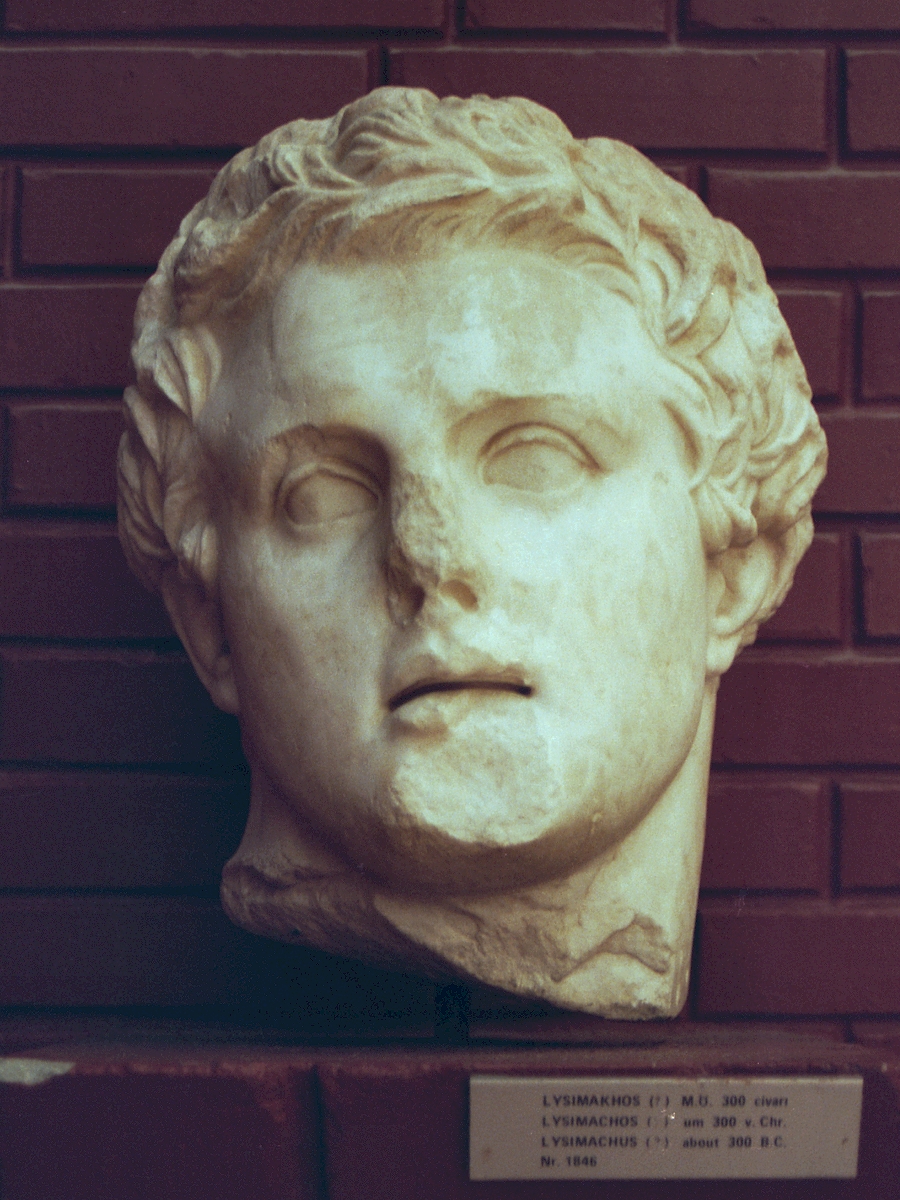
Photo: Zde, CC BY-SA 4.0 (Wikimedia Commons); reproduced unmodified.
Attribution: SNG Copenhagen 1149 (this variety, spearhead below lion); cf. Müller, Die Münzen des thracischen Königs Lysimachus (1858), 76, and Hoover, Handbook of Coins of Macedon and Its Neighbors, Part II (HGC 3.2), 1758, for the leaping-lion bronze series with its control-mark variants. The lion-hunt tradition: Quintus Curtius Rufus 8.1.14–17; Justin, Epitome 15.3.7–8. The Theopompan account of Agathokles of Krannon: Theopompos ap. Athenaeus, Deipnosophistai 6.259f–260a. Comparanda online: the Wildwinds Lysimachos index and the Numista entry for the Lysimacheia Athena/lion bronzes. Ipsos: Plutarch, Demetrius 28–30; Korupedion and the king’s death: Appian, Syriaca 62–64 (both linked in the references). The Ephesos head: Ephesus Archaeological Museum, no. 1846; Lysimachos’ rebuilding of Ephesos: Strabo 14.1.21 with Pausanias 1.9.7.
The Athena / running-lion bronzes are Lysimachos' standard royal small change, conventionally given to the Lysimacheia mint (so Numista and most dealer cataloguing; SNG Copenhagen groups them under Lysimacheia at nos. 1149 ff.). The series carries varying control marks below and around the lion — spearhead alone (as SNG Cop 1149, this type), or spearhead with kerykeion and monogram (SNG Cop 1153–4) — and the mint attribution of individual control-groups is not settled; treat 'Lysimacheia' as the conventional rather than a proven attribution. Module c. 17–19 mm, c. 4–6 g.
John's Ancient Coin Collection · Type · lysimachos-athena-lion-ae18
Image credits for this coin — photographs, maps and graphics used on this page