Type · krannon-hydria-cart-dichalkon
Current: Thessaly, Krannon, AE dichalkon, c. 350–300 BC (HGC 4, 385; BCD Thessaly II 119; Rogers 195/201)
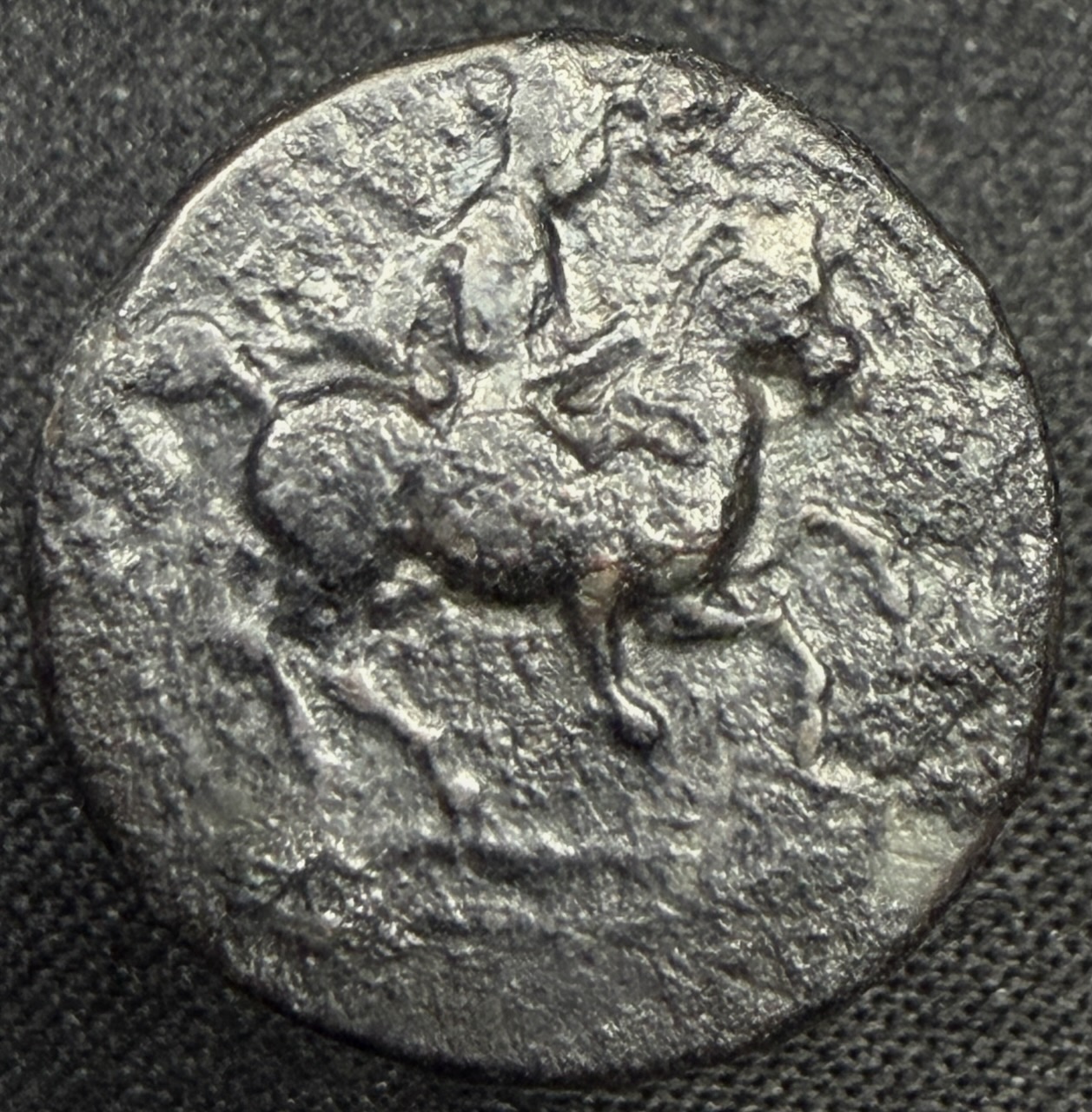
Obverse: Thessalian horseman wearing chlamys and petasos galloping right
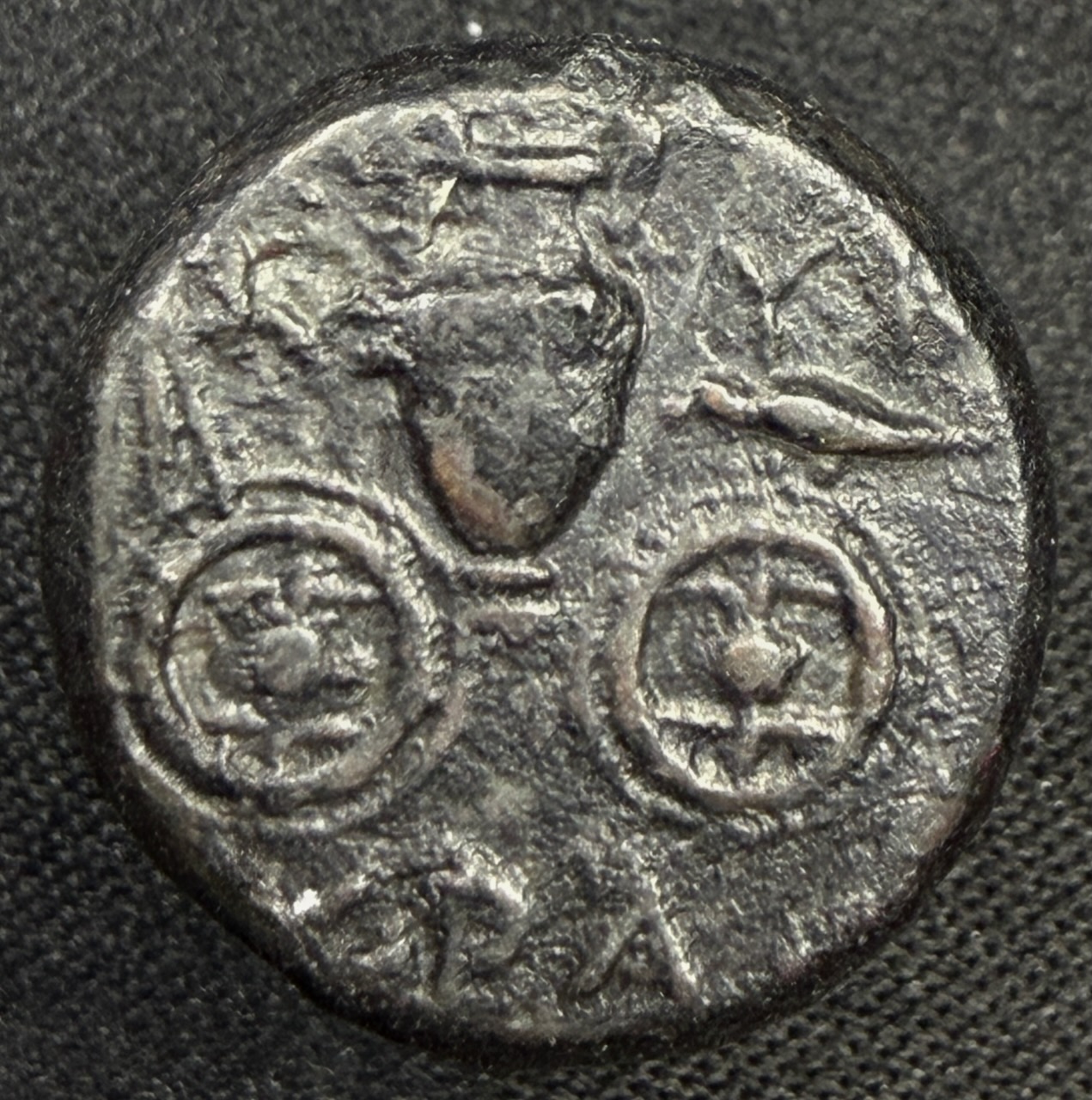
Reverse: Hydria (water jug) on a two-wheeled cart; crow perched at the wheel; city ethnic around (ΚΡΑ visible below on this specimen)
Primary reference: HGC 4, 385
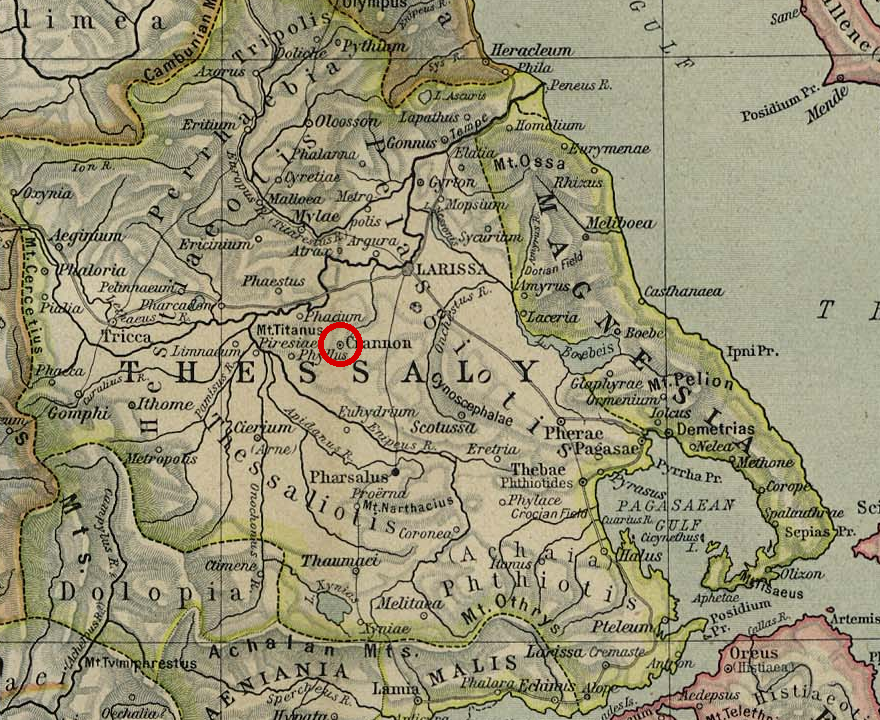
Thessaly on Shepherd’s reference map of northern ancient Greece. Krannon (“Crannon”) — circled in red — lies in the dry heart of the western Pelasgiotis plain, south-west of Larissa and north of Pharsalos, in the horse country that put riders on nearly all Thessalian coinage. Its inland, rain-dependent position is the whole point of this type’s reverse: no river god or harbor to appeal to — the Krannonians rattled a wagon at the sky.
“Reference Map of Ancient Greece, Northern Part,” from William R. Shepherd, Historical Atlas (1926 edition) — public domain; scan from the Perry-Castañeda Library Map Collection. Courtesy of the University of Texas Libraries, The University of Texas at Austin (https://maps.lib.utexas.edu/). Modified by JSB Coins: cropped to Thessaly, and a red circle added to mark Crannon (Krannon).
Almost every Greek coin type advertises a god, a hero, a local product, or a military boast. This little bronze of Krannon advertises a weather ritual. The reverse shows a hydria — a water jug — mounted on a two-wheeled cart, with a crow perched beside the wheel: the apparatus of a rain-making ceremony that the ancient paradoxographer Antigonos of Karystos thought curious enough to record. In time of drought, he says, the Krannonians would shake or drive the sacred wagon about while petitioning the god for rain, and the crows were part of the town’s civic badge (Antigonos, Historiarum mirabilium collectio 15). Head’s Historia Numorum reads the petitioned god as Zeus; dealer cataloguing often names Apollo instead, and the ancient notice does not settle it. Either way, it is one of the most direct depictions of ritual practice anywhere in Greek numismatics — not the deity, but the ceremony itself.
The setting explains the anxiety. Krannon (the older spelling Crannon appears on most maps) sat in the middle of the western Thessalian plain, home of the aristocratic Skopadai clan whose wealth in horses and herds Simonides sang for — splendid country in a wet year, dust in a dry one, with no great river close at hand. Poseidon, in Thessaly a god of springs, horses, and the cracked earth rather than the sea, dominated the city’s cults, and the horseman obverse belongs to the same world: the petasos-hatted, chlamys-flying rider is the badge of the Thessalian cavalry aristocracy generally, shared across the coinages of Larissa, Pharsalos, and later the refounded Thessalian League.
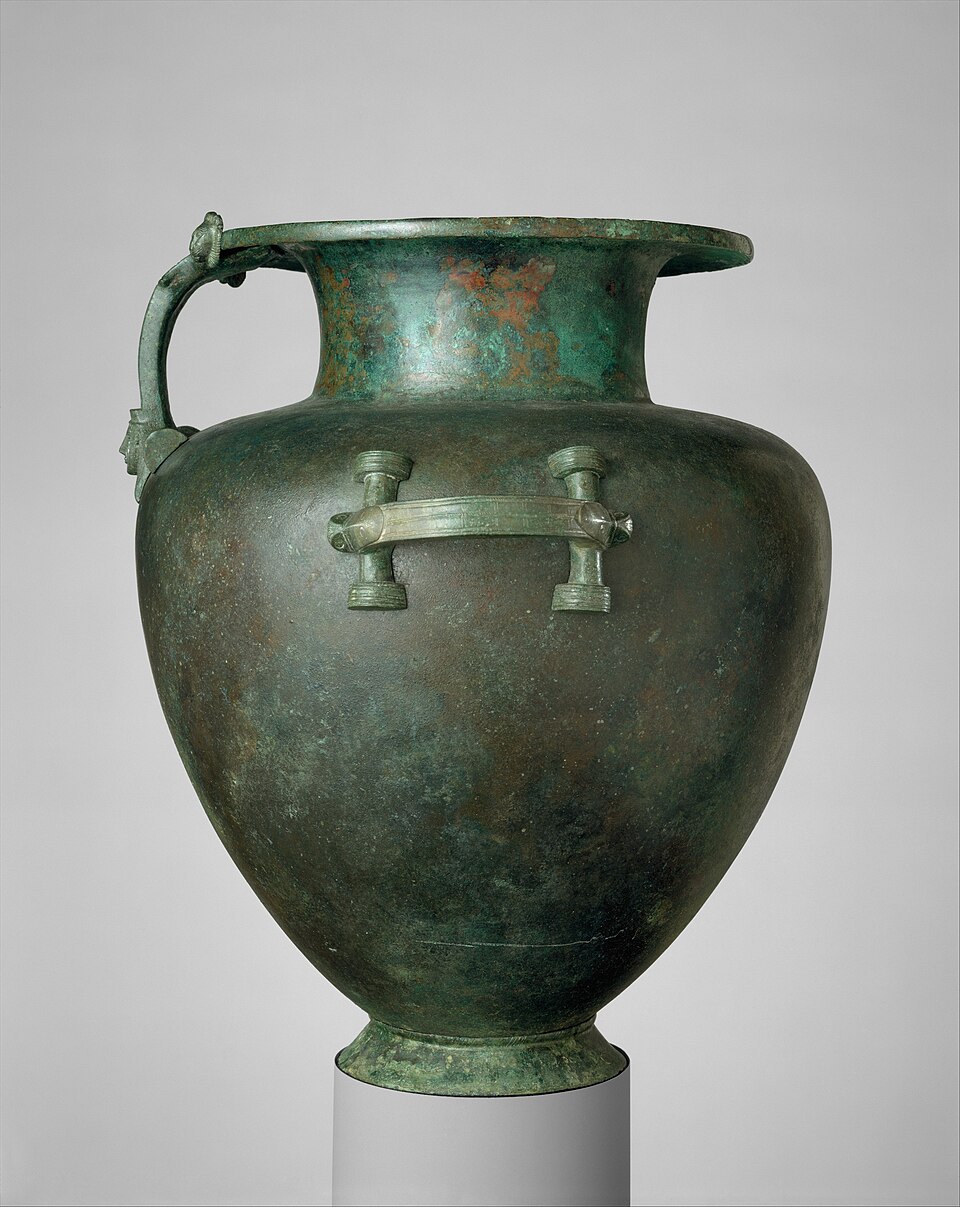
Image courtesy of the Met’s Open Access program (Wikimedia Commons, CC0); reproduced unmodified.
Krannon earns two other notices in the histories. Its lords the Skopadai were patrons of the poet Simonides, and the banquet-hall collapse that killed Skopas and his kin — from which Simonides alone walked out, having stepped outside to greet the divine Dioskouroi — became the founding legend of the art of memory. And in August 322 BC, within the date range of this coin, the plain outside Krannon saw the battle that ended Greek freedom in the old sense: Antipater’s Macedonians broke the Greek allies of the Lamian War there, and Athens’ democracy was extinguished in the settlement that followed. A market-goer at Krannon could plausibly have paid for bread with this coin while the armies formed up within sight of the walls.
There is also a family connection to another coin catalogued alongside this one. The hostile historian Theopompos claimed that Agathokles, father of Lysimachos — Alexander’s bodyguard and later king of Thrace — began as a penestes, a Thessalian serf, of this very town before rising at Philip II’s court. The story is invective and other sources make the family respectable Thessalian stock, but the tradition ties Krannon by name to one of the great careers of the age.
The horseman / hydria-cart bronzes exist in several closely related varieties (legend placement, flanking letters, one crow or two); the classic references are Rogers, The Copper Coinage of Thessaly 195–201, the BCD Thessaly collections (BCD Thessaly II 118–119), and now HGC 4, 385, which dates the group c. 350–300 BC. This specific variety is genuinely scarce: Marc Breitsprecher’s cataloguing of the collection’s specimen notes that the only other example he could find was CNG Electronic Auction 244 (10 November 2010), lot 64. A related variety with a laureate Zeus head obverse and two crows on the wheels (Rogers 202–203) carries the same cart; the BCD example of that type sold for CHF 1,500 hammer in 2011, an indication of how keenly Thessalian specialists pursue the rain-cart types.
Antigonos of Karystos, Historiarum mirabilium collectio 15, with B.V. Head, Historia Numorum (2nd ed., 1911), p. 292 (Crannon), which cites it — the Digital Historia Numorum entry for Crannon reproduces the passage; see also G. Macdonald, Coin Types (1905), p. 65. Catalogues: E. Rogers, The Copper Coinage of Thessaly (1932); Nomos, The BCD Collection: Coins of Thessaly (2011–12); O. Hoover, Handbook of Coins of Northern and Central Greece (HGC 4, 2014), no. 385; BMC Thessaly (Crannon 4–5); SNG Copenhagen (Thessaly) 43. Comparanda online: the Wildwinds Krannon index and the Numista entry for the Zeus / two-crows chalkon (BCD Thessaly I 1088). On the battle of Krannon: Diodorus Siculus 18.16–17.
The horseman / hydria-on-cart bronzes of Krannon exist in several closely related varieties distinguished by legend arrangement and flanking letters (Rogers 195–201; BCD Thessaly II 118–119); the two tags that came with the collection's specimen cite different Rogers numbers (195 on MRB's tag, 201 on an earlier ticket), and without Rogers' plates on hand the subvariety is left open. Denomination follows BCD/HGC ('dichalkon'); older references call these chalkoi. Dating is likewise split: BMC-era references say c. 400–344 BC, while BCD Thessaly and HGC date the group c. 350–300 BC, followed here.
John's Ancient Coin Collection · Type · krannon-hydria-cart-dichalkon
Image credits for this coin — photographs, maps and graphics used on this page
_MET_DT11679.jpg)