Type · alexander-iii-herakles-club-bow-ae20
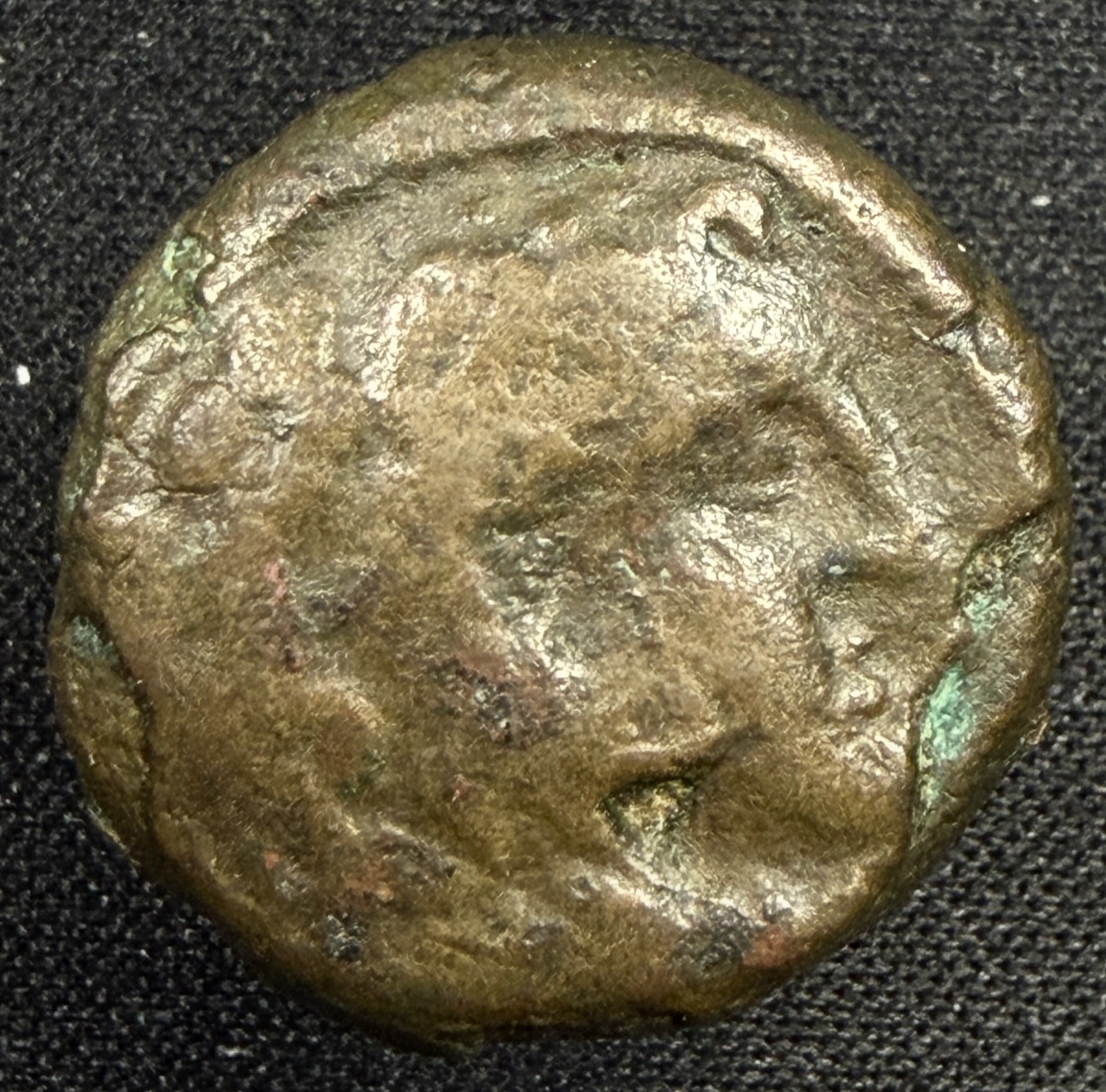
Current: Kings of Macedon, Alexander III the Great, AE unit (Æ20), lifetime issue, 336–323 BC (SNG Copenhagen 1055 type). Head of Herakles right in lion skin / ΑΛΕΞΑΝΔΡΟΥ between bow in case and club, AP monogram below
Obverse: Head of Alexander as Herakles right, wearing lion skin headdress
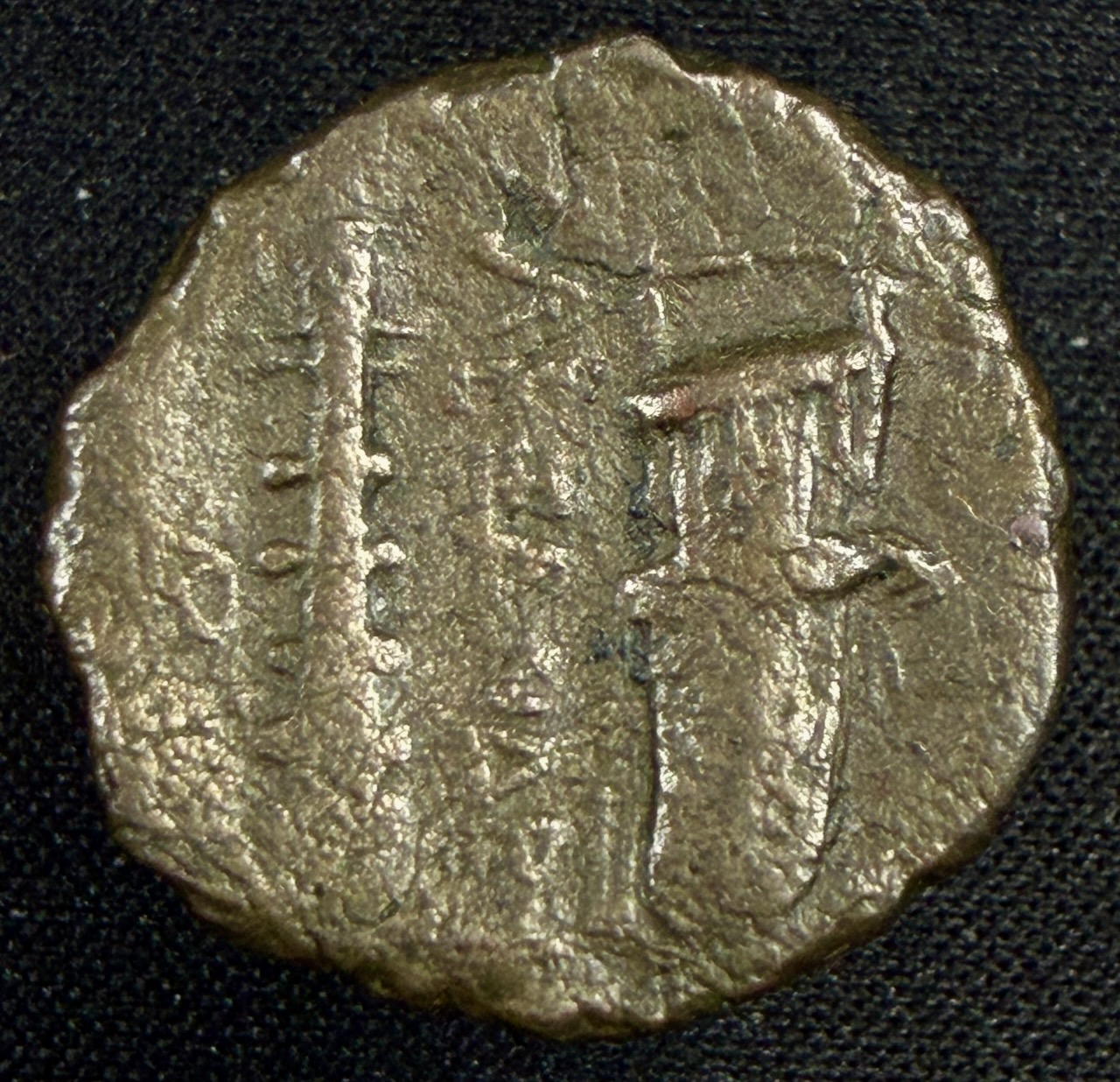
Reverse: Bow in bowcase (gorytos) above, club below; AP monogram below club
Primary reference: SNG Copenhagen 1055 type
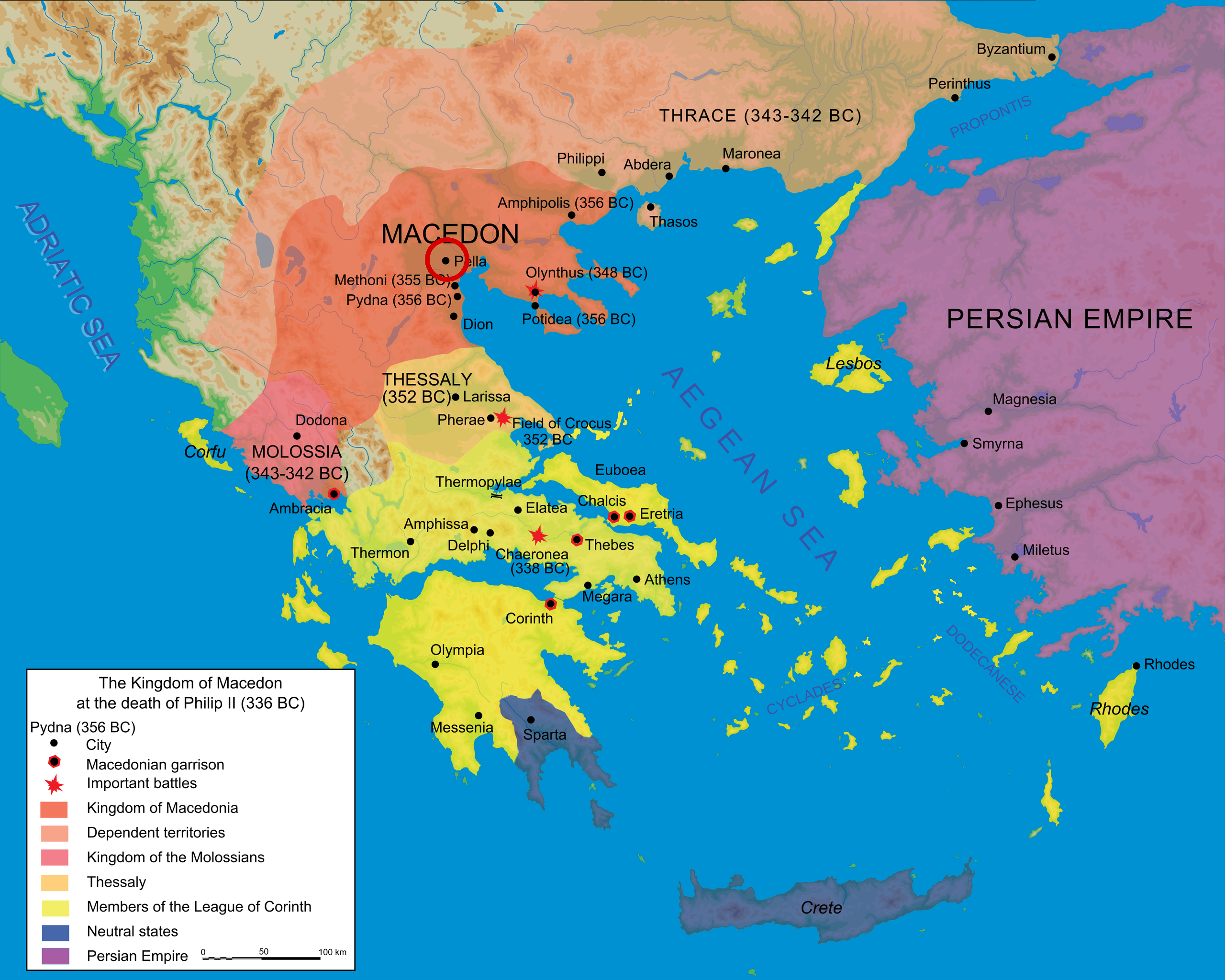
The kingdom of Macedon at the death of Philip II in 336 BC — the realm Alexander inherited in the year this coin’s issue began. Pella, the royal capital and this coin’s conventional mint, is circled in red. The red zone is Macedon proper with its dependent territories shading outward; the yellow states below are the League of Corinth, the Greek alliance whose army Alexander led east against the purple mass of the Persian Empire on the right edge — the campaign this bronze helped pay.
“Map of the Kingdom of Macedon at the death of Philip II in 336 BC” by Marsyas (French original), Kordas (Spanish translation), and MinisterForBadTimes (English derivative), Wikimedia Commons, File:Map Macedonia 336 BC-en.svg, licensed CC BY-SA 3.0 (https://commons.wikimedia.org/wiki/File:Map_Macedonia_336_BC-en.svg; license: https://creativecommons.org/licenses/by-sa/3.0/); map data from R. Ginouvès et al., La Macédoine (Paris, 1992). Modified by JSB Coins: rendered to PNG at 2560 px, and a red circle added to mark Pella. This derivative is shared under the same CC BY-SA 3.0 license.
While Alexander’s silver tetradrachms and gold staters financed the conquest of an empire and became the common currency of the eastern Mediterranean for two centuries, his kingdom’s daily business ran on unpretentious bronzes like this one. The royal bronze unit — Herakles on one face, the hero’s weapons on the other, the king’s name between them — was struck in enormous quantities from the beginning of Alexander’s reign, and pieces like this passed through the hands of soldiers, camp followers, and market sellers from Macedonia to wherever the army’s supply lines reached.
The conventional mint of the lifetime Macedonian bronzes is Pella, and the city deserves a portrait of its own. Around 400 BC King Archelaos moved the Macedonian capital down from old Aigai to Pella, then a harbor town linked to the Thermaic Gulf by a navigable lagoon; he brought Euripides to his court, where the poet wrote the Bacchae. Philip II and Alexander were both born in its palace — Plutarch’s Life of Alexander opens among its horse-paddocks and schoolrooms, with Aristotle hired in from Stageira to tutor the crown prince. By the end of the fourth century Pella was the largest city of Macedon, laid out on a grid with palatial houses whose floors are the reason the city is famous today: the pebble mosaics, among them the Stag Hunt signed by Gnosis — the earliest mosaic signature known anywhere. The mint that served this capital struck silver and, from Philip’s reign on, the kingdom’s everyday bronze; whether this particular unit is Pella’s work or another Macedonian shop’s is exactly what the pending Price-number lookup would settle (see the type notes).
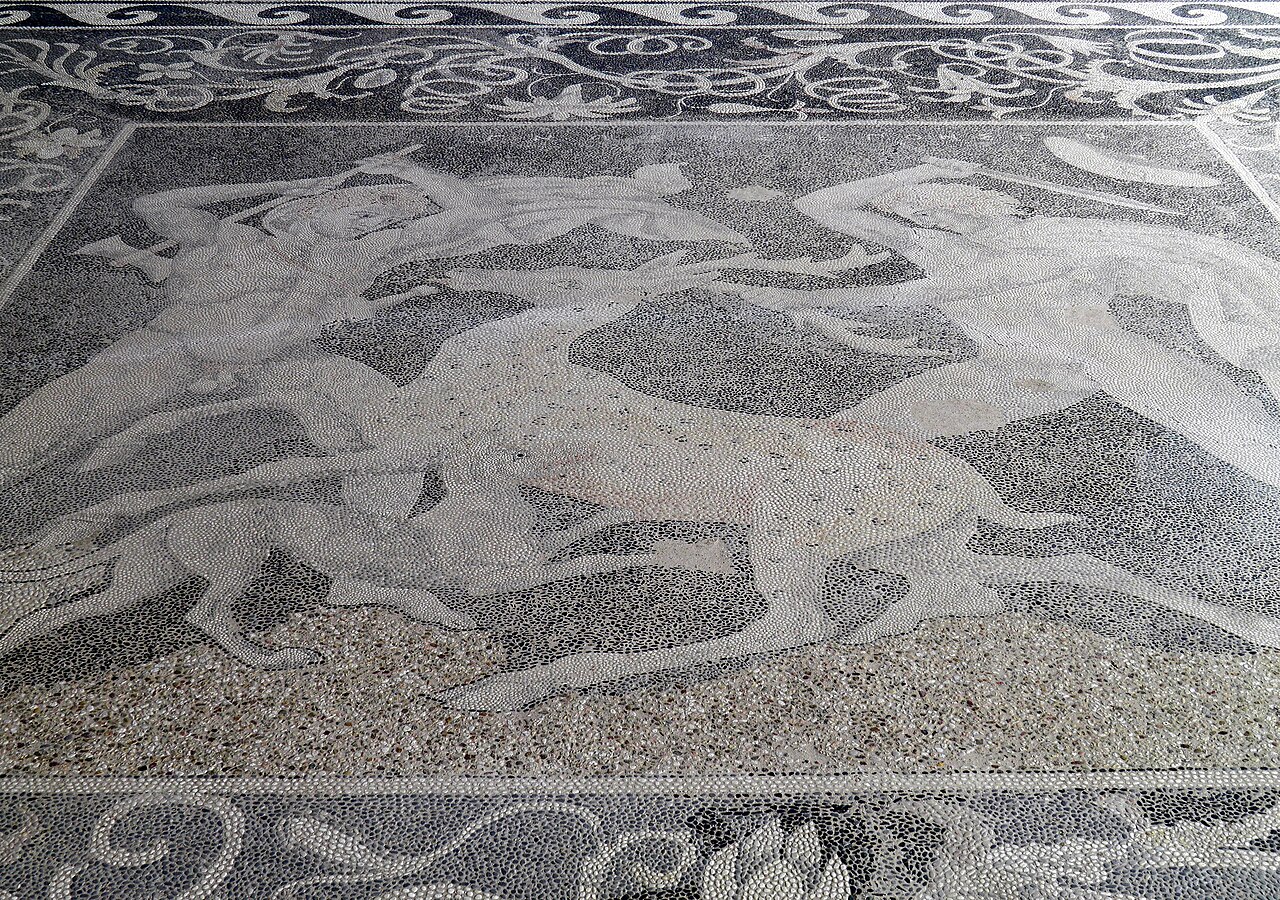
Photo: Carole Raddato, Wikimedia Commons, licensed CC BY-SA 2.0, reproduced unmodified.
The obverse shows Herakles wearing the scalp of the Nemean lion — the canonical image of Alexander’s coinage in every metal, whose backstory (the first labor, the invulnerable lion, the hero who wears his victory) is told well in Augustin’s CoinWeek essay on the silver. The Argead kings of Macedon claimed descent from Herakles, and the hero had appeared on Macedonian royal coinage for generations before Alexander; but on Alexander’s issues the young, beardless Herakles came to carry an unmistakable suggestion of the king himself. Whether the die-cutters intended a true portrait remains a famous open question of Greek numismatics — the ancient sources never say so, and the type predates him — but users of the coin in the 320s BC could hardly fail to make the association, and Hellenistic engravers after his death made it explicit. The reverse lays out the hero’s arsenal as a heraldic badge: the club, and the Scythian-style bow in its combined bowcase, with the genitive ΑΛΕΞΑΝΔΡΟΥ — “of Alexander” — between them, and the AP monogram of a mint magistrate below.
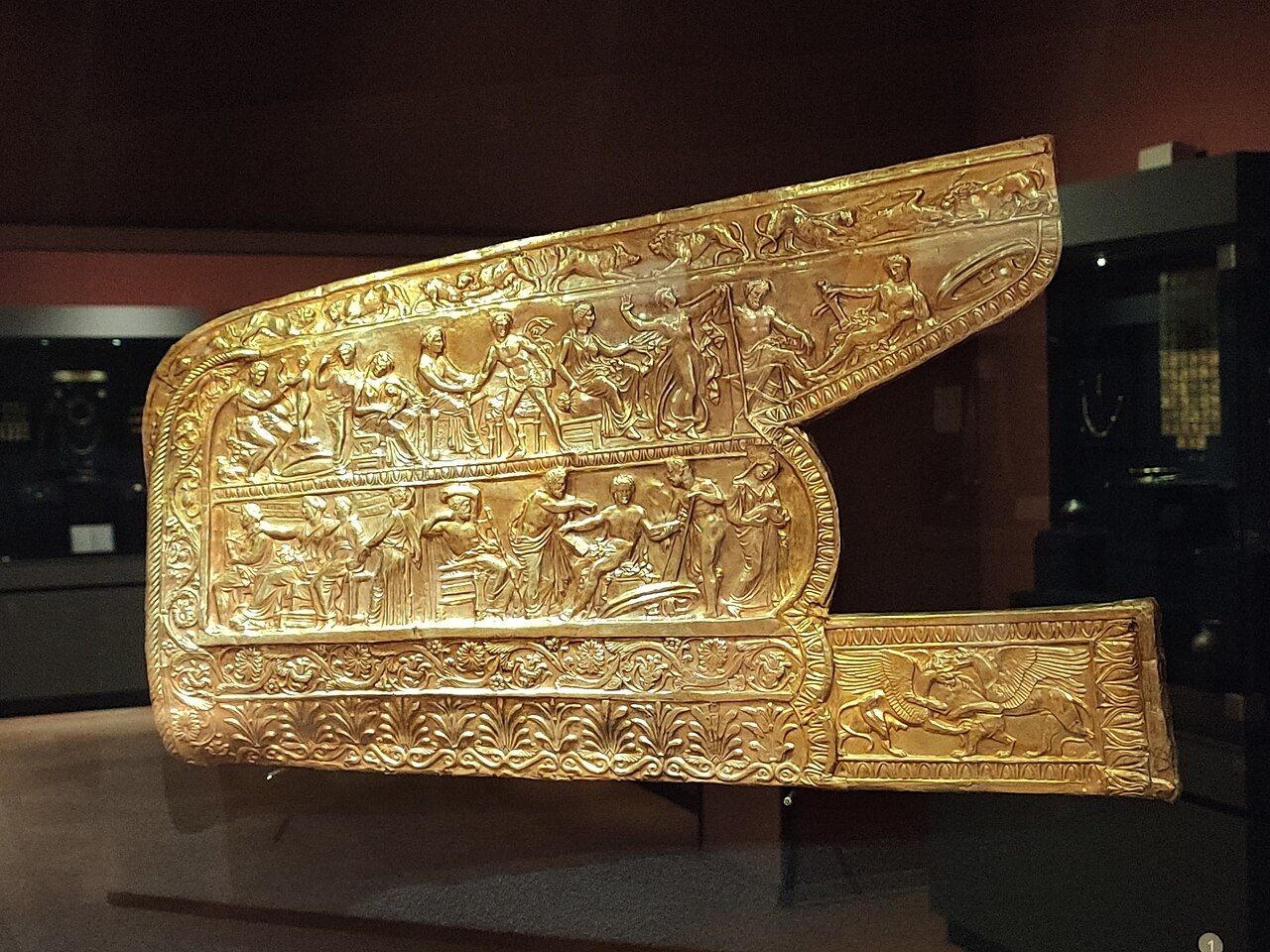
Photo: VoidWanderer, Wikimedia Commons, licensed CC BY-SA 4.0, reproduced unmodified.
Royal Macedonian bronze was an innovation of Alexander’s father. Philip II’s horseman bronzes established a kingdom-wide token coinage for small transactions, and Alexander continued the system seamlessly: same module, same royal formula, his own types. The units were struck at several Macedonian mints (Pella, the capital, is the conventional attribution used here — see the type notes) and later at mints across the new empire, on flans that were cast rather than cut, as the dealer’s slip notes of this piece. What a unit was worth is genuinely uncertain: token bronze answered to the chalkoi, the copper fractions of the obol, at a rate set by royal say-so rather than by weight, and no ancient source records the tariff. The same king’s silver in this collection — the posthumous tetradrachm from Kolophon — shows where the types went after 323 BC: multiplied across the world he conquered, in the names of the successors who divided it; the home mint’s own posthumous silver is here too, as the Amphipolis tetradrachm of the regency years. And when the successors finally crowned themselves, the royal-bronze habit went with them: this collection’s Lysimachos Athena/lion unit, struck across the Thracian border a political generation later, is the same idea under a new king’s name.
The open thread on this type is a library errand: fixing the Price number for the AP-monogram unit from Price (1991), whose Macedonian bronze listings would also settle the mint. The ANS’s PELLA database covers the corpus online (search the Herakles/club-and-bow bronzes; no deep link here, per the collection’s verified-links rule). For the iconography, the CoinWeek essay linked above; for the world of the mint city, Plutarch’s Life of Alexander (linked); for Pella’s archaeology, the excavation literature on the mosaic houses is the way in (Gnosis and the Stag Hunt are discussed in every handbook of Greek art).
Attribution: SNG Copenhagen (Macedonia) 1055 type, with lifetime dating 336–323 BC, per the Ancient Imports (Marc Breitsprecher) slip. The standard corpus is M. J. Price, The Coinage in the Name of Alexander the Great and Philip Arrhidaeus (1991); the Price number for this AP-monogram unit is an open thread. On Philip II’s introduction of royal Macedonian bronze and its continuation under Alexander, see the collection’s Philip II type page and the literature cited there (Le Rider; Mørkholm, Early Hellenistic Coinage). Pella: Plutarch, Alexander 2–8; Xenophon, Hellenica 5.2.13 (Pella the greatest city of Macedon); the Gnosis signature, standard handbooks of Greek mosaic art.
MINT IS A BEST GUESS (Pella): the royal Herakles / club-and-bow bronze units were struck at several Macedonian (and later Asian) mints, and the dealer's attribution ('SNG Copenhagen 1055 type') does not fix one; Pella, the royal capital and a principal bronze mint, is used here as the conventional home of the lifetime Macedonian series pending a Price-number lookup on the AP monogram. The dealer's slip notes the cast (rather than cut) flan, a normal feature of these units. Lifetime dating 336–323 BC per the slip. The unit's face value is not securely known — royal token bronze was tariffed by decree, not metal content, and how many chalkoi a 5–6 g unit answered to is a standing question of Macedonian numismatics.
John's Ancient Coin Collection · Type · alexander-iii-herakles-club-bow-ae20
Image credits for this coin — photographs, maps and graphics used on this page

,_Ancient_Pella_(7059958071).jpg)
