Type · seleukos-i-susa-trophy-tetradrachm
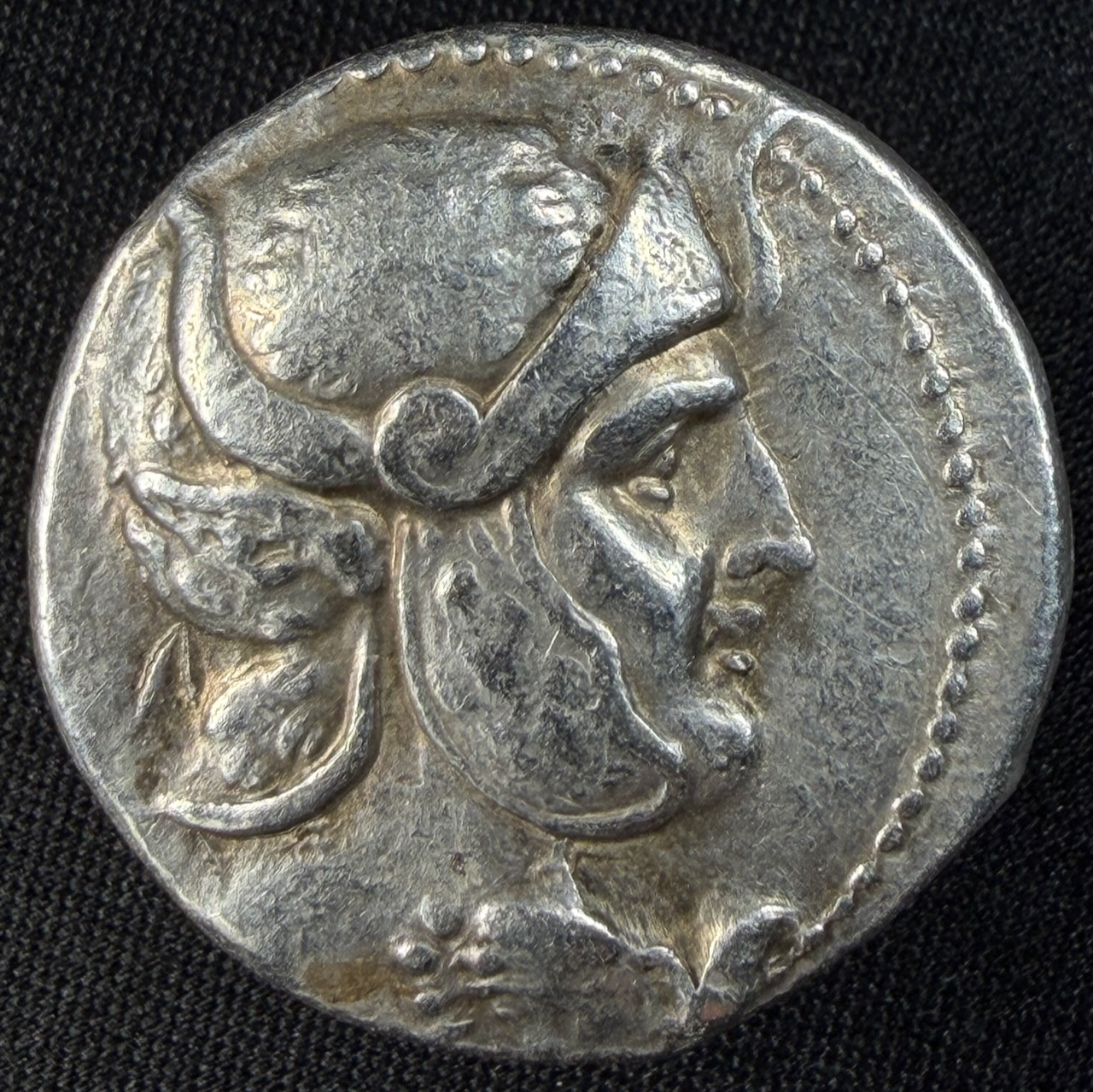
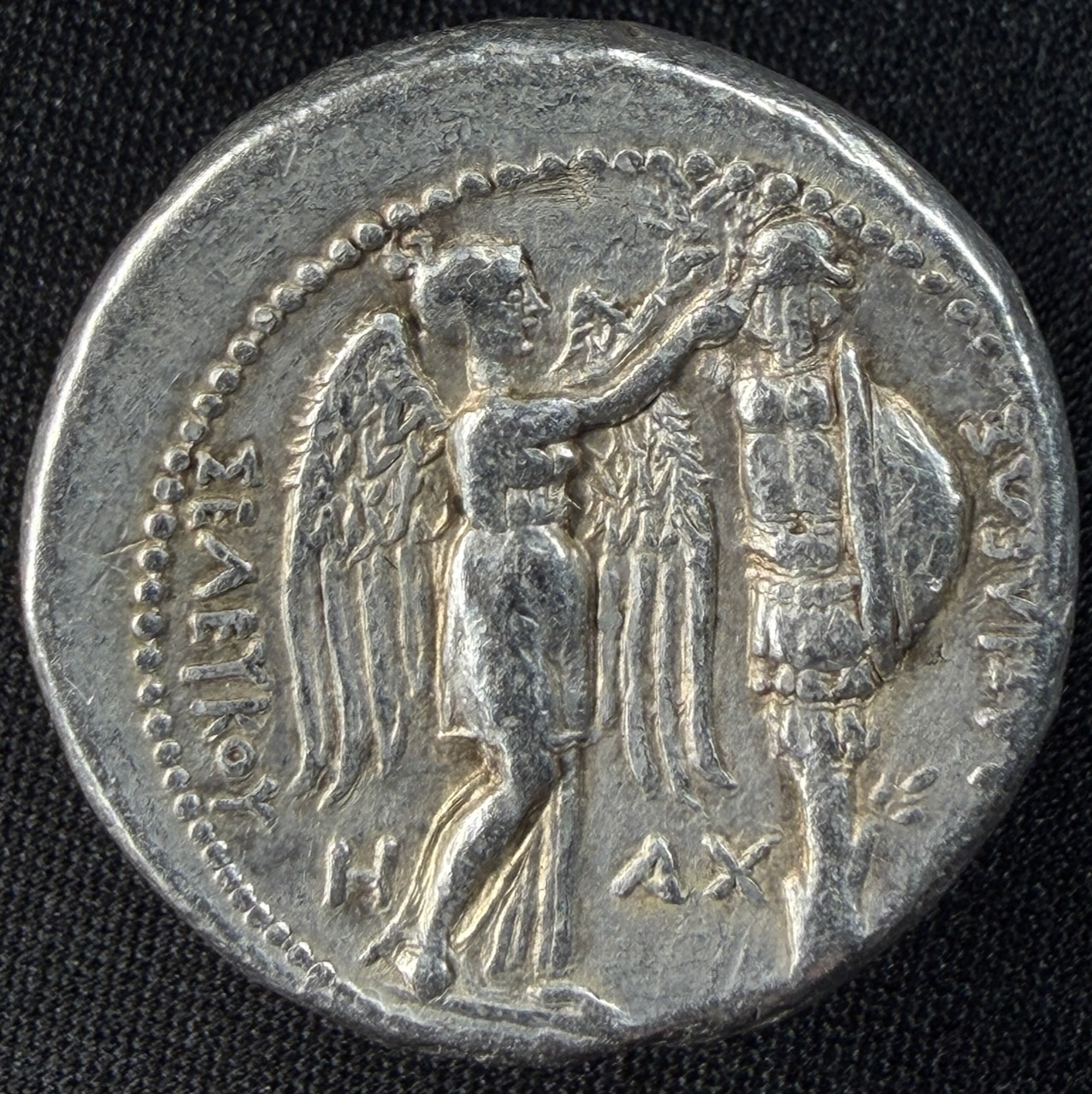
Current: Seleukid Kingdom, Seleukos I Nikator, AR tetradrachm, Susa mint, c. 305/4–295 BC. Helmeted head of hero right / Nike standing right crowning a trophy. SC 173.12; HGC 9, 20.
Obverse: Head of a hero right, wearing a helmet covered with panther skin and adorned with the ear and horn of a bull; a panther skin is knotted at the throat. The figure's identity is debated (see notes).
Reverse: Nike standing right, crowning a trophy of arms (helmet, cuirass, spears) with a wreath; control marks in field (typically a monogram below the wing and letters between Nike and the trophy).
Primary reference: SC 173.12; HGC 9, 20
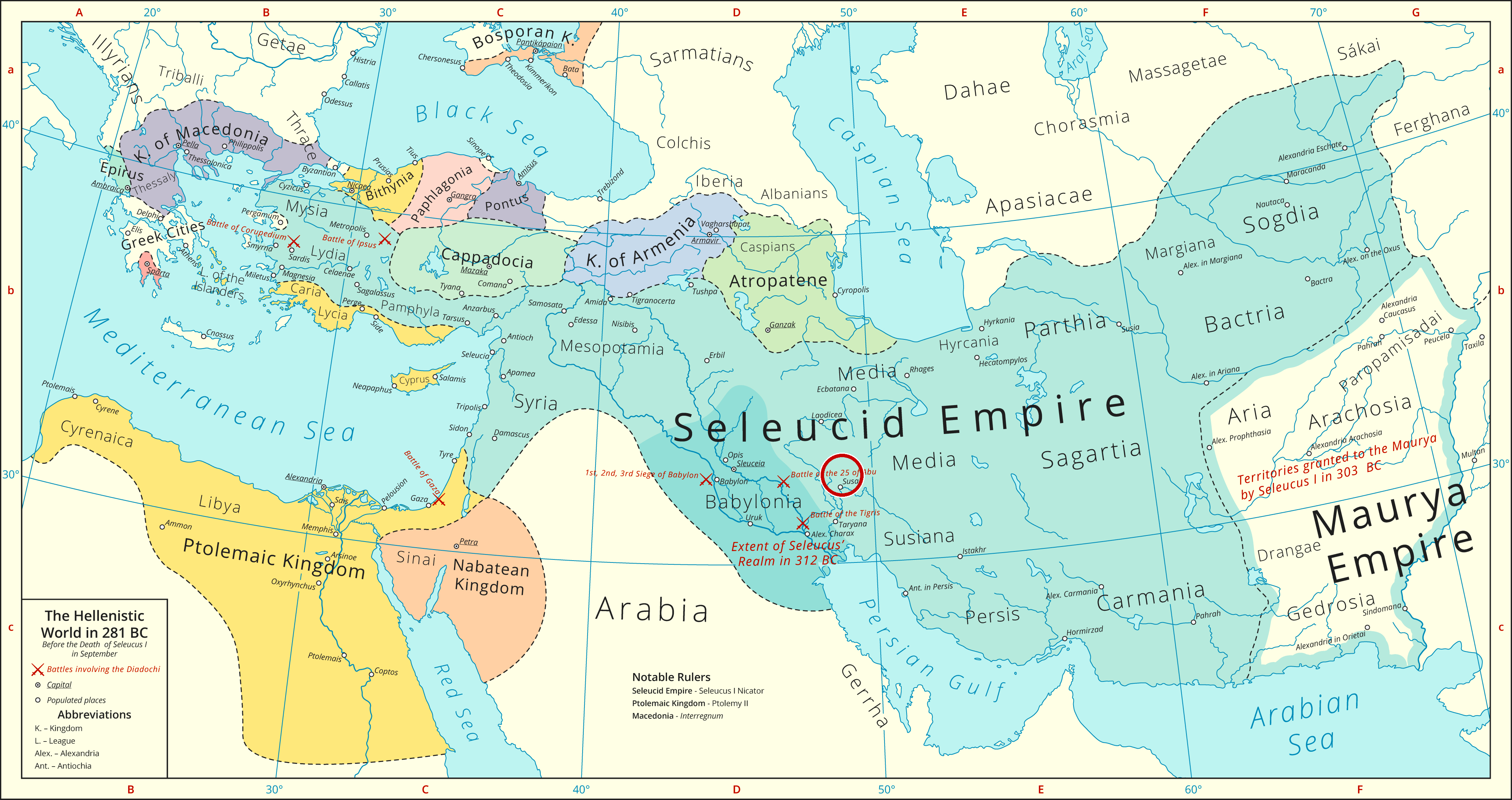
The Seleukid Empire at roughly its greatest extent (c. 305–281 BC). Susa — circled — lies in Susiana (modern southwestern Iran), near the head of the Persian Gulf and just east of the Tigris. A former Achaemenid royal capital and one of the principal mints of the Seleukid east, Susa struck this “trophy” tetradrachm in the years after Seleukos I assumed the royal title in 305 BC. The map shows the realm at its height under Seleukos rather than the precise political moment of the coin’s striking.
Base map by Cattette (Wikimedia Commons), “Seleucid Empire alternative map” (extracted from “The Hellenistic World in late 281 BC”), File:Seleucid Empire alternative map.jpg, licensed CC BY-SA 4.0 (https://commons.wikimedia.org/wiki/File:Seleucid_Empire_alternative_map.jpg; license: https://creativecommons.org/licenses/by-sa/4.0/). Modified by JSB Coins: on the main map, Susa circled; the inset is an enlarged crop of the Susa region from the same base map. This derivative is shared under the same CC BY-SA 4.0 license.
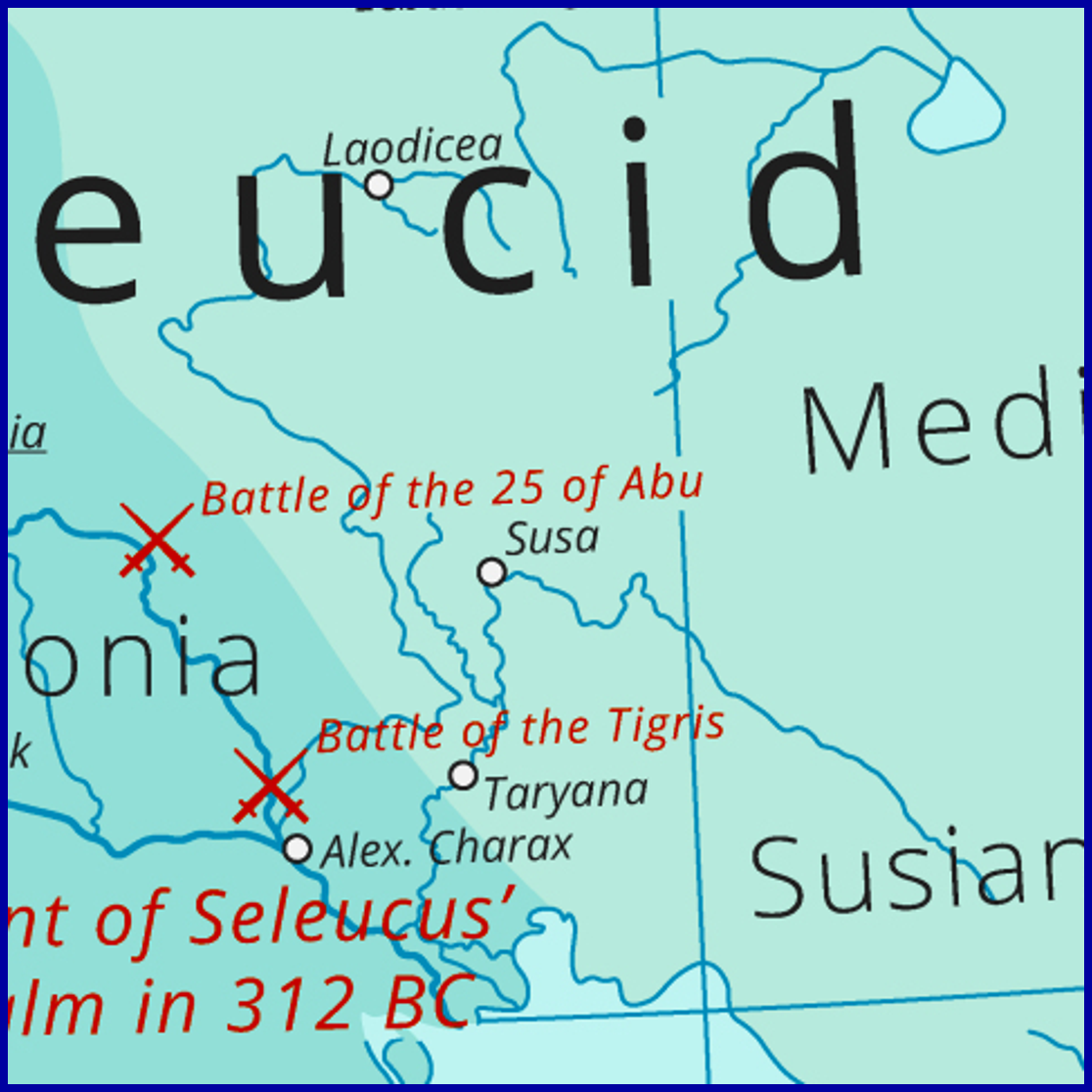
Detail of the Susa region (the circled area on the main map). Susa sits among its neighbors — Babylon and Seleukeia on the Tigris to the west, Taryana and the Susiana plain to the east, the head of the Persian Gulf to the south.
This tetradrachm is among the most arresting coinages of the early Hellenistic age — struck at Susa, one of the ancient capitals of the Persian empire, by the most successful of Alexander the Great’s surviving generals at the very moment he claimed a crown of his own. Both of its images are statements of conquest, and together they mark the transformation of a Macedonian officer into the founder of a dynasty that would rule much of Asia for two and a half centuries.
Graphic: JSB Coins, 2026 (CC0).
When Alexander died at Babylon in 323 BC, his empire was carved up among his marshals. Seleukos received the satrapy of Babylonia but was driven out in 316/315 by his rival Antigonos Monophthalmos. He recovered Babylon in 312 BC — the year from which the Seleukid Era was later counted — and over the following decade fought his way eastward across the Iranian plateau, securing the Upper Satrapies as far as the borders of India, where he came to terms with the Mauryan emperor Chandragupta. In 305/4 BC, following the example of Antigonos and the other Successors, Seleukos took the title of king (basileus). The Susa trophy coinage belongs to exactly this period of triumphant consolidation, and the reverse legend — “of King Seleukos” — announces the newly assumed royalty.
The reverse shows Nike, the winged goddess of victory, stepping forward to set a wreath upon a trophy — a frame of captured armour and weapons erected on the battlefield in the Greek manner to mark the spot where the enemy turned and fled. It is among the most direct martial images in Greek coinage: not a god in repose but the act of victory itself, the moment of crowning a hard-won triumph. The reference is to Seleukos’ campaigns in the east and to the wars against his fellow Successors that secured his kingdom. The field carries control marks — letters and a monogram identifying officials, workshops, or issue — by which the prolific Susa series is sorted into its many sub-varieties; Kritt’s die study counts roughly 67 obverse and at least 93 reverse dies across the run.
The obverse is one of the great puzzles of Hellenistic numismatics, and it remains an open question rather than a settled one. A male head faces right, wearing a helmet sheathed in the spotted skin of a panther and crowned with the ear and curving horn of a bull. The panther skin and the bull’s attributes are Dionysiac — and Dionysos was the god whose mythical conquest of the East furnished a template for Alexander’s own. From this point scholarship divides. R. A. Hadley argued that the head is Alexander the Great assimilated to Dionysos; Oliver Hoover, in the Handbook of Greek Coinage, reads it instead as Seleukos himself, claiming those same divine and Alexandrian associations for his new kingship; still others see a deliberate composite that lets the viewer recognize Alexander, the god, and the new king at once. The bull is in any case bound up with Seleukos’ own image — he was said to have wrestled a wild bull, and bull’s horns recur on his portraits and on the horned horses and elephants of his other types. The ambiguity may well have been intentional, and a responsible catalogue entry should leave it open.
The debate over the helmeted head has a fixed point of comparison: the portrait tradition of Seleukos himself. Its best-known survivor is a bronze bust from the Villa of the Papyri at Herculaneum, now in Naples — a Roman-period copy after a Hellenistic original, identified as Seleukos I by comparison with the named portraits on his coins. It shows the king in plain human middle age, diademed but unhorned, and that restraint is the point of contrast: on the coinage the same man could be dressed in panther skin and bull’s horn, halfway to a god. The two images are two audiences — the divinized king for the army and the Greek cities of Asia, the sober dynast for posterity.
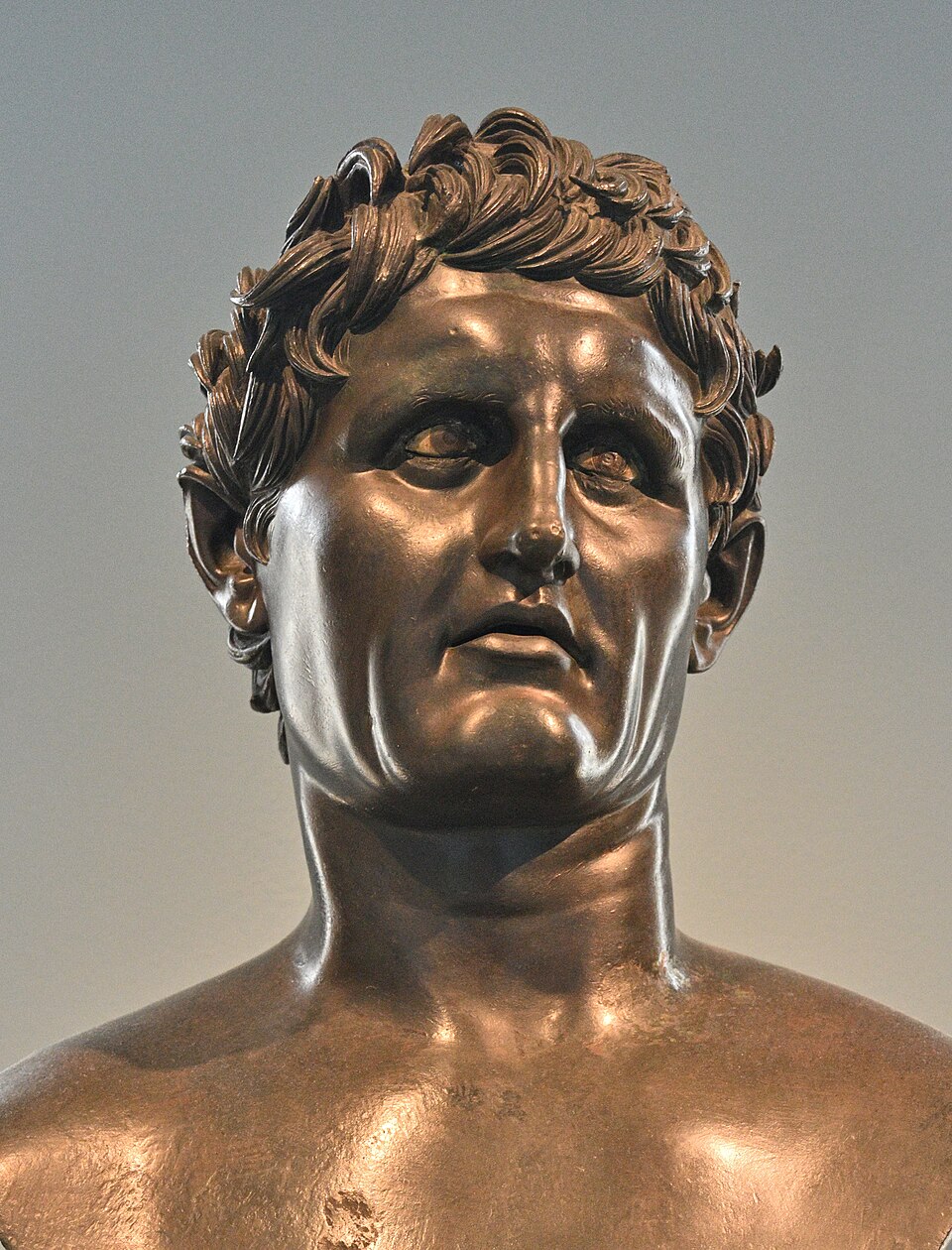
Photo: Allan Gluck, CC BY 4.0 (Wikimedia Commons); reproduced unmodified.
That this coinage was struck at Susa is significant. Susa had been a royal seat of the Achaemenid Persian kings and remained one of the principal cities and mints of the Seleukid east. By issuing a heavy silver coinage there on the Attic weight standard — the standard of Alexander’s own empire-wide currency — Seleukos tied his new realm into the monetary world Alexander had created while asserting his own authority over the old Persian heartland. Tetradrachms like this one paid soldiers, funded administration, and circulated widely across the eastern Mediterranean and Near East.
The victories this coinage celebrates were only the middle of the story. In 301 BC, at Ipsos in Phrygia, Seleukos and Lysimachos together destroyed Antigonos the One-Eyed — Plutarch’s Demetrius (linked in the references) describes how Seleukos’ four hundred elephants, the price of his Indian treaty, screened the field and decided the day. Ipsos fixed the map of the successor kingdoms for a generation. Twenty years later the last two of Alexander’s marshals faced each other at Korupedion in Lydia (281 BC), both near eighty: Seleukos defeated and killed Lysimachos — whose everyday bronze is also in this collection — and stood, briefly, within reach of Alexander’s whole empire. Within months, crossing into Europe to claim Macedon, he was stabbed to death by his own protégé Ptolemy Keraunos. Appian’s Syriaca (linked in the references) preserves the omens, the foundations, and the end of the most successful of the Diadochi.
The Susa trophy tetradrachm captures the founding moment of the Seleukid kingdom: victory in the east, the assumption of kingship, and the careful fashioning of a royal image poised between Alexander, Dionysos, and Seleukos himself. It is both a fine work of die-engraving and a piece of political theatre struck in metal — one of the defining coinages of the age of the Successors.
Houghton & Lorber, Seleucid Coins, Part I (SC 173). Hoover, Handbook of Greek Coinage vol. 9 (HGC 9, 20). B. Kritt, The Early Seleucid Mint of Susa (CNG, 1997), for the trophy-series die study, chronology, and the c. 67 obverse / 93+ reverse die counts. L. W. H. Taylor, “Seleukos I’s Victory Coinage of Susa Revisited,” American Journal of Numismatics 28 (2016), pp. 1–63, for a revised die study and commentary. On the disputed obverse identity, R. A. Hadley (Alexander/Dionysos) versus O. D. Hoover, “The Identity of the Helmeted Head on the ‘Victory’ Coinage of Susa,” SNR 81 (2002), arguing for Seleukos (freely available on Academia.edu; SNR volumes are also on E-Periodica). Narrative history: Plutarch, Demetrius 28–30 for Ipsos, and Appian, Syriaca 52–64 for Seleukos’ career, omens, and death (both linked in the references). The Naples bronze: Museo Archeologico Nazionale, Naples, inv. 5590.
Struck on the Attic weight standard (tetradrachm ~17.0–17.2 g). The Susa "trophy" or "victory" coinage was issued over an extended period (c. 305 to c. 295 BC); Kritt's die study records some 67 obverse and at least 93 reverse dies, distinguished by a large repertoire of control marks that sort the series into many sub-varieties (SC 173.x); our specimen's controls (H below Nike's wing, ΑΧ in the middle field) fix it at SC 173.12, per its CNG Electronic Auction 594 cataloguing. The reverse celebrates Seleukos' victories in the Upper Satrapies and his assumption of the royal title in 305 BC. The identity of the helmeted obverse head is genuinely contested and should not be stated as settled: Hadley reads it as Alexander the Great assimilated to Dionysos (the panther skin and bull's horns being Dionysiac attributes), while Hoover (HGC) reads it as Seleukos himself bearing those same divine attributes; others propose a deliberate composite of Seleukos, Alexander, and Dionysos. The bull's horn also evokes Seleukos' personal iconography (the horned head and horned-horse/elephant types).
John's Ancient Coin Collection · Type · seleukos-i-susa-trophy-tetradrachm
Image credits for this coin — photographs, maps and graphics used on this page