Type · teos-archaic-griffin-stater
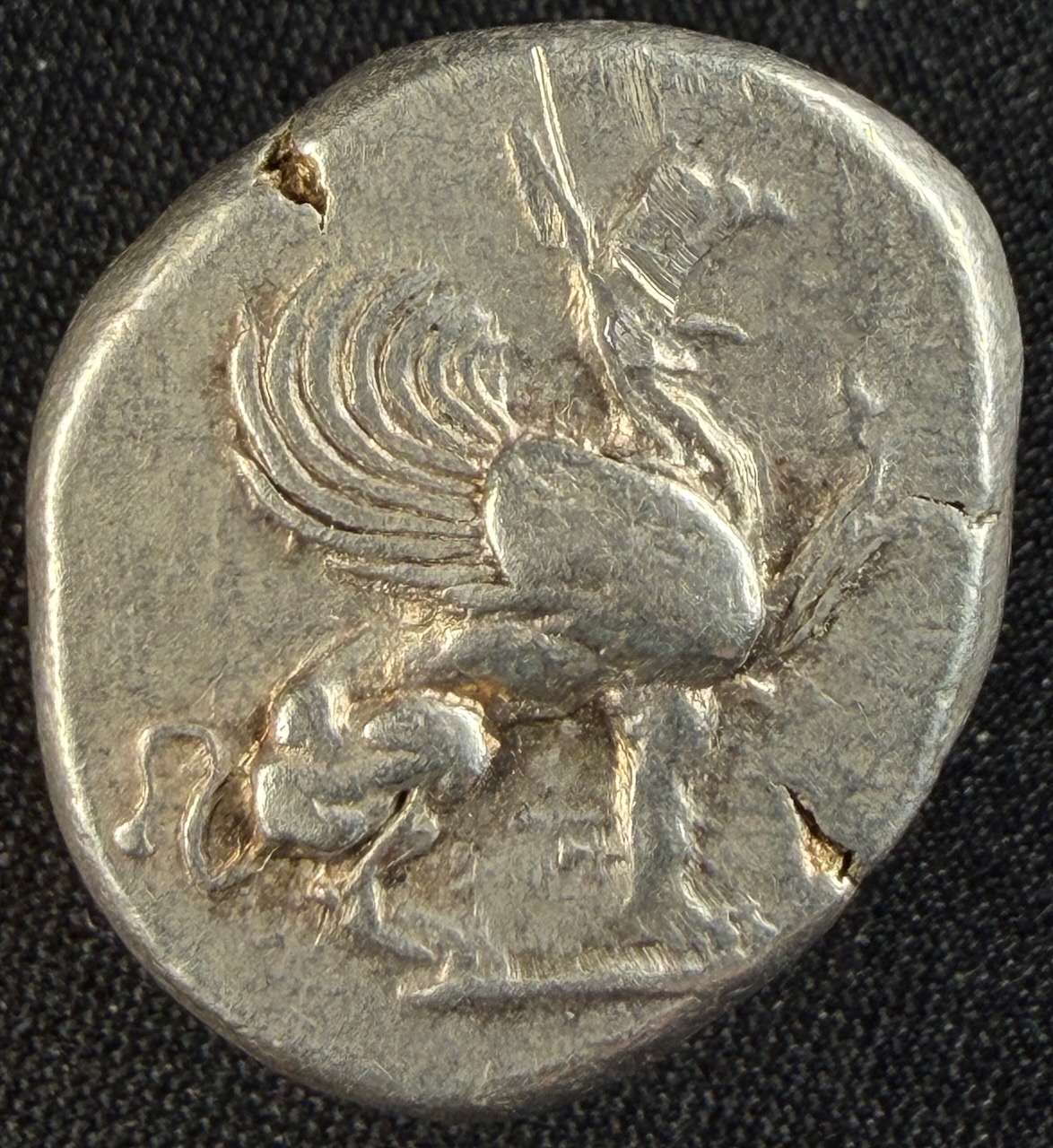
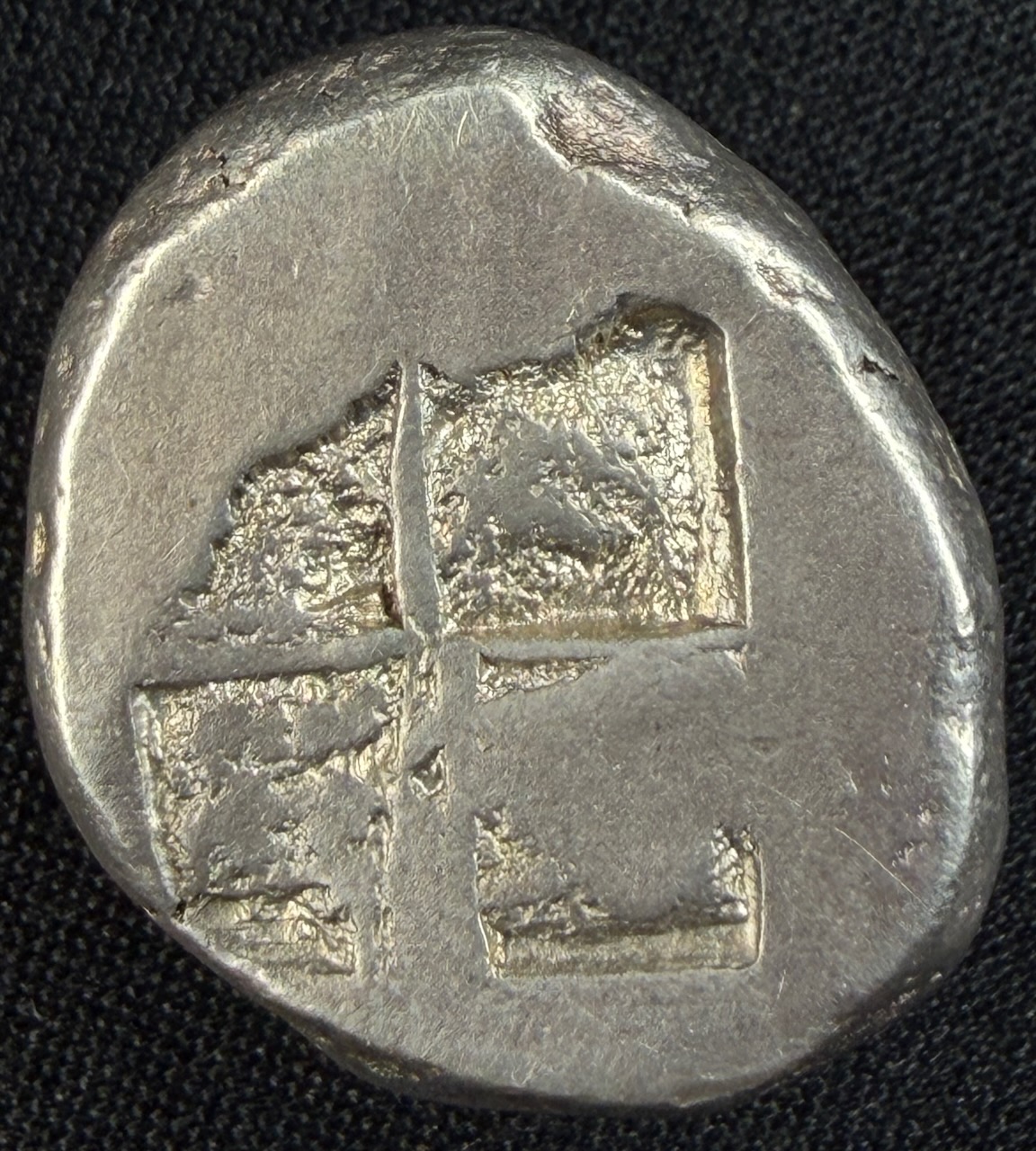
Current: Ionia, Teos, AR stater, late 6th century BC (c. 520–490 BC). Griffin seated right, forepaw raised / Quadripartite incuse square. SNG von Aulock 2252.
Obverse: Griffin with curled wing seated right, head erect, raising the left forepaw
Reverse: Quadripartite incuse square (rough/'mill-sail' punch)
Primary reference: SNG von Aulock 2252
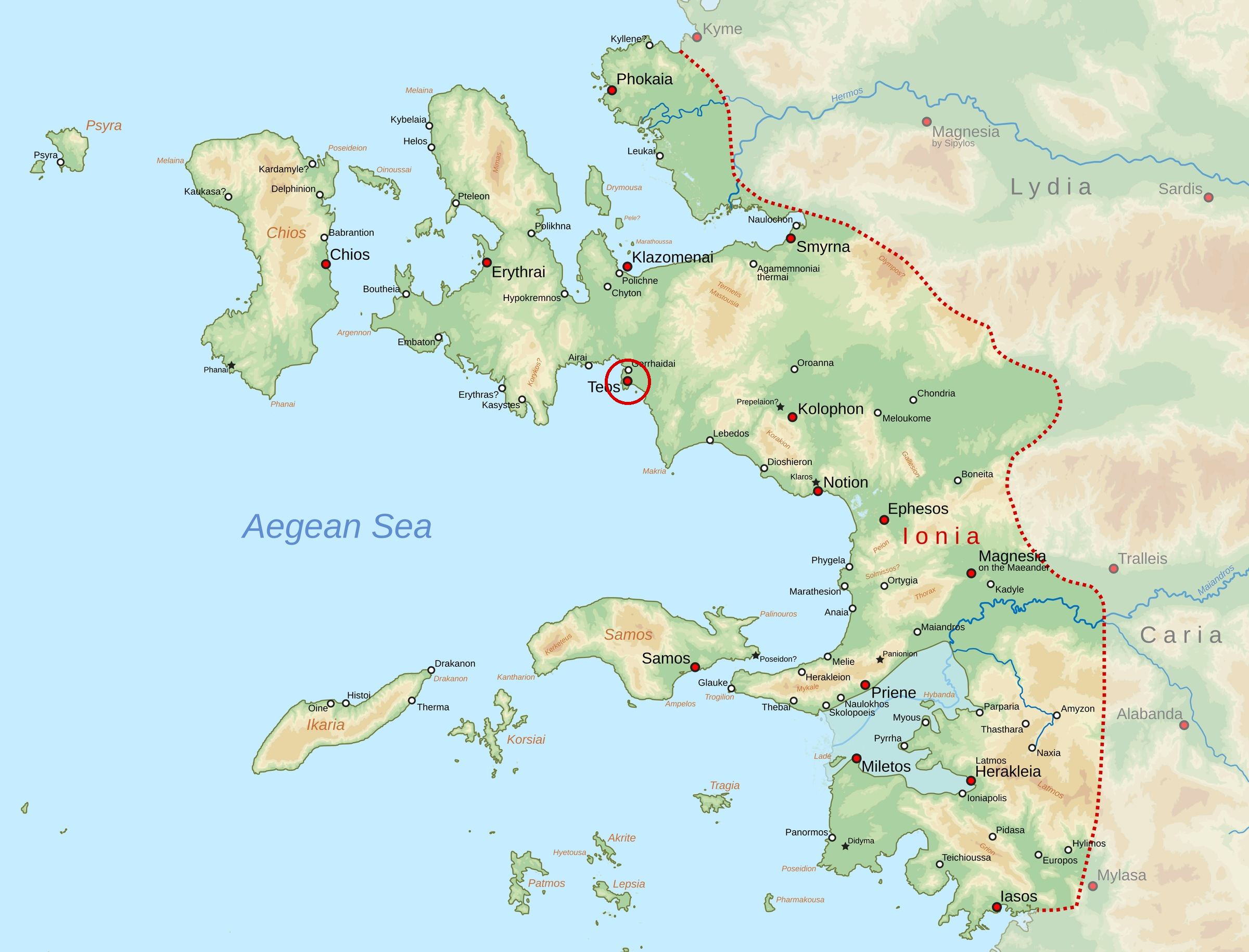
Ancient Ionia, on the Aegean coast of Asia Minor. Teos is circled in red, on the south shore of the Erythraean peninsula between the gulfs of Smyrna and Ephesos; the city’s own red marker sits inside the ring. Klazomenai and Erythrai lie north and west, Lebedos and Kolophon to the southeast — the collection’s Alexander tetradrachm of Kolophon was struck a short way along this coast, two centuries after this stater. Teos was one of the twelve cities of the Ionian League, and its position is the reason Herodotus reports Thales proposing it as the seat of a single common council for all Ionia: it lay at the center (Hdt. 1.170).
“Map of ancient Ionia” by Tomisti (Wikimedia Commons), File:Ancient Ionia map en.svg, licensed CC BY-SA 4.0; cities and roads based on the Digital Atlas of the Roman Empire (DARE) and Pleiades; topographic base © OpenMapTiles, © OpenStreetMap contributors (https://commons.wikimedia.org/wiki/File:Ancient_Ionia_map_en.svg; license: https://creativecommons.org/licenses/by-sa/4.0/). Modified by JSB Coins: rasterized from SVG to a 2400 px PNG, and a red circle added to mark Teos; the inset is a crop of the same rasterization. Drawn on a clean copy — the collection’s other copy of this base is already ringed at Kolophon. This derivative is shared under the same CC BY-SA 4.0 license. The unringed rasterization is kept at maps/Ancient_Ionia_map_en_2400.jpg.
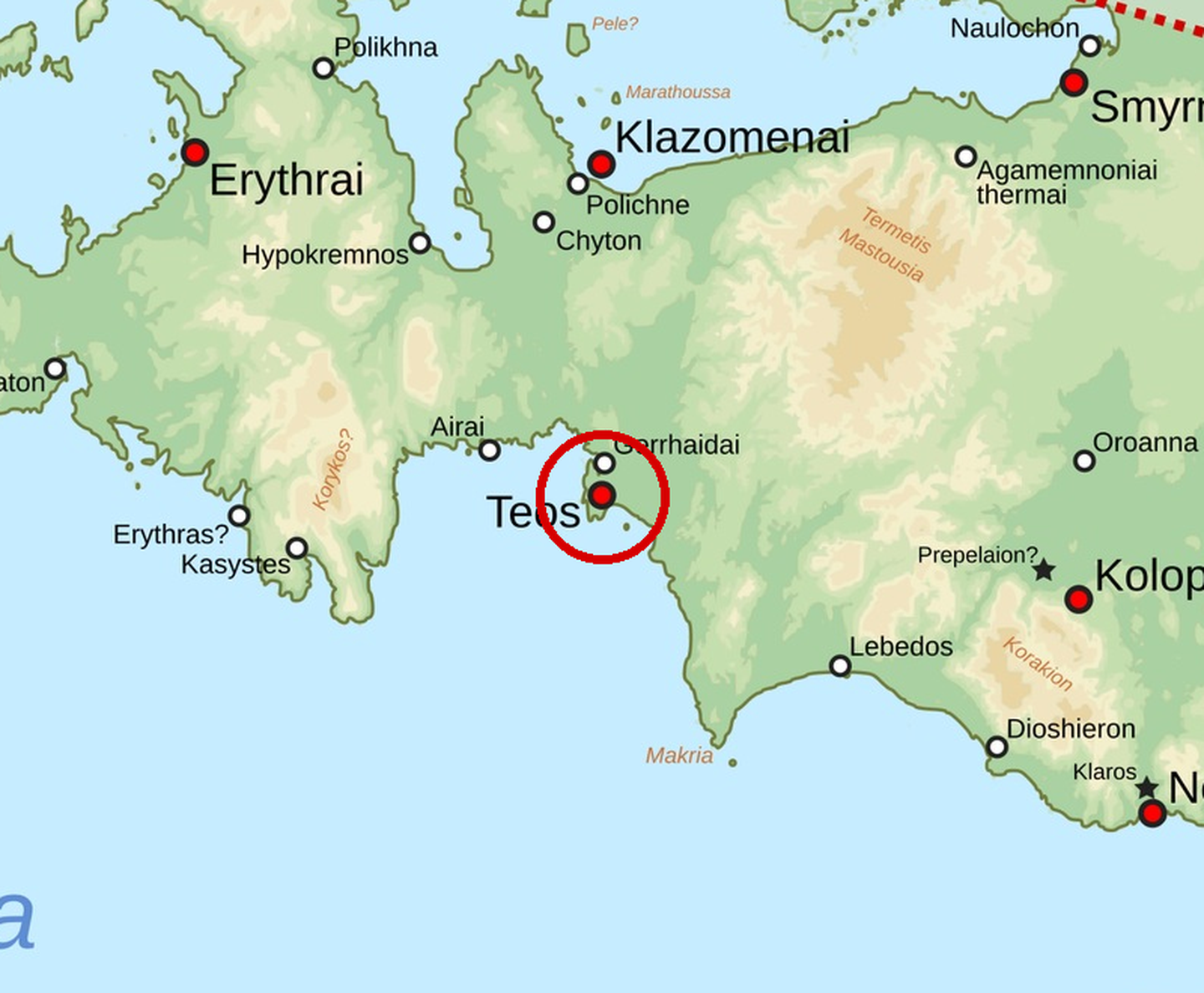
Detail: Teos on its narrow isthmus, with Airai west along the shore and Gerrhaidai just inland.
This silver stater is among the earliest coins of Teos, an Ionian Greek city on the coast of Asia Minor (near modern Sığacık in Turkey). It belongs to the Archaic age of Greek coinage — the late sixth century BC, when the cities of Ionia were among the first in the Greek world to strike money, and when the coin’s reverse was still nothing more than the rough mark of the punch that drove the blank into the die.
Graphic: JSB Coins, 2026 (CC0).
The obverse shows a griffin — the lion-bodied, eagle-headed, winged guardian of myth — seated with one forepaw raised, wing curled elegantly over its back. The griffin was the emblem (the “civic badge”) of Teos, and it appears on the city’s coins with remarkable continuity for some six hundred years, from these Archaic staters through Hellenistic bronzes to the provincial coinage of the Roman emperors. In Greek thought griffins were creatures of Apollo and of the sun, fierce protectors of treasure and sacred places; for Teos the seated griffin functioned much as the owl did for Athens or the turtle for Aegina — an instantly recognisable mark of the issuing city, guaranteeing the coin’s origin and value.
The image had deep roots in Greek art well before coinage existed: from the seventh century BC, bronze griffin heads on long snake-like necks snarled from the shoulders of the great cauldrons dedicated at sanctuaries such as Olympia and Delphi — among the signature bronzes of the Orientalizing age, when Greek craftsmen were absorbing Near Eastern monsters and making them their own. The Teian die-cutters drew on that prestige: their seated griffin is the cauldron guardian domesticated into a civic seal.
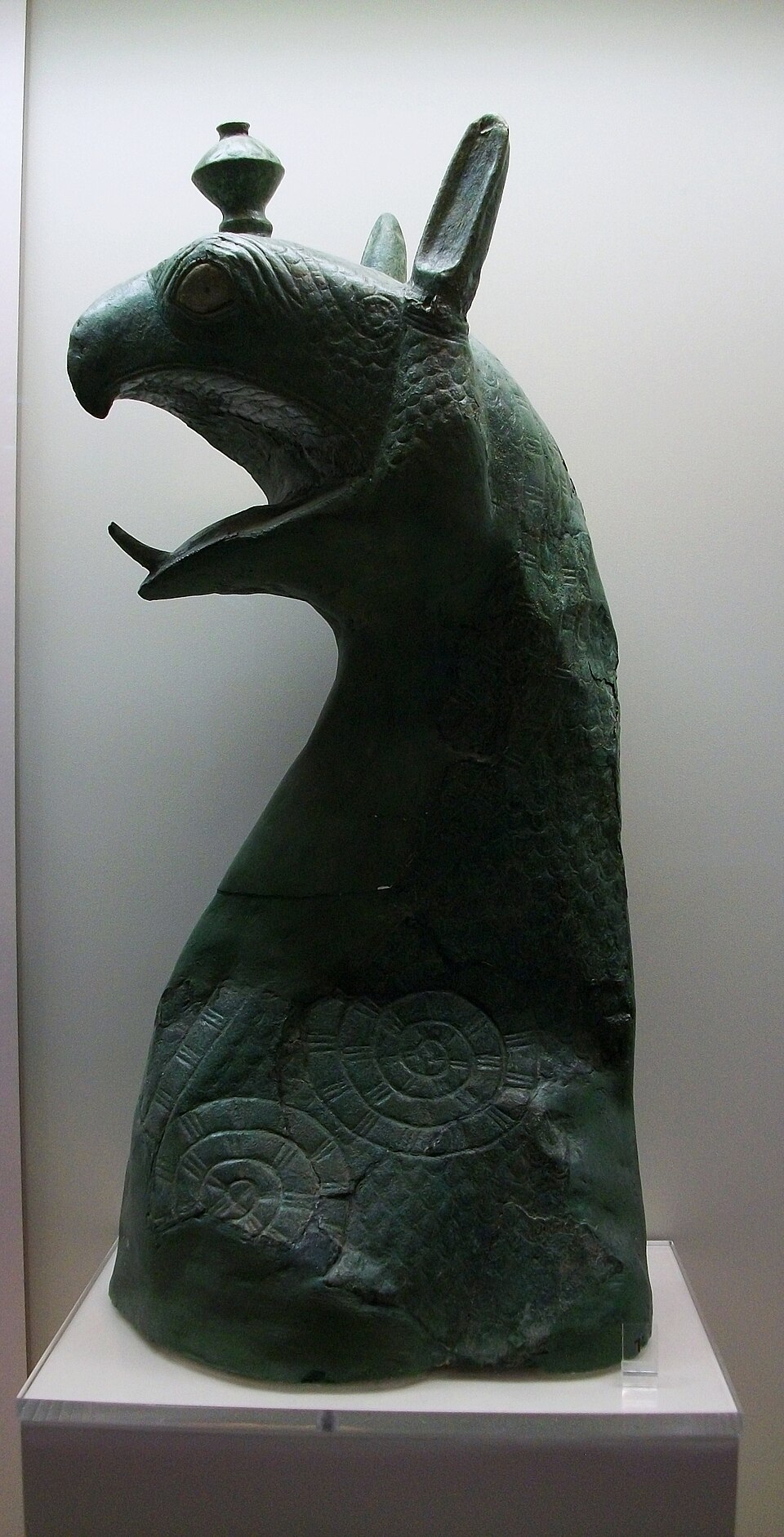
Photo: Joanbanjo, CC BY-SA 3.0 (Wikimedia Commons); reproduced unmodified.
The reverse carries no image, only a quadripartite incuse square — a sunken square divided into four compartments, the impression left by a punch with a raised cross or “mill-sail” pattern. In the earliest Greek coinage the reverse die had not yet been engraved with its own design; the punch merely held the heated blank steady while the obverse type was struck. The progressive refinement of this incuse — from irregular pits to neat geometric squares to, eventually, true reverse types — is one of the ways numismatists date and order Archaic coins. The rough quadripartite square here is fully consistent with a late-sixth-century date. (Not every incuse square is early, though: compare the collection’s Byzantion siglos, which kept this same mill-sail reverse deep into the fourth century BC as deliberate, trust-preserving archaism — on Teos the fabric is original; at Byzantion it became a brand.)
Teos was a wealthy and cultured member of the Ionian dodecapolis, the league of twelve Ionian cities. It was the birthplace of the lyric poet Anacreon and a great center of the worship of Dionysos — associations the city celebrated on its later coins, which pair the griffin with the wine-cup (kantharos) and grapes. But the city’s prosperity coincided with the rise of Persia. After Cyrus’ general Harpagos subdued Ionia around 545 BC, a large part of the population of Teos famously chose exile over Persian rule and sailed north to found (or refound) Abdera in Thrace. The city that remained continued to coin money under Persian overlordship; staters such as this one were struck in the generation or two on either side of 500 BC, in the tense decades leading up to the Ionian Revolt (499–494 BC) and the Greco-Persian Wars.
As a coastal commercial polis, Teos needed good silver coin for trade across the Aegean. The stater was its principal large denomination, supported by a range of smaller fractions — drachms, hemidrachms, obols, and tiny tetartemoria — all bearing the same griffin. The exact weight standard of the early Teian silver is still discussed by specialists, but the stater of roughly twelve grams placed Teos within the broad family of Aegean trading currencies of the day.
An Archaic griffin stater of Teos is a coin from the dawn of Greek money, struck by one of the cities that helped invent the medium. Its bold mythological obverse and primitive punched reverse together capture a pivotal moment — the point at which coinage was becoming the civic emblem and economic instrument it would remain for the rest of antiquity — and it does so through the single image, the seated griffin, by which Teos announced itself to the world for centuries.
SNG von Aulock 2252 (and the Teos series 2252–2258). J. M. Balcer, “The Early Silver Coinage of Teos,” Schweizerische Numismatische Rundschau 47 (1968). SNG Copenhagen, Ionia (Teos), 1433 ff. General historical background on Teos, the Ionian dodecapolis, and Archaic Ionian coinage from standard handbooks; the flight to Abdera after Harpagos took the city: Herodotus 1.168 (Book I linked in the references). The Olympia griffin protome: Archaeological Museum, Olympia.
The griffin is the civic badge of Teos and recurs on its coinage from the Archaic staters down to the Roman provincial bronzes. The early staters stand near the start of Teian coinage; the reverse is a simple punched incuse square typical of late-6th-century Ionian issues, before the introduction of figural reverse types. Weight standard of the early Teian staters is debated (a stater of c. 11.7–12.0 g); confirm against Balcer for the precise series and any control symbol (swan, grape cluster, etc., distinguish sub-types) — Balcer's numbering (Balcer 13, 15, etc.) is the subtype system dealers and auction houses actually cite. CNG's Feature Auction 121 cataloguing of the collection's specimen (lot 366, Oct 2022) classifies it Matzke Series Bc1; Balcer Group I; SNG von Aulock 2252, with no control symbol noted.
John's Ancient Coin Collection · Type · teos-archaic-griffin-stater
Image credits for this coin — photographs, maps and graphics used on this page