Type · tiberius-tribute-penny
Current: Roman Imperial, Tiberius (14–37 AD), AR denarius, Lugdunum; this variety Group 1, c. 15–18 AD (RIC I 26)
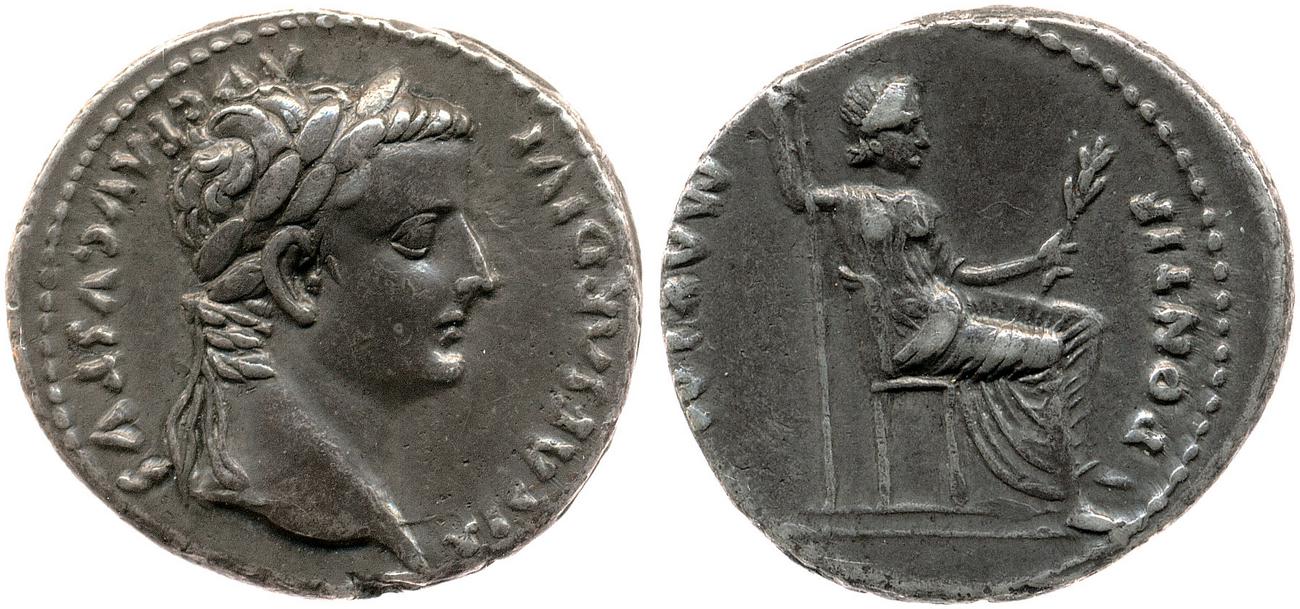
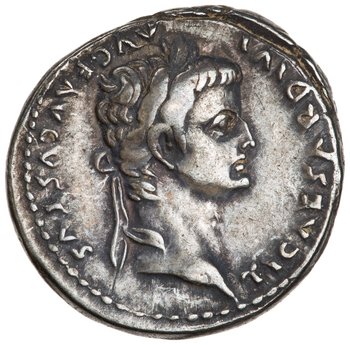
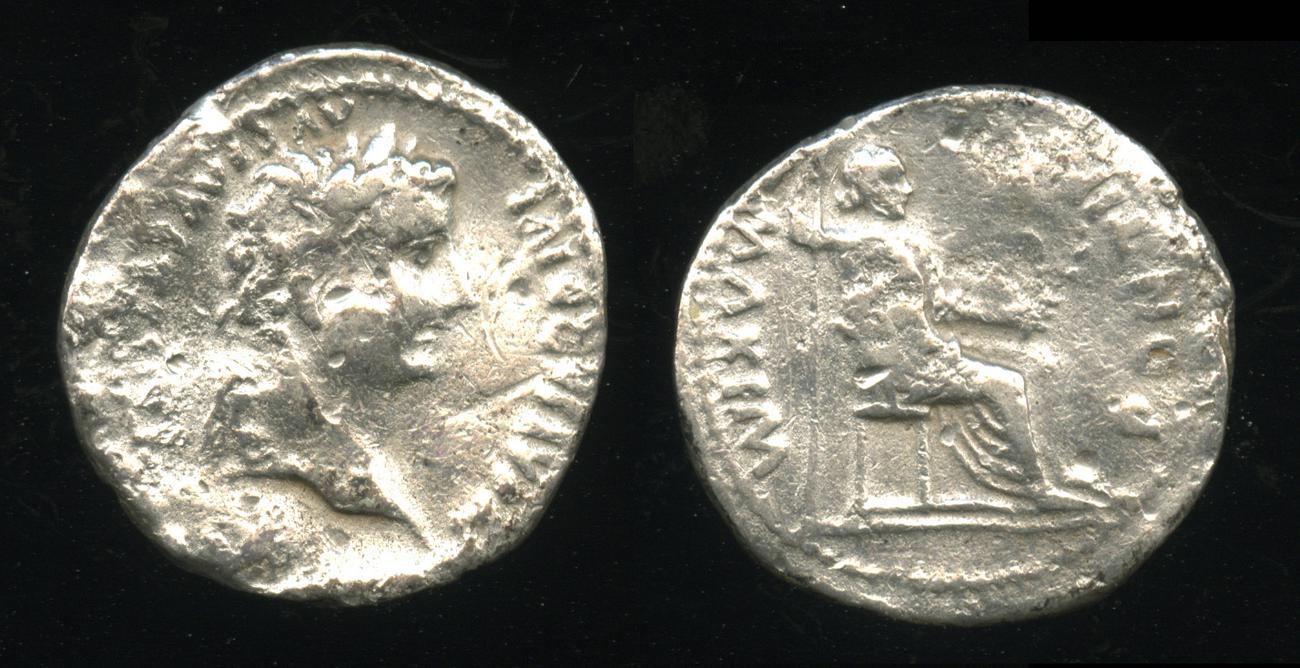
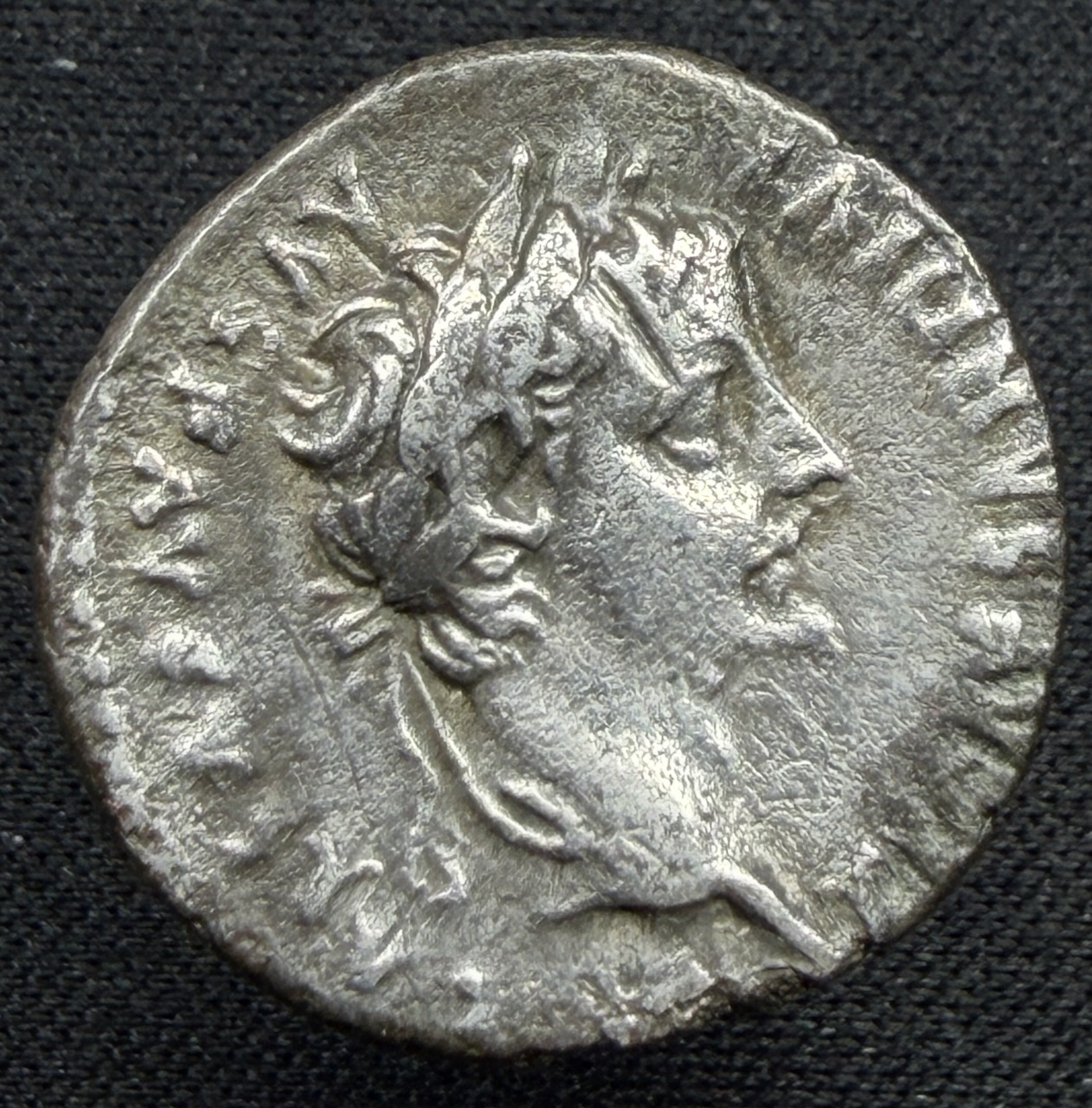
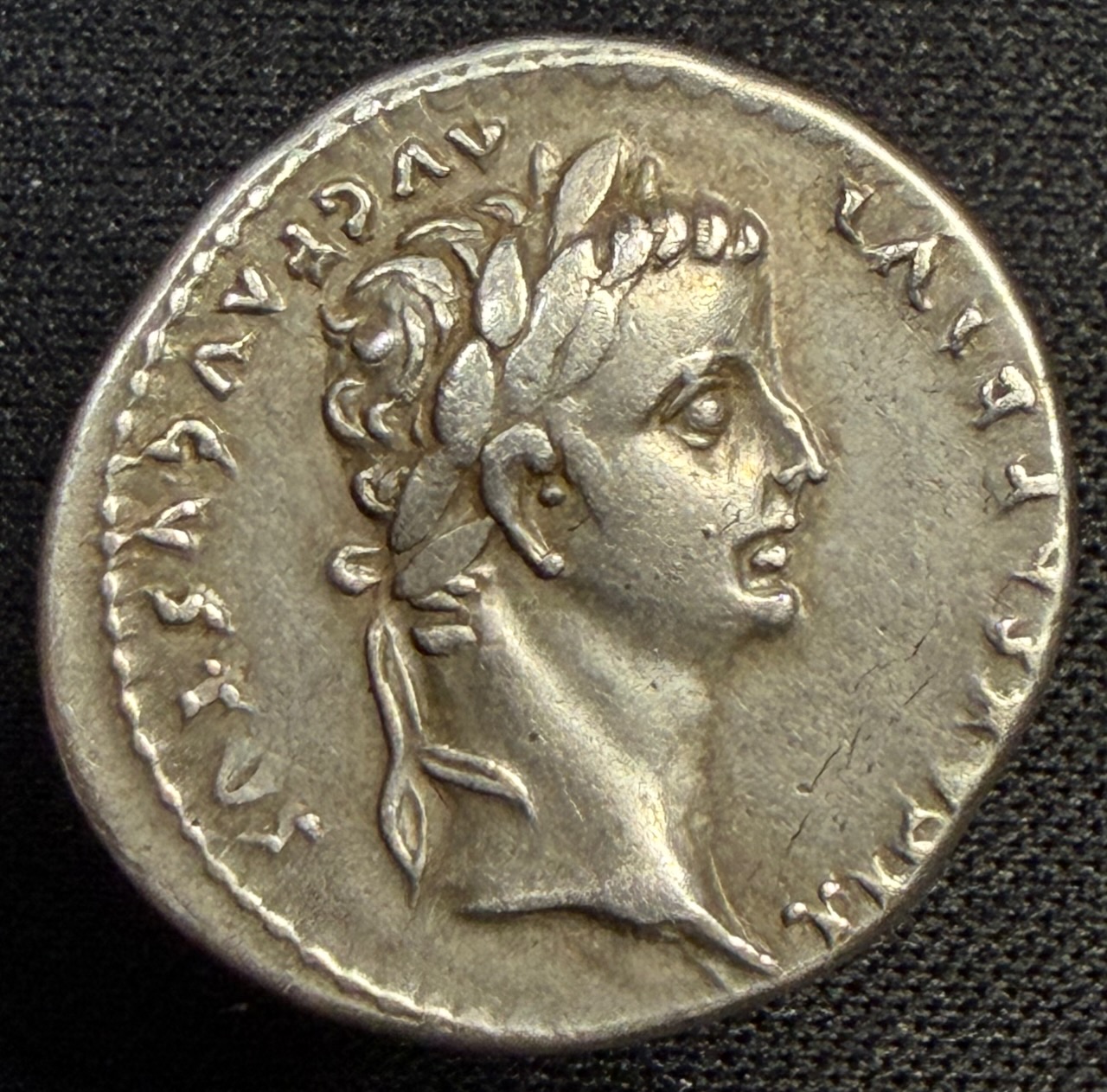
Obverse: Laureate head of Tiberius right
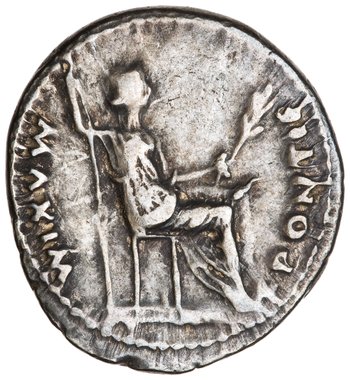
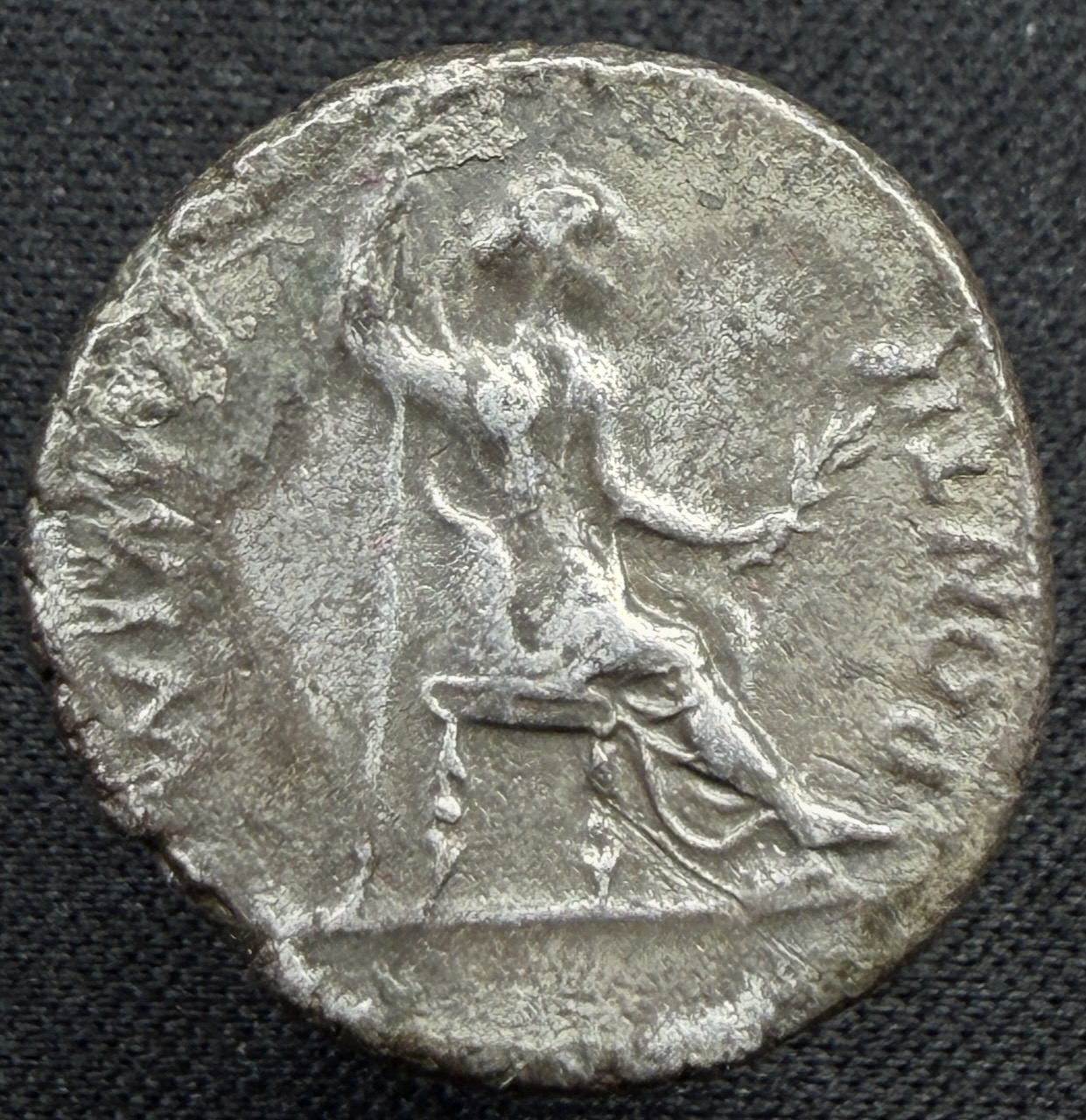
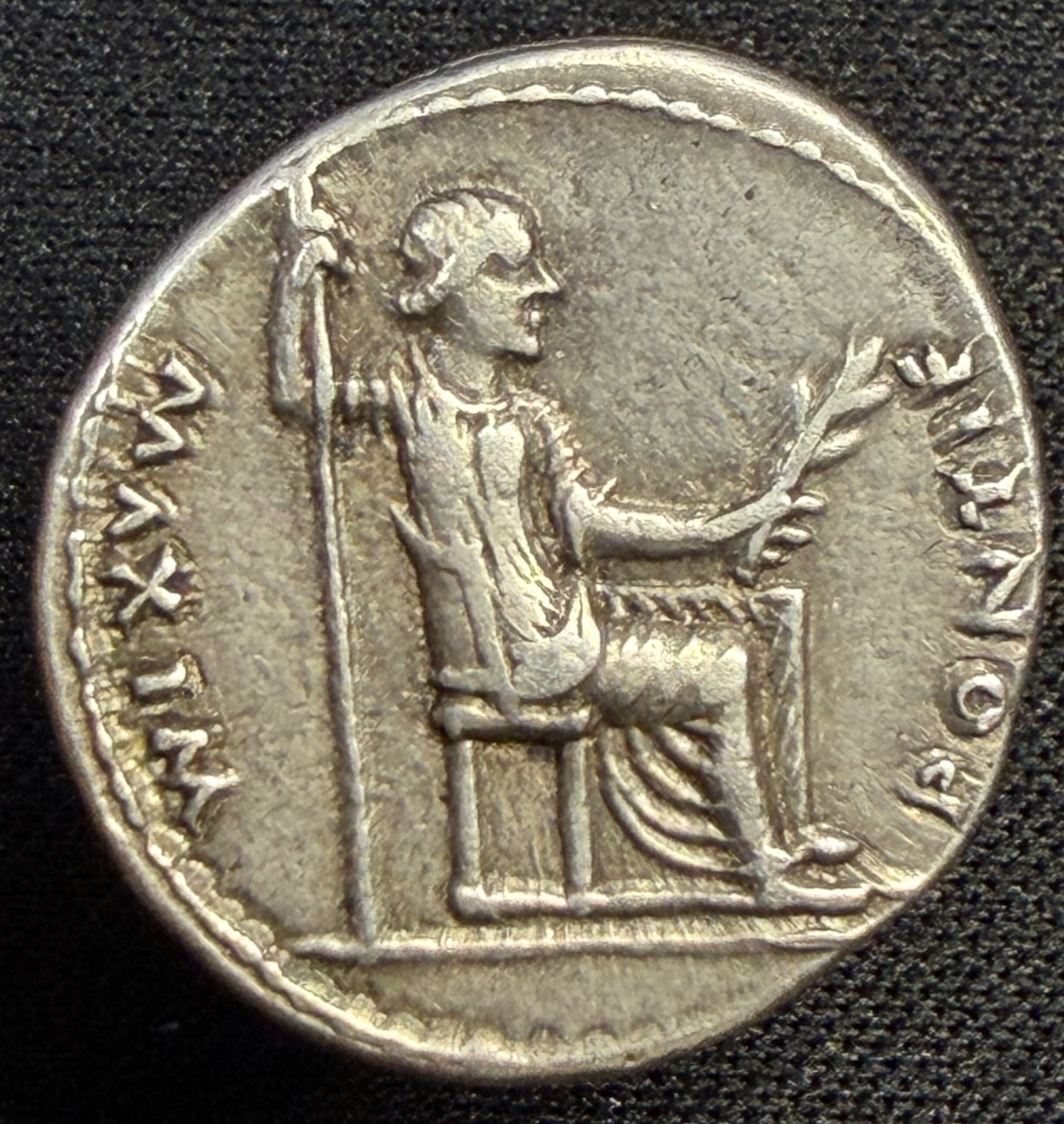
Reverse: Female figure (traditionally Livia as Pax), draped, seated right on chair with plain legs, holding long sceptre and olive branch; double line below chair
Primary reference: RIC I 26
32 specimens in public collections (British Museum 12, ANS 5, Göttingen 3, Ashmolean 1, Bergakademie Freiberg 1); 16 British finds recorded by the Portable Antiquities Scheme; weights 0.92–3.98 g, median 3.6 g across 45 recorded; die axis most often 6h.
This collection's specimen, at 3.63 g (tag), is heavier than 51% of the recorded weights.
This collection's specimen, at 3.78 g (tag), is heavier than 87% of the recorded weights.
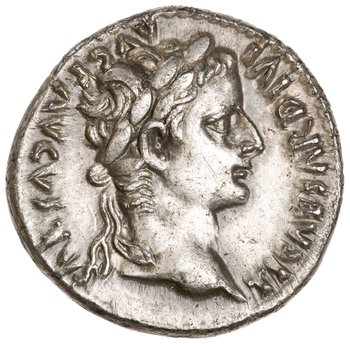
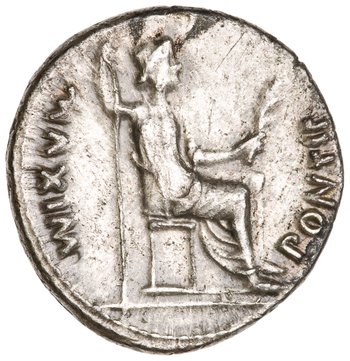
American Numismatic Society, 1935.117.356. CC BY-NC 4.0. https://numismatics.org/collection/1935.117.356
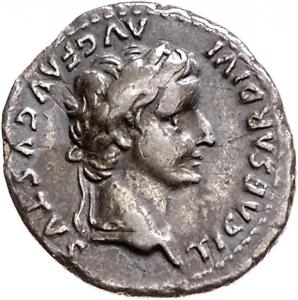
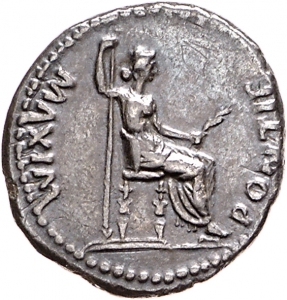
Münzkabinett, Staatliche Museen zu Berlin, 18211338. CC BY-NC-SA 4.0. https://ikmk.smb.museum/object?id=18211338
© The Trustees of the British Museum, 1841,0730.65. CC BY-NC-SA 4.0. https://www.britishmuseum.org/collection/object/C_1841-0730-65
American Numismatic Society, 1948.19.1042. CC BY-NC 4.0. https://numismatics.org/collection/1948.19.1042
© The Trustees of the British Museum, 1932,0706.24.4. CC BY-NC-SA 4.0. https://www.britishmuseum.org/collection/object/C_1932-0706-24-4
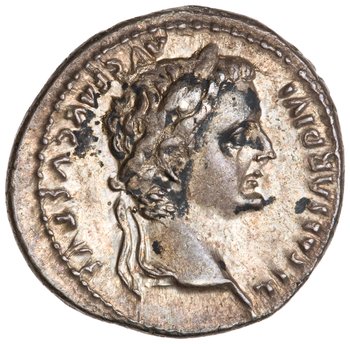
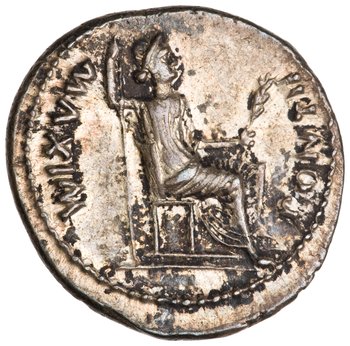
American Numismatic Society, 1957.172.1513. CC BY-NC 4.0. https://numismatics.org/collection/1957.172.1513
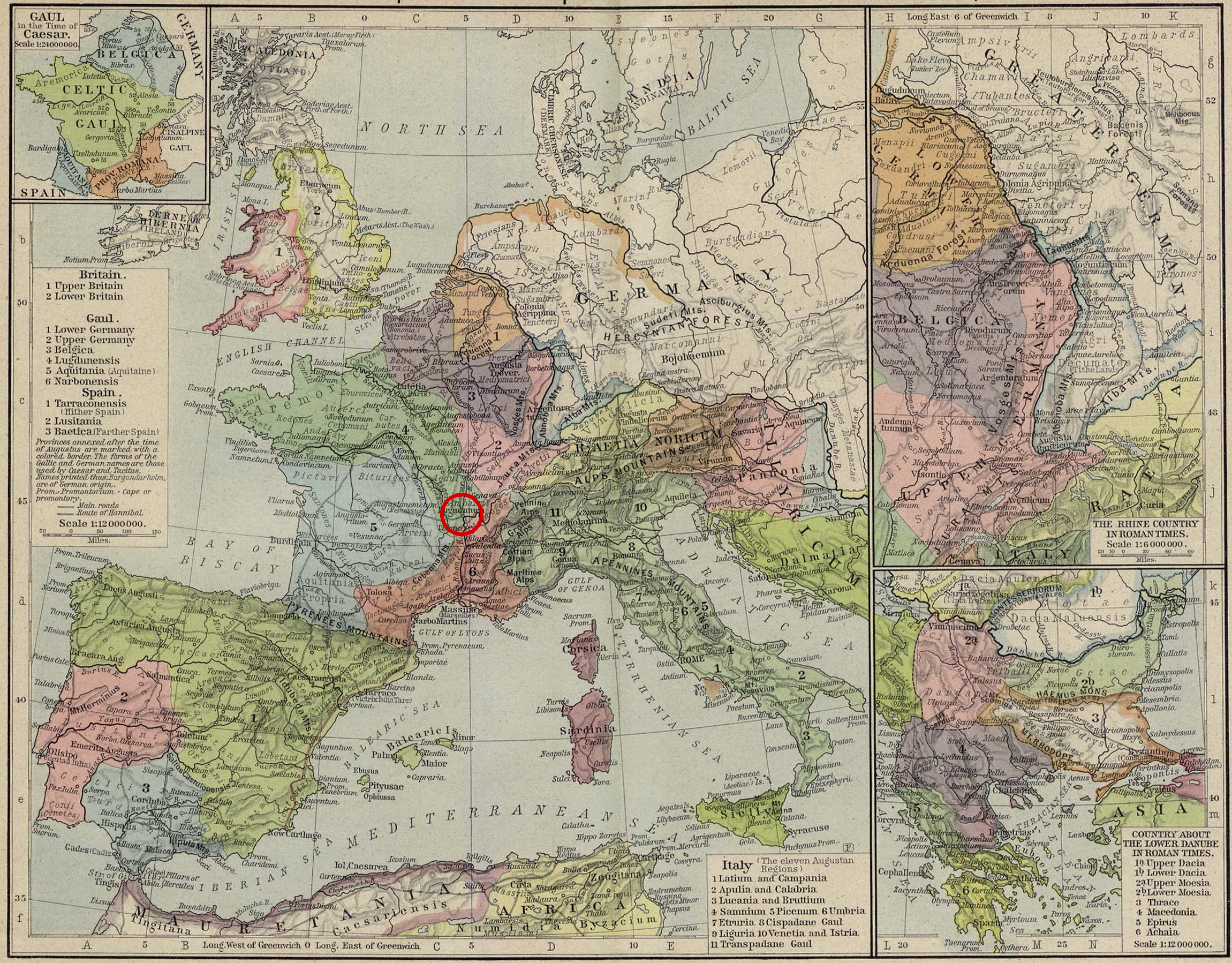
The European provinces of the Roman Empire (Shepherd’s reference map). Lugdunum — circled in red — sits at the confluence of the Rhône and Saône in Gallia Lugdunensis. The city’s mint struck the empire’s gold and silver through Tiberius’s reign, this type above all. Click through to the inset for a closer view of Gaul.
“Reference Map of the European Provinces of the Roman Empire” by William R. Shepherd, Historical Atlas (Henry Holt & Co., 1926 printing), public domain; via Wikimedia Commons, File:European Provinces of the Roman Empire.jpg (scan via the Perry-Castañeda Library, University of Texas). Red circle added to mark Lugdunum.
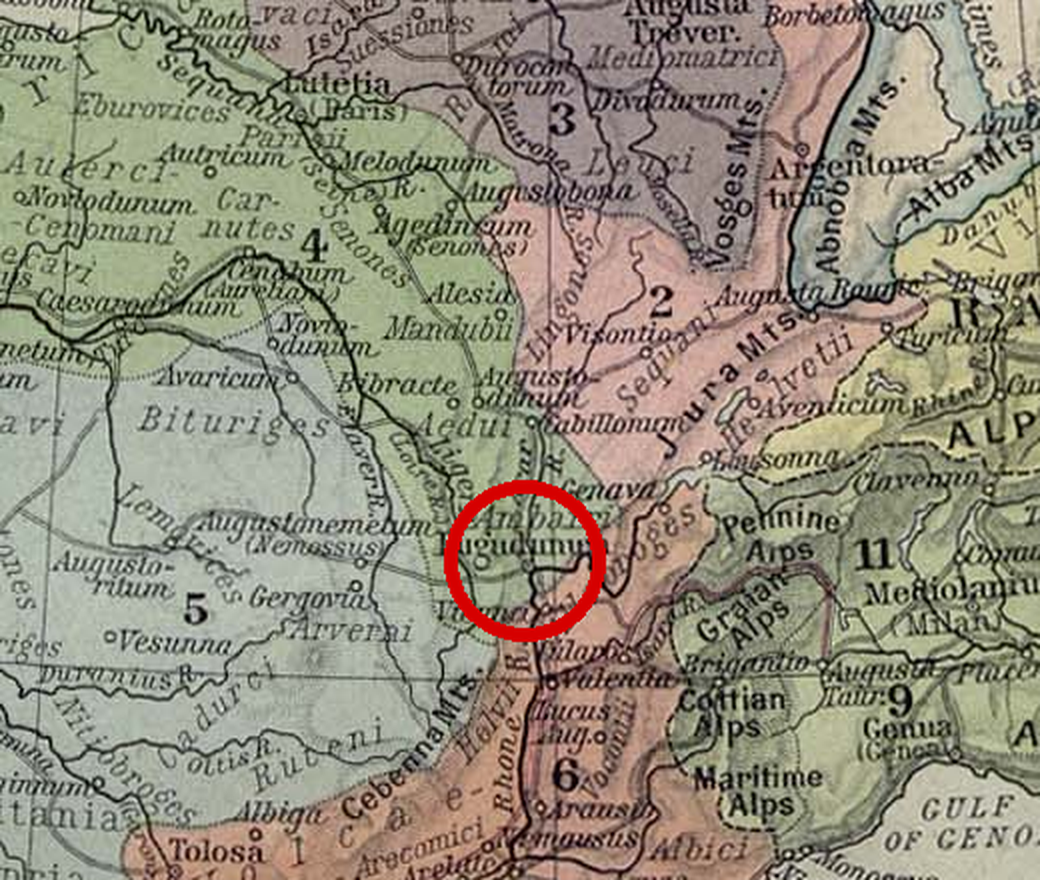
Detail: central Gaul, with Lugdunum circled in red at the Rhône–Saône confluence — Vienna of the Allobroges just downstream, Genava to the east, and the old Aeduan centers Bibracte and Augustodunum to the northwest.
No ancient coin carries a heavier freight of association than this one. It is, by longstanding tradition, the “Tribute Penny” — the denarius handed to Jesus in the Temple courts when he asked whose image and inscription it bore and answered, “Render unto Caesar the things that are Caesar’s” (Matthew 22:19–21). The tradition is an inference, not a fact: the Gospel names only “a denarius,” and the identification rests on this type’s overwhelming dominance of the silver currency in the years of the ministry. Tiberius struck essentially one denarius design for twenty-three years, and this is it — which is precisely why, of all the empire’s coins, this is the one a Judaean questioner would most plausibly have pulled from his purse.
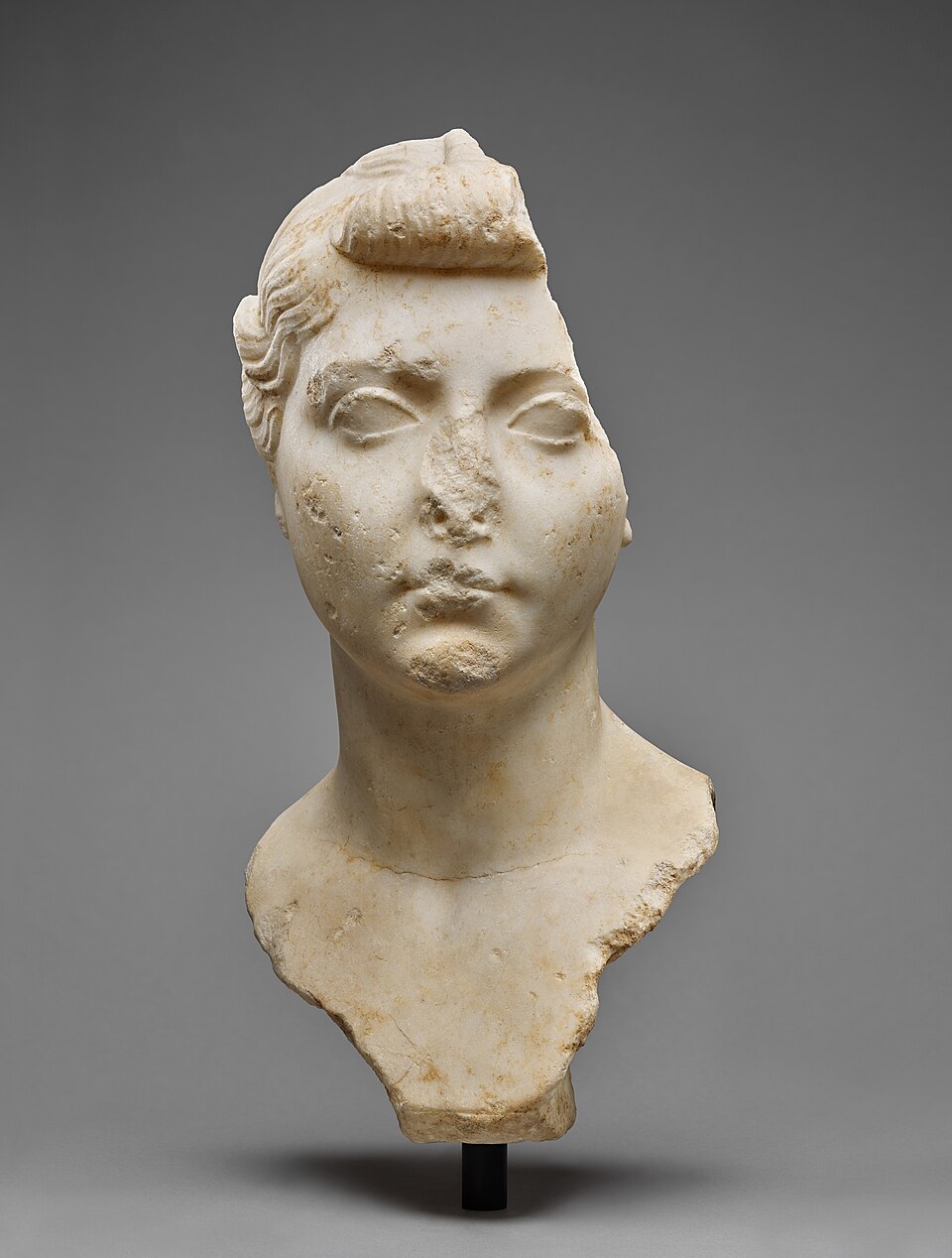
Image courtesy of the Getty’s Open Content Program (Wikimedia Commons, CC0); reproduced unmodified.
One refinement the research literature adds to the tradition is worth recording. The excavated coin finds of early Roman Judaea are dominated by local bronze — prutot like this collection’s First Revolt prutah, and, from the very years of the ministry, the prutah struck under Pontius Pilate and dated to Tiberius’s seventeenth regnal year — and by Tyrian silver, the shekels the Temple tax itself required; imperial denarii are comparatively scarce in Judaean hoards before the later first century. That does not unseat the tradition — the Gospel scene turns precisely on the coin being Caesar’s, a Roman denomination bearing a Roman image and superscription, produced on demand rather than pulled from everyday change (Matthew 22:15–22) — but it sharpens it: the questioners had to fetch the coin, and its image of the deified Augustus’s son was exactly the scandal the question needed. The scarcity is the story.
The obverse names Tiberius as Caesar, son of the deified Augustus, Augustus — his whole claim to rule compressed into a lineage. The reverse says only PONTIF MAXIM, chief priest, the office Tiberius assumed in 15 AD, and shows a draped woman enthroned with a sceptre and olive branch. She is conventionally read as Livia — Tiberius’s mother, Augustus’s widow — in the guise of Pax, though the coin itself names no one and the identification, while old and plausible, remains a scholarly convention rather than a certainty. The monotony of the design was itself a message: where Augustus’s mint had rung the changes on heirs, victories, and honors, Tiberius chose one image of priestly and dynastic continuity and held it, almost unaltered, for a generation.
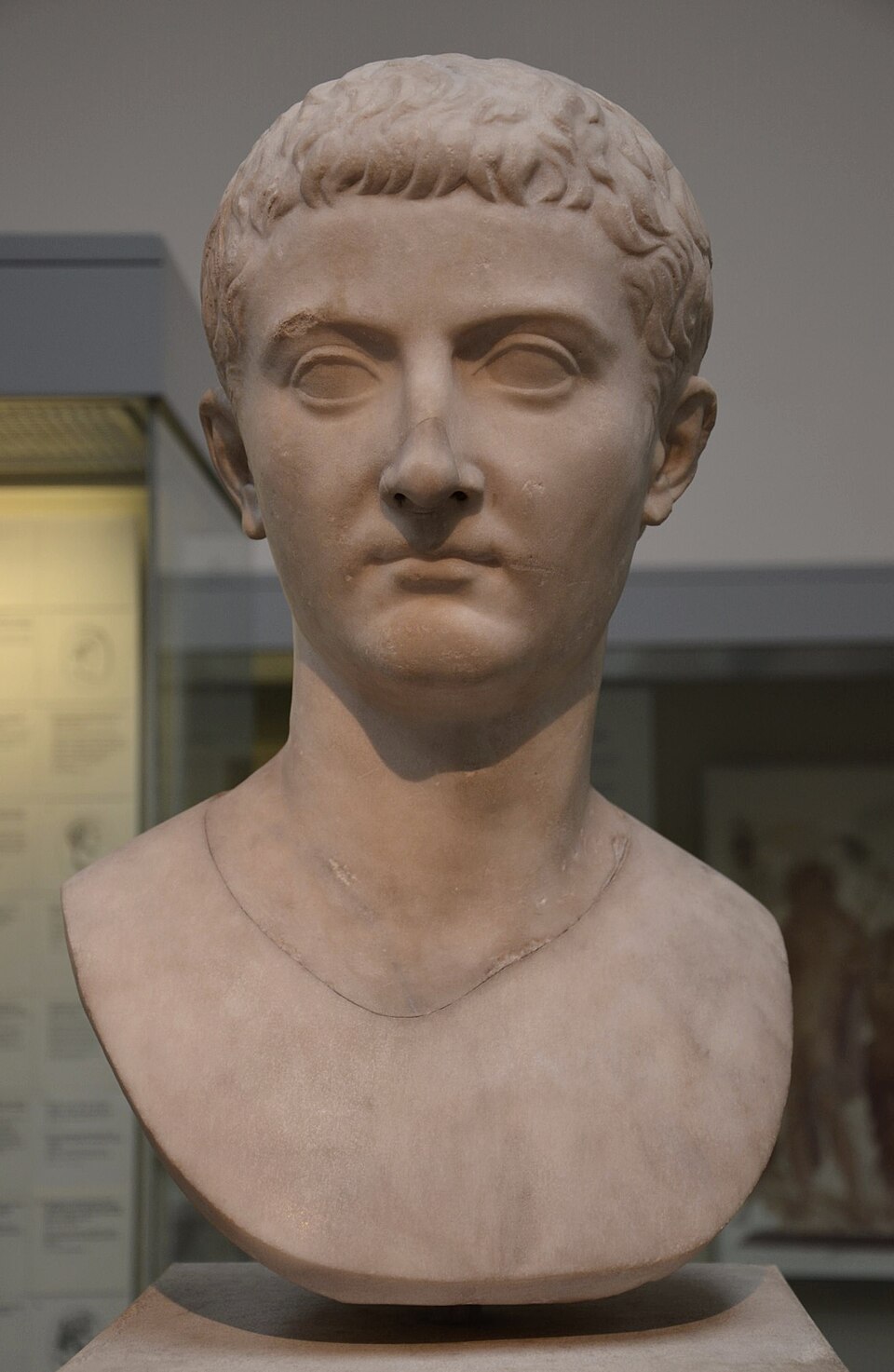
Photo: Carole Raddato, Wikimedia Commons, licensed CC BY-SA 2.0, reproduced unmodified.
Like Augustus’s last issues — struck at the same mint, naming the same two men, months before the succession — the PONTIF MAXIM coinage belongs to Lugdunum in Gaul, the empire’s principal gold-and-silver mint (the collection’s Gaius-and-Lucius denarius is the same mint a generation earlier, advertising the heirs who died and left Tiberius the throne). Across the long production run the engraving drifted, and modern study (Giard’s corpus of the Lyon mint) sorts the series into successive groups: this coin’s dealer attribution places it in Group 1, c. 15–18 AD, the earliest phase, on the evidence of style and the chair’s plain legs with a double line below (the variety RIC I 26 records; later phases ornament the chair and add a footstool). A coin of this group was some fifteen years old — well-worn pocket silver — by the time of the Gospel scene it is remembered for.
Beyond the biblical resonance, the type is the purest numismatic statement of the Tiberian principate: legitimacy by descent from the deified Augustus, power expressed as priesthood, the imperial mother enthroned like a goddess. The line back to the beginning is short: the man on this obverse was the stepson, adopted son and heir of the Imperator Caesar who, half a century earlier, had put his own statue on a rostral column and left the portrait side of his silver without a legend at all. It is also the bridge between the collection’s Lugdunum denarius of Augustus and the later empire — the design Augustus’s mint was striking when he died simply gave way to this one, and this one held until Caligula. And it is the last full-weight standard this collection’s Julio-Claudian silver shows: Nero’s reform of 64 AD trimmed the denarius that the Tribute Penny still represents at Augustus’s original weight. Few coins so common are so consequential.
The Lugdunum mint’s later history is in this collection too: three centuries after this denarius, the same city was striking Constantine’s Sol folles — the same Shepherd map, with the same red circle, serves both pages. And the standard this coin still keeps at Augustus’s original weight runs down, four centuries and a long debasement later, to the REPARATIO REIPVB maiorina of Magnus Maximus — a world away in fabric, fineness and message.
Attribution follows C. H. V. Sutherland, The Roman Imperial Coinage I (revised ed., London 1984), Tiberius 26, with the variety (plain chair legs, double exergual line) confirmed against the ANS’s Online Coins of the Roman Empire record for RIC I (2nd ed.) Tiberius 26; also RSC 16. The group attribution follows the dealer tag’s citation of Giard’s Lyon arrangement (Group 1, c. 15–18 AD). The Livia-as-Pax identification and the Tribute Penny tradition are discussed, with due caution, in the standard handbooks; the Gospel text is Matthew 22:19–21.
The PONTIF MAXIM denarius was struck at Lugdunum through virtually the whole reign; Giard's Lyon corpus divides the series into groups, the dealer tag assigning this coin to Group 1 (c. 15–18 AD). RIC I 26 is the variety with plain chair legs and a double exergual line below the chair (RIC 30 has ornamented legs, footstool variants). Two traditional identifications are debated: the seated woman is conventionally Livia in the guise of Pax, though the coin names no one; and the type's fame as the Gospel 'Tribute Penny' of Matthew 22:19–21 rests on its being the commonest denarius of the reign, not on any ancient testimony.
John's Ancient Coin Collection · Type · tiberius-tribute-penny
Image credits for this coin — photographs, maps and graphics used on this page
.jpg)
