Type · judaea-pontius-pilate-lituus-prutah
Current: Judaea, Roman prefects. Struck under Pontius Pilate, prefect AD 26–36, in the name of Tiberius. AE prutah, Jerusalem, dated LIZ = regnal year 17 of Tiberius = AD 30/31. Lituus / date in wreath. GBC 6, 6371; Hendin 1342 (5th ed.); Meshorer TJC 230; RPC I 4968.
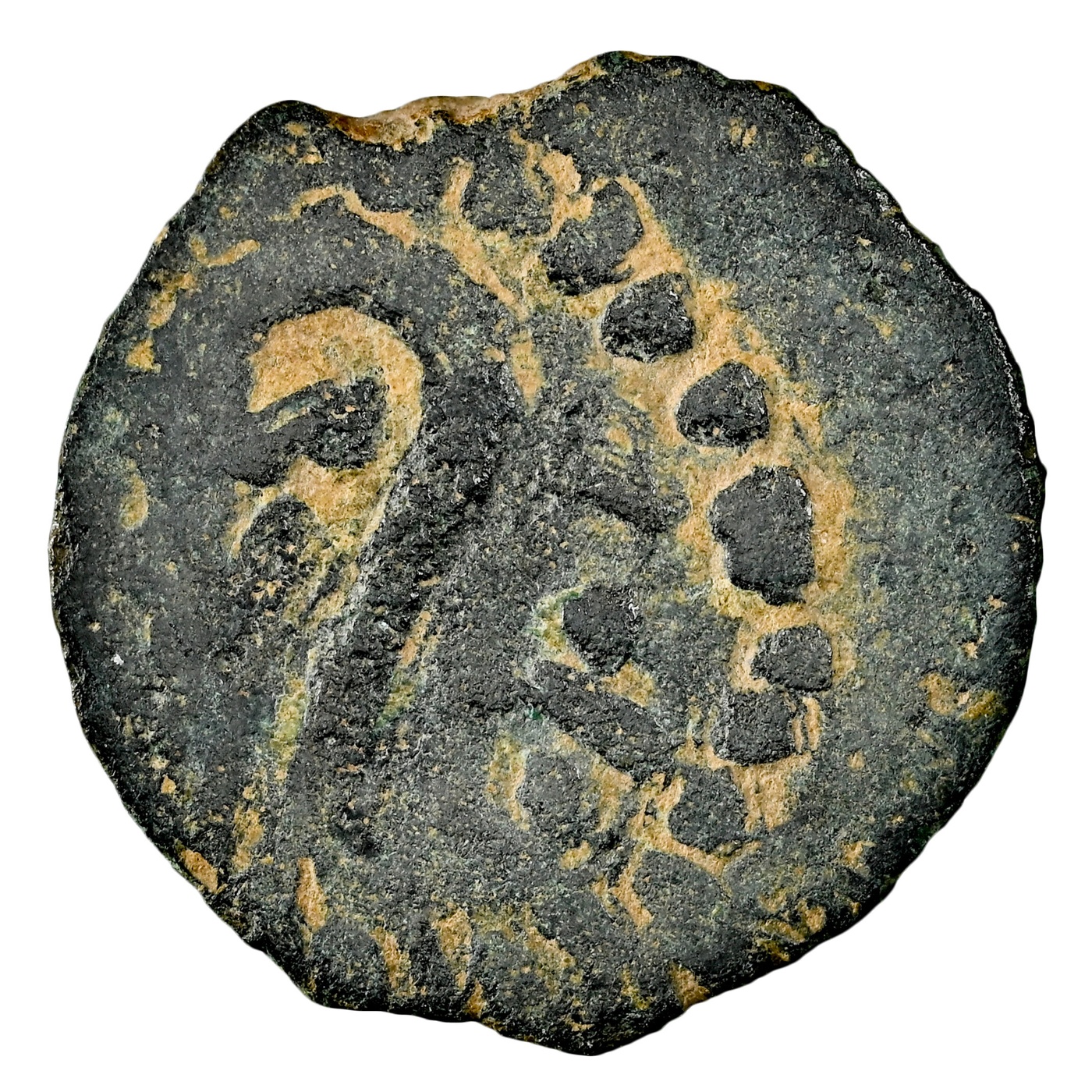
Obverse: A lituus — the curved augural staff of a Roman priest — set upright with the crook to the right, the legend running around it.
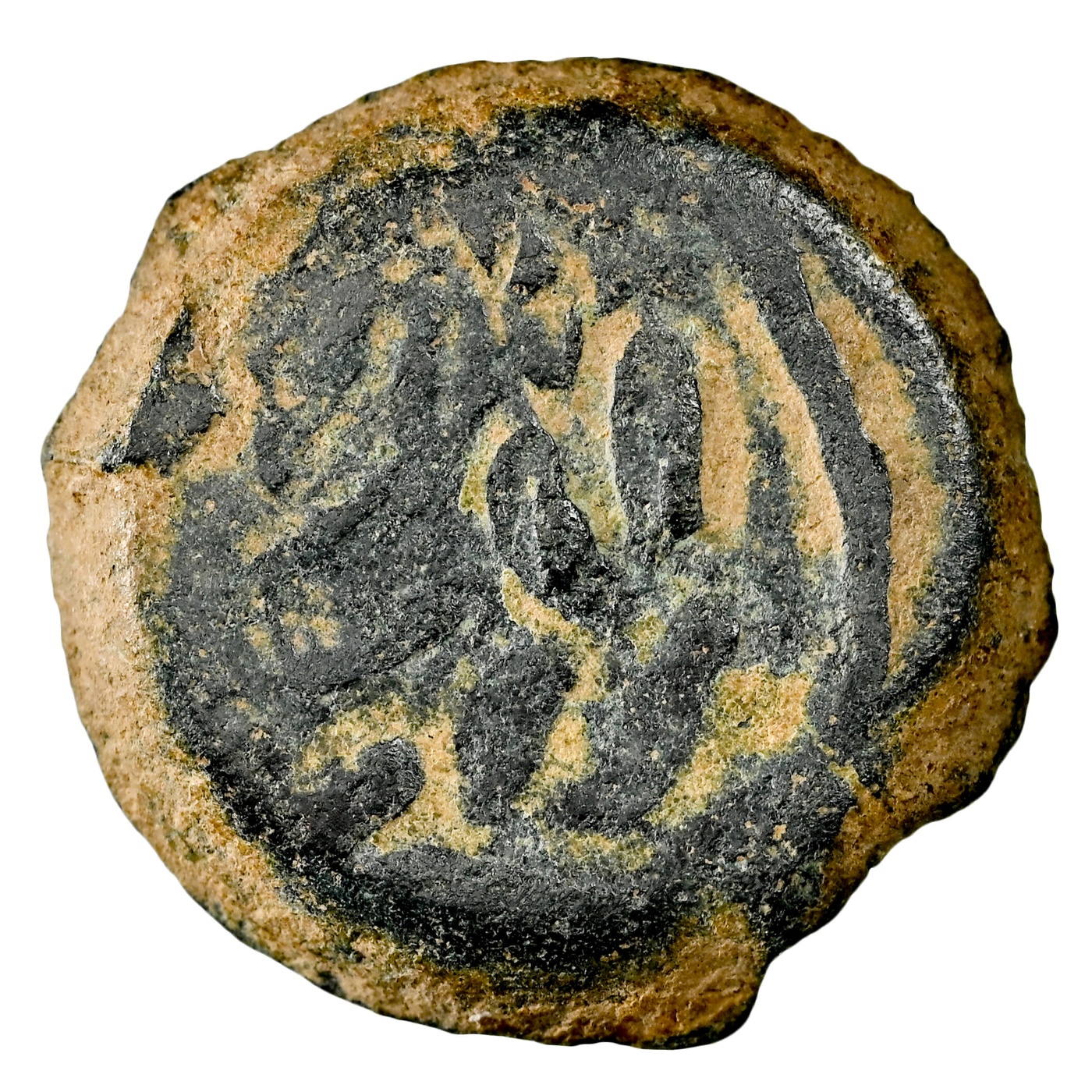
Reverse: The regnal date in Greek numerals inside a wreath tied at the foot.
Primary reference: GBC 6, 6371
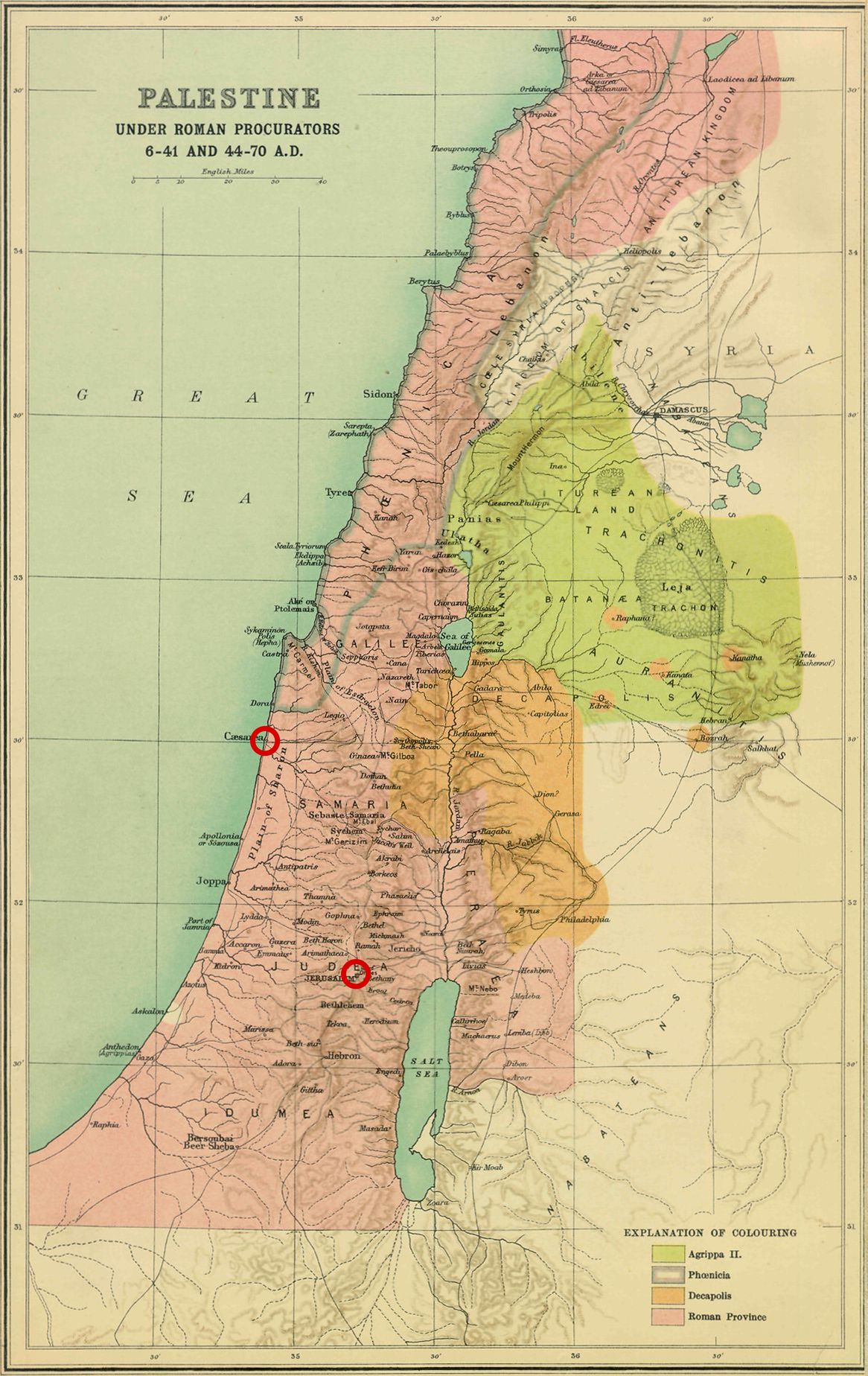
Palestine under the Roman procurators, from George Adam Smith’s historical atlas of 1915 — the plate covers 6–41 and 44–70 AD, so it shows the province as it stood during Pilate’s own prefecture. Jerusalem, where this coin was struck, is ringed in red inland toward the lower center. The second ring, on the coast, marks Caesarea Maritima, where Pilate actually governed from — and the mint of the collection’s bronze of Faustina Junior. The pink shading is the Roman province proper.
“Palestine under Roman Procurators, 6-41 and 44-70 A.D.” from George Adam Smith, Atlas of the Historical Geography of the Holy Land (1915). Public domain (published 1915; the author died 1942). Wikimedia Commons: https://commons.wikimedia.org/wiki/File:Palestine_under_Roman_Procurators_(Smith,_1915).jpg MODIFIED: two red rings added by this catalogue, one on Jerusalem and one on Caesarea. The unmarked original is kept at maps/Palestine_under_Roman_Procurators_Smith_1915.jpg.
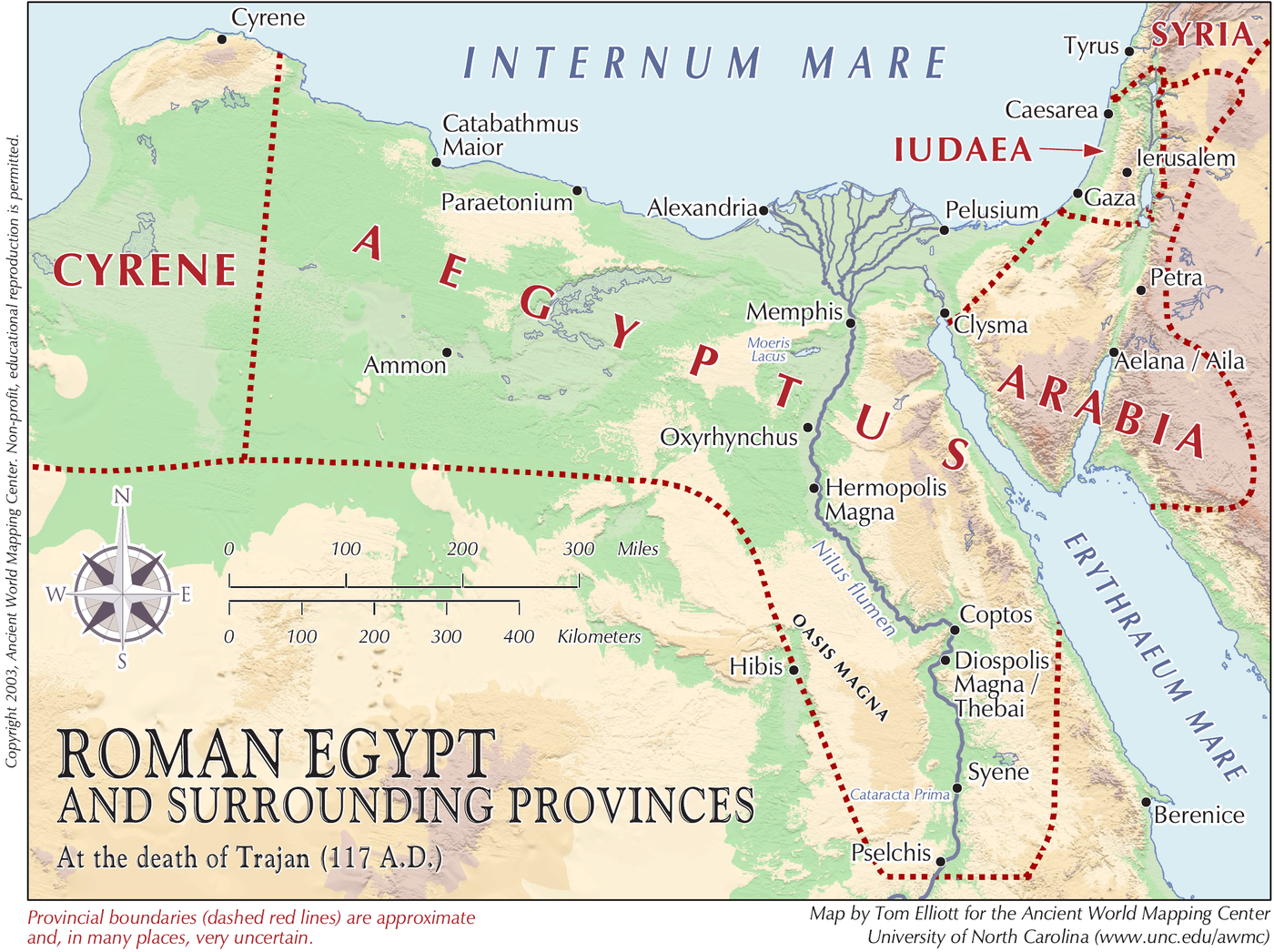
Ierusalem sits at the right, inland from the coast, with Caesarea — Pilate’s actual seat of government — on the shore north-west of it. The map is drawn for AD 117, some eighty-five years after this prutah, and shows Iudaea as the Roman province it had become: a small administered district on the land bridge between Egypt and Syria, which is most of the explanation for why Rome kept a prefect there at all.
Pontius Pilate governed Judaea from AD 26 to 36, the fifth Roman prefect of a province annexed in AD 6 after Rome deposed Herod’s son Archelaus. He is the best-attested of those prefects and the least representative of them, because everything about him has been read backwards through the trial narratives of the Gospels. Almost everything written about him has had to argue its way out from under them.
This coin is one of the few things he left behind that is not a text about him. It was struck in Jerusalem under his authority — strictly, in Tiberius’s name — and it is dated, in Greek numerals, to regnal year 17: AD 30/31.
Judaea under the prefects was not a mint of consequence. It struck no silver at all. The silver circulating in the province was Tyrian, Antiochene or Roman, and the denarius of Tiberius that tradition calls the tribute penny was made at Lugdunum in Gaul, most of a continent away. What the prefects issued was the prutah: bronze the size of a fingernail, struck by the thousand, the coin that actually filled a purse in Jerusalem.
Rome minted it locally for the ordinary reason that small change does not travel — it is too low in value to be worth shipping — and because a province needs coin to buy bread with. The designs are correspondingly modest. No portrait, no imperial image, and before Pilate no conspicuously Roman religious object either: his predecessors kept to palms, ears of grain, cornucopias and vine leaves, the deliberately neutral vocabulary of a Jewish province, chosen to stay clear of the graven image that the Second Commandment forbids.
The lituus on this coin is the curved staff of a Roman augur — the priest who read the will of the gods in the flight of birds. The simpulum on the year-16 issue is the ladle for pouring a libation. Both are unmistakably Roman cult implements, and both appear on the coinage of a province whose population objected, sometimes violently, to Roman religious symbols being brought into its space.
Whether that was deliberate provocation is genuinely disputed, and this page does not settle it.
Ethelbert Stauffer and those following him read the designs as of a piece with the incidents Josephus and Philo record — the military standards carried into Jerusalem by night, the votive shields set up in Herod’s palace — that is, as a governor testing Jewish sensibilities on purpose and repeatedly.
Helen Bond argued the contrary in an article whose title puts the question outright: that these are ordinary instruments of Roman administrative and priestly iconography, that Pilate’s coins carry no human or divine image and so break no prohibition, and that the more economical reading is a governor folding his province into the empire’s visual language rather than baiting it (The Coins of Pontius Pilate, JSJ 27.3, 1996).
Both readings are live in the literature. What is not in dispute: the objects are Roman priestly equipment, they are the first such objects to appear on Judaean provincial coinage, and the issues stop after AD 32.
Not Jerusalem. The prefect’s seat was Caesarea Maritima on the coast, Herod’s artificial harbour city; the governor came up to Jerusalem for the festivals, when crowds made trouble likely. The one inscription that names Pilate — the “Pilate Stone”, found reused in the theatre at Caesarea in 1961, reading […]TIVS PILATVS and PRAEF[ECTVS] IVDA[EA]E — comes from that city. It is also the reason his title is known to have been prefect rather than the procurator the later literary sources call him.
The collection holds the city as well as the man: a bronze of Caesarea Maritima struck under Faustina Junior, whose reverse legend records the colonial title Vespasian gave the place a generation after Pilate left it.
Year 17 is AD 30/31. Dealers routinely describe these as coins of the crucifixion year, and it is worth saying plainly what that claim is worth. The standard scholarly candidates for the crucifixion are AD 30 and AD 33, argued from Passover dating and from the length of the ministry, and neither is secure. A year-17 prutah was therefore struck inside the window of one of the two leading dates — which is a real thing to be able to say, and rather less than “the coin of that year”.
The honest version is simpler and holds whichever date is right: this coin was made in Jerusalem, on the authority of the man the Gospels name, during the decade they describe, and it circulated in that city, in those years, among those people.
He was removed in AD 36 after a complaint from the Samaritans and sent to Rome to answer for it. Tiberius died before he arrived, and he disappears from the record. The province kept its prefects, then its procurators, until the grievances accumulated into the revolt of AD 66 — whose rebel government struck its own prutot in the same city, in paleo-Hebrew, with the slogan Freedom of Zion, in deliberate answer to coins like this one. The collection holds one of those as well: the Year Two prutah of the First Revolt. Set the two side by side and they are the same denomination, from the same city, thirty-six years apart, and on opposite sides of the argument.
Attribution follows Hendin, Guide to Biblical Coins (6th ed., 2021), no. 6371 — the reference used in cataloguing this specimen; the same type is Hendin 1342 in the 5th edition and 649 in older ones, and it is Meshorer, TJC, no. 230, and RPC I 4968. The debate over the meaning of the augural implements is set out in Helen K. Bond, “The Coins of Pontius Pilate: Part of an Attempt To Provoke the People or To Integrate Them Into the Empire?”, Journal for the Study of Judaism 27.3 (1996), 241–262, and in her Pontius Pilate in History and Interpretation (SNTS Monograph Series 100, Cambridge, 1998); the provocation reading it argues against is associated with Ethelbert Stauffer. The Pilate Stone was excavated at Caesarea Maritima by the Italian mission in 1961 and is in the Israel Museum.
THE DENOMINATION. The prutah is Judaea's small bronze — the everyday coin of the province and the smallest thing most people handled. They are struck on irregular flans and are usually off-center; a specimen carrying both the full legend and a complete wreath is unusual rather than routine. THE DATE IS THE POINT. Most provincial small change is undated. Pilate's is not: LIS (year 16 = AD 29/30), LIZ (year 17 = AD 30/31) and LIH (year 18 = AD 31/32). Tiberius acceded in AD 14, so the regnal years convert straight across. These are among the very few coins anywhere that can be fixed to a single year of the prefecture. TWO DESIGNS ACROSS THREE YEARS. Year 16 carries the simpulum, the ladle used to pour a libation, with three bound ears of grain and the legend IOVLIAC KAICAPOC — Julia, that is Livia, Tiberius's mother, who died in AD 29. Years 17 and 18 carry the lituus. Both objects are Roman priestly equipment. THE NUMBERING MOVES BETWEEN EDITIONS. Hendin renumbered wholesale for the 6th edition: this type is 6371 there, 1342 in the 5th, 649 in older ones. Auction cataloguing may cite any of the three for the same coin.
John's Ancient Coin Collection · Type · judaea-pontius-pilate-lituus-prutah
Image credits for this coin — photographs, maps and graphics used on this page
.jpg)