Type · anonymous-victory-biga-denarius
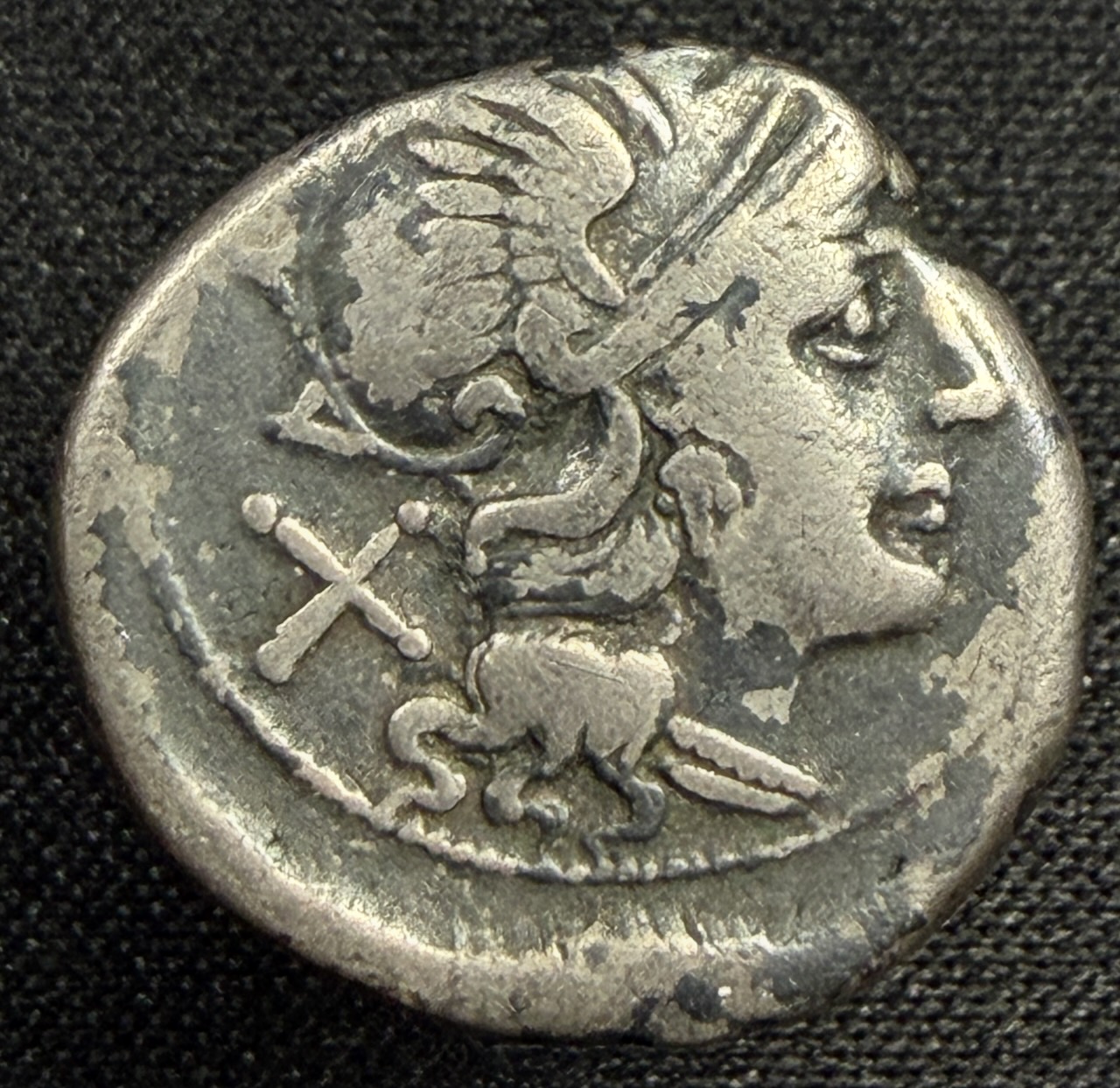
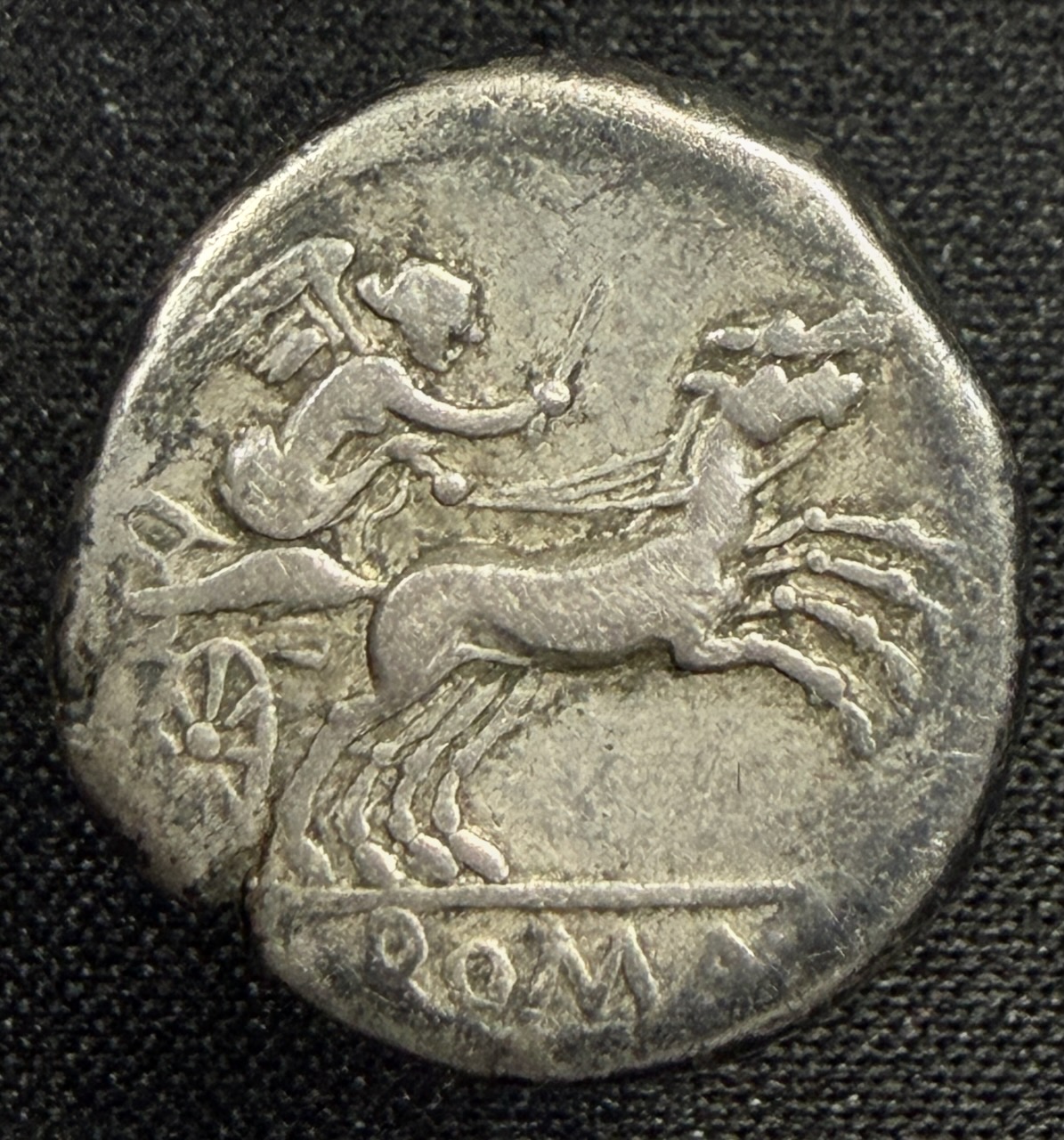
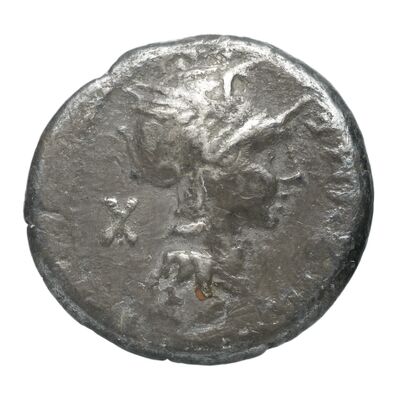
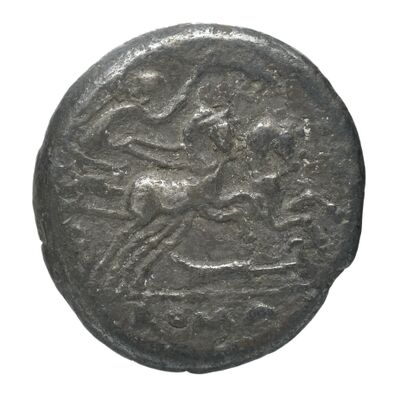
Current: Roman Republic, anonymous AR denarius, Rome, 157–156 BC (Crawford 197/1b; Sydenham 376; RSC Anonymous 6). Helmeted head of Roma right, X behind / Victory in galloping biga right, ROMA in exergue
Superseded: Roman Republic, 145–138 BC (the earlier dealer's typed tag, dating since revised; annotated 'near last anon.')
Obverse: Head of Roma right in winged helmet; denomination mark X (= 10 asses) behind
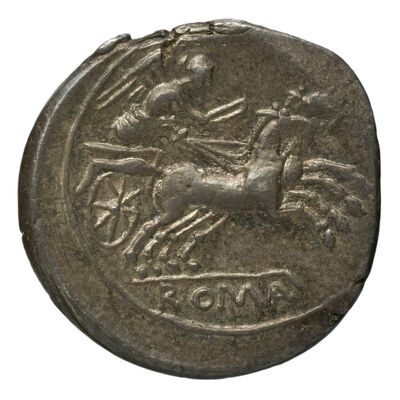
Reverse: Victory, holding whip and reins, driving galloping biga right; ROMA in exergue
Primary reference: Crawford 197/1b
21 specimens in public collections (Fitzwilliam 6, Kbr 4, BnF 3, British Museum 2, Museum August Kestner 1); 8 sale records in the Schaefer RRDP archive; weights 2.95–4.16 g, median 3.685 g across 26 recorded; die axis most often 12h; recorded in hoards CHRR ALL, CHRR CAC, CHRR CDA, CHRR CDR, CHRR FA2, CHRR FSL, CHRR GDJ, CHRR MC1 and 3 more.
This collection's specimen, at 3.92 g (tag), is heavier than 85% of the recorded weights.
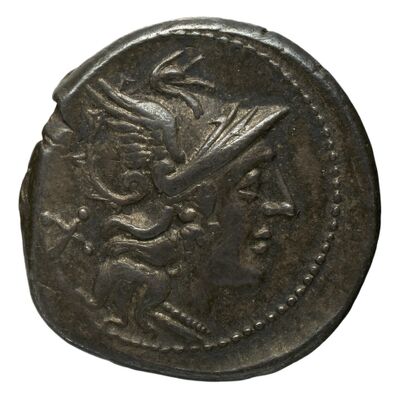
Bibliothèque nationale de France (Gallica), REP-1795. non-commercial reuse permitted. https://gallica.bnf.fr/ark:/12148/btv1b10422198r
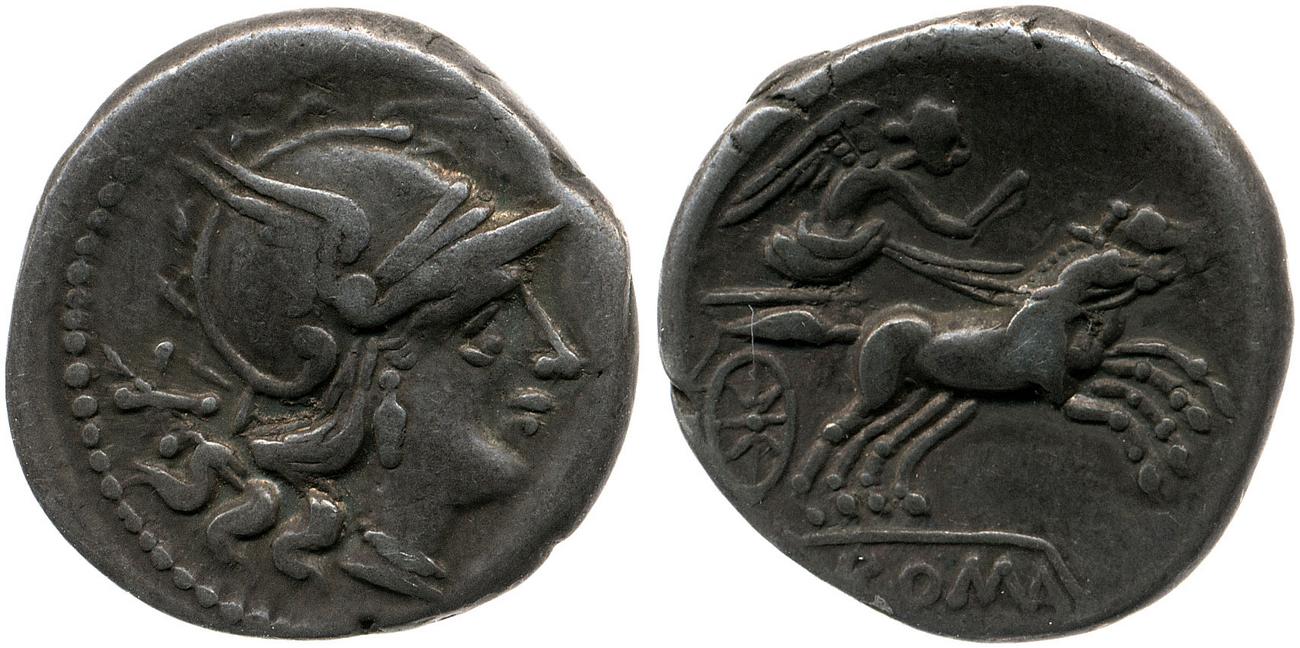
© The Trustees of the British Museum, 1934,1011.26. CC BY-NC-SA 4.0. https://www.britishmuseum.org/collection/object/C_1934-1011-26
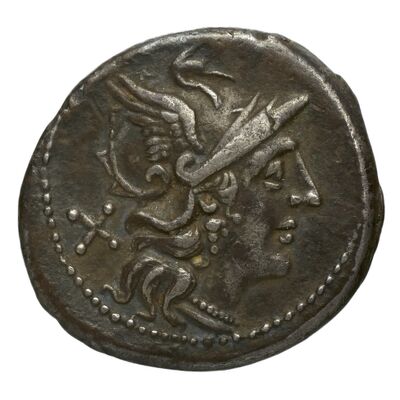
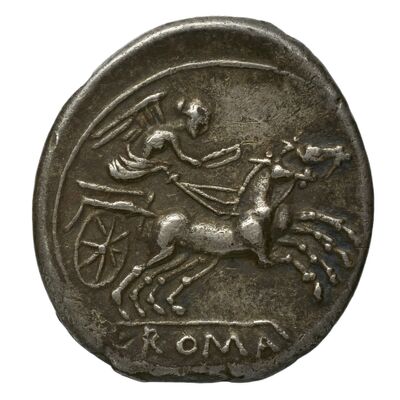
Bibliothèque nationale de France (Gallica), REP-1796. non-commercial reuse permitted. https://gallica.bnf.fr/ark:/12148/btv1b104221996
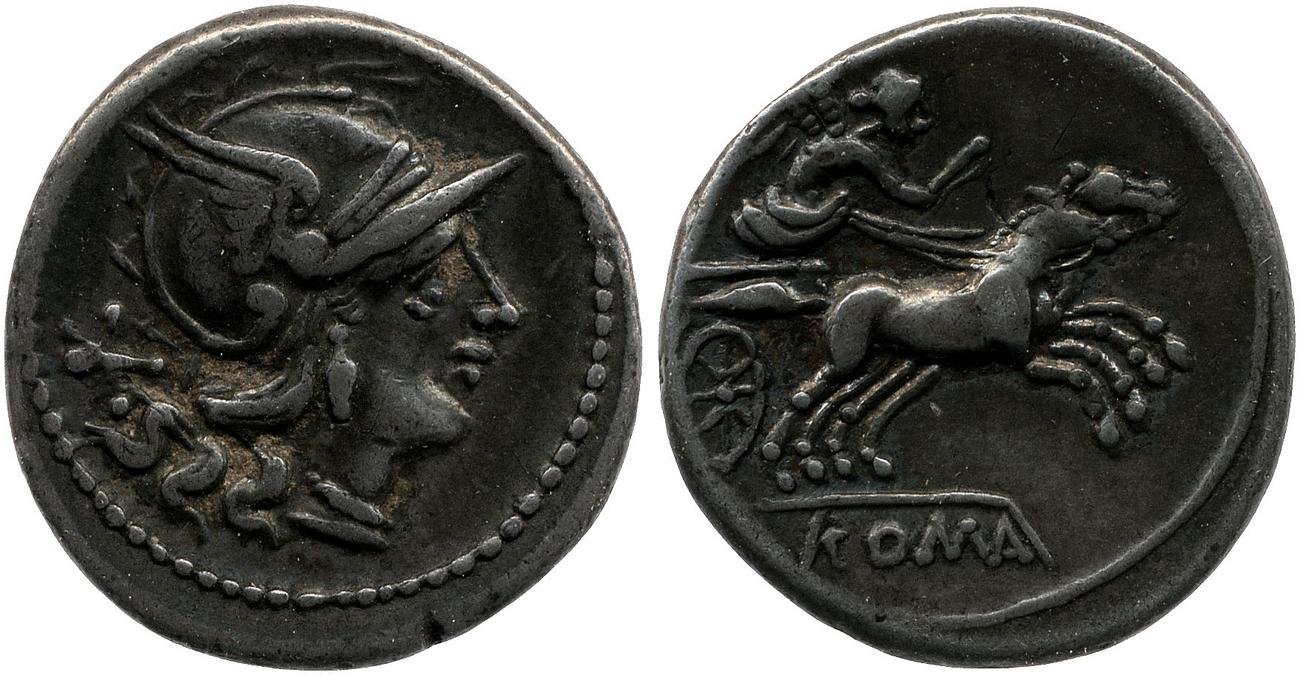
© The Trustees of the British Museum, 2002,0102.741. CC BY-NC-SA 4.0. https://www.britishmuseum.org/collection/object/C_2002-0102-741
Bibliothèque nationale de France (Gallica), REP-22559. non-commercial reuse permitted. https://gallica.bnf.fr/ark:/12148/btv1b104546145
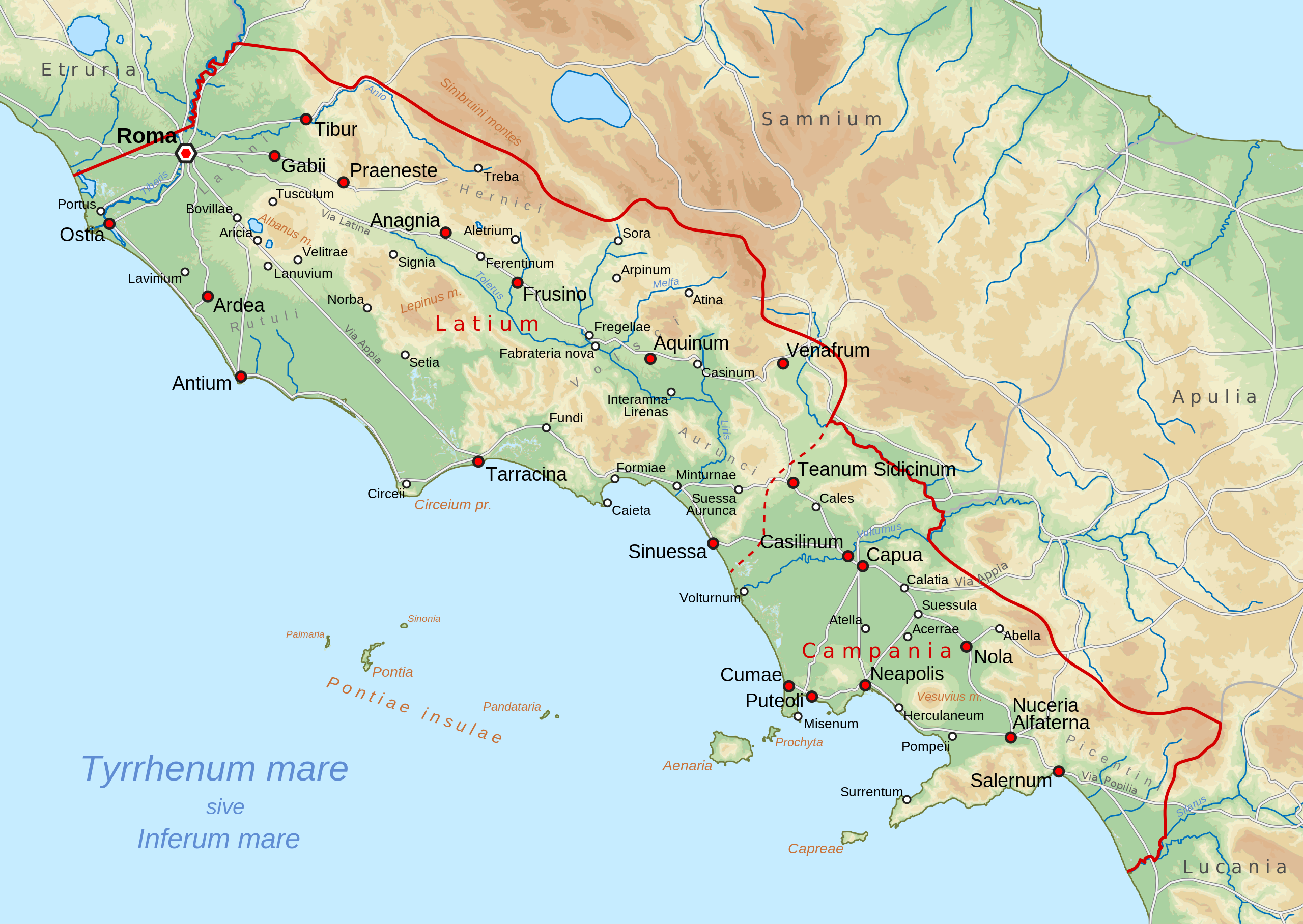
Regio I, Latium et Campania — the heartland of Roman Italy as organized under Augustus, more than a century after this coin. Roma sits at the upper left, marked by the map’s hexagonal capital symbol and bold label. The Republican mint stood on the Capitoline beside the temple of Juno Moneta.
“Map of Augustan Regio I Latium et Campania” by Tomisti (Wikimedia Commons), File:Regio I Latium et Campania map.svg, licensed CC BY-SA 4.0; cities and roads based on the Digital Atlas of the Roman Empire (DARE) and Pleiades; topographic base © OpenMapTiles, © OpenStreetMap contributors. Rasterized from SVG to PNG; otherwise reproduced unmodified (Roma already carries the base map’s capital marker).
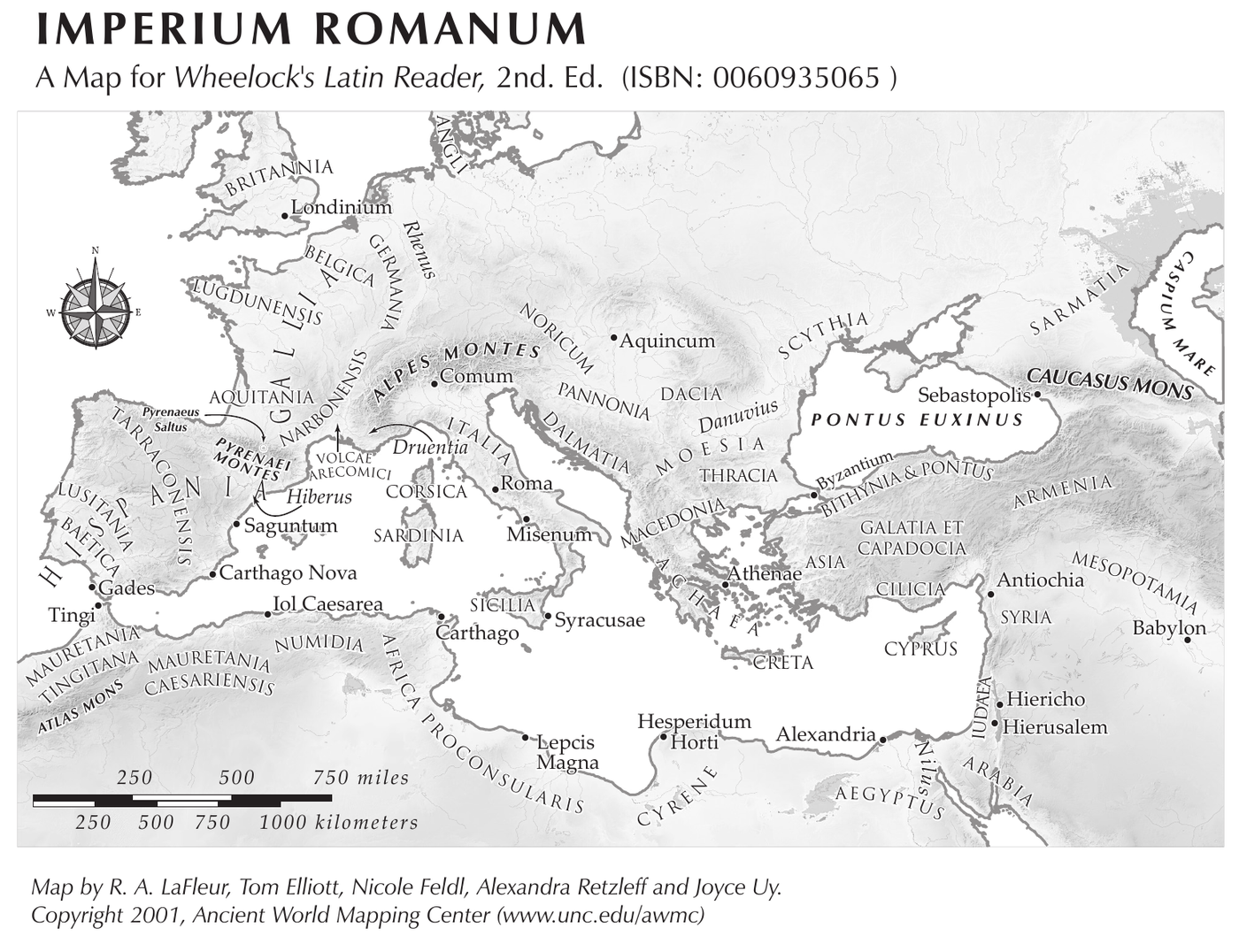
Roma sits at the center of Italia. This denarius was struck the year after Pydna broke Macedon. Rome then held Italia, Sicilia, Sardinia and the Spains, with Macedonia and Achaea reduced to protectorates — a fraction of the world drawn here, which is roughly the empire of two centuries later.
This denarius was struck in the mid-150s BC, in the confident generation between Rome’s crushing of Macedon at Pydna (168 BC) and the destruction of Carthage and Corinth in 146 BC — the moment Polybius chose as the completion of Rome’s rise to mastery of the Mediterranean world. (What Rome made of dismantled Macedon is in this collection as the First Meris tetradrachm, struck at Amphipolis under the settlement Pydna imposed.) The treasury that paid for those wars ran on coins exactly like this one: the denarius, tariffed at ten asses (the X behind Roma’s head), struck at the mint beside the temple of Juno Moneta on the Capitoline hill. (The denarius system itself was born in the Second Punic War — the introduction is dated c. 212–211 BC largely on the evidence of the Morgantina excavations in Sicily — and the enemy’s money of those years is in this collection twice over: a Carthaginian bronze shekel from the home mint, and the Akragas Punic quarter-shekel, silver struck in occupied Sicily in the very years the denarius was born.)
Graphic: JSB Coins, 2026 (CC0).
The place this coin was made has left a longer mark on language than almost any building in Rome. In 345 BC the dictator L. Furius Camillus, facing the Aurunci in battle, vowed a temple to Juno Moneta — “Juno the Warner” or “the Reminder,” from monere, though ancient etymologists argued about it even then — and it was dedicated the following year on the Arx, the northern summit of the Capitoline (Livy 7.28). The site had a history of warnings: it was on the Arx that the sacred geese had raised the alarm against the Gauls in 390 BC. When the Republic organized its silver coinage, the workshops operated beside — perhaps within the precinct of — Moneta’s temple, and the goddess’s epithet transferred first to the workshop, then to its product: moneta came to mean both the mint and the money it made, and through Latin into the daughter languages it still does — English mint and money are both Juno’s epithet, worn smooth by two thousand years of change-making. Every coin in the Roman half of this collection descends, in name as well as fact, from the building where this denarius was struck. The temple itself is gone; its platform lies somewhere under the medieval church of Santa Maria in Aracoeli, whose famous marble stair now climbs the Arx where the mint’s deliveries once did.
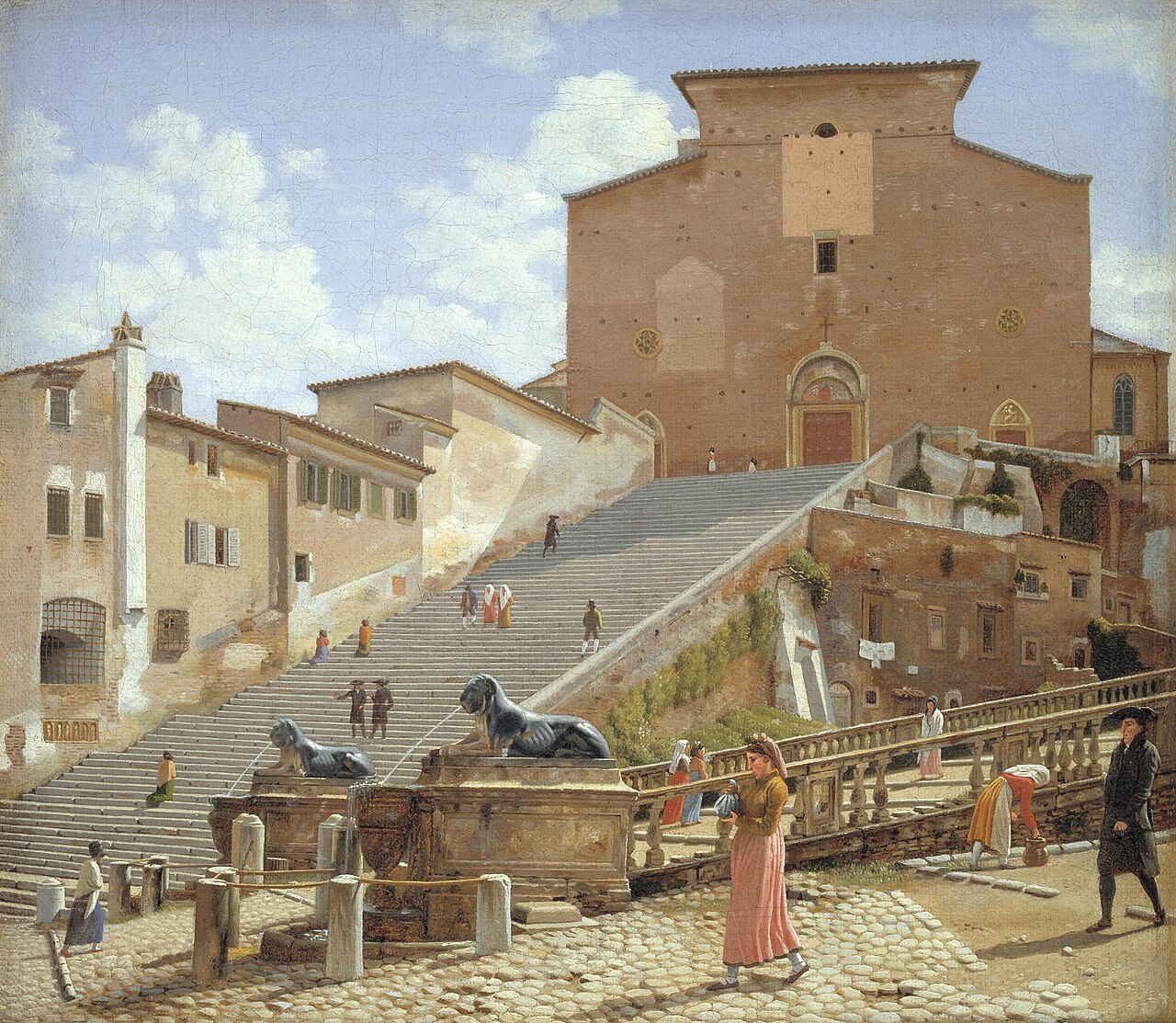
Public-domain work of art (Wikimedia Commons); reproduced unmodified.
What makes the issue historically interesting is what it lacks: a name. The earliest denarii, from their introduction during the Second Punic War, identified themselves only by the state’s own badge — ROMA in the exergue — and at most a small symbol. Through the second century the young aristocrats who supervised each year’s coinage (the tresviri monetales) began adding first symbols, then monograms, and finally full names, turning the coinage into a gallery of family advertisement that would culminate in the richly personal types of the late Republic — the very next step is in this collection as the C. Porcius Cato denarius of 123 BC, the same Roma/Victory-biga design with a moneyer’s name under the horses. Crawford places this issue, his 197/1b, at 157–156 BC, among the very last with no moneyer’s mark at all — a point the unknown earlier owner of this specimen noted in ink on its old typed tag: “near last anon.” The types themselves are the conservative core of the tradition: Roma armed and helmeted on the obverse, and on the reverse Victory lashing her two-horse chariot — the biga — a promise of divine favor for Roman arms that needed no family name to explain it. Where that road ends is in this collection too: the elephant denarius of Julius Caesar, struck in 49 BC with no god, no ROMA, and CAESAR written plain in the exergue.
This specimen’s two tags record the scholarship moving. The earlier dealer’s typed tag gives “145–138 B.C.” (partly corrected on the tag itself) with the old Sydenham reference (Syd 376) and Babelon/RSC classification (RSC Anonymous 6); Crawford’s 1974 die-and-hoard-based arrangement redated the issue to 157–156 BC, which the modern Ancient Imports slip follows (Crawford 197/1b). The superseded dating is preserved in this page’s frontmatter, as the older classification is what any pre-1974 auction record of this coin would carry.
Companions of this coin’s era in the collection: the denarius of L. Antestius Gragulus of 136 BC shows the very next stage of the same evolution — the moneyer’s name spelled out on the coin — while the anonymous types here still speak only for the Republic itself.
Crawford’s Roman Republican Coinage (1974) remains the framework — his introductory chapters on the anonymous issues and the coming of the moneyers’ marks are the essential reading behind this page; the ANS’s CRRO database puts the whole corpus online with museum specimens (search RRC 197/1 — no deep link here, per the collection’s verified-links rule). Livy Book 7 (linked) carries the Moneta temple’s foundation; for the mint’s operation and the tresviri monetales, Crawford again, with the hoard-based dating method set out in his opening chapters. The two dealer tags on this specimen are themselves a miniature historiography — worth reading against the specimen page.
Attribution: M. H. Crawford, Roman Republican Coinage (1974), no. 197/1b (dating 157–156 BC); E. A. Sydenham, The Coinage of the Roman Republic (1952), no. 376; RSC (Babelon) Anonymous 6 — all as cited across the two dealer tags accompanying the specimen. On the development from anonymous to signed issues, Crawford, RRC, introductory chapters on the moneyers and the sequence of marks. The temple of Juno Moneta: Livy 7.28 (vow and dedication), with the mint’s location beside it per the standard topographies of ancient Rome (Platner–Ashby s.v. ‘Moneta’); the moneta-to-money etymology is traced in every history of the word.
One of the last fully anonymous denarius issues, struck just before moneyers' symbols and monograms became standard — the old tag's annotation 'near last anon.' makes the same point. Crawford's 157–156 BC dating supersedes the mid-140s dating on the earlier dealer's typed tag (visible as a correction on the tag itself). The X behind Roma's head is the mark of value: ten asses.
John's Ancient Coin Collection · Type · anonymous-victory-biga-denarius
Image credits for this coin — photographs, maps and graphics used on this page