Type · alexander-iii-amphipolis-tetradrachm
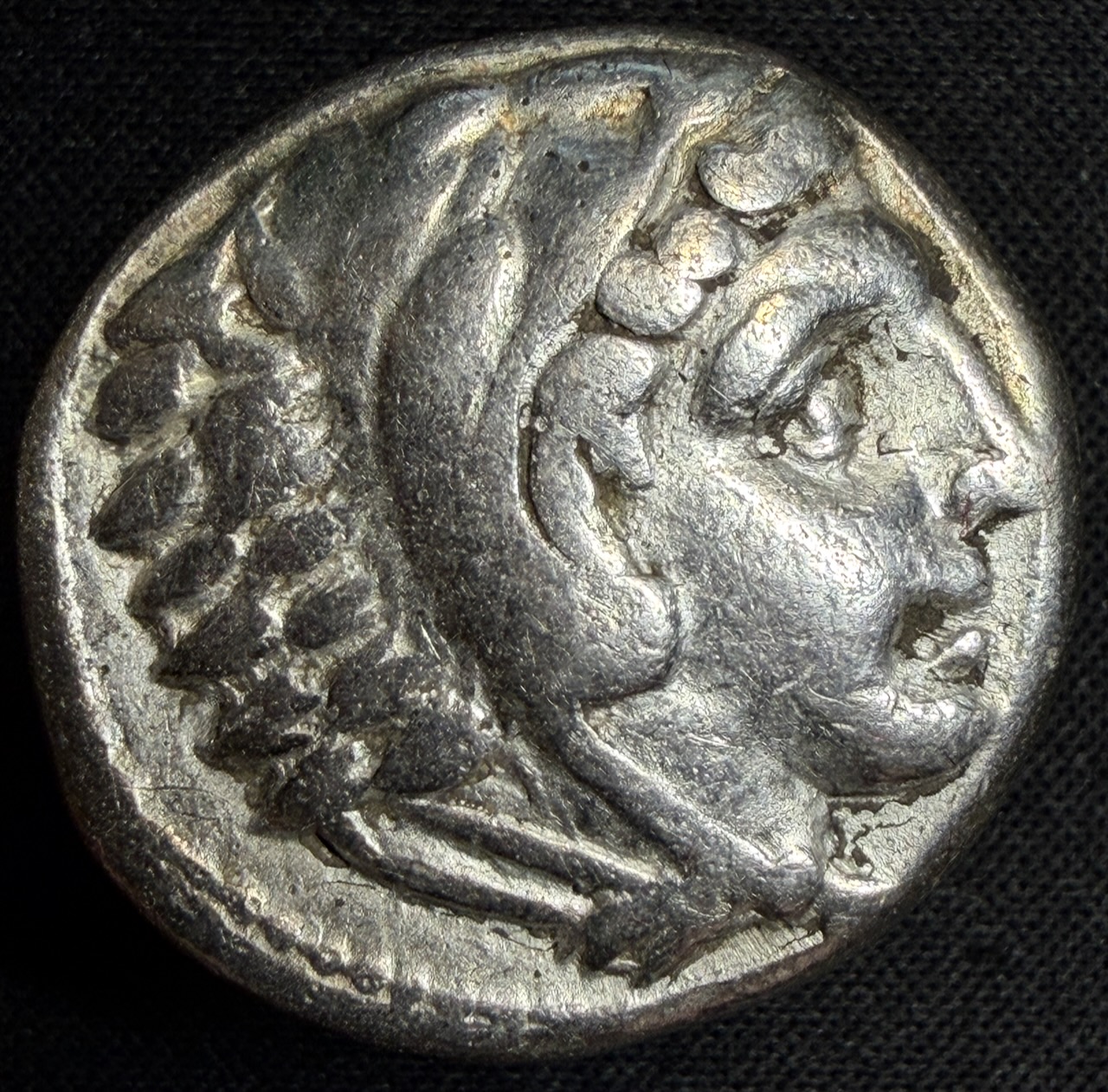
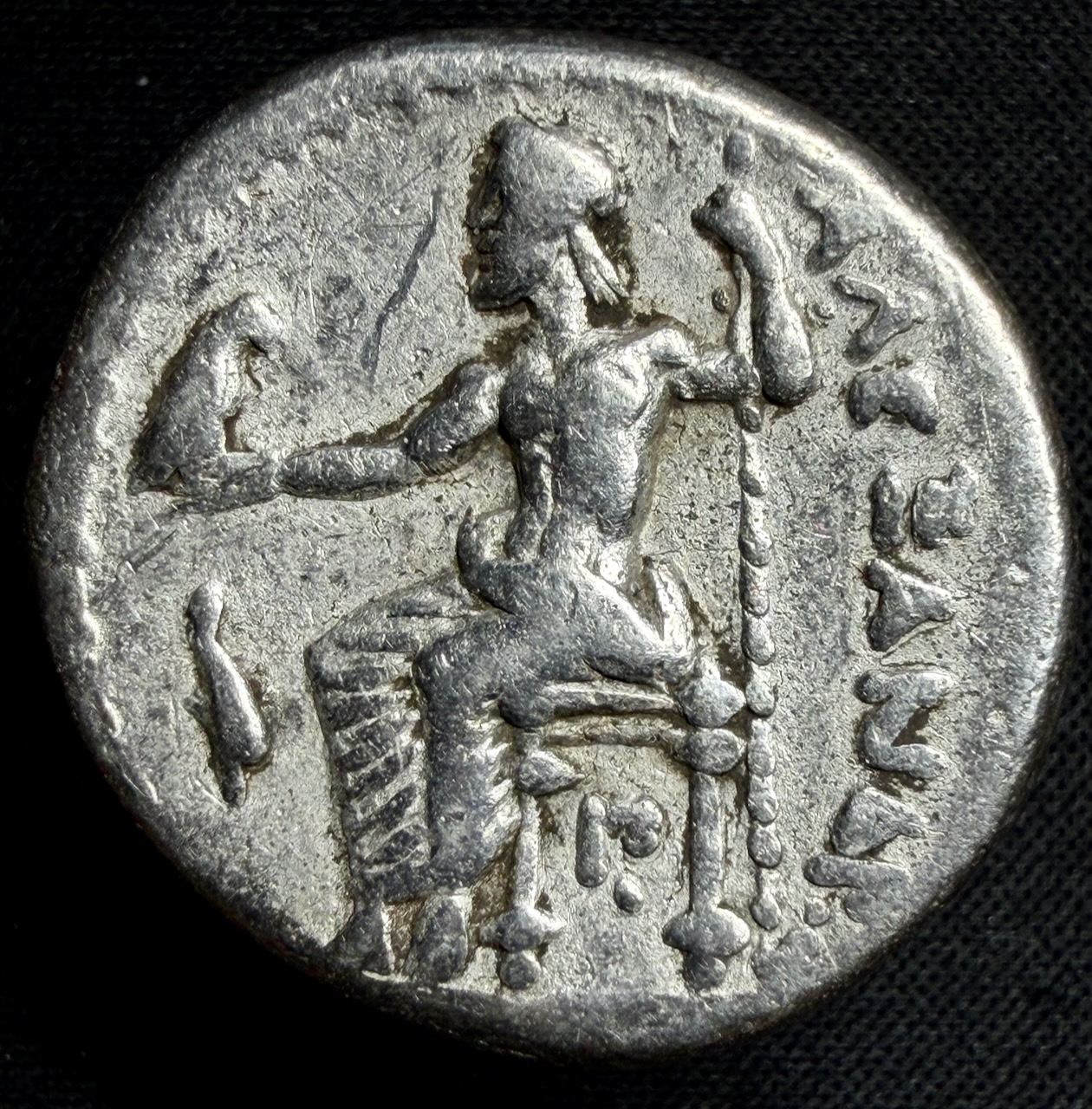
Current: Kings of Macedon, in the name of Alexander III 'the Great'. AR tetradrachm, Amphipolis, c. 320–317 BC, struck under Antipater or Polyperchon during the reign of Philip III Arrhidaios (Price 129: aplustre in left field, ΠΟ monogram below throne)
Obverse: Head of young Herakles right, wearing the lion-skin headdress knotted at the neck
Reverse: Zeus Aetophoros enthroned left, eagle on his outstretched right hand, sceptre in left; aplustre (ship's stern ornament) in left field; ΠΟ monogram below throne; ΑΛΕΞΑΝΔΡΟΥ downward to right
Primary reference: Price 129
44 specimens in public collections (ANS 28, Berlin 5, Ashmolean 4, British Museum 4, BnF 2); weights 15.49–17.35 g, median 16.96 g across 44 recorded; die axis most often 9h; recorded in hoards IGCH 1293, IGCH 1368, IGCH 1403.
This collection's specimen, at 16.89 g (tag), is heavier than 34% of the recorded weights.
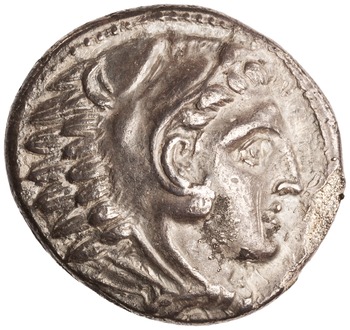
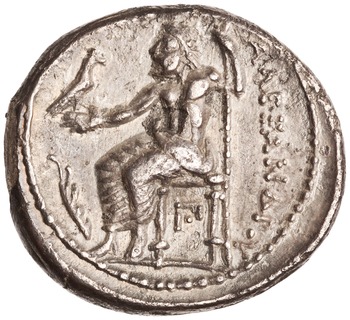
American Numismatic Society, 1944.100.28892. CC BY-NC 4.0. https://numismatics.org/collection/1944.100.28892
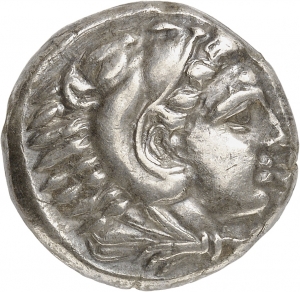
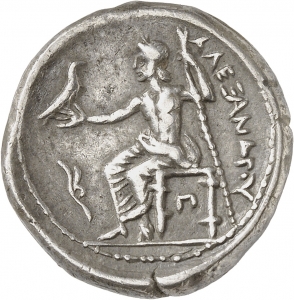
Münzkabinett, Staatliche Museen zu Berlin, 18251276. CC BY-NC-SA 4.0. https://ikmk.smb.museum/object?id=18251276
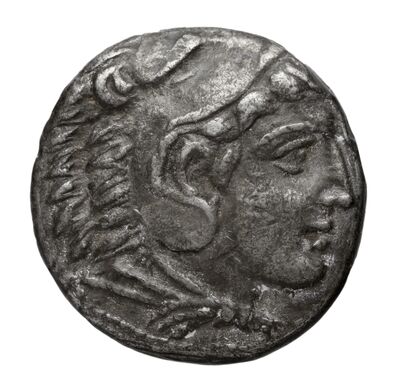
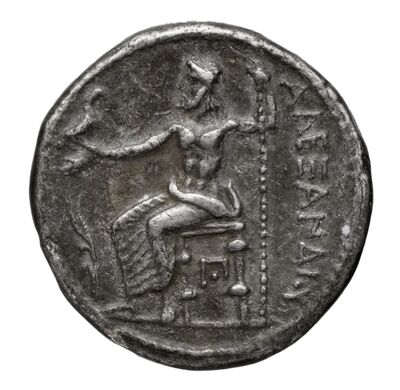
Bibliothèque nationale de France (Gallica), Fonds général 604. non-commercial reuse permitted. https://gallica.bnf.fr/ark:/12148/btv1b10304638z
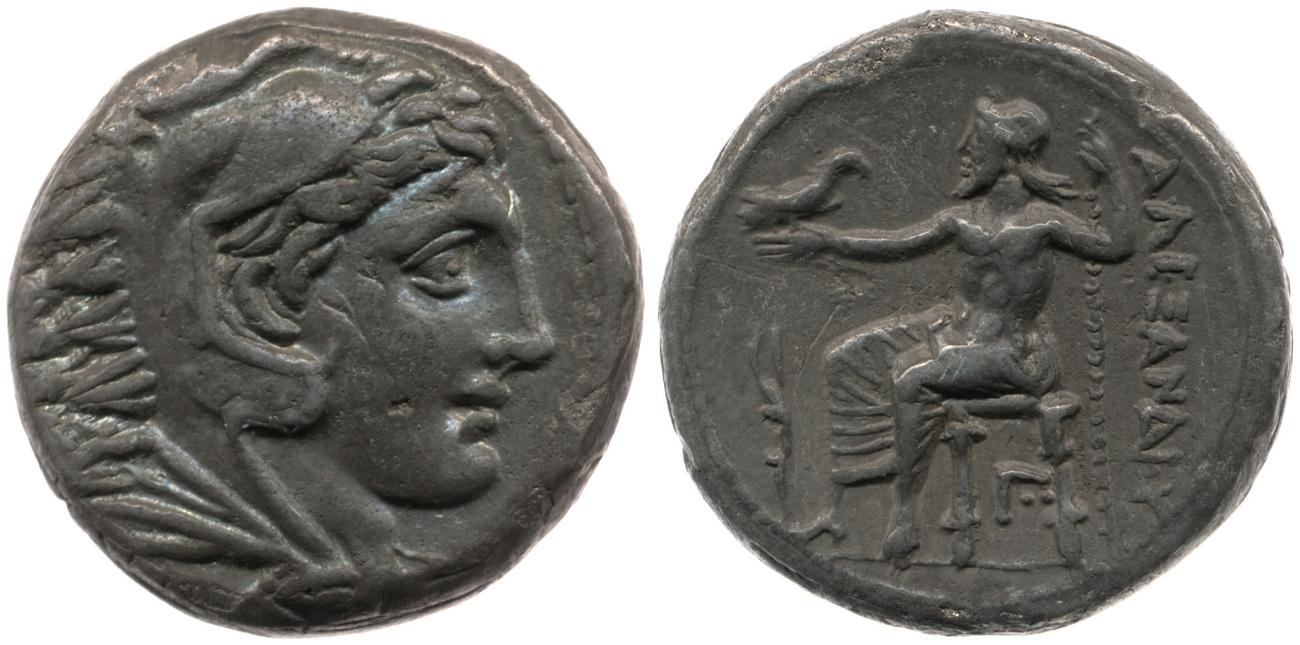
© The Trustees of the British Museum, 1911,0704.34. CC BY-NC-SA 4.0. https://www.britishmuseum.org/collection/object/C_1911-0704-34
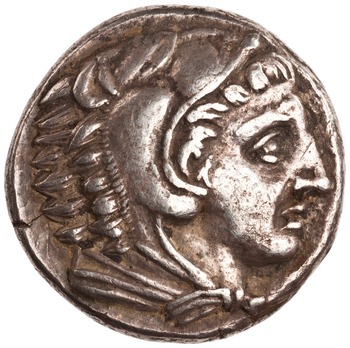
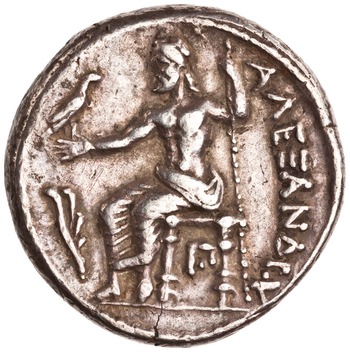
American Numismatic Society, 1944.100.28893. CC BY-NC 4.0. https://numismatics.org/collection/1944.100.28893
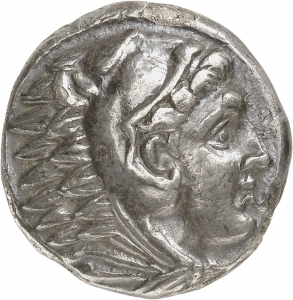
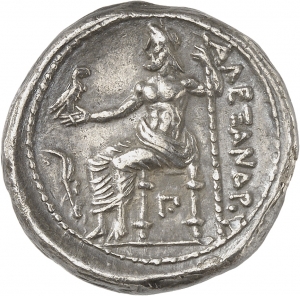
Münzkabinett, Staatliche Museen zu Berlin, 18251277. CC BY-NC-SA 4.0. https://ikmk.smb.museum/object?id=18251277
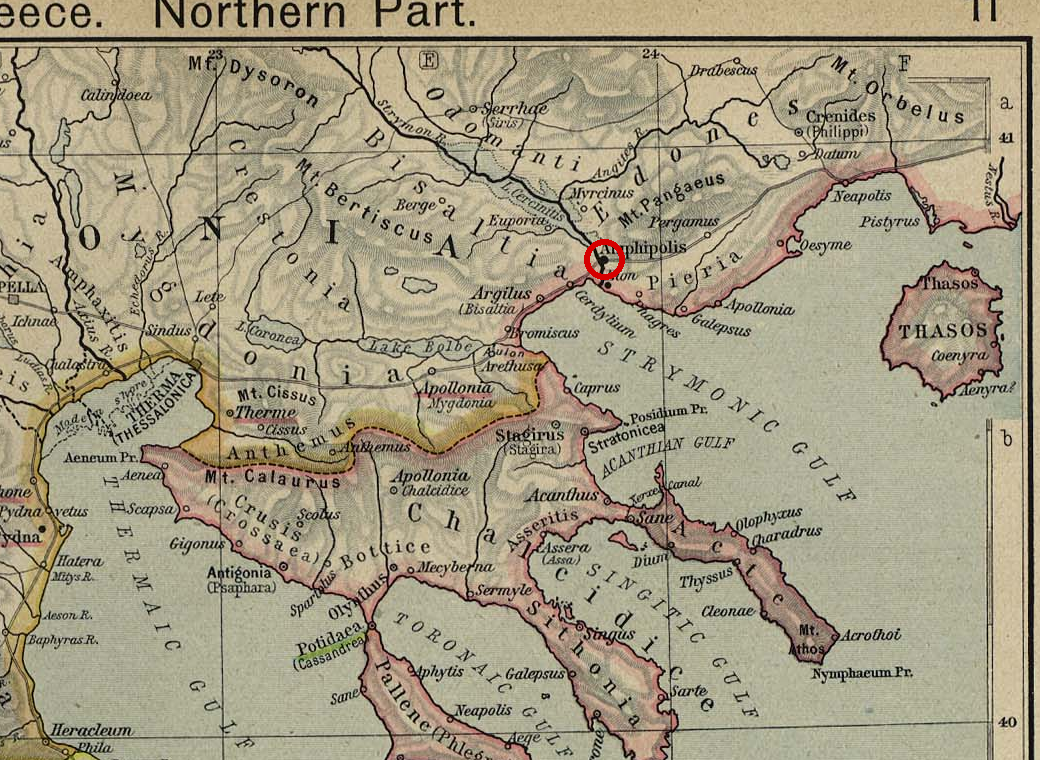
Macedonia and the Chalcidice on Shepherd’s reference map of northern ancient Greece. Amphipolis — circled in red — commands the crossing of the Strymon just above its port Eïon, with the mining district of Mt. Pangaeus immediately to the east. Silver from these mines fed the greatest of all Alexander mints: Amphipolis struck his imperial coinage in enormous volume from c. 332 BC, and kept striking it in his name for decades after his death — this coin among that posthumous flood.
“Reference Map of Ancient Greece, Northern Part,” from William R. Shepherd, Historical Atlas (1926 edition) — public domain; scan from the Perry-Castañeda Library Map Collection. Courtesy of the University of Texas Libraries, The University of Texas at Austin (https://maps.lib.utexas.edu/). Modified by JSB Coins: cropped to Macedonia and the Chalcidice, and a red circle added to mark Amphipolis.
When Alexander died at Babylon in June 323 BC, his money did not die with him. The silver tetradrachm bearing Herakles in the lion skin and Zeus enthroned with his eagle had become the common currency of the eastern Mediterranean, and the men who divided his empire kept striking it unchanged — same types, same name, ΑΛΕΞΑΝΔΡΟΥ, “of Alexander” — because soldiers trusted it and trade demanded it. This tetradrachm is exactly such a coin: struck at Amphipolis around 320–317 BC, in the name of a king three years dead, under the regents Antipater and then Polyperchon, who governed Macedon for Alexander’s half-brother Philip III Arrhidaios — a king in name only, mentally incapable, soon to be murdered in the wars his brother’s empire spawned. For the coinage’s origins and its lifetime organization, see the collection’s essay on the Kolophon tetradrachm; for the drachm denomination struck for the same system in Asia, the Sardes drachm.
Few Greek cities were fought over so hard for so long, and the reason is on the map: Amphipolis commands the only good crossing of the river Strymon, the timber of the Thracian interior, and the gold and silver of Mt. Pangaion. Athens tried to plant a colony at the site — then called Ennea Hodoi, “Nine Ways” — as early as 465 BC and lost the settlers at Drabeskos; the successful foundation came in 437 BC under Hagnon. Athens held its prize barely thirteen years. In the winter of 424/3 BC the Spartan Brasidas marched through the snow and took the city by surprise; the Athenian general who failed to relieve it in time — arriving with his squadron just late enough to save only the port of Eïon — was the historian Thucydides, who spent the next twenty years in the exile that gave him leisure to write his history (4.102–108; 5.26). Two years later Kleon and Brasidas both died in battle beneath the walls, and the city buried Brasidas in its agora as a second founder. Athens never got Amphipolis back: in 357 BC Philip II took it, and from then on it was a Macedonian royal city — the mint and mustering ground of the east. It was from Amphipolis that Alexander’s army marched for the Hellespont in the spring of 334 BC (Arrian 1.11), and to Amphipolis that much of Asia’s silver came home to be re-coined.
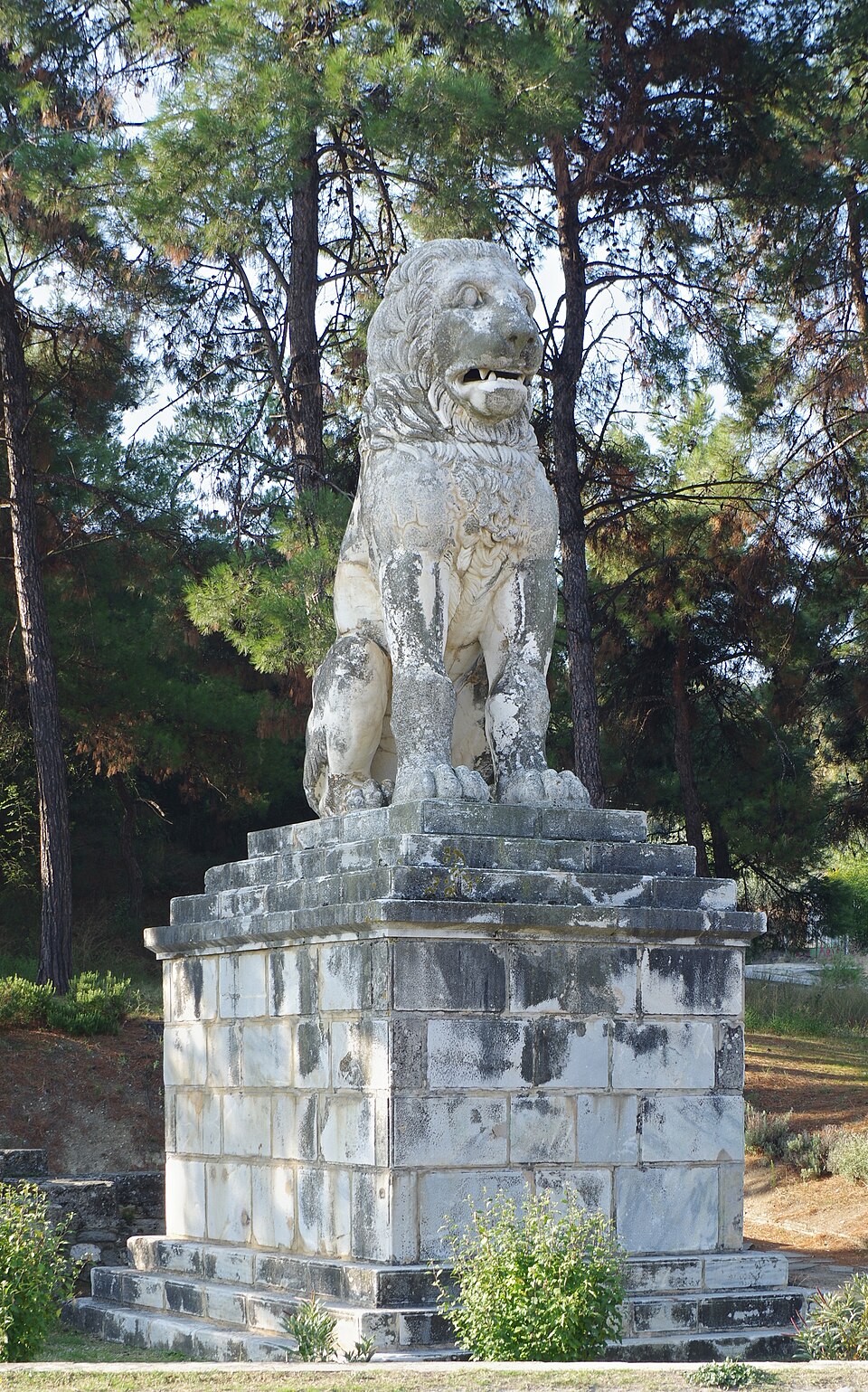
Photo: Berthold Werner, Wikimedia Commons, licensed CC BY-SA 3.0, reproduced unmodified.
Amphipolis was the engine room of the European coinage. Price’s corpus makes it the most prolific Alexander mint in Europe, striking from c. 332 BC through the 290s; the output of these years paid the home army, the garrisons, and the endless successor campaigns. Each issue is distinguished not by date but by control marks, and this coin’s pair — an aplustre (the curved, flared stern-ornament of a warship) in the left field and a ΠΟ monogram under the throne — is Price 129, assigned to c. 320–317 BC. The aplustre is a fitting stamp for the fleet-minded administration of the regency; whether it references a specific naval command or is simply a magistrate’s badge, the corpus does not say, and it is best left as a control mark. The die study underlying the Macedonian series is Hyla Troxell’s (ANS NS 21, 1997), whose arrangement of the control-mark groups confirms the corpus’s relative order for issues like this one. A century and a half later the same city struck this collection’s First Meris tetradrachm under Roman supervision — Amphipolis silver bookending Macedonian independence.
A genuine scholarly dispute sits behind this coinage’s start date, and it is worth knowing because it decides what “lifetime issue” means for the whole series. Price opened the imperial coinage at Alexander’s accession in 336 BC. Troxell’s die study of the Macedonian mint, building on arguments of Le Rider and others, moved the first Amphipolis tetradrachms down to c. 333/2 BC — after the conquest of Cilicia — on the evidence of hoards and die-links, which would make the enthroned Zeus not a fresh invention but an adaptation: the seated, eagle-bearing Baaltars struck at Tarsos by the satrap Mazaios (in this collection as the Baaltars stater) becomes the model his own mint-masters carried over when Tarsos fell to Alexander. The lower chronology is now widely followed, though not universally; either way it does not move this coin, which sits securely in the posthumous 320s. What it does is tighten the family connection between two coins in this collection — the satrap’s god and the king’s god, a decade apart.
The types carry their original propaganda into a new age: Herakles, ancestor of the Argead house, wearing the lion skin — and, always implicitly, wearing something of Alexander’s own features; whether any dies intend a true portrait is a famous open question, discussed further on the collection’s lifetime bronze unit of Alexander. Zeus enthroned with eagle and sceptre is the king of gods for a king of kings — an image with a long Anatolian-Levantine pedigree, as the dating debate above makes concrete. After 323 BC the unchanged types became something subtler: a claim of continuity by regents ruling in the name of a dynasty that was visibly dying. Within a few years of this coin, Arrhidaios was dead (317 BC), Alexander IV followed (c. 310), and the successors began striking as kings themselves — yet ‘Alexanders’ like this one kept being minted, somewhere in the Greek world, for another two centuries.
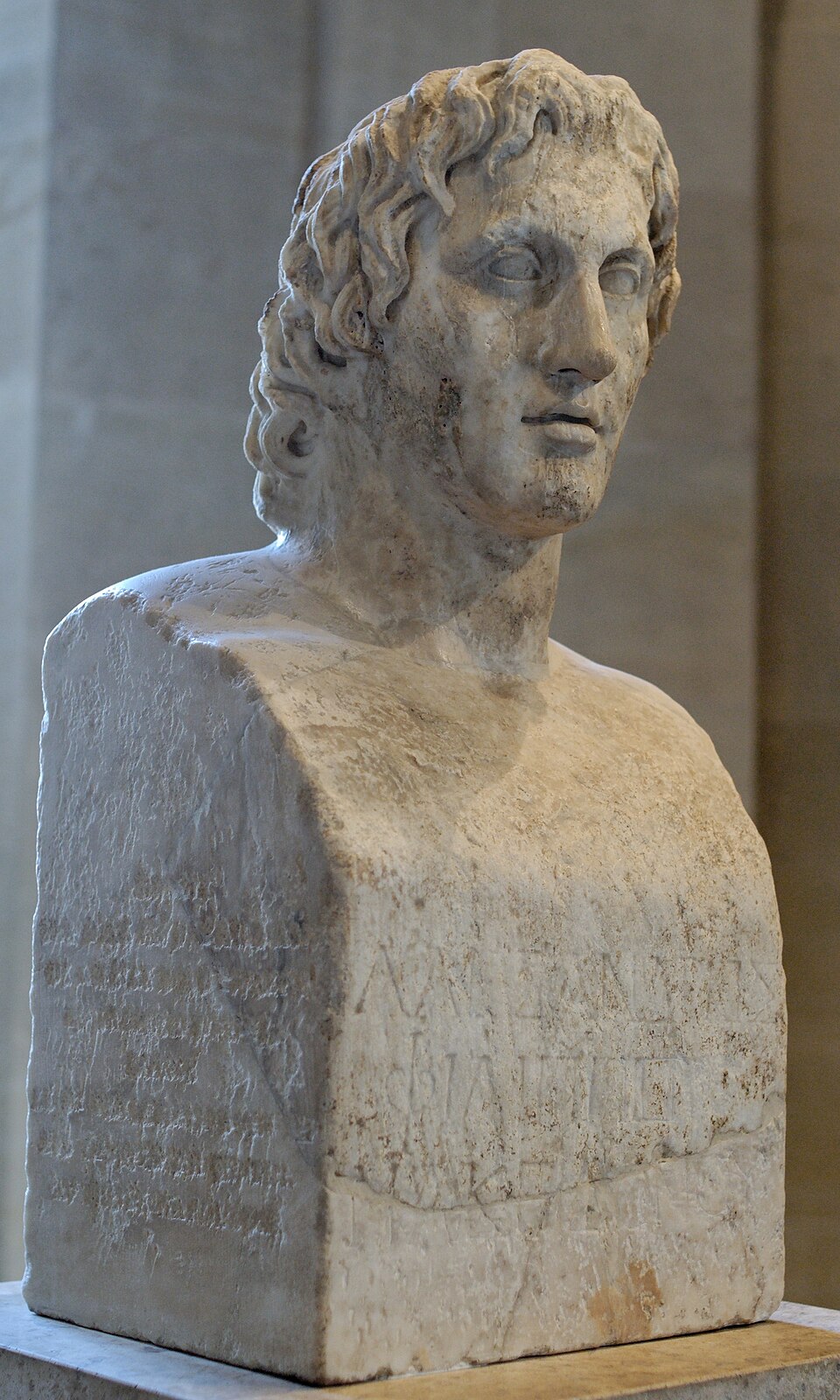
Photo: Jastrow, Wikimedia Commons, public domain; reproduced unmodified.
The politics compressed into this coin’s three-year date range were murderous even by Macedonian standards. The Babylon settlement of 323 BC had produced two nominal kings — Alexander’s incapable half-brother Philip III Arrhidaios and his posthumous infant son Alexander IV — with real power held by a regent: Perdikkas until his murder in 320, then old Antipater, who brought the kings home to Macedon, then (at Antipater’s death in 319) Polyperchon, whose appointment over Antipater’s son Kassander lit a new round of civil war. Price 129 belongs exactly to these hand-offs, which is why the corpus can say only “Antipater or Polyperchon.” The sequel belongs to this coin’s own city. In the fighting that followed, Olympias had Philip III killed (317 BC) and was executed in turn by Kassander (316 BC) — and Kassander then shut the boy Alexander IV and his mother Roxane in the citadel of Amphipolis under the keeper Glaukias, where, about 310 BC, both were quietly poisoned and the Argead line ended (Diodorus 19.52, 19.105 — Book 18 linked in the references leads into the narrative). The mint kept striking ΑΛΕΞΑΝΔΡΟΥ all the while: the last of Alexander’s blood died within earshot of the workshops still coining his name.
A posthumous Amphipolis Alexander is the sound of an empire running on momentum: the home mint of Macedon, paying the armies of a regency, in the name and image of a man in a tomb at Memphis — struck in the very city where the dynasty’s last heir would shortly be murdered. As a type it is among the most historically dense of all Greek coins: one flan carrying the Argead ancestor-god, the imperial Zeus, the dead conqueror’s name, and the control marks of the men actually in power.
Price’s corpus (1991) remains the reference skeleton for every Alexander; the ANS’s PELLA database puts the whole corpus online with photographed specimens (search “Price 129” — the collection’s other Alexanders, Kolophon and Sardes, live in the same system). Troxell (ANS NS 21, 1997) is the specialist die study for this mint and the entry to the chronology debate; the ANS Digital Library lists an open-access scan. The NGC/CoinWeek survey linked in the references is the quick orientation. For the history: Thucydides Book 4 (linked) for the city’s Athenian tragedy; Diodorus 18–19 (linked) for the regency and the murders; Arrian 1.11 for the army’s departure from Amphipolis in 334 BC.
Attribution follows M.J. Price, The Coinage in the Name of Alexander the Great and Philip Arrhidaeus (Zurich–London 1991), no. 129 — Amphipolis, c. 320–317 BC, aplustre in left field, ΠΟ monogram below throne, assigned to the administration of Antipater or Polyperchon under Philip III; the Zauche tag’s S-6718v is the Sear concordance. Die study and chronology: H.A. Troxell, Studies in the Macedonian Coinage of Alexander the Great (ANS NS 21, 1997); the start-date debate is summarized above. The regency and the fates of Philip III Arrhidaios and Alexander IV: Diodorus Siculus 18–19 (esp. 19.52, 19.105). Amphipolis’s earlier history: Thucydides 4.102–108 and 5.6–11; the Pangaeus mines, Diodorus 16.8; the army’s departure, Arrian, Anabasis 1.11. On the Lion monument and Laomedon, O. Broneer, The Lion Monument at Amphipolis (1941), with the Kasta-tumulus connection from the 2012–14 excavation reports.
Attic-standard tetradrachm (17.2 g standard; this coin 16.89 g per the accompanying printed ticket, matching Price 129 examples at 16.8–17.2 g). The identification rests on the control marks: the left-field symbol is clearly the curved, knobbed aplustre, and the under-throne monogram reads as the ligate ΠΟ, though it is soft on this strike and should be confirmed in hand against Price's plate. Struck in Alexander's name and types three to six years after his death, while Antipater and then Polyperchon governed Macedon for the incapable king Philip III Arrhidaios — the corpus assigns the issue to their administration. The dealer tickets' 'Amphipolis, 320–317 BC' matches Price's dating exactly. Note the absolute chronology of the Amphipolis series is Price's; Troxell's die study (ANS NS 21, 1997) keeps the relative arrangement but argues the series opened c. 333/2 BC rather than 336 — a debate that does not move this posthumous issue.
John's Ancient Coin Collection · Type · alexander-iii-amphipolis-tetradrachm
Image credits for this coin — photographs, maps and graphics used on this page