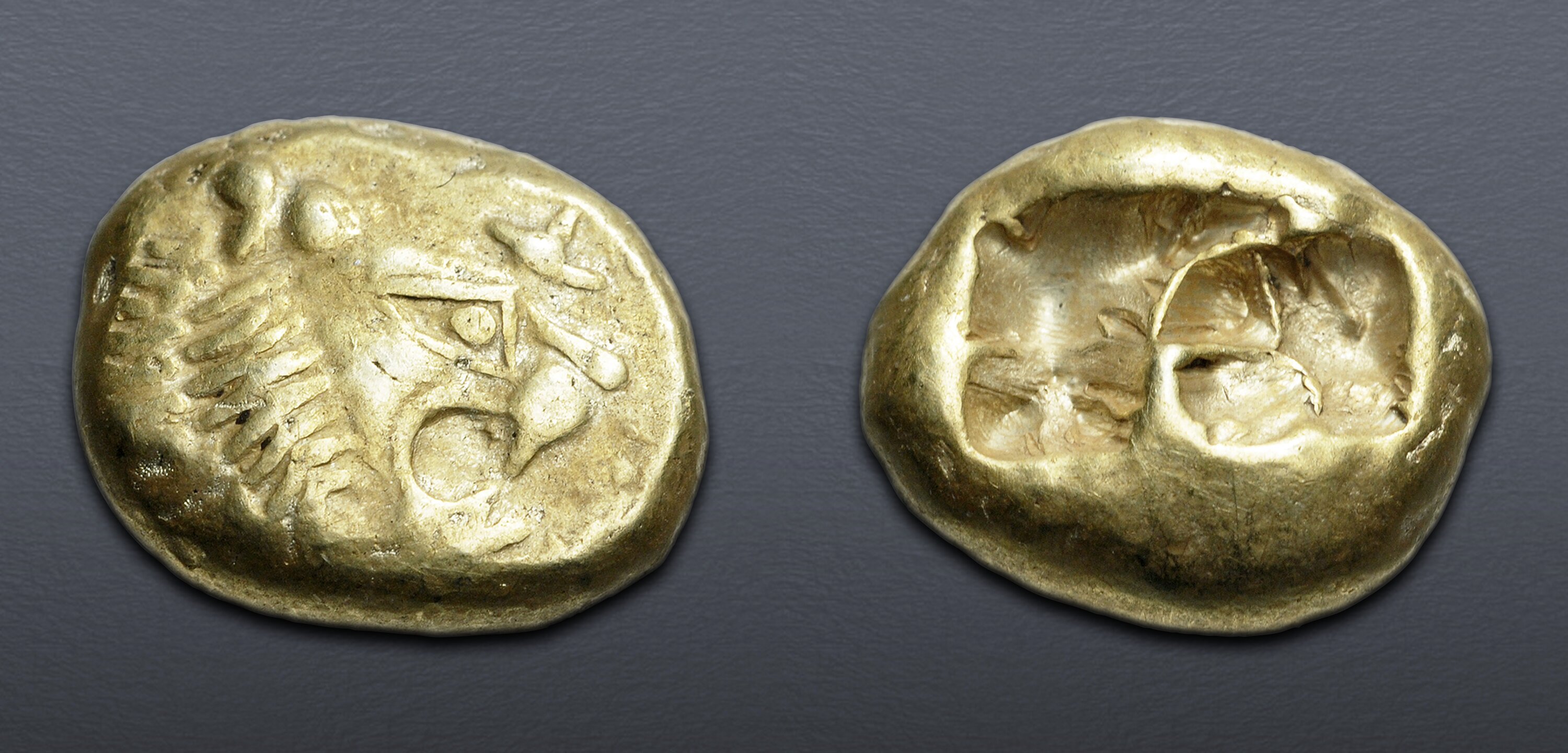
Type · lydia-electrum-trite-lion-sardes
Current: Kings of Lydia, temp. Walwetes (Alyattes) II (Ardys) – Walwetes (Alyattes) III, EL trite (third-stater), Sardes, late 640s – early 6th century BC (Weidauer Group XVI, 65; Artemision 7)
Obverse: Head of a roaring lion right, with a four-rayed 'sun' or radiate boss on the forehead
Reverse: Two incuse square punches, side by side
Primary reference: Weidauer Group XVI, 65
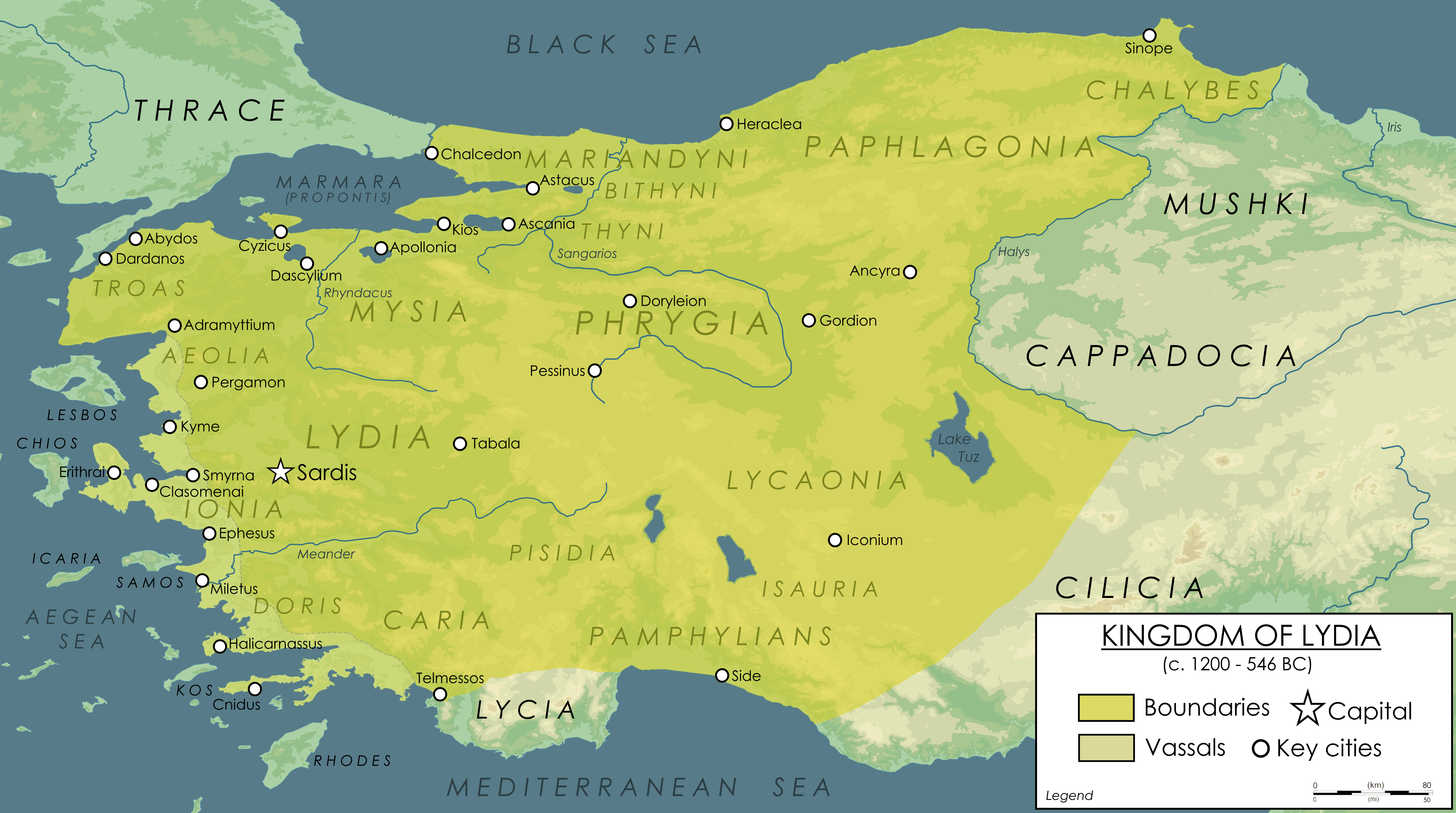
The Kingdom of Lydia, with Sardes — the mint that struck this coin — marked by the capital star. One honest caveat: this map shows Lydia at its greatest extent, under Kroisos in the 560s–540s, a generation or two after this coin. The Halys frontier drawn here was in fact fixed earlier, by Alyattes, when the battle against the Medes broke off during the solar eclipse of 585 BC — so for the later end of this coin’s date range the picture is close to right. The same base map serves the Croeseid third-stater, the coinage that replaced this one.
“Kingdom of Lydia at its Greatest Extent” by Ennomus (Wikimedia Commons), File:Kingdom_of_Lydia.png, licensed CC BY-SA 4.0 (https://commons.wikimedia.org/wiki/File:Kingdom_of_Lydia.png; license: https://creativecommons.org/licenses/by-sa/4.0/). Reproduced unmodified.
This is a coin from the first century of coinage, struck in the kingdom that invented it, at the mint where it was invented. Everything else in this collection descends from it.
Electrum is a gold-and-silver alloy, and it occurs naturally in the Pactolus, the stream that ran through Sardes and made the Lydian kings a byword for wealth. The obvious story is that the Lydians simply stamped the metal the river gave them.
That is not what the analyses show, and the difference is the whole invention.
Natural Pactolus electrum runs at roughly 73% gold. The royal Lydian coinage was struck at a consistent 54% gold, 44% silver, 1–2% copper — an alloy that does not occur, made on purpose and held remarkably steady. The coins were tariffed as though they were the natural metal, which means they circulated at something like 15–20% above the value of what they were made of (Kroll).
Now consider what that requires. You cannot see the difference. A touchstone tests the surface, and a surface can be enriched. Weighing tells you the mass, not the alloy. The only thing bridging the gap between what the metal is worth and what the coin is worth is the lion’s head on the obverse — the mark of a king, asserting a value the object does not physically contain, and being believed.
That is the line between weighed bullion and money. It is on this coin.
Graphic: JSB Coins, 2026 (CC0).
Close, and the qualification is worth having exactly right.
The type is concorded to Artemision 7 — meaning an example was in the foundation deposit beneath the Archaic temple of Artemis at Ephesos, excavated by D. G. Hogarth in 1904–05. That deposit is the earliest stratified group of coins anywhere in the world: it is the archaeological evidence that coinage was invented, rather than an inference from later sources.
But the deposit is layered in its own way. The earliest objects in it are typeless — plain electrum dumps, some carrying nothing but a punch mark. Then come pieces with simple devices. The developed lion’s head, with its radiate boss, is a step after the beginning.
So the accurate claim is: among the earliest coins struck with a type, from the place and the moment coinage was invented. Not literally the first object ever called a coin — but from the generation that worked out what a coin was for.
One correction worth carrying, because it is repeated everywhere: Herodotus (1.94) says the Lydians were the first to strike gold and silver coinage. He is describing the later bimetallic reform, not electrum. He is not talking about this coin.
CNG dates it “late 640s – early 6th century BC.” That is a sixty-year bracket, and it is honest rather than lazy.
E. S. G. Robinson’s 1951 study put the Artemision deposit around 650–625 BC, and that chronology stood for decades. Anton Bammer’s later excavation of the temple’s foundations, and Michael Kerschner and Koray Konuk’s re-reading of the associated pottery, have pushed parts of the deposit toward 600 BC or later. Konuk has separately restated the case for a genuine seventh-century horizon.
The argument is live. Present it as live: this coin is either from the third quarter of the seventh century BC or from around the turn of the sixth, and the discipline of the collection is to say so rather than pick the flattering end.
The royal attribution is unsettled in the same way. The inscribed pieces of this coinage read WALWET — Lydian for Alyattes — and KUKALIM or KALIL. CNG’s formula “temp. Walwetes (Alyattes) II (Ardys) – Walwetes (Alyattes) III” belongs to a revised reconstruction in which more than one Lydian king bore that name, and the tidy Greek list (Gyges, Ardys, Sadyattes, Alyattes, Kroisos) may be compressing rulers it does not name.
It would be easy to assume these were prestige objects — royal gifts, temple dedications, something ceremonial. The denominations say otherwise.
The system runs from the stater at about 14.1 g down through the trite (a third, about 4.7 g — this coin), the hekte, and on to fractions as small as 1/96 of a stater at roughly 0.15 g, a speck of metal with a lion’s paw on it. Kroll notes that half the electrum in the Ephesos deposit weighs under 1.2 g.
Nobody mints a 0.15 g coin for ceremony. That is a currency built for transactions, and the trite — this denomination — was its workhorse.
Kroisos called the electrum in. Around the middle of the sixth century he withdrew it and replaced it with a bimetallic coinage of refined gold and refined silver — a system where the metal in the coin was what the coin was worth, and the 15–20% question simply disappeared.
The collection holds the result: the Croeseid third-stater and the Croeseid siglos.
Which means this coin is, quite literally, what those were made from. Metal of exactly this issue went into the furnaces at Sardes to become the lion-and-bull coinage. And when Cyrus took Sardes in 546 the Persians kept striking the lion-and-bull types, and then replaced them in turn with the Achaemenid siglos.
Four coins, one mint, in sequence: the invention of money, its first reform, and its absorption into the first world empire. Two centuries later Alexander struck drachms at the same Sardes.
One footnote on the metal itself. Lydia invented electrum coinage and then abandoned it; the Greek cities of the Asian coast did the opposite and kept it going for three hundred years — Kyzikos, Phokaia and Mytilene were still striking electrum in the fourth century, as the Kyzikos hekte in this collection shows. The alloy that Kroisos found too ambiguous to keep, they found convenient precisely because its value rested on the issuing city’s word.
John H. Kroll, “The Coins of Sardis” (Sardis Expedition, Harvard), for the type sequence, the denominational structure, the alloy analyses and Kroisos’ withdrawal of the electrum. Kerschner and Konuk, “Electrum Coins and Their Archaeological Context: The Case of the Artemision of Ephesus,” for the redating argument, against Robinson’s 1951 chronology; Konuk, “Electrum Coinage of the Seventh Century BC” (2018), for the seventh-century case. Herodotus 1.94 for the much-misquoted claim about gold and silver. The type is Weidauer Group XVI, 65; Artemision 7; SNG Ashmolean 749–753.
THE DATING IS THE MAIN OPEN QUESTION and the wide bracket is not vagueness but honesty. Robinson (1951) dated the Ephesian Artemision deposit c. 650–625 BC; later stratigraphic and ceramic work (Bammer's excavation, and Kerschner and Konuk's re-reading of the pottery) pushes parts of it toward c. 600 or later, while Konuk has restated the case for a seventh-century horizon. CNG's 'late 640s – early 6th century BC' spans the whole live argument. THE ROYAL ATTRIBUTION IS ALSO UNSETTLED: the Greek king-list (Gyges, Ardys, Sadyattes, Alyattes, Kroisos) may compress more rulers than it names, and CNG's 'Walwetes (Alyattes) II (Ardys) – Walwetes (Alyattes) III' reflects a revised reconstruction in which more than one king bore the Lydian name Walwet. Do not present either question as settled. WEIGHT STANDARD: Lydo-Milesian, stater c. 14.1–14.2 g, trite (1/3) c. 4.7 g; fractions run down to 1/96 stater at c. 0.15 g. The number of reverse punches tracks the denomination — three on a stater, TWO on a trite, one on a hekte — which is a useful first check on any piece offered. THE ALLOY IS THE POINT: analysis of the royal coinage gives c. 54% gold against a natural Pactolus electrum of c. 73%, i.e. deliberately alloyed and tariffed above its metal value by 15–20% (Kroll).
John's Ancient Coin Collection · Type · lydia-electrum-trite-lion-sardes
Image credits for this coin — photographs, maps and graphics used on this page