Type · marcus-aurelius-jupiter-sestertius
Current: Roman Imperial, Marcus Aurelius, Æ sestertius, Rome, 173 AD (RIC III 1064)
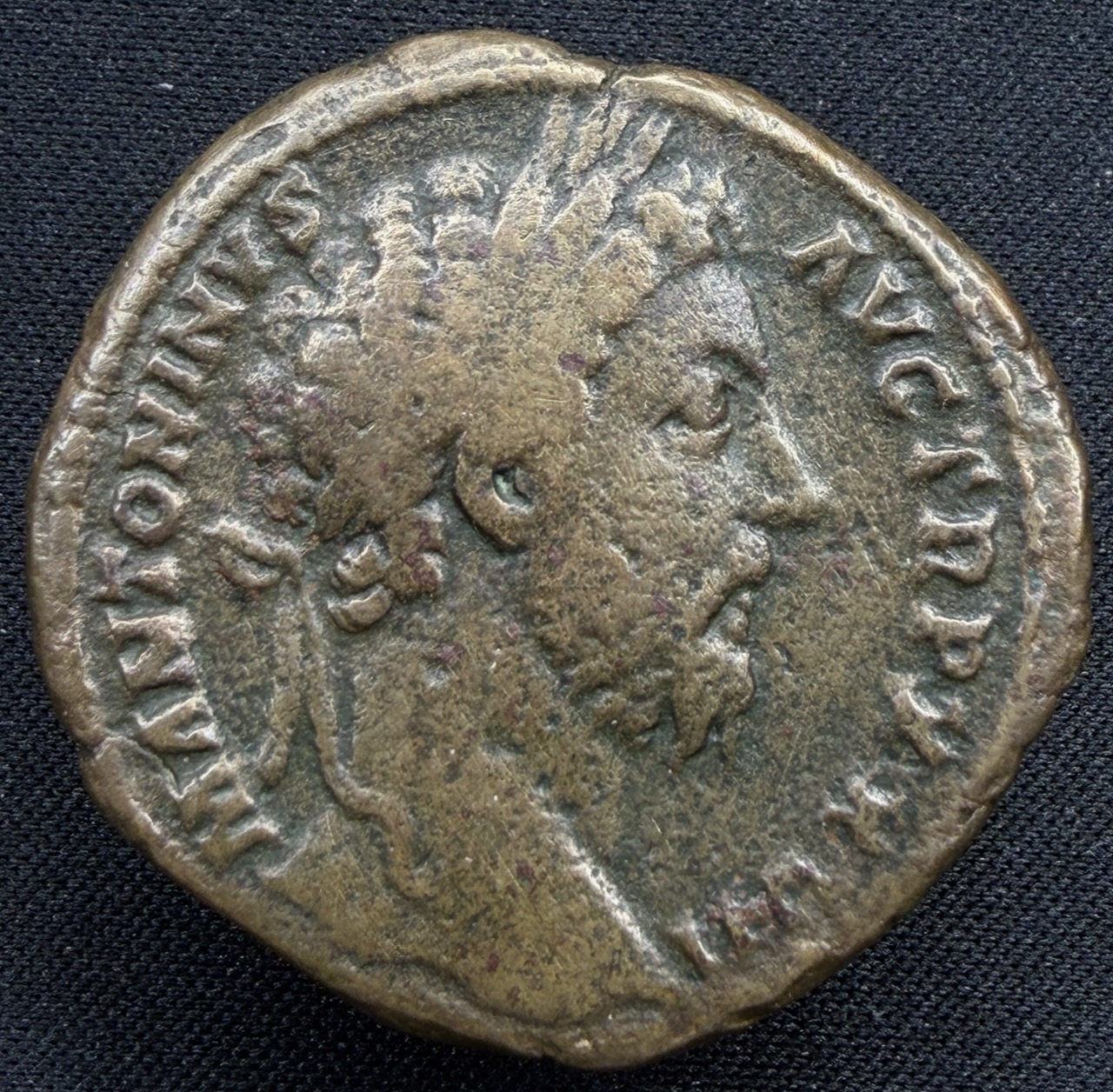
Obverse: Laureate head of Marcus Aurelius right
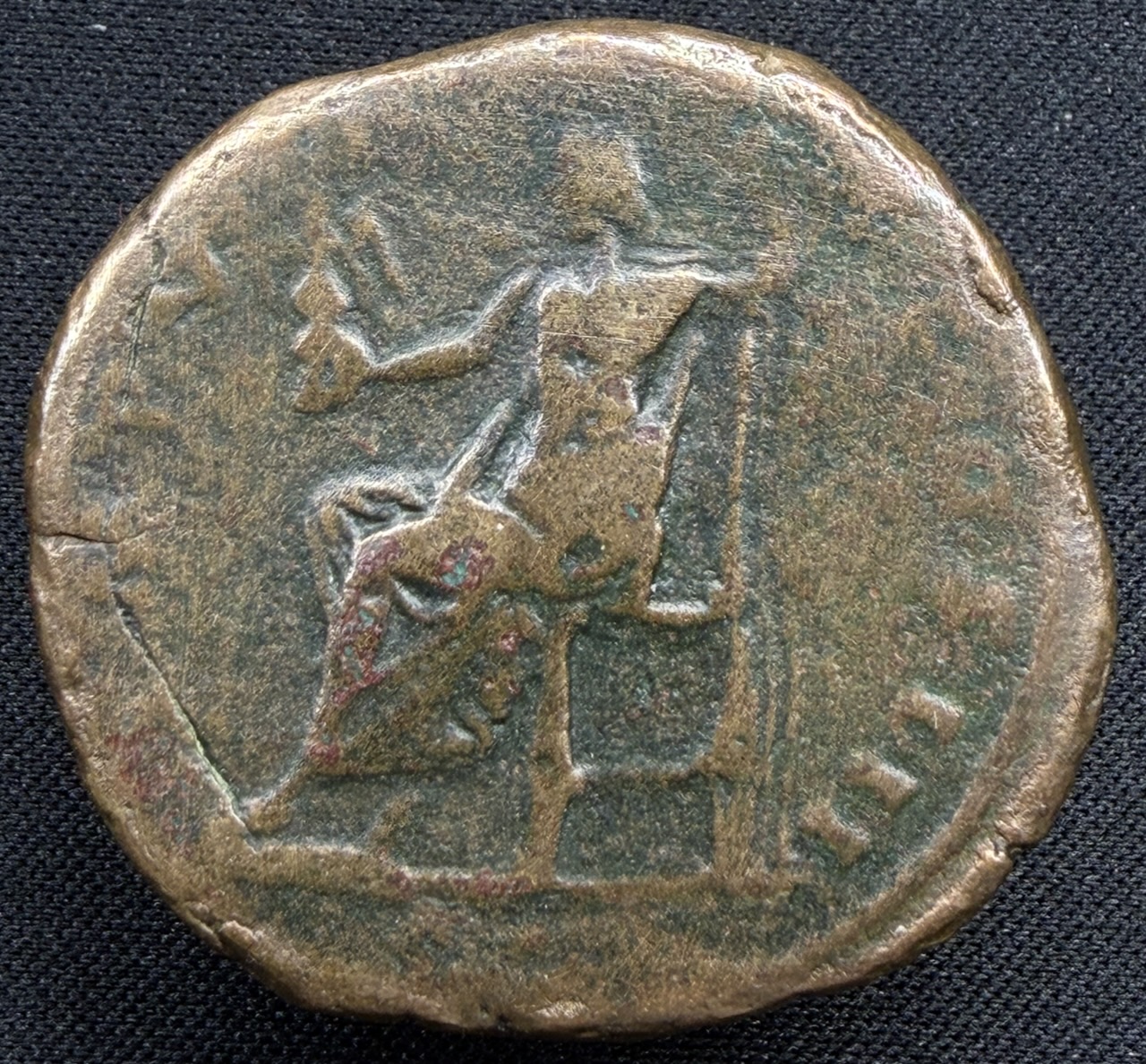
Reverse: Jupiter seated left on throne, holding Victory in extended right hand and long sceptre in left; S C in exergue
Primary reference: RIC III 1064
19 specimens in public collections (Mk Winterthur 6, Göttingen 4, British Museum 2, Goethe Uni Frankfurt Arch Wiss 2, Freiburg 2); 2 British finds recorded by the Portable Antiquities Scheme; weights 15.56–27.03 g, median 23.44 g across 21 recorded; die axis most often 6h.
This collection's specimen, at 26.77 g (tag), is heavier than 90% of the recorded weights.
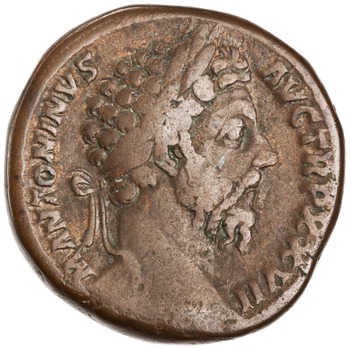
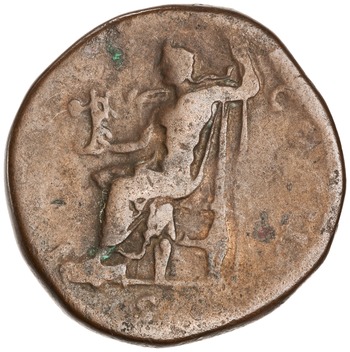
American Numismatic Society, 1995.11.987. CC BY-NC 4.0. https://numismatics.org/collection/1995.11.987
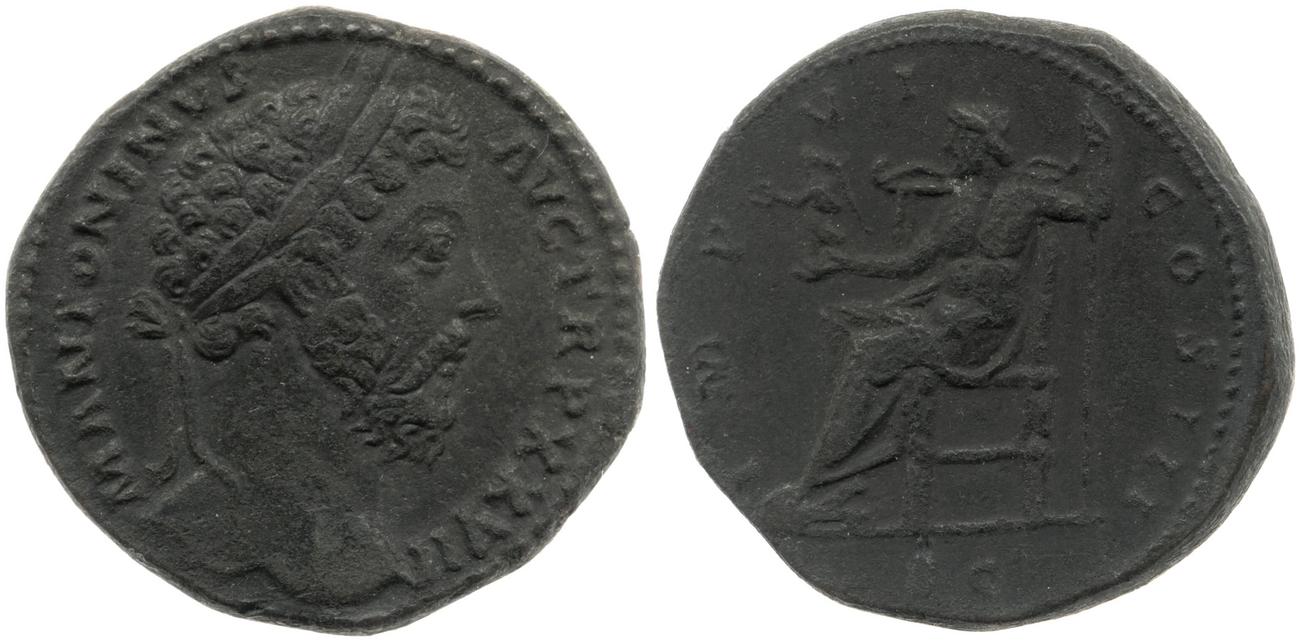
© The Trustees of the British Museum, R.14642. CC BY-NC-SA 4.0. https://www.britishmuseum.org/collection/object/C_R-14642
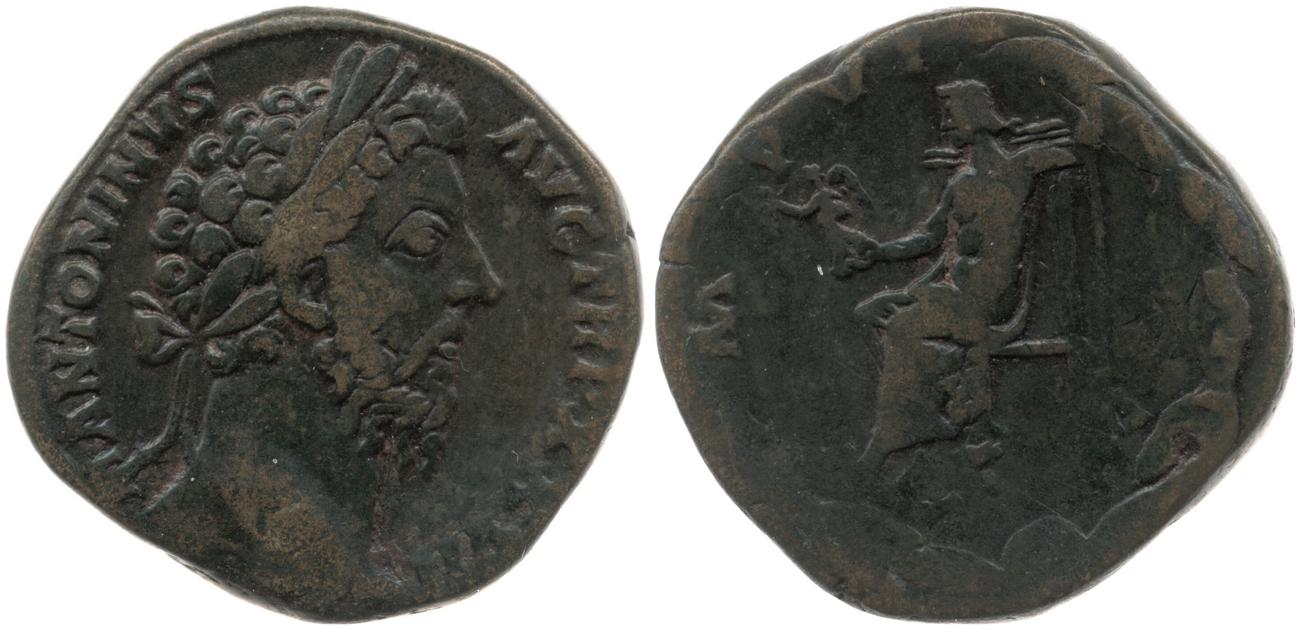
© The Trustees of the British Museum, R1982,0731.1. CC BY-NC-SA 4.0. https://www.britishmuseum.org/collection/object/C_R1982-0731-1
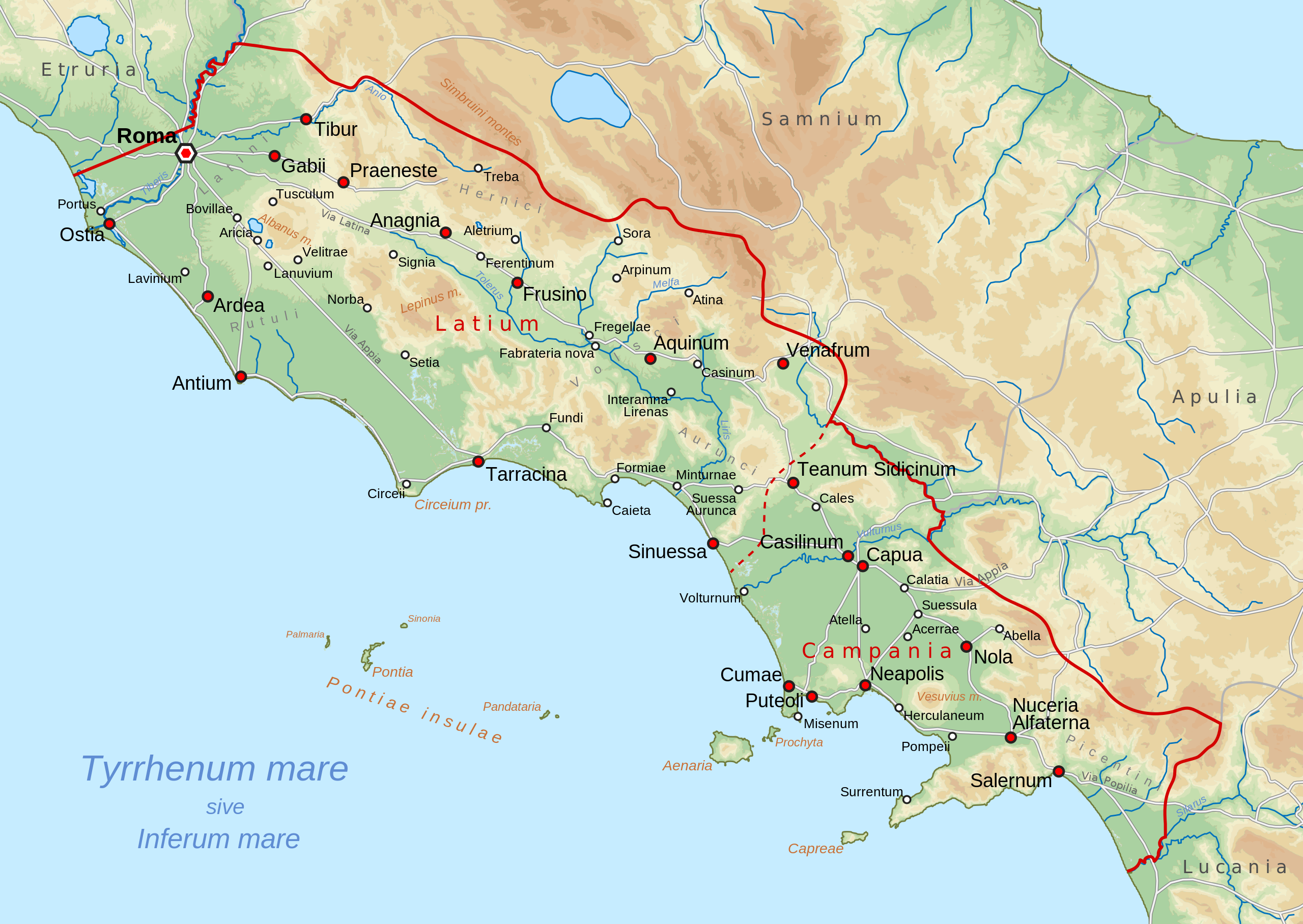
Regio I, Latium et Campania — the heartland of Roman Italy as organized under Augustus. Roma sits at the upper left, marked by the map’s hexagonal capital symbol and bold label. The imperial mint of the Antonine age stood in the city, on the slopes near the Colosseum valley.
“Map of Augustan Regio I Latium et Campania” by Tomisti (Wikimedia Commons), File:Regio I Latium et Campania map.svg, licensed CC BY-SA 4.0; cities and roads based on the Digital Atlas of the Roman Empire (DARE) and Pleiades; topographic base © OpenMapTiles, © OpenStreetMap contributors. Rasterized from SVG to PNG; otherwise reproduced unmodified (Roma already carries the base map’s capital marker).
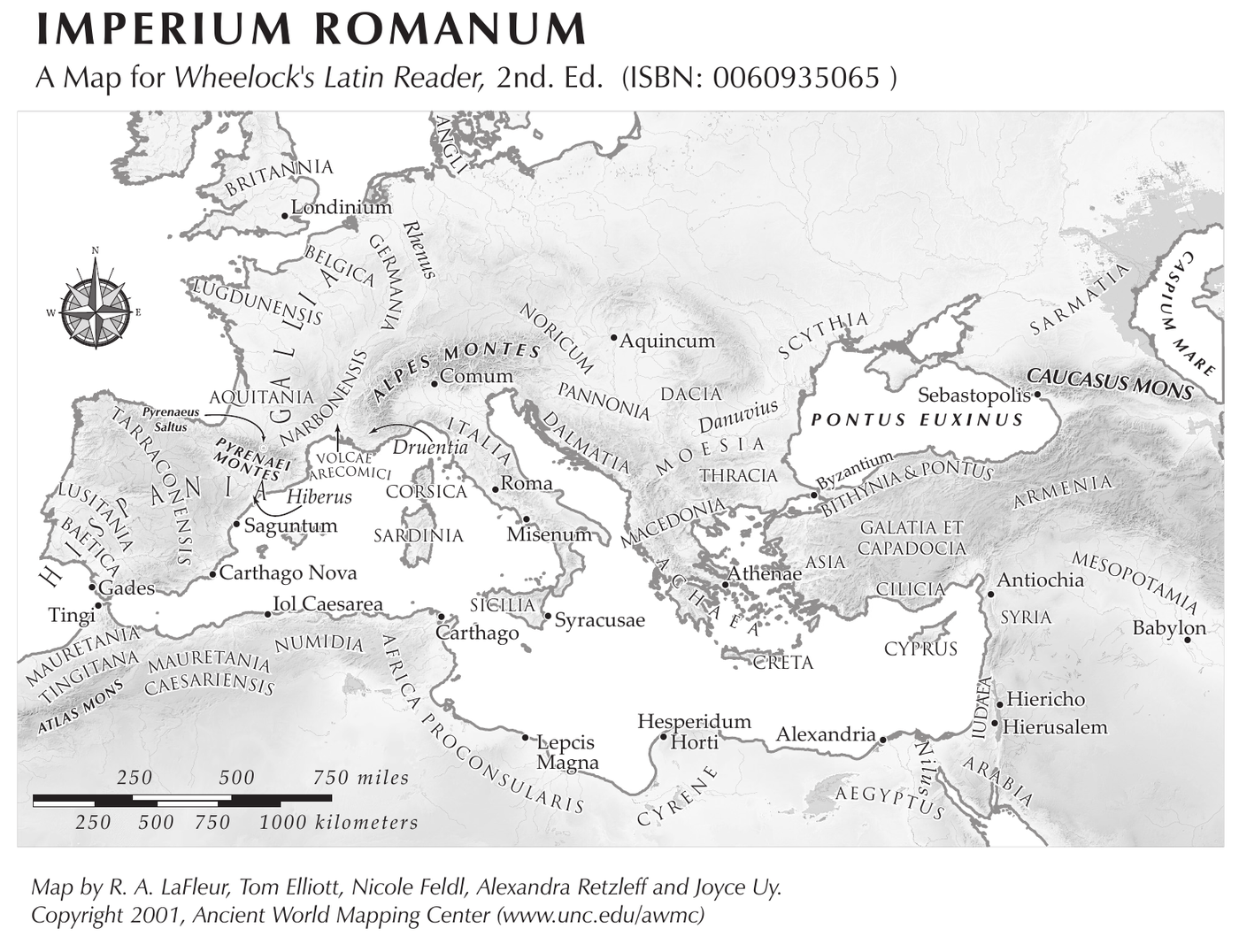
Roma sits at the center of Italia. Struck in AD 173, when Marcus was on the Danuvius — the line running past Aquincum in Pannonia — fighting the Marcomannic wars. He spent his last years on that frontier, and wrote the Meditations there.
This heavy brass sestertius was struck at Rome in 173 AD, while Marcus Aurelius was on the Danube fighting the Marcomannic Wars — the long, grinding barbarian emergency during which he wrote the Meditations in camp. He had been marked for the purple since boyhood, in the succession settlement Hadrian scripted on his deathbed — the moment recorded on the accession denarius of his adoptive father Antoninus Pius in this collection. The obverse titulature dates it exactly: tribunicia potestate XXVII, the tribunician year running from 10 December 172 to 9 December 173. The reverse answers with IMP VI — his sixth imperial salutation, taken for the Danubian victories of 171–172 — and shows Jupiter enthroned, handing out Victory with his right hand while holding the sceptre of cosmic rule in his left: the king of the gods underwriting the emperor’s success. A generation later the same god appears standing and armed on the Jupiter denarius of Septimius Severus — the difference between a god who guarantees a reign and one who fights for it.
Graphic: JSB Coins (CC0).
No coin in this collection sits closer to a surviving book. The private notebook Marcus kept on this front — the Meditations, though he titled it nothing — carries its own dateline: the notes after Book 1 are headed “Among the Quadi at the Granua,” the river country of the very campaigns that earned the IMP VI on this reverse (the Long translation is on Wikisource). The man the mint was wrapping in Jupiter’s sponsorship was privately reminding himself that he was “an old man” who must waste no more of his short time on complaint. The distance between the two documents — the public theology of the sestertius and the private stoicism of the notebook, the same year, the same war — is one of the sharpest contrasts antiquity offers, and this coin is the affordable half of the pair.
These are the years of the famous “rain miracle,” when a sudden storm was said to have saved a parched Roman army in the Quadi country — Cassius Dio tells it at 72.8–10, complete with the competing pagan and Christian claims to the credit (an Egyptian magician’s prayers to Mercury, or the prayers of the Christian soldiers of the “Thundering Legion”) — an event Marcus’ court promptly attributed to divine favor, and which was carved a generation later onto the Column of Marcus Aurelius as a rain-god wringing the storm from his own hair. The coinage’s insistent Jupiter types echo the same theology of sponsorship. The wars strained the treasury as badly as the Antonine plague strained the army; rather than raise taxes, the Historia Augusta says, Marcus auctioned palace treasures — imperial plate, his wife’s silks — in the Forum of Trajan (Life of Marcus 17), and the mint’s big bronze — the sestertius was the workhorse denomination of civilian Rome, four to the silver denarius — carried the reassuring message of heaven’s sponsorship into every marketplace transaction. The S C in the exergue preserves the old fiction that the Senate stood behind the aes coinage, as it had since Augustus.
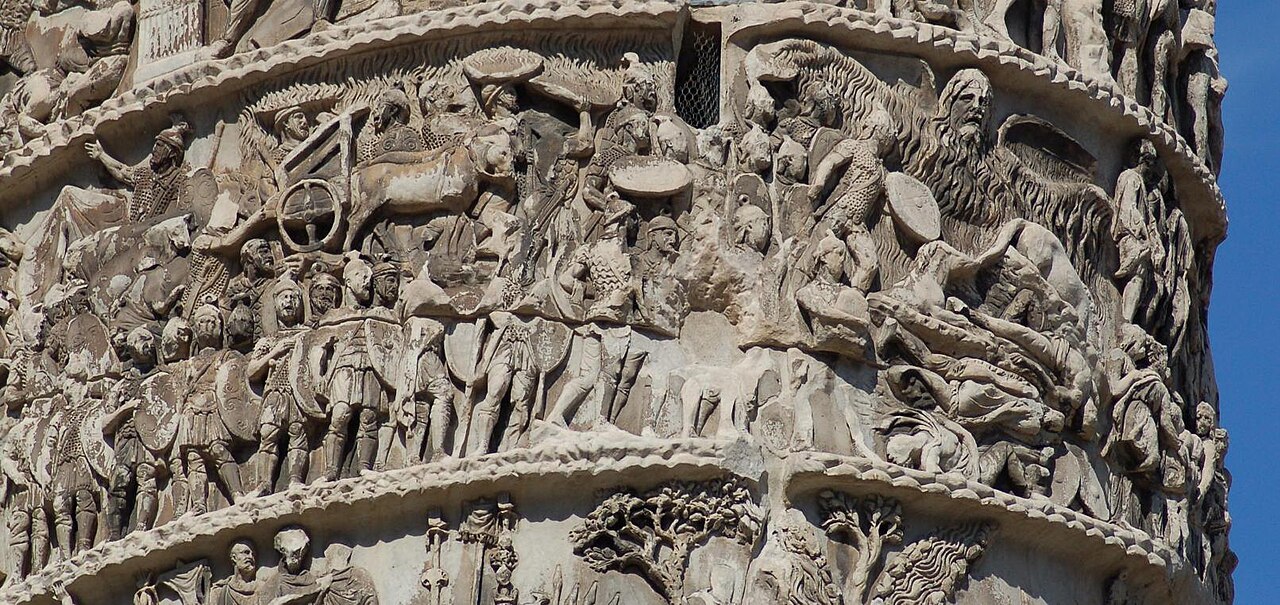
Photo: Cristiano64, Wikimedia Commons, licensed CC BY-SA 3.0, reproduced unmodified.
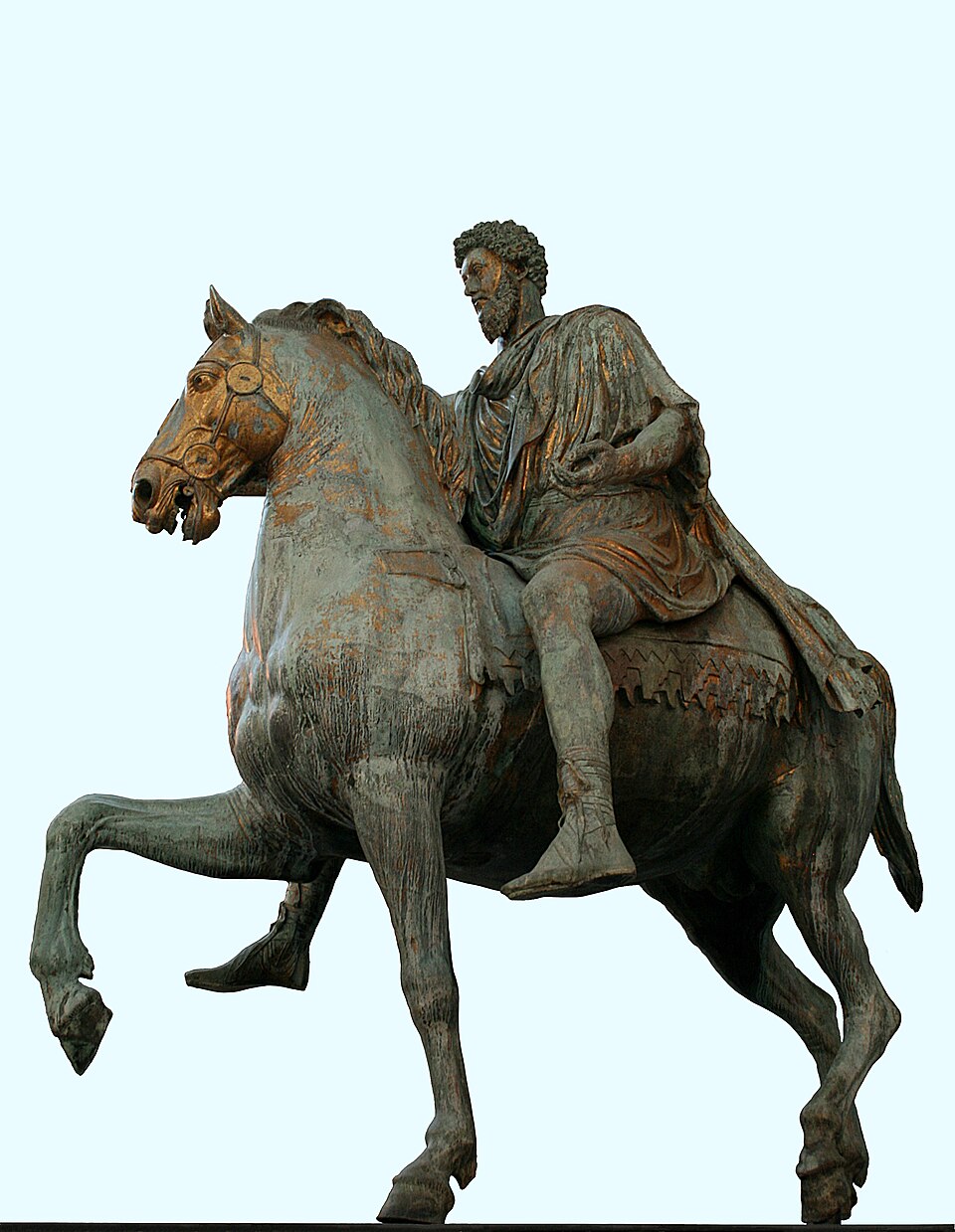
Photo: Jean-Pol Grandmont, Wikimedia Commons, licensed CC BY-SA 3.0, reproduced unmodified.
At over 26 grams of orichalcum (brass), the sestertius offered die-engravers the empire’s largest regular canvas, and Antonine sestertii are the summit of Roman bronze portraiture: here the tired, bearded philosopher-emperor in his early fifties, unmistakable even under wear. This is the collection’s second big imperial aes piece, a generation after the dupondius of Domitian Caesar; set side by side they show the denomination system holding steady across a century while the silver beneath it quietly thinned. Twenty years after Marcus died, Septimius Severus would have himself declared his son and Julia Domna a new Faustina — adopting his way into the family this coin belongs to. The beard had a long afterlife too: two centuries later Julian II wore a philosopher’s beard of the same kind on his own coinage, was mocked for it at Antioch, and in his satire The Caesars gave Marcus the prize as the best of all the emperors.
The primary sources are unusually rich and all linked above: Dio’s epitome of Book 72 for the wars and the rain miracle, the Historia Augusta life for the reign’s anecdotes (auction of the palace treasures, ch. 17), and the Meditations themselves — Book 2, headed “Among the Quadi,” is ten minutes’ reading and the best companion this coin could have. The OCRE record (linked in the references) supplies museum comparanda for RIC 1064. For the Column of Marcus Aurelius and the rain-miracle relief, any illustrated handbook of Roman sculpture; for the plague and the wars’ economics, the modern literature on the Antonine plague is the way in.
Attribution: RIC III (Mattingly & Sydenham), Marcus Aurelius 1064, per the dealer’s slip (Ancient Imports #41252) and the ANS Online Coins of the Roman Empire record (ric.3.m_aur.1064); obverse/reverse readings and the TR P XXVII date band as on the slip and OCRE. Narrative history: Cassius Dio 72 (rain miracle at 72.8–10); Historia Augusta, Marcus 17 (auction of palace treasures); Meditations, Book 1 dateline and Book 2 (Long translation). The Column relief and the miracle’s iconography: standard treatments of the Column of Marcus Aurelius.
TR P XXVII fixes the issue to 10 Dec 172 – 9 Dec 173 AD, in the middle of the Marcomannic Wars; IMP VI records the salutation taken for the victories of 171–172 on the Danube. The Jupiter-with-Victory reverse is the mint's standing thanksgiving type of these war years.
John's Ancient Coin Collection · Type · marcus-aurelius-jupiter-sestertius
Image credits for this coin — photographs, maps and graphics used on this page

.jpg)