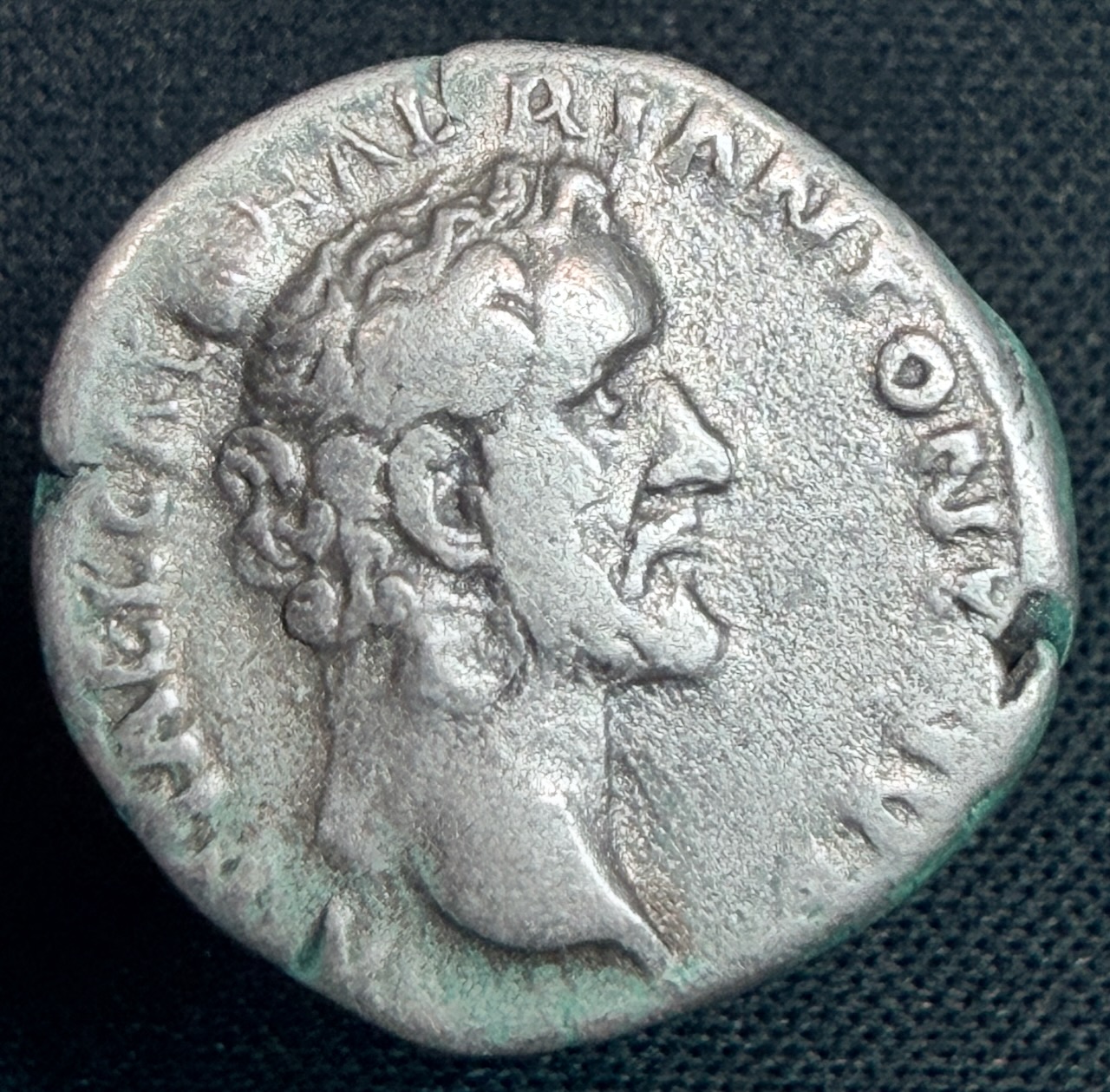
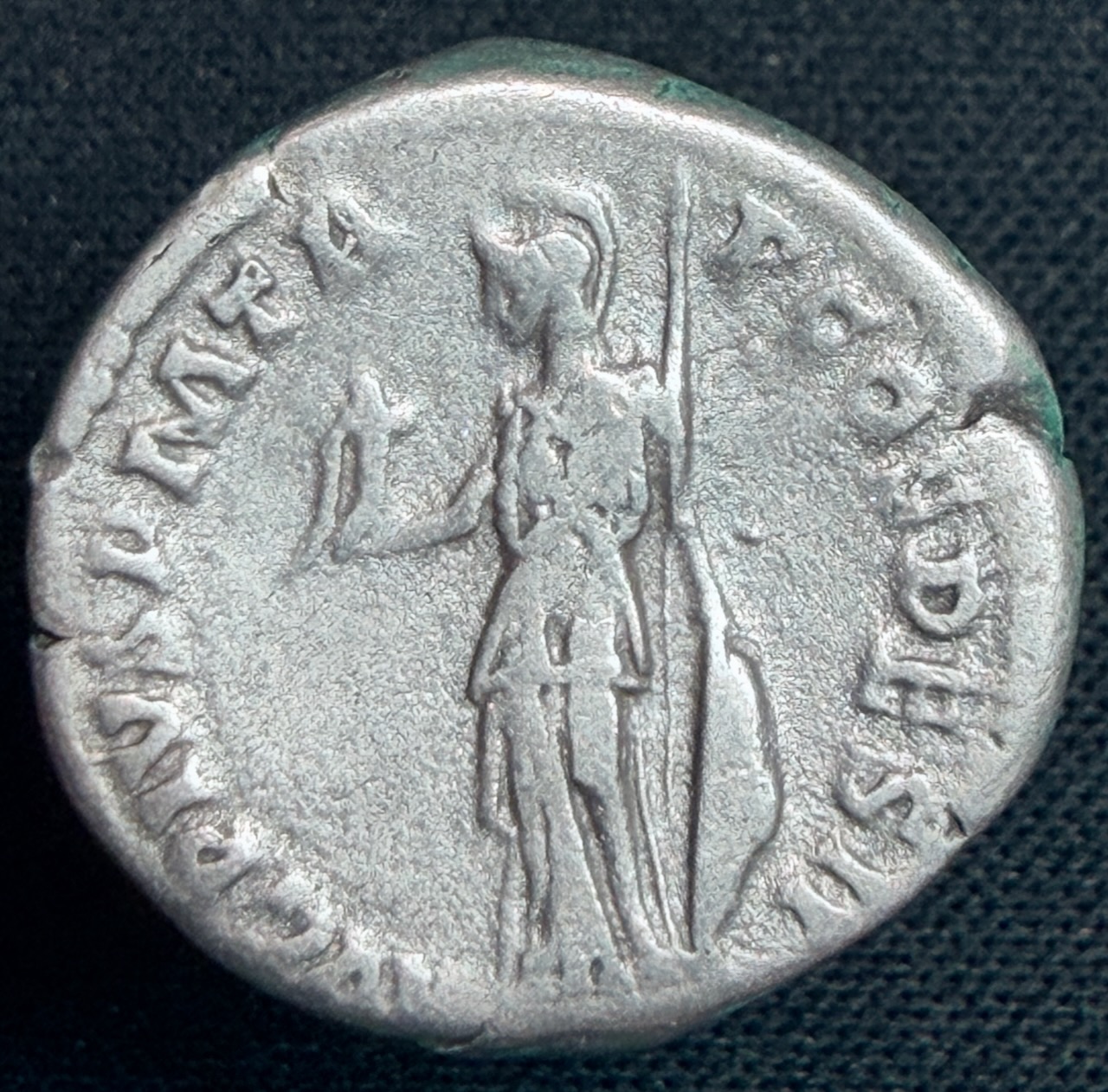
Type · antoninus-pius-minerva-denarius
Current: Roman Imperial, Antoninus Pius, AR denarius, Rome, 138 AD (RIC III 9)
Obverse: Bare head of Antoninus Pius right
Reverse: Minerva standing left, holding Victory in extended right hand, left hand resting on shield, spear resting against left arm
Primary reference: RIC III 9
7 specimens in public collections (ANS 1, Ashmolean 1, Mall 1, Göttingen 1, Mpv 1); weights 2.79–3.5 g, median 3.18 g across 7 recorded; die axis most often 6h.
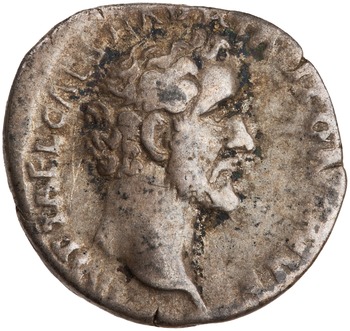
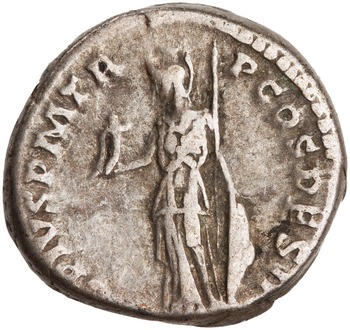
American Numismatic Society, 1956.127.334. CC BY-NC 4.0. https://numismatics.org/collection/1956.127.334
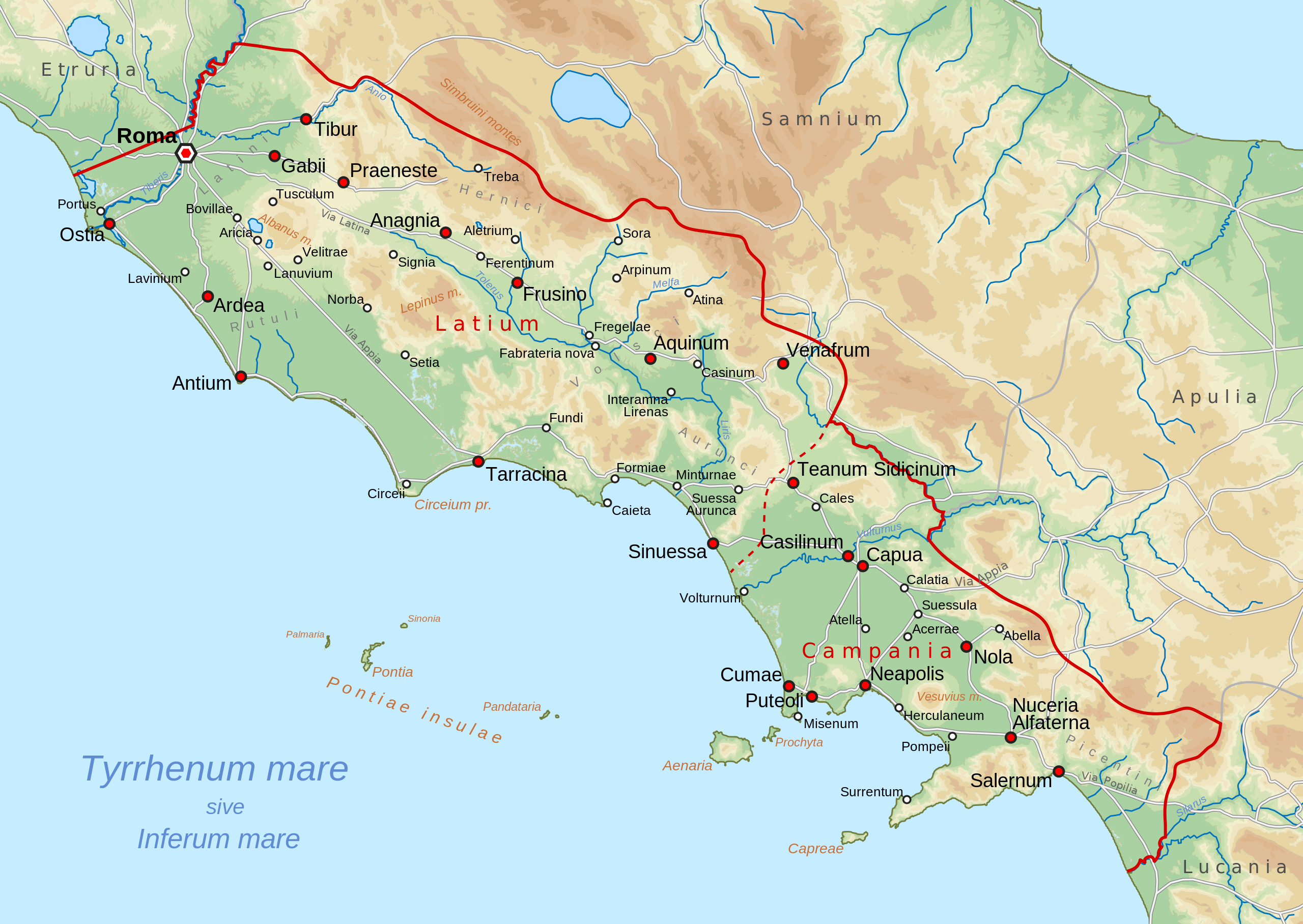
Regio I, Latium et Campania — the heartland of Roman Italy as organized under Augustus. Roma sits at the upper left, marked by the map’s hexagonal capital symbol and bold label. Antoninus rarely left this map: alone among the second-century emperors he governed for twenty-three years almost without stirring from Rome and its Campanian villas.
“Map of Augustan Regio I Latium et Campania” by Tomisti (Wikimedia Commons), File:Regio I Latium et Campania map.svg, licensed CC BY-SA 4.0; cities and roads based on the Digital Atlas of the Roman Empire (DARE) and Pleiades; topographic base © OpenMapTiles, © OpenStreetMap contributors. Reproduced unmodified.
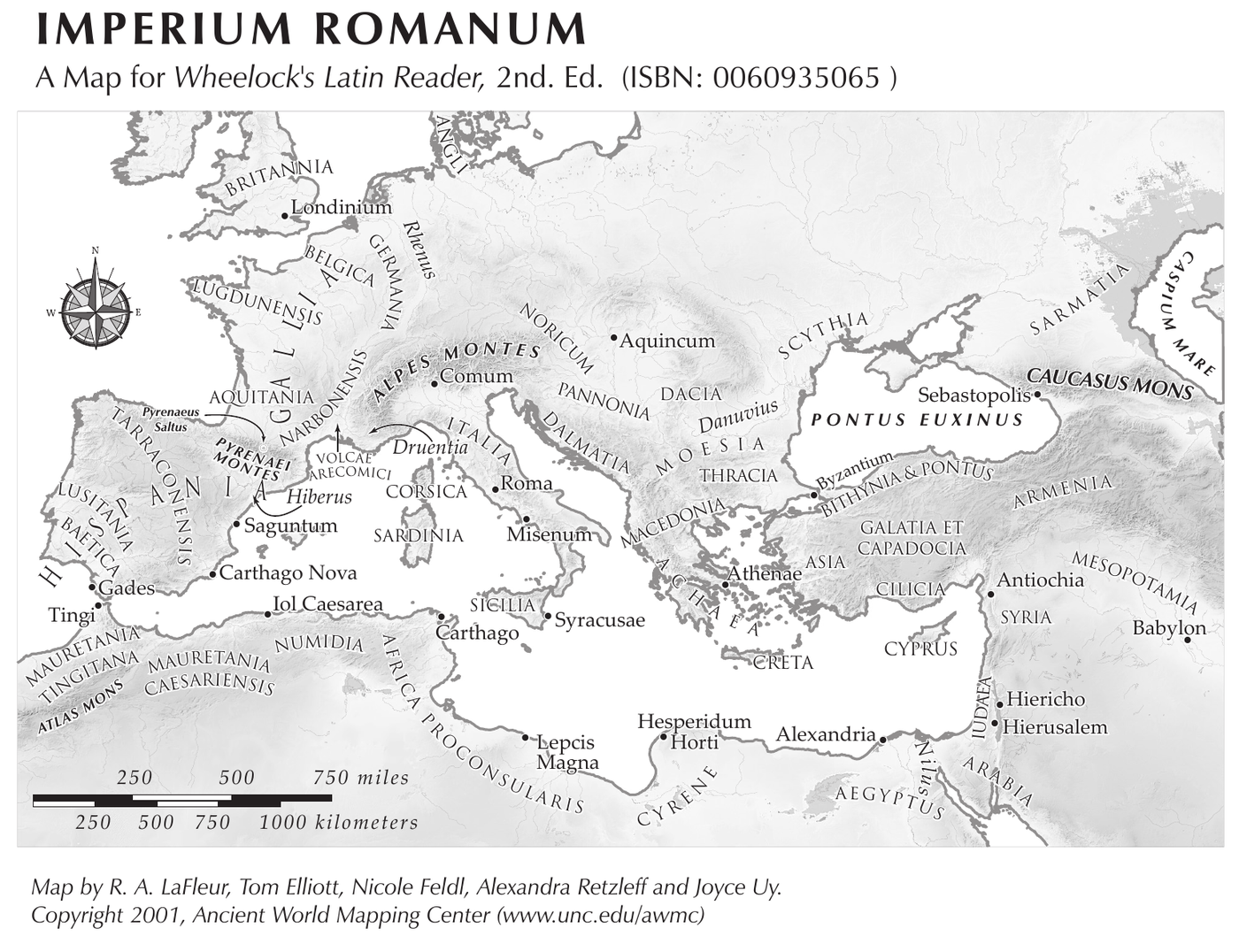
Roma sits at the center of Italia. Struck in AD 138, the year Antoninus succeeded. He never left Italia in twenty-three years as emperor — alone among the emperors on this map — and the empire drawn here is very close to the one he governed from the center.
This denarius is a coin of a single, carefully managed year. On 25 February 138 the dying Hadrian — his first chosen heir, Aelius Caesar, having died on New Year’s Day — adopted the fifty-one-year-old senator Titus Aurelius Fulvus Boionius Arrius Antoninus, on the condition that Antoninus in turn adopt two boys: his wife’s nephew Marcus Annius Verus, the future Marcus Aurelius, and Aelius’ young son Lucius Verus. In one stroke Hadrian scripted the imperial succession for the next forty-four years. When he died at Baiae on 10 July 138, the transfer of power was — for once in Roman history — entirely uneventful.
The coin’s two faces straddle that moment. The obverse still names the new emperor as Hadrian’s adopted son, Titus Aelius Caesar Hadrianus Antoninus, with the bare-headed, deliberately civilian portrait convention Hadrian’s own late coinage had favored (compare the bare-head AEGYPTOS denarius). The reverse carries his new style: AVG PIVS — the first coins to bear the name by which history knows him — with TR P and COS DES II, consul designate for the second time, which places the strike before he opened that consulship on 1 January 139. The Historia Augusta offers a menu of explanations for the new cognomen Pius, from his physically supporting his aged father-in-law into the Senate house to his forcing a reluctant Senate to deify Hadrian (Life of Antoninus Pius 2); dutifulness toward Hadrian’s memory runs through all of them, and this issue — Hadrian’s name held aloft on the obverse of the new reign’s first silver — is that dutifulness in metal.
Graphic: JSB Coins (CC0).
Who was the fifty-one-year-old the dying emperor picked? A senator of provincial stock — his family came from Nemausus (Nîmes) in Gallia Narbonensis, part of the same westward widening of the elite that had produced Trajan and Hadrian from Spain — enormously rich, twice distinguished in office (an honest proconsulship of Asia was the highlight), and famous chiefly for being blameless. The Historia Augusta draws him with unusual warmth: strikingly tall and handsome, of “natural gravity” tempered by mildness, a landlord who lived like a private gentleman on his own estates. Ancient and modern cynics have added the obvious point — Antoninus was chosen partly as a caretaker, a healthy man of a certain age who would keep the throne warm for the boy Marcus — but the caretaker outlived expectation by two decades and gave the empire the longest reign since Augustus. The portrait on this coin, cut within weeks of the accession, is the earliest numismatic look at him: bare-headed, spare, still more senator than god.
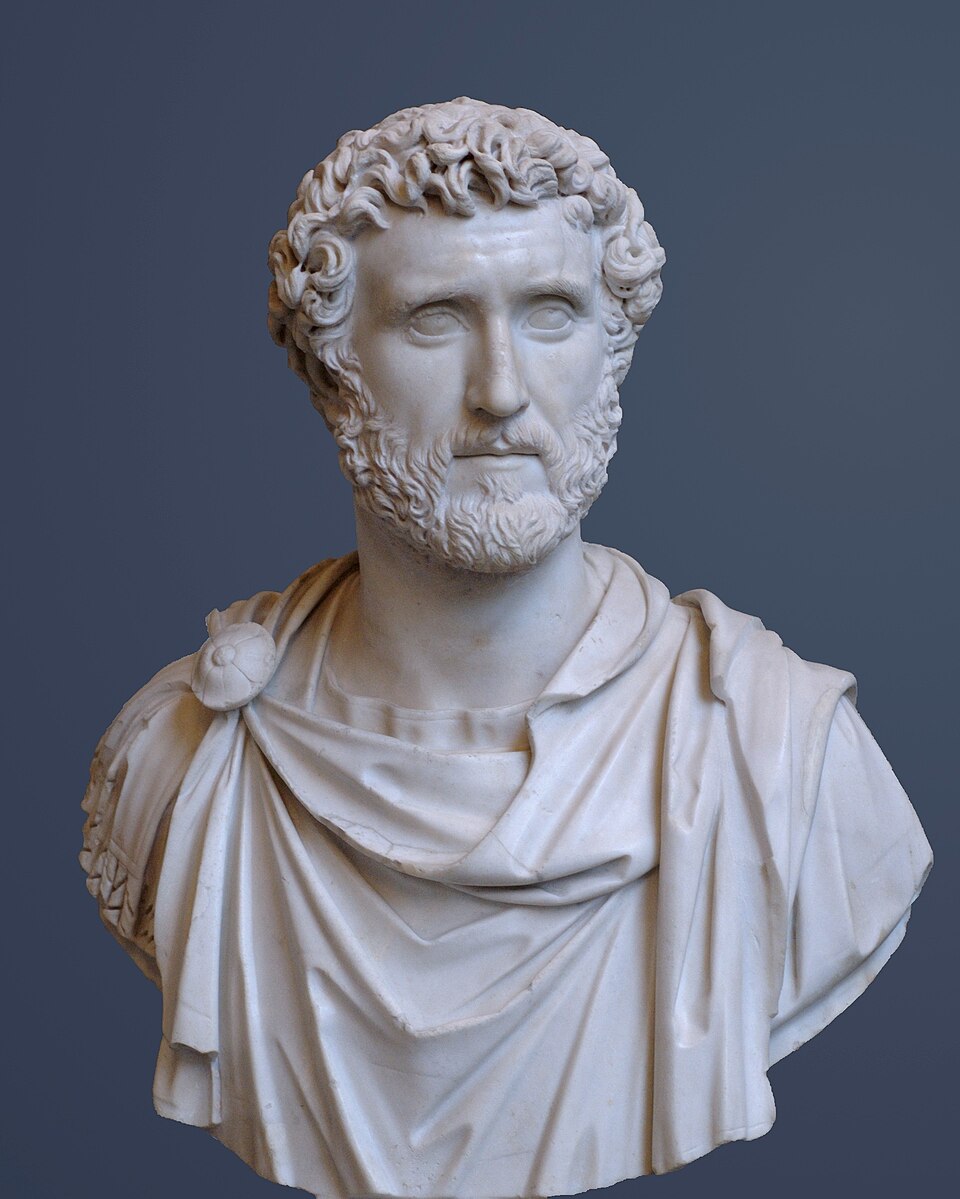
Photo by Wikimedia Commons user Bibi Saint-Pol, released into the public domain by the author; reproduced unmodified.
The reverse figure is Minerva, helmeted, with Victory alighting on her outstretched hand and her shield and spear at rest — armed wisdom presenting victory, with none of the campaign machinery of an actual war, for there was none: the reign now opening would be the most peaceful of the imperial age (compare the quiet Genius on Hadrian’s COS III silver for the same governing mood a decade earlier). Antoninus would rule until 161 without leaving Italy, managing the empire by correspondence; the elaborate accession-year coinage, of which the Minerva type is one of several reverses (Aequitas, Fides, Pietas and others share the COS DES II legend), was in a sense the reign’s one big public event until the decennial celebrations. A denarius from the far end of the same reign — the Annona issue of 157–158 — shows the government still quietly advertising the grain supply twenty years on.
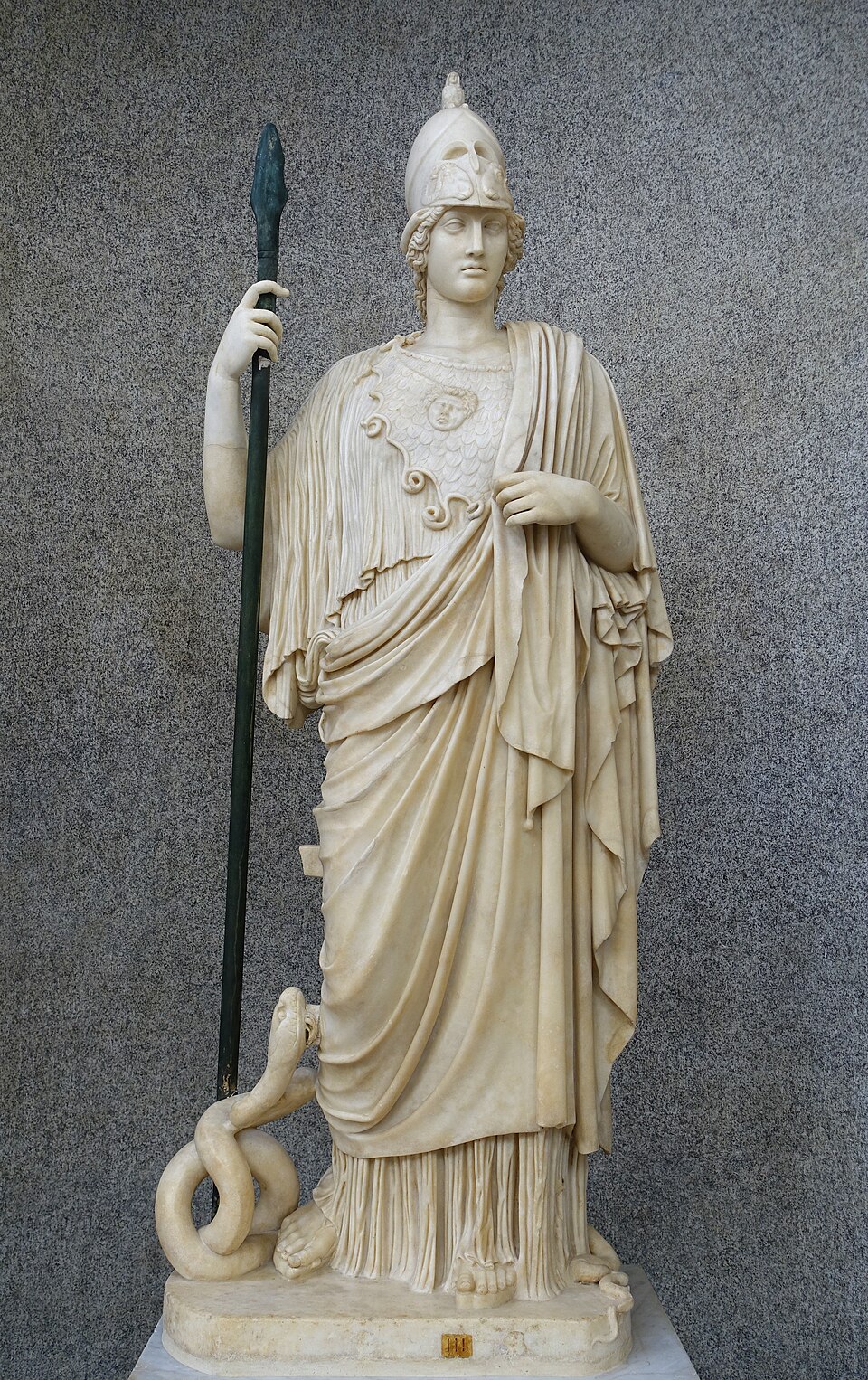
Photo: Daderot, Wikimedia Commons, public domain; reproduced unmodified.
The Historia Augusta life (linked) is the fullest ancient account and takes twenty minutes to read; Cassius Dio’s book for the reign survives only in a threadbare epitome (Book 70) — the most peaceful reign is also the worst documented, a fact every historian of the Antonines laments and this coin’s tidy titulature helps offset: the COS DES II silver is itself primary evidence for the accession’s timeline. The introductions to BMCRE IV and RIC III lay out the accession coinage; OCRE serves the type as RIC III 9a (search it by number — no deep link, per the collection’s verified-links rule). The RSC 66 vs 67a question on Zauche’s tag remains the specimen’s open thread.
Attribution: RIC III 9; RSC 66; Sear RCV 4053 — see the WildWinds Antoninus Pius index for the type (Zauche’s tag cites RSC 67a; the RSC subdivision question is an open thread on the specimen). The adoptions of 138 and the accession: Historia Augusta, Hadrian 24–25, Antoninus Pius 2–5 (the Pius explanations at 2.3–7; the character sketch at 2.1); Cassius Dio 69.20–21, 70.1–2. On the COS DES II accession coinage, the introduction to RIC III and BMCRE IV.
The accession issue of the second half of 138 AD: the obverse still carries Hadrian's name (IMP T AEL CAES HADRI ANTONINVS), while the reverse titulature — AVG PIVS, TR P, COS DES II (designate for the consulship of 139) — brackets the issue between Hadrian's death on 10 July 138 and the year's end. WildWinds pairs RIC 9 with RSC 66; Zauche's tag cites RSC 67a, likely the Cohen/RSC subdivision for an obverse-legend variant (HADR vs HADRI break) — the exact legend break is soft on the collection's specimen (see specimen open threads). OCRE subdivides the entry as RIC III 9a. An earlier variant struck before Hadrian's death carries TRIB POT COS DES II with IMP T AEL CAES ANTONINVS (RIC 455, under Hadrian).
John's Ancient Coin Collection · Type · antoninus-pius-minerva-denarius
Image credits for this coin — photographs, maps and graphics used on this page