13.971 g (tag) · 24.9 mm · axis 0° · VF, scrapes, scratches, some corrosion and encrustation
Current:Ptolemaic Kingdom, Cleopatra VII Thea Philopator, AR tetradrachm, Paphos (Cyprus), regnal year 10 = 43/42 BC (Svoronos 1824 [as Ptolemy XIII]; SNG Cop 404; BMC Ptolemies p. 115, 10)
Superseded: Ptolemy XIII — Svoronos 1824 assigned the issue to Cleopatra's brother; the regnal-year sequence is now read as Cleopatra VII's own (see essay)
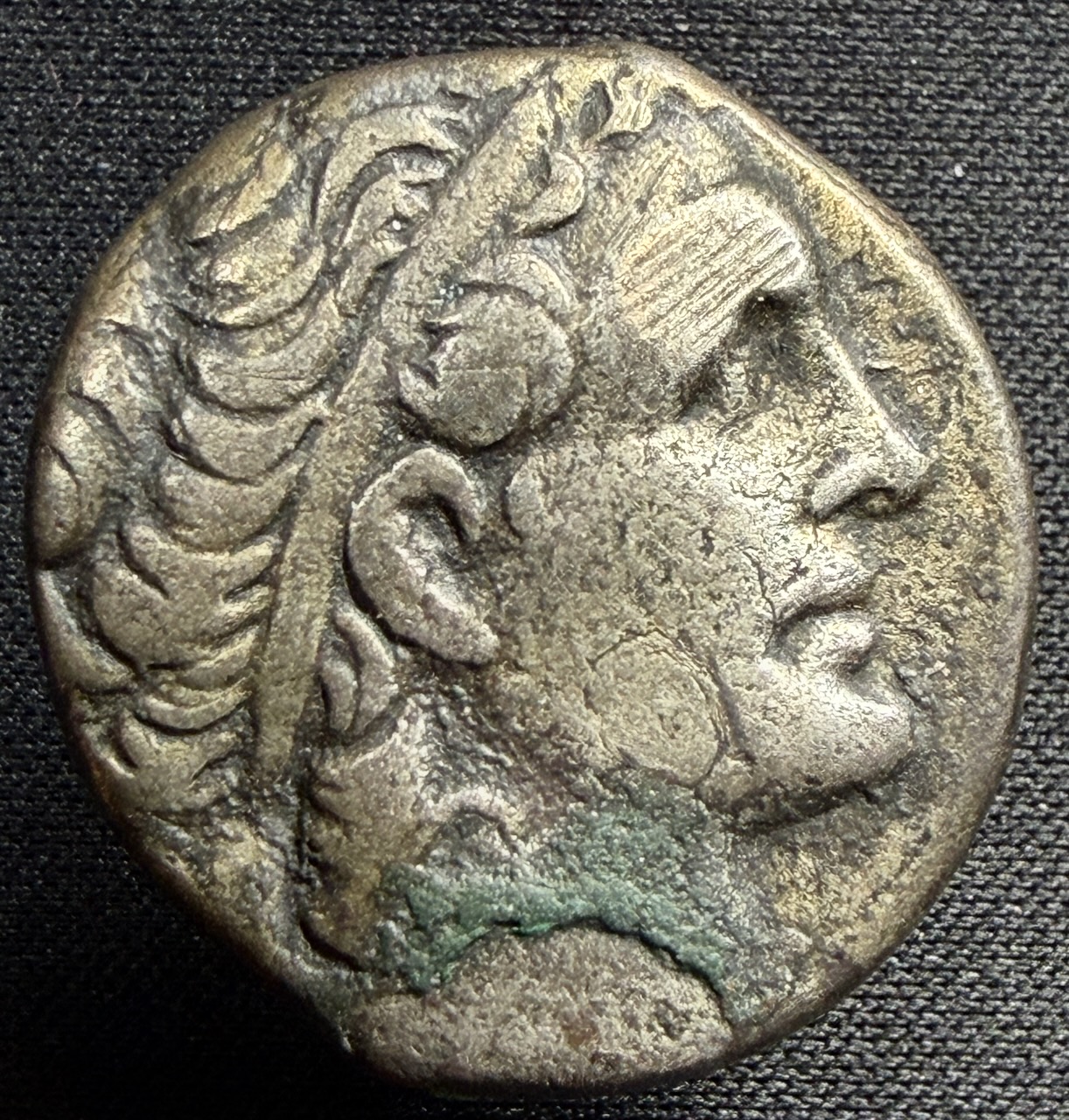
Obverse: Diademed head right, wearing aegis — the standardized dynastic portrait of Ptolemy I retained on late Ptolemaic silver, not a portrait of the reigning queen
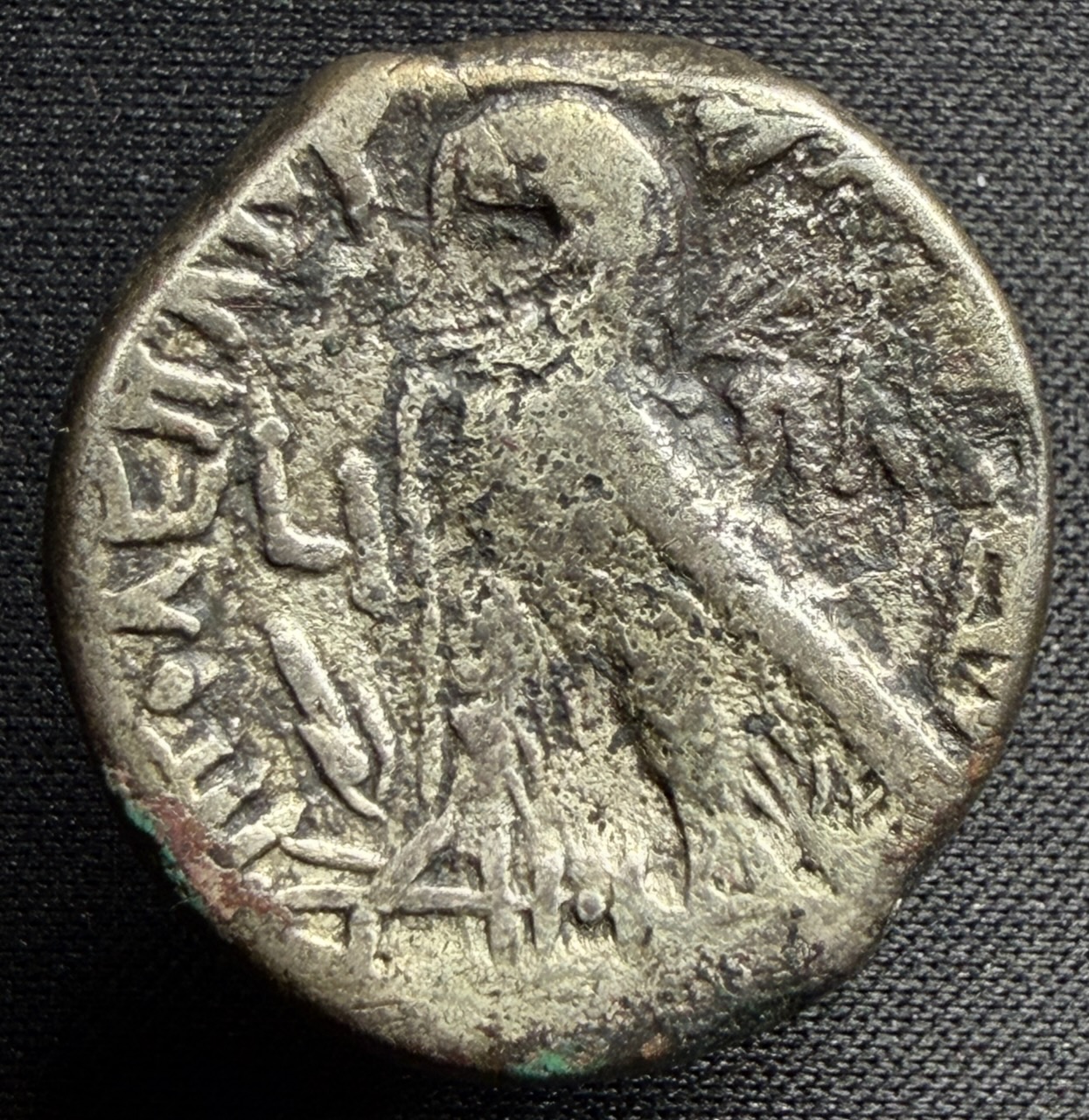
Reverse: Eagle standing left on thunderbolt, wings closed; in left field, LI (regnal year 10) above the headdress of Isis; ΠΑ (mint of Paphos) in right field
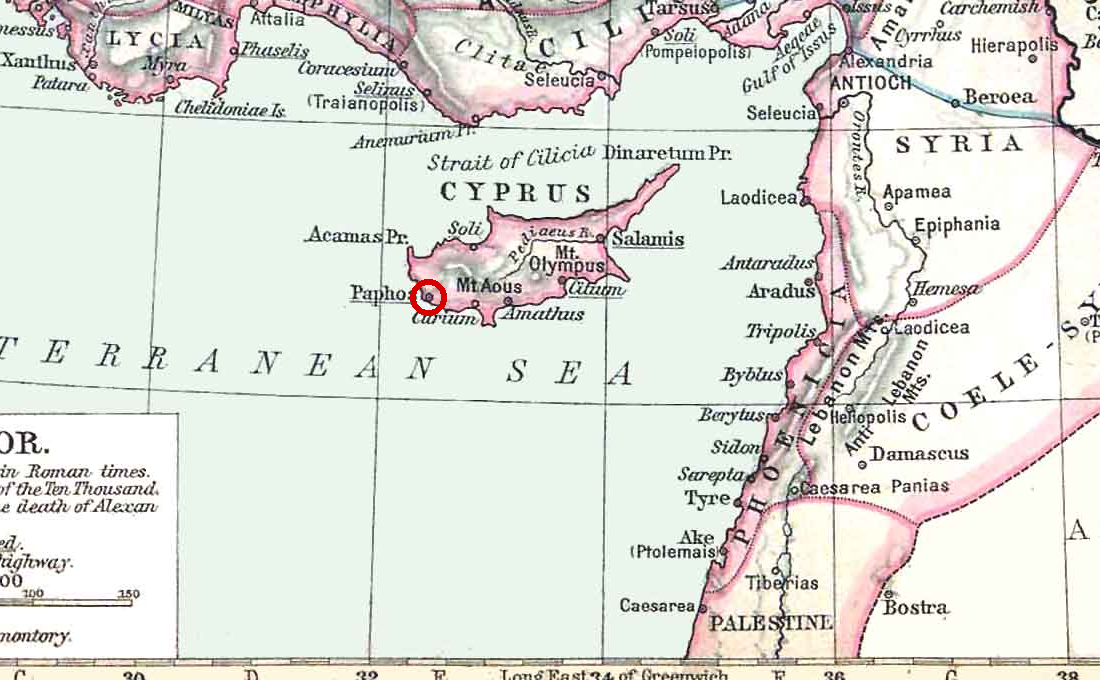
Cyprus and the eastern Mediterranean coast on Shepherd’s 1923 map.
Paphos — circled in red — on the island’s southwest coast was the
seat of the Ptolemaic (and later Roman) administration of Cyprus and
its principal mint. Alexandria lies beyond the map’s lower edge, some
400 km south across open water; the Levantine coast at right is the
world of the Donations of Alexandria, by which Antony parceled these
shores among Cleopatra’s children.
Image source & licence
“Asia Minor under the Greeks and Romans” from William R. Shepherd,
The Historical Atlas (1923). Public domain (author died 1934); house
copy of the plate. Modified by JSB Coins: cropped to Cyprus and the
eastern Mediterranean, and a red circle added to mark Paphos.
Catalogue References
Svoronos 1824 (assigned there to Ptolemy XIII — superseded) current
SNG Copenhagen 404 current
SNG Milan 421 current
BMC Ptolemies p. 115, 10 current
Hosking 140 current
Historical Context
The Queen Behind the King’s Mask
This is a coin of the most famous woman of the ancient world, on which
she appears nowhere. Struck at Paphos on Cyprus in her tenth regnal
year — 43/42 BC, the year after Caesar’s assassination — it carries
the images her dynasty had used for two and a half centuries: the
diademed, aegis-wearing head of Ptolemy I, founder of the house, and
the eagle on the thunderbolt, with the changeless legend ΠΤΟΛΕΜΑΙΟΥ
ΒΑΣΙΛΕΩΣ, “of King Ptolemy.” Only the small marks in the field tell
the truth of the moment: LI, year 10 — of Cleopatra VII — above the
headdress of Isis, the goddess the queen claimed as her own.
The successor kingdoms, 323–30 BC: the four Macedonian dynasties that divided Alexander’s empire, with the collection’s five successor-state coins placed in time — from the “year of the kings” in 305 BC to the last Ptolemaic silver of Cleopatra VII. Coin markers link to the collection’s specimen pages.Image source & licence
Graphic: JSB Coins, 2026 (CC0).
Cyprus and the queen
Cyprus was the Ptolemaic empire’s last overseas possession, lost to
Rome in 58 BC and pointedly restored to Cleopatra by
Julius Caesar
(and confirmed by Antony) — a restoration this coinage embodies:
Paphos, the island’s capital, resumed striking regnal-dated royal
tetradrachms. Year 10 fell in 43/42 BC, when the Roman world was
tearing itself apart after the Ides of March; Cleopatra, governing
from Alexandria with her son Caesarion as co-ruler, held Cyprus
through a governor and equipped fleets from it in the wars that
followed. Within a few years she would stand with
Mark Antony
against Octavian; the legionary denarii of Patrae, paid for from her
treasury, are the other side of the story this quiet provincial
tetradrachm begins.
The queen the coins never show
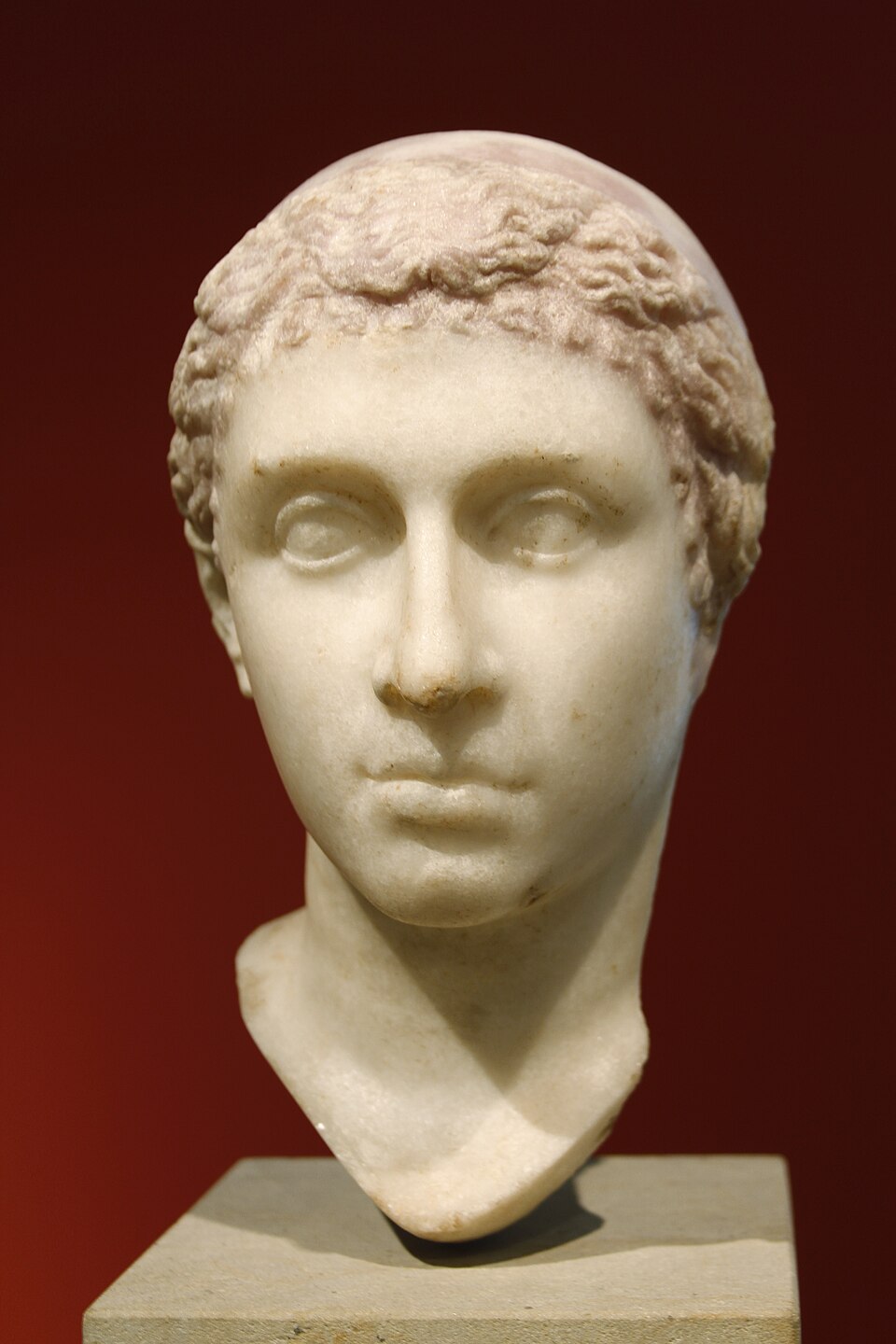
The frozen founder’s portrait on this coin makes it worth asking what
Cleopatra actually looked like — a question her own coinage answers
elsewhere, unflatteringly. Where she does appear — on the bronze
80-drachma pieces of Alexandria, and on the silver she shared with
Antony at eastern mints in the 30s BC — the queen has a strong hooked
nose and a jutting chin, a deliberately Ptolemaic, dynastic face rather
than a romantic one. Plutarch, writing four generations later from the
memories of men who had known her court, insists the power was never
in the face: her beauty “was not altogether incomparable,” but her
presence, her conversation, and a voice “like an instrument of many
strings” were irresistible (Antony
27) —
she spoke, he adds, most of the languages of her subjects, the first
of her dynasty to trouble learning Egyptian. On this Cypriot silver,
none of that appears at all: royal tetradrachms wore the dynasty’s
mask, because the institution outranked the person — even this person.
The “Berlin Cleopatra” (Altes Museum, Berlin), c. 40–30 BC — one of the few sculpted portraits generally accepted as the queen, made in her own lifetime; diademed, Hellenistic, and closer to her coin portraits than to her legend.Image source & licence
Whose coin? Svoronos’s Ptolemy XIII and the modern reading
The attribution has its own history, preserved on the dealer’s tag.
Svoronos (1904–08) catalogued the issue as no. 1824 under Ptolemy
XIII, Cleopatra’s brother and first co-ruler, reading the regnal
years as his. The regnal-year sequence of the late Paphos mint is now
read as Cleopatra’s own — Mørkholm’s study of the last Ptolemaic
silver of Cyprus (Chiron 13, 1983) is the standard treatment, and
year 10 = 43/42 BC falls years after Ptolemy XIII drowned in the Nile
(47 BC), settling the question for this date at least. The old
attribution is kept searchable here, as auction records under
“Ptolemy XIII, Svoronos 1824” describe exactly this coinage.
The last Ptolemaic silver
The fabric tells the dynasty’s late story: a dumpy, reduced-standard
tetradrachm of just under 14 g, its silver visibly baser than the
bright metal of the third century — the currency of a kingdom that
had spent generations debasing to survive. It is nonetheless true
royal silver, struck for pay and trade in the kingdom’s last decade,
and the final issue of a coinage tradition that ran back three
centuries: the same eagle, the same legend, the same founder’s
portrait as on the money of the dynasty’s height (this collection’s
great bronze of Ptolemy III
carries the pair a hundred and eighty years earlier). After Actium
and the queen’s death in 30 BC, Egypt’s mints would strike for Rome —
and Egypt itself would become an emperors’ possession, pictured a
century and a half later on this collection’s
AEGYPTOS denarius of Hadrian.
Sources
Attribution and references: the Forum Ancient Coins listing and tag
(GP77852): Svoronos 1824 (as Ptolemy XIII), SNG Copenhagen 404, SNG
Milan 421, BMC Ptolemies p. 115, 10, Hosking 140. The late Cypriot
regnal-year silver: O. Mørkholm, “The last Ptolemaic silver coinage
in Cyprus,” Chiron 13 (1983), pp. 69–79; M. Kreuzer, The Coinage
System of Cleopatra VII, Marc Antony and Augustus in Cyprus (2004);
C. C. Lorber, Coins of the Ptolemaic Empire (2018) for the corpus
framework. Historical frame: Caesar’s restoration of Cyprus and the
events of 43/42 BC per the standard narratives (Plutarch, Caesar and
Antony; Cassius Dio 42–47). For the end of the story, Cassius Dio 51
(linked in the references).
Further reading — Forum’s Ptolemaic bibliography
The reference list below is the standing Ptolemaic bibliography that
Forum Ancient Coins prints on its Ptolemaic listings, captured from
this coin’s listing (GP77852) — a useful working library for the
series, beyond the specific references cited above. For a Cypriot
issue like this one, note especially Hill’s BMC Cyprus, the two
Nicosia Cyprus catalogues, Nicolaou’s Paphos II, the Mørkholm Cyprus
studies, and Kreuzer.
Aumaître, H. & C. Lorber. “New Evidence Concerning a Mint Imitating Ptolemaic Tetradrachms” in INR 16 (2021), pp. 59–70, pls. 2–5.
Brett, A. “Dated coins of Ptolemy V, 204–180 B.C.” in ANSMN 2 (1947), pp. 1–11.
Brooks, E. “The overstruck coinage of Ptolemy I” in ANSMN 6 (1954), pp. 69–84.
Burnett, A., M. Amandry, et al. Roman Provincial Coinage (1992–).
Cox, D. Coins from the Excavations at Curium, 1932–1953. ANSNNM 145 (New York, 1959).
Davesne, A. & G. Le Rider. Gülnar II. Le trésor de Meydancikkale (Paris, 1989).
Faucher, T., A. Meadows & C. Lorber. Egyptian Hoards I, The Ptolemies (2017).
Faucher, T. & M. Shahin. “Le Trésor de Gezeir (lac Mariout, Alexandrie)” in RN 162 (2006), pp. 135–157.
Gitler, H. & D. Master. “Cleopatra at Ascalon: Recent Finds from the Leon Levy Expedition” in INR 5 (2010), pp. 67–98.
Hill, G. A Catalog of the Greek Coins in the British Museum, Greek Coins of Cyprus (London, 1904).
Hill, G. Catalogue of Greek Coins in the British Museum: Phoenicia (London, 1910).
Jenkins, G. “An early Ptolemaic hoard from Phacous” in ANSMN 9 (1960), pp. 17–37.
Kreuzer, M. The Coinage System of Cleopatra VII, Marc Antony and Augustus in Cyprus (Springfield, MA, 2004).
Lorber, C. Coins of the Ptolemaic Empire (New York, 2018).
Macdonald, G. Catalog of Greek Coins in the Hunterian Collection, Vol. III (Glasgow, 1905).
Malter, J. The Coinage of Ancient Egypt, Auction II (Encino, CA, 1978).
Michaelidou, L., ed. Museum of the History of Cypriot Coinage, Coin Catalogue (Nicosia, 1996).
Michaelidou, L. & E. Zapiti. Coins of Cyprus, From the Collection of the Bank of Cyprus Cultural Foundation (Nicosia, 2008).
Mildenberg, L. “Yehud: A Preliminary Study of the Provincial Coinage of Judaea” in Essays Thompson.
Meshorer, Y., et al. Coins of the Holy Land: The Abraham and Marian Sofaer Collection. ACNAC 8 (New York, 2013).
Mørkholm, O. “Cyprus Hoard, 1982” in NC 147 (1987), pp. 156–158.
Mørkholm, O. Early Hellenistic Coinage. From the Accession of Alexander to the Peace of Apamea (336–188 BC) (Cambridge, 1991).
Mørkholm, O. “Ptolemaic coins and chronology: The dated silver coinage of Alexandria” in ANSMN 20 (1975), pp. 7–24.
Mørkholm, O. “The Ptolemaic ‘coins of an uncertain era’” in Nordisk Numismatisk Årsskrift 1975–1976, pp. 23–58.
Mørkholm, O. “The last Ptolemaic silver coinage in Cyprus” in Chiron 13 (1983), pp. 69–79.
Nicolaou, I. Paphos II. The Coins from the House of Dionysos (Nicosia, 1990).
Noeske, H. Die Münzen der Ptolemäer (Frankfurt, 2000).
Olivier, J. & T. Faucher. “EH 69. Le Trésor de Paphos (IGCH 1471; CH 2.106; 4.68)” in Egyptian Hoards I (2017), pp. 258–315, pls. 101–224.
Pitchfork, C. The Jon Hosking Collection of Ptolemaic Coins (Sydney, 2000).
Poole, R. A Catalog of the Greek Coins in the British Museum, the Ptolemies, Kings of Egypt (London, 1882).
Robinson, E. A Catalog of the Greek Coins in the British Museum, The Greek Coins of Cyrenaica (London, 1927).
Rosenberger, M. The Rosenberger Israel Collection (Jerusalem, 1972–1978).
Sear, D. Greek Coins and Their Values, Volume 2, Asia and Africa (London, 1979).
Svoronos, J. Ta Nomismata tou Kratous ton Ptolemaion (Athens, 1904–08).
SNG Denmark, Danish National Museum, Vol. 8: Egypt, North Africa, Spain–Gaul (New Jersey, 1994).
SNG Italy, Milano XIII, Aegyptus, Part 1: Ptolemaei (Milan, 1989).
Weiser, W. Katalog Ptolemäischer Bronzemünzen der Sammlung des Instituts für Altertumskunde, Universität Köln (Opladen, 1995).
Visonà, P. “A Hoard of Ptolemaic Bronze Coins in the J. Paul Getty Museum” in J. Paul Getty Museum Journal 6–7 (1978–1979), pp. 153–162.
Wolf, D. “New Observations on the Ptolemaic Bronze Coinage of Tyre” in INR 11 (2016), pp. 29–46, pls. 4–6.
Wolf, D. “The ‘Galatian Shield Without Σ’ Series of Ptolemaic Bronze Coins” in NC 171 (2011), pp. 7–52, pls. 1–3.
Wolf, D. The PtolemAE Project — http://ptolemybronze.com/
Wolf, D. & C. Lorber. “Syracusan Imitations of the Bronze Diobols of Ptolemy II Philadelphus” (19 March 2009).
Zervos, O. “The early tetradrachms of Ptolemy I” in ANSMN 13 (1967), pp. 1–16.
Zervos, O. “The Delta hoard of Ptolemaic ‘Alexanders’” in ANSMN 21 (1976), pp. 37–58.
Notes
Late Ptolemaic reduced-standard tetradrachm (this specimen 13.971 g; the standard had drifted well below the c. 14.3 g of earlier Ptolemaic silver). ATTRIBUTION: Svoronos gave the issue to Ptolemy XIII; the now-standard reading takes the Paphos regnal-year series LI = year 10 as Cleopatra VII's (43/42 BC) — Mørkholm's Chiron 13 study is the key treatment of these last Cypriot tetradrachms. The obverse is the frozen dynastic portrait of Ptolemy I (with aegis), not Cleopatra; the legend likewise stays 'of King Ptolemy.' The Isis headdress under the date is a small but pointed touch for a queen who styled herself the New Isis.
References & Further Reading
Otto Mørkholm (1983) The last Ptolemaic silver coinage in Cyprus Chiron 13 (1983), pp. 69–79 — the study of the late Cypriot regnal-year tetradrachms and their attribution among the last Ptolemies
Michael Kreuzer (2004) The Coinage System of Cleopatra VII, Marc Antony and Augustus in Cyprus Springfield, MA, 2004
Catharine C. Lorber (2018) Coins of the Ptolemaic Empire American Numismatic Society (New York, 2018) — current corpus framework for the Ptolemaic series
Plutarch (trans. Evelyn/Clough) (1859) Plutarch, Life of Antony (English translation) [link] Wikisource — the source of almost everything posterity believes about Cleopatra, hostile and dazzled at once; chapter 27 for the famous verdict on her charm, chapters 25–29 for the meeting at Tarsos and the Alexandrian winter
Cassius Dio (Loeb trans., LacusCurtius) (1917) Cassius Dio, Roman History, Book 51 (English translation) [link] LacusCurtius (University of Chicago) — the fullest connected account of the end: Actium's aftermath, the negotiations with Octavian, the asp and the alternative stories, and Egypt made a Roman possession
John's Ancient Coin Collection · Type · cleopatra-vii-paphos-tetradrachm