Type · ptolemy-iii-zeus-ammon-eagle-bronze
Current: Ptolemaic Kingdom of Egypt, Ptolemy III Euergetes, AE hemidrachm, Alexandria, c. 246–230 BC (Lorber CPE B371; Svoronos 974)
Superseded: Ptolemy IV Philopator — the attribution carried by the older references on the dealer's tag (SNG Cop 229, Noeske 161, Hosking 44, Weiser 92, all 'Ptolemy IV'); Lorber's Coins of the Ptolemaic Empire reassigned the series to Ptolemy III
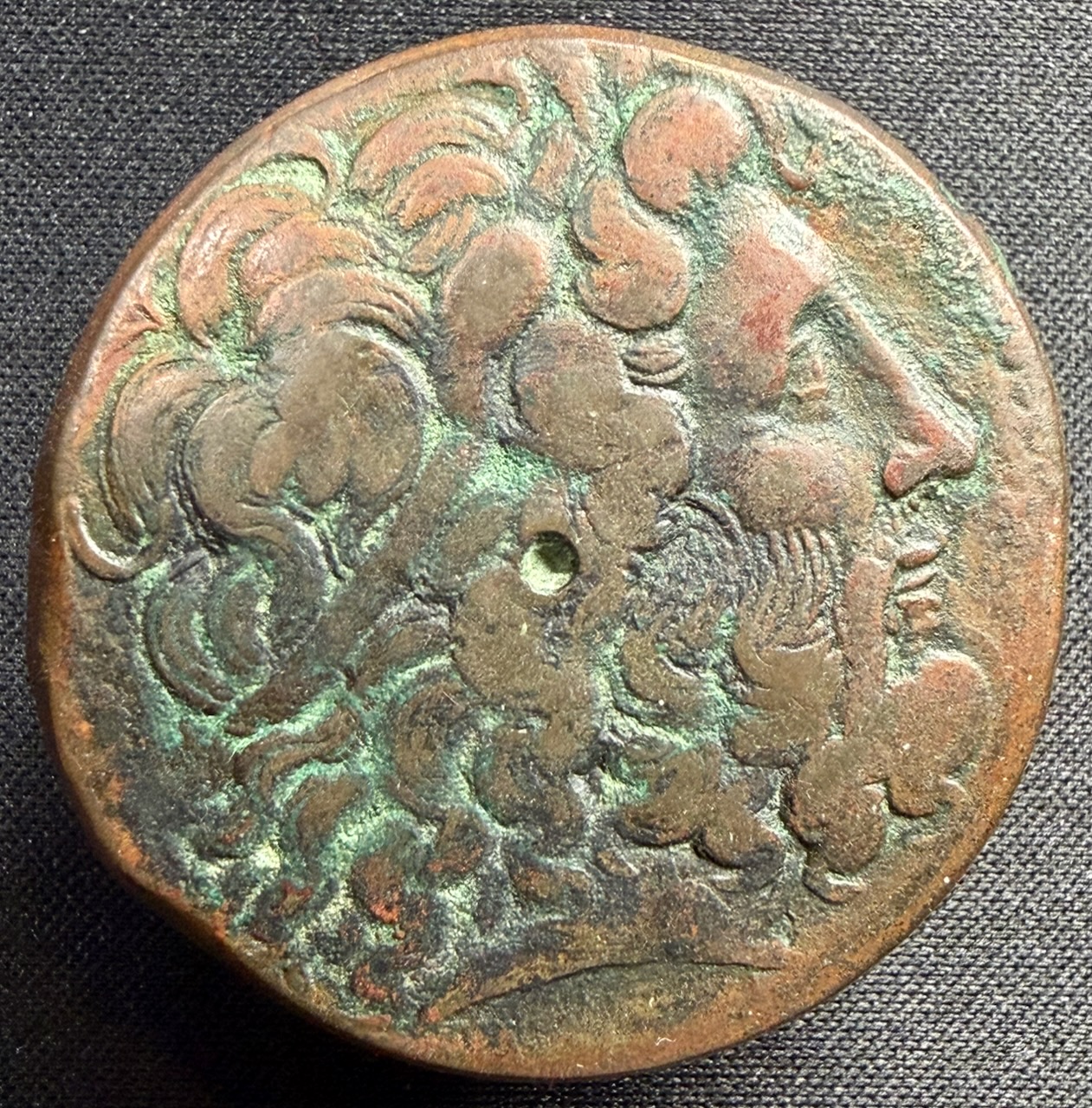
Obverse: Head of Zeus-Ammon right, wearing taenia, ram's horn curling at the temple; centration dimple at center
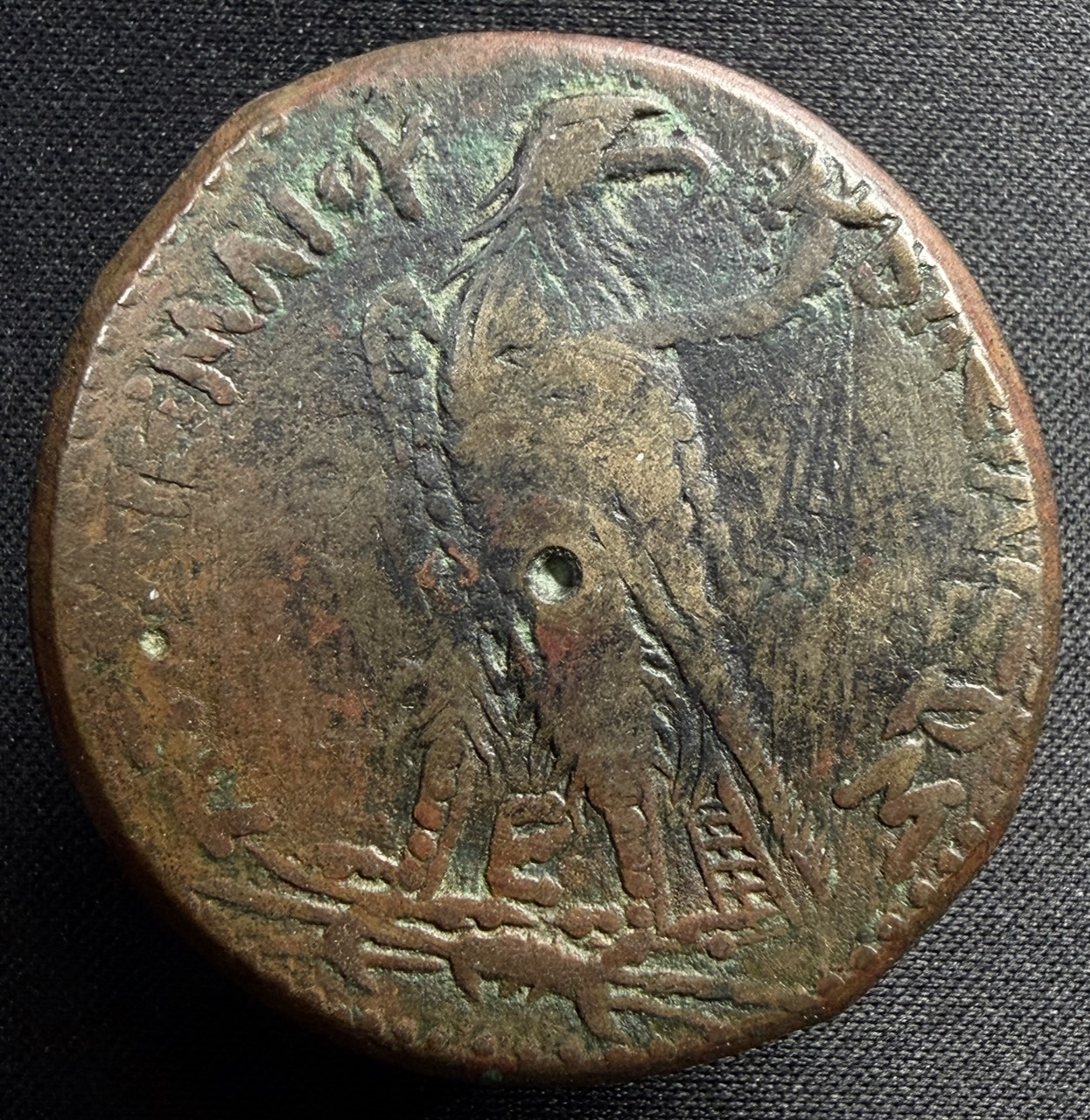
Reverse: Eagle standing half left on thunderbolt (fulmen), wings closed, head right; filleted cornucopia ascending behind from shoulder; monogram between legs (read as E on the tag, EP in Forum's current listing); centration dimple at center
Primary reference: Lorber CPE B371
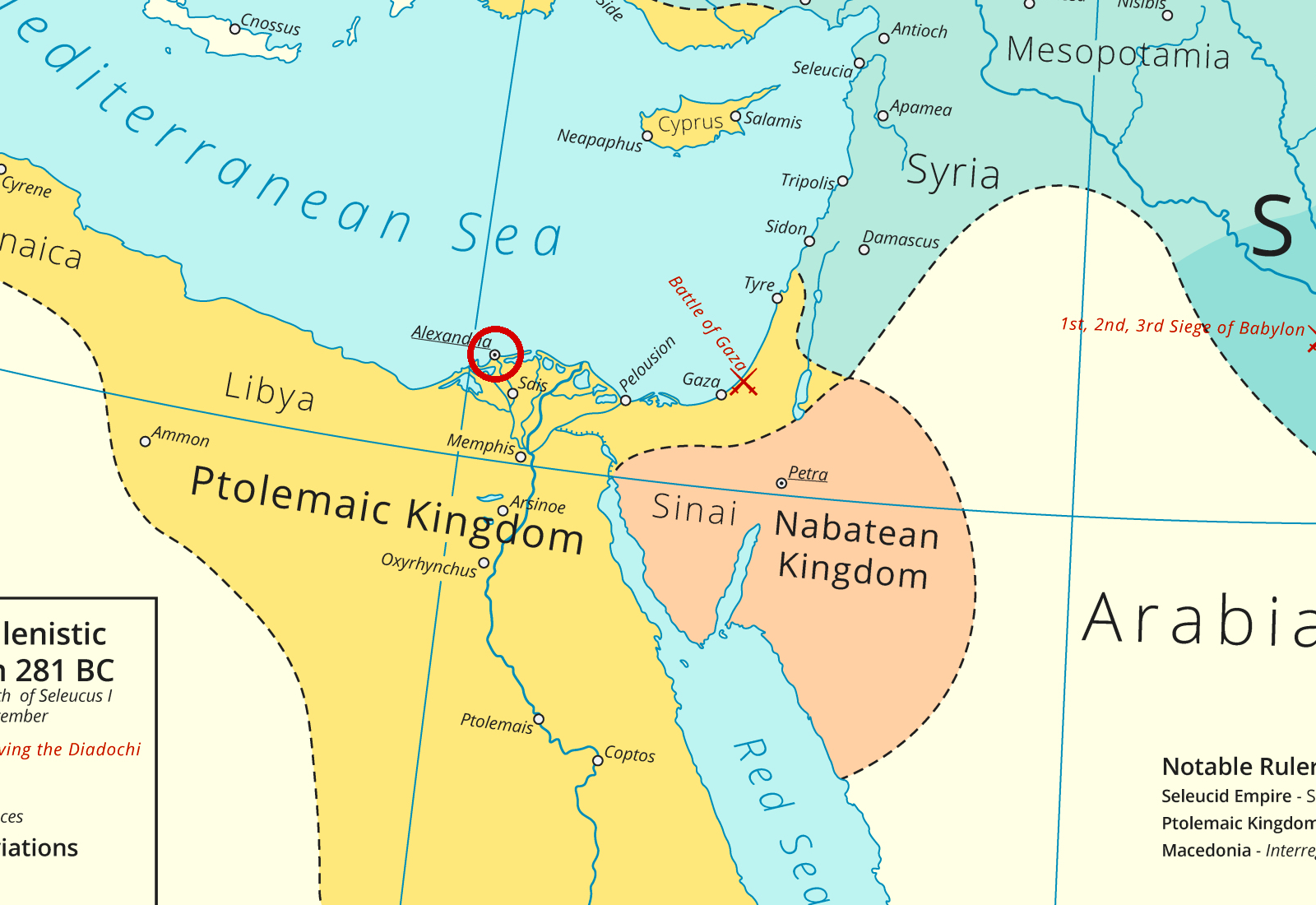
The eastern Mediterranean of the Hellenistic kingdoms (the map shows the world of 281 BC, a generation before this coin). Alexandria — circled in red — commands the western edge of the Nile Delta, the royal capital and mint of the Ptolemaic Kingdom (yellow). The kingdom’s overseas holdings visible here — Cyprus, Cyrenaica, and the Levantine coast contested in the Syrian Wars — are the world Ptolemy III’s fleets and armies dominated at the dynasty’s height.
Base map by Cattette (Wikimedia Commons), “Seleucid Empire alternative map” (extracted from “The Hellenistic World in late 281 BC”), File:Seleucid Empire alternative map.jpg, licensed CC BY-SA 4.0 (https://commons.wikimedia.org/wiki/File:Seleucid_Empire_alternative_map.jpg; license: https://creativecommons.org/licenses/by-sa/4.0/). Modified by JSB Coins: cropped to the eastern Mediterranean, and a red circle added to mark Alexandria. This derivative is shared under the same CC BY-SA 4.0 license.
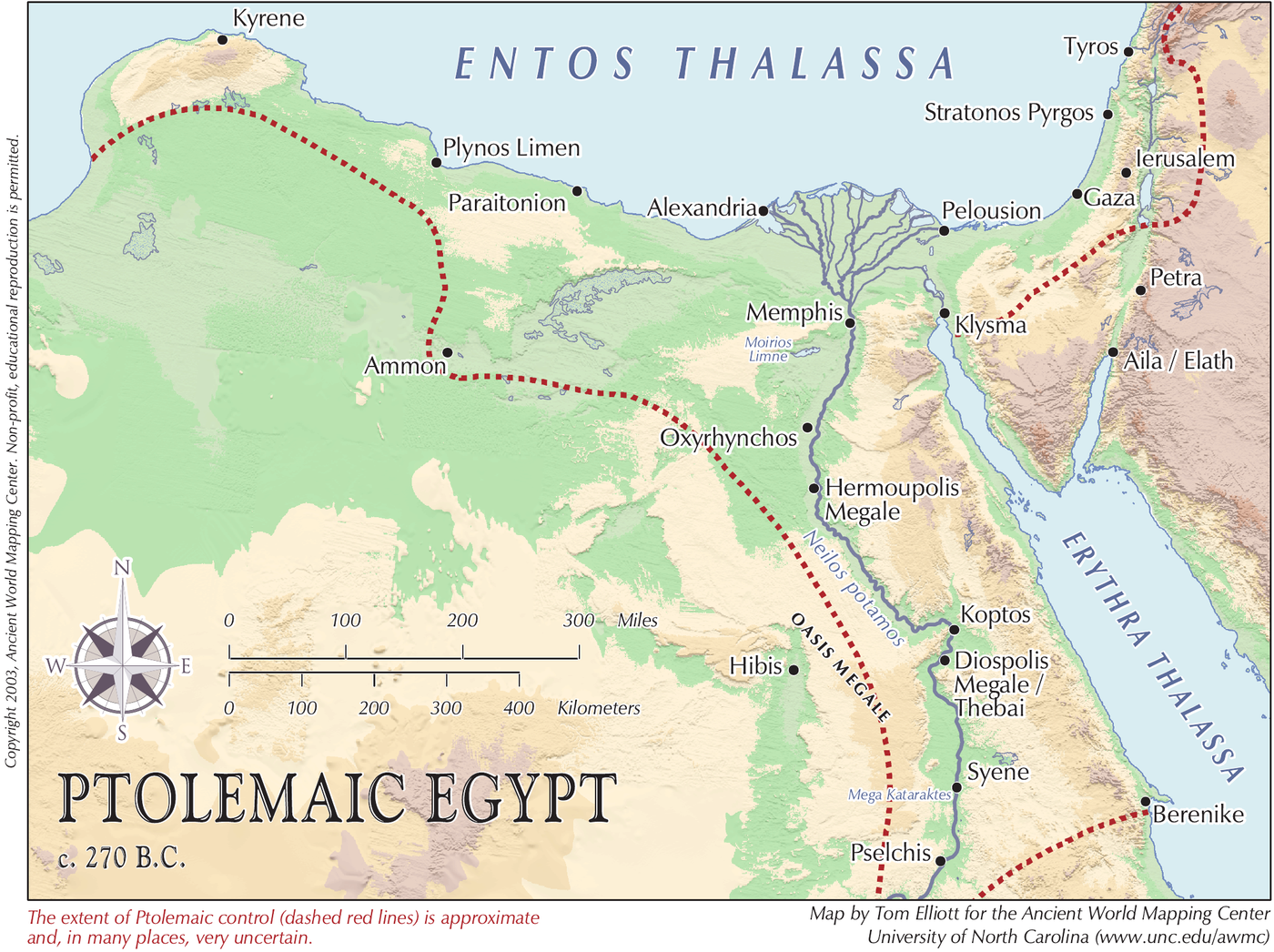
Alexandria, on the western edge of the delta, struck this bronze — and the map is drawn for about 270 BC, within a generation of it. The dotted line is the approximate reach of Ptolemaic control, which is the empire this coin’s eagle stood for: Egypt itself, the Cyrenaica to the west, and a Levantine coast held against the Seleukids. Ammon, in the western desert, is the oracle whose ram’s horns Zeus wears on the obverse.
Nothing announces the strangeness and confidence of Ptolemaic Egypt’s money like its bronze. This is a coin of nearly 43 grams — heavier than ten silver tetradrachms — struck at Alexandria for a kingdom that had deliberately walled its currency off from the rest of the Greek world. On the obverse, Zeus-Ammon: the king of the Greek gods wearing the ram’s horn of the Egyptian Amun, the two faiths fused in a single profile. On the reverse, the eagle on the thunderbolt that Ptolemy I made the badge of his house, with the cornucopia of dynastic plenty rising behind its shoulder and the legend that never changed: ΠΤΟΛΕΜΑΙΟΥ ΒΑΣΙΛΕΩΣ, “of King Ptolemy.”
Graphic: JSB Coins, 2026 (CC0).
The Ptolemies ran the ancient world’s most tightly managed monetary system. Foreign silver had to be exchanged at the border for Ptolemaic coin (struck on the kingdom’s own reduced standard), and within Egypt an enormous bronze coinage did work that silver did elsewhere — wages, rents, taxes, the daily economy of the Nile valley. The big bronzes of the third century, of which this is a prime example, were the flagship of that internal currency. Their manufacture was distinctive too: the flans were cast, then faced on a lathe, leaving the neat central dimples visible on both sides of this coin — an Alexandrian workshop signature so characteristic that its absence is a warning sign. Egypt had run its own kind of money for a very long time: two centuries earlier the country was still importing and imitating Athenian owls (the collection’s Egyptian owl tetradrachm is that chapter), and the Ptolemaic closed system was the decisive break with that world.
Ptolemy III Euergetes (“the Benefactor,” r. 246–222 BC) took the dynasty to its zenith. His reign opened with the Third Syrian War — launched, the ancient accounts say, to avenge his sister Berenice, murdered at the Seleucid court; his armies took Antioch and marched as far as Babylon (the campaign echoes cryptically in Daniel 11:7–9, as the dealer’s tag notes). At home he was a builder — the Serapeum at Alexandria, the great temple of Horus at Edfu — and under him the Alexandrian mint poured out the bronze series to which this coin belongs. The dynasty this coinage served would end, two centuries later, with Cleopatra VII, whose silver still carried the same eagle and the same legend.
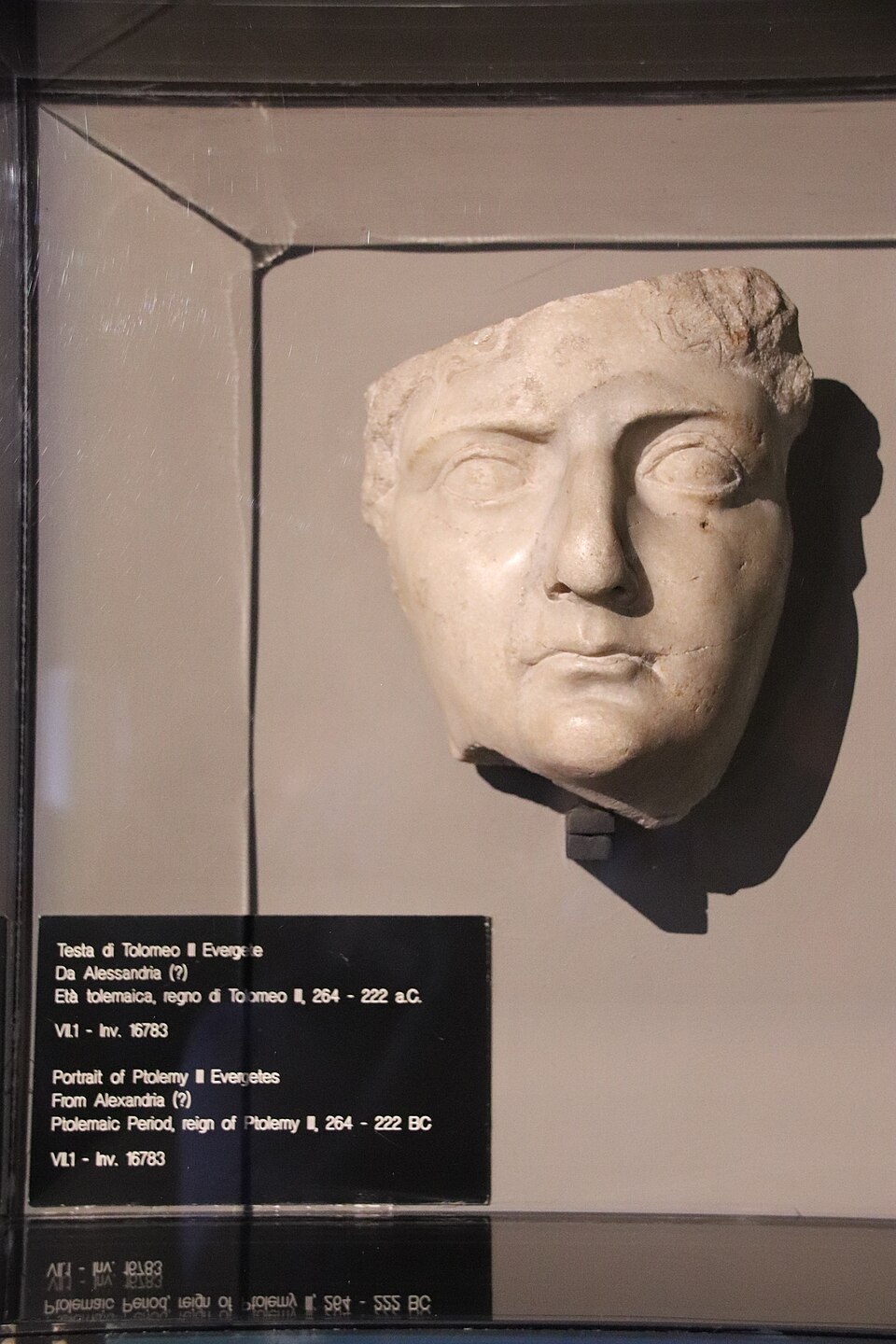
Photo: Gary Todd, public domain (Wikimedia Commons); reproduced unmodified.
Two curiosities of the reign put Euergetes in the sky and in the calendar. When the king marched east in 246 BC, his queen Berenice II vowed a lock of her hair for his safe return and dedicated it in a temple; the lock vanished, and the court astronomer Conon announced that it had been carried up among the stars — the faint sprinkle between Leo and Boötes still called Coma Berenices, “Berenice’s Hair.” Callimachus turned the episode into a court poem whose Latin translation by Catullus (poem 66) preserves it. And in 238 BC a synod of Egyptian priests at Canopus, decreeing honors for the royal pair, ordered among much else that a sixth epagomenal day be added to the Egyptian year every fourth year — the first known legislated leap day, two centuries before Julius Caesar’s Alexandrian astronomers made the idea stick in Rome. Coinage, calendar, and constellation: the big bronzes belong to the same confident machine of a kingdom, all of it managed from the palace quarter of Alexandria.
The tag on this coin is a little museum of attribution history: every older reference it cites — SNG Copenhagen 229, Noeske 161, Hosking 44, Weiser 92 — assigns the type to Ptolemy IV Philopator, while Forum’s listing follows Catharine Lorber’s Coins of the Ptolemaic Empire (2018), which reassigned the series to Ptolemy III as CPE B371, c. 246–230 BC. The reshuffling of the big Zeus-Ammon bronzes between the third-century reigns is one of the main results of Lorber’s corpus, built on hoards, overstrikes, and die studies; this page follows CPE while preserving the Ptolemy IV references for anyone searching the older literature. A small residual: the tag reads the control between the eagle’s legs as E (Svoronos 974 var), Forum’s current listing as an EP monogram — worth checking against the coin in hand.
Attribution: C. C. Lorber, Coins of the Ptolemaic Empire (ANS, 2018), no. B371; J. Svoronos, Ta Nomismata tou Kratous ton Ptolemaion (1904–08), no. 974; the superseded Ptolemy IV references as on the dealer’s tag (SNG Copenhagen 229, Noeske 161, Hosking 44, Weiser 92). The closed Ptolemaic monetary system and the bronze coinage: Lorber, CPE, introduction; D. Wolf’s PtolemAE Project (ptolemybronze.com) for the bronze series framework. Historical frame: the Third Syrian War per the dealer’s description; Daniel 11:7–9 for the biblical allusion. The lock of Berenice: Callimachus, Aetia fr. 110, with Catullus 66; the leap-day reform: the Canopus decree of 238 BC (OGIS 56); the war memorial of the eastern campaign: the Adulis inscription (OGIS 54).
The reference list below is the standing Ptolemaic bibliography that Forum Ancient Coins prints on its Ptolemaic listings, captured from this coin’s listing (GP76551) — a useful working library for the series, beyond the specific references cited above.
A giant of a coin: this specimen 42.814 g and 37.5 mm (dealer data). The paired dimples at the centers of both faces are CENTRATION DIMPLES from the lathe used to face the cast flans — a normal feature of Ptolemaic bronze manufacture, not damage. Denomination naming for the big Ptolemaic bronzes is conventional; Forum (following Lorber's system) calls this module a bronze hemidrachm. ATTRIBUTION HISTORY: the older catalogues on the tag (SNG Cop, Weiser, Noeske, Hosking) place the type under Ptolemy IV; Lorber (CPE, 2018) reassigns it to Ptolemy III, c. 246–230 BC — keep the old references searchable under Ptolemy IV.
John's Ancient Coin Collection · Type · ptolemy-iii-zeus-ammon-eagle-bronze
Image credits for this coin — photographs, maps and graphics used on this page

,_284-222_BC_(48464996766).jpg)