Type · caesar-elephant-denarius
Current: Roman Imperatorial, Julius Caesar, AR denarius, military mint traveling with Caesar, 49–48 BC (Crawford 443/1)
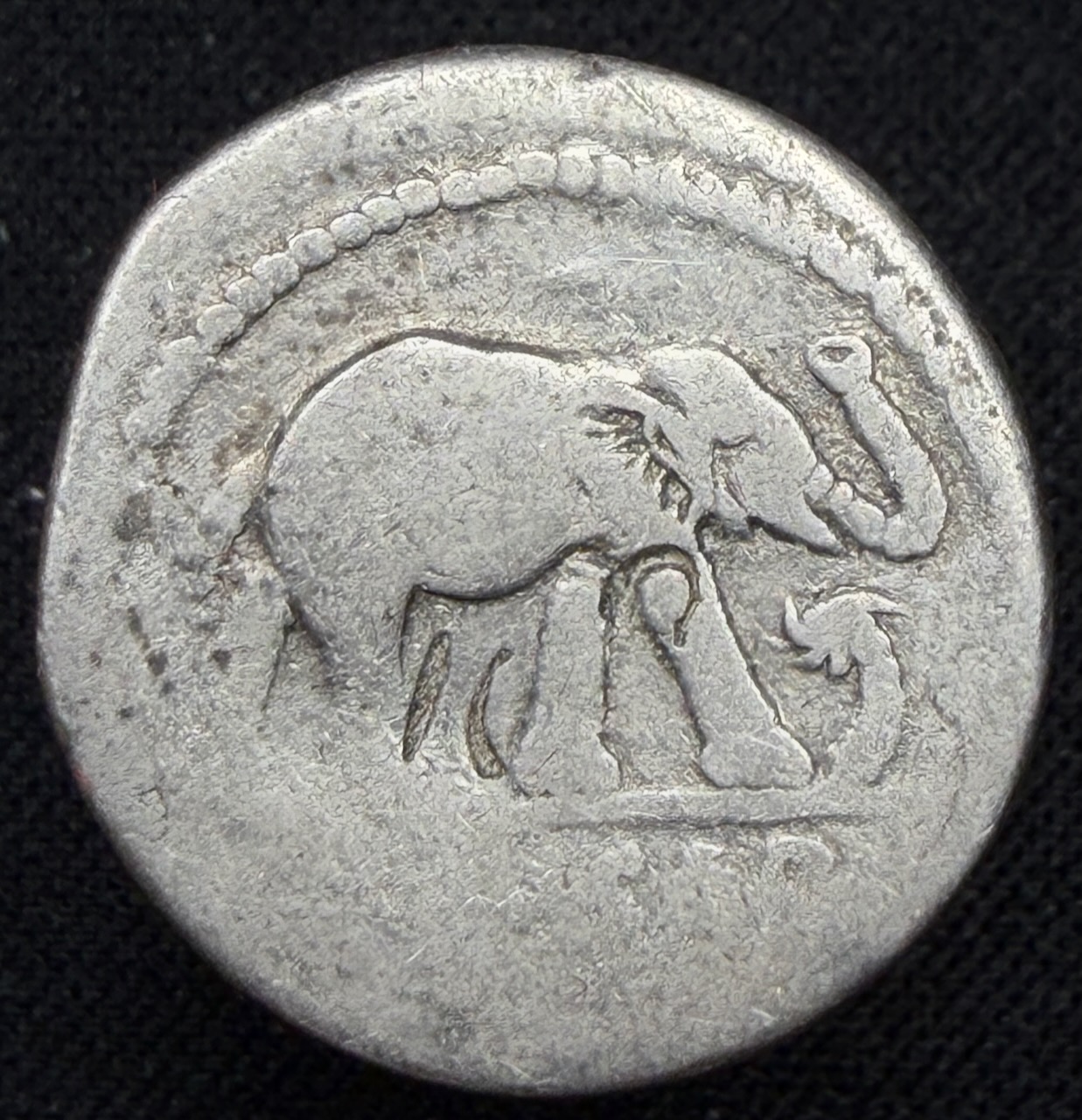
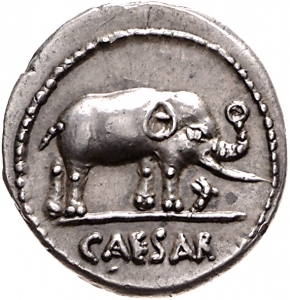
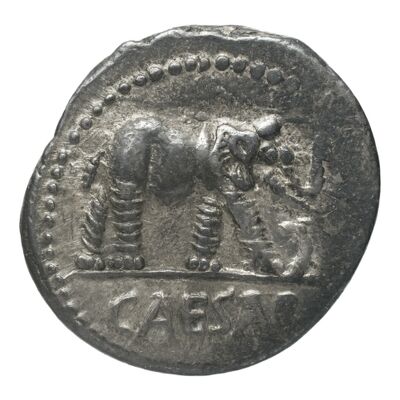
Obverse: Elephant advancing right, trampling on a horned serpent (or dragon-headed Gallic war-trumpet, a carnyx); CAESAR in exergue
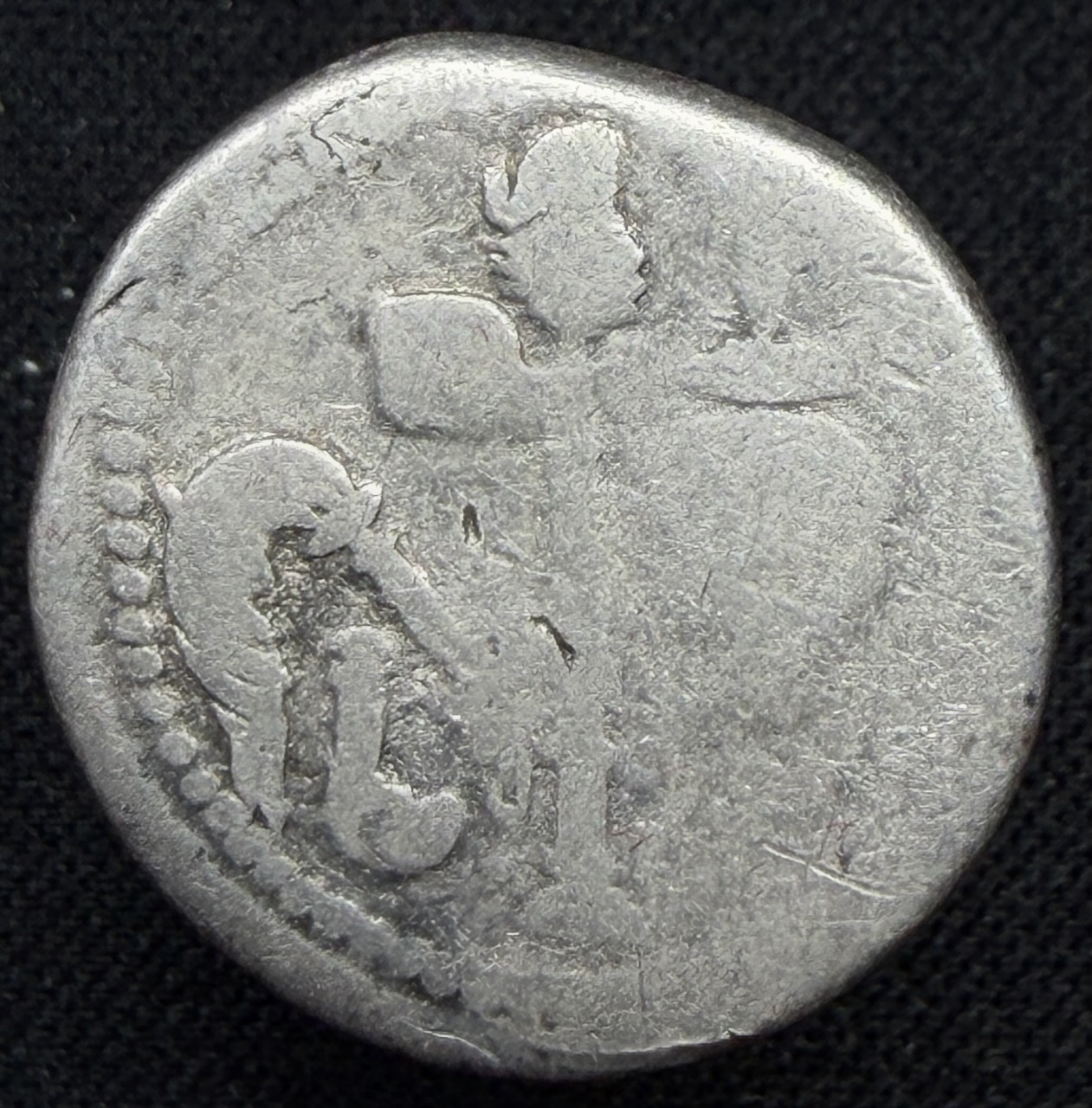
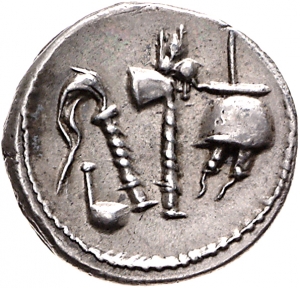
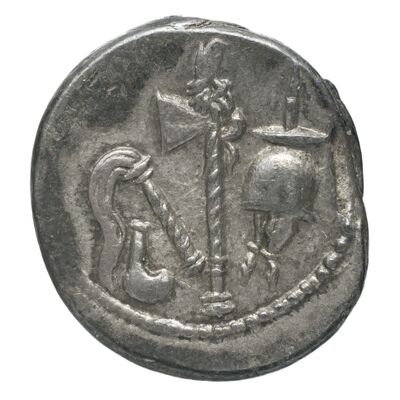
Reverse: Priestly emblems: culullus (libation cup, or simpulum), aspergillum, sacena (pontifical sacrificial axe), and apex (spiked priestly cap — whose office it marks is debated; see Deeper dive)
Primary reference: Crawford 443/1
241 specimens in public collections (BnF 113, ANS 24, Fitzwilliam 24, British Museum 17, Berlin 9); weights 2.1–4.29 g, median 3.85 g across 152 recorded; die axis most often 0h; recorded in hoards CHRR 1PO, CHRR AGN, CHRR ALA, CHRR ALL, CHRR ALV, CHRR ANA, CHRR AQU, CHRR ARB and 98 more.
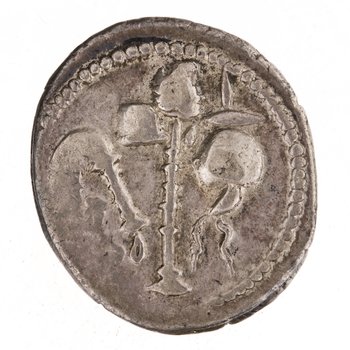
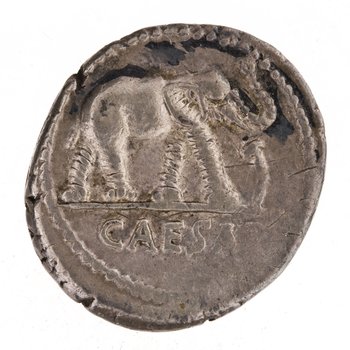
American Numismatic Society, 1908.89.17. CC BY-NC 4.0. https://numismatics.org/collection/1908.89.17
Münzkabinett, Staatliche Museen zu Berlin, 18202168. CC BY-NC-SA 4.0. https://ikmk.smb.museum/object?id=18202168
Bibliothèque nationale de France (Gallica), REP-13065. non-commercial reuse permitted. https://gallica.bnf.fr/ark:/12148/btv1b10435553q
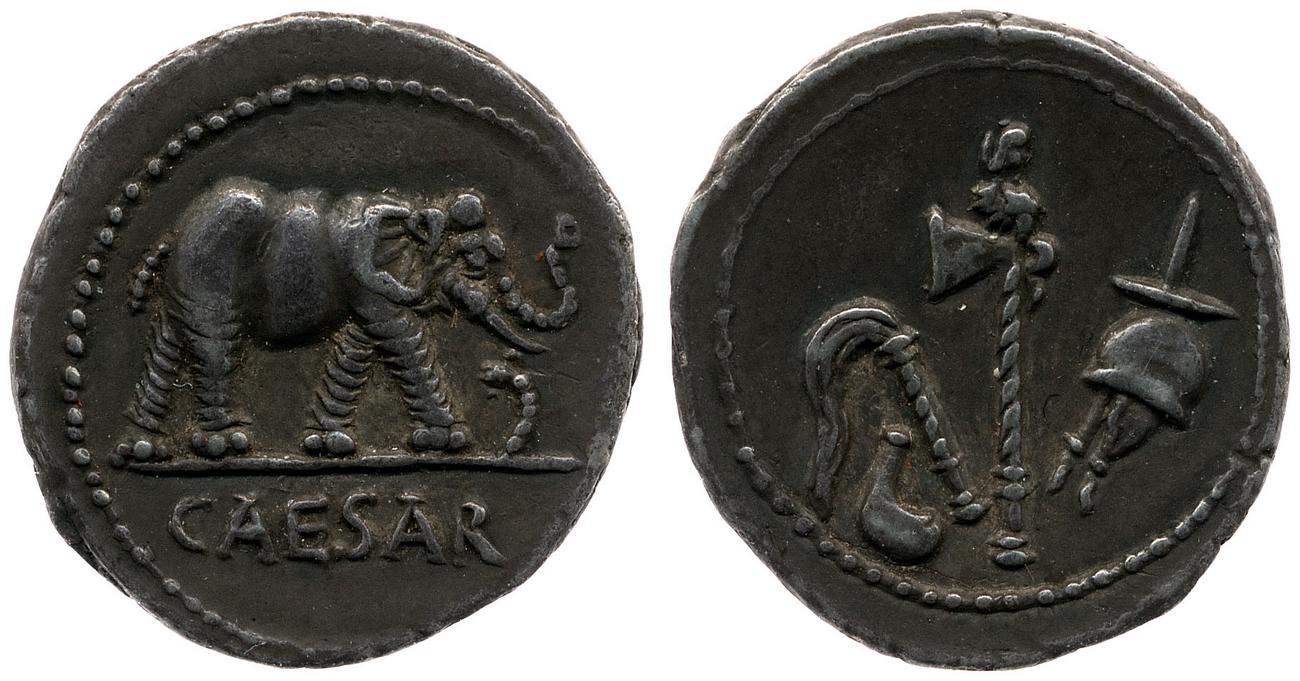
© The Trustees of the British Museum, 1843,0116.653. CC BY-NC-SA 4.0. https://www.britishmuseum.org/collection/object/C_1843-0116-653
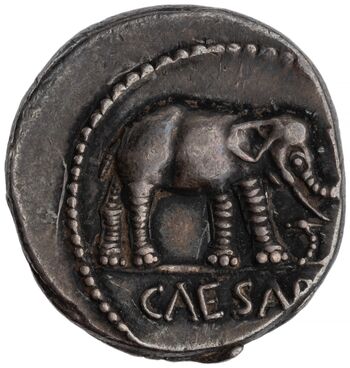
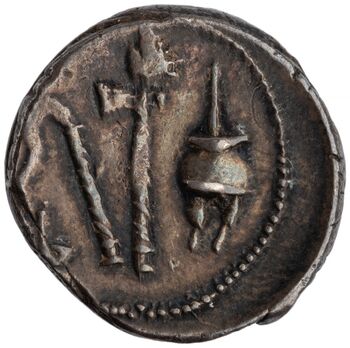
American Numismatic Society, 1922.40.2. CC BY-NC 4.0. https://numismatics.org/collection/1922.40.2
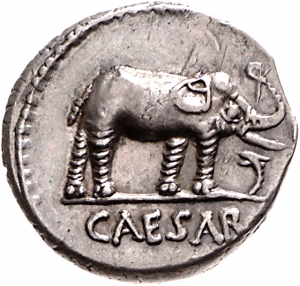
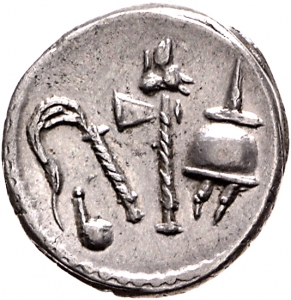
Münzkabinett, Staatliche Museen zu Berlin, 18202169. CC BY-NC-SA 4.0. https://ikmk.smb.museum/object?id=18202169
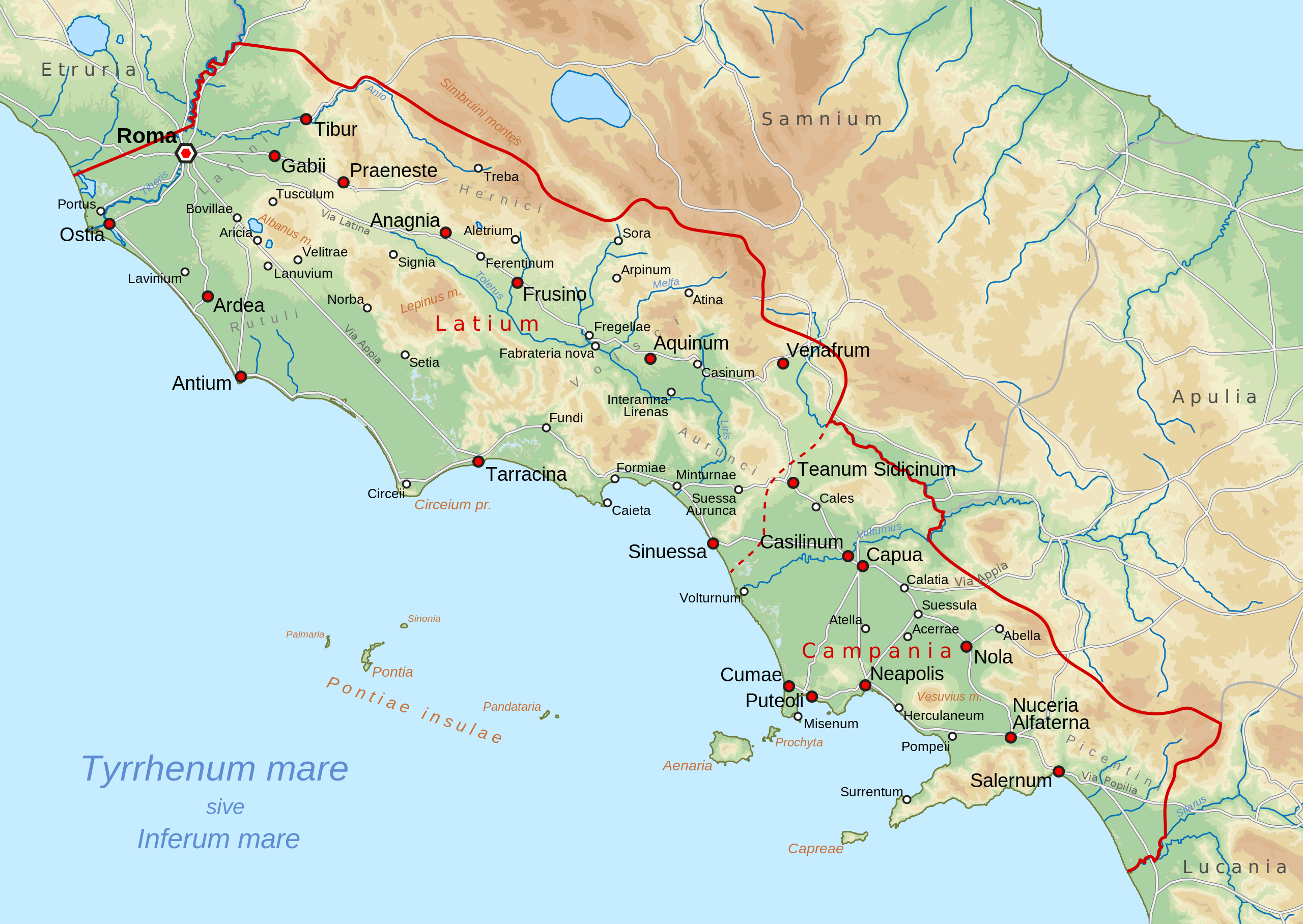
Regio I, Latium et Campania — the heartland of Roman Italy as organized under Augustus. Roma sits at the upper left, marked by the map’s hexagonal capital symbol and bold label. The issue is catalogued as a military mint moving with Caesar; the treasury silver behind it was seized at Rome in April 49 BC (see notes — the mint is a best guess).
“Map of Augustan Regio I Latium et Campania” by Tomisti (Wikimedia Commons), File:Regio I Latium et Campania map.svg, licensed CC BY-SA 4.0; cities and roads based on the Digital Atlas of the Roman Empire (DARE) and Pleiades; topographic base © OpenMapTiles, © OpenStreetMap contributors. Rasterized from SVG to PNG; otherwise reproduced unmodified (Roma already carries the base map’s capital marker).
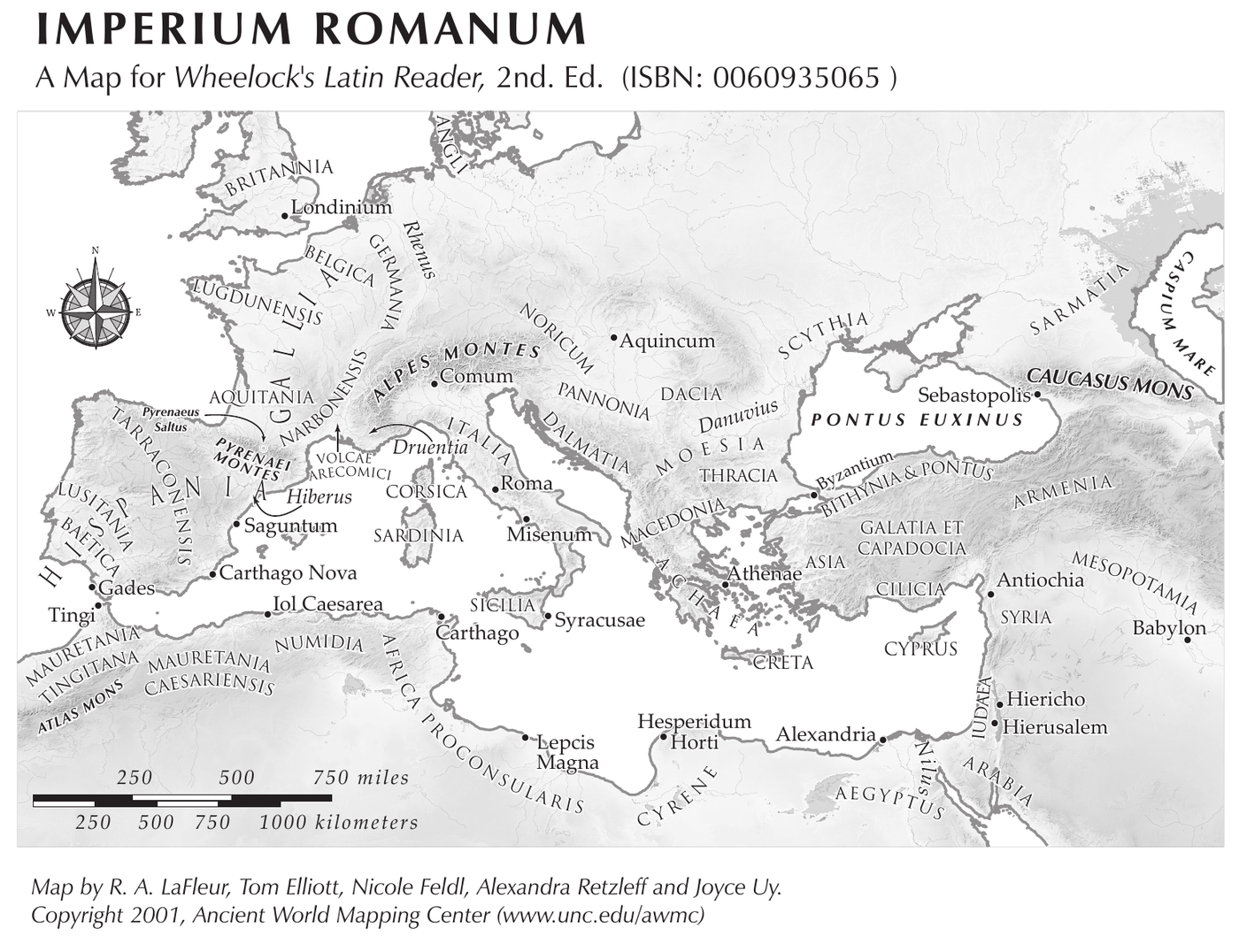
Roma sits at the center of Italia. Struck in 49–48 BC by a moving mint, for an army that crossed from Gallia into Italia, went the length of the peninsula, and then over the Adriatic into Achaea — the whole width of the western half of this map in under a year.
This is the first coin Julius Caesar ever struck in his own name — and he struck it in defiance of every convention of the Republic. In January 49 BC Caesar crossed the Rubicon; by April he had taken Rome and, over the tribune’s veto, broken open the state treasury in the temple of Saturn. The silver that flooded out became one of the largest coinages the Republic had ever seen (Crawford counted upwards of 750 obverse dies), struck by a mint that moved with the army and signed not by a moneyer, not by the Senate’s authority, but with a single word in the exergue: CAESAR. A general’s name as the whole guarantee of the coin — the denarius of a man who was about to make himself the state.
Graphic: JSB Coins, 2026 (CC0).
The elephant face shows the animal striding right over an object at its feet, and almost everything about the image is honestly disputed. Crawford read the object as a serpent and the scene as “victory over evil”; older numismatic literature connected the elephant to the Gallic conquests, and a version of that reading popular in the trade sees the trampled object as a carnyx, the dragon-headed Gallic war-trumpet. Ancient etymology (reported in the Historia Augusta and Servius) claimed “caesai” was a Punic/Moorish word for elephant, making the animal a pun on the general’s name — a folk etymology, but one Caesar’s contemporaries could conceivably have known. The fullest modern study, Debra Nousek’s 2008 Phoenix article (read in full for this page), rejects all three readings and argues something sharper: the elephant was the famous family badge of the Caecilii Metelli — the family of Pompey’s new father-in-law and of the very tribune who tried to bar Caesar from the treasury — and the snake is the elephant’s proverbial natural enemy, caught rearing to strike with the outcome, like the civil war’s, still undecided. The full argument, and what each reading has going for it, is set out in the Deeper dive below.
The other face answers the war-image with religion: a libation cup (culullus), sprinkler (aspergillum), the pontifical sacrificial axe (sacena), and the spiked priestly cap (apex). Caesar had been chief priest of Rome since 63 BC, and the panoply reminded every user that the man whose name stood on the other side was no rebel but the head of the state religion. The traditional reading takes all four emblems as the kit of the pontifex maximus — but the apex is a genuine puzzle, since pontiffs did not wear one, and Meghan DiLuzio has argued (AJP 2018, read in full for this page) that it points instead to a nearly invisible priesthood Caesar held: the salii, Mars’ leaping priests. See the Deeper dive. Either way, war and piety, one on each face, was precisely the double claim on which Caesar fought the civil war. His heirs learned the language: a generation later Antony’s legionary denarii — including the LEG X issue naming the successor of Caesar’s own beloved Tenth Legion — ran the same formula of military symbol plus scrupulously traditional titles. The war this coin opened also carried Caesar, by way of Pharsalus, to Alexandria and to Cleopatra VII, whose Cypriot silver is in this collection — the alliance that outlived him and set the stage for the last act at Actium.
The elephant denarius carries no portrait — that taboo Caesar broke only in the last months of his life, in 44 BC, when his profile went onto the denarius and helped get him killed. For the face of the man of 49 there is one sculpture with a serious claim to be contemporary: the “Tusculum portrait,” excavated at Tusculum in 1825 by Lucien Bonaparte and now in the Museo di Antichità in Turin. Generally dated to Caesar’s lifetime or immediately after, it matches the lean, long-necked, hollow-cheeked profile of the 44 BC coin portraits — an unidealized middle-aged face, closer to the man who signed this coin with a word than any marble made for his heirs’ propaganda.
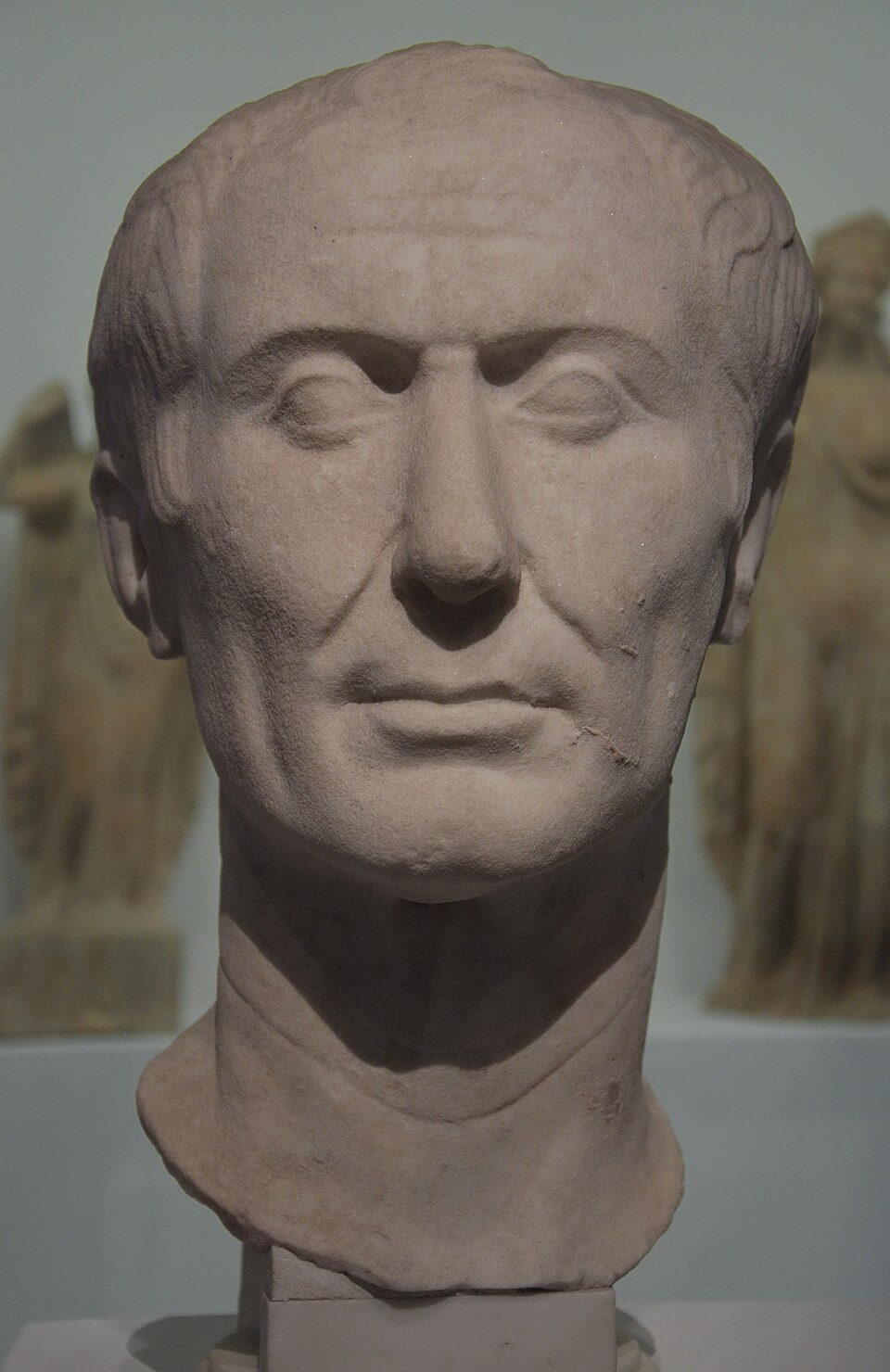
Photo: Carole Raddato (“Following Hadrian”), CC BY-SA 2.0 (Wikimedia Commons); reproduced unmodified.
The elephant denarius paid the army that won at Ilerda and Pharsalus; it circulated for decades and survives in quantity, which makes it the most accessible coin of the man himself. Numismatically it marks the moment the Republic’s money became a dynast’s: within five years Caesar’s portrait would be on the denarius, and within twenty the coinage would belong to emperors. This collection’s Roman arc runs straight through it — from the anonymous denarius of the impersonal Republic to CAESAR written plain, and on to Actium and Augustus. Actium’s own coinage closes the sequence: Octavian’s rostral-column denarius, struck by Caesar’s heir in the months the Republic finally stopped pretending. The road’s other end is here too: the Victory biga denarius of M. Porcius Cato, struck by a young moneyer for whom the point was getting the family name into every purse in Italy — the ordinary ambition that, by 49 BC, a single name in the exergue had swallowed whole.
This section digests two full scholarly articles held in this type’s reference library: Debra L. Nousek, “Turning Points in Roman History: The Case of Caesar’s Elephant Denarius,” Phoenix 62.3/4 (2008) 290–307, and Meghan J. DiLuzio, “Caesar as Salius: A Reconsideration of the Apex on Caesar’s Elephant Denarius (RRC 443/1),” AJP 139.2 (2018) 249–276.
Which side is the obverse? Even this is argued. Babelon, Grueber, Sydenham and Sear — and most dealers, this page included — call the elephant face the obverse; Crawford lists it as the reverse. Nousek sides with Crawford on a neat technical ground: legends on Republican obverses run vertical, horizontal or curved, but “there is no example of a strict exergue, with the traditional horizontal line as divider, on the obverse of a republican coin” — and CAESAR sits in a ruled exergue (Nousek 290–1 n. 3; quoted with approval by DiLuzio 249 n. 1).
Date and scale. Sydenham put the issue in 54–51 BC among the coinages of Gaul; Grueber chose 50; Crawford’s 49–48 BC now stands essentially unchallenged, clinched by the San Giuliano hoard (discovered 1964, too late for the older catalogues), where this is Caesar’s only military issue present (Nousek 291 nn. 2, 7). The size is staggering: Crawford’s estimate of c. 750 obverse dies makes it the third-largest issue in the entire Republican series — behind only the Social War emergency coinages of Piso and Vibius Pansa, a telling parallel, since those too paid huge armies in a civil crisis — implying on standard assumptions some 22.5 million denarii, roughly 2,500 talents of silver (Nousek 293 nn. 17–18). Nousek argues the bullion is best identified with the aerarium sanctius Caesar broke open on 1 April 49 (the sources report 15,000 gold bars, 30,000 of silver): if Caesar had been sitting on Gallic booty sufficient for such a coinage, she asks, why force a public confrontation with a tribune over the treasury at all (293–4 nn. 20–21)?
The elephant: four readings. (1) The old Gallic-victory reading (the elephant recalls the conquest of Gaul, on some versions trampling a carnyx) descends from the catalogues that dated the issue to the 50s and grouped it with Gaul; it loses most of its force once the date moves to 49. (2) The etymological reading — “caesai” as Punic/Moorish for elephant, per Historia Augusta Aelius 2.3 and Servius on Aeneid 1.286 — is rejected by Nousek as a late folk etymology, too recondite for a coin’s mass audience, unsupported by any other elephant-ancestor allusion in Caesar’s coinage, and fatally undercut by the bronze imitation of this very type struck by Caesar’s legate Hirtius with HIRTIVS in place of CAESAR: the image evidently was not tied to the name (296–8, n. 35). (3) Crawford’s victory over evil she dismisses in a word as anachronistic (291). (4) Her own case: the elephant was the hereditary badge of the Caecilii Metelli, paraded since L. Metellus captured some 140 Punic elephants at Panormus in 251 BC and stamped on at least six Metellan issues. In 49 the family stood at the center of the opposition — Metellus Scipio was Pompey’s father-in-law and the war party’s stiffest voice, and it was a tribune L. Metellus who physically barred Caesar’s way into the treasury that paid for these very coins. Caesar, she argues, seized his enemies’ emblem and turned it: his elephant faces right where the Metellan elephants face left, and it simultaneously mocks Pompey’s Alexander-style elephant pretensions (the botched elephant-quadriga triumph of 81; the crowd-sickening elephant show of 55) and the ancestral elephant procession of L. Domitius Ahenobarbus’ grandfather through conquered Gaul (299–301). She finds a precedent for such iconographic theft in the Social War, when the Italian allies re-struck Roman types with Italia in Roma’s place (302).
The snake. On Nousek’s reading the trampled creature is exactly what it looks like: a serpent, the elephant’s proverbial natural enemy. Pliny (HN 8.32–34) describes their perpetua discordia — the python that rears to strike at the elephant’s eyes, and a struggle that regularly kills both combatants. The coin freezes the moment before contact: the outcome, like the civil war’s in early 49, is formally undecided, though no viewer of the composition — the elephant huge and central, CAESAR beneath — could doubt how Caesar expected it to end. She allows the grimmer overtone that in Pliny’s telling victory is mutually ruinous: an apt image for civil war (303–4). Older alternatives (Juno Sospita’s snake, a Ceres-cult serpent) she reviews and finds uncompelling (302–3).
The apex: whose cap is it? The traditional account calls all four ritual objects the kit of the pontifex maximus. DiLuzio’s article is a sustained challenge on one point: the apex — the leather skullcap with olive-wood spike — was never pontifical. Wissowa noticed a century ago that pontiffs did not wear it; DiLuzio shows that no coin before Caesar’s death pairs an apex with the pontificate, while pontifical issues (Sulpicius Galba’s, Pupius Piso’s, Lepidus’) consistently show cups, knives, axes and dishes without it — and that Caesar’s own AVGVR PONT MAX issue of 46 BC (RRC 467) shows pontifical and augural implements but no apex (253–8). In the visual record the pontifex maximus is marked instead by the veiled head (capite velato) — as on Caesar’s own portrait denarii of 44 and on every emperor after him; no emperor is ever shown in an apex (258–9). The apex belongs overwhelmingly to the flamines (it is their insigne in Livy and on the coins of the Fabii, Postumii and Valerii) — and to one other priesthood: the salii, the leaping warrior-priests of Mars who danced through the city each March and October carrying the sky-fallen shields (ancilia). Since Caesar was only ever flamen Dialis designate (stripped by Sulla before inauguration), DiLuzio argues the apex most likely advertises Caesar as a salius — a patrician priesthood he would have entered as a youth, corroborated by the ancile on his quinarius of 48/47 (RRC 452/3, the coin that led Crawford and Rüpke to the same suspicion) — and she reads the apex-and-tripod quinarius of Brutus, of all people, the same way (259–67). On this account the elephant denarius names three sanctities: pontifical cup, sprinkler and axe; salian cap; and the auctoritas of the name below the elephant. The pax deorum, the coin says, travels with Caesar (271–2).
After the Ides. DiLuzio’s coda explains how the traditional reading arose: Caesar’s heirs made it true retroactively. Lepidus reproduced this coin’s emblem-face wholesale on his joint issue with Antony in 43 BC to advertise his (irregular) succession as pontifex maximus; Domitius Calvinus did the same at Osca in 39; only then did the apex begin to mean “pontifex maximus” — an association born of Caesarian legacy-claiming, not Republican practice (267–71). The elephant denarius thus shaped the iconography of the next generation twice over: its types were the things to copy precisely because they were understood as Caesar’s own.
Where this leaves the type page: the date (49 BC), the treasury silver, and the coin’s basic message — legitimacy through religion, confidence through the elephant — are on firm ground. The elephant’s precise referent (Metellan badge, Gallic trophy, name-pun, or several at once) and the apex’s office (pontifical convention vs DiLuzio’s salius) remain live questions, and this page presents them as such.
Attribution: M. H. Crawford, Roman Republican Coinage (1974), 443/1 (mint moving with Caesar, 49–48 BC; die estimate); Sear, CRI 9; Sydenham 1006. Read in full for this page (see Deeper dive): D. L. Nousek, “Turning Points in Roman History: The Case of Caesar’s Elephant Denarius,” Phoenix 62 (2008) 290–307 (dating, die count, treasury silver, Metellan-badge and Pliny-serpent readings), and M. J. DiLuzio, “Caesar as Salius,” AJP 139 (2018) 249–276 (the apex question). The elephant-name etymology: Historia Augusta, Aelius 2.3; Servius on Aeneid 1.286. The treasury seizure: Caesar, BC 1.33; Plutarch, Caesar 35 (linked in the references); Cassius Dio 41.17; Pliny, HN 33.56. The Tusculum portrait: Museo di Antichità, Turin. The elephant-serpent enmity: Pliny, HN 8.32–34.
MINT IS A BEST GUESS (Rome): Crawford catalogues the issue as a military mint traveling with Caesar, 49–48 BC; the output is widely connected to the bullion Caesar seized from the aerarium at Rome in April 49 BC (Nousek 2008, 293–4), and no single city can be pinned. One of the largest denarius issues of the Republic: c. 750 obverse dies, the third-largest of the whole series (Nousek 2008, 293). Which face is the obverse is itself contested: dealers and older catalogues (Babelon, Grueber, Sydenham, Sear) call the elephant face the obverse, as this page does; Crawford and Nousek make it the reverse, since no Republican coin carries a true exergue on an obverse (Nousek 2008, 290–1 n. 3). The elephant's meaning and the identity of the trampled object are genuinely contested — see the essay and Deeper dive.
John's Ancient Coin Collection · Type · caesar-elephant-denarius
Image credits for this coin — photographs, maps and graphics used on this page