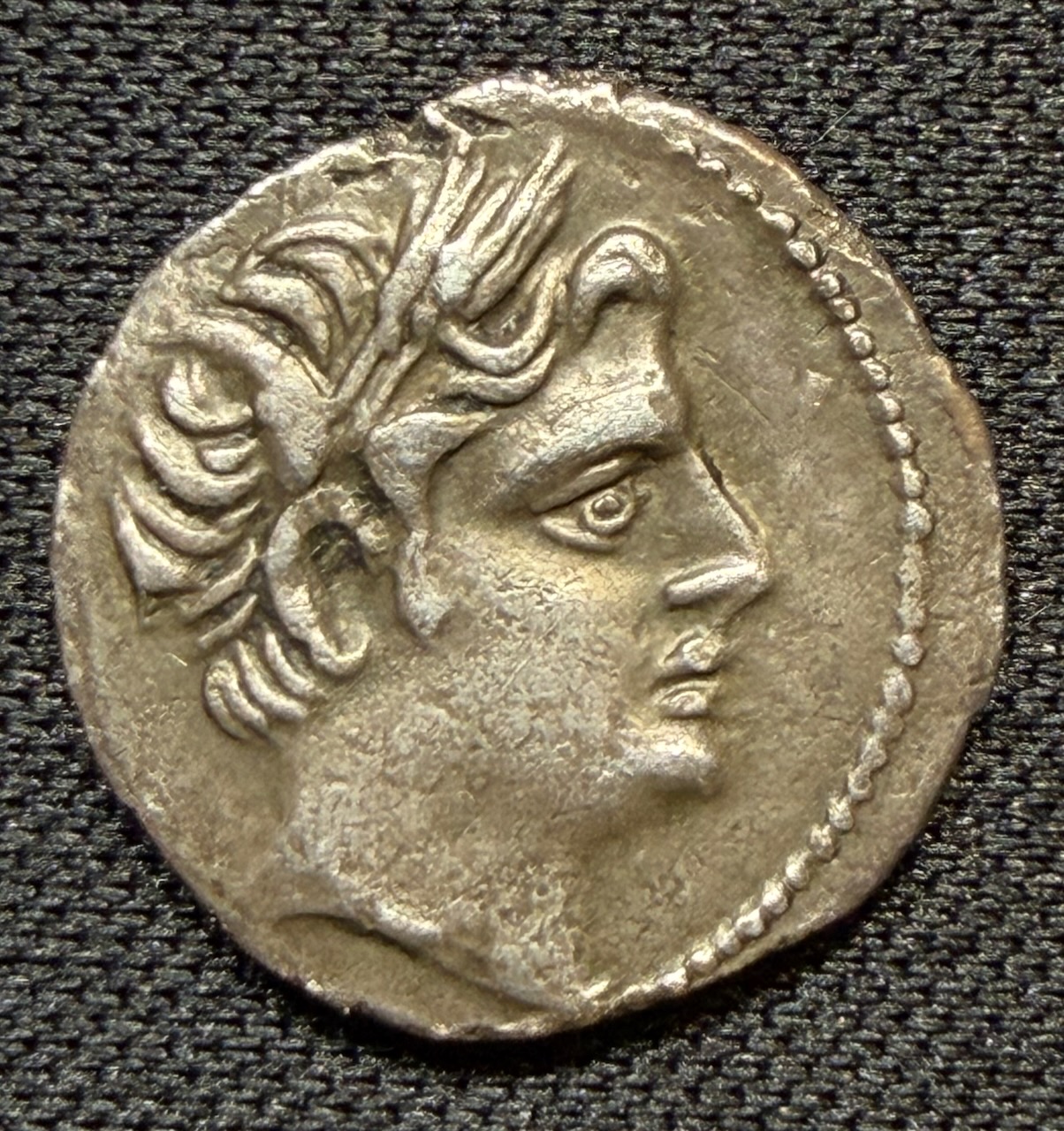
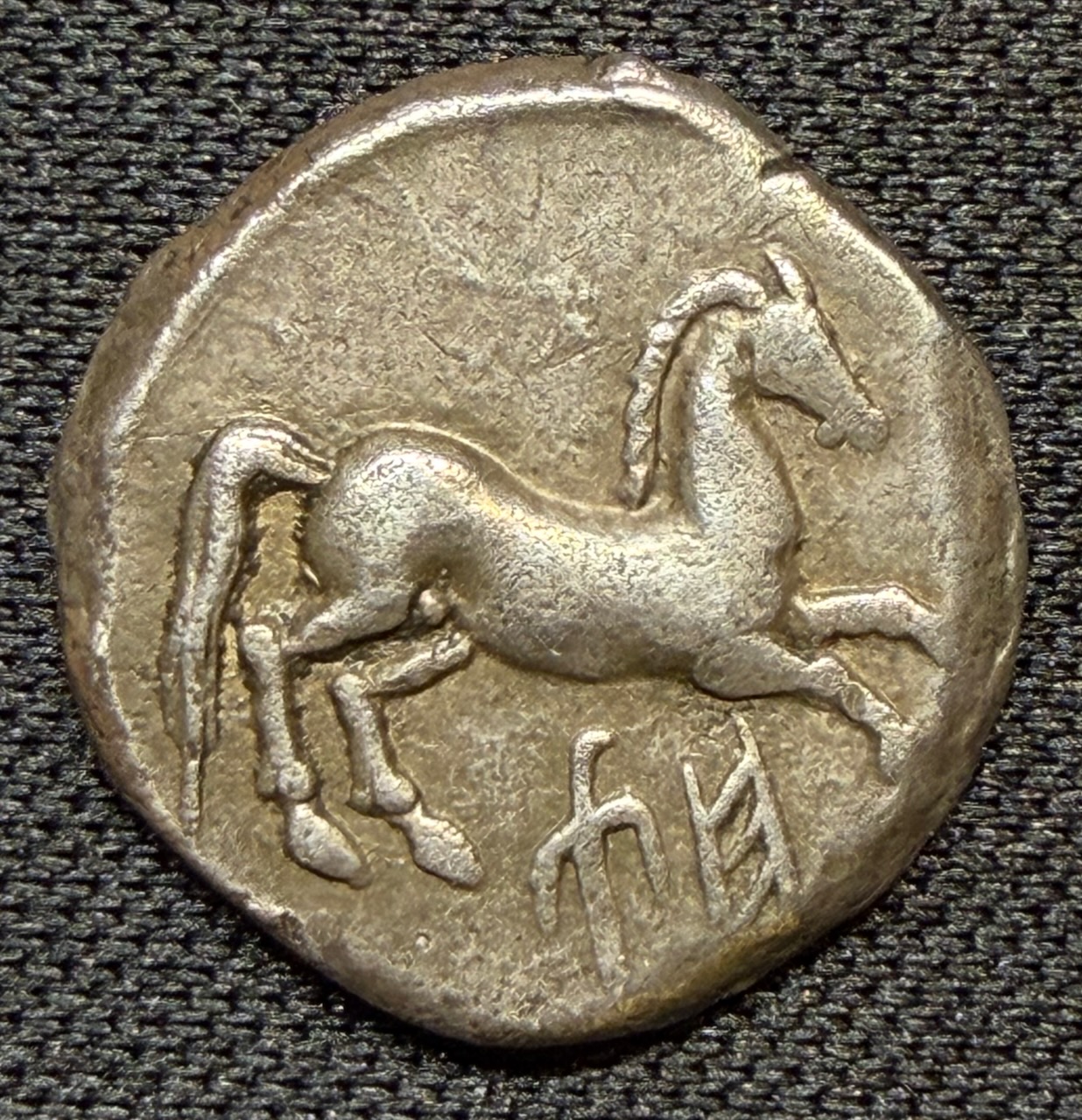
Type · akragas-punic-quarter-shekel
Current: Sicily, Akragas (Agrigentum), Carthaginian (Punic) occupation, AR quarter-shekel, c. 213–211 BC (HGC 2, 173)
Superseded: Numidia, Hiempsal II, AR quinarius, c. 105/62 BC (Mazard 80 R³; Müller III, 38/47)
Obverse: Wreathed head of Triptolemos right (grain wreath; deity of the Demeter/Kore cult of Akragas)
Reverse: Free horse right, one foreleg raised; Punic letters ḥt in exergue
Primary reference: HGC 2, 173
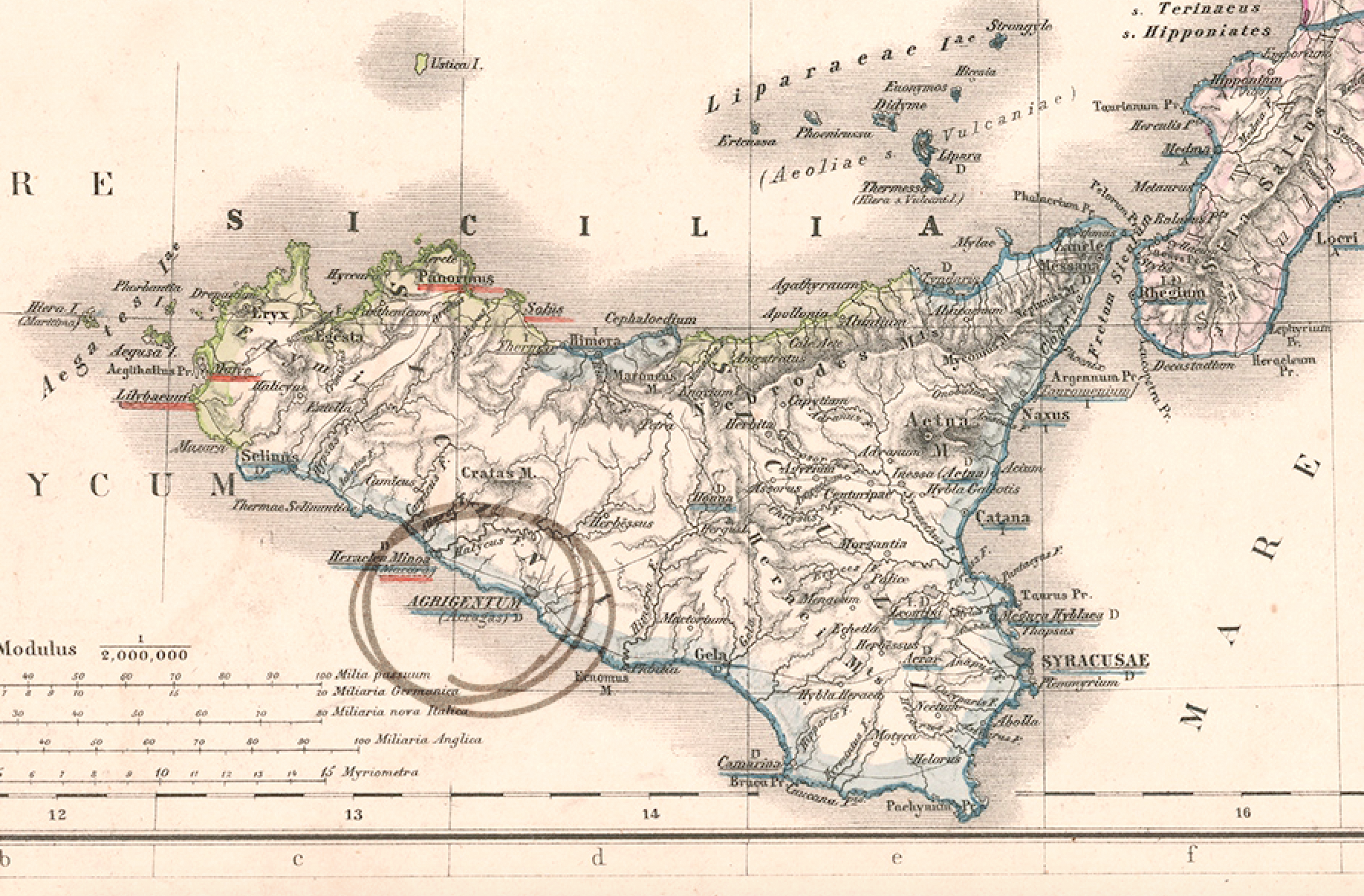
Sicily under the Roman Republic, c. 200 BC. Akragas — circled — appears under its later Roman name Agrigentum. By the date of this map the city had been retaken by Rome (210 BC), only a year or two after this quarter-shekel was struck under Carthaginian occupation. The map illustrates the geography of the brief Punic command at Akragas during the Second Punic War rather than the political situation contemporary with the coin itself.
This quarter-shekel is emergency military silver, struck to pay the last Carthaginian army in Sicily during one of the most dramatic reversals of the Second Punic War. In fewer than three years, the coin passed from the mint to the paymaster to the defeated — Carthage’s hold on Sicily ended within months of its striking.
The city that struck this coin was already four centuries old, and had been famous for most of them. Akragas was founded c. 580 BC by colonists from Gela (themselves of Rhodian and Cretan stock) on a ridge between two rivers, three kilometers back from Sicily’s southern coast. Under its early tyrant Phalaris — whose bronze bull, in which he was said to roast his enemies, made him a byword for cruelty — and then under Theron (488–472 BC), the city grew into one of the two great powers of Greek Sicily. In 480 BC Theron and his son-in-law Gelon of Syracuse crushed the Carthaginian invasion at Himera, a victory the Greeks ranked beside Salamis; the same battle, seen from the victors’ mint, opens the story of this collection’s Gelon-era tetradrachm of Syracuse. The spoils of Himera and the wealth of its grain lands built the ridge of Doric temples that still stands above the modern town — Pindar called Akragas “most beautiful of mortal cities,” and a saying attributed to its philosopher Empedocles held that the Akragantines feasted as if they would die tomorrow, and built as if they would live forever.
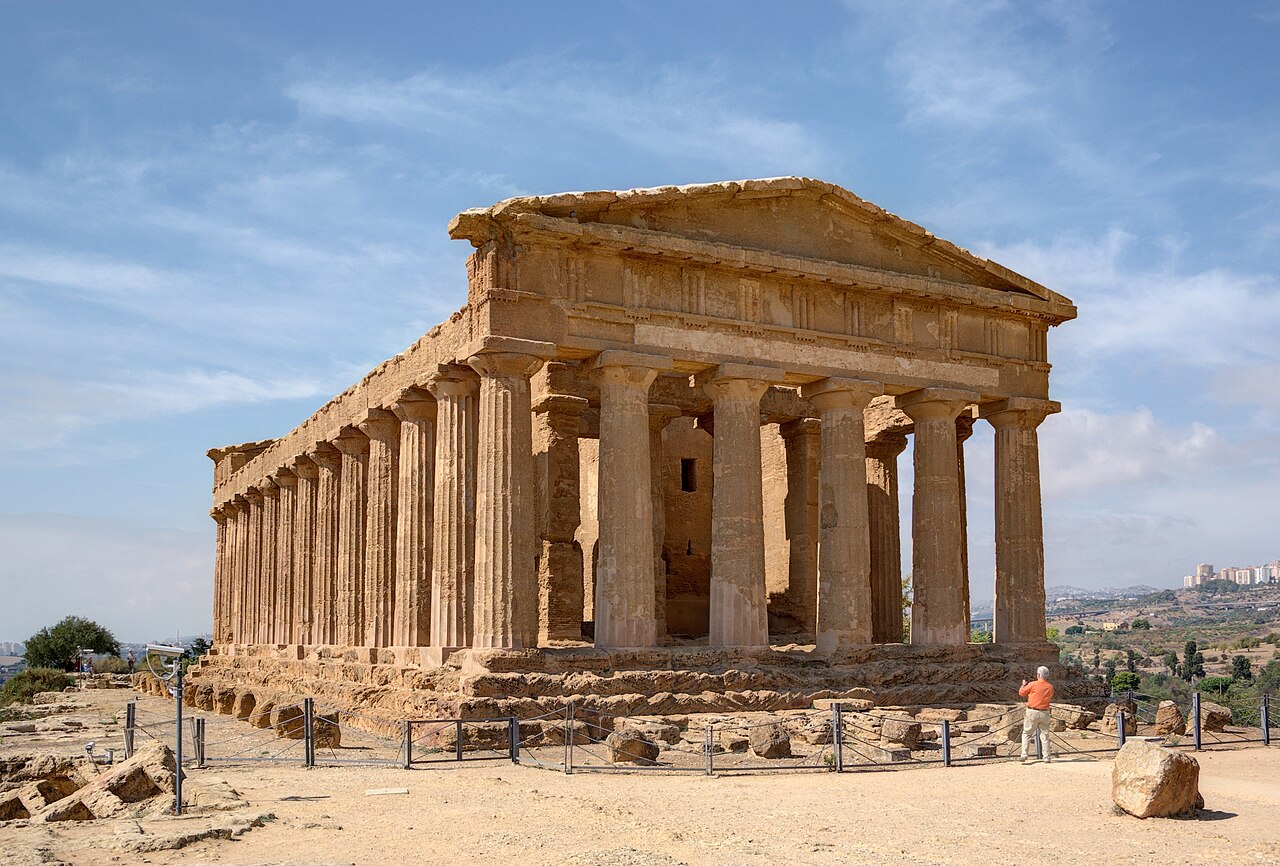
Photo: Berthold Werner, Wikimedia Commons, licensed CC BY-SA 3.0, reproduced unmodified.
The good years ended abruptly. In 406 BC a Carthaginian army under Himilco sacked the city after an eight-month siege; Akragas revived under Timoleon in the 330s but never regained its fifth-century rank. Then came Rome. In 262 BC, in the first great land campaign of the First Punic War, the Romans besieged and stormed Agrigentum (as they called it), enslaving some 25,000 of its people; in 255 BC a Carthaginian force retook and burned it. By the Second Punic War the city on the ridge was a strategic prize with a long habit of changing hands — which is exactly what it did, one last time, in the years this coin was struck.
Rome seized Sicily from Carthage in the First Punic War (264–241 BC), making it Rome’s first overseas province. Sicily remained contested territory: a patchwork of Roman allies, nominally independent Greek cities, and Carthaginian sympathizers. When Hannibal crossed the Alps in 218 BC and began his devastating march through Italy, several Sicilian cities reconsidered their allegiances.
The critical turning point came in 215 BC, when Hiero II of Syracuse — Rome’s most reliable Sicilian ally — died. His grandson Hieronymus reversed course toward Carthage. After Hieronymus was assassinated, Syracuse formally allied with Carthage, triggering a Roman military response. The consul Marcus Claudius Marcellus began the siege of Syracuse in 213 BC. The city fell in 212 BC, its fall memorably shadowed by the death of Archimedes during the Roman sack. Meanwhile Carthage had landed an army of its own: in 213 BC Himilco disembarked at Heraclea Minoa with 25,000 infantry, 3,000 cavalry and 12 elephants (Livy 24.35), seized Agrigentum, and made it the Carthaginian headquarters on the island.
After Syracuse fell, Carthaginian forces withdrew west and consolidated at Akragas, which became the headquarters of Punic resistance in Sicily. The dominant figure there was Muttines (Mottones), a Libyphoenician cavalry commander from Hippou Acra trained under Hannibal, sent over from Italy in 211 BC with 3,000 Numidian horsemen and 8,000 infantry (Livy 26.21). He deployed Numidian light cavalry in devastating raids across the Roman province — Livy has him and his Numidians “roaming all through the island and laying waste the fields of Rome’s allies” — and even the Carthaginian commander-in-chief, Livy admits, rested all his hopes on him. Those riders had to be paid in Punic-standard coin — and it was at Akragas, in those final months, that this quarter-shekel was struck.
The coin’s hybrid character captures the moment exactly. Triptolemos on the obverse is the Greek civic deity of grain-rich Akragas (though the identification of the grain-wreathed head is not unanimous — part of the scholarship reads it as Apollo). The free horse on the reverse is the Punic military badge. One side honors the Greek polis whose mint produced the silver; the other names the Carthaginian army it paid.
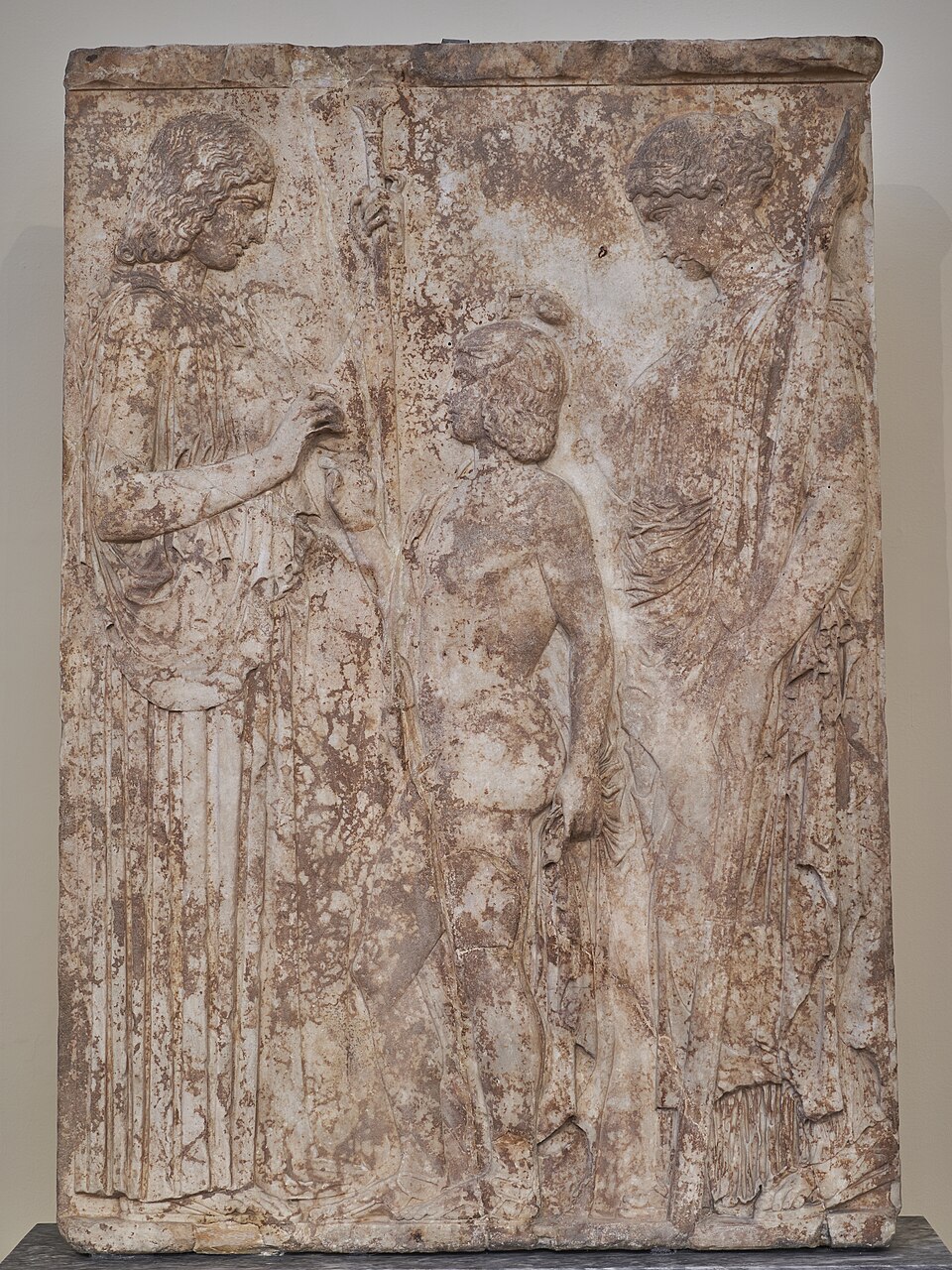
Photo: George E. Koronaios, Wikimedia Commons, licensed CC BY-SA 4.0, reproduced unmodified.
This quarter-shekel belongs to a small, tightly datable family of emergency issues from occupied Sicily. Himilco’s army brought or struck silver marked with a marching elephant and the Punic letter aleph — taken as the initial of Agrigentum — in shekels and half-shekels. Beside it runs the prancing-horse silver of this page: half, quarter and eighth shekels with the grain-wreathed head and the letters ḥt below the horse. A parallel bronze series with Persephone/Demeter and a prancing horse was struck for the garrison at Morgantina, the supply depot halfway between Syracuse and Agrigentum; and in 210 BC a final wreathed variant of the horse silver appeared, struck — on one modern reading — after the command had changed sides to Rome. All of it together spans barely four years.
The home front is in this collection too. At Carthage itself the war was financed in debased silver, electrum and heavy bronze — the collection’s Second Punic War bronze shekel is that home-mint money, and its standing horse descends through the First Punic War trishekel and the small 4th-century Æ unit — the same civic horse of Carthage that steps free on this quarter-shekel’s reverse.
Beneath the horse stand two Punic letters, ḥt — copied faithfully onto the Bezayiff tag as “HT.” They are the defining legend of the series, and what they abbreviate is a genuine open question. The most pointed proposal is Fernando López-Sánchez’s (Potestas 3, 2010): that the ḥt- and h-marked silver of Second Punic War Sicily — half, quarter, and eighth shekels — should be tied to the command of Muttines himself, the money of his Numidian cavalry. If that reading is right, this coin does not merely come from Muttines’ Akragas; it carries the mark of his authority. The suggestion has not hardened into consensus — the letters have also been taken as a mint or magistrate abbreviation — and the question stays open. (His full argument is worked through in the Deeper dive below.)
Hanno, jealous of Muttines’s success, stripped him of his cavalry command and gave it to his own son (Livy 26.40). Muttines opened the gates of Agrigentum to the consul-designate Marcus Valerius Laevinus on a pre-arranged day; Hanno and Epicydes fled to Africa, and the city fell without a siege. Livy adds the arithmetic of the collapse: six more Sicilian towns taken by force, forty surrendering of their own accord, twenty betrayed — and, providentially for a Rome then paying famine prices for grain, the Sicilian harvest restored to Roman hands. Muttines was rewarded with Roman citizenship as Marcus Valerius Muttines (Livy 27.5), kept the command of his Numidians, and later served Rome in the East. Carthaginian Sicily was over.
One more thing was minted out of this Sicilian endgame: Rome’s own silver. The excavation deposits at Morgantina — the garrison town of this coin’s own series, sacked by Rome in 211 BC — provided the key archaeological evidence that the denarius was introduced c. 212–211 BC, in the same fiscal emergency that produced this quarter-shekel on the other side of the lines (Buttrey et al., Morgantina Studies II: The Coins). The two war currencies briefly shared the island; Rome’s went on to eight centuries of history. The earliest denarius in this collection, the anonymous Victory-biga denarius of 157–156 BC, is a direct descendant, struck two generations later in the system born here.
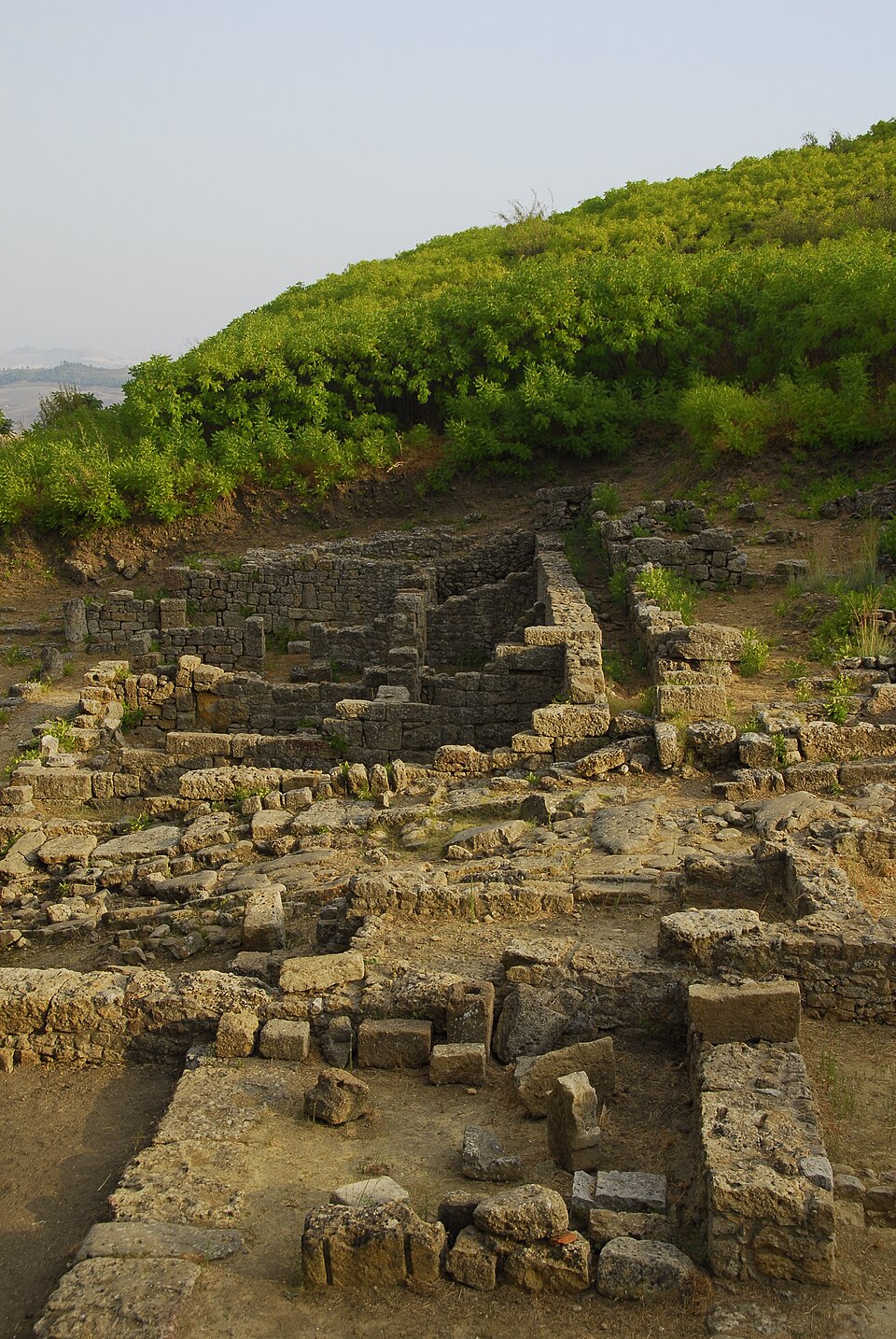
Photo: Rino Porrovecchio, Wikimedia Commons, licensed CC BY-SA 2.0, reproduced unmodified.
For a century after this coin re-entered the numismatic record at the Hirsch XXXII sale of 1912, it was catalogued as Numidian — Hiempsal II, AR quinarius. The instinct was not wrong: Numidians are central to the story. The cavalry it paid were Numidian; the free horse is as much their symbol as it is Carthage’s. But the cataloguers had the mint, century, and king wrong. Jenkins’s die studies in the SNR finally anchored the type to Punic Sicily.
(Based on a full reading of F. López-Sánchez, “Numidian Kings and Numidian Garrisons during the Second Punic War: Coins and History,” Potestas 3 (2010), pp. 17–52 — the PDF in this type’s references.)
The misattribution, and why it happened. The prancing-horse silver — half, quarter and eighth shekels with a male head crowned with ears of grain — was linked “until well into the twentieth century” with Hiempsal II, king of Numidia 105–62 BC (Müller 1862; Charrier 1912) (pp. 18–19). The Punic letters ḥt and t under the horses do denote a North African rather than a Sicilian-Greek milieu, so the instinct was defensible; what killed it was find evidence. These issues are absent from the Numidian territories of North Africa and abundant in the major Sicilian hoards of the Second Punic War, and they travel in those hoards with the elephant-and-aleph shekels of Himilco’s army, struck at Agrigentum from 213 BC (p. 19, with Manganaro’s hoard study at n. 7). Walker’s die study (1984) and Burnett (1993) fixed the modern framework that HGC and the sale catalogues now follow.
A tighter date than the catalogues print. Within that framework López-Sánchez pushes further: the site-finds of Morgantina “have — to a greater extent than those of any Sicilian hoard — allowed us to establish with great precision the date of coining of the prancing horse series in the years 211/210, rather than simply in the generic period from 213–210” (p. 21, following Burnett). On this view the series begins not with Himilco’s landing in 213 BC but with the arrival of Mottones and his 3,000 Numidians in 211 BC — the cataloguers’ “c. 213–211 BC” (kept as this page’s working date) and the argued “211/210” bracket the same short window from opposite ends.
What ḥt means: the royal-cipher reading. The heart of the article is epigraphic. The letters ḥet and taw under the horse have long been associated with the Semitic term mmlkt — “royalty” or “leadership” (Manfredi’s reading, pp. 20–21). The same elliptical formula appears on later Numidian royal bronzes: issues of Massinissa pair mn with ḥt, and issues read as Adherbal’s pair ḥt with ʼl, while others drop the king’s name entirely and let ḥt alone “indicate the royalty of the character to whom they referred elliptically” (p. 20, figs. 4–6). The Sicilian prancing-horse silver, on this reading, is “North African in neither its minting nor its distribution, though it most certainly is in terms of its ethnic and monarchical appeal” (p. 20): coin types chosen to speak to the Numidian horsemen they paid, stamped with the cipher of their chief. Since the only Numidian commander of rank in Sicily in 211–210 was Mottones — Livy’s praefectus (26.21.15) — the ḥt silver becomes, in the article’s argument, quite literally the money of Mottones.
Triptolemos or Apollo? The article also reopens the obverse. Walker and Burnett read the grain-wreathed head as Triptolemos, noting that similar corn-eared heads occur in Punic issues before the Second Punic War, which rules out topical identifications with Hippocrates, Hannibal or Mottones himself (p. 20). López-Sánchez counters with the small bronze of Thurium (HNI 1928, struck 211 BC): its Apollo — short-haired, with ears of grain in his hair — is in his view identical in style to the Agrigentum fractions, and Thurium is where Mottones’ expedition embarked for Sicily; he concludes the engravers moved with the army, and that the head is “an Apollo quite different from the norm… but at the end of the day it is Apollo” (pp. 38–39). The identification stays split in the literature — HGC and CNG print Triptolemos, and this page follows them — but the Thurium stylistic link is the strongest single piece of evidence on either side.
The wreathed finale of 210 BC. A late variant of the horse silver (and of the Morgantina bronzes) adds a wreath fully surrounding the horse. López-Sánchez reads the wreath — a device adopted by Melita and Cossura in token of obedience to Rome — as marking the pro-Roman phase after Mottones’ defection: same badge, same cipher (ḥt now alone, standardized with Morgantina’s h), new allegiance, “an unwillingness to modify in any way the recognition in Sicily of Mottones’ status as a Numidian chief” (p. 26). If right, the series that began as Carthage’s last Sicilian money ended as Rome’s — with the same Numidian horse on it.
The wider thesis, and its limits. The article’s larger claim is that the prancing horse is a marker of Numidian garrisons wherever it appears: at Arpi, Salapia, Capua–Mons Tifata, Thurium, Beneventum, Luceria and Larinum in Italy (216–207 BC), and in the shekels of Carthago Nova struck for Massinissa’s troops in Iberia (212/211–209 BC) (pp. 27–46). Parts of this are avowedly conjectural — the suggestion that Mottones stood to the scattered Numidian detachments roughly as the Batavian chief Julius Civilis later stood to the Batavian cohorts is offered as “no more than a speculative hypothesis” (p. 41) — and the redating of the Romano-Roma didrachms to a pro-Carthaginian Capua is a minority position. But the Sicilian core of the argument — hoards, Morgantina site-finds, the royal cipher, the Thurium link — is tightly evidenced, and it is the reason this small coin can be read not as generic occupation money but as the pay of a named commander in a datable year.
The four parts of Jenkins’s Coins of Punic Sicily (SNR 1971–1978) remain the die-study foundation for all Siculo-Punic silver and are free to read online (E-Periodica; searchable scans on Academia.edu — links in the references above). Walker (1984) is the die study for this specific series — this coin is Walker Group I, dies II/1, per CNG’s 2024 cataloguing. Manfredi’s Monete Puniche (1995) is the epigraphic repertory behind the mmlkt reading. For the Roman side of the island’s story, Prag’s “Provincia Sicilia” (linked above) traces how the Republic digested its first province in exactly these decades; Lazenby’s Hannibal’s War (1978) and Hoyos’s Hannibal’s Dynasty (2003) give the military and Carthaginian frames. The primary narrative is Livy 24–27 (Books 25–26 for Muttines; linked above), with Polybius 9.22 and 9.27 preserving fragments on Agrigentum’s site and the war’s Sicilian economics.
Ancient sources: Livy, Books 24–27 (esp. 24.35 — Himilco’s landing; 25.40 — Muttines’ arrival and first victories; 26.21, 26.40 — his raids, supersession and the fall of Agrigentum; 27.5 — his citizenship); Plutarch, Life of Marcellus; Polybius (fragmentary; 9.11 on the grain crisis of 211, 9.27 on Akragas); Pindar, Pythian 12 (praise of Akragas); Diodorus 13.81–91 (the sack of 406 BC).
Numismatic: HGC 2 (Hoover), no. 173; A. Walker, “Some hoards from Sicily and a Carthaginian issue of the Second Punic War,” Festschrift für Leo Mildenberg (1984) — the die study (this type: Group I); G. K. Jenkins, Coins of Punic Sicily (SNR 50, 53, 56, 57; 1971–1978); A. Burnett, “The coinage of Punic Sicily during the Hannibalic War,” in La Sicilia tra l’Egitto e Roma (1993); L.-I. Manfredi, Monete Puniche. Repertorio epigrafico e numismatico (1995); F. López-Sánchez, “Numidian Kings and Numidian Garrisons during the Second Punic War: Coins and History,” Potestas 3 (2010) — read in full, see Deeper dive; T. V. Buttrey et al., Morgantina Studies II: The Coins (1989) — the denarius-dating evidence; G. Manganaro, “Un ripostiglio Siciliano del 214–211 a.C. e la datazione del denarius,” JNG 31–32 (1981/2); Mazard (1955), no. 80; Müller (1860–62), III, 38/47; SNG Copenhagen, North Africa; CNP (Viola, Corpus Nummorum Punicorum), no. 117.
In depth: the story of these coins, the battle of Cannae, and the full reference coinage of both sides is told in the article Hannibal’s War Money.
The 'HT.' on the Bezayiff tag is not a die reference: it transcribes the Punic letters ḥt in the reverse exergue, the defining legend of the series (the standard catalogues describe the type as 'horse right; Punic ḥt below'). The letters' meaning is debated — López-Sánchez (Potestas 3, 2010) ties the ḥt/h silver to the command of Muttines himself; other readings take them as a mint or magistrate abbreviation. The grain-wreathed obverse head is identified as Triptolemos in HGC and most sale catalogues, but as Apollo in part of the scholarship (including López-Sánchez) — the identification is not settled. Morgantina site-finds narrow the prancing-horse silver to 211/210 BC (López-Sánchez p. 21, following Burnett), slightly tighter than the catalogues' c. 213–211 BC — see the Deeper dive. Weight discrepancy (1.53 g vs. 1.48 g) is ordinary scale variation between two historical weighings over a century apart. The superseded attribution to Hiempsal II persisted until Jenkins's die studies anchored this type firmly to Punic Sicily; preserving both attributions allows a future researcher to trace the coin through auction records where it still appears under the Numidian classification.
John's Ancient Coin Collection · Type · akragas-punic-quarter-shekel
Image credits for this coin — photographs, maps and graphics used on this page