Type · tarsos-mazaios-baaltars-stater
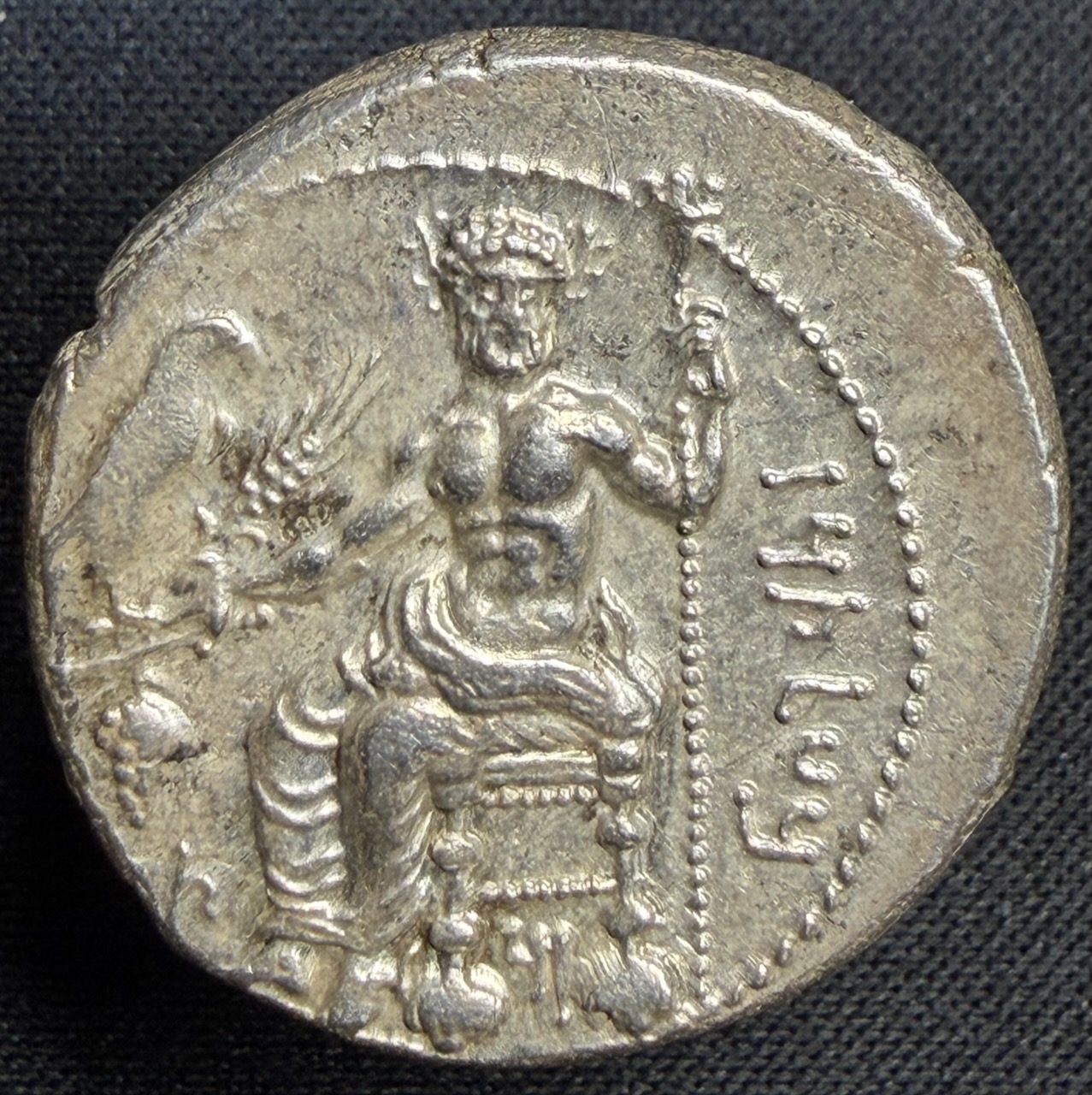
Current: Cilicia, Tarsos. Mazaios, Achaemenid satrap of Cilicia, 361–334 BC. AR stater. Baaltars enthroned with eagle, grain ear, and grapes / lion attacking bull, Aramaic MZDY above. SNG Levante 106; Casabonne Series 2.
Obverse: Baaltars (the Baal of Tarsos) enthroned left, torso facing, holding eagle, grain ear, and grape bunch in his extended right hand, lotus-headed sceptre in his left; Aramaic legend BʿLTRZ (Baaltars) downward to right; Aramaic letter(s) beside or below the throne on most dies
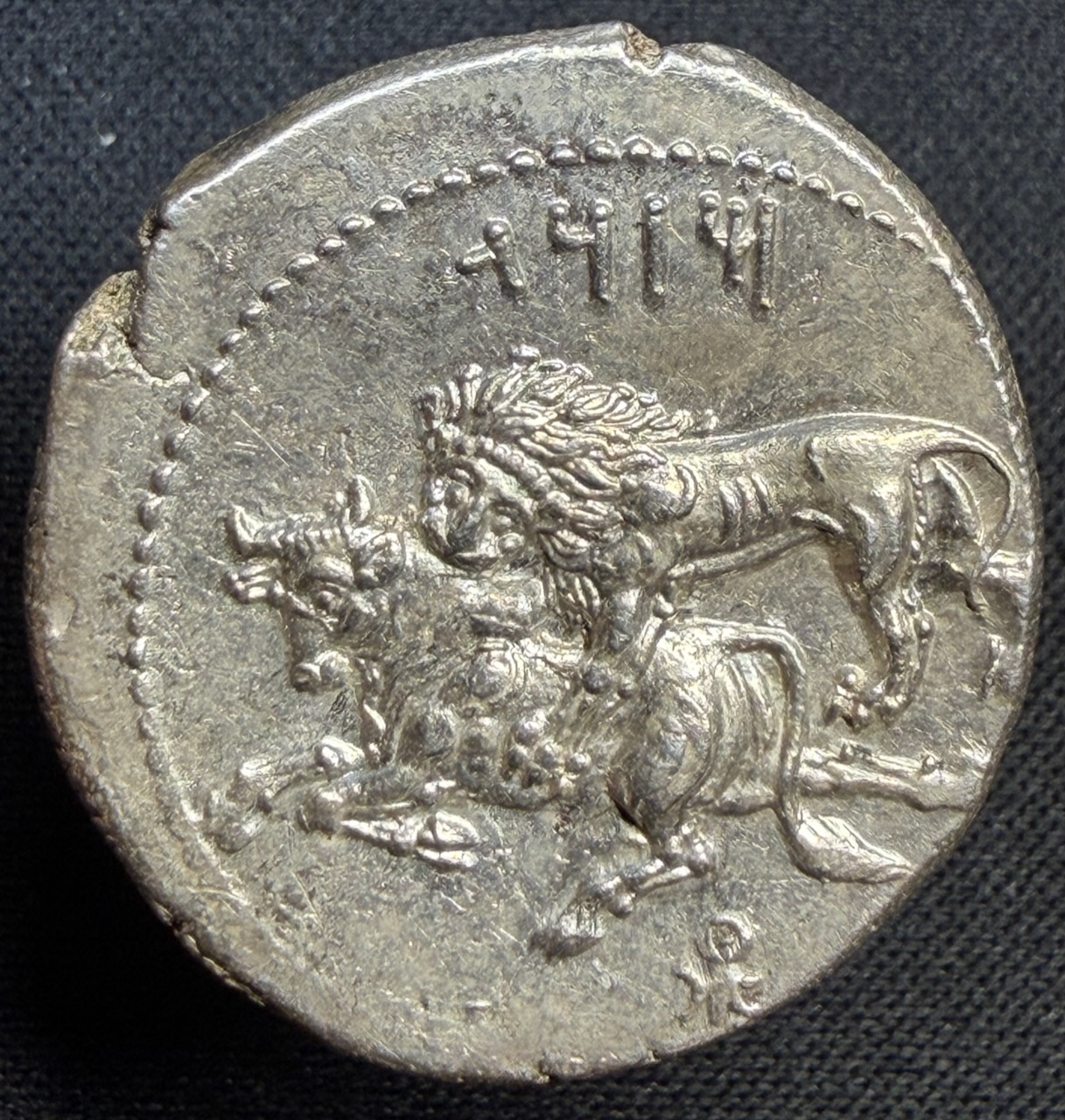
Reverse: Lion attacking a bull to left, bringing it down from above; Aramaic legend MZDY (Mazday = Mazaios) above; monogram or symbol below on most dies
Primary reference: SNG Levante 106
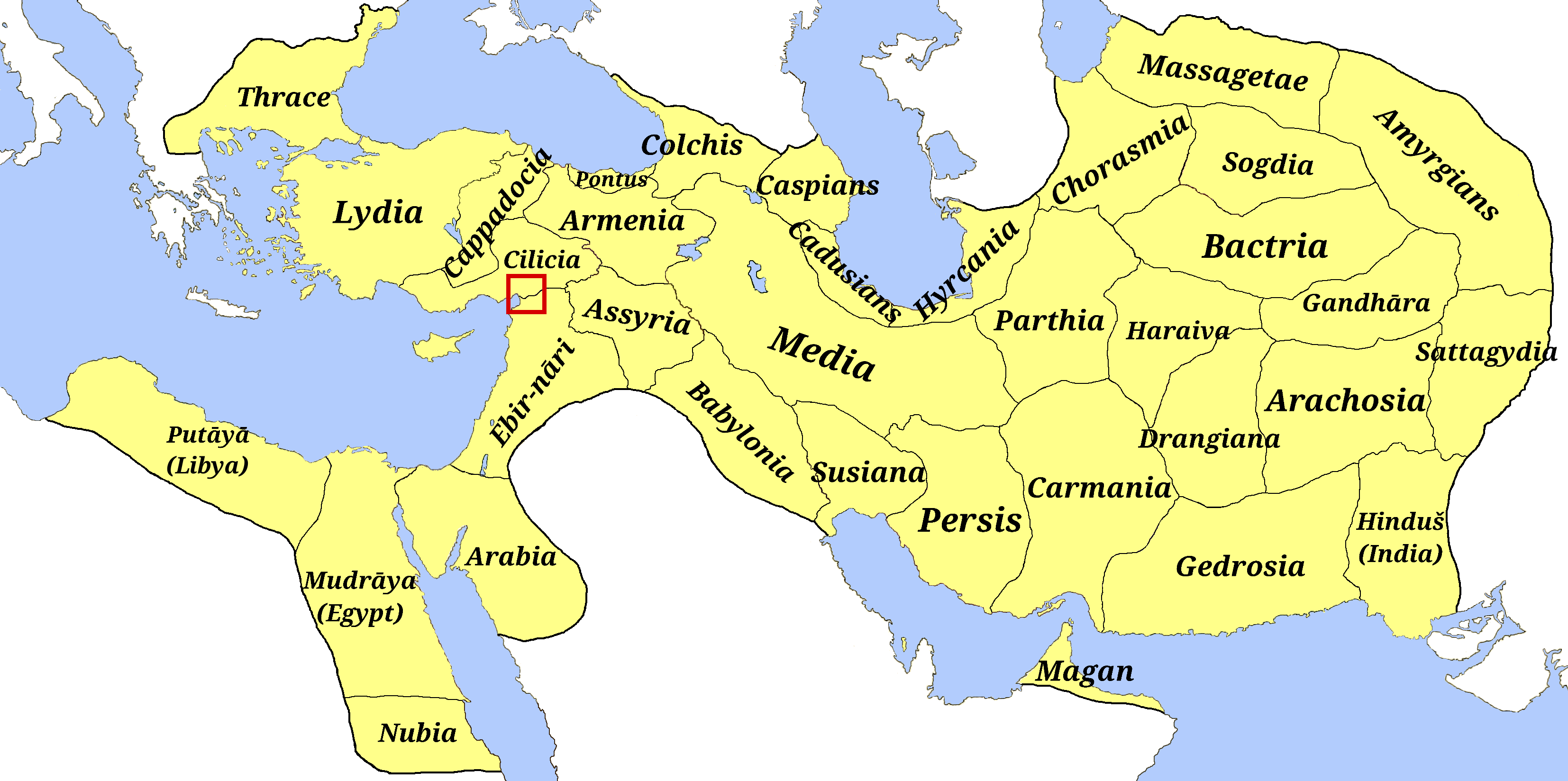
The Achaemenid (Persian) Empire as its network of imperial satrapies. The red square marks Tarsos, chief city of the satrapy of Cilicia, in the corner where Asia Minor meets Syria. Cilicia’s position on the great road through the Cilician Gates — the pass linking Anatolia to the Levant — made Tarsos a key military mint of the empire’s last decades, and this stater is its money.
Base map: “Map of Achaemenid Imperial Satraps (English Version)” by M.r ebrahim zadeh (Wikimedia Commons), File:Map of Achaemenid Imperial Satraps (English Version).png — released by the author into the public domain and additionally licensed CC BY-SA 4.0 (https://commons.wikimedia.org/wiki/File:Map_of_Achaemenid_Imperial_Satraps_(English_Version).png; license: https://creativecommons.org/licenses/by-sa/4.0/). The base map was compiled from Atlas Antiquus (Justus Perthes, 1909) and the “Achaemenid Satrapies” article in Encyclopaedia Iranica. Modified by JSB Coins: a red square has been added to mark the position of Tarsos. This derivative is shared under CC BY-SA 4.0.
Second map (Asia Minor): “Asia Minor under the Greeks and Romans” from William R. Shepherd, The Historical Atlas (1923), via Wikimedia Commons, File:Asia minor-Shepherd 1923.JPG (https://commons.wikimedia.org/wiki/File:Asia_minor-Shepherd_1923.JPG). Public domain (author died 1934); credited as a courtesy. Modified by JSB Coins: a red circle added to mark Tarsus.
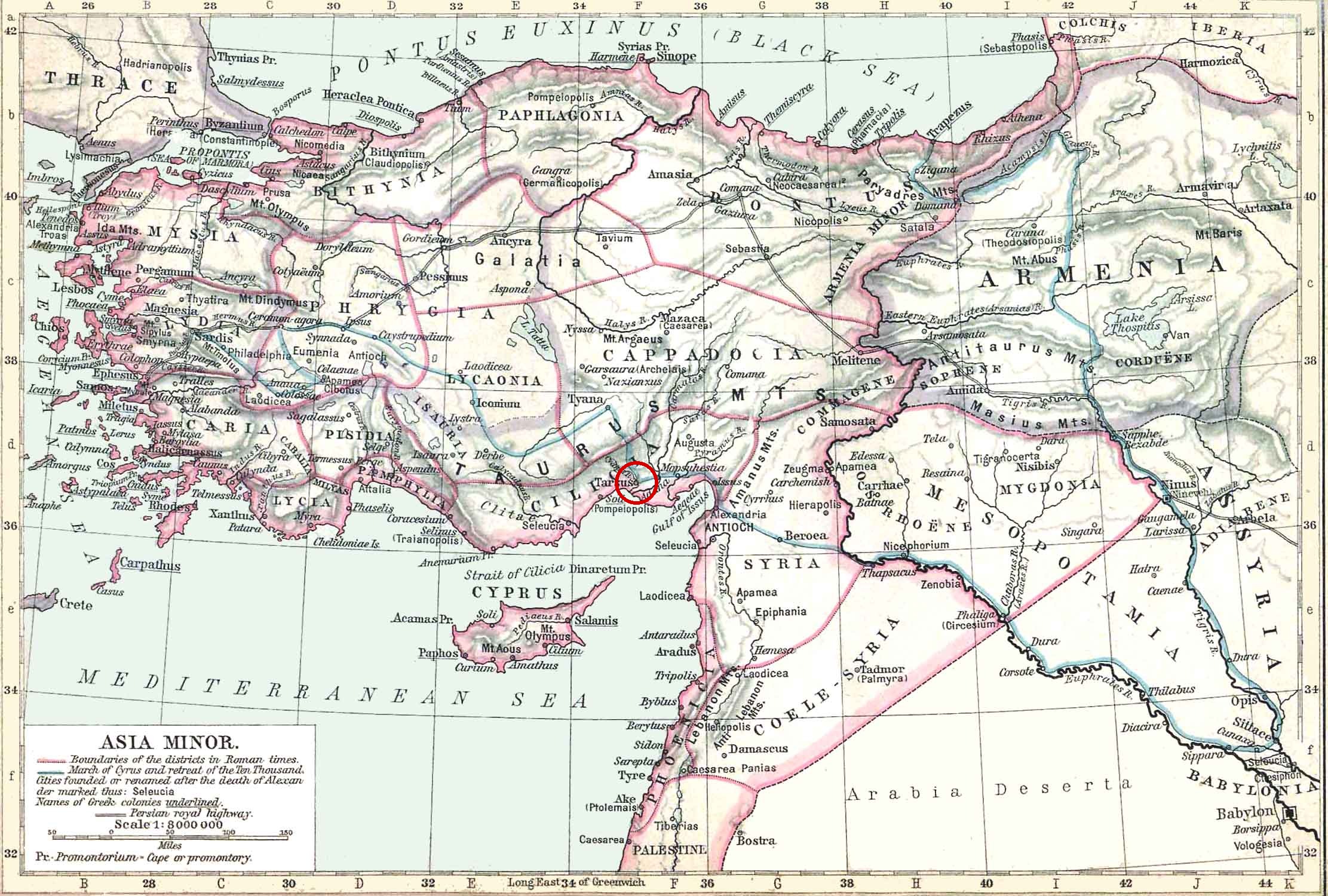
And the same corner of the world in close detail, on William R. Shepherd’s 1923 map of ancient Asia Minor. Tarsus — circled in red — sits on the Cilician plain between the Taurus mountains and the sea, on the road that runs from the Cilician Gates down to Syria; Issus, where Alexander broke Darius III’s army in 333 BC and ended the coinage of Persian Cilicia, lies just around the gulf to the east. (The map’s boundaries are those of Roman times, drawn some three centuries after this coin.)
This stater carries the money of empire’s end. Struck at Tarsos by Mazaios — the last Achaemenid satrap of Cilicia, and the man who would hand Babylon to Alexander the Great — it pairs the enthroned Baal of Tarsos with a lion pulling down a bull, Near Eastern images cut with Greek engraving skill, labeled in Aramaic, the administrative language of the Persian west.
Graphic: JSB Coins, 2026 (CC0).
Cilicia was the hinge of the Persian empire’s western communications: the road from the Anatolian plateau to Syria and the imperial heartlands squeezed through the Cilician Gates above Tarsos, and armies moving between the satrapies of Asia Minor and the Levant passed the city’s walls. For most of the fifth century the region had been governed lightly through a native dynasty (whose kings each bore the name or title Syennesis), but from the early fourth century the Great Kings imposed direct satrapal rule. Tarsos, the chief city on the river Kydnos, housed the mint. Under a sequence of fourth-century satraps and generals — Tiribazos, Pharnabazos, Datames, and finally Mazaios — that mint issued a large silver coinage on the local standard, generally understood as military money: Cilicia was the marshalling ground for Persian campaigns, above all the long effort to recover Egypt.
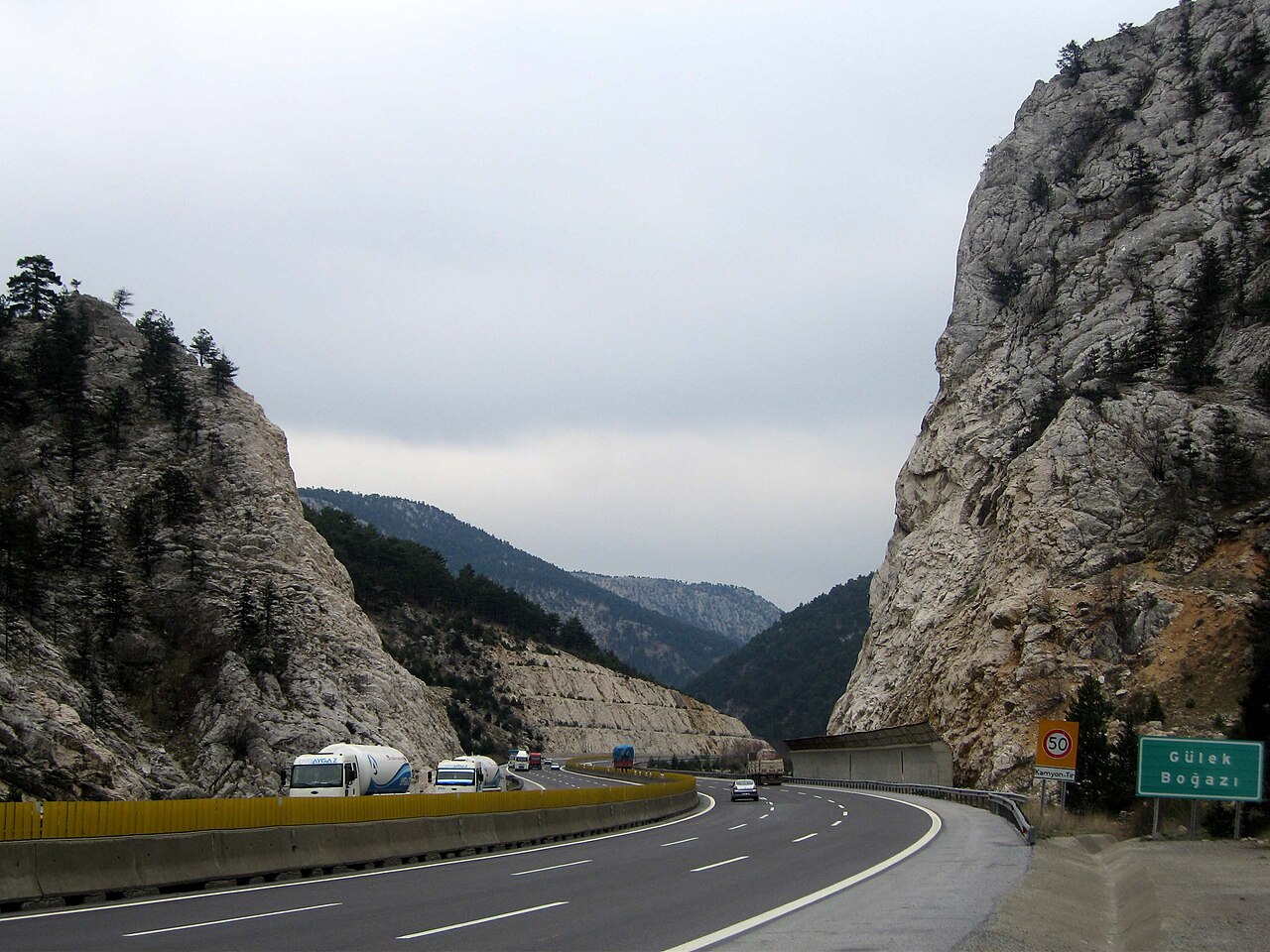
Photo: Teogomez, public domain (Wikimedia Commons); reproduced unmodified.
Mazaios (the Aramaic of the coins spells him MZDY, Mazday) governed Cilicia from c. 361 BC, and under Artaxerxes III his command grew: issues of this mint name him over both Cilicia and “Beyond the River” — the Transeuphrates province embracing Syria and Phoenicia. He was thus one of the great magnates of the late empire. His later career is famous. At Gaugamela in 331 BC he commanded the Persian right wing against Alexander; after the defeat he withdrew to Babylon, and when Alexander approached, Mazaios surrendered the city without a fight (Arrian, Anabasis 3.16; Curtius 5.1). Alexander confirmed him as satrap of Babylonia — the first Persian grandee to hold high office under the new order — and he held it until his death in 328 BC. The satrap of this coin is, in short, the empire’s great survivor, and his coinage had a matching afterlife: the lion types he had struck in the west were continued at Babylon, and numismatists have long seen the satrapal silver of Tarsos as a bridge between Persian and Hellenistic coinage.
The obverse enthrones Baaltars, “the Baal of Tarsos,” the city’s chief god: a bearded figure seated on a backless throne, holding in one hand the emblems of abundance — an eagle, a grain ear, a bunch of grapes — and in the other a sceptre headed with a lotus. The conception is thoroughly Near Eastern, a lord of sky and fertility; the execution is Greek, and the type stands among the most accomplished die-engraving of fourth-century Asia Minor. Its most discussed relationship is with the coinage that replaced it: the seated, eagle-bearing Zeus of Alexander’s imperial tetradrachms — in this collection, the Amphipolis and Kolophon tetradrachms and the Sardes drachm — is strikingly close to Baaltars, and it has long been argued — going back to E. T. Newell — that Alexander’s engravers, some of them at this very mint after 333 BC, took the satrapal image as their model. The direction and degree of that influence remain debated rather than settled, and the resemblance may partly reflect a shared iconographic tradition; both positions are represented in the literature.
The reverse sets a lion on a bull, the predator seizing the bull’s hindquarters as it collapses. The group is one of the oldest royal motifs of the Near East — it decorates the staircase reliefs of Persepolis itself — and its meaning has been read variously: as an emblem of royal power, as an old Anatolian/Mesopotamian symbol retained for its authority, and (more speculatively) as astronomical, Leo overtaking Taurus. None of these readings is provable, and the motif is best described rather than decoded. Above the group runs the satrap’s own name and authority: MZDY, in Aramaic.
The stater follows the local Cilician standard of c. 10.5–11 g, distinct from both the Attic and the Persic royal standards, and the output under Mazaios was very large — these are the most common of all Cilician satrapal staters, consistent with their usual interpretation as pay for troops and mercenaries concentrated in Cilicia during the campaigns of the 350s and 340s, including Artaxerxes III’s reconquest of Egypt (343 BC). After Issus (333 BC), when Alexander took Tarsos intact, the same mint turned to striking his imperial types — the seated Zeus replacing the seated Baal.
Few coins compress the transition from the Persian to the Hellenistic world so neatly: a Greek-engraved Near Eastern god, an Aramaic legend naming a Persian satrap who ended his career serving Alexander, and an image family that arguably fathered the most abundant coinage of the ancient world, the Alexander tetradrachm. It is also simply one of the handsomest silver coins of its century.
The type is SNG Levante 106 (E. Levante, SNG Switzerland I: Levante–Cilicia, 1986), within Series 2 of O. Casabonne, La Cilicie à l’époque achéménide (2004), the standard modern study of the satrapal coinage; subvarieties are distinguished by control letters and monograms and should be fixed from the specimen’s controls (see the specimen’s open threads). Mazaios’ career: Arrian, Anabasis 3.16 (linked in the references) and Curtius 5.1 for Gaugamela and the surrender of Babylon. The suggested dependence of Alexander’s seated Zeus on Baaltars descends from E. T. Newell’s studies of the Tarsos mint and is discussed, with due caution, in the subsequent literature; it is presented above as a debated question, not a settled fact.
Struck on the local Persic-derived standard (full staters run c. 10.5–11 g; this specimen 10.86 g per tag). The Baaltars/lion-and-bull staters are the most abundant of the Cilician satrapal silver issues, generally understood as military coinage of the last Achaemenid decades. Control letters and monograms (beside Baaltars' throne, below the lion group) distinguish many varieties within Casabonne's Series 2; the subvariety of a given specimen should be fixed from those controls.
John's Ancient Coin Collection · Type · tarsos-mazaios-baaltars-stater
Image credits for this coin — photographs, maps and graphics used on this page
.png)

