Type · carthage-tanit-horse-palm-ae16
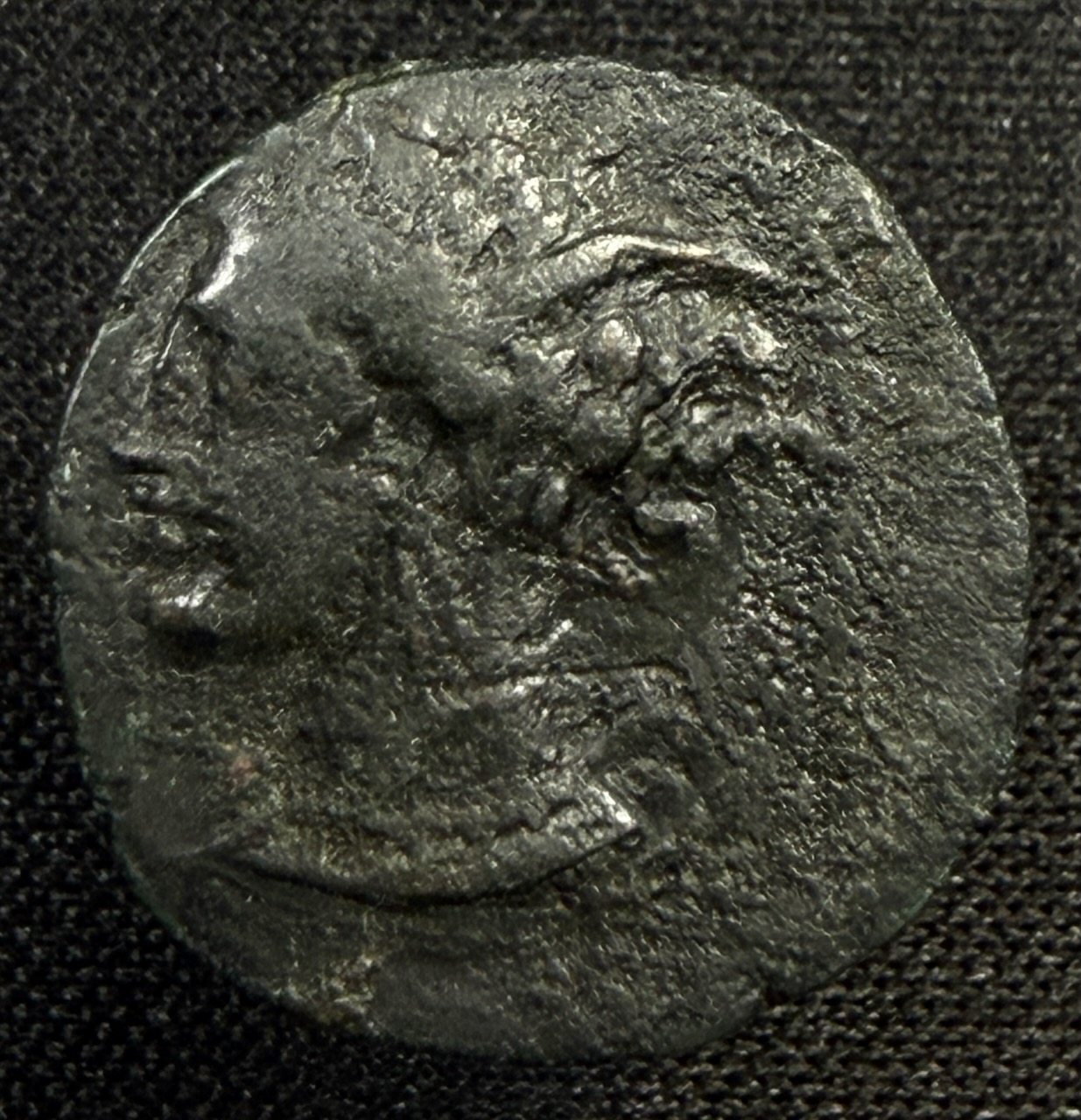
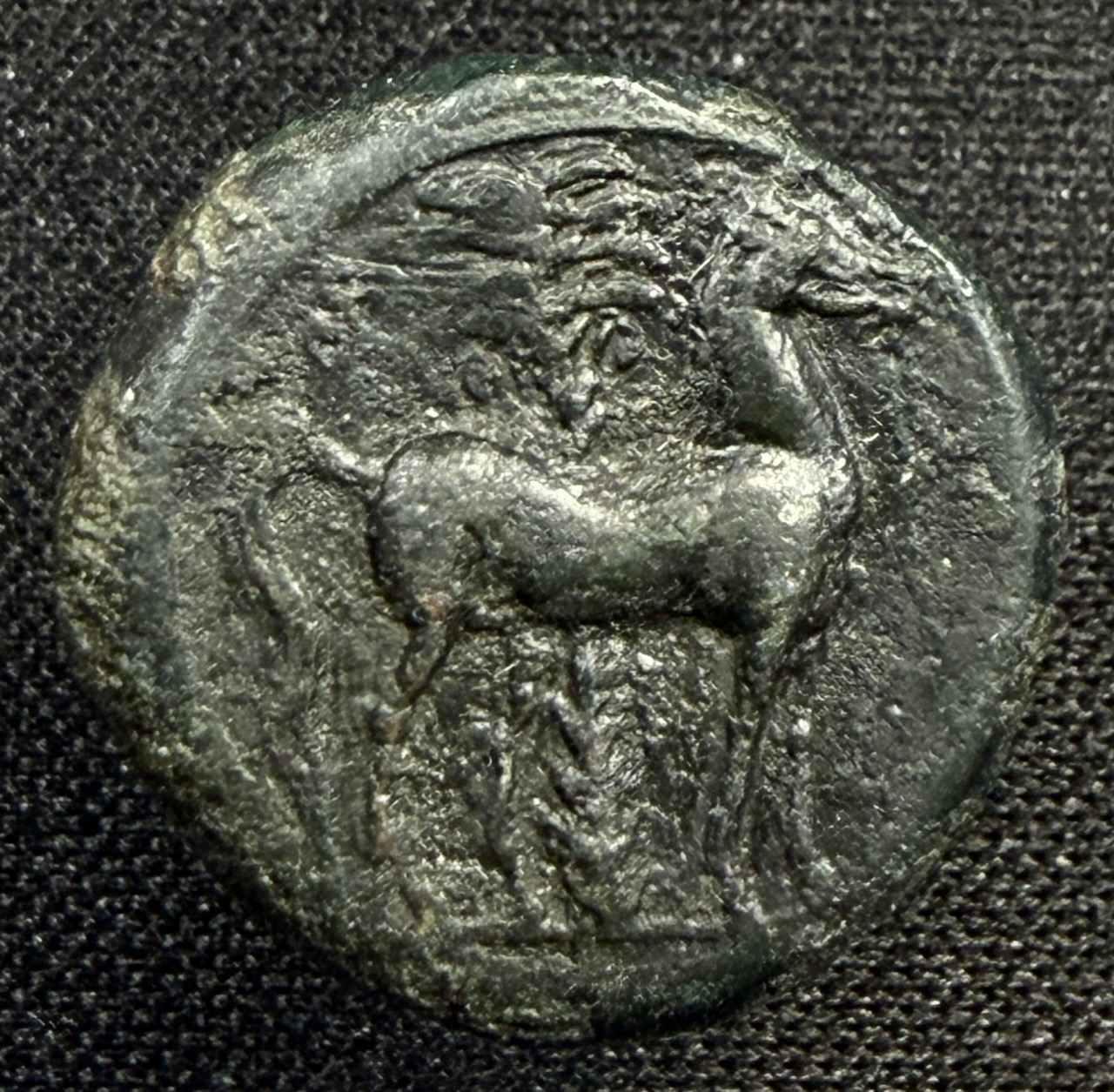
Current: Zeugitana, Carthage, AE unit (Æ16), c. 400–350 BC. Wreathed head of Tanit left / Horse standing right, palm tree behind. SNG Copenhagen 111
Obverse: Head of Tanit (in the Persephone/Kore manner) left, wreathed with grain ears, wearing pendant earring and necklace
Reverse: Horse standing right; date palm behind
Primary reference: SNG Copenhagen 111
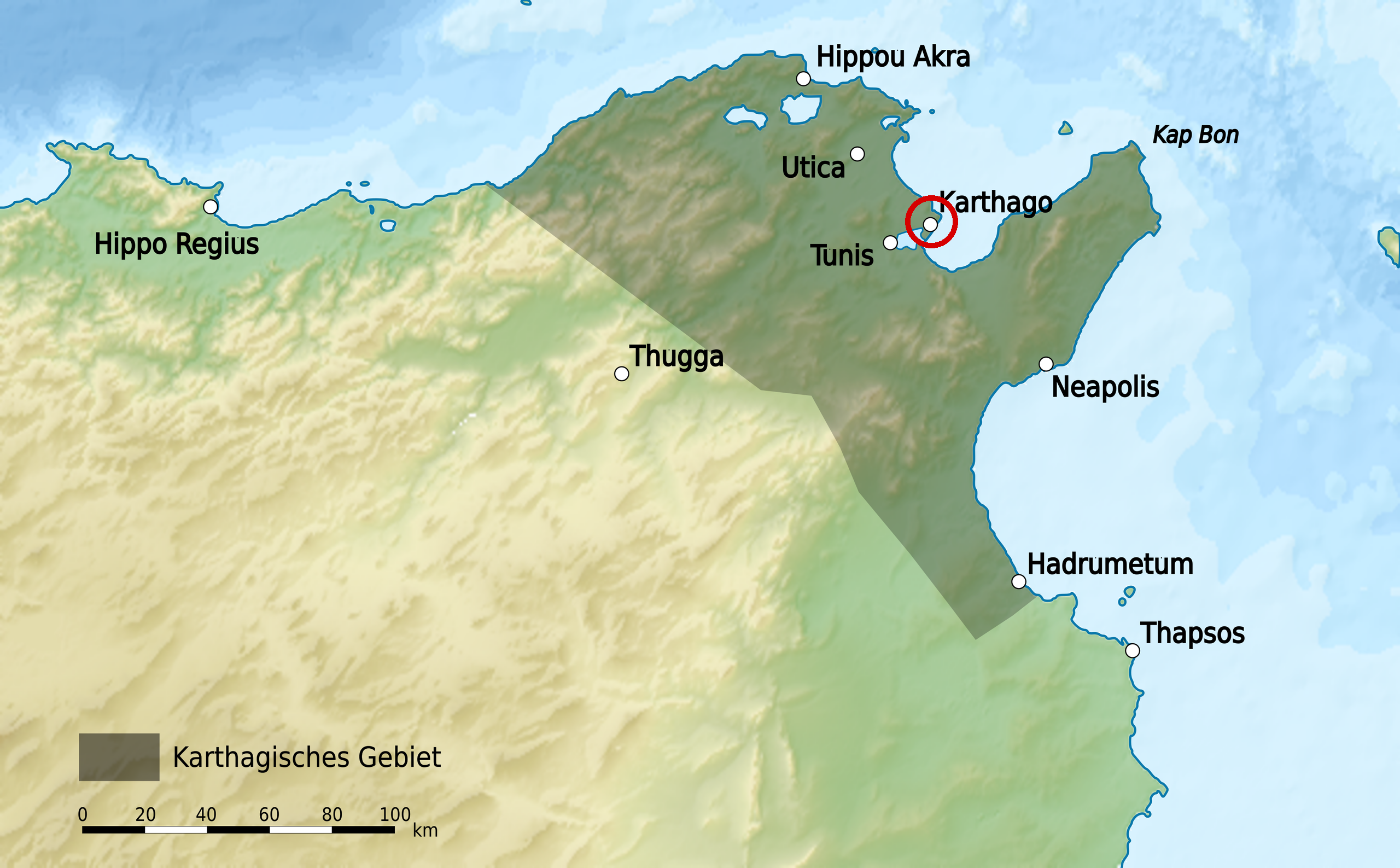
Carthage’s African home territory around 300 BC — within a half-century of this coin. Carthage (Karthago) — circled in red — sits on its peninsula in the Gulf of Tunis; the shaded zone (“Karthagisches Gebiet,” German for Carthaginian territory) is the chora that fed the city, with the older Phoenician foundation of Utica to the northwest and the emporia of Hadrumetum and Neapolis down the coast. The map shows the African heartland only — Carthage’s Sicilian, Sardinian, and Iberian holdings, where much of its early coinage circulated, lie beyond the frame.
“Map of Carthage around 300 B.C.” by Uwe Dedering (Wikimedia Commons), File:Carthage 300BC map.svg, licensed CC BY-SA 3.0 (https://commons.wikimedia.org/wiki/File:Carthage_300BC_map.svg; license: https://creativecommons.org/licenses/by-sa/3.0/). Modified by JSB Coins: rendered from SVG to PNG at 2560 px, and a red circle added to mark Carthage. This derivative is shared under the same CC BY-SA 3.0 license.
For nearly four centuries the greatest commercial power of the western Mediterranean did without coined money altogether. Carthage — heir of Tyre, mistress of a trading network from Gades to the Levant — kept her accounts in bullion and barter long after every Greek city of consequence had a mint, and only adopted coinage when war made it unavoidable: silver struck in Sicily from the end of the fifth century BC to pay the mercenaries of her long duel with the Greek cities of the island. Once begun, however, the habit spread quickly from war-silver to everyday money, and in the first half of the fourth century Carthage began striking small bronzes like this one — her earliest substantial bronze coinage (the unit series SNG Copenhagen 109–113; CNP 194; MAA 18), and among the earlier civic bronze coinages anywhere in the Punic world.
The obverse head is conventionally called Tanit, the great goddess of Carthage, consort of Baal Hammon — but she is rendered in a thoroughly Greek idiom, wreathed in grain ears in the manner of Persephone/Kore of Sicily. The borrowing is no accident: Carthage’s die-cutters took the Syracusan Kore as their model, and the type advertises how deeply the Punic and Sicilian Greek worlds interpenetrated even as they fought.
The reverse pairs the city’s two great badges. The horse recalls the foundation legend — Justin (18.5) and Virgil (Aeneid 1.441–445) preserve the story that Dido’s settlers, digging on the site, unearthed a horse’s head, an omen of the warlike prosperity of the city to come. The date palm behind it is both an emblem of the African land and a visual pun Greek users could read at sight: phoinix in Greek means both “palm tree” and “Phoenician.” Horse and palm remained the constant reverse language of Carthaginian bronze for two centuries, carried on at heavier weight by this collection’s First-to-Second-Punic-War era trishekel of the same design pair, and into Hannibal’s war — minus the palm — by the Second Punic War Æ shekel.
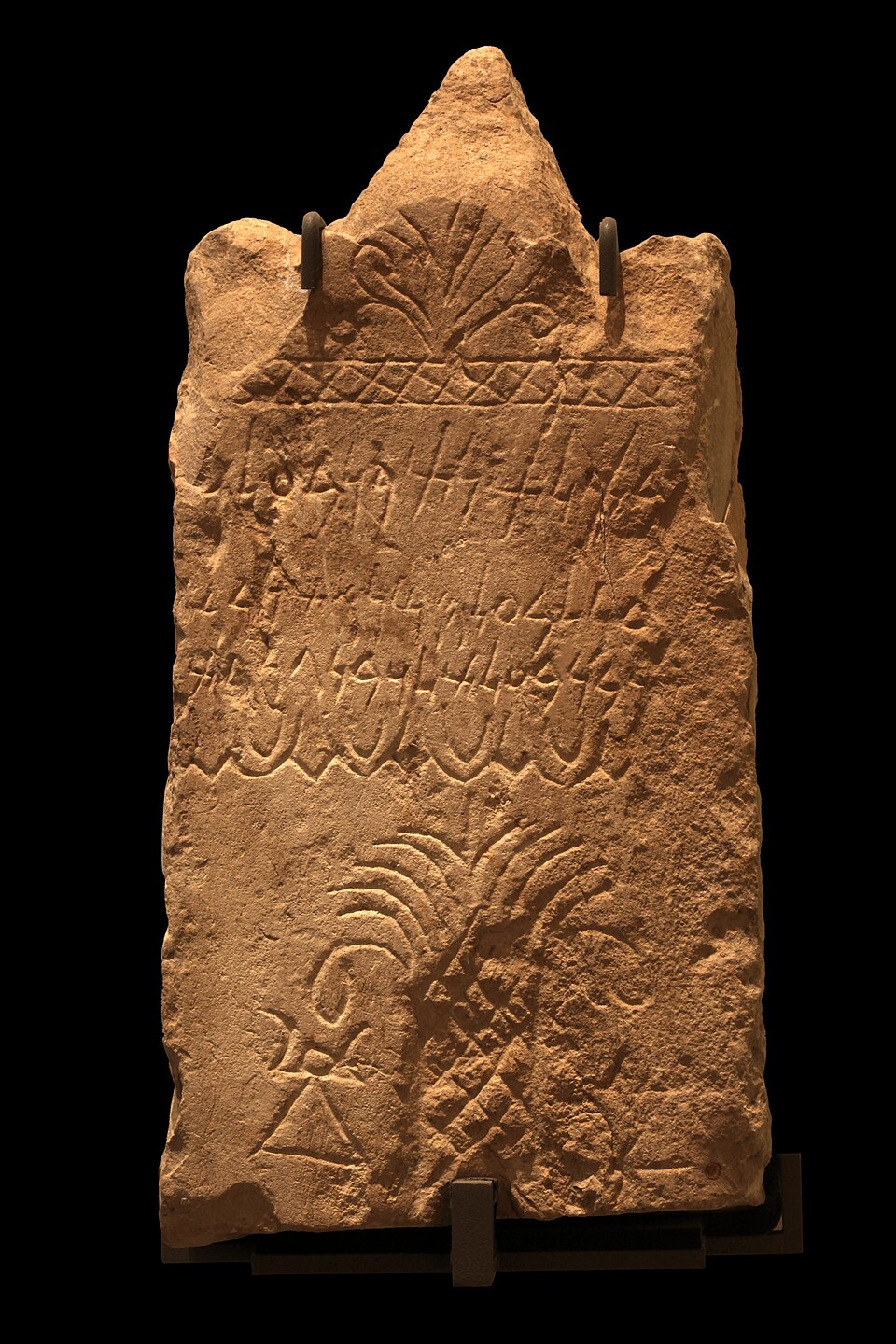
Photo: Rama, Wikimedia Commons, licensed CC BY-SA 2.0 FR, reproduced unmodified.
The Greek dress of the goddess has a datable historical trigger, and Diodorus preserves it. In 396 BC the Carthaginian commander Himilco, besieging Syracuse, plundered the temples of Demeter and Kore; plague promptly wrecked his army, and the war ended in disaster. Diodorus reports (14.77) that the Carthaginians, attributing the catastrophe to the offended goddesses, formally introduced their cult at Carthage — appointing distinguished citizens as priests and celebrating the rites in the Greek manner, with Greek residents of the city taking part. The grain-wreathed, Kore-styled head on this bronze, adopted in the very decades after that decree, is thus more than an engraver’s borrowing: it is the coin-image of an official act of state religion, a Greek goddess naturalized at Carthage and assimilated to Tanit. On stone the city preferred its own idiom — the Tophet stelae render Tanit as a stark geometric sign beneath the same palm — but on money, made to pass in Greek markets and Greek-speaking camps, she wears her Sicilian face.
Tanit’s story has a strange Roman coda. Long after Carthage fell, the Romans went on worshipping her as Dea Caelestis, the “heavenly goddess” of Africa — and in the early 220s AD the emperor Elagabalus had her cult image and treasure fetched from Carthage to Rome to be married, in solemn ceremony, to his Syrian sun-god (Cassius Dio 80.12). The goddess on this little bronze outlived the city that struck it by four centuries, and ended as an empress in Rome.
A bronze unit of this size was market money — the small change of the city’s harbors, of the African chora, and of the garrisons and camp markets of the Sicilian wars. Its period of issue, c. 400–350 BC, spans Carthage’s grinding conflicts with Dionysios I and II of Syracuse, when Punic armies repeatedly held the western epikrateia of Sicily; Punic silver of that theater is represented in this collection by the later quarter-shekel struck at Akragas. Bronzes of this class occur both in Africa and in Sicily, moving with the soldiers and traders who used them, and their sheer commonness today witnesses how thoroughly Carthage — the late adopter — came to rely on token bronze in daily life.
In depth: the story of these coins, the battle of Cannae, and the full reference coinage of both sides is told in the article Hannibal’s War Money.
Attribution: SNG Copenhagen (North Africa) 111, as cited on the Ancient Imports (Marc Breitsprecher) slip; series references CNP 194, MAA 18, and the Carthage mint attribution with dating c. 400–350 BC follow Classical Numismatic Group’s current cataloguing of the unit series (CNG Electronic Auction, 2024: “CNP 194; MAA 18; SNG Copenhagen (Africa) 109–13”). Standard treatments: J. Alexandropoulos, Les monnaies de l’Afrique antique (2000); M. G. Viola, Corpus Nummorum Punicorum (2010). Foundation legend of the horse’s head: Justin 18.5; Virgil, Aeneid 1.441–445. Carthage’s late adoption of coinage and the Sicilian war-context: G. K. Jenkins and R. B. Lewis, Carthaginian Gold and Electrum Coins (1963), introduction, and G. K. Jenkins, “Coins of Punic Sicily” I–IV, Schweizerische numismatische Rundschau 50, 53, 56–57 (1971–1978; Part I linked in the references). The sacrilege of 396 BC and the official adoption of the cult of Demeter and Kore at Carthage: Diodorus 14.63 and 14.77 (linked in the references). The Tophet stele illustrated is Museum of Fine Arts of Lyon, inv. 1969-86.
Carthage's earliest substantial bronze denomination: the small Tanit / horse-and-palm units (SNG Cop 109–113; CNP 194; MAA 18) are dated c. 400–350 BC and given to the Carthage mint by CNG's current cataloguing, which this page follows. Same badge pair as the collection's later, much heavier trishekel — one design language across a century of Punic bronze.
John's Ancient Coin Collection · Type · carthage-tanit-horse-palm-ae16
Image credits for this coin — photographs, maps and graphics used on this page