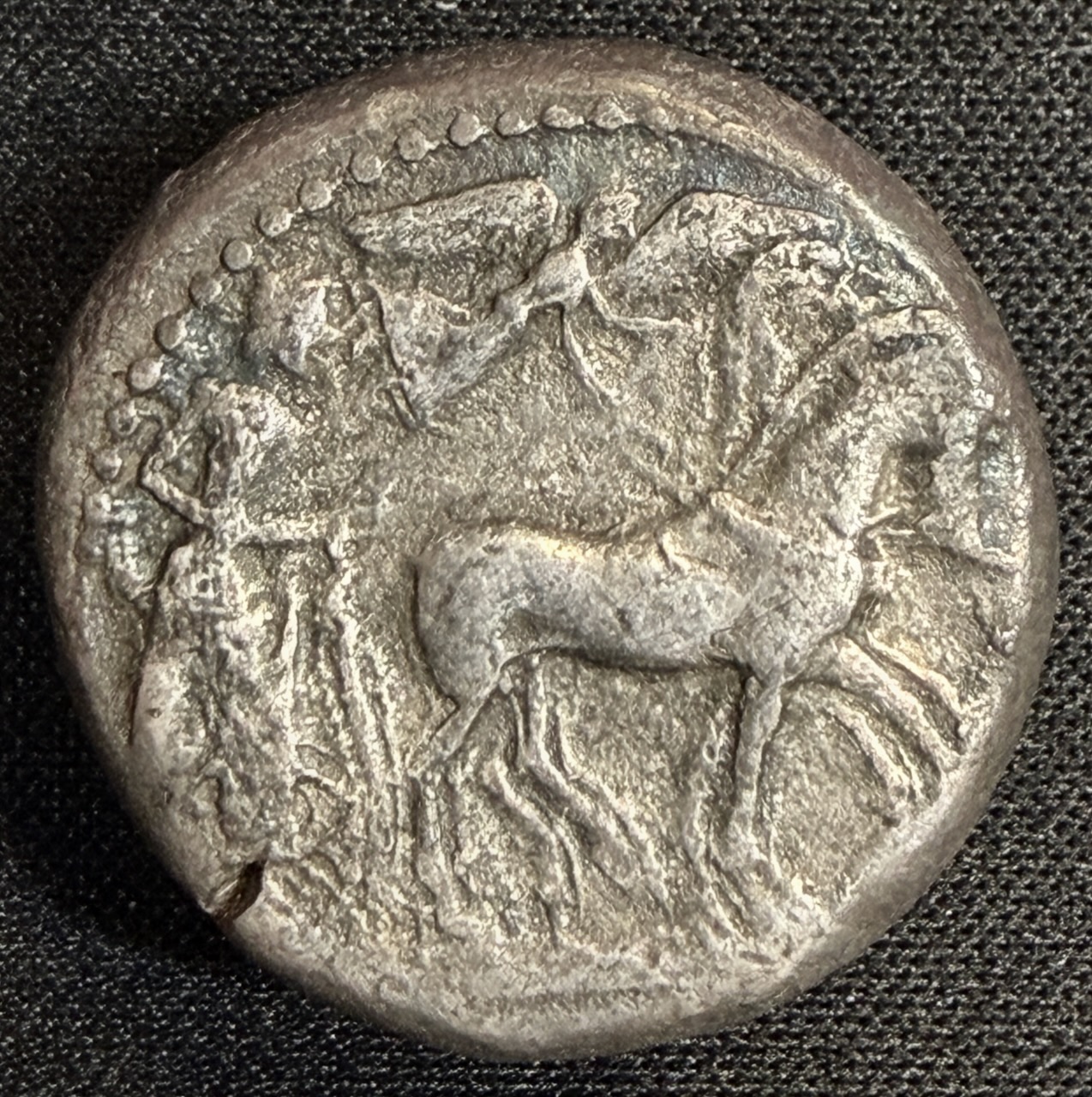
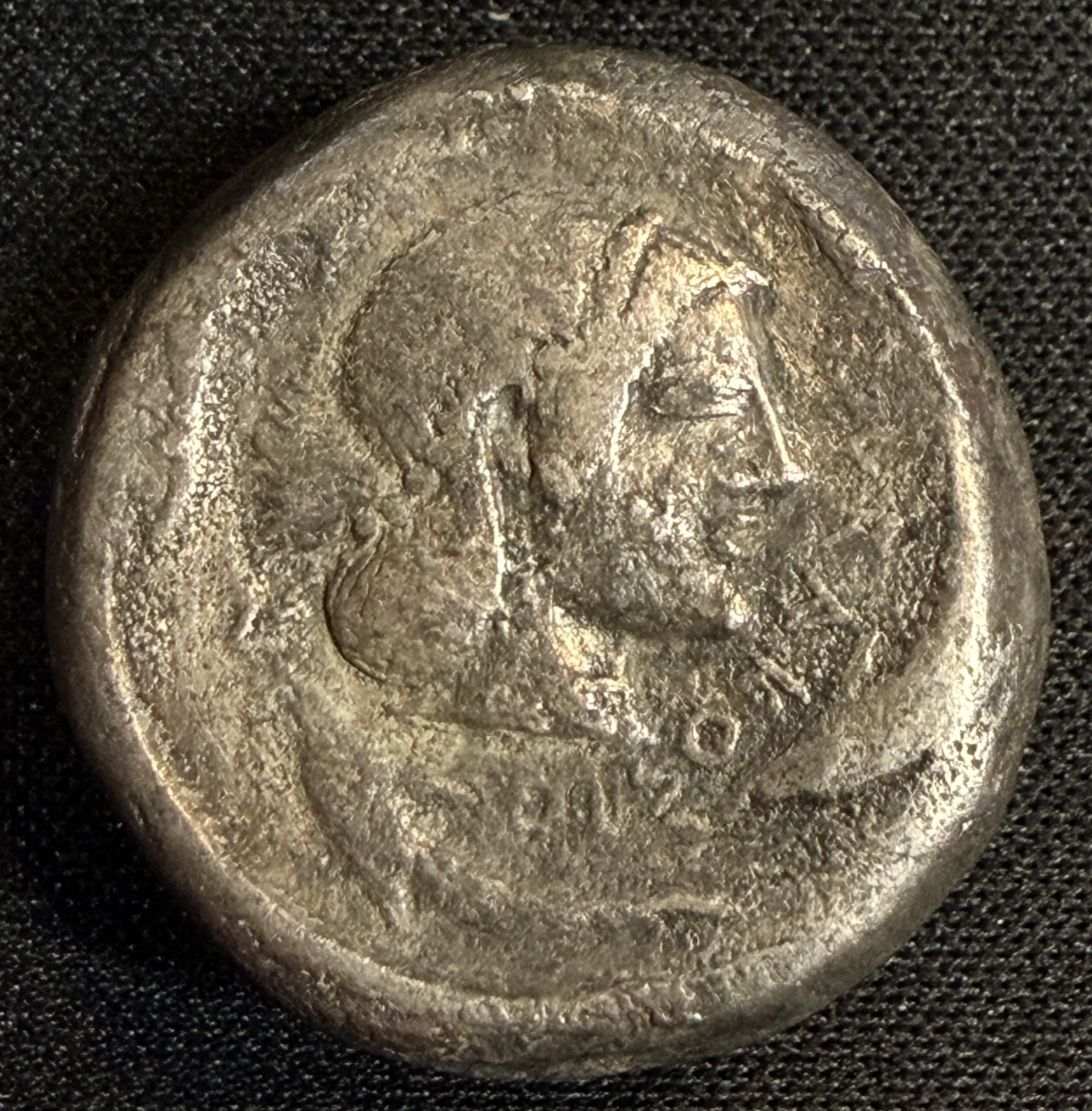
Type · syracuse-gelon-tetradrachm
Current: Sicily, Syracuse, Deinomenid Tyranny, AR tetradrachm — dealer's tag: Gelon I, 485–478 BC (no catalogue reference on tag; Boehringer series undetermined)
Obverse: Charioteer, holding kentron and reins, driving slow quadriga right; above, Nike flying right, crowning the horses; border of dots
Reverse: Head of Arethusa right, wearing taenia and pearl necklace, within a circle of four dolphins and the ethnic
Primary reference: cf. Boehringer, Die Münzen von Syrakus (series/die undetermined — open thread)
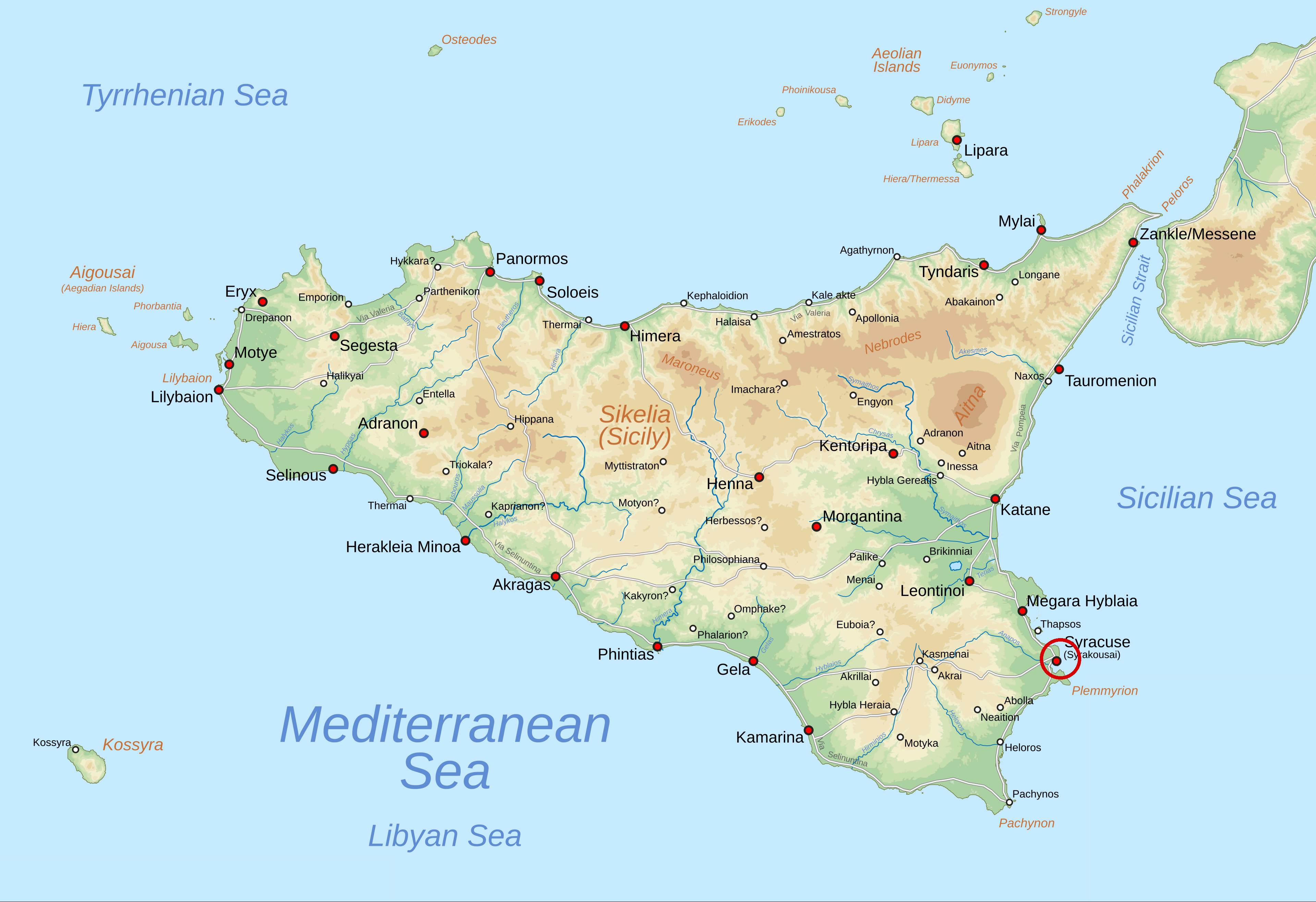
Ancient Sicily, with the Greek cities of the coasts and the native peoples of the interior. Syracuse (Syracusae) — circled in red — sits on the southeast coast, its heart the island of Ortygia with the spring of Arethusa, whose head this coin carries. Under Gelon the city became the capital of the Deinomenid tyranny and, after Himera (480 BC), the wealthiest power of the Greek West; Himera itself lies on the north coast, and Gela, Gelon’s first city, on the south coast to the west.
“Map of ancient Sicily” by Tomisti (Wikimedia Commons), File:Ancient Sicily map en.svg, licensed CC BY-SA 4.0; cities and roads based on the Digital Atlas of the Roman Empire (DARE) and Pleiades; topographic base © OpenMapTiles, © OpenStreetMap contributors (https://commons.wikimedia.org/wiki/File:Ancient_Sicily_map_en.svg; license: https://creativecommons.org/licenses/by-sa/4.0/). Modified by JSB Coins: rasterized from SVG to PNG, and a red circle added to mark Syracuse (the same marked copy used for this collection’s Hieron I tetradrachm). This derivative is shared under the same CC BY-SA 4.0 license.
If the dealer’s dating holds, this tetradrachm belongs to the founding decade of Syracusan greatness. In 485 BC Gelon, tyrant of Gela, seized Syracuse, moved his capital there, and made the city the strongest Greek power in Sicily; in 480 BC, at Himera, he and Theron of Akragas crushed a Carthaginian invasion in a victory the Greeks ranked beside Salamis. The war indemnity — Diodorus (11.26) reports 2,000 talents — poured through the Syracusan mint, and the quadriga/Arethusa tetradrachms of these years were struck in enormous quantity. They are the coins that carried the Deinomenid name across the Mediterranean. (Theron’s Akragas appears in this collection at the other end of its long duel with Carthage: a quarter-shekel struck under Carthaginian occupation in the Second Punic War, two and a half centuries after Himera.)
Graphic: JSB Coins (CC0); dates follow Diodorus and standard chronologies.
The two sides are a political program in miniature. The slow four-horse chariot with Nike descending to crown the team is the image of agonistic victory — the chariot race was the most aristocratic of all Greek competitions, and Gelon himself was an Olympic chariot victor (488 BC) before he was master of Syracuse. The reverse belongs to the city: the head of Arethusa, nymph of the freshwater spring on Ortygia around which Syracuse was founded, ringed by four dolphins for the harbor and the sea, with the civic legend ΣΥΡΑΚΟΣΙΟΝ. The pairing of dynastic glory and civic identity served both audiences at once — the scheme proved so durable that Syracuse kept it, through every change of regime, for over a century. That Gelon thought carefully about what his coins said is well documented: Lewis (GRBS 2019) shows him using another early Syracusan issue — the Alpheos/barley-grain tetradrachm — to advertise his Olympic chariot victory and his claim to Sicily.
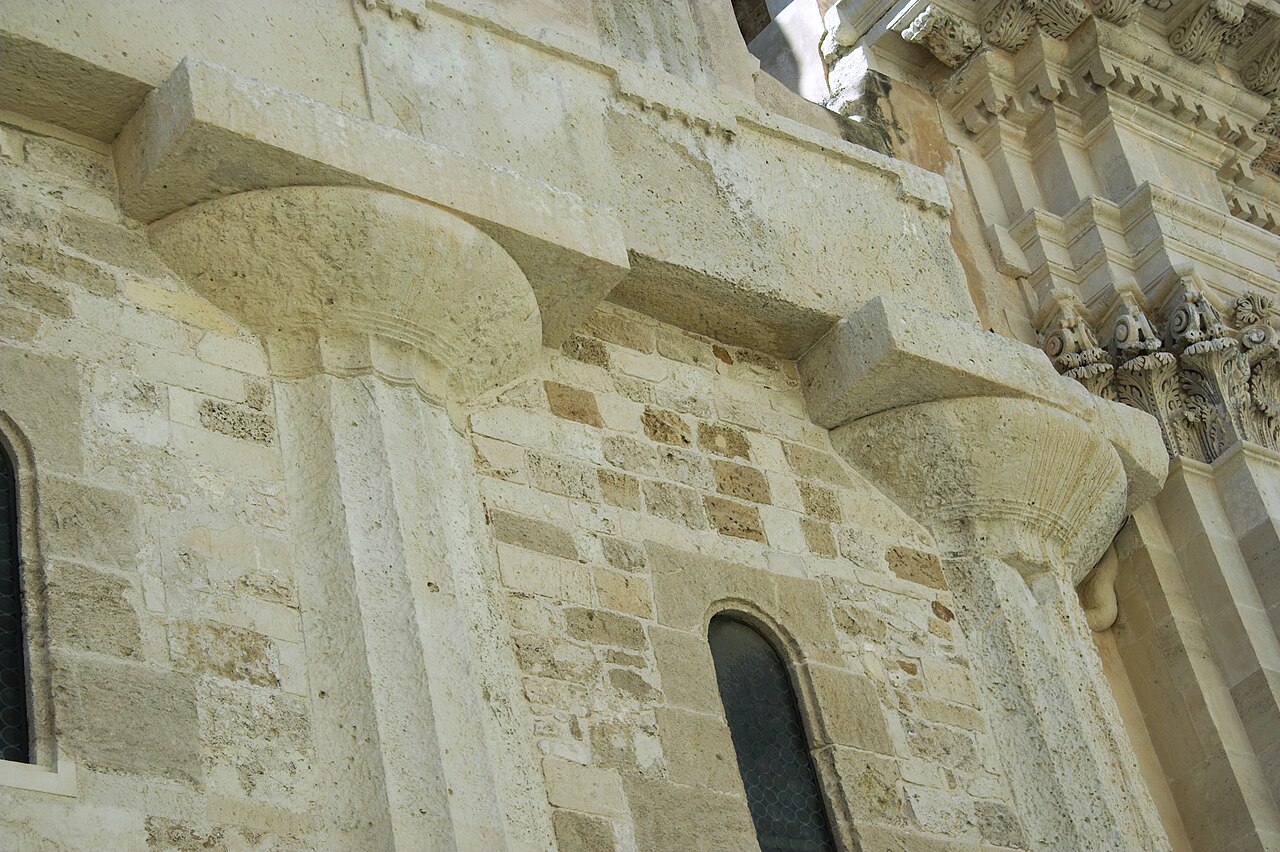
Photo: Zde, Wikimedia Commons, licensed CC BY-SA 4.0, reproduced unmodified.
The same windfall that fed the mint built in marble. Diodorus records that after Himera the Deinomenids poured the spoils into temple-building, and the great Doric Temple of Athena on Ortygia — raised in precisely these years, and traditionally connected with the Himera spoils — is the standing proof: converted to a church in the seventh century AD, it survives with its columns visible in the walls of the working cathedral of Syracuse, perhaps the longest continuously used sacred building in Europe. Coin and colonnade are two forms of the same silver.
The tag’s “485–478 BC” is the conventional trade dating for Gelon’s reign at Syracuse, and the coin’s fabric and style fit the early series. But the tag carries no catalogue reference, and the die corpus for this coinage — Boehringer’s Die Münzen von Syrakus (1929), which arranges the early tetradrachms in die-linked series — has not yet been consulted for this specimen. Until that die study is done, the Gelon attribution should be treated as plausible but unverified: the coin could equally belong a few years later in the Deinomenid sequence, alongside this collection’s die-attributed tetradrachm of Hieron I (Boehringer 320, c. 475–470 BC). The two pages are kept separate on the strength of the tags’ distinct attributions; a die identification would settle the relationship either way.
Syracuse struck on the Attic standard (tetradrachm of c. 17.2 g; Kraay, Archaic and Classical Greek Coins), the standard of Athens and the international maritime economy, and Deinomenid tetradrachms were the dominant currency of Greek Sicily. The scale of the Himera-indemnity coinage made Syracusan silver a Mediterranean currency and set the stage for the artistic flowering of the mint in the following decades — the engravers who would make Syracuse the most admired mint in the Greek world worked in the tradition these coins established.
Attribution: the dealer’s handwritten tag (Gelon, 485–478 BC); the attribution’s limits are set out above. Die corpus: E. Boehringer, Die Münzen von Syrakus (1929) — consultation pending. Design ideology under Gelon: the GRBS article cited in the references. Historical frame: Herodotus 7.153–167 (Gelon, Himera); Diodorus Siculus 11.20–26 (Himera, the indemnity, and the victory temples; Book 11 is linked in the references). On the Temple of Athena inside the cathedral, see the standard guides to Greek Sicily. Weight standard: C. M. Kraay, Archaic and Classical Greek Coins (1976).
Attic-standard tetradrachm (c. 17.2 g; cf. Kraay, Archaic and Classical Greek Coins). IMPORTANT: the 485–478 BC / Gelon attribution is the dealer's tag dating only — the classic trade dating for early quadriga/Arethusa tetradrachms — and has not been verified by die study. Without a Boehringer number the coin could sit anywhere in the early Deinomenid series; the collection's other Syracuse tetradrachm is die-attributed to Hieron I (c. 475–470 BC). Keep the two types distinct unless a die study shows otherwise.
John's Ancient Coin Collection · Type · syracuse-gelon-tetradrachm
Image credits for this coin — photographs, maps and graphics used on this page