Type · carthage-tanit-horse-palm-trishekel
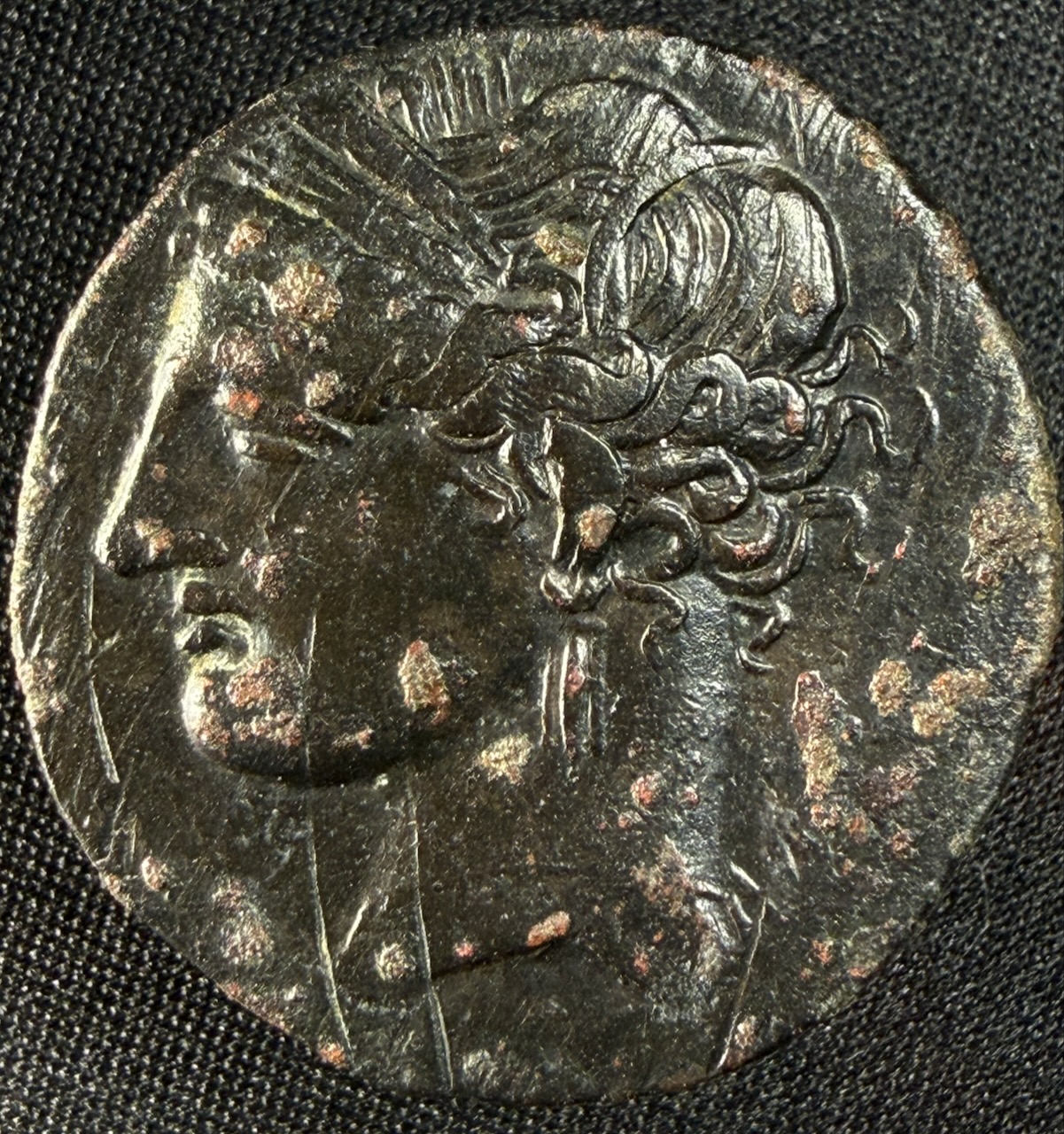
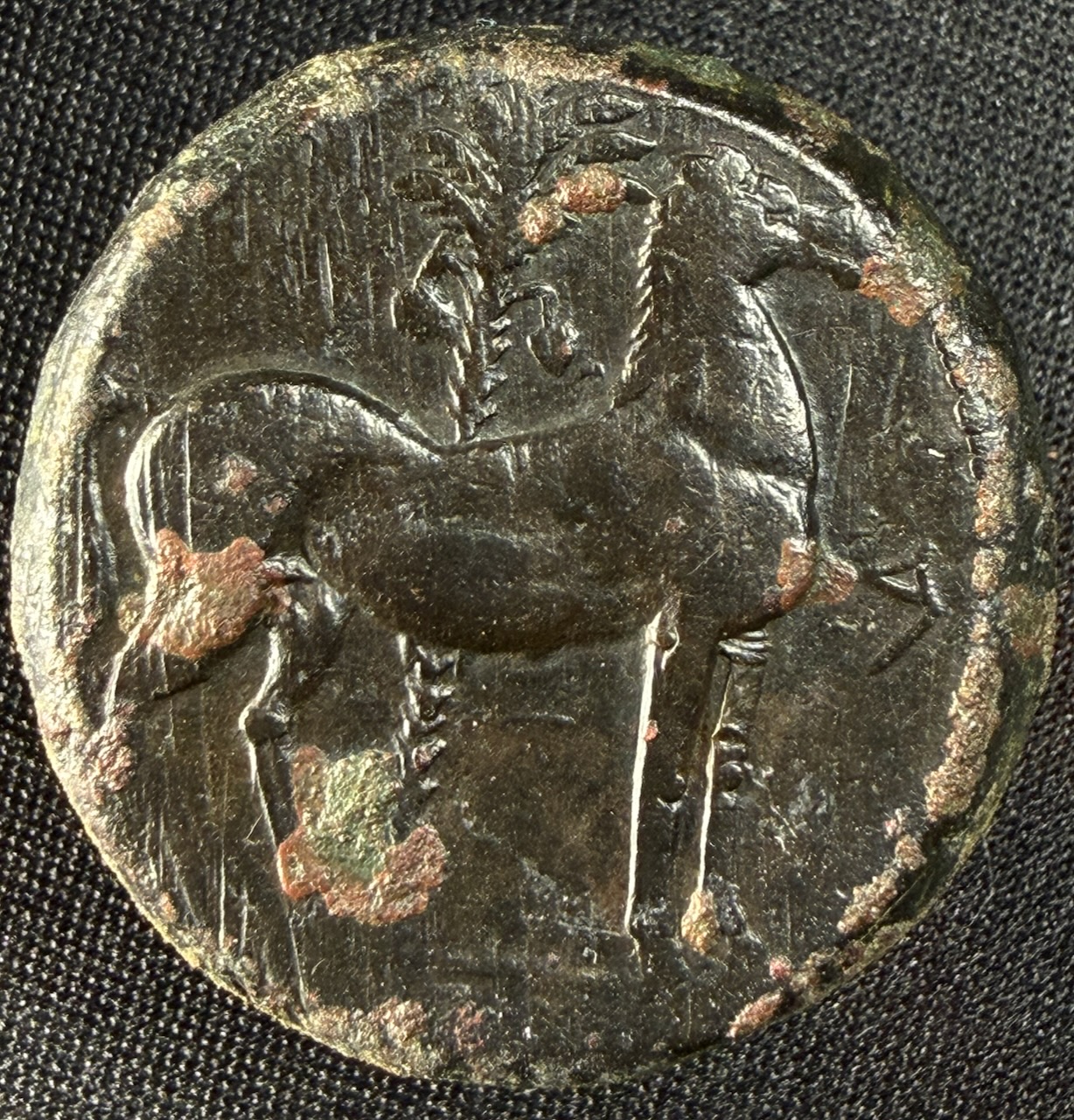
Current: Zeugitana, Carthage, Æ trishekel, c. 264–241 BC (First Punic War). Wreathed head of Tanit left / Horse standing right, palm tree behind, Punic letter bet (𐤁) in field. SNG Copenhagen 253–254 var.
Obverse: Head of Tanit (in the Persephone/Kore manner) left, wreathed with grain ears, wearing triple-pendant earring and pearl necklace
Reverse: Horse standing right, head raised; date palm with fruit clusters behind; Punic control letter bet (𐤁) in the field
Primary reference: SNG Copenhagen 253–254 var.
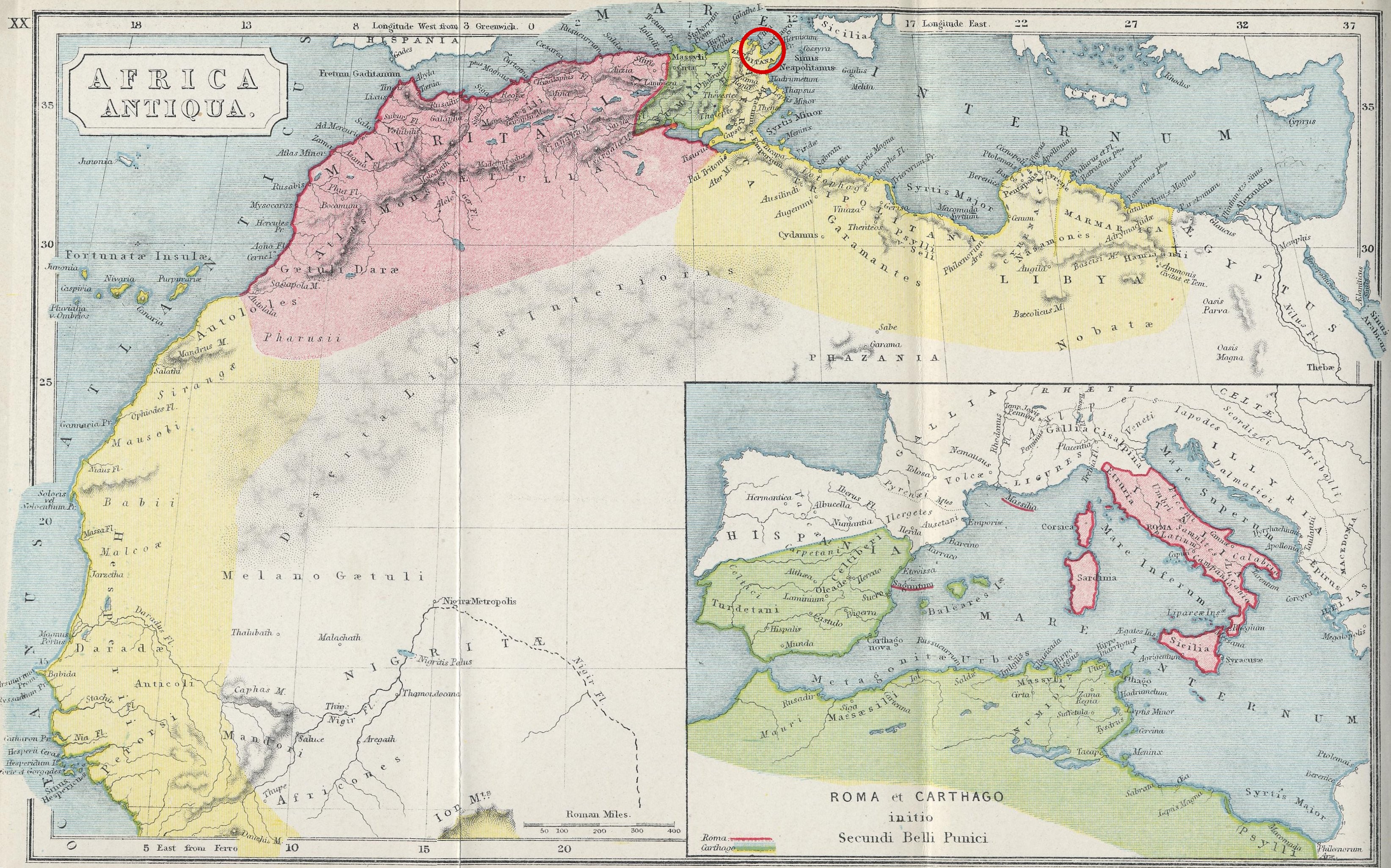
Roman North Africa in Samuel Butler’s classical atlas. Carthago is ringed in red, on the promontory at the head of the Gulf of Tunis, with ZEUGITANA — the district this coin is catalogued under — lettered across the peninsula behind it and Sicilia lying just across the strait at the top right. That short stretch of water is the whole subject of the coin: the First Punic War (264–241 BC) was fought for Sicily, and this bronze was struck while it was being fought.
One caution about the plate. The names it carries — Zeugitana, Africa, Numidia, Mauretania — are the Roman administrative geography of a later age, not the political map of 264 BC, when all of this was Carthaginian, Numidian or unclaimed. It is used here for the coastline and the city, which did not move.
The Africa plate from Samuel Butler, The Atlas of Ancient and Classical Geography, Ernest Rhys ed. (Everyman’s Library, J. M. Dent, 1907). Public domain — published 1907, and Butler died in 1902. Scan via Wikimedia Commons, Category:The Atlas of Ancient and Classical Geography by Samuel Butler (https://commons.wikimedia.org/wiki/Category:The_Atlas_of_Ancient_and_Classical_Geography_by_Samuel_Butler). The exact Commons file page for this individual plate has not been pinned down and should be, so that the credit points at the file rather than the category. Modified by JSB Coins: one red ring added to mark Carthago; the inset is a crop of the same plate, otherwise unmodified. The unmarked original is kept at maps/Africa_Antiqua_Butler_1907.jpg.
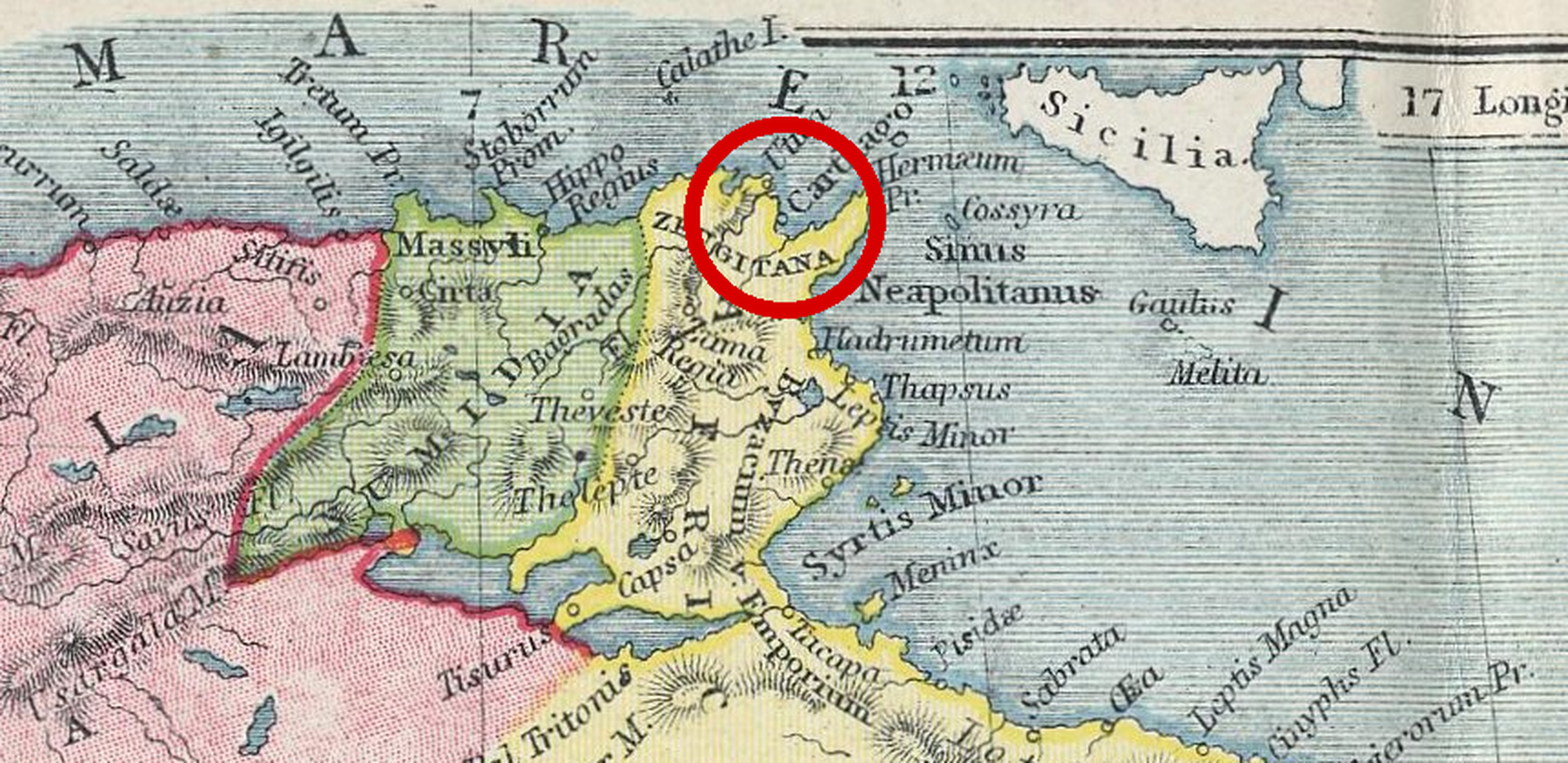
Detail: Carthago on its promontory, Utica to the west, Hermaeum Pr. (Cape Bon) closing the gulf to the east, and Sicilia across the water.
The large bronze coinages of Carthage carry, with almost monotonous insistence, two images: the wreathed head of a goddess and a standing horse. Both were charged with civic and religious meaning, and both ran continuously across the Punic world from the late fourth century down to the destruction of the city in 146 BC. This piece belongs to the heavy-bronze tradition of the third century — the coinage of a maritime empire that, in these very decades, fought Rome twice for the mastery of the western Mediterranean.
The female head is conventionally called Tanit, the chief goddess of Carthage, though her features were borrowed wholesale from the Persephone (Kore) of Syracusan and wider Sicilian coinage — the wreath of grain ears, the triple-pendant earring, the necklace of pearls. The borrowing was deliberate: Carthage minted its first coins in Sicily, for Sicilian purposes, and adopted the visual language its Greek neighbors and mercenaries already understood. Over time the Greek goddess of grain was assimilated to the Punic Tanit, patroness of the city, so that the same image served two religious vocabularies at once. The Syracusan side of Carthage’s long Sicilian confrontation is represented in this collection by the bronze of King Agathokles, the ruler who, a generation before the wars with Rome, carried the fight to Africa itself.
The reverse horse is the emblem of Carthage par excellence. Punic foundation legend held that when the settlers dug the ground of the new city they unearthed a horse’s head, an omen of martial prowess and prosperity, and the animal became the city’s badge. Behind or beside the horse stands a date palm heavy with fruit. The pun is almost certainly intentional: the Greek word phoinix meant both “date palm” and “Phoenician,” so the tree on the coin is a visual signature — the Phoenicians’ tree, marking the Phoenicians’ coin. On this type the horse stands quietly with head raised, the palm rising behind it, a small Punic control letter — here bet (𐤁) — placed in the field to mark the series or workshop.
Carthaginian money was unusual among the great Mediterranean powers in how heavily it leaned on bronze and billon rather than on a flood of fine silver. Gold and electrum staters served large state payments; silver and billon shekels did the heavier commercial and military work; and a substantial bronze coinage handled everyday transactions, garrison pay, and provincial circulation, especially in Sardinia and Sicily, the islands Carthage held or contested. That bronze tradition began a century and more earlier with the small Tanit / horse-and-palm units of c. 400–350 BC — see this collection’s bronze unit of the same design pair — whose badges this heavy piece carries on unchanged. The denomination written on this coin’s tag, “trishekel,” reflects the convention of naming the largest bronzes as multiples of the shekel; the precise metrology of Punic bronze is still debated, and dealers and scholars differ on whether a given heavy piece is a “trishekel,” a “double shekel,” or simply a large unit.
The tag for this specimen follows SNG Copenhagen 253–254, which places the type in the First Punic War, c. 264–241 BC, and — in the Copenhagen arrangement — at a Sardinian mint, where Carthage struck abundant Tanit/horse bronze during the long struggle with Rome over Sicily. That war ended in 241 BC with the loss of Sicily and a crushing indemnity; the Mercenary (Libyan) Revolt and the loss of Sardinia followed immediately, and within a generation Carthage rebuilt its strength in Spain under the Barcids and returned to war with Rome under Hannibal (218–201 BC). The bronze of that second war is in the collection too — a wartime Æ shekel of c. 221–210 BC whose horse stands alone, the palm dropped from the design — and so is the last Punic silver struck on Sicilian soil, the Akragas quarter-shekel of the occupation of 213–210 BC, whose free horse is this same civic badge gone to war.
It is worth recording that this individual coin sits at the boundary between two closely related series. Its heavy weight (18.97 g), its “trishekel” size, and its bet control letter match very precisely the large Second Punic War heavy bronzes catalogued as SNG Copenhagen 340–344 (MAA 84; CNP 164), c. 221–202 BC, struck at Carthage or in Italy and frequently bearing a Punic B before the horse. Current auction records support the fit: a CNG-sold Second Punic War trishekel of this iconography (c. 220–215 BC, 30 mm, 17.81 g; SNG Copenhagen 341–3, CNP 164b, MAA 84b) sits in the same module and weight bracket as this specimen’s 18.97 g. The two groups share the same iconography and differ mainly in module, weight, and the scholarly framework used to date them. The dealer’s First Punic War attribution is preserved here as the working identity — and it has since gained professional support: when this very specimen appeared at CNG Electronic Auction 594 (August 2025; see the specimen page), CNG catalogued it as First Punic War, Carthage mint, CNP 188 var. / MAA 45 var. / SNG Copenhagen 253–4 var., noting that its bet is an unlisted letter for the type in all three references. The Second Punic War heavy-bronze alternative remains flagged in the specimen’s open research threads, since it materially affects both date and mint.
Photo: Emna Mizouni, Wikimedia Commons, licensed CC BY-SA 4.0, reproduced unmodified.
If the First Punic War attribution is right, this bronze belongs to the most expensive war fought anywhere in the ancient world to that date. Polybius — whose first book is the primary narrative — reckoned it the greatest war in history for sustained scale: twenty-three years (264–241 BC), fleets of hundreds of quinqueremes on each side, and losses at sea, mostly to storms, that he puts at some 700 Roman and 500 Carthaginian warships. Both states hit financial bottom. Rome’s citizens famously financed the final fleet by private subscription when the treasury was empty (Polybius 1.59); Carthage, defeated at the Aegates Islands in 241, took peace at the price of Sicily plus an indemnity of 3,200 talents — 1,000 down and the rest over ten years (1.62–63). The sequel shows what the strain meant in coin: the mercenary army shipped home from Sicily could not be paid, and the haggling over arrears exploded into the Mercenary or “Truceless” War of 241–237 BC (1.65–88), which came closer to destroying Carthage than Rome ever had. Heavy civic bronze of this class — token money, its face value guaranteed by the state rather than its metal — is precisely the currency of a treasury stretched past its silver, whether it paid dock-hands at the cothon or garrisons in Sardinia; and Sardinia’s own revolt in the mercenary crisis, ending in Roman annexation in 238/237 BC, is why the Copenhagen sylloge’s “Sardinian mint” attribution for this series carries such historical weight.
Whether struck during the first war or the second, this is the coinage of Carthage at the height of its conflict with Rome — money that paid the mercenary armies and provisioned the fleets of the only power that ever seriously rivalled Rome for control of the western Mediterranean. The grain-crowned goddess and the horse beneath the palm are among the most recognisable images of the pre-Roman Mediterranean, and large bronzes of this kind are the most accessible surviving artifacts of a civilisation whose own literature was almost entirely destroyed. They are, in a real sense, Carthage speaking in its own images.
In depth: the story of these coins, the battle of Cannae, and the full reference coinage of both sides is told in the article Hannibal’s War Money.
SNG Copenhagen, Sylloge Nummorum Graecorum, The Royal Collection of Coins and Medals, Danish National Museum: North Africa (Zeugitana, Carthage), nos. 253–254 and 340–344. L. Müller, Numismatique de l’Ancienne Afrique, vol. 2 (Carthage). G. K. Jenkins and R. B. Lewis, Carthaginian Gold and Electrum Coins (for the broader series and chronology). Standard handbooks on Punic bronze metrology (CNP; MAA) for the trishekel question. General historical context: Polybius, Book 1 (the war, its costs, the indemnity of 3,200 talents, and the Truceless War: 1.58–88, linked in the references); Appian, Punic Wars 96 (the military harbor; linked in the references); on the war’s naval scale, Polybius 1.63 with the standard modern accounts (Lazenby, The First Punic War, 1996; Goldsworthy, The Fall of Carthage, 2003).
Large Tanit / horse-and-palm bronze of Carthage. SNG Copenhagen catalogues the 253–254 series under the First Punic War (c. 264–241 BC) at a Sardinian mint. NOTE a live attribution question: the heavy recorded weight (18.97 g on the specimen), the 'trishekel' denomination, and the bet (𐤁) control letter correspond closely to the larger Second Punic War heavy-bronze trishekels (SNG Cop 340–344; MAA 84; CNP 164, c. 221–202 BC, Carthaginian or Italian mint, often with Punic B before the horse). CNG's EA 594 cataloguing of the collection's specimen (lot 19, Aug 2025) comes down on the First Punic War side: 'Circa 264-241 BC. Carthage mint. CNP 188 var. (unlisted letter on rev.); MAA 45 var. (same); SNG Copenhagen 253–4 var. (same)' — note CNG reads the bet as UNLISTED in all three references, making this a scarcer letter variety. The palm-tree reverse is the standard Carthaginian self-referential type (Greek phoinix = both 'palm' and 'Phoenician').
John's Ancient Coin Collection · Type · carthage-tanit-horse-palm-trishekel
Image credits for this coin — photographs, maps and graphics used on this page