Type · pharsalos-athena-horse-head-hemidrachm
Current: Thessaly, Pharsalos, AR hemidrachm, c. 370–340 BC (Lavva 126, V58/R73; BCD Thessaly II 655; HGC 4, 634)
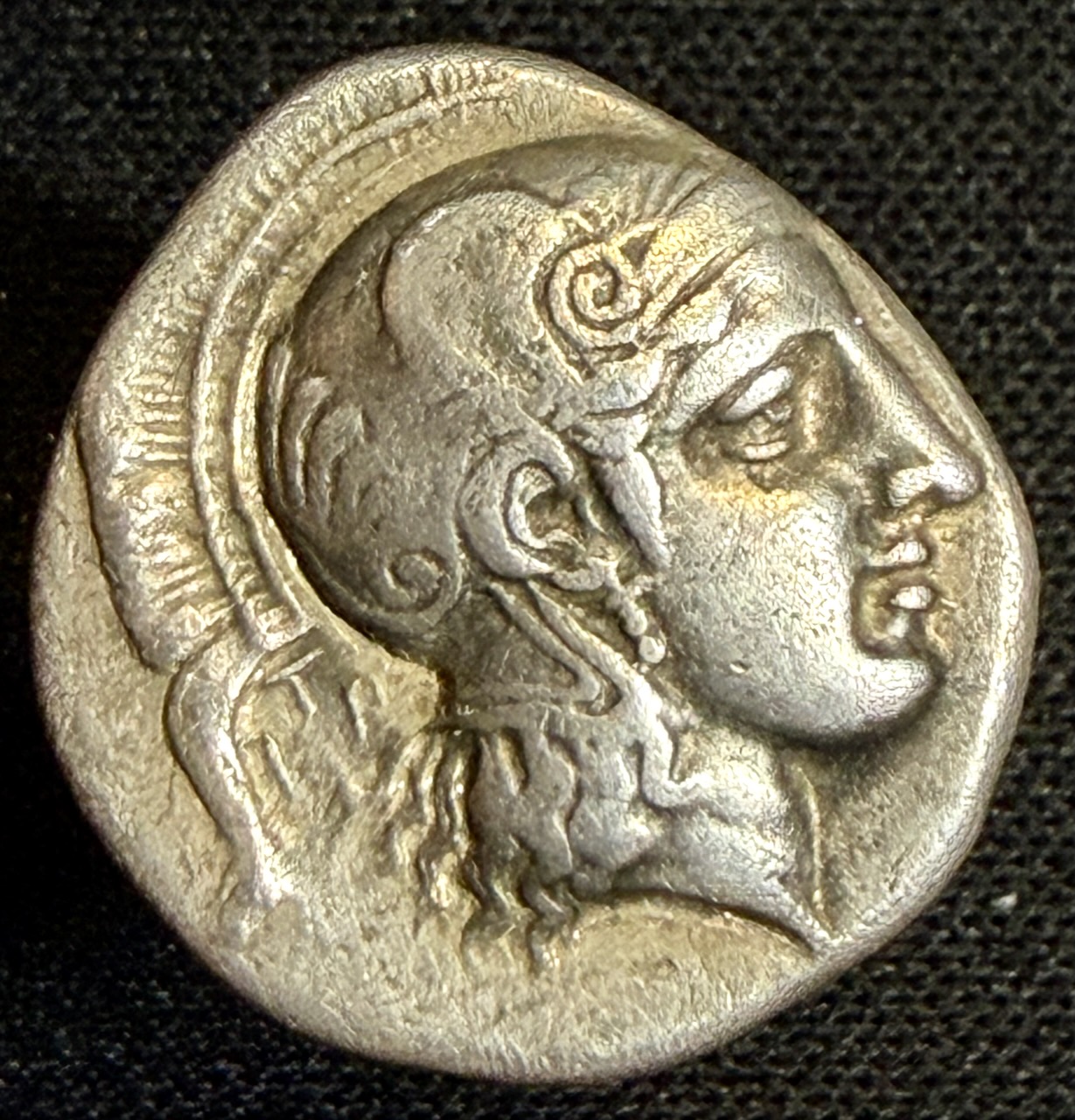
Obverse: Head of Athena right, wearing pendant earring and crested Attic helmet with raised cheek flaps, adorned with scrolls, hair out from under the neck guard; T (the master engraver Telephantos) over ΙΠ (his apprentice?) behind neck
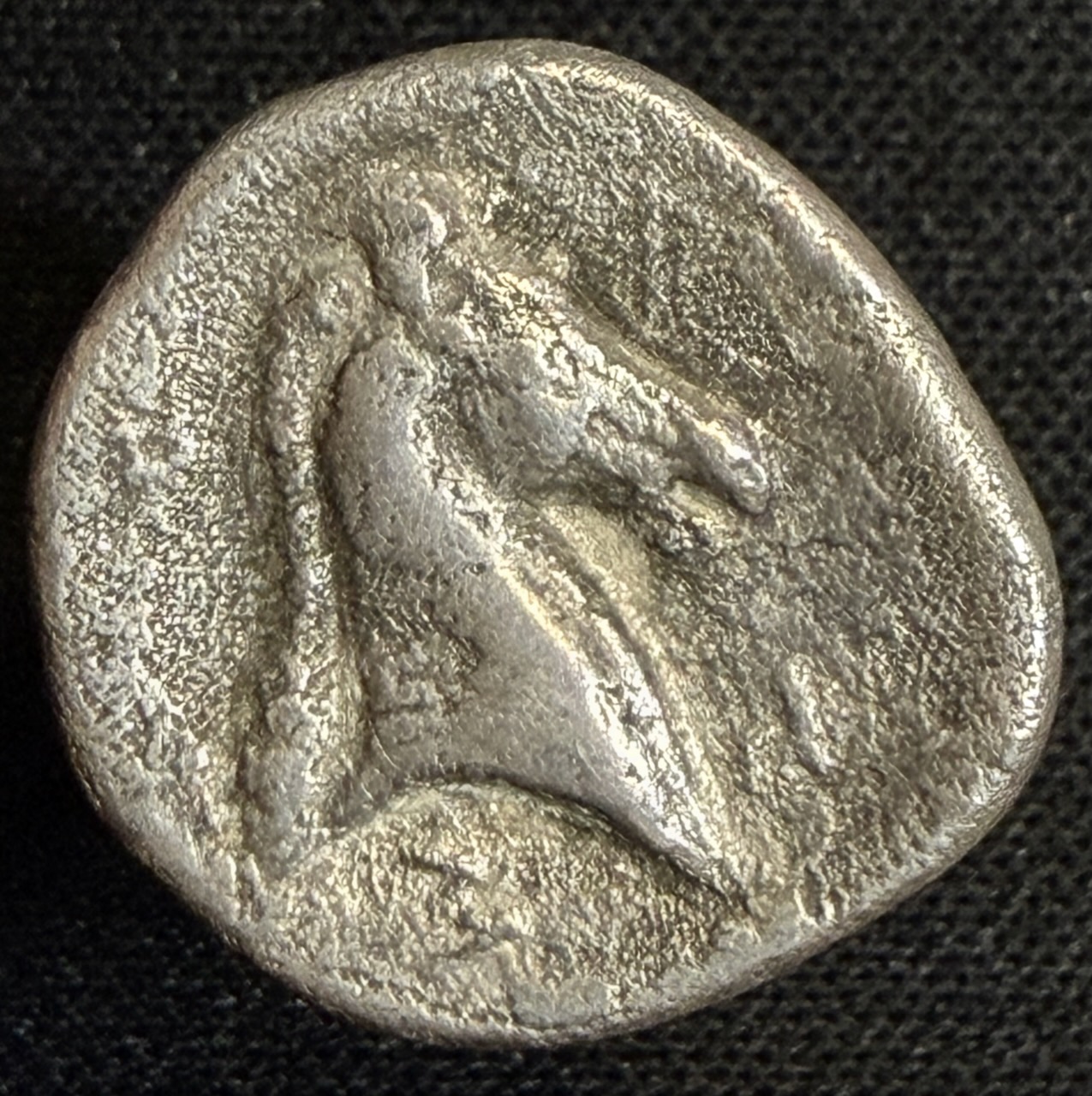
Reverse: Horse's head and neck right, concave field
Primary reference: Lavva 126 (V58/R73)
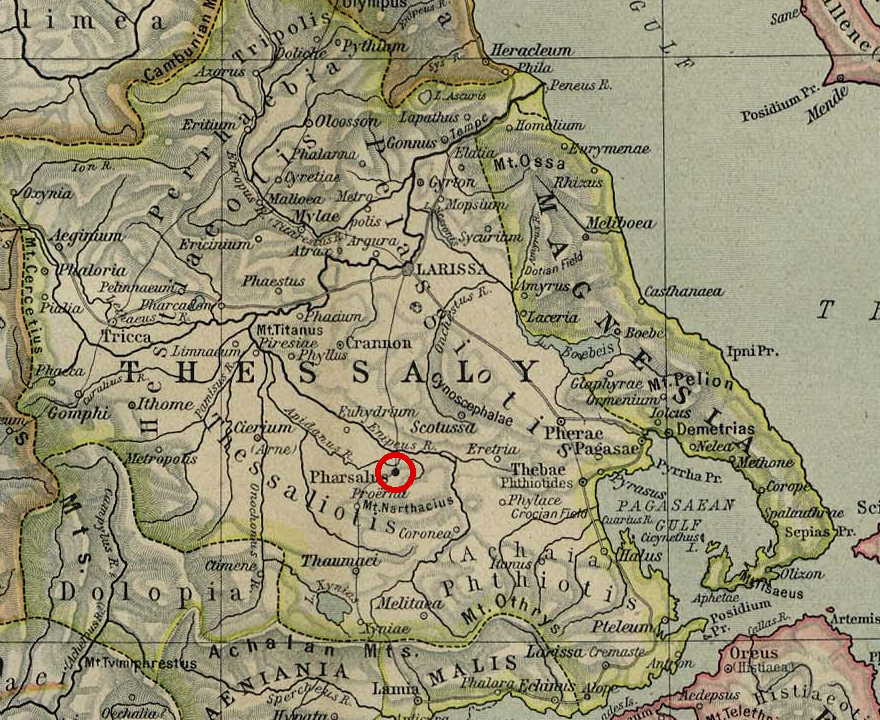
Thessaly on Shepherd’s reference map of northern ancient Greece. Pharsalus — circled in red — commands the southern edge of the Thessalian plain above the Enipeus valley, in the district that ancient tradition identified with Homeric Phthia, home of Achilles. Larissa, its great rival, lies to the north across the plain; Pherae toward the Pagasaean Gulf to the east. The town’s name is written along the road running past Mt. Narthacius — the hill country from which the city looked down on the battlefield of 48 BC.
“Reference Map of Ancient Greece, Northern Part,” from William R. Shepherd, Historical Atlas (1926 edition) — public domain; scan from the Perry-Castañeda Library Map Collection. Courtesy of the University of Texas Libraries, The University of Texas at Austin (https://maps.lib.utexas.edu/). Modified by JSB Coins: cropped to Thessaly, and a red circle added to mark Pharsalos.
Few Greek fractional coins carry as much art in as little silver as the hemidrachms of Pharsalos. On the obverse, Athena turns her helmeted head to the right, the raised cheek-flaps and scroll ornament of her Attic helmet rendered with a delicacy that led the cataloguers of the BCD collection to speak of dies “of the finest style”; on the reverse a horse’s head and neck, the emblem of the Thessalian plain, fills a gently concave field inside the clockwise ethnic ΦΑΡΣ. Behind Athena’s neck stand two tiny groups of letters, T over ΙΠ — not a legend but signatures, the marks of the hands that cut the die. This combination of civic badge and artist’s pride makes the Pharsalos series one of the touchstones for the study of die engravers in classical Greece.
Pharsalos, built against the hills at the southern rim of the great Thessalian plain, was one of the four leading cities of Thessaly, and ancient tradition placed in its district the Homeric Phthia of Achilles — an association a horse-proud aristocracy will not have discouraged. In the Persian Wars the city sided with the Athenians, and through the fifth century it remained one of the pillars of the loose Thessalian federation alongside its northern rival Larissa and plain-country neighbors like Krannon — a federation Rome would later revive as the Thessalian League, whose bronze kept the horse-and-Athena imagery of cities like Pharsalos. The first half of the fourth century, the period in which this coin was struck, was Thessaly’s most turbulent: Xenophon (Hellenica 6.1) preserves the story of Polydamas of Pharsalos, so trusted by his fellow citizens that they placed the acropolis and the city’s revenues in his hands, and his unavailing embassy to Sparta when Jason, tyrant of Pherae, forced Pharsalos into his new Thessalian order about 375 BC. Jason’s assassination in 370 BC threw the region back into strife between the Pheraean tyrants and the cities, resolved only when the Thessalians called in Philip II of Macedon, who crushed the Phokian-Pheraean alliance at the Crocus Field (353/352 BC — the year is disputed) and by 344 BC had reorganized Thessaly under Macedonian control (see the bronze of Philip II in this collection). Centuries later the city’s name became a byword for the end of the Roman Republic: the plain below Pharsalos was the scene of the final battle between Caesar and Pompey in 48 BC.
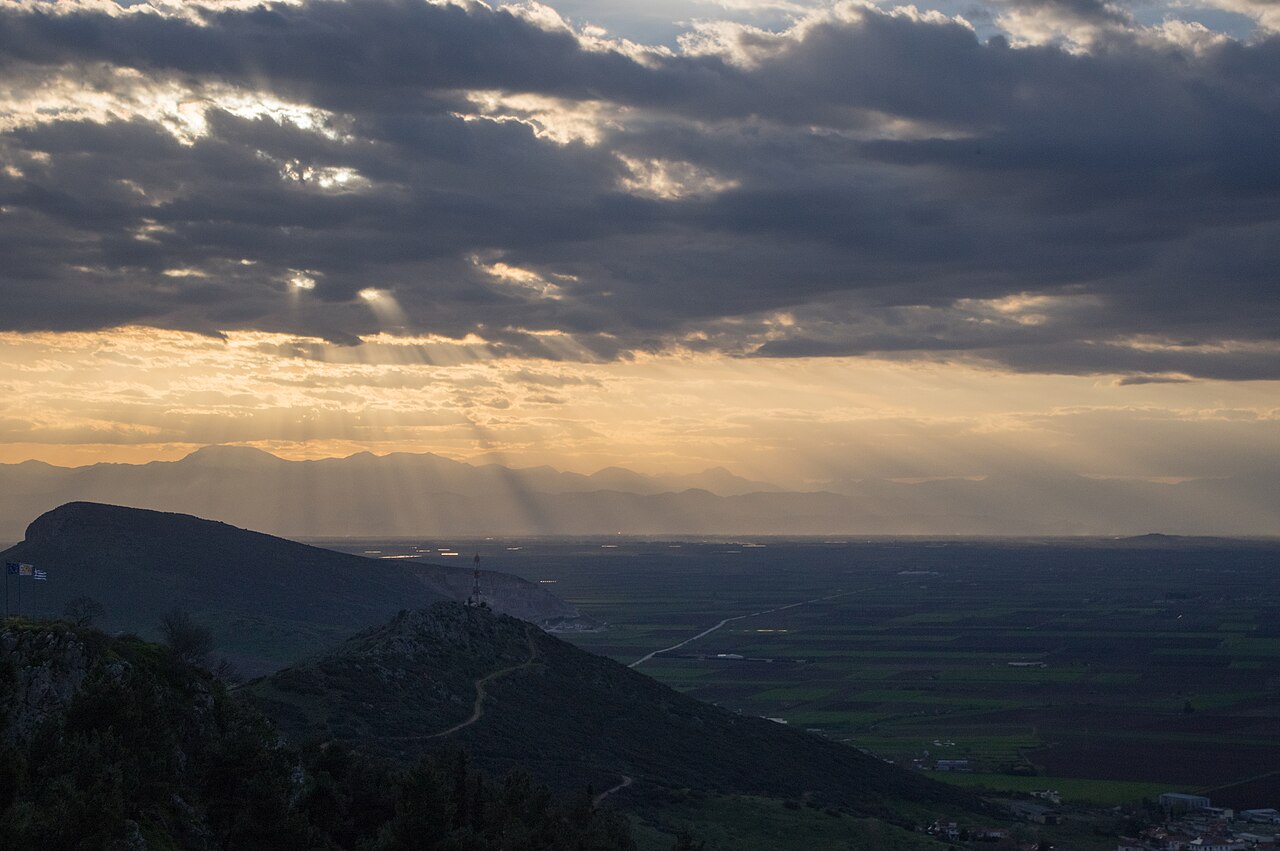
Photo: Robin Rönnlund, Wikimedia Commons, licensed CC BY-SA 4.0, reproduced unmodified.
The types are the city in miniature. The helmeted Athena is the armed patron goddess appropriate to a community that prided itself on its cavalry, and the horse protome on the reverse advertises the wealth that made Thessaly famous — the horse-breeding plain itself. Pharsalos struck on the Aeginetic weight standard shared across Thessaly and much of central Greece (hemidrachm/triobol of c. 2.9 g; cf. Hoover, HGC 4), the standard also used by neighbors like Phokis to the south. The hemidrachm — half a drachm, three obols — was everyday money, the denomination of the marketplace rather than of interstate trade, and Pharsalos produced it in quantity across the late fifth and fourth centuries with remarkable conservatism: the Athena/horse-head pairing persisted for generations while style evolved from severe to fully classical. Hoover rates this variety Scarce (HGC 4, 634 [S]).
What sets the Pharsalian series apart is its signatures. Lavva’s die corpus (2001) assembles the evidence: one obverse die carries the name ΤΗΛΕΦΑΝΤΟ written in full, and the initials T or TH appear on a series of further dies — as here, where T stands over a second group, ΙΠ. Lavva reads T as the master engraver Telephantos signing his work, takes the second monogram for a collaborator or apprentice, and goes further, identifying the man with the sculptor Telephanes of Phokaia mentioned by Pliny the Elder — an identification on which she hangs the absolute chronology of the whole signed group. Her reviewers were not persuaded: Fischer-Bossert (Numismatic Chronicle 163, 2003) accepts the signatures as those of die-cutters but is skeptical of the equation with Pliny’s sculptor and of the chronological weight Lavva places on it. The dealer’s attribution of this coin follows the mainstream reading — “T (the master engraver Telephantos) over ΙΠ (his apprentice?)” — with the question mark where it belongs. Who ΙΠ was, and whether Telephantos was anyone Pliny ever heard of, remain open questions.
The absolute dates of the signed group are likewise contested, and the positions differ by a full half-century. Lavva ties the signed dies to the working life of her Telephantos/Telephanes in the later fifth century, and dealers following her framework date signed Pharsalian silver to c. 424–405 BC. The BCD Thessaly catalogue (Triton XV, 2012) and the dealer’s attribution of this specimen place the type at c. 370–340 BC, in the generation of Polydamas, the Pheraean tyrants, and Philip’s intervention. This page follows the dealer’s c. 370–340 BC dating while flagging that the chronology of Pharsalos’ classical silver is genuinely unsettled — Fischer-Bossert’s review makes the case that the signature-based chronology, in particular, cannot bear the weight placed on it.
Attribution and dies: S. Lavva, Die Münzprägung von Pharsalos (Saarbrücken, 2001), no. 126, dies V58/R73; BCD Thessaly II (Classical Numismatic Group, Triton XV, 3 January 2012), lot 655; O. Hoover, Handbook of Greek Coinage vol. 4 (HGC 4), no. 634 (Scarce; Aeginetic standard). Signatures and their criticism: Lavva, op. cit.; W. Fischer-Bossert, review of Lavva, Numismatic Chronicle 163 (2003), pp. 399–405. Historical context: Xenophon, Hellenica 6.1 (Polydamas of Pharsalos and Jason of Pherae); the dealer’s description (Forum Ancient Coins, GS84796) for the city’s history and the 48 BC battle.
Struck on the Aeginetic weight standard used throughout Thessaly (hemidrachm/triobol of c. 2.9 g; cf. Hoover, HGC 4). Hoover rates the type Scarce (HGC 4, 634 [S]). The obverse dies of this group carry engravers' signatures — here T over ΙΠ behind Athena's neck; Lavva's die study reads T as the master engraver Telephantos, whose full signature survives on a single die, with ΙΠ possibly an apprentice or second hand. The identification and the chronology built on it are contested (see essay).
John's Ancient Coin Collection · Type · pharsalos-athena-horse-head-hemidrachm
Image credits for this coin — photographs, maps and graphics used on this page