Type · larissa-taurokathapsia-drachm
Current: Thessaly, Larissa, AR drachm, late taurokathapsia group, c. 400–380 BC (BCD Thessaly II 372.10, same dies)
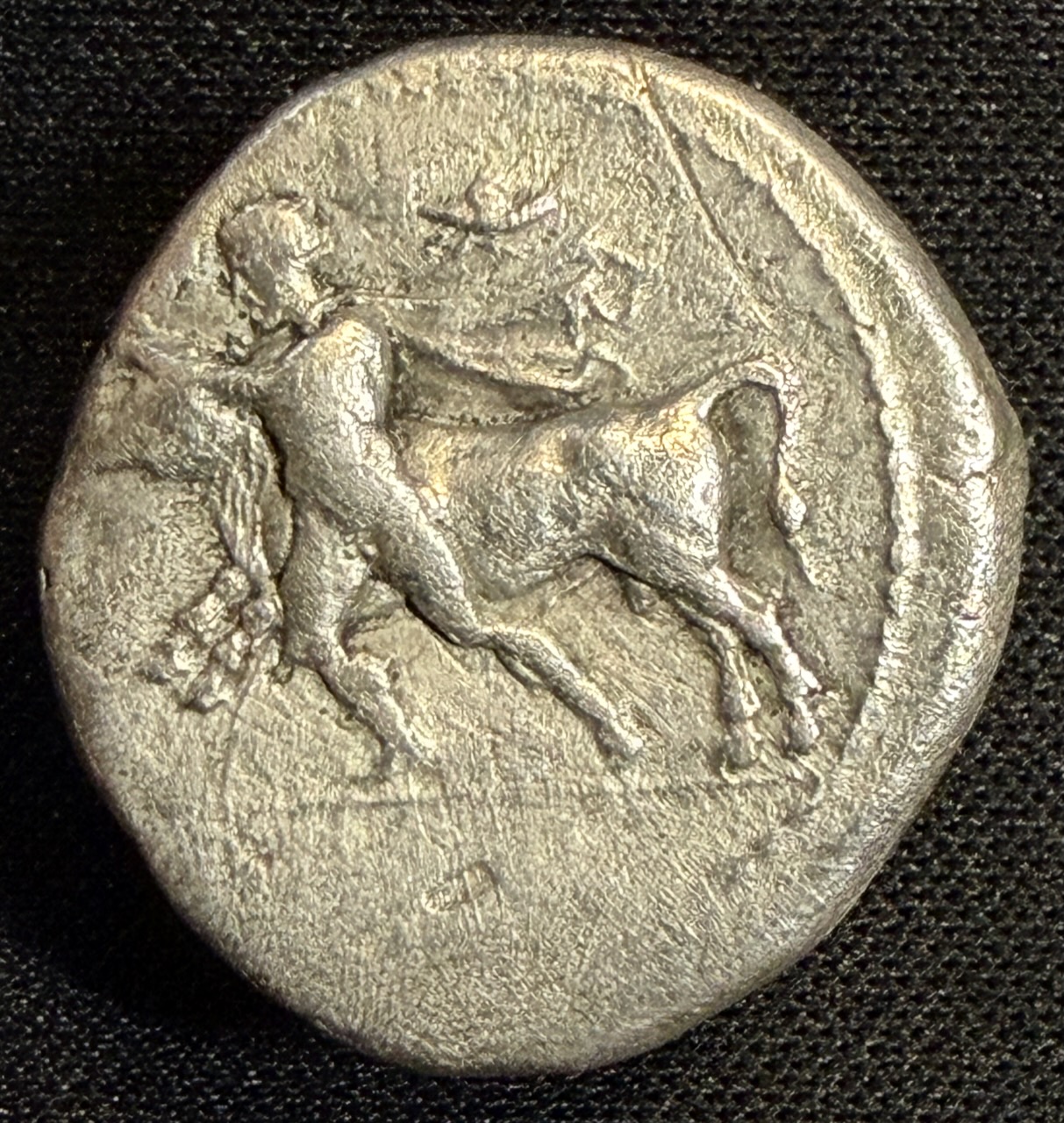
Obverse: Thessalos to left, nude but for chlamys over his shoulders, his petasos attached to a cord around his neck and flying in the air behind him, restraining a bull leaping left by a band held in both hands around its forehead; all within a border of dots
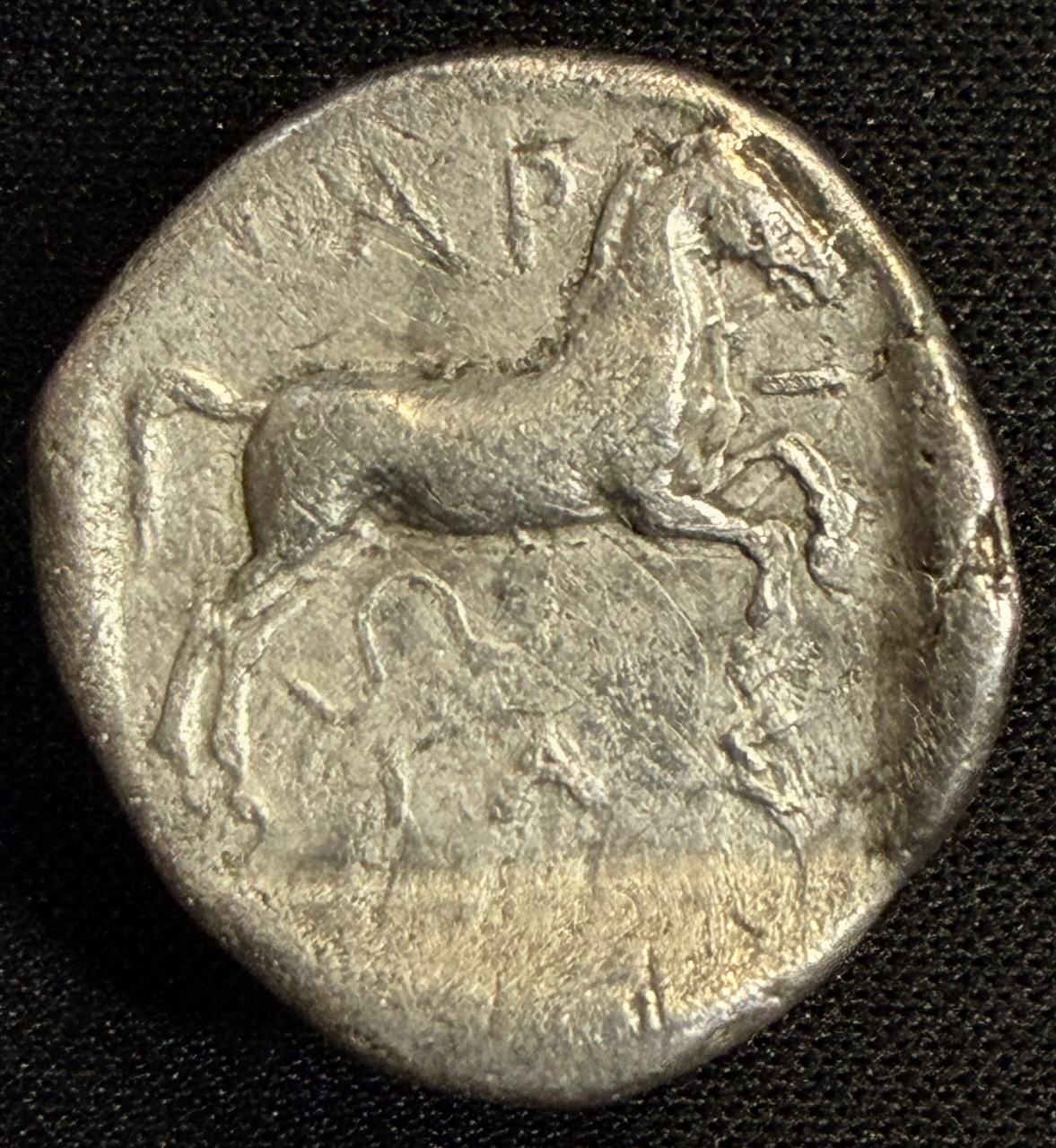
Reverse: Bridled horse with trailing rein prancing right, no ground line, all within a shallow incuse square
Primary reference: BCD Thessaly II 372.10
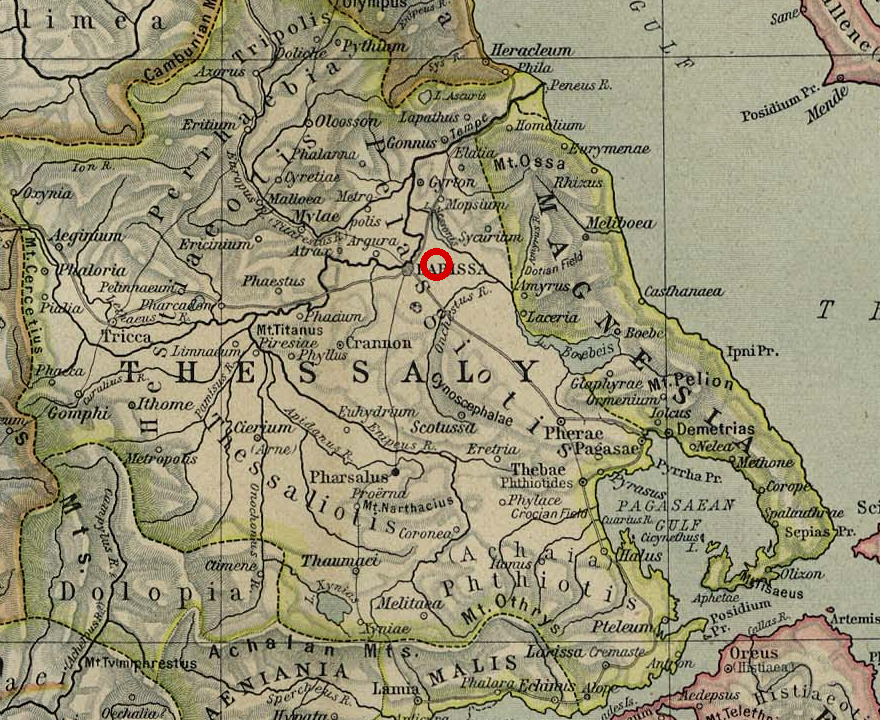
Thessaly on Shepherd’s reference map of northern ancient Greece. Larissa — circled in red — sits on the Peneios in the middle of the great Thessalian plain, the horse- and cattle-country that made the bull-games imagery of its coinage a statement of regional identity. Around it lie the rival Thessalian cities that struck related types: Pherae to the southeast, Krannon and Pharsalos to the south, with the Magnesian coast and Mt. Ossa closing the plain toward the Aegean.
Main map: “Reference Map of Ancient Greece, Northern Part,” from William R. Shepherd, Historical Atlas (1926 edition) — public domain; scan from the Perry-Castañeda Library Map Collection. Courtesy of the University of Texas Libraries, The University of Texas at Austin (https://maps.lib.utexas.edu/). Modified by JSB Coins: cropped to Thessaly, and a red circle added to mark Larissa. Second map: “Map showing the Greek world during the Greco-Persian Wars (ca. 500–479 BC)” by Bibi Saint-Pol (Wikimedia Commons), File:Map Greco-Persian Wars-en.svg, licensed CC BY-SA 3.0 (https://commons.wikimedia.org/wiki/File:Map_Greco-Persian_Wars-en.svg; license: https://creativecommons.org/licenses/by-sa/3.0/). Modified by JSB Coins: rasterized from SVG to PNG, and a red circle added to mark Larissa. This derivative is shared under the same CC BY-SA 3.0 license.
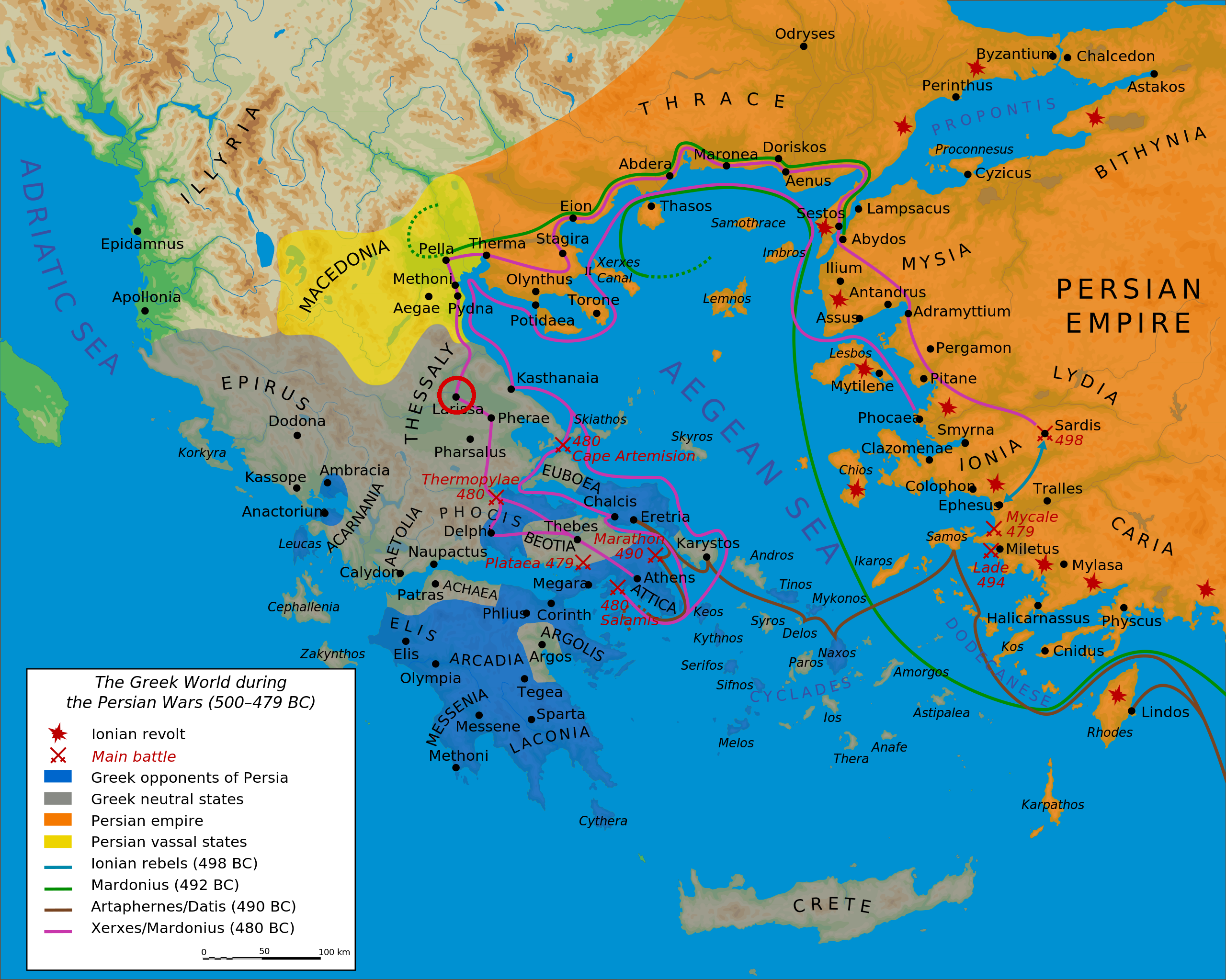
The wider Greek world two to three generations before this drachm was struck: the Greco-Persian Wars, c. 500–479 BC. Larissa — circled in red — shows Thessaly’s exposed position astride the invasion route from Macedonia; the Aleuadai of Larissa notoriously sided with Xerxes in 480 BC.
Among the most evocative of all Greek civic coinages, the fifth- and early fourth-century silver of Larissa puts on a coin what a visitor to the Thessalian plain would actually have seen at festival time: the taurokathapsia, the bull-wrestling contest in which a rider chased a bull on horseback, leapt from the saddle onto the animal’s neck, and wrestled it to the ground by the horns. The obverse of this drachm freezes the climax — a nude athlete, cloak flying, hauling on a band looped around the forehead of a leaping bull — while the reverse shows the other actor in the drama, the rider’s horse galloping free with its rein trailing after the leap was made. The two sides of the coin are two moments of the same event, a piece of narrative design rare in archaic and classical numismatics.
Larissa, on the Peneios river in the heart of the Thessalian plain, was the seat of the Aleuadai, the aristocratic clan that dominated Thessalian politics for much of the fifth century BC. Thessaly’s wealth was its land — grain, cattle, and above all the horses that made Thessalian cavalry famous throughout Greece — and its games celebrated exactly these things. The bull-games were held in honor of Poseidon Taureos, the god of horses and herds; scenes of the event appear on the coins of several Thessalian cities, but Larissa made the type its civic signature, striking drachms and fractions with taurokathapsia scenes for the better part of a century. The imagery advertised not merely a festival but the martial, equestrian identity of the Thessalian aristocracy itself.
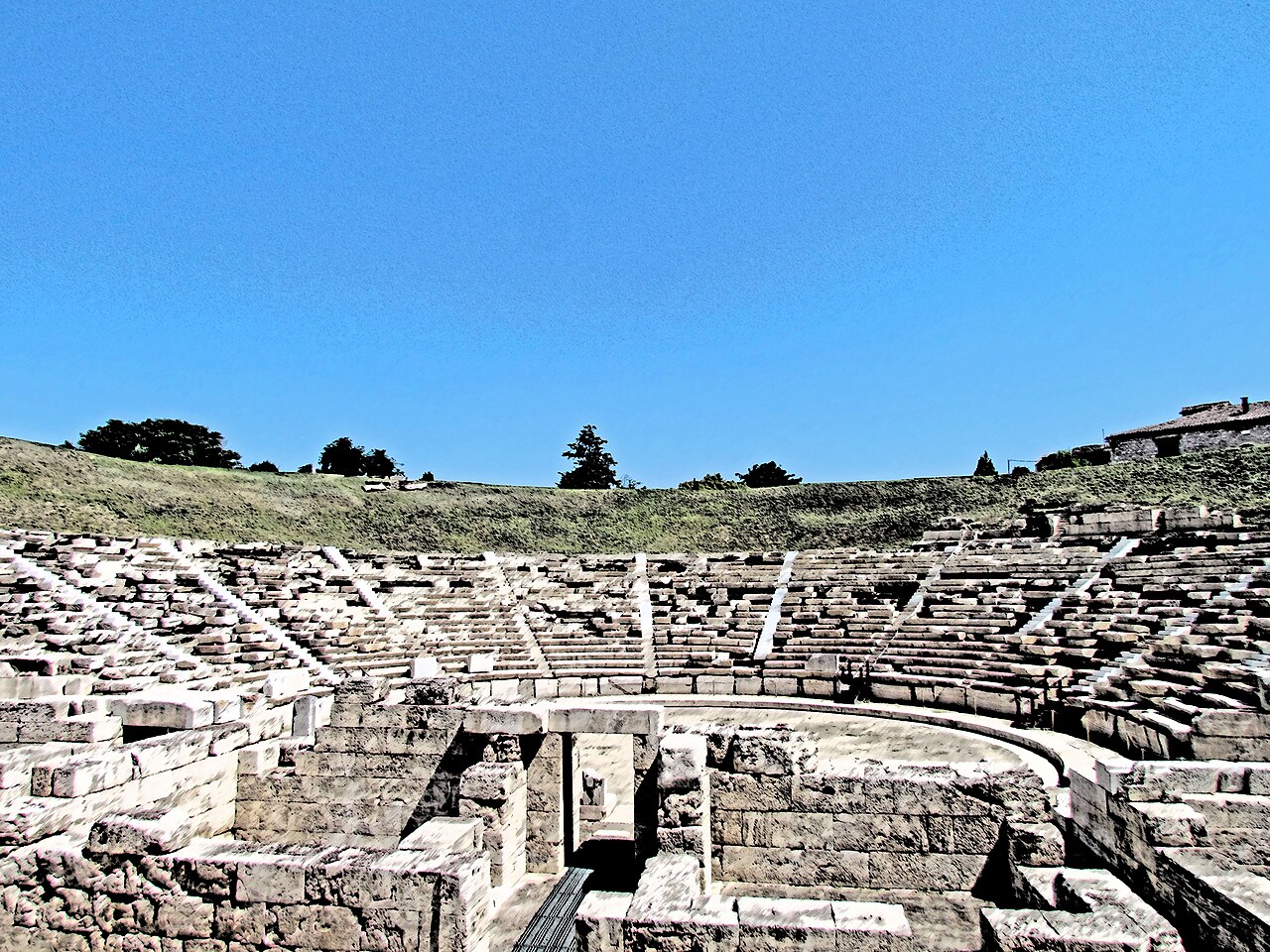
Photo: Theoaristi53, Wikimedia Commons, licensed CC BY-SA 4.0, reproduced unmodified.
The taurokathapsia coinage evolved in recognizable phases. The earlier drachms, from about 460 BC onward, set the wrestling scene against a reverse struck in a clear, deep incuse square in the archaic manner; over time the style of both dies loosened and the incuse became progressively shallower. This drachm belongs to the late taurokathapsia group. Its reverse sits in only a shallow incuse square, and the die pair is linked by the BCD catalogue to the very end of the series: the cataloguer of the BCD Thessaly collection (Triton XV, lot 372) observes that in the latest issues the incuse disappears entirely, leaving a flat field, and argues that these final bull-wrestler drachms were being struck at the same time as the earliest of the famous facing-head nymph drachms that replaced them.
The absolute dates remain genuinely contested. Herrmann’s classic die study (ZfN 1925) and the older literature kept the incuse-square drachms in the fifth century, with the series ending around 420–400 BC; the BCD Thessaly catalogue dates the late group “early to mid 4th century BC”; the dealer’s attribution for this specimen, following the hoard-informed lowering of Larissa’s chronology associated with Lorber’s work on the Thessalian hoards (AJN 2008), gives c. 400–380 BC. This page follows the dealer’s c. 400–380 BC dating while noting that the question is one of decades, not centuries, and is not settled.
What makes this particular die pair notable is the reverse legend. The ethnic of the Larisaeans is normally distributed around the horse in reading order (ΛΑΡΙ above, ΣΑΙ below, or similar); here it is scrambled — ΛΑΡ above, a lone horizontal Ι tucked below the horse’s head, and ΙΑΣ below. The BCD catalogue calls the same-dies specimen (BCD Thessaly II 372.10) “a very rare reverse legend variety,” known to it otherwise from the same reverse die in SNG Delepierre (1108). Whether the arrangement is an engraver’s error or a deliberate space-filling solution is an open question of the kind these civic dies often pose.
Larissa struck on the Aeginetic weight standard shared across Thessaly (drachm of c. 6.1 g; cf. Hoover, HGC 4), a standard suited to the region’s overland trade with central Greece rather than the Attic-standard maritime networks. The bull-wrestler drachms were a workhorse local currency: worn examples are common, and this specimen’s honest circulation wear shows a coin that did decades of work in the marketplaces of the plain. After the type’s end, Larissa’s celebrated facing-head nymph drachms — engraved under the influence of Kimon’s facing Arethusa at Syracuse — carried Thessalian silver to the end of the fourth century, until Philip II of Macedon’s absorption of Thessaly folded the region into the Macedonian monetary orbit. A century and a half later, when Rome’s defeat of Macedon freed Thessaly, the prancing horse returned under the federal ethnic ΘΕΣ on the bronze of the refounded Thessalian League — a deliberate revival of the civic imagery this drachm pioneered. The same horse-proud aristocracy stamped its neighbors’ coin as well: the collection holds the Athena and horse-head hemidrachm of Pharsalos and the hydria-and-cart dichalkon of Krannon, rivals of Larissa on the same plain.
Attribution and die identity: BCD Thessaly II (Classical Numismatic Group, Triton XV, 3 January 2012), lot 372.10 (same dies; “a very rare reverse legend variety”), with SNG Delepierre 1108 (same reverse die), SNG Copenhagen 108 ff. var. (ethnic arrangement), and Herrmann pl. III, 18 var., as cited on the Forum Ancient Coins tag. Series structure and the parallel striking of the latest taurokathapsia and earliest facing-head drachms: BCD Thessaly II, lots 370–372 commentary. Chronology: F. Herrmann, “Die Silbermünzen von Larissa in Thessalien,” ZfN 35 (1925); C. C. Lorber, “Thessalian Hoards and the Coinage of Larissa,” AJN 20 (2008); Hoover, HGC 4 (Aeginetic standard; taurokathapsia types).
Late taurokathapsia group, struck on the Aeginetic weight standard used throughout Thessaly (full drachm c. 6.1 g; cf. Hoover, HGC 4). This die pair belongs to the very end of the incuse-square series: the BCD cataloguer (Triton XV, lot 372) notes that the latest taurokathapsia reverses shade from a shallow incuse square into an entirely flat field, and argues they were struck in parallel with the earliest facing-head drachms. The scrambled reverse ethnic (ΛΑΡ / Ι / ΙΑΣ) is a very rare legend variety — the Triton XV cataloguer calls the same-dies coin 'a very rare reverse legend variety,' and the Forum tag flags the 'rare ethnic arrangement.'
John's Ancient Coin Collection · Type · larissa-taurokathapsia-drachm
Image credits for this coin — photographs, maps and graphics used on this page