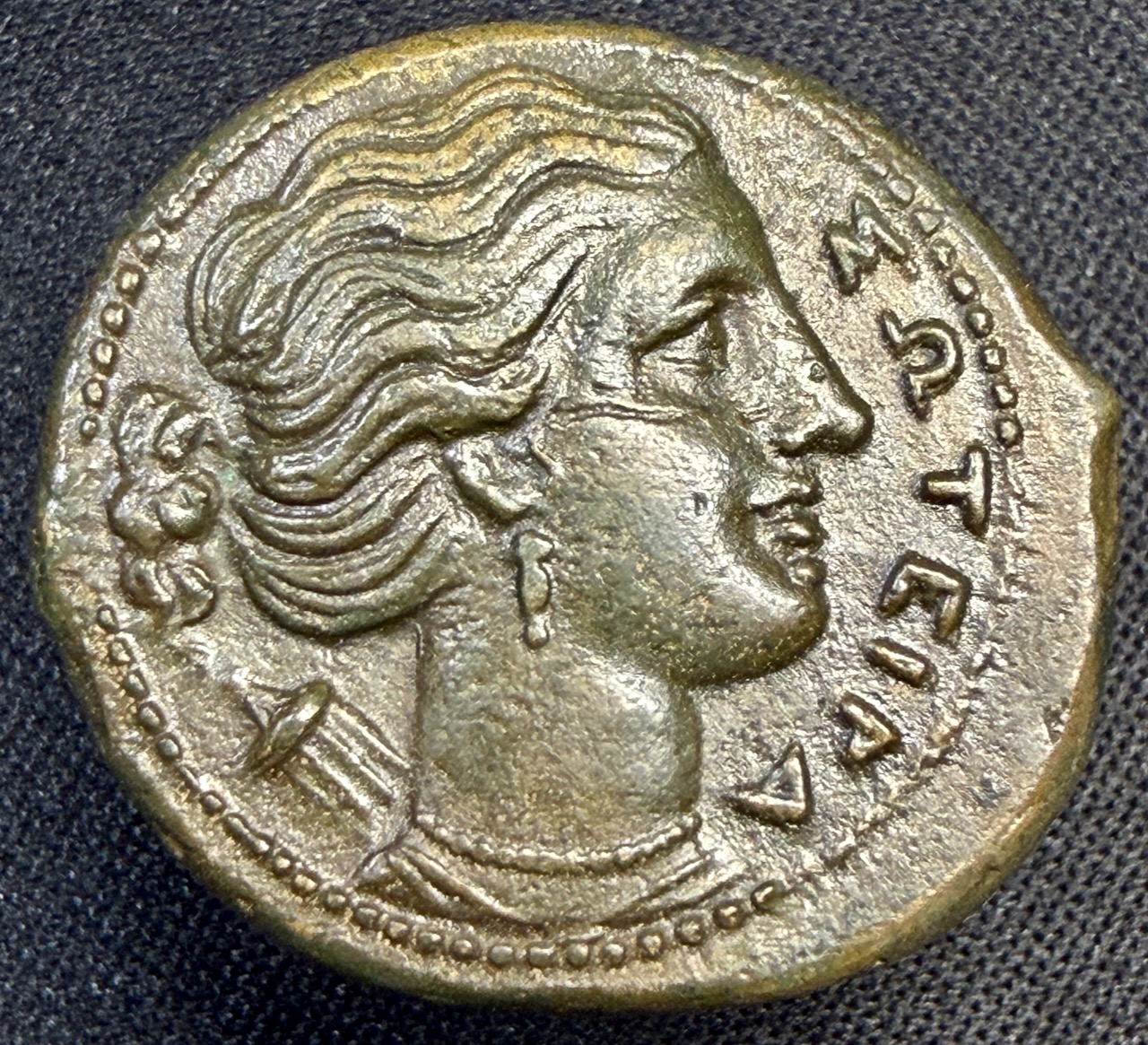
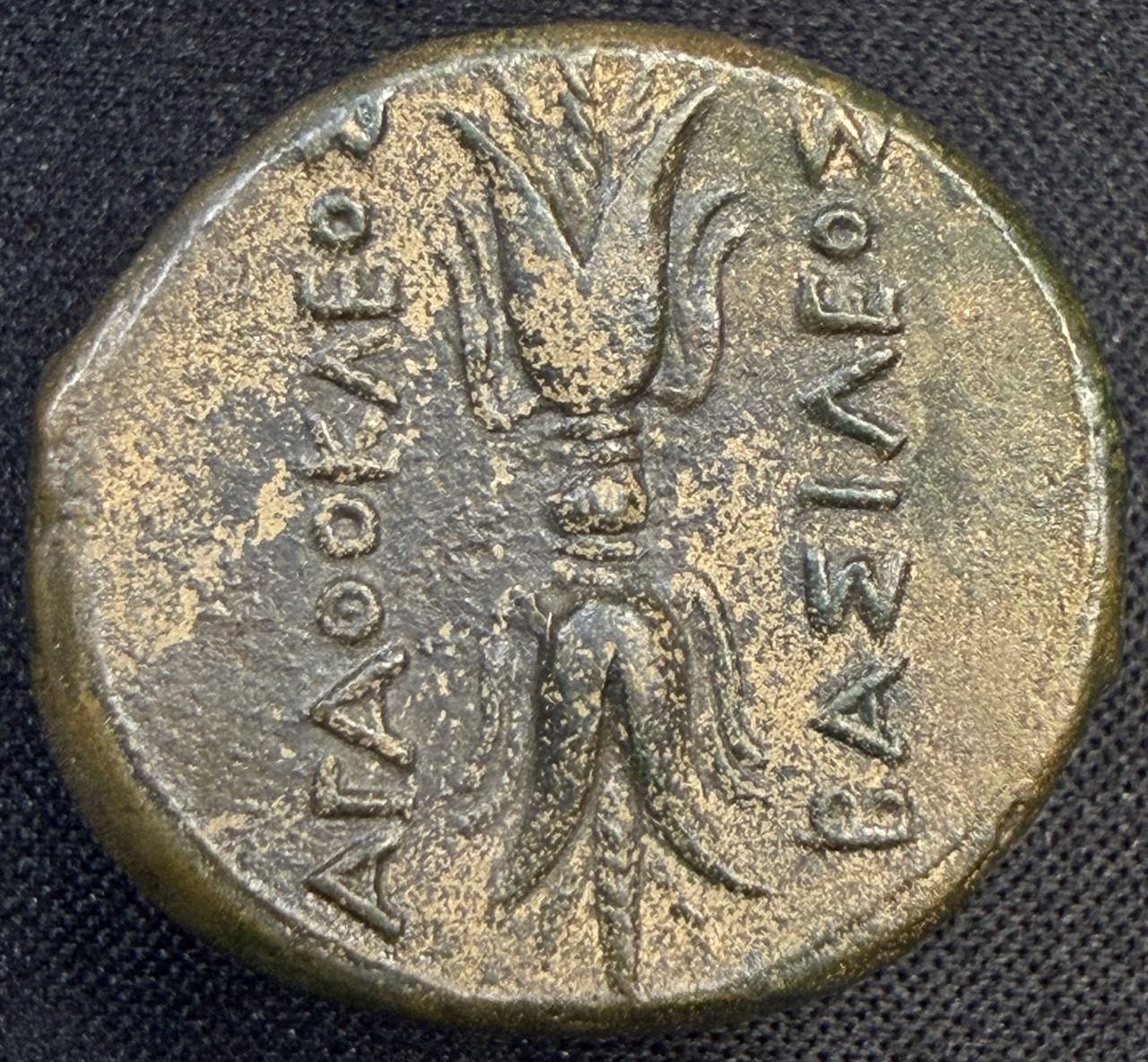
Type · syracuse-agathokles-artemis-thunderbolt
Current: Sicily, Syracuse. Agathokles (317–289 BC), as king, struck c. 304–289 BC. Æ litra(?). Bust of Artemis Soteira / winged thunderbolt (CNS II 142; SNG ANS 708; HGC 2, 1537)
Obverse: Draped bust of Artemis Soteira right, quiver over shoulder
Reverse: Winged thunderbolt
Primary reference: CNS II 142
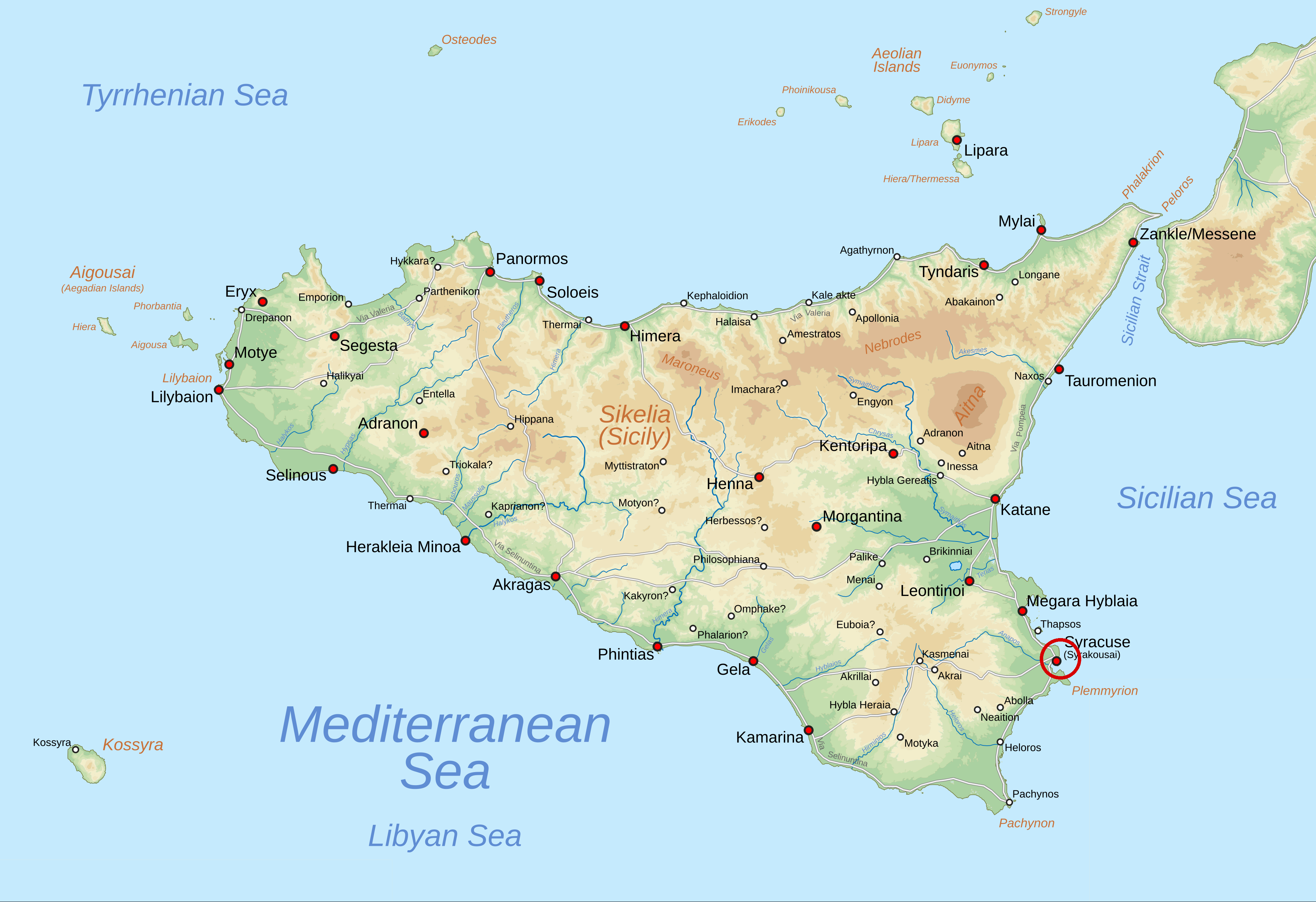
Ancient Sicily, with the Greek cities of the coasts and the native peoples of the interior. Syracuse (Syracusae) — circled in red — sits on the southeast coast. From here Agathokles ruled most of Greek Sicily and, at the height of his war with Carthage, carried the fight across to Africa — the Carthaginian domain occupying the island’s western end on this map.
“Map of ancient Sicily” by Tomisti (Wikimedia Commons), File:Ancient Sicily map en.svg, licensed CC BY-SA 4.0; cities and roads based on the Digital Atlas of the Roman Empire (DARE) and Pleiades; topographic base © OpenMapTiles, © OpenStreetMap contributors; red circle added to mark Syracuse.
Agathokles is the great self-made monster and marvel of Sicilian history: a potter’s son who rose through the Syracusan army, seized the city in a bloody coup in 317 BC, fought Carthage nearly to destruction, and ended his days a king. This bronze belongs to the last phase of that career. The reverse names him ΑΓΑΘΟΚΛΕΟΣ ΒΑΣΙΛΕΟΣ — “of King Agathokles” — a title he assumed around 305/4 BC, when, following the lead of Alexander’s successors in the East, the strongmen of the Greek world converted their de facto power into royal diadems. He was the first ruler of Sicily to do so, and his coinage is where that claim was broadcast.
Graphic: JSB Coins (CC0); dates follow Diodorus and standard chronologies.
The obverse carries a draped bust of Artemis with her quiver at her shoulder, named ΣΩΤΕΙΡΑ — “Saviouress.” The epithet is pointed: Syracuse had survived a desperate Carthaginian siege in 310 BC, the crisis Agathokles answered with his astonishing gamble of invading Africa itself (310–307 BC), carrying the war to Carthage’s homeland while his own city held the walls. A deliverance cult title on the coinage of the years that followed reads naturally as thanksgiving for the city’s salvation, though the sources do not spell the connection out and it remains an inference from the type rather than a documented dedication. The winged thunderbolt of the reverse is Zeus’s weapon, here paired with the royal title — divine power and kingly power presented as one design.
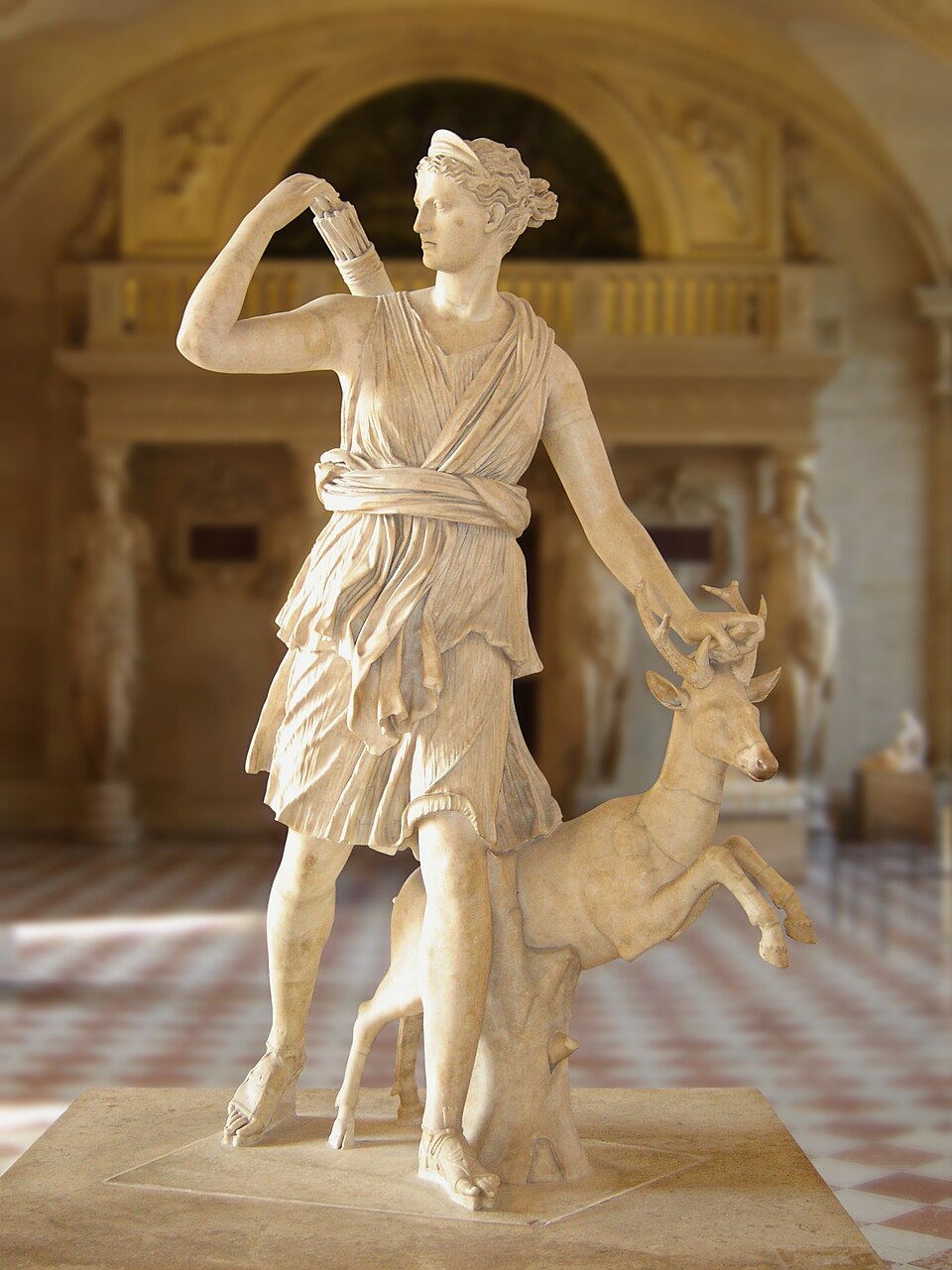
Photo: Eric Gaba, Wikimedia Commons, licensed CC BY-SA 2.5, reproduced unmodified.
The African gamble behind the epithet deserves its detail, because Diodorus preserves it (20.3–16): blockaded in Syracuse in 310 BC, Agathokles ran the Carthaginian blockade with sixty ships, landed his army in Africa — the first European invasion of the Carthaginian homeland — and burned his own fleet on the beach so that no man could think of retreat. For three years his army lived off Carthage’s estates and defeated her levies under the city’s walls. The expedition ultimately failed, but it forced the war to a stalemate peace and made his reputation unassailable at home. When Rome faced Carthage a generation later, Agathokles’s African strategy was the precedent — Scipio’s landing of 204 BC finished what the Syracusan adventurer had begun.
Bronze on this scale was itself a Sicilian specialty: Syracuse had pioneered large civic bronze coinage in the fifth and fourth centuries, and Agathokles’s mints poured out this type in enormous numbers — it is the most frequently encountered bronze of his reign, the everyday money of his kingdom. The contrast with the city’s earlier money is instructive: where the Deinomenid tetradrachm of the 470s BC names only “the Syracusans” around Arethusa’s head, this coin names the king, with no mention of the city at all. Two centuries of Syracusan history — polis to monarchy — are legible in that shift. His lifelong adversary is also represented in this collection by the Carthaginian Tanit/horse trishekel, the money of the power whose siege lines Artemis Soteira answers here.
Agathokles’s royal coinage marks the moment the Hellenistic revolution reached the Greek West: kingship, ruler-centered types, and cult epithets deployed as political language on everyday small change. When he died in 289 BC the kingdom dissolved into the chaos that ultimately invited Pyrrhus and then Rome into Sicily — but the model he set, of a Syracusan king with a court coinage, was taken up directly by Hieron II a generation later.
The type is Calciati, Corpus Nummorum Siculorum II 142; SNG ANS 708 ff.; Hoover, Handbook of Coins of Sicily (HGC 2), 1537; the dealer tag cites BMC 2.422 and Sear (Greek Coins and Their Values I) 1200. Dating within the royal period varies among cataloguers (c. 304–289 BC in CNG listings; c. 295–289 BC elsewhere) and is left approximate here. For Agathokles’s career the principal ancient account is Diodorus Siculus, books 19–21 (linked in the references); the African expedition and the burning of the ships: Diodorus 20.3–16. His posthumous notoriety runs from Polybius (9.23) to Machiavelli, who made him the exemplar of “those who come to power by crimes” (The Prince, ch. 8) — a chapter that concedes his ability while damning his cruelty.
The royal title ΒΑΣΙΛΕΟΣ places the issue after Agathokles assumed the kingship (c. 305/4 BC, in emulation of the Diadochi). Cataloguers' dates vary within the royal period — CNG auction descriptions give c. 304–289 BC, others c. 295–289 BC — and the denomination is variously called a litra or left as Æ; both points are presented here as unsettled. Struck in very large quantity; the commonest bronze of Agathokles's reign.
John's Ancient Coin Collection · Type · syracuse-agathokles-artemis-thunderbolt
Image credits for this coin — photographs, maps and graphics used on this page