Every coin on this page is a Roman promise to pay a certain weight of silver. Laid end to end, they record that promise being broken — first quietly, then routinely, then completely. The story runs from a Republic that struck almost pure metal, through an emperor who discovered he could rebuild a burnt city out of the difference, to a coinage that was silver in name and copper in fact. It ends with a coin containing no silver at all.
The promise
For most of the Republic the denarius was simply, boringly good. Struck at 84 to the Roman pound — a libra of about 327 grams, so roughly 3.9 g a coin — and at a fineness in the mid-to-high nineties, it did exactly what it said. There was no reason to doubt it, and the archaeology suggests nobody much did.
That reliability was not sentiment. It was strategy. Rome was buying grain, hiring auxiliaries, and paying legions across a Mediterranean full of people who had no particular reason to trust Romans, and a coin whose metal could be relied upon travelled where a Roman magistrate could not. The denarius worked abroad for exactly the reason the Athenian owl had worked abroad: it was known to be honest.
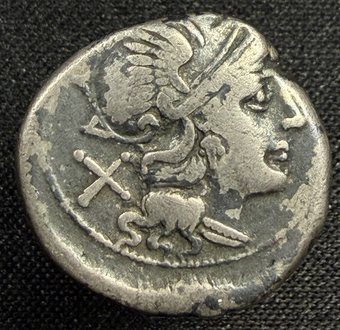 Anonymous
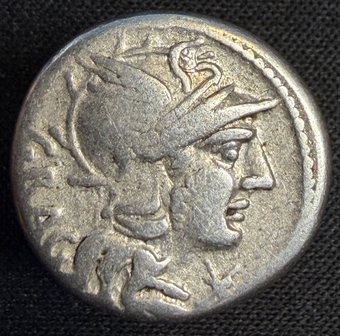 Antestius
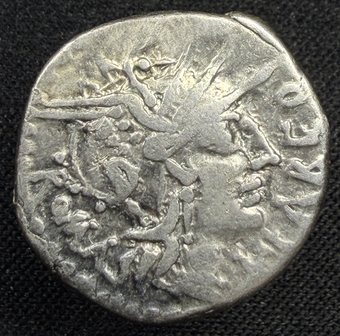 Fabius Labeo
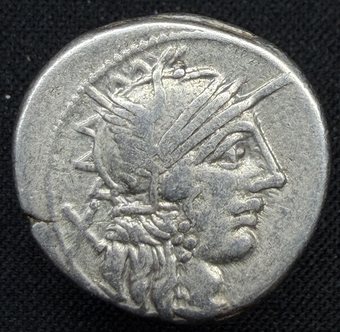 Cato
Cato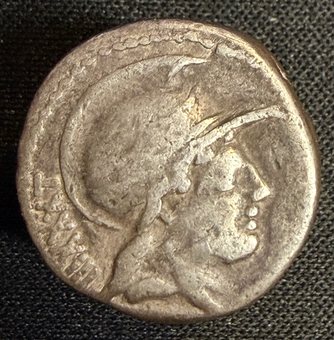 Satrienus
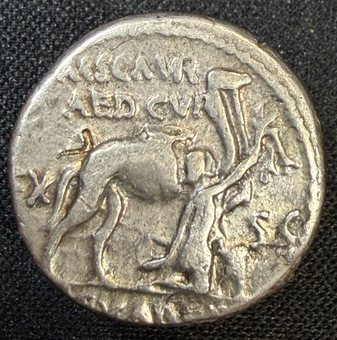 Scaurus
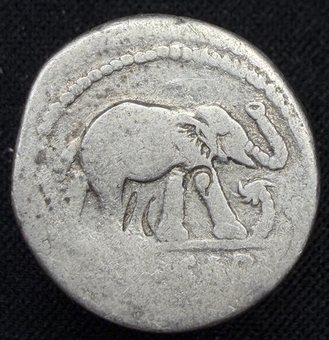 Caesar
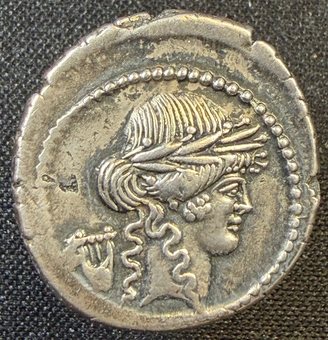 Clodius
Note what these coins are doing with their reverses: advertising ancestors, wars, elephants, camels, a she-wolf. A moneyer's whole concern was what the coin said. Nobody was arguing about what it contained, because the answer was not in dispute. That is what a sound currency looks like — the metal is so uncontroversial that it becomes invisible, and all the attention goes to the picture.
Hold on to that. The moment the metal becomes interesting is the moment something has gone wrong.
Debased at birth
The first crack is not an emperor's. It belongs to a man losing a civil war.
In the autumn of 32 BC, with Actium ahead of him, Mark Antony needed to pay an army and a fleet, and he needed to do it at a scale his silver could not honestly cover. The result is the legionary coinage — one of the largest silver issues of the ancient world, struck on the move, each reverse naming a specific legion. Every one of them is a promise slightly smaller than it appears. Against a contemporary Roman denarius of about 97% fine, Antony's run around 92%.
He lost anyway. But the coins had a second life that nobody planned, and it is the most instructive thing in this entire article.
Mark Antony · Legionary denarius · LEG X · Patrae, 32–31 BC
Catalogue entry →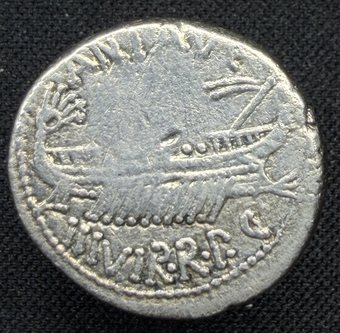 Obverse · the galley
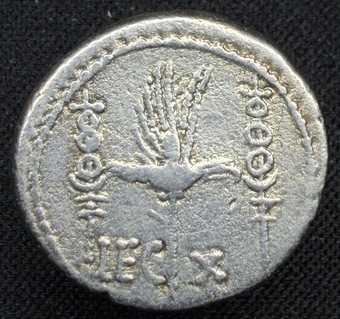 Reverse · aquila & standards
Because they were known to be base, nobody hoarded them. A Roman with a good Augustan denarius and a legionary denarius in his purse spent the Antony and kept the other — which is Gresham's law working exactly as advertised, four hundred years before Gresham. So the bad coin stayed in circulation. And stayed. And stayed.
The empire's own silver eventually fell to meet Antony's. A coin struck by a defeated traitor outlasted the standard it had cheated — because it had cheated.
These things turn up in hoards two centuries later, worn to smoothness, and by then the imperial denarius circulating beside them was no better. That is not an anecdote. It is the whole thesis of this article compressed into one object: bad money survives, good money disappears — and the survival of a bad coin is a measurement of how far everything else has fallen. You can also see the other half of the story on the flans themselves. Legionary denarii are commonly found with bankers' test marks, because people checked them. Nobody was checking Cato's.
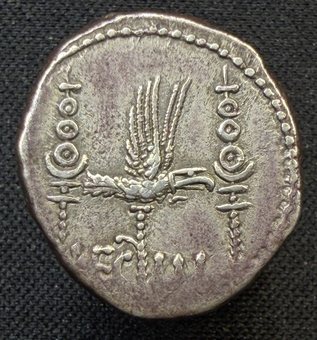 LEG IIIc. 92% fine
The hinge: Nero, and the fire
Augustus and Tiberius held the line. The denarius of the early Principate is a superb coin — around 98% fine, consistently struck, and trusted from Britain to the Euphrates. The famous "tribute penny" of Tiberius is the coin the Gospels put in Christ's hand, and it is good silver.
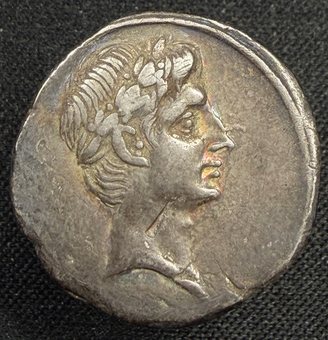 Octavian
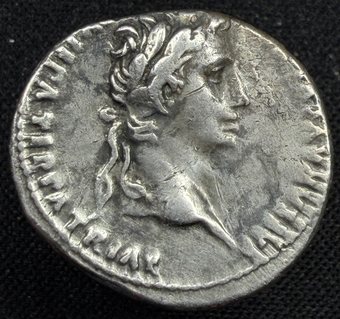 Augustus
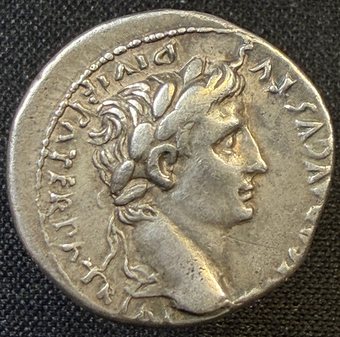 Augustus
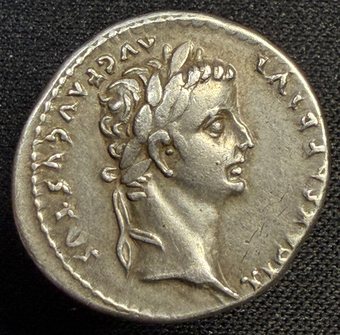 Tiberius
Then, in July of AD 64, Rome burned.
The cost of rebuilding was enormous, and Nero found the money in the most elegant place available: the coinage already in people's hands. He cut the denarius from 84 to the pound to 96 to the pound — the weight falling from about 3.9 g to about 3.4 g — and he cut the fineness at the same time. Old coin came in; more, lighter, baser coin went out; the treasury kept the difference. The gold aureus was trimmed alongside it.
It is important to be precise about what this was and was not. It was not hyperinflation and it was not a collapse. It was a competent, quiet, technically sophisticated skim, and it worked. It is also the moment the Roman state discovered a lever it would never stop pulling.
Nero · Denarius · IVPPITER CVSTOS · Rome, c. AD 64–65
Catalogue entry →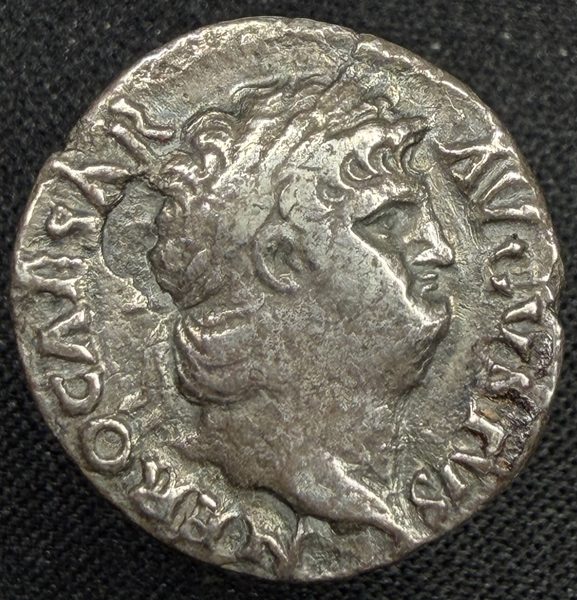 Obverse · Nero
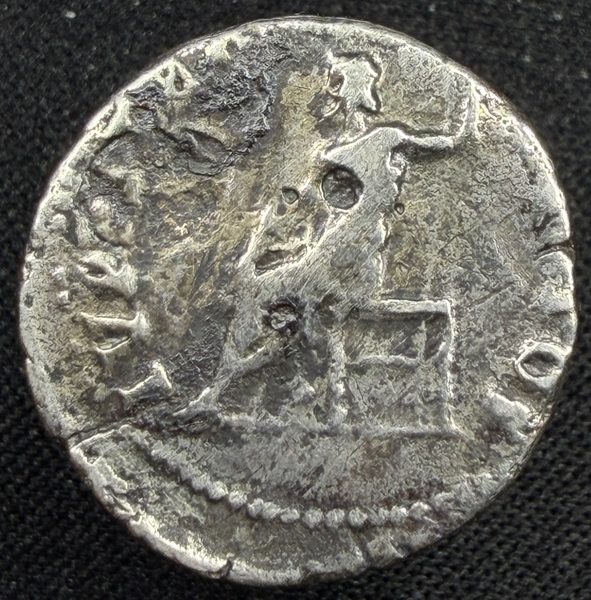 Reverse · Jupiter the Guardian
Look at what the reverse says. Jupiter Custos — Jupiter the Guardian, the Protector. This is the coin of the reform, and it is advertising security. Whether that is grim irony or ordinary imperial messaging, the historian cannot say; the coin is not going to tell us. But it is the reason this specimen belongs at the centre of the argument rather than in a drawer.
One immediate consequence: Gresham again. The old, heavy, fine denarii of Augustus, Tiberius, Caligula and Claudius stopped circulating and started disappearing — into hoards, into melting pots. Trajan appears to have formally called in the pre-Neronian silver decades later. That is why early Julio-Claudian denarii are comparatively scarce today, and it is why the coins you find in later hoards are the ones nobody wanted to keep.
How the lie was hidden
Here is the part that lifts this from an economics lecture into something stranger.
A denarius that is 80% silver and 20% copper does not look like a denarius that is 98% silver. It looks slightly wrong — pinker, duller. That is a problem if your entire scheme depends on nobody noticing. So the mint solved it, and the solution was chemistry.
Before striking, the blanks were pickled — heated and treated with an acidic solution (weak organic acids would do; the process is a standard silversmith's technique called blanching) which preferentially attacked the copper at the surface and dissolved it away. What remained was a skin of nearly pure silver, a fraction of a millimetre thick, wrapped around an alloyed core. Strike that blank and you get a coin that is substantially copper, and looks like sterling.
The coin was engineered to lie about itself. And it lied so well that it went on lying, successfully, to men with X-ray machines, nineteen centuries later.
Because here is the sting. In the 1970s D. R. Walker published a landmark three-volume study, The Metrology of the Roman Silver Coinage, measuring the silver content of Roman coins by X-ray fluorescence. XRF is non-destructive — it reads the surface. It became the standard authority, and its numbers propagated into every popular account of Roman debasement written for the next forty years.
They are too high. Systematically, and by a lot. Walker was reading the blanched skin — the very layer the Roman mint had engineered precisely so that a surface inspection would give a flattering answer. Two thousand years later, the trick still worked.
The correction came from Kevin Butcher and Matthew Ponting, who did the thing you have to do: they drilled into the coins. Sampling the core rather than the surface, across more than 1,300 analyses, they found that Walker's figures run roughly 15 percentage points too high. Where Walker read Nero's reformed denarius at about 93% fine, core analysis puts it nearer 80%.
If you go looking for the fineness of a Neronian denarius you will find 94%, 93%, 90%, 82%, and 80%, all stated with confidence, often in the same afternoon. This is not sloppiness. It is a real and unresolved seam in the literature, and it has three causes:
Surface versus core. Older XRF figures read the enriched skin. Core-sampled figures read the metal. They will never reconcile, and the gap is about 15 points.
Corrosion adds to the problem. Copper leaches out of a buried coin over centuries too, enriching the surface all over again — so even an un-blanched coin can read high. The Roman deception and eighteen hundred years in the ground push the error the same way.
Elemental silver versus silver bullion. Some published figures count the silver alone; others count the bullion, which carried its own impurities. A percentage point or two hides in the definition.
Rule of thumb: if a source cites a fineness without saying how it was measured, treat the figure as an upper bound.
Take the chart below in that spirit. The solid line is the commonly cited curve; the dashed line shows where core sampling actually lands for the period Butcher and Ponting analysed. The shape is not in doubt. The precise depth of each step is.
The plateau, and one real step
Here the story most books tell — a steady, century-long slide, every emperor shaving a little more — turns out to be wrong. It is worth being blunt about that, because the corrected version is both better history and a better story.
The traditional picture came from D. R. Walker's Metrology of the 1970s, whose surface readings showed the denarius drifting downward reign by reign: a cut under Trajan, another under Antoninus Pius around 148, a "dramatic" debasement by Marcus Aurelius to pay for his wars, more under Commodus. Walker even fixed a date to the empire's decline — not the death of Marcus Aurelius, he wrote, but his accession. That sentence has been quoted for fifty years.
When Kevin Butcher and Matthew Ponting drilled the cores, the slide disappeared. In its place was something stranger: a long plateau, interrupted by a single real step. From Nero's reform to the end of the second century the denarius sat at essentially two standards — Nero's roughly 80%, and a lower one of about 70% — divided by one decisive event. Everything else Walker had seen was noise.
The one real step was Antoninus Pius, and not in 148 but in AD 155–157, in two stages: "In AD 155–156 the fineness decreased to about 74%, and [in] 156–157, to 70%, where it stayed for the rest of the reign." That 70% standard then held for nearly forty years. It is "the first notable departure from the standard introduced by Nero," and — pointedly — it does not line up with any of Antoninus' recorded bouts of lavish spending. The frugal emperor who left his successors a treasury surplus appears to have debased not in crisis but as an economy: a quiet way to raise income without visibly changing the coin.
And Marcus Aurelius — the Stoic, the philosopher, the emperor traditionally blamed for cracking the currency to fund the Marcomannic wars — did no such thing. His denarii run at Antoninus' 70% for essentially the whole reign. Walker's "dramatic" debasement was an artifact of his own scattered surface numbers. Butcher and Ponting's verdict is worth quoting exactly:
The Marcus Aurelius debasement, "signposted by Walker as the beginning of the decline of the Roman empire, appears to be a ghost, formed by the somewhat random nature of his erratic analytical results."
They are harder still in a footnote, calling it "this phantom one" — the most-cited, it turns out, of all Walker's debasements. The single most repeated fact about second-century Roman money is a measurement error.
Commodus is the other correction. He did reduce the denarius — but in weight, not fineness, trimming it from about 3.4 g toward 3.0 g while the silver held near the 70% standard. Cutting the weight is the more honest of the two moves: a lighter coin at least declares itself on the scale, where a blanched one hides in plain sight. Elliott even suggests Commodus' mints put out better-controlled coinage than his reputation allows.
So there was no vicious cycle of war-driven debasement running through the second century. There was stability, one deliberate step down under a careful emperor, and a great deal of noise in the old data. As Butcher and Ponting put it, once the phantom debasements of Marcus and Commodus are removed, "the most convincing link between debasement and specific episodes of expenditure has been broken."
Then the Severans, and the pace does change. Septimius Severus doubled army pay and expanded the legions, and in AD 194 came a real debasement — the denarius cut to about 46%, roughly half copper. This was the decisive break from Nero's fineness. But watch what Severus did with the weight: he pushed it back up. By the last decade of his reign the mean denarius weighed the full Neronian 3.36 g again — while being half base metal — which let him strike, as Elliott notes, "twice as many denarii per pound of silver as Augustus." The reason he bothered to restore the weight is the whole subject of Section IX.
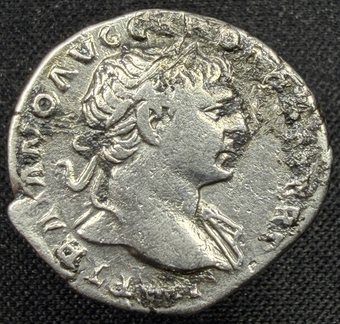 Trajan
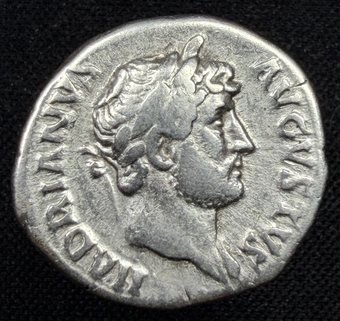 Hadrian
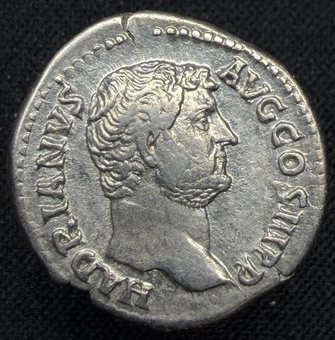 Hadrian
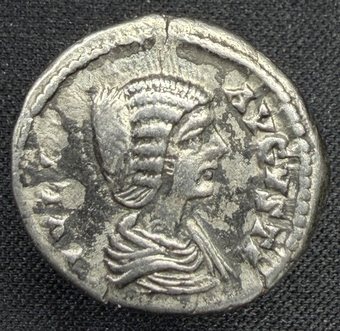 Julia Domna
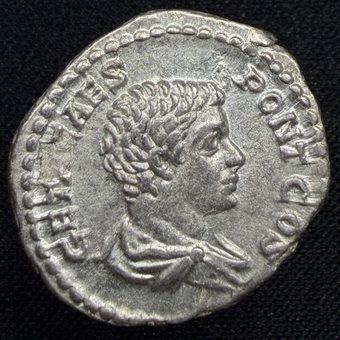 Geta
Geta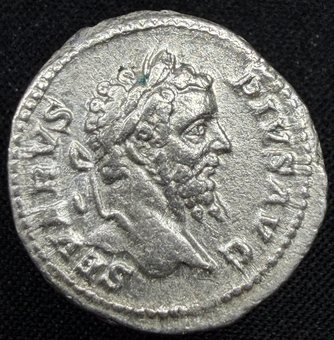 Sept. Severus
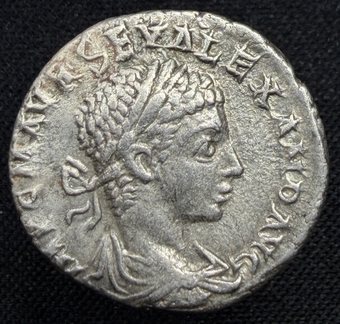 Sev. Alexander
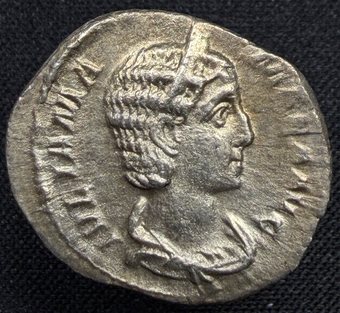 Julia Mamaea
Read that row correctly and it is not a smooth slide but a cliff. The three earlier coins — Trajan and the two Hadrians — sit together on Nero's ~80% plateau, decades apart and barely distinguishable. Then the Severan coins drop to the mid-40s. The whole second century of "decline" is really that: a long flat stretch, and then, in 194, the floor gives way.
And put your eye along it the other way. The portraits get no worse; the Severan dies are perfectly competent. Nothing on the surface of a denarius of Julia Domna announces that it holds barely half the silver of the Hadrian three coins to its left. That is the lesson of Section IV — the coin is designed not to tell you — and it is why the debasement could run for a century and a half before anyone treated it as a crisis.
A note on the figures: these are the core-sampled values, not the surface readings you will meet in older catalogues and in Walker. As a rule the surface numbers run roughly fifteen points higher, because the mint's blanching and eighteen centuries of burial both enrich the surface in silver. Where this collection's catalogue entries cite the traditional figures, that is the gap you are seeing.
The double that wasn't
By AD 215 the skim had reached its limit. You cannot take much more silver out of a denarius before it stops being recognisable as one. Caracalla's answer was not to debase the coin further but to redefine the unit.
He introduced a new denomination — modern numismatists call it the antoninianus, after his own regnal name; we do not know what the Romans called it. It was tariffed at two denarii. The emperor wears a radiate crown, the standard Roman visual shorthand for a double denomination, so the coin announces its own value from across a room.
It contained the silver of about one and a half.
This is a different kind of act from Nero's, and worth pausing on. Nero lied about the metal. Caracalla told the truth about the metal and lied about the value. It is the moment Roman money begins its shift from a commodity — worth what it weighs — to a token, worth what the state says it is worth. That is not automatically a catastrophe; every modern currency is a token. But a token currency requires a state whose word is good, and the Roman state was about to spend fifty years demonstrating that its word was not.
Gordian III · Antoninianus · SECVRITAS · Rome, AD 243–244
Catalogue entry →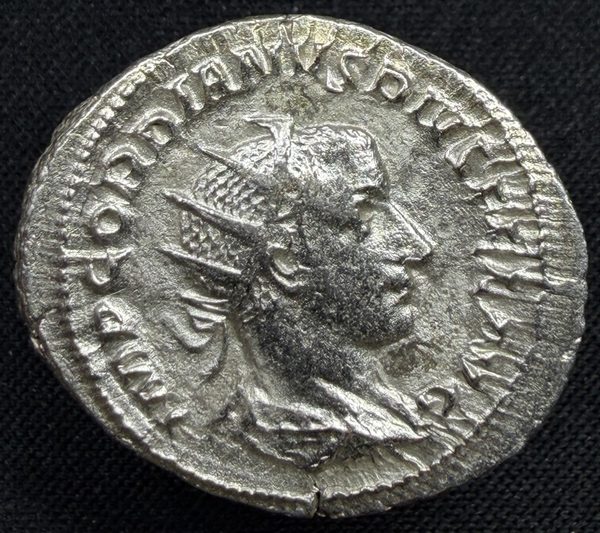 Obverse · the radiate crown
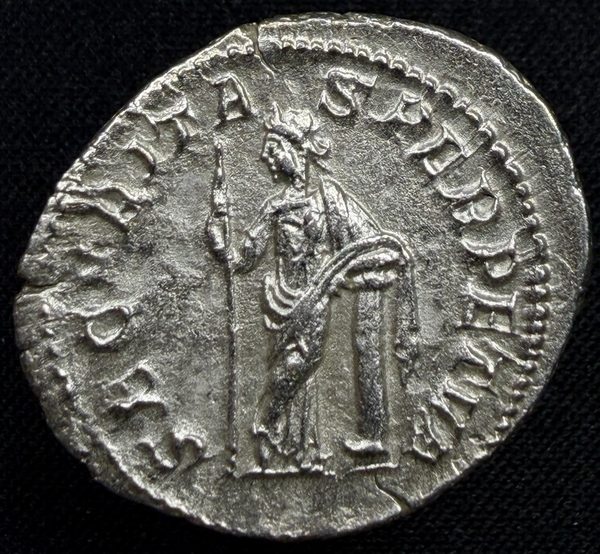 Reverse · Securitas
The spiked crown is the tell — it is the coin insisting, in a visual language every Roman could read, that it is worth double. By Gordian's reign the silver is down around forty percent and falling. And the reverse, once again, is selling reassurance: Securitas, security, leaning comfortably on her column. The denarius itself effectively stops being struck for circulation during this reign. The double killed the single.
The bottom
What happens between 244 and 268 is not a slide. It is a fall.
The empire in those years is fighting on the Rhine, the Danube and the Euphrates simultaneously, losing emperors at a rate of roughly one every two years, splitting into breakaway Gallic and Palmyrene states, and absorbing a plague. Every claimant needs to pay troops immediately, and every claimant has one instrument. Under Gallienus the antoninianus — nominally a double-denarius, nominally silver — reaches a silver content of under five percent, and specimens as low as 2.5% are recorded.
At that point the mint's old trick becomes the coin's entire silver content. The flans were pickled to leach the copper from the surface, leaving a microscopically thin silver wash on what is, in every meaningful sense, a bronze coin. It looked like silver for as long as it took to hand over. Then it wore through, and everybody could see the copper underneath.
A currency does not usually die of a decree. It dies when the wash wears off in a soldier's purse and he can see what he has actually been paid.
The recovery, when it comes, is the work of soldiers rather than economists. Aurelian, in AD 274, tried to restore some credibility with a new coin and — remarkably — an explicit public guarantee: the mark XXI (or KA in the Greek East) stamped in the exergue, understood to certify a ratio of twenty parts base metal to one of silver. Roughly 5% silver, and the state saying so out loud on the coin. It is one of the more honest things any Roman government ever did with money, and it is a measure of how bad things had become that publishing your own five percent counted as reform.
It was not enough. The public traded the coin above its official rate anyway, and the debased radiates of Gallienus and Claudius II went on circulating in vast quantities alongside it, along with a flood of unofficial imitations.
Diocletian, and the end of silver
Diocletian swept the wreckage away in a comprehensive reform around AD 294. He abolished the antoninianus. He struck a new, genuinely fine silver coin, the argenteus, at 96 to the pound and better than 90% silver — the weight of Nero's reformed denarius, deliberately reaching back over two centuries to a standard people might still believe in.
And alongside it he struck this:
Maximianus · Post-reform radiate · Kyzikos, c. AD 295–299
Catalogue entry →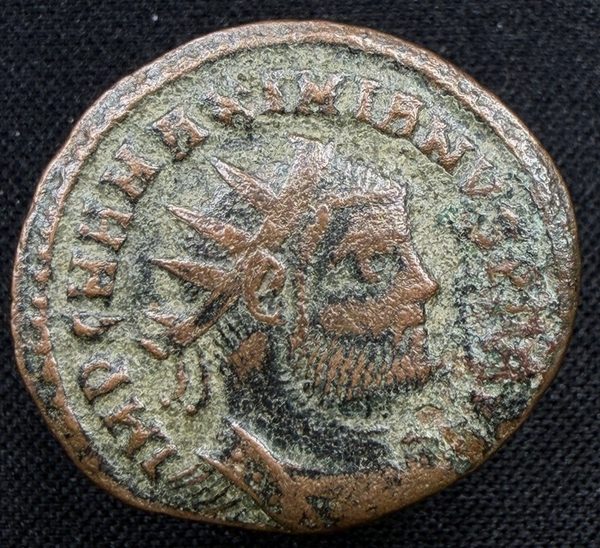 Obverse · still radiate
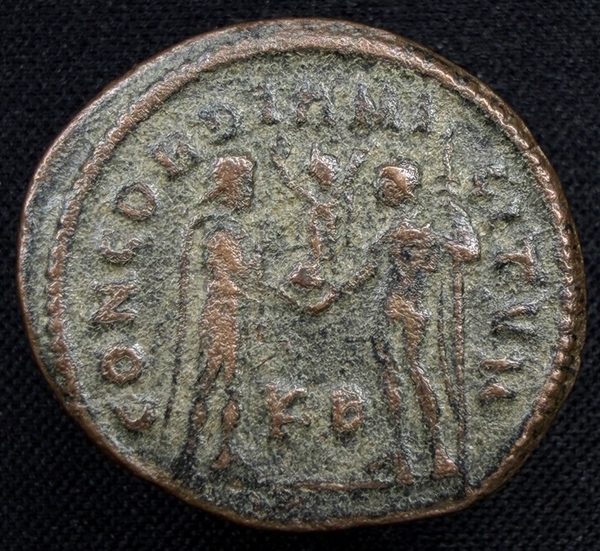 Reverse · Concordia
Look at the crown. It is still radiate — still carrying the ancient signal for a double denomination — and this coin has essentially no silver in it at all. Not five percent. Not a wash worth mentioning. The radiate crown has become a fossil: a piece of monetary grammar that has outlived every fact it once described. The picture on the coin is still telling you about a silver double-denarius. The metal stopped being either a long time ago.
The argenteus, meanwhile, did what good coins do in a bad system. It was hoarded, and it vanished. Gresham does not care how sincere your reform is.
Where does it end? Here, with a coin struck a century later, by a usurper, in Gaul:
Magnus Maximus · Æ2 · REPARATIO REIPVB · Arelate, AD 383–388
Catalogue entry →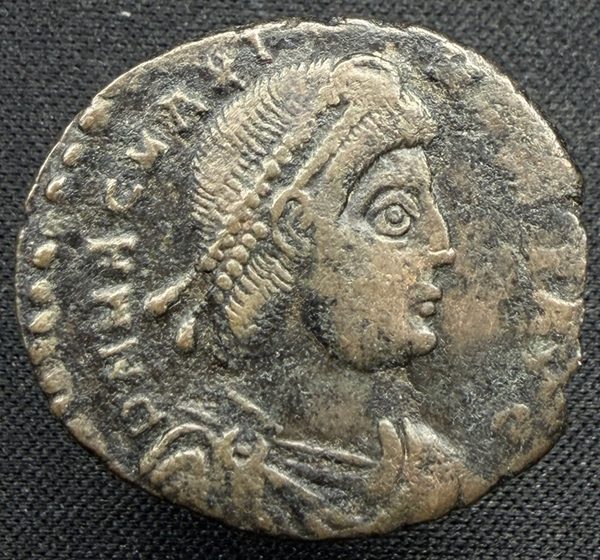 Obverse · the diadem
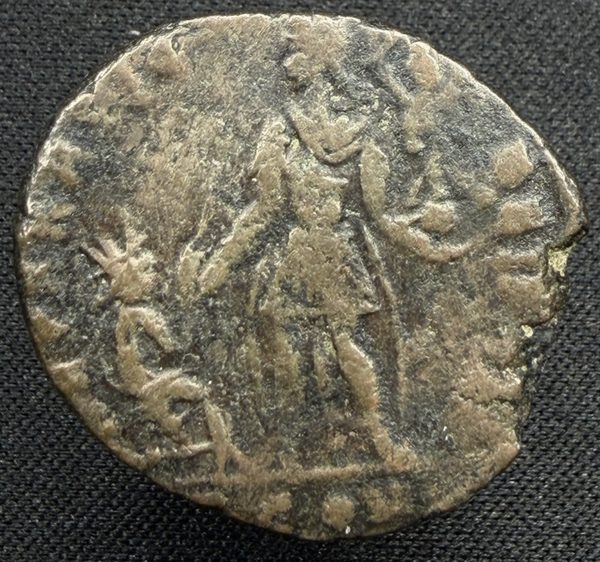 Reverse · REPARATIO REIPVB
It is bronze. It is not pretending to be anything else, and the radiate crown is gone. The everyday coinage of the late empire is frankly base metal, and real value has migrated upward into gold — Constantine's solidus, which held its weight and fineness for centuries and became the most successful coin in European history. The empire did eventually get an honest currency again. But it was gold, and it was for the people who had gold.
And the reverse legend? REPARATIO REIPVB — "the restoration of the state." The emperor is shown raising a kneeling, turreted woman, the Republic personified, back onto her feet. It is struck in copper by a usurper who would be dead within five years.
Six hundred years earlier, an anonymous moneyer had struck a coin of almost pure silver and not bothered to put a slogan on it at all.
Anonymous · Denarius · Rome, 157 BC · Crawford 197/1a
Catalogue entry →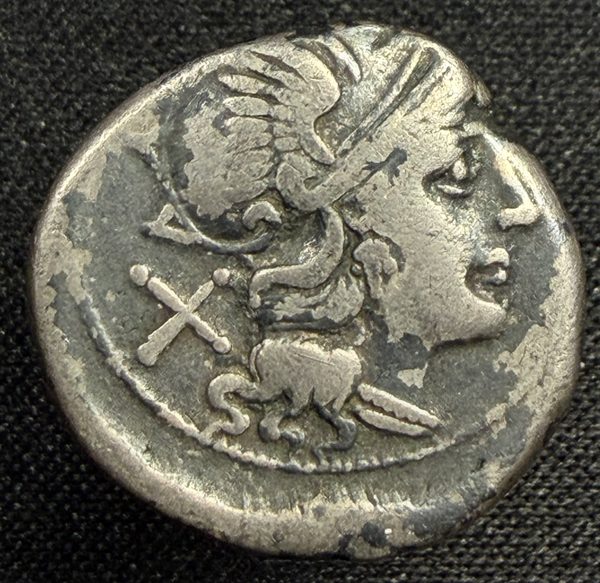 Obverse · Roma, and the mark X
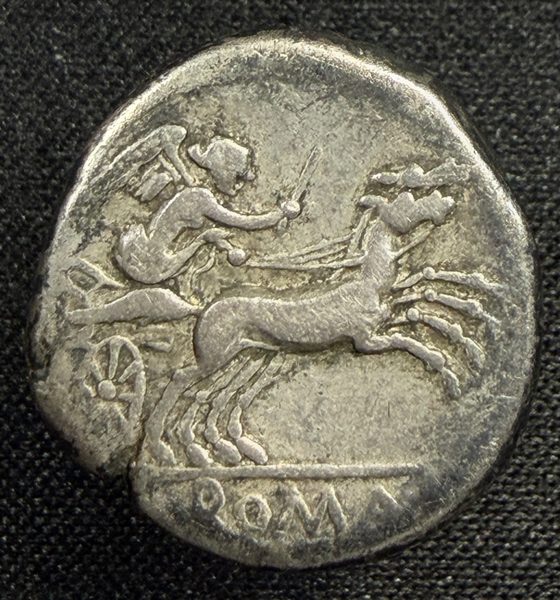 Reverse · Victory in the biga · ROMA
No moneyer's name. No ancestor, no campaign, no god pressed into the service of a family's ambition — only Roma, the mark of value, Victory, and the city's name. It is almost pure silver and it makes almost no claim. Everything after it says more and means less. That is what the decline of a coinage looks like from the inside: the pictures grow louder as the metal grows thinner, until a bronze coin of a doomed usurper is shouting about the restoration of the state.
Why the metal could fall for two centuries and nothing happened
Here is the puzzle the corrected chronology forces on us. If a debased coin is simply worth its metal, then two hundred years of falling silver should have produced two hundred years of rising prices. It did not. Prices stay broadly flat through the first and second centuries and then explode in the second half of the third. Why the long delay?
The numismatist Colin Elliott has the sharpest answer, and it starts from a detail we have already seen. Across the whole plateau, the mint held the weight of the denarius to Nero's standard with almost obsessive precision — target weights consistent, issue to issue, to within a hundredth of a gram — while letting the fineness fall underneath. Think about what that means. Enormous care to keep the coin looking and weighing exactly right; comparatively little concern to keep the silver in it. The thing being defended was not the metal. It was the coin's acceptability.
A Roman coin was worth what people would take it for — and for two centuries, they took it for more than its metal. That gap, between value-in-exchange and value-in-melt, is the space the emperors quietly mined.
A coin accepted by tale — at its face, by count, not by assay — is a partly fiduciary object: its value rests on confidence, law, and the authority of the issuer as much as on its bullion. The imperial denarius spent the first two centuries in exactly that condition, and it is why Nero's skim and Antoninus' step could pass almost unnoticed. As Elliott puts it, minting authorities "deliberately preserved the Neronian weight standard throughout most of the second century and believed that it was important to do so."
What kept that confidence honest was a network of professionals: the argentarii and nummularii, the money-changers and assayers who could weigh a coin, test its metal, and set the rate at which it actually passed. They were the immune system of the currency — the mechanism by which real information about a coin's quality reached the market, allowing a worn or suspect piece to be discounted rather than refused. While they functioned, a fiduciary coinage could absorb a surprising amount of quiet debasement without breaking.
Elliott's account of the third century, then, is not fundamentally about metal at all. It is about the destruction of that network. As the state pushed harder to force its overvalued coin through at official rates — outlawing the discounting of imperial money, penalising the refusal of it — the independent assayers were, in his phrase, "crowded out of local markets." And once the people whose job was to tell you what a coin was really worth had been driven out, confidence had nothing left to stand on. The coin was now backed only by the emperor's word, at exactly the moment the emperors were killing each other every eighteen months.
That is why the collapse comes when it comes — not with Nero's reform, not with Antoninus' step, not even with the Severan drop to 46%, but a half-century later, when the institutions of trust finally failed. The metal had been falling the whole time. The confidence broke all at once.
When the break comes it is unmistakable. The evidence is best in Egypt, where the papyri preserve actual transactions: wheat prices hold broadly steady for two and a half centuries and then go vertical, until by the fourth century an artaba of wheat is quoted in the millions of denarii and the series has to be plotted on a logarithmic scale. Diocletian's Edict on Maximum Prices of AD 301 — over a thousand goods and services, the death penalty for overcharging — is the act of a government that has lost control. Lactantius reports the result: goods vanished from the market, which is what price controls do.
But keep Elliott's caution in view. The third-century "crisis" has often been built on assumed debasement figures — the very surface readings Section IV showed to be too high — and on a picture of relentless second-century decline that, as Section V showed, was largely a ghost. The debasement is real; its role as a cause is genuinely contested. The safest formulation is that debasement is what a state reaches for when it is already in trouble, and that what actually broke in the third century was not the alloy but the confidence — and the institutions — that had let a fiduciary coinage work.
This is a live argument among economic historians. Anyone who presents the debasement-to-inflation link as simple and settled is selling something.
There is a final irony worth having, and it belongs to Septimius Severus. When he cut the denarius to 46% in 194, he simultaneously pushed its weight back up to the full Neronian standard — a heavier coin with less silver in it. On Elliott's reading that was not clumsiness but confidence-management: a restored weight that coin-users might, he suggests, take "as a restoration of silver-content as well." The emperor understood exactly what his currency was made of — and it was not, in the end, silver. It was belief. He was managing the belief.
Long before the Edict, the state stopped believing its own coins. Taxes began to be assessed and collected in kind — grain, cloth, livestock; soldiers were paid in rations and equipment. The government issuing the money had quietly concluded that the money was not worth taking.
| Date | Emperor / event | Core-sampled | Traditional (Walker) | What happened |
|---|---|---|---|---|
| c. 211 BC | Introduction | c. 96–98% | c. 96–98% | 72 to the pound, c. 4.5 g |
| c. 141 BC | Retariffing | c. 97% | c. 97% | 84 to the pound; retariffed 10 → 16 asses |
| 32–31 BC | Mark Antony | c. 92% | c. 92% | Legionary coinage: debased at birth, so never hoarded |
| 27 BC–AD 37 | Augustus, Tiberius | c. 97–98% | c. 98% | The high-water mark of imperial silver |
| AD 64 | Nero | c. 80% | c. 93.5% | 96 to the pound, c. 3.4 g. The hinge. |
| AD 68 | Nero (late), Otho | c. 90% → 80% | — | Raised to 90%, then back to 80% |
| AD 82–85 | Domitian | ~98% → 90% | ~98% → 90% | A genuine restoration to pure silver — reverted in three years |
| AD 99–100 | Trajan | c. 80% | c. 89–90% | Back to Nero's original standard; old good silver called in |
| 117–138 | Hadrian | c. 80% | c. 88–90% | Held the plateau; brief experiments (118, 123/5–128) reversed |
| 155–157 | Antoninus Pius | 80% → 70% | c. 83% (dated 148) | The one real step: two-stage cut to 70%, held ~40 years |
| 161–180 | Marcus Aurelius | c. 70% (no cut) | c. 75–79% "decline" | The "ghost": Walker's famous debasement is a data artifact |
| 180–192 | Commodus | c. 70% fineness | c. 70–74% | Reduction was in weight (→ ~3.0 g), not fineness |
| AD 194 | Septimius Severus | c. 46% | c. 50–57% | The real break from Nero; weight raised to 3.36 g |
| AD 215 | Caracalla | c. 50% | c. 50% | The antoninianus: 2 denarii by decree, ~1.5 in metal |
| 222–235 | Elagabalus, Sev. Alexander | c. 43% | c. 43–46% | Antoninianus dropped, then revived; denarius fading |
| AD 238–244 | Gordian III | c. 40% | c. 40% | The denarius ceases to be struck for circulation |
| AD 253–268 | Gallienus | under 5% | under 5%, some ~2.5% | The bottom. Bronze with a silver wash. |
| AD 274 | Aurelian | c. 5% | c. 5% | The XXI / KA mark: the state certifies its own 5% |
| AD 294 | Diocletian | ~0% / 90%+ | ~0% / 95% | Silverless radiate + the argenteus (hoarded, gone) |
| AD 383–388 | Magnus Maximus | 0% | 0% | Bronze. Value has migrated to gold. |
The metallurgy is where this subject lives or dies. Any source quoting a fineness figure without saying whether it was measured at the surface or in the core should be treated with caution — including, in places, sources on this list. Links were checked live; book references without a link are standard print scholarship.
The three papers this rewrite rests on
- Kevin Butcher & Matthew Ponting, “The Beginning of the End? The Denarius in the Second Century” The core-sampling paper that dismantles the “long slide.” Its findings drive Section V: the two-standard plateau; the Antoninus Pius debasement of AD 155–157 as the one real step (74% then 70%); the Marcus Aurelius debasement as a “ghost… formed by the somewhat random nature of [Walker’s] erratic analytical results” (p. 82); Commodus reducing weight not fineness; and the Balkan silver of Roșia Montană and Mount Kosmaj behind the later Antonine trace-element signature (pp. 80–81). For readers without JSTOR, the authors’ open-access companion “The Reforms of Trajan and the End of the Pre-Neronian Denarius” (2015, PDF) restates much of the same evidence.
- Colin P. Elliott, “The Acceptance and Value of Roman Silver Coinage in the Second and Third Centuries AD” The argument behind Section IX. The mint held the Neronian weight to a hundredth of a gram while varying fineness, implying acceptance was partly fiduciary; the third-century collapse came when “independent exchanges and assayers were crowded out of local markets” and the network sustaining confidence failed. Also the source for Severus minting “twice as many denarii per pound of silver as Augustus.”
- “Money and Mid-Republican Rome” On what the earliest denarius was and how it became a coordinated state coinage — the framing behind the article’s opening and its closing bookend on the anonymous 157 BC issue.
The metallurgy — further
- Kevin Butcher & Matthew Ponting, The Metallurgy of Roman Silver Coinage: From the Reform of Nero to the Reform of Trajan The book that reset the field. Over 1,300 analyses taken from drilled cores rather than surfaces, superseding Walker outright. Their headline finding underwrites this article: the denarius was near-pure until Nero, and the reformed coin lands around 80% fine, not the 93% the older surface readings gave.
- Butcher & Ponting, “The Denarius in the First Century” The argument in article form and freely available — including the curious Domitianic restoration of AD 82, where the flans appear to have been cut from silver plate, hinting that Domitian restored the standard by seizing somebody's silverware.
- Analysis of Roman Silver Coins, Augustus to the Reform of Trajan — Archaeology Data Service The project archive, with an explicit account of why Walker's non-destructive XRF failed: the same coins, re-analysed by drilling, gave materially different answers.
- D. R. Walker, The Metrology of the Roman Silver Coinage, 3 vols The classic surface-XRF study, and still the ultimate source of most fineness figures in circulation, including many quoted online today. Read it knowing what it measured: the enriched skin, not the metal.
- “Dating Roman Silver Coins: Getting to the True Composition” — Bruker A modern laboratory demonstrating the problem on a single coin: the surface reads rich, the polished edge reveals a copper-rich core at roughly 35% silver. The clearest short illustration of why the surface lies.
- Green, Ishida, Hampshire, Butcher et al., “Understanding Roman Gold Coinage Inside Out” Muon spectroscopy shows Roman gold was not surface-enriched. The contrast sharpens the point: the enrichment of the silver was not an accident of chemistry but a deliberate act of the mint.
The coinage & the reforms
- Rome: A Thousand Years of Monetary History — American Numismatic Society The ANS's own exhibit, tracing the debasement with specimens from the cabinet — Nero mixing in up to a quarter copper, and “silver” denarii below 50% by the Severans.
- Online Coins of the Roman Empire (OCRE) The standard open corpus of imperial types. Every RIC number cited in this collection resolves here, with die-linked specimens from museums worldwide.
- “Monetary System” — MER-RIC (RIC V online) The best short account of Aurelian's XXI/KA reform — and of why it failed: the public simply traded the coin above its official rate, while the debased radiates of Gallienus and Claudius II went on circulating alongside it.
- NGC Ancients, “The Decline of Roman Silver Coinage”, Part I Augustus to Gallienus, told clearly for collectors. Uses the traditional Walker-derived figures throughout, so read the percentages as ceilings.
- NGC Ancients, “The Decline of Roman Silver Coinage”, Part II Gallienus to the fall: the aurelianianus, Diocletian's argenteus struck at 96 to the pound in conscious imitation of Nero's reformed denarius, and the post-reform radiate that kept the crown and lost the silver.
- Campbell Orchard, “Antony's Legionary Denarii” On the coin debased at birth, at roughly 92% against a contemporary 97% — and on the irony that its baseness is exactly why it survived, circulating for centuries until the empire's own silver fell to meet it.
- “Denarius, Mark Antony, Legion XX” — Museums Victoria An object record that states the whole argument in three sentences: the silver was short, the coins were not hoarded, they stayed in circulation, and they carry bankers' test marks because people checked them.
- Michael H. Crawford, Roman Republican Coinage The standard catalogue. The Republican denarii illustrated above are cited to it, and Antony's legionary series is RRC 544.
Inflation, prices & the economy
- Prodromos I. Prodromidis, “Economic Environment, Policies and Inflation in the Roman Empire up to Diocletian's Price Edict” Quantitative, careful, and unusually honest about what the evidence will and will not support — including the awkward fact that prices stayed broadly flat for two centuries while the silver was falling. The basis of Section IX's refusal to draw a straight causal line.
- Kyle Harper, “People, Plagues, and Prices in the Roman World: The Evidence from Egypt” The Egyptian wheat-price series from the papyri — and the reason the fourth century needs a logarithmic axis, with a maximum recorded price of over eight million denarii the artaba.
- “The Edict on Maximum Prices” — UNRV Background on Diocletian's price controls of AD 301, the death penalty attached to them, and their failure. Lactantius reports the predictable result: goods vanished from the market.
- “Edict of Diocletian on Maximum Prices” — Imperium Romanum Useful on the edict's own rhetoric — the emperors blame the avaritia of merchants rather than the coinage they themselves had hollowed out.
- Kenneth W. Harl, Coinage in the Roman Economy, 300 B.C. to A.D. 700 Still the standard single-volume survey of the whole millennium.
- Richard Duncan-Jones, Money and Government in the Roman Empire On what the state actually did with the coin it struck — including the drift toward taxation in kind, the clearest sign that the government had stopped believing its own money.
Related, on this site
- Struck, not made How the coins above were physically produced — and why a blanched flan was possible at all.
- The libra and the drachm The weight standards behind the silver: 84 to the Roman pound, and what a Roman pound actually was.
- Test cuts and bankers What people did when they did not trust the metal — and why Antony's legionaries carry the marks that Cato's do not.
- Toning, patina, and the eye The surface chemistry of buried silver — which, by leaching copper all over again, pushes a debased coin's apparent fineness in the very same direction the mint intended.