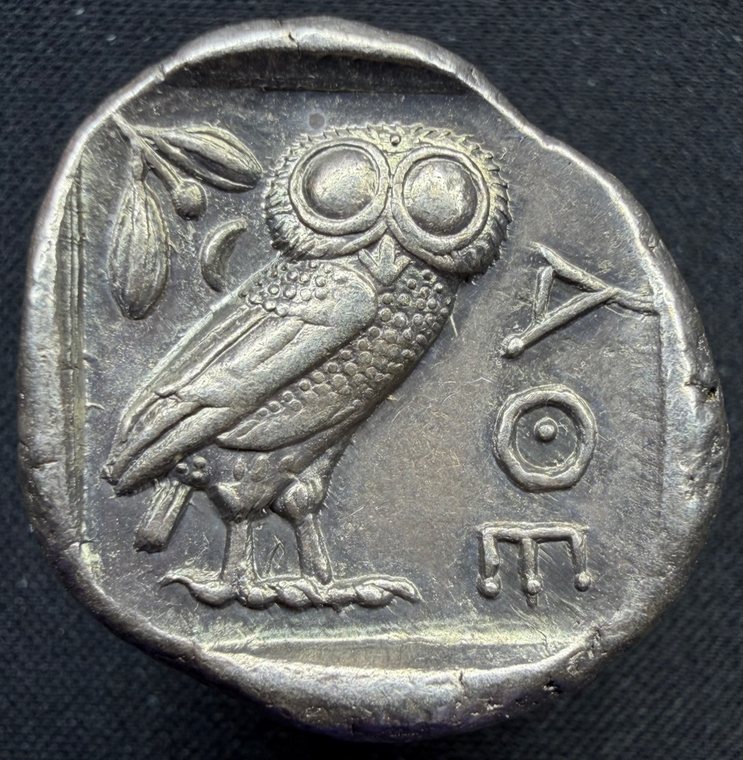
Weigh a handful of ancient silver and a puzzle appears at once. Coins struck to the same standard, in the same city, from the same dies, do not weigh the same. One denarius is 3.97 g, the next 3.71, a worn one 3.08. Yet the mint was not careless, and the coins were not forgeries. To read that scatter you have to know two things: what a standard actually was, and how a hand mint kept to it.
A coin is a weight
Before it is a picture, an ancient coin is a quantity of precious metal certified by an authority. The stamp does not add value; it testifies to value already present in the disc — this much good silver, guaranteed by the city or the emperor whose types it carries. That is why the names of the coins are, almost without exception, the names of weights.
The Greek drachm is a handful — literally, from drassomai, “to grasp” — originally a fistful of six iron spits, the obeloi that gave the small change its name, the obol. The Roman libra is simply “pound,” the unit our own scales still abbreviate lb. A tetradrachm is four drachms; a denarius is “the tenner,” denarius nummus, ten bronze asses. The denominations are arithmetic done in metal. Once you see a coin as a weight first and a picture second, its weight stops being a footnote and becomes the primary fact about it — the thing the whole apparatus of the mint existed to control.
What a standard is
A weight standard is an agreed value for the base unit — the drachm, the stater, the pound — from which every denomination is a multiple or a fraction. It is a convention, not a law of nature, and the ancient Mediterranean ran several at once. A city chose its standard the way a country chooses which side of the road to drive on: what mattered was that its neighbours and trading partners used the same one.
Three Greek standards dominated, and the difference between them is a difference in the drachm. On the Attic standard of Athens the drachm weighed about 4.3 g, so its tetradrachm — the owl — ran near 17.2 g. The Aeginetic standard, older and heavier, set the drachm near 6.1 g; the Corinthian stater of about 8.6 g divided into three lighter drachms of roughly 2.9 g. To the east, the Persian empire and the Anatolian coast reckoned in the siglos, near 5.3–5.5 g, inherited from the bimetallic system of Lydian Sardis. A “drachm” was therefore not one thing but a family of related things, and half of ancient numismatics is knowing which family a coin belongs to.
The Roman pound
Rome reckoned its silver not in drachms but as a fraction of the libra, the pound. The libra is not our pound: it weighed about 327 g, some eleven and a half modern ounces, appreciably lighter than the 454 g pound. And Rome did not count in tens. The libra divided duodecimally, into twelve unciae — the word that gives us both ounce and inch.
The denarius was defined as a count to the pound, and that count moved. Introduced around 211 BC during the war with Hannibal, it began at 72 to the pound — about 4.5 g, exactly four scripula, elegantly clean. Over the following decades it settled to 84 to the pound, about 3.9 g, the weight the great mass of surviving denarii carry. Around 141 BC it was also re-tariffed from ten bronze asses to sixteen, to reflect how far the as had fallen — which is why a coin whose name means “tenner” was, for most of its life, worth sixteen.
Al marco, not al pezzo
Here is the fact that explains the scatter. Ancient mints controlled weight al marco — by the mark, the batch — not al pezzo, by the piece. The mint guaranteed that a fixed count of coins balanced a fixed weight of metal, not that any one coin hit its target. Weigh out a pound of silver, divide it into eighty-four blanks, strike them: the eighty-four together weigh a pound, but individually they run light and heavy around the mean. The error averages out across the batch and is never removed from the single coin.
The count balances the pound
Eighty-four denarii must weigh one libra. No blank is individually adjusted; the flans are cut roughly to size and the tally does the accounting. Fast, cheap, and the method of nearly every ancient mint — at the cost of a wide spread on any single coin.
Each coin brought to weight
An overweight blank is filed or shaved down to a tolerance before striking — the permitted deviation was later called the remedium. It tightens the spread but adds a labour step per coin, so it is reserved for high-value gold and for periods that could afford the care.
Reading the scatter
The theory is visible in a tray of real coins. Below are the silver pieces of this collection, plotted at their actual recorded weights. Hover or tap a dot to see the coin and follow it to its catalogue entry. Two patterns emerge immediately, and both are the argument of this page made concrete.
Tetradrachms cluster just under their target. The Attic standard aims at about 17.2 g, and the owls, the Alexanders, the Seleukid and Sicilian tetradrachms all sit a little below it — near, but never on, and never above. Below them sit two coins that look like tetradrachms but weigh far less: a Ptolemaic issue of Cleopatra and a Syrian tetradrachm of Nero’s Antioch, each struck on a lighter regional standard. Same denomination, different pound.
Denarii scatter below 3.9 g, and drift downward over time. The second chart is the denarius across three centuries. The Republican and early-imperial coins spread across a band a little under the 3.89 g target — ordinary al marco scatter, plus wear, plus the odd banker’s test cut that shaved metal away. Then the band steps down. Nero’s reform of AD 64 cut the standard from 1/84 to 1/96 of a pound, and the third-century coins fall lower still as the silver was repeatedly reduced. The single line of dots is three hundred years of fiscal history.
None of this is disorder. A denarius’s job was to be one eighty-fourth of a pound of good silver; struck al marco, worn in a purse for a generation, occasionally chiselled by a suspicious banker, it still did that job. The scatter is the fingerprint of a hand economy that counted by the batch and trusted the average.
When the standard moves
A standard is a promise, and promises can be quietly rewritten. The most consequential number in Roman monetary history is not a design change but a reduction in weight and fineness — the slow debasement of the denarius, which turned a coin that was a weight of silver into a token that merely stood for one.
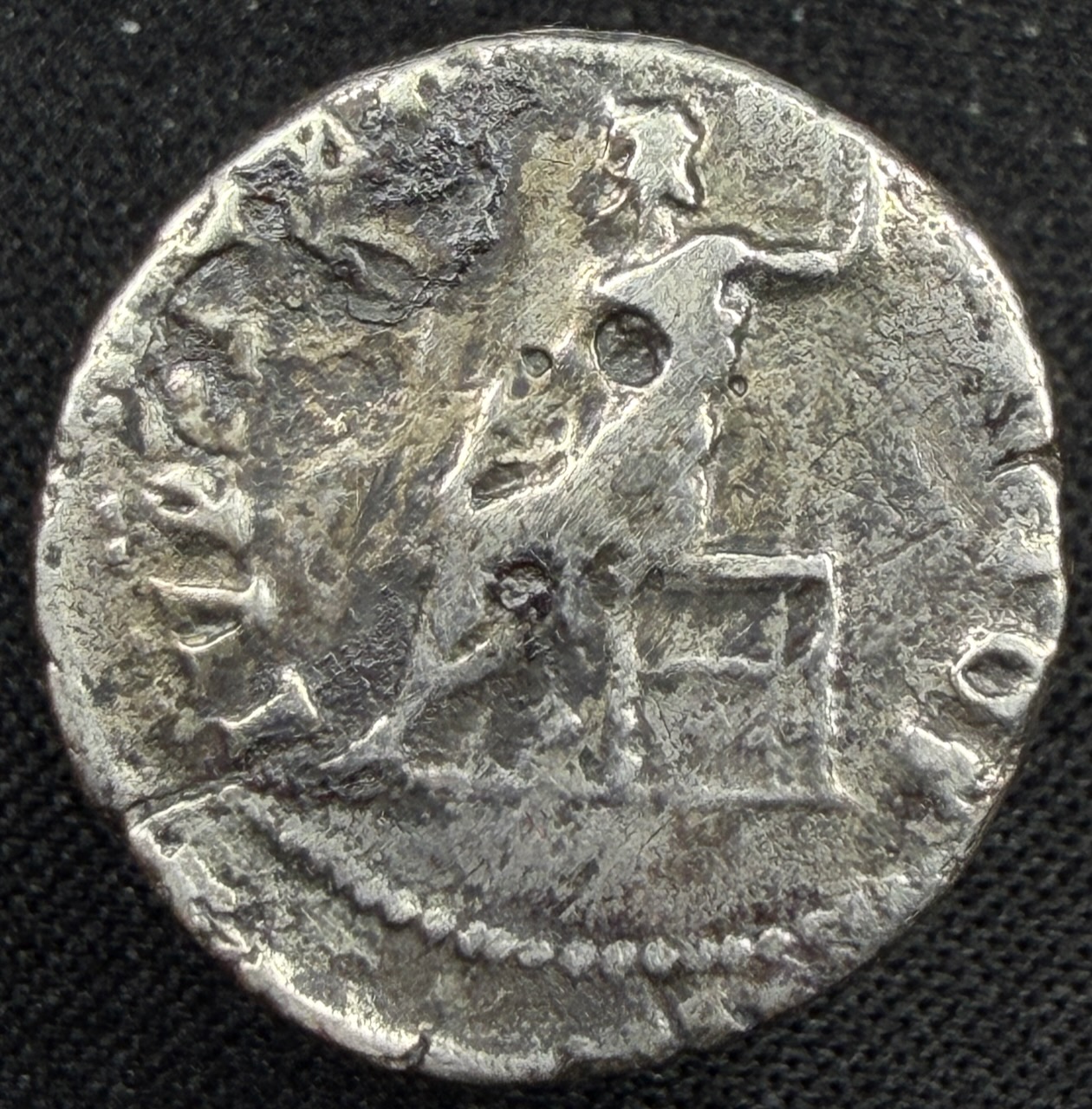
The first cut is datable to the coin. In AD 64 Nero moved gold and silver production to Rome and dropped the denarius from about 1/84 to 1/96 of a pound, at a reduced fineness of roughly 80 per cent. It was the template every later emperor followed. The specimen below is a post-reform denarius of Nero: at 2.82 g it is a full gram lighter than the Republican coins in the chart above — the reform made visible in the hand.
Nero · Denarius · IVPPITER CVSTOS · Rome, post-reform (AD 64–68)
Catalogue entry →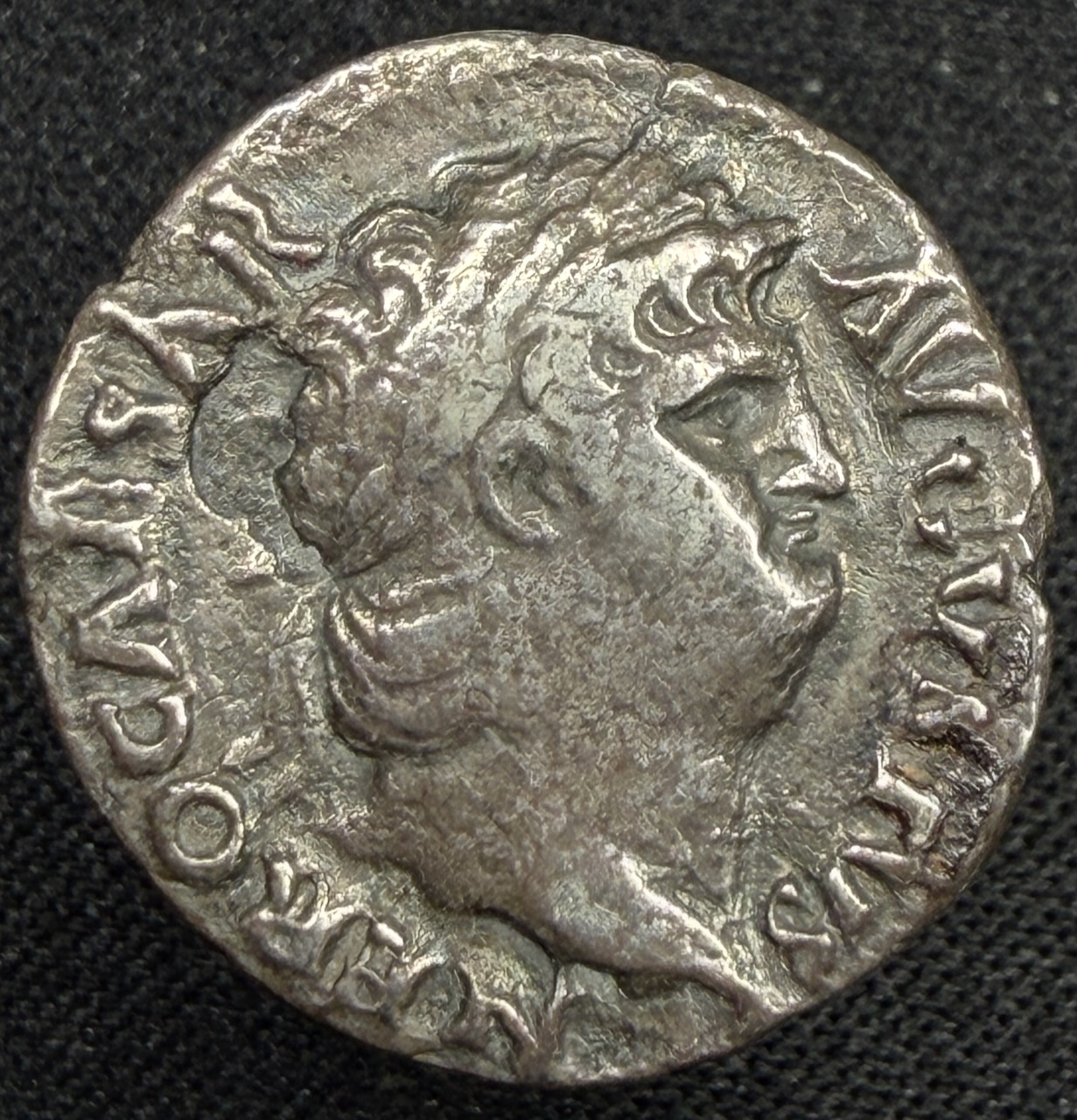
- 12.82 g. Weighed in hand. The pre-reform target was 3.89 g; this coin is the new, lighter 1/96-pound standard — the first debasement of the imperial silver, and the model for all that followed.
- 2Tone over lower fineness. Nero’s reform also cut the silver to roughly 80 per cent. Weight and fineness were reduced together; the standard is both how heavy and how pure.
- 3A full, round flan. Imperial blanks are more uniform than Republican ones — better centring, tighter shape — yet still cut al marco, so the weight is not individually adjusted.
- 4IVPPITER CVSTOS. “Jupiter the Guardian,” struck after the conspiracy of AD 65. Within four years Nero was dead — but his lighter standard outlived him by centuries.
Metallurgical work by Kevin Butcher and Matthew Ponting (The Metallurgy of Roman Silver Coinage, 2014) traced Nero’s reform precisely and showed its ripples reaching even the provincial silver — an empire-wide currency managed as one fiscal system.
By the third century the denarius had been reduced so far — the Julia Mamaea in the chart above weighs 2.40 g — that it was abandoned for the double-denarius antoninianus, itself soon debased to a silver-washed copper. The standard had been moved so often that the coin stopped being believed. When money is only a promise, the promise can be broken; a coin that is genuinely a weight of silver cannot lie about what it is. That is the deep reason weight mattered so much to the people who used these coins — and why it still tells us so much about them.
| Standard | Base unit | Key denomination · target | In this collection (recorded g) |
|---|---|---|---|
| Attic | drachm c. 4.31 g | Tetradrachm · c. 17.2 g | Seleukid 17.09; Syracuse 17.08; pi-style owl 16.98; Alexander 16.97; Egyptian-imitative owl 16.83 |
| Aeginetic | drachm c. 6.1 g | Stater (didrachm) · c. 12.2 g | — (heavier Peloponnesian/island standard; not represented in silver here) |
| Corinthian | drachm c. 2.9 g | Stater · c. 8.6 g | Corinth Pegasos stater 7.58 (worn) |
| Persic / Lydo-Milesian | siglos c. 5.3–5.5 g | Siglos · c. 5.35–5.55 g | Amisos owl-siglos 5.75; Achaemenid siglos 5.28; Croeseid siglos 5.22 |
| Ptolemaic | reduced drachm | Tetradrachm · c. 14 g | Cleopatra VII, Paphos 13.97 |
| Roman (pre-64) | libra c. 327 g | Denarius · 1/84 lb = 3.89 g | Republican–Julio-Claudian: 3.97 down to 3.08 (wear) |
| Roman (post-64) | libra c. 327 g | Denarius · 1/96 lb = 3.41 g | Nero 2.82; later 3rd-c. issues 2.40–3.44 |
Four points where the evidence thins and honest accounts should say so:
- When the denarius fell from 1/72 to 1/84. That it began near 4.5 g and settled near 3.9 g is not in doubt; when is. Some place the reduction early, within a generation of 211 BC; Crawford ties the 1/84 standard to the re-tariffing of about 141 BC. The 141 BC date is often stated as settled — it is not quite.
- How tightly ancient mints held tolerance. That Greek and Republican mints worked al marco is inferred from the scatter itself; no ancient source gives a numeric remedium for them. The permitted deviation is a modern reconstruction, not a figure any mint wrote down.
- Whether any flans were adjusted at all. A few series show filing marks that may be weight adjustment (al pezzo) rather than flan-tree cleanup. How common the practice was, and on which coins, is unresolved.
- The “17.2 g” owl itself. The Attic target is variously given as 17.2 or 17.26 g depending on the drachm figure used, and whether it was a mint target or a market convention is debated. Treat any single decimal as a convenience.
Weights shown are as recorded for each specimen: some weighed in hand, several taken from dealer tags or auction cataloguing, as noted per coin in the catalogue. Dating throughout is BC/AD.
Every figure on this page traces to one of the works below. Where the scholarship disagrees — on the exact weight of the pound, or when the denarius fell to 1/84 — the disagreement is flagged in the text and its endnote rather than smoothed over. Links were checked live; book references without a link are print scholarship worth seeking out.
Primary source
- Pliny the Elder, Natural History, Book 33 The single ancient statement behind the Roman arithmetic used here: “the legitimate proportion being eighty-four denarii to a pound of silver” (33.132). Pliny also records that the denarius, first tariffed at ten asses, was later reckoned at sixteen (33.13). Latin text at LacusCurtius; the 33.132 passage is quoted in English, with commentary, in Yarrow’s post below.
Key modern scholarship
- Michael H. Crawford, Roman Republican Coinage The standard catalogue of the Republican series (“RRC”) and the reference for the denarius’s weight history — its introduction near 1/72 of the pound around 211 BC and its settling to 1/84, tied by Crawford to the re-tariffing at sixteen asses about 141 BC. The date is often quoted as settled; see the endnote for why it is not quite.
- Kevin Butcher & Matthew Ponting, The Metallurgy of Roman Silver Coinage Subtitled From the Reform of Nero to the Reform of Trajan: the definitive scientific study of imperial silver. It dates and quantifies Nero’s AD 64 cut to weight and fineness — the reform embodied by the 2.82 g denarius on this page — and traces its ripples across the empire’s coinage.
- Lisa Kallet & John H. Kroll, The Athenian Empire: Using Coins as Sources On the Attic standard and how Athenian silver functions as historical evidence — the drachm of c. 4.31 g, the tetradrachm near 17.2 g, and the trade weight behind them. Kroll is also the author of the standard treatment of the Athenian coins from the Agora excavations.
Reference & further reading
- List of ancient Greek monetary standards — Wikipedia The whole family of standards side by side (Attic, Aeginetan, Corinthian, Persian siglos, Ptolemaic, Rhodian and more), each with its unit weight — and a clear statement of why real coins fall below nominal: manufacturing imprecision, wear, and mints deliberately shaving the standard. Well sourced to Kallet & Kroll and Mørkholm.
- Attic weight — Wikipedia A focused overview of the Athenian/Euboic standard: drachm 4.31 g, tetradrachm 17.26 g, the interchangeable Euboic stater, and the slow Hellenistic decline in weight that produced the lighter Seleucid and Ptolemaic tetradrachms seen in the chart above.
- William Smith, “Denarius,” Dictionary of Greek and Roman Antiquities (1875) A readable Victorian classic at LacusCurtius, still sound on the essentials: the ten-to-sixteen-as change, the reduction from 84 to 96 denarii per pound whose timing “is uncertain, as it is not mentioned in history,” and the caution that the denarius only roughly equalled the Attic drachm.
- Liv Mariah Yarrow, “The Roman Pound” (2014) A working Roman numismatist weighs the evidence for the pound itself — the case for 322.8 g against the conservative 325–327 g used here — and reproduces Pliny 33.132 in full. A good window onto how a seemingly fixed number is still argued over.