Two coins, four centuries and a thousand miles apart, made almost the same way. The Athenian tetradrachm — the “owl” — and the Roman denarius were both produced by hand, one blow at a time, by men standing at an anvil. The differences between them are differences of scale, organisation and taste, not of technology.
The metal
Athens struck its owls on silver from Laurion, the mining district in south-east Attica whose galleries the city worked with slave labour on an industrial scale. It was a strategic asset as much as an economic one: a rich new strike in the 480s BC paid for the fleet that fought at Salamis. The silver was refined by cupellation — smelted with lead, then oxidised in a hearth until the lead and base metals were driven off — leaving a metal of roughly 98% fineness.
Rome had no Laurion. The Republican denarius, introduced around 211 BC during the war with Hannibal, ran on captured bullion, indemnities, melted-down plate, and above all on the silver of Iberia once Spain was in Roman hands. Early denarii are also near-pure, in the mid-90s or better. That purity is the thing to watch across the centuries: it is the slow debasement of the denarius — accelerating under Nero, collapsing in the third century AD — that turns a coin into a promise.
The flan
Before anything can be struck, you need a blank — a flan, of the right weight. This is the least glamorous stage and the one that leaves the most obvious fingerprints on the finished coin.
Cast lumps, then beaten
Owl flans are thick, dumpy and irregular — often visibly globular. The likeliest method is casting molten silver into simple open moulds or shallow depressions and then hammering the lumps roughly flat. Nobody was trying to make them pretty; the flan is frequently too small for the die, which is why so many owls are struck off-centre with the owl’s tail or Athena’s crest running off the edge.
Cast in trees, then clipped
Roman practice used linked moulds, casting a branching “tree” of flans joined by channels of metal. The blanks were snapped or clipped off the sprues and the stubs filed away — which is why you sometimes find a flat facet or a file scar on the edge of a denarius. The result is a rounder, flatter, more uniform blank than anything Athens produced.
Weight control worked al marco, not al pezzo: the mint guaranteed the count per pound, not the weight of any individual coin. A denarius was struck at 84 to the Roman pound, so eighty-four coins had to balance the scale — but any one of them could run light or heavy. This is why single-specimen weights scatter, and why weight alone is weak evidence of authenticity.
The dies
The die is the coin. Everything else is consumable.
A die is a block of iron — sometimes bronze, more often hardened iron — with the design cut into its face in negative and in intaglio: what stands proud on the coin is cut hollow in the die. The engraver worked with gravers and burins for the flowing lines, and with small shaped punches for repeated elements: pellets, the beads of a border, sometimes whole letters. On the finest Greek work, the difference between a great die-cutter and a competent one is visible at arm’s length, which is why signed dies by the Sicilian engravers are collected as sculpture.
The two dies are not equal partners. The obverse die — Athena’s head, or the deity or portrait on a denarius — was sunk into the anvil, immobile, taking the load through the flan. The reverse die, the punch or trussell, was held in the hand and hit directly with a hammer. It absorbed the blow. It failed first, and it failed constantly: reverse dies shatter, crack, mushroom at the head, and get replaced while the obverse die grinds on underneath. Die studies routinely find substantially more reverse dies than obverse ones in a given issue — the asymmetry is one of the most reliable signals in the whole discipline, and it is the basis for estimating how large an issue actually was.
The blow
Now the work itself. The flan was almost certainly warmed — annealed — before striking. Modern experimental reconstructions have found that hot or warm silver flows into the die recesses with a single blow, whereas cold metal resists, requires repeated hammering, and cracks at the edges. Not everyone agrees that every mint heated every flan, and the argument is still live; but the sharpness of a well-struck owl, on a thick blank, is hard to get from cold metal.
The sequence is brutally simple. The flan is set on the anvil die, probably with tongs. The punch is placed on top and held vertical. The hammer comes down. Metal, under a load in the region of tens of tons concentrated on a disc the width of a thumbnail, has nowhere to go but sideways and into the hollows — and the coin is made in that instant.
Then the coin is knocked off, the next flan goes on, and the cycle repeats — perhaps a few hundred times an hour, by a team of three: one to place the flan, one to hold the punch, one to swing. It is a forge, not a factory.
Why nothing is centred
The obvious question, once you have looked at enough ancient coins: why is the design so often sliding off the edge? Did nobody at the mint think to hold the blank in place?
They did not — and they could not. At the moment of impact nothing is gripping the flan. It is placed on the anvil die with tongs, the tongs come away, the punch is set on top, and a man swings. Anything still holding the blank when the hammer lands is a hand or a tool that gets destroyed; anything clamped around it would itself be struck into the metal. So there is a brief instant in which a slightly domed disc is simply sitting in a shallow engraved hollow, and whatever position it is in when the blow arrives is the position it keeps forever. Strike it twice and it can shift between blows, which is where doubling comes from.
There is one weak self-centring effect. The die face is not flat — it is cut in intaglio, so its deepest point is roughly central, and a lumpy blank tends to settle toward that hollow. It helps slightly. It is nowhere near a fixture.
So why not build one? Two reasons, and the first is the real one.
It did not matter. A denarius’s job was to be one eighty-fourth of a pound of good silver. Off-centre by a tenth, it still weighs what it should and still contains what it should. Centring is a collector’s concern, and a largely modern one. The soldier being paid did not check whether the beaded border ran off at six o’clock. And throughput. Striking was piecework at volume — place, punch, hammer, knock clear, repeat, several hundred an hour by a team of three. Any device that must be loaded, aligned and released costs seconds per coin, and seconds per coin is the difference between filling a strike order and missing it.
They did partly solve it later, and the evidence is subtle. Republican die axes are effectively random: the punch was loose in the hand and landed however it landed. From the Imperial period, die axes increasingly cluster at six or twelve o’clock — hard to achieve with a free punch, and it implies that something registered the punch against the anvil die: a sleeve, a collar, a hinged or tethered arrangement. Nobody knows exactly what. It is inferred from the coins, not from any surviving description. Whatever it was would have constrained lateral position too, which is why Imperial coins are on average better centred than Republican ones. The Hadrian above is mildly off, not badly — about right for its date.
The thing that finally solved it is the collar: a ring that confines the flan so metal cannot escape sideways at all, giving a perfectly round, perfectly centred coin with a defined edge — and, eventually, reeding and edge lettering. That is an early-modern invention, bound up with the mechanised screw press. The ancients never had it. Which is exactly why every ancient coin is a slightly different shape, and every modern one is not.
A picture of the Roman mint, drawn by the mint
If you want a period photograph of the kit, there is one — struck onto a coin. In 46 BC the moneyer T. Carisius issued a denarius carrying Juno Moneta on the obverse and, on the reverse, the tools of his own trade: the anvil die at the centre, the cap-shaped punch die garlanded above it, the tongs at the left, the hammer at the right, all inside a laurel wreath.
It is an extraordinary object. Roman moneyers used the reverse to advertise their families; Carisius used it to advertise the job itself. It is the closest thing we have to a photograph of a Roman mint from the inside, made by a man who worked there — and it shows the anvil, the punch, the tongs and the hammer, and no centring device of any kind. Everything on that coin is a tool for hitting metal. Nothing on it is a tool for aiming.
T. Carisius · Denarius · Rome, 46 BC · RRC 464/2
American Numismatic Society · 1941.131.309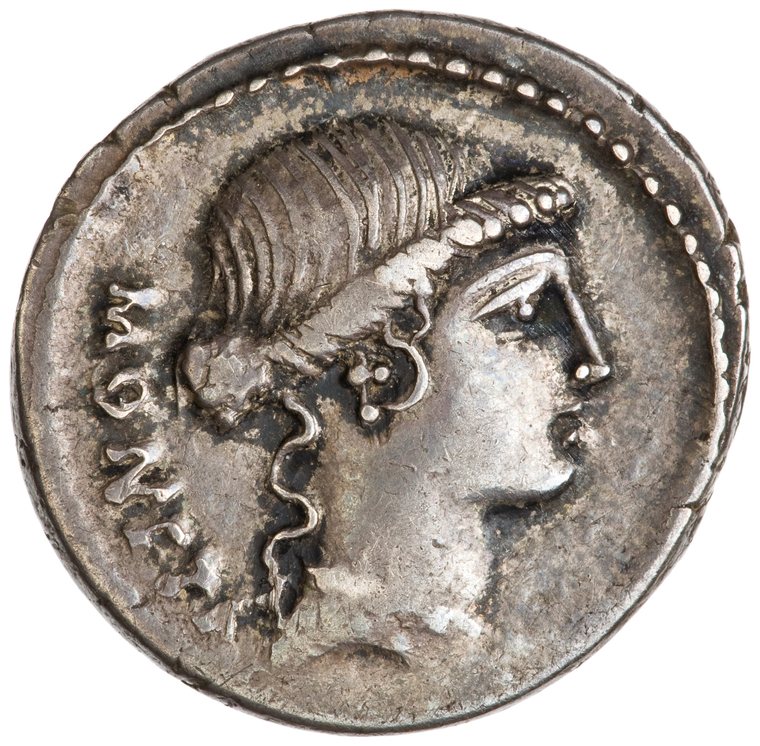
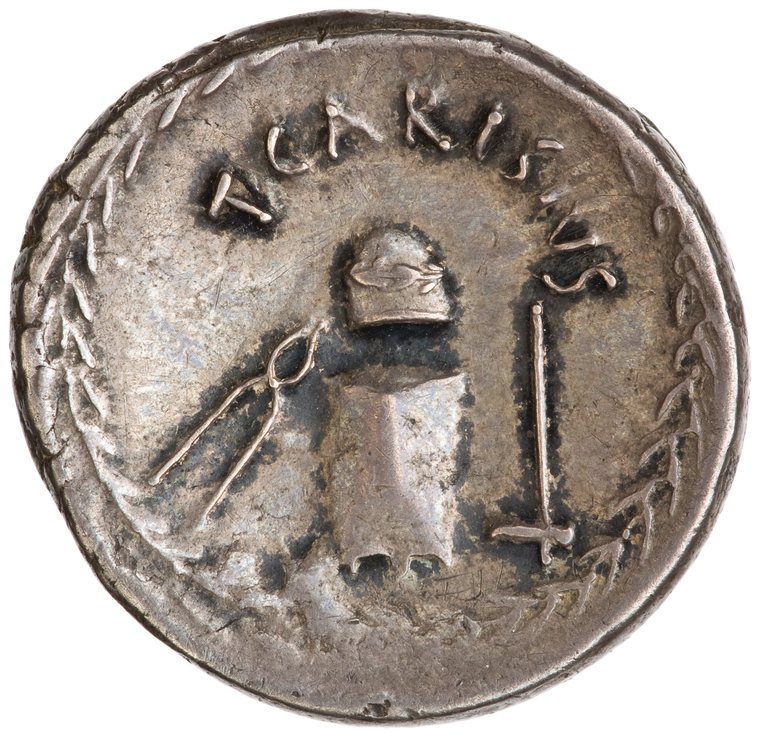
- 1MONETA. The epithet, running up the left field. Her temple on the Capitoline housed the mint; the word became moneta, then money, then mint.
- 2Juno Moneta. The goddess in whose house the coin was struck — the mint asserting its own legitimacy on its own product.
- 3The garlanded punch die. The upper die, cap-shaped, wreathed. It sits poised directly above the anvil — caught in the instant before the blow.
- 4The anvil die. The lower die in its block: immobile, load-bearing, long-lived. Everything in this document happens on top of that.
- 5The tongs. For placing the flan — and then letting go of it. Note what they are not doing: holding it steady.
- 6The hammer. The entire mechanism of the ancient mint, in one object.
- 7Laurel wreath enclosing the whole, with T·CARISIVS above. He put a victor’s crown around a set of workshop tools.
The garlanded cap is usually read as the upper die about to come down on a blank held in the tongs. Some have taken it instead for the workman’s cap of Vulcan, god of the forge. The argument has never been settled — and either reading points at the same workshop.
What the metal remembers
Because the process is manual, it fails in characteristic ways — and those failures are evidence. They are how you tell an ancient coin from a cast copy, and how you read the life of the dies that made it.
Both coins below are from this collection. Tap a marker to read what it is.
Athens · Tetradrachm · c. 454–404 BC
Catalogue entry →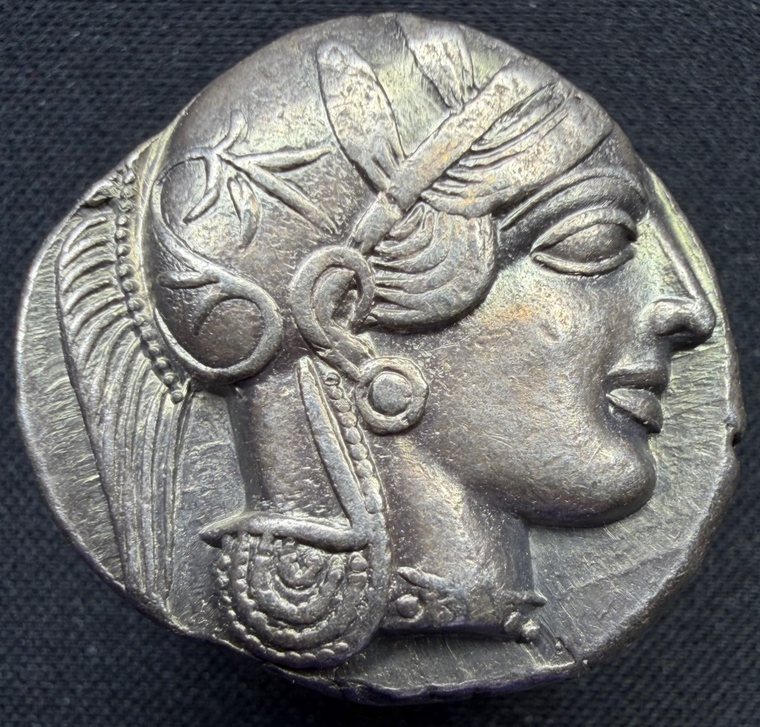
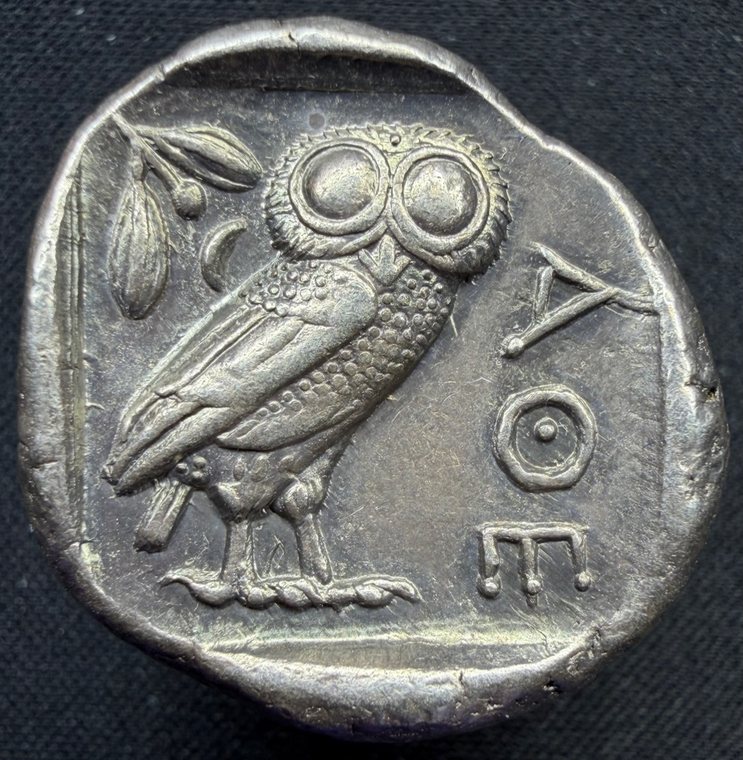
- 1The die is bigger than the flan. Athena’s crest runs clean off the edge. The engraver cut a full design; the blank was never large enough to receive it. Standard for owls, and not a fault.
- 2Split edge. A thick blank driven outward under the hammer tears at the rim. The metal had to go somewhere.
- 3A full strike. The cheek and eye are crisp and deep — metal reached the bottom of the recess. This is the argument for a warmed flan: cold silver rarely fills like this.
- 4Edge of the punch. That straight ledge is the boundary of the reverse die’s field. You are looking at the physical shape of the tool.
- 5Crowded periphery. Olive sprig and crescent are jammed against the flan edge — the same undersized-blank problem, seen from the other side.
- 6No test cuts. Owls that travelled east are routinely chopped by bankers checking for a plated core. This one has none — it was not chopped, which is itself a fact about where it circulated.
Hadrian · Denarius · AEGYPTOS · Rome
Catalogue entry →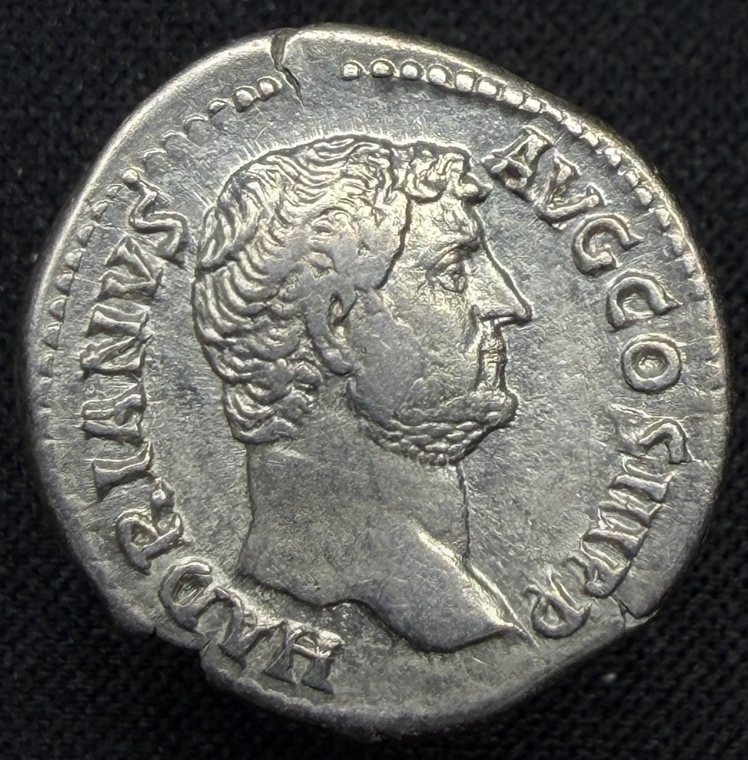
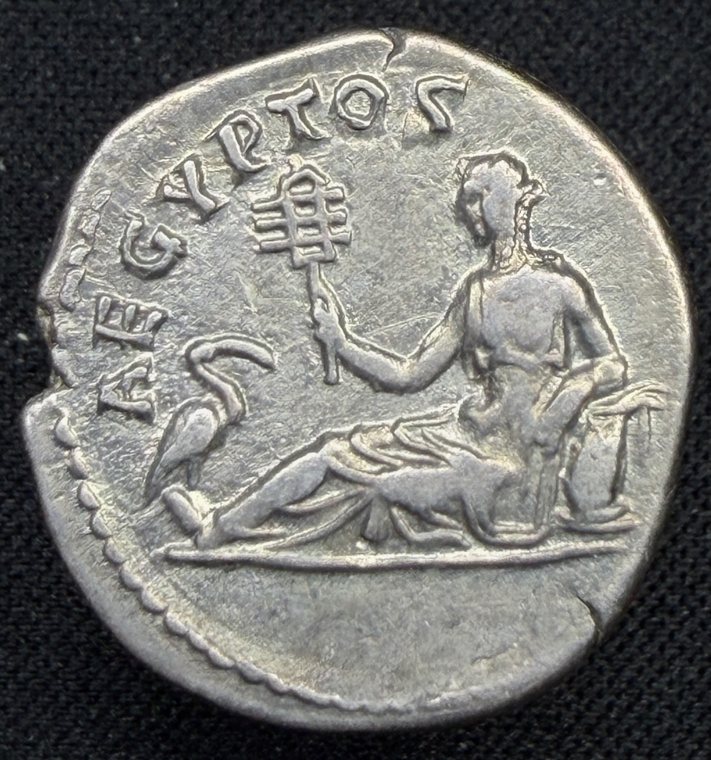
- 1Die crack. The raised ridge breaking through the beaded border is not damage to the coin — it is a fracture in the iron die, filled with silver at the moment of the blow. The die was failing and still in service.
- 2A second crack running from the bust truncation toward the rim. Two fractures on one face: this obverse die was late in its life.
- 3Border off the flan. The beaded border survives at the top and vanishes at the bottom — so this is lateral displacement, not an undersized blank. A blank simply too small for the die loses its border evenly all round. See Why nothing is centred, above.
- 4The reverse cracked too. A matching fracture at the top of the punch die. Both tools were breaking down while this issue was still being struck.
- 5Irregular outline. The blank was cast, snapped from its sprue and filed. That is why a Roman flan is round-ish rather than round.
- 6Edge flaw. A split at the rim where the metal spread past the die. Compare the owl: the same physics, on a thinner blank.
None of this is a defect in the modern sense. It is the process, visible. A cast forgery reproduces the design but cannot reproduce a die crack — because a die crack is a hole in a tool that no longer exists.
A few worth knowing by name. A brockage occurs when a struck coin sticks in the punch and is itself used as a die for the next flan — producing a coin with a normal obverse and a sunken, mirror-image obverse on the reverse. Doubling means the punch bounced or shifted between blows. Die rust, showing as raised pitting, tells you the die sat idle in a damp workshop and came back into service. And the deep chisel test cuts so common on owls that travelled east are not damage inflicted on a collectable — they are a Levantine or Egyptian banker satisfying himself that the coin was not a copper core in a silver coat. On owls, they are provenance.
Who ran the mint
Athens struck in the Agora, near the south-east corner, in a workshop whose remains have produced the debris of the trade. The owl’s design barely changes for well over a century — deliberately. The Athenians had discovered that an instantly recognisable, reliably fine coin was worth more abroad than a fashionable one, and they froze the type into an archaic-looking brand while Greek art moved on around it. It is the earliest example of a currency trading at a premium for its reputation alone.
Rome struck at the Temple of Juno Moneta on the Capitoline — the epithet from which every word for money in half the languages of Europe descends. Production was supervised by three junior magistrates a year, the tresviri monetales, who signed the coinage with their names and, increasingly, used the reverse to advertise the achievements of their own families. That is why the Republican denarius series is so wildly various where the owl is so static: at Rome the coin was a young aristocrat’s billboard, and the design changed every time the job did.
How many coins came off a single die? The honest answer is that nobody knows. Experimental strikings and statistical estimates from surviving die-links have produced figures ranging from a few thousand to tens of thousands per obverse die, and the estimates carry very large error bars. Treat any confident number you read — in a catalogue or an auction description — with scepticism.
| Athenian tetradrachm | Roman denarius | |
|---|---|---|
| Period | c. 510 BC onward; classical “mass” owls c. 454–404 BC | Introduced c. 211 BC; runs to the 3rd century AD |
| Standard | Attic; c. 17.2 g | 84 to the Roman pound (libra, c. 327 g); c. 3.9 g. Earlier 72 to the pound, c. 4.5 g |
| Fineness | c. 98% Ag, stable for a century | c. 95–98% Ag at first; debased from Nero onward |
| Silver source | Laurion mines, Attica | Iberia, war indemnities, recycled bullion |
| Flan | Cast lumps, hammered; thick, globular, often undersized | Cast in linked moulds, clipped from sprues; flatter, rounder |
| Obverse (anvil die) | Head of Athena, helmeted | Deity; later the emperor’s portrait |
| Reverse (punch die) | Owl, olive sprig, crescent, ΑΘΕ | Moneyer’s or emperor’s chosen type — changes constantly |
| Die axis | Uncontrolled; effectively random | Variable in the Republic; often regularised under the Empire |
| Design policy | Frozen for reputation abroad | Rotated annually as political advertising |
| Characteristic flaw | Off-centre strike; test cuts from eastern circulation | Sprue scar on edge; doubling; die cracks |
| Reference | Kroll; SNG; HGC 4 | RRC (Crawford); RIC; OCRE |
Three points on which the literature genuinely disagrees, and which any confident account should flag rather than paper over:
- Hot or cold striking. Experimental work supports warming the flan; the counter-case argues that good strikes are achievable cold and that annealing every blank is impractical at volume. Probably varied by mint and by metal.
- Coins per die. Estimates span an order of magnitude. The statistics rest on assumptions about survival rates that cannot be independently checked.
- How Athenian flans were actually made. Casting is the consensus, but the specific mould technology is inferred from the coins themselves rather than from a well-preserved workshop.
Dating throughout is BC/AD.
The account above follows the works below; links were checked live. Book references without a link are standard print scholarship. The Carisius denarius illustrated is American Numismatic Society 1941.131.309, linked in its plate.
Reference & further reading
- Mike Markowitz, “How Ancient Coins Were Made” — CoinWeek A well-referenced overview of the whole process: casting versus striking, preparing flans, the anvil (obverse) die fixed in a tree-trunk and the reverse die on a hand-held shank, double-striking, the “continuing controversy” of hot versus cold striking, and the Carisius denarius — including the same open question this page raises, whether the garlanded object is a punch die or Vulcan's leather cap.
- Hammered coinage — Wikipedia Concise on the mechanics: the planchet cast from a mould, the anvil die (pile) sunk in a log, the hand-held trussel, and the experimental-archaeology estimates of die lifespans — a lower die good for thousands of strikes, with the Delphi evidence suggesting tens of thousands.
- Andrew Meadows, “The Technology of Coinage” A scholarly synthesis of ancient minting technique — dies, flans, and the striking process — and the evidential limits behind confident-sounding reconstructions.
- Michael H. Crawford, Roman Republican Coinage The standard catalogue of the Republican series; the moneyer's-tools denarius of T. Carisius is RRC 464, and the weight history of the denarius discussed here rests on this work.