Pick up a handful of Athenian owls that travelled east in antiquity and many will carry a deep, deliberate slash across the reverse. To a modern eye it looks like vandalism. It is the opposite: it is the single most reliable test an ancient merchant had for the one fraud that silver coinage could not otherwise defeat — the plated fake.
The gash that isn't damage
A coin is a promise about metal: this disc is good silver, of this weight. A stamp is easy to copy; the metal underneath is the thing that matters. And there was one forgery that defeated eye and scale alike — a base-metal core wrapped in a thin skin of silver, struck from decent dies at close to the right weight. It looked right, it rang close enough, and it could pass from hand to hand for years.
There was only one certain way to expose it: cut into the coin and look. A test cut is exactly that — a chisel driven into the edge or across the face, hard enough to open the metal so the interior shows. Good silver is silver all the way down. A plated fake reveals a copper or lead core at the bottom of the cut. The gash is not damage inflicted on a collectable; it is the record of a transaction being checked.
The fourrée
The forgery being hunted has a name: the fourrée, from the French for “stuffed,” known to the Romans as subaeratus — “bronze underneath.” A copper core was clad in silver foil or a plating of precious metal and then struck between ordinary dies. If the coating was seamless, the dies good, and the weight close, it could pass as genuine.
Some fourrées were struck by outright criminals; some, awkwardly, from the very dies of official mints, which has fuelled a long argument about whether cash-strapped states occasionally passed their own plated coins. Athens certainly did once openly: during the ruinous end of the Peloponnesian War, in 406 BC, the city issued emergency silver-plated bronze — “money of necessity” — and only redeemed it for good silver as the economy recovered around 393 BC.
The banker's chisel
Owls were the dollar of the eastern Mediterranean. Athens sent them abroad by the tens of thousands to buy grain, and they piled up in the markets of the Levant and Egypt, where they were trusted precisely because they were reliably fine. Trust invites forgery, and forgery invites testing — which is why test cuts cluster on exactly the coins that travelled furthest. A money-changer at Tyre or Memphis, handed a heavy Athenian tetradrachm, had every reason and every right to cut it and be sure.
The marks come in grades. A shallow banker's mark — a small punch, often a symbol or letter — could be a validation stamp, a merchant's way of saying “I have checked this one.” A deep test cut is the full interrogation: a chisel driven in far enough to open the core. On owls the cut most often lands on the reverse, across the owl itself. None of it was aimed at spoiling the coin; all of it was aimed at trusting it.
The law that ordered the cut
The most striking evidence that the test cut was official, not vandalism, is that a state wrote it into law. In 375/4 BC Athens passed a statute — known from a marble stele dug out of the Agora in 1970, and called Nikophon's Law after its proposer — establishing a public dokimastés, an official Tester, to sit among the bankers' tables in the Agora and the market of Piraeus and rule on disputed silver. His judgement was final.
Reading a real cut
The collection's clearest test cut is not on an owl at all, but on a Roman denarius — and that is itself part of the story. Testing did not stop with the Greeks; the same suspicion followed silver for centuries. This succession denarius of Augustus, advertising the young Tiberius in a triumphal chariot, carries a notch chiselled into its edge, catalogued by the auction house that sold it as an edge test cut.
Augustus · Denarius · Tiberius in quadriga · Lugdunum, AD 13–14
Catalogue entry →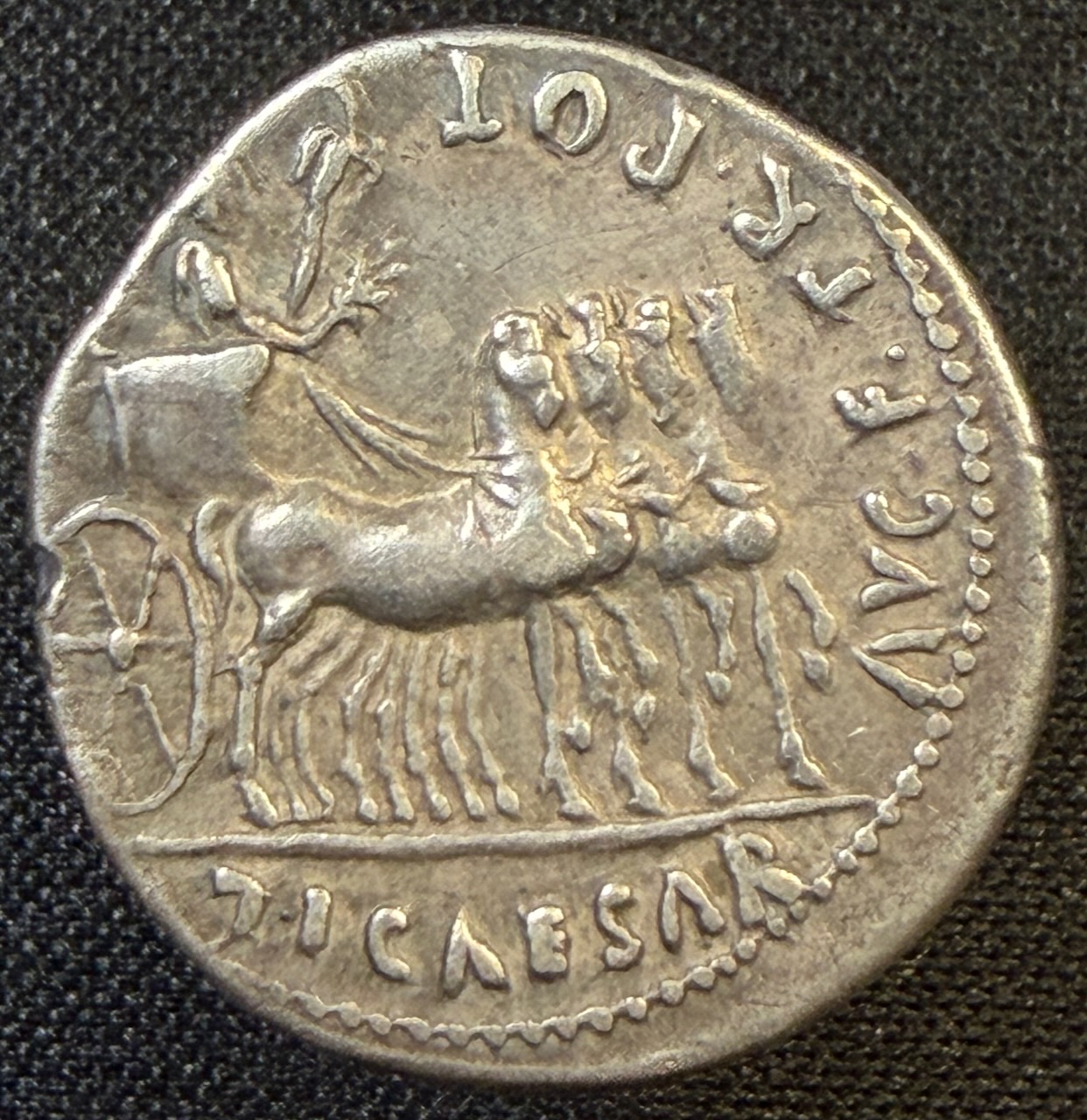
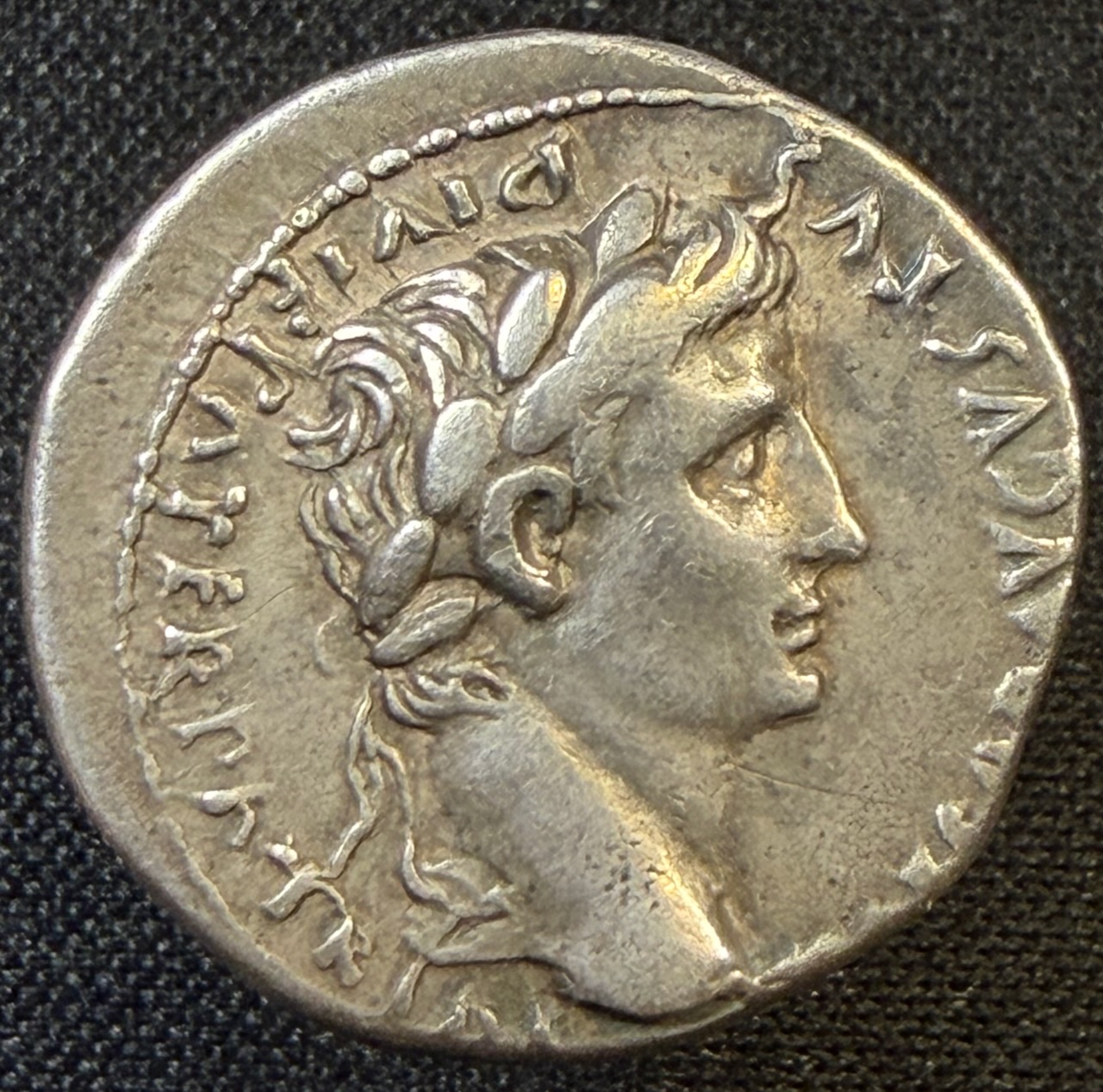
- 1The test cut. A notch chiselled into the edge at nine o'clock, beside the chariot wheel — a check that the coin was silver through and through. It came back clean: this is good metal, and the coin kept circulating.
- 2A full strike. The quadriga and horses are sharp — the coin is sound and well made. The cut is not a flaw in the striking; it was added later, in commerce.
- 3TI CAESAR. In the exergue: the coin advertises Tiberius' succession. It was money and a message — and, to a wary money-changer, a disc to be verified like any other.
- 4The portrait of Augustus, laureate. A recognisable imperial type was no protection against a plated fake — only the cut could settle that.
- 5Cabinet toning. Centuries of quiet oxidation, unrelated to the cut. See the collection's essay on toning and patina.
Honesty about the market: a test cut is the single feature auction bidders discount hardest, and this coin is no exception. The gash that makes it history also makes it cheaper — the collector's loss is the historian's gain.
And the owls? The classical tetradrachm and the pi-style owl in this collection are both uncut — and that too is a fact worth reading. A clean owl did not travel the chisel-happy routes east, or was pulled out of circulation before a banker reached it. Absence of a test cut is not nothing; it is a small statement about where a coin spent its life. (The owls appear in the collection's minting essay, where their want of test cuts is one of the annotated points.)
Provenance, not damage
Two truths sit side by side, and an honest account keeps both. To the market, a test cut is an injury: it lowers the grade and the price, and a flawless owl will always outsell a chopped one. To the historian, a test cut is a document: it is physical proof that this exact coin passed through a real ancient economy, was doubted, was tested, and was found good — the fake would have been slashed and melted, not preserved for us.
So the same mark is a defect and a credential at once. It is worth learning to tell a test cut — deliberate, deep, aimed at the core — from mere edge knocks, scratches, or the small validating banker's punch, because each carries a different piece of the coin's biography. The gash is the coin's passport, stamped at a border two thousand years ago.
| Mark | Looks like | Made by / when | Means |
|---|---|---|---|
| Test cut | Deep chisel slash, edge or face, opening the metal | Merchant / banker, in circulation | Checked for a plated core — found good (the fakes were destroyed) |
| Banker's mark | Small punch: a symbol, letter, or dot | Money-changer, in circulation | “I have validated this coin” — a lighter check than a full cut |
| Countermark | A stamped device or legend added to the coin | An authority, later than striking | Revalidation, revaluation, or re-branding by a state — see the countermarks essay |
| Graffito | Scratched letters or symbols, shallow | An owner, any time | Ownership, a tally, or a note — not a metal test |
| Edge knock / flaw | Irregular ding, split, or strike crack | Accident or the minting itself | Wear and handling, not a deliberate mark |
Points where the evidence is thinner than confident captions suggest:
- Were all cuts about testing? Most deep cuts are best explained as metal tests, but some scholars read certain slashes as deliberate cancellation or even ritual — a coin taken out of use rather than checked. Motive cannot always be recovered from the mark alone.
- Official fourrées. Plated coins struck from official dies are real; whether they mean corrupt mint workers, stolen dies, or states quietly issuing debased money in a crisis is argued case by case.
- Does “uncut” prove a route? An owl without a test cut probably avoided the eastern money-changers — but it might simply have been withdrawn early, or tested with a light punch that then wore away. Absence is suggestive, not decisive.
- Cut versus banker's mark. The line between a deep validating punch and a shallow test cut is not always sharp, and cataloguers do not always agree on which a given mark is.
Dating throughout is BC/AD.
The claims here rest on the works below. The Athenian law is quoted from its modern edition; links were checked live, and book references without a link are print scholarship worth seeking out.
Primary source
- Nikophon's Law — Athenian law on silver coinage, 375/4 BC The inscribed statute, from a marble stele found in the Athenian Agora in 1970, establishing the public Tester (dokimastés) and ordering that coins found to be bronze or lead at the core be “cut across.” The foundational evidence that testing was official practice. Text and translation are also reproduced in the CoinWeek article below.
Reference & further reading
- Mike Markowitz, “Bad Money: Ancient Counterfeiters and Their Fake Coins” — CoinWeek A well-referenced survey of ancient counterfeiting: how fourrées were made, why owls were tested, the text of Nikophon's Law, the 17.24 g Attic standard, Athens' 406 BC emergency plated coinage, and Pliny on Romans who collected fine fakes. The single best accessible overview of this topic.
- William Smith, “Denarius,” Dictionary of Greek and Roman Antiquities (1875) Notes the serrati — denarii with saw-toothed edges “done to prove that they were solid silver, and not plated” — a mint-side answer to the same anxiety that drove the banker's chisel. At LacusCurtius.
- Peter van Alfen, “Problems in Ancient Imitative and Counterfeit Coinage” A leading scholar of ancient monetary practice on the blurred line between imitation, official copy, and outright forgery — the grey zone that made testing necessary in the first place.
- John H. Kroll, The Athenian Agora XXVI: The Greek Coins The standard study of the Athenian coinage, including the owls and the hoard and circulation evidence that shows where test-cut coins travelled and accumulated.