Type · thebes-shield-kantharos-hemidrachm
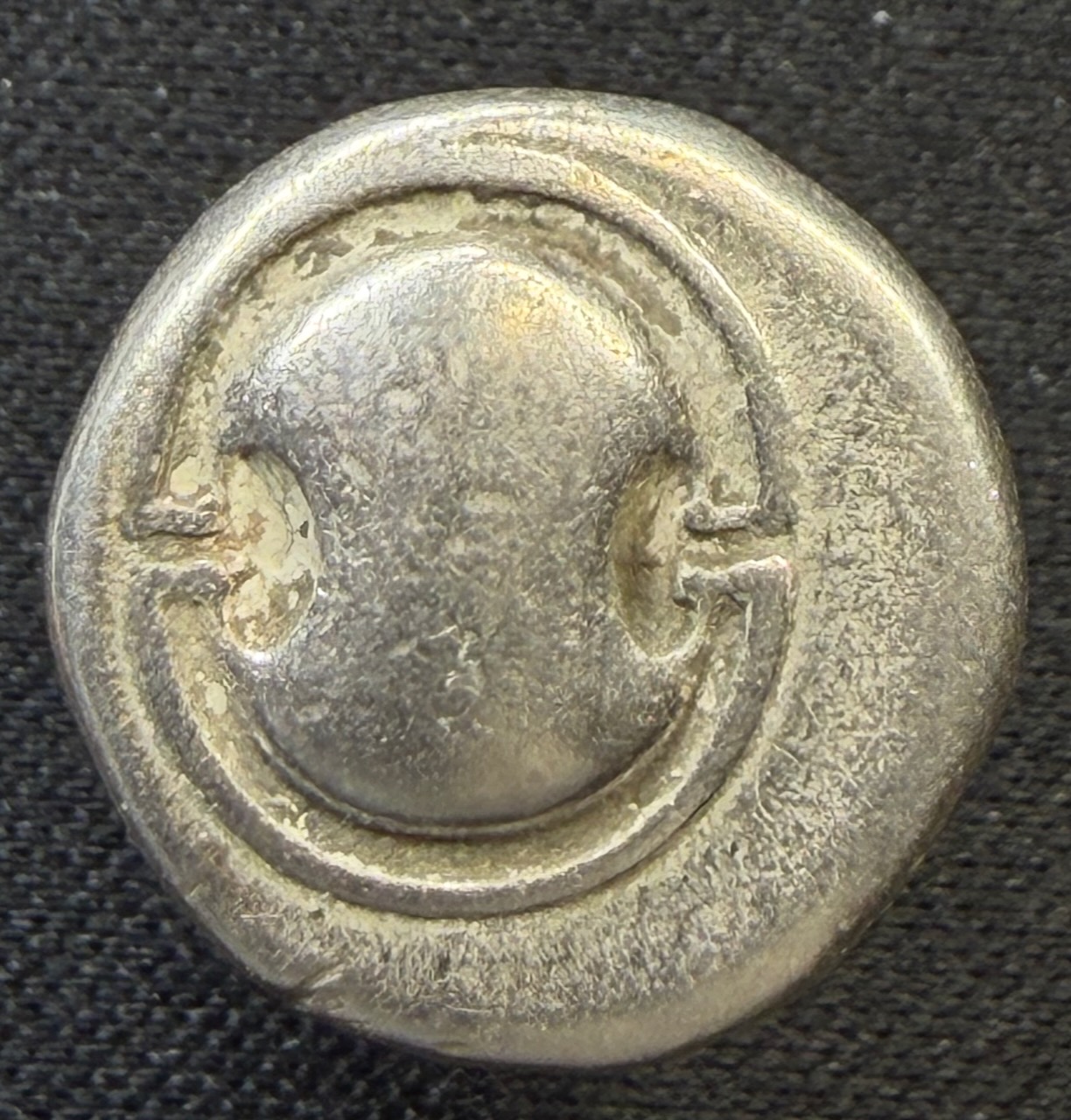
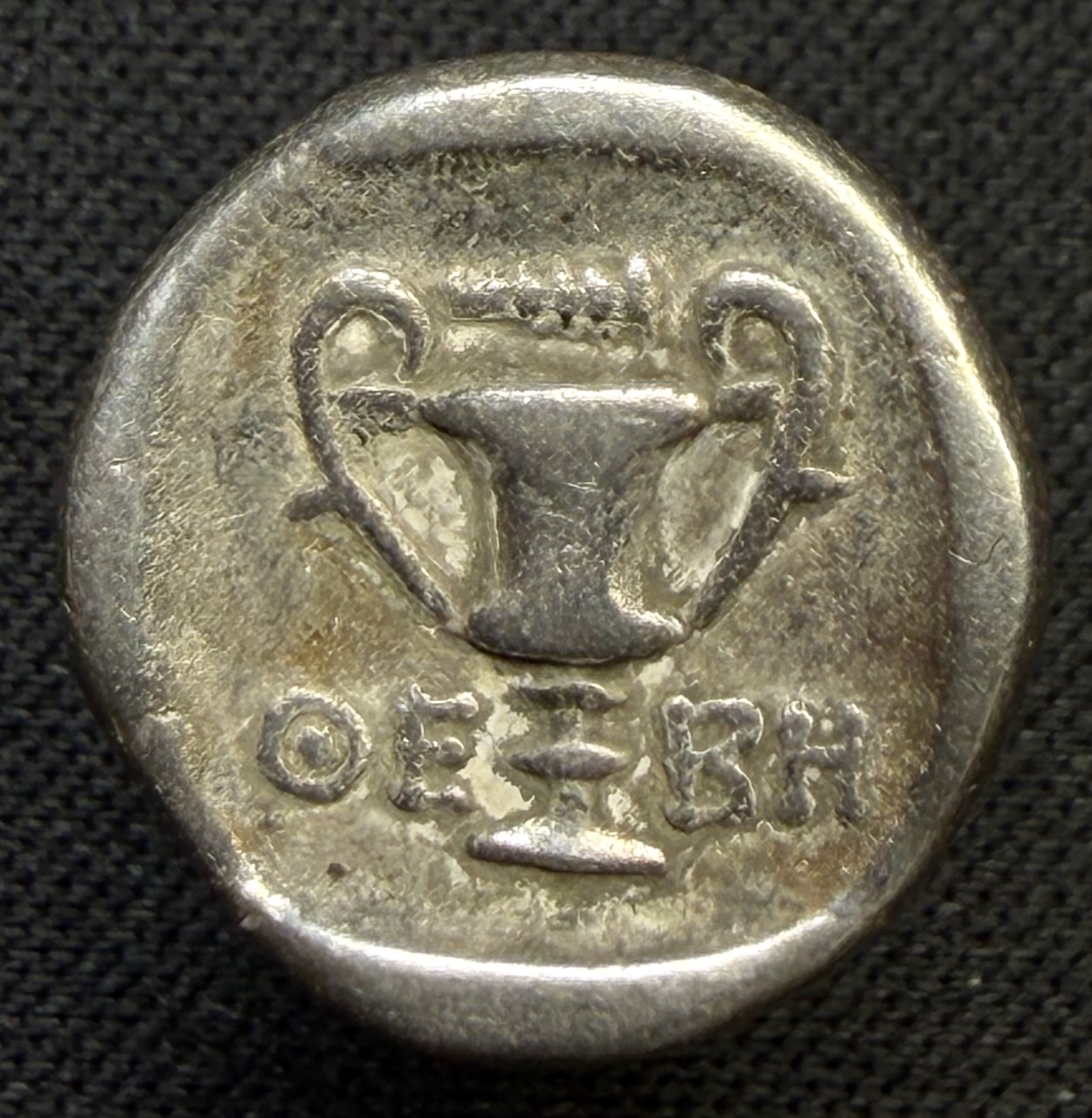
Current: Boiotia, Thebes, AR hemidrachm, c. 425–375 BC. Boiotian shield / kantharos, club above, ΘΕ-ΒΗ (BCD Boiotia 412; HGC 4, 1348)
Obverse: Boiotian shield — oval with rounded cut-outs at each side
Reverse: Kantharos (two-handled drinking cup); above, club right; all within shallow incuse square
Primary reference: BCD Boiotia 412
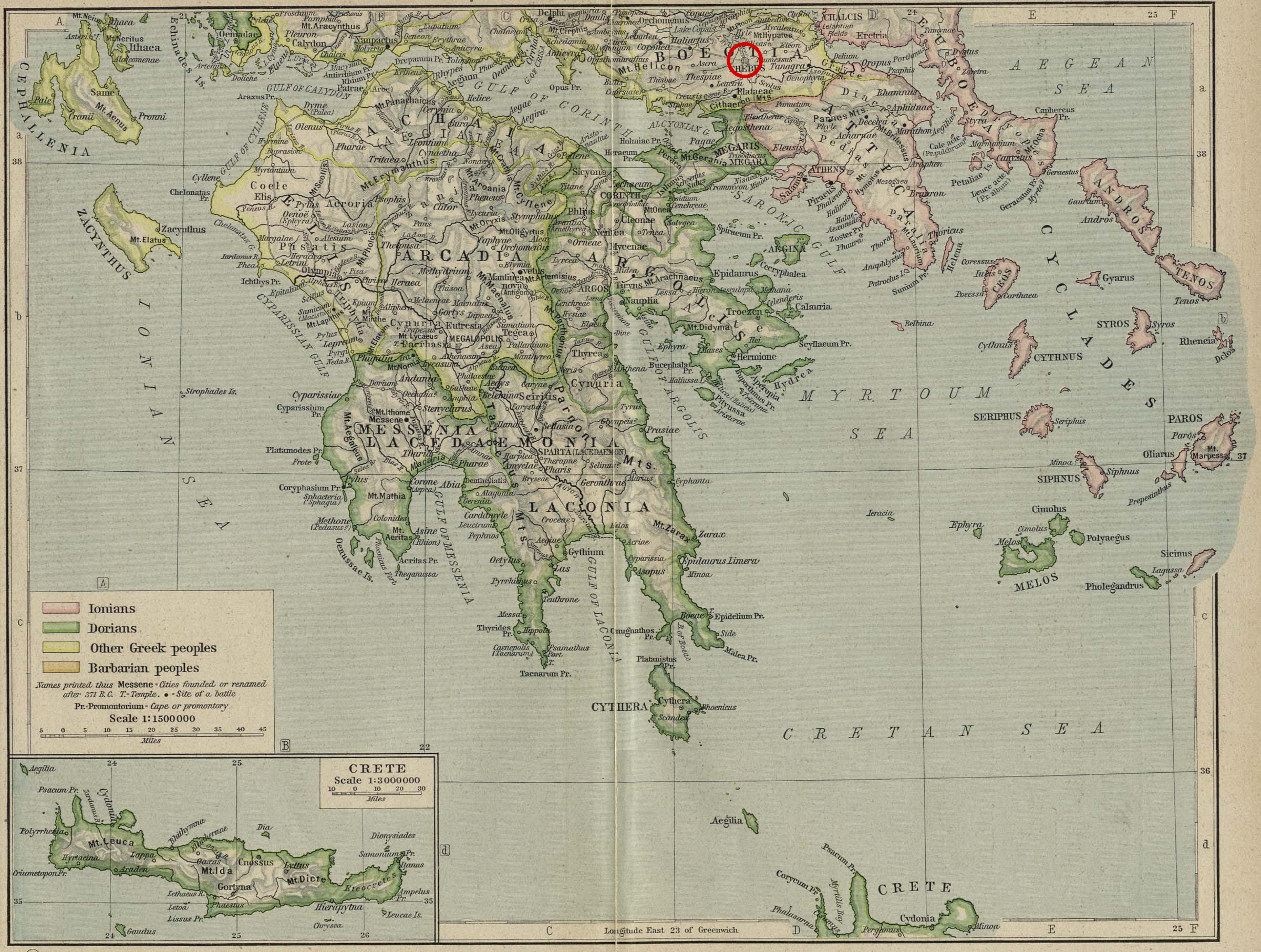
Central and southern Greece, with Thebes circled in red in the heart of Boiotia — the plain between Mt. Helicon and the Euboean channel whose cities shared the shield coinage. Athens lies just over the Cithaeron ridge to the southeast; Delphi and Phokis to the west.
“Reference Map of Ancient Greece, Southern Part” by William R. Shepherd, Historical Atlas (Henry Holt & Co., 1923 and later printings), public domain; via Wikimedia Commons, File:Ancient greece so 1926.jpg (scan via the Perry-Castañeda Library, University of Texas). Red circle added to mark Thebes.
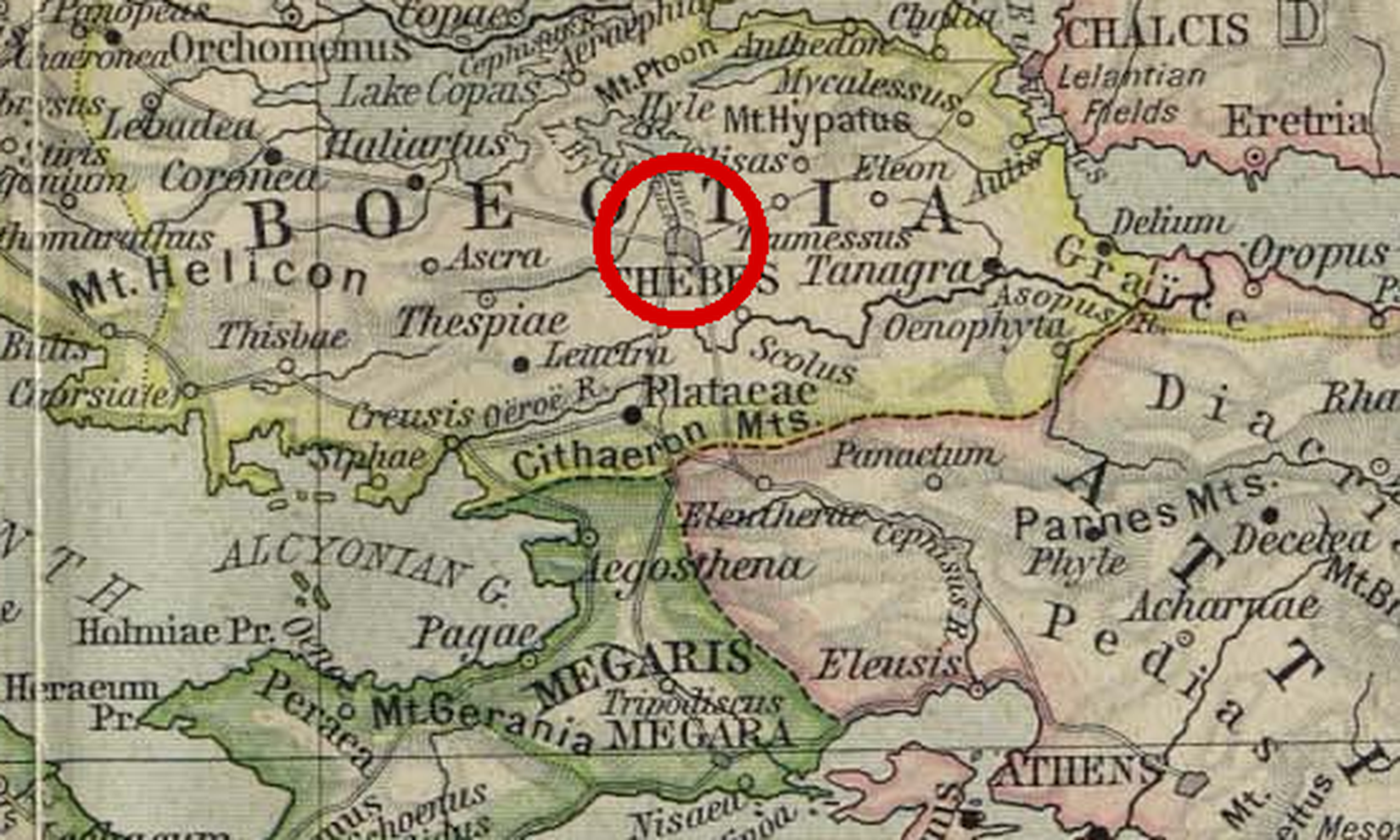
Detail: Boiotia, with Thebes circled. The map is a gazetteer of the city’s history — Plataea and Thespiae, the rivals it crushed; the Cithaeron passes toward Athens; and just southwest of the circle, Leuctra, where Epaminondas broke Sparta in 371 BC, within the very years this hemidrachm was struck.
Every coin of classical Boiotia wears the same armor: the Boiotian shield, an oval body-shield with a rounded cut-out on each side for the spearman’s grip. It was the badge of the Boiotian League, the federation of cities that Thebes dominated, and it made Boiotian money instantly recognizable from Olympia to the Black Sea. The reverse is where each city signed its work — and Thebes, on this hemidrachm, chose the kantharos, the deep two-handled wine cup of Dionysos, who was born at Thebes to the princess Semele. Above the cup lies a club, the weapon of Herakles, the city’s other great native son; the four letters ΘΕ-ΒΗ flanking the base leave no doubt about the mint.
Graphic: JSB Coins (CC0).
The half-century this coinage spans (c. 425–375 BC) carried Thebes from junior partner to superpower. The city fought beside Sparta to destroy Athens in the Peloponnesian War, then turned on its old ally; by 371 BC — within a few years of this coin’s series ending — Epaminondas would shatter the Spartan army at Leuktra, on Boiotian soil, and make Thebes briefly the first power of Greece. The instruments of that victory were forged in these coin-years: the liberation of the Kadmeia from its Spartan garrison in the winter rising of 379 BC (Xenophon, who was there in spirit if not in body, tells it at Hellenica 5.4), and the creation of the Sacred Band, the picked corps of one hundred fifty sworn pairs whom Gorgidas raised and Pelopidas led (Plutarch, Pelopidas 18–19). At Leuktra Epaminondas massed his left wing fifty shields deep behind that corps and refused his right — the oblique order that became the most studied tactical idea in Greek history — and the Spartan king Kleombrotos died where he stood. The League’s federal silver, this shield-and-cup money, paid for that ascent. A generation later Thebes would lead the Amphiktyonic coalition in the Third Sacred War against its neighbor Phokis — the war memorialized in this collection’s Phokian triobol struck from Delphi’s melted treasure.
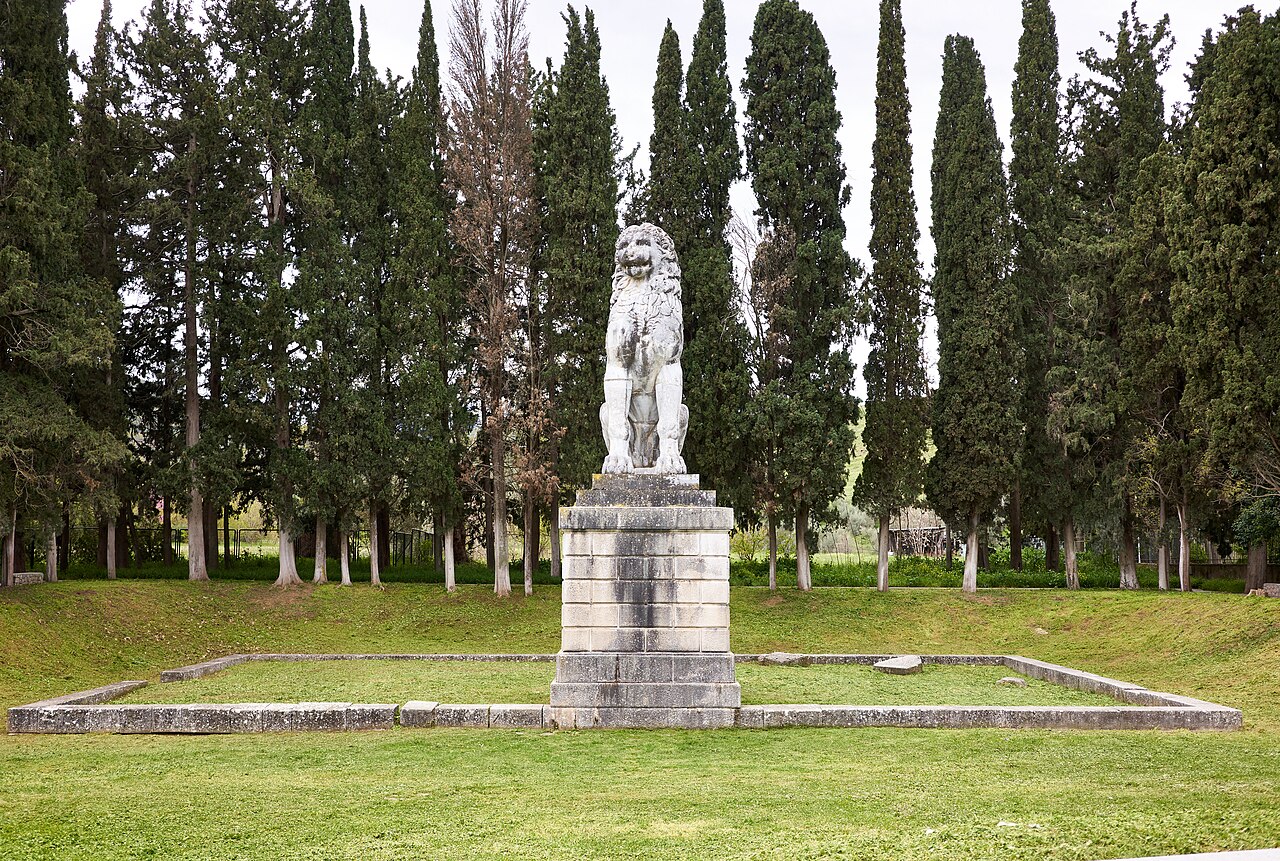
Photo: George E. Koronaios, Wikimedia Commons, licensed CC BY-SA 4.0, reproduced unmodified.
The shield coinage’s world ended on a single afternoon in August 338 BC, a day’s walk west of Thebes. At Chaeronea Philip of Macedon broke the allied Greek line, and the Sacred Band — the corps that had made the Theban hegemony — was annihilated in its place; Plutarch records that Philip, surveying the three hundred dead lying in their ranks, wept (Pelopidas 18). The marble lion later raised over their common grave still sits beside the road, and the mass burial beneath it, opened in 1879–80, held 254 men in seven ordered rows. Three years later Thebes rose against Alexander, and the city itself was erased: six thousand killed, thirty thousand sold, every building but the temples and Pindar’s house leveled (Diodorus 17.8–14; Arrian 1.9). The Boiotian shield outlived on coinage the city that made it famous.
The League struck the shield on everything from staters to obols. The stater (c. 12 g) carried magistrates’ names after 395 BC; the hemidrachm kept the simpler civic formula of cup, club, and ethnic. The little cut-out shield proved so durable an emblem that it outlived Theban power itself — it was still on the coinage when Alexander destroyed the city in 335 BC.
Attribution follows the BCD Collection catalogue (Triton IX: Coins of Boiotia, lot 412) and Oliver D. Hoover, Handbook of Coins of Northern and Central Greece (HGC 4), no. 1348; concordances SNG Delepierre 1362 and BMC Central Greece (Thebes) 78 per CNG’s Triton XXIII sale description of the same issue. For Thebes in the period, Xenophon’s Hellenika (Books 5–7) and Diodorus Book 15 are the primary narratives, both linked in the references; the Sacred Band and Philip’s tears at Chaeronea: Plutarch, Pelopidas 18–19; the destruction of 335 BC: Diodorus 17.8–14 and Arrian 1.9; the 1879–80 excavation beneath the Lion of Chaeronea is summarized in the standard treatments of the battle.
The hemidrachm of Thebes's classical silver: Boiotian shield obverse shared across the League's mints, with the kantharos-and-club reverse and four-letter ethnic ΘΕ-ΒΗ distinguishing the Theban issue. Attic-Boiotian weight standard, c. 2.5–2.7 g. The full-legend kantharos hemidrachms sit between the early ethnic-less issues and the magistrate staters of 395–338 BC; CNG's Triton XXIII example (BCD Boiotia 412 dies) carried a Spink 1970 pedigree.
John's Ancient Coin Collection · Type · thebes-shield-kantharos-hemidrachm
Image credits for this coin — photographs, maps and graphics used on this page