Type · caesarea-maritima-faustina-junior-genius-ae
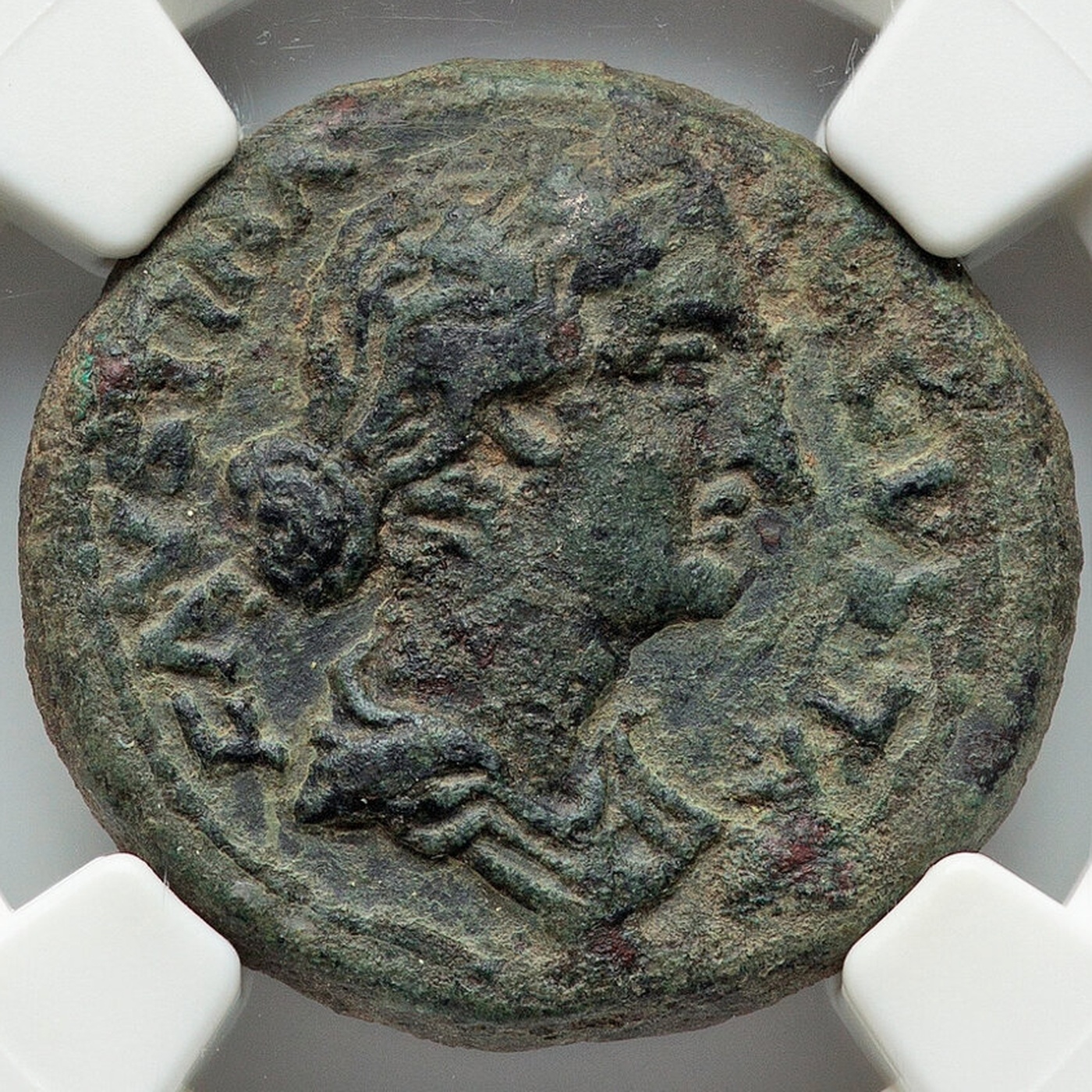
Current: Roman Provincial, Samaria. Caesarea Maritima (Colonia Prima Flavia Augusta Caesarea). Faustina Junior, Augusta AD 147–175/176. AE 24 mm. Draped bust right / Genius (or the emperor) standing facing, head left, cornucopia in the left arm, sacrificing from a patera over a thymiaterion decorated with a bull's head. RPC IV.3 online, temporary no. 6321.
Obverse: Draped bust of Faustina Junior right, seen from the front, the hair braided and coiled at the back of the head in a large chignon.
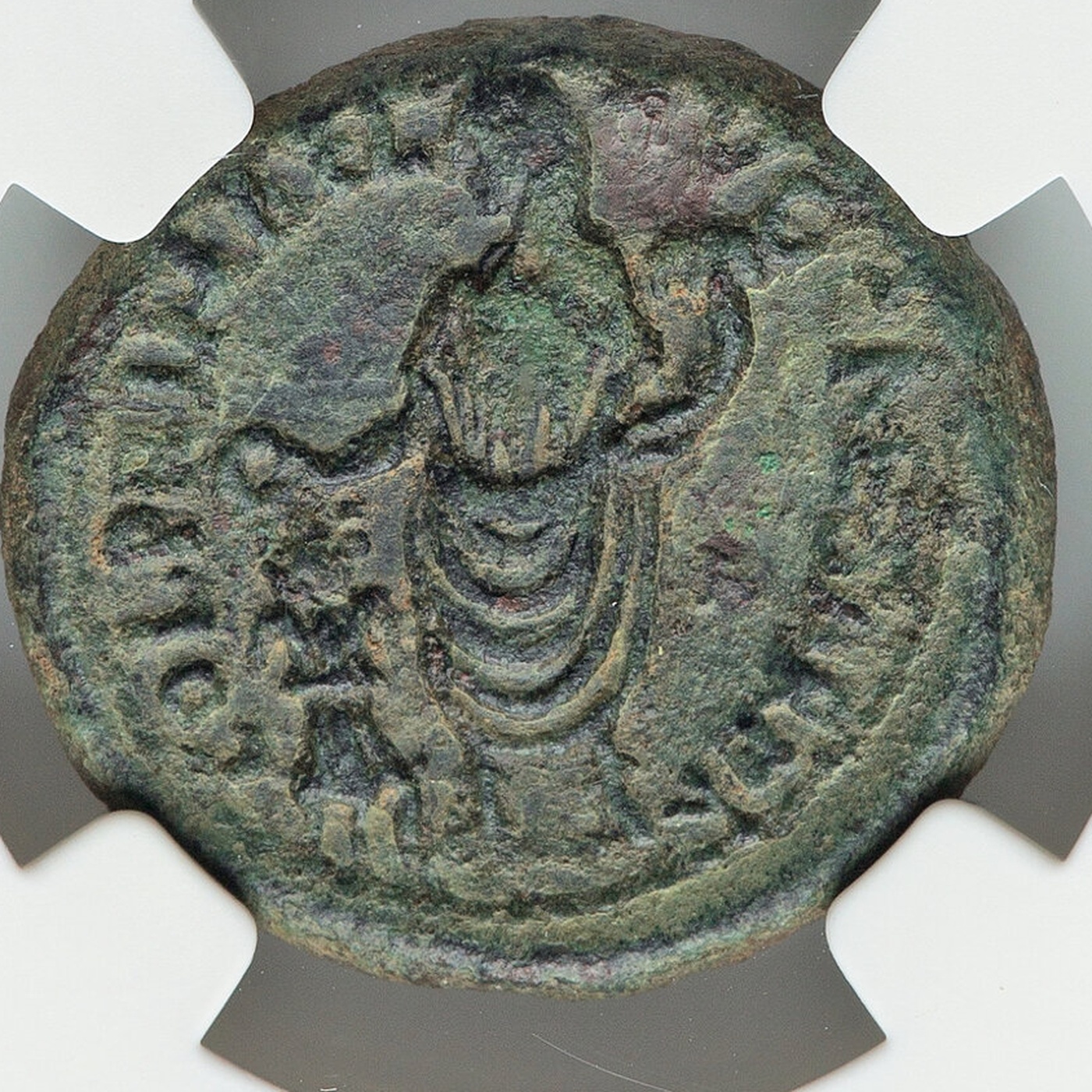
Reverse: Genius — or the emperor; the cataloguing leaves the identification open — standing facing, head turned left, a cornucopia cradled in the left arm, pouring a libation from a patera held out in the right hand, over a thymiaterion (an incense altar) whose body is decorated with a bull's head.
Primary reference: RPC IV.3 online, temporary no. 6321
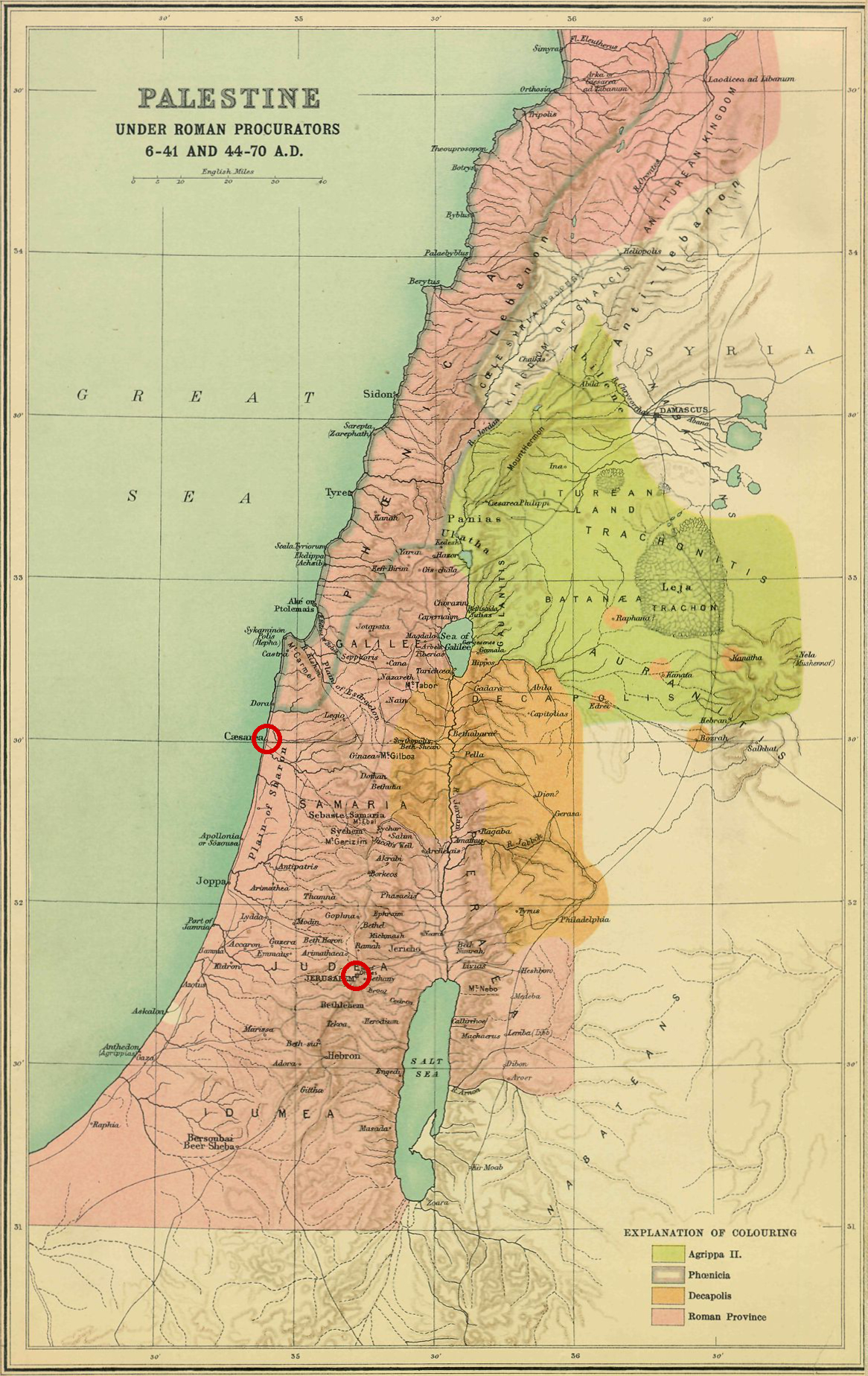
Palestine under the Roman procurators, from George Adam Smith’s historical atlas of 1915. Caesarea Maritima, the mint of this coin, is ringed in red on the coast — the harbour city Herod built and the seat of the Roman governors of Judaea. The map’s date range (6–41 and 44–70 AD) is a century before this coin, and is used here because it shows the administrative geography the city’s status came from: the second ring marks Jerusalem, mint of the prutah of Pontius Pilate bought in the same sale, whom Caesarea housed.
“Palestine under Roman Procurators, 6-41 and 44-70 A.D.” from George Adam Smith, Atlas of the Historical Geography of the Holy Land (1915). Public domain (published 1915; author died 1942). Wikimedia Commons: https://commons.wikimedia.org/wiki/File:Palestine_under_Roman_Procurators_(Smith,_1915).jpg MODIFIED: two red rings added by this catalogue, one on Caesarea and one on Jerusalem. The unmarked original is kept at maps/Palestine_under_Roman_Procurators_Smith_1915.jpg.
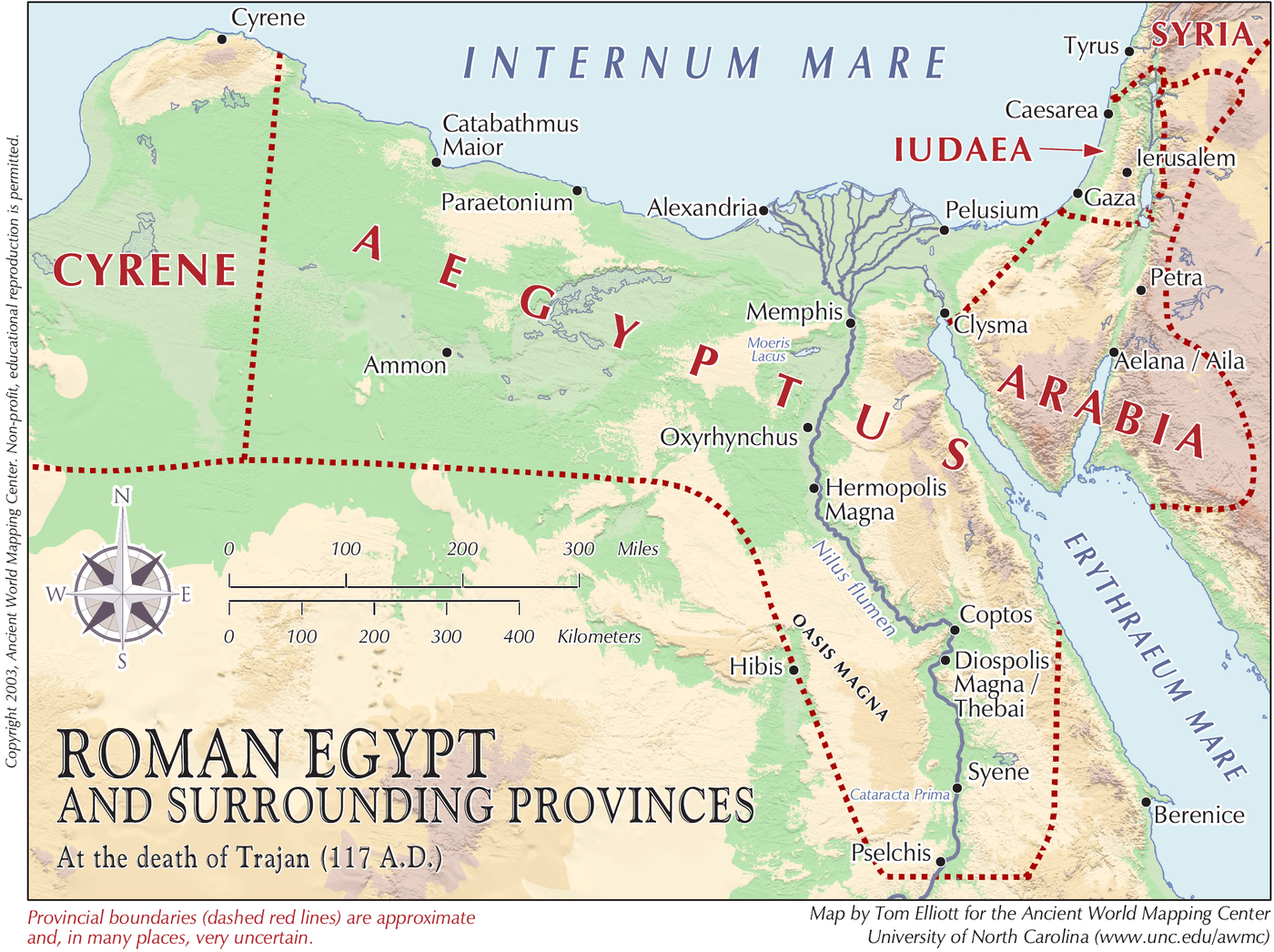
Caesarea on the Judaean coast — this coin’s mint, Herod’s artificial harbour and the seat of the Roman governor. The map is drawn for AD 117, a generation or so before this bronze, and shows why the city mattered: it is the province’s link to the sea, on the route between Egypt and Syria. Ierusalem lies inland to the south-east.
Caesarea Maritima was not an old place. Herod the Great built it from nothing between about 22 and 10 BC on the site of a modest Hellenistic anchorage called Strato’s Tower, and what he built was extraordinary: an artificial deep-water harbour on a coast with no natural one, its moles sunk in hydraulic concrete that set underwater, with a temple to Rome and Augustus raised above the quay so that it was the first thing a ship saw. He named the city for his patron.
When Rome annexed Judaea in AD 6, Caesarea became the seat of government. The prefects lived there, not in Jerusalem — including Pontius Pilate, whose name survives on a stone found reused in the city’s theatre. Jerusalem was the religious capital and the place where trouble started; Caesarea was where the administration sat, on the coast, facing Rome.
By the time this coin was struck, the city had been through the war that destroyed Jerusalem. Vespasian — who had begun the campaign in Judaea, and was proclaimed emperor at Caesarea in AD 69 — raised the city to the rank of Roman colony. The reverse legend is that grant, written out: COL PRIMA FL AVG CAESAREA, Colonia Prima Flavia Augusta Caesarea.
A colony was a legal status, not a description: it meant Roman law, Roman magistrates, a Roman civic constitution, and for its citizens a tax position distinct from the province around them. Caesarea got it first among the cities of the region — prima — and the coin says so a century later, because that is what civic coinage is for. These bronzes were struck by the city itself, for local circulation, and their reverses are the city talking about itself: its status, its gods, its founder’s harbour.
A figure stands facing, head turned left, a cornucopia in the crook of the left arm, pouring a libation from a patera in the outstretched right hand. Beneath the patera is a thymiaterion — a tall incense altar — with a bull’s head worked into its body.
Who the figure is was left open by the cataloguers, and is left open here. RPC and Heritage both give “Genius (or emperor)”. The cornucopia and the act of sacrifice suit the Genius of the colony, the personified spirit of the place, which is a common civic reverse. They suit an emperor sacrificing just as well. Nothing in the type settles it, and a page that picked one would be inventing certainty the evidence does not supply.
The bull’s head on the altar is the detail worth having. Bucrania — ox skulls — were standard decoration on Roman altars, a permanent image of the animals sacrificed on them.
Annia Galeria Faustina, called Faustina the Younger to distinguish her from her mother, was born about AD 130, the daughter of Antoninus Pius and Faustina the Elder, and married to Marcus Aurelius in AD 145. She bore at least thirteen children, of whom few survived; she accompanied Marcus on campaign and was given the title Mater Castrorum, Mother of the Camp; she died in AD 175 or 176 in Cappadocia, and Marcus had her deified.
The rest of what is usually said about her should be handled carefully. The ancient tradition — the Historia Augusta above all, and Cassius Dio — accuses her of serial adultery with soldiers, sailors and gladiators, and of complicity in the revolt of Avidius Cassius in AD 175. Auction cataloguing repeats these flatly, and the Heritage description of this very coin does. But the Historia Augusta is a late, unreliable and frequently invented source, and hostile gossip about imperial women is one of the things it is least trustworthy on; Dio is better but not disinterested. What can be said is that these charges are what the hostile sources allege, that Marcus himself gave no sign of believing them, and that no contemporary evidence supports them.
Her coinage, struck across some thirty years, is genuinely useful for something less lurid: it tracks a woman from a young princess to a matron, and with her the changing architecture of Roman women’s hair — this coin’s large coiled chignon among them.
It was bought on appeal rather than off a want list, in the same sale as the Pilate prutah, and the pairing is better than coincidence. One coin was struck in Jerusalem under the authority of the prefect; the other is the coinage of the city that prefect actually governed from, a century later and under a different name. Between them they hold both ends of Roman Judaea: the administration and its seat, the province and its capital.
Attribution follows RPC IV.3 online, temporary no. 6321 — the reference given by Heritage in cataloguing this specimen. RPC IV is published online in advance of print and its numbers in this range are provisional; the permanent number should be checked at rpc.ashmus.ox.ac.uk before the reference is treated as settled. Caesarea’s foundation and harbour engineering, the Flavian colonial grant, and the city’s role as the seat of the prefects are standard; the Pilate Stone found in the theatre there in 1961 is in the Israel Museum. On Faustina Junior, the hostile tradition derives from the Historia Augusta (Marcus 19, 24) and Cassius Dio; both are treated here as allegation rather than fact.
THE LEGEND IS THE HISTORY. COL PRIMA FL AVG CAESAREA spells out Colonia Prima Flavia Augusta Caesarea: the colonial status Vespasian conferred on the city after the First Jewish Revolt. The city had been Herod's foundation and then the seat of the Roman prefects of Judaea; the Flavian title on this coin records what it became after the war. GENIUS OR EMPEROR? The RPC/Heritage description hedges deliberately — "Genius (or emperor)". The figure has the attributes of a civic Genius (cornucopia, patera, sacrificing) but nothing that fixes it as either. Do not resolve this on the page; the cataloguers did not. THE BULL'S-HEAD THYMIATERION is the distinctive detail of the reverse and the thing to look at: an incense altar with a bukranion ornament on its body. It is what separates this reverse from the many other standing- figure-sacrificing types of the eastern provinces. DENOMINATION UNKNOWN, AND THAT IS THE POINT OF 'AE unit'. RPC assigns this issue no denomination: the ancient name for a 24 mm civic bronze of Caesarea is simply not recorded, which is why the literature cites coins like it by module (AE24) instead. Where a provincial denomination IS known the collection uses the real name - see the Antioch octassarion of Elagabalus. Here it is not, so the house's unnamed-bronze bucket is correct. The 24 mm figure lives in current_attribution and in the specimen's diameter_mm, not in the denomination facet. CIVIC COINAGE. Struck by the city for local circulation, not by the imperial mint - true of most Roman Provincial bronze, so it describes the issuer rather than the denomination. NOT DATED. Unlike the coins of the Judaean prefects, this issue carries no era year or regnal year, so it can only be placed within Faustina's years as Augusta.
John's Ancient Coin Collection · Type · caesarea-maritima-faustina-junior-genius-ae
Image credits for this coin — photographs, maps and graphics used on this page
.jpg)