Type · syracuse-deinomenid-tetradrachm
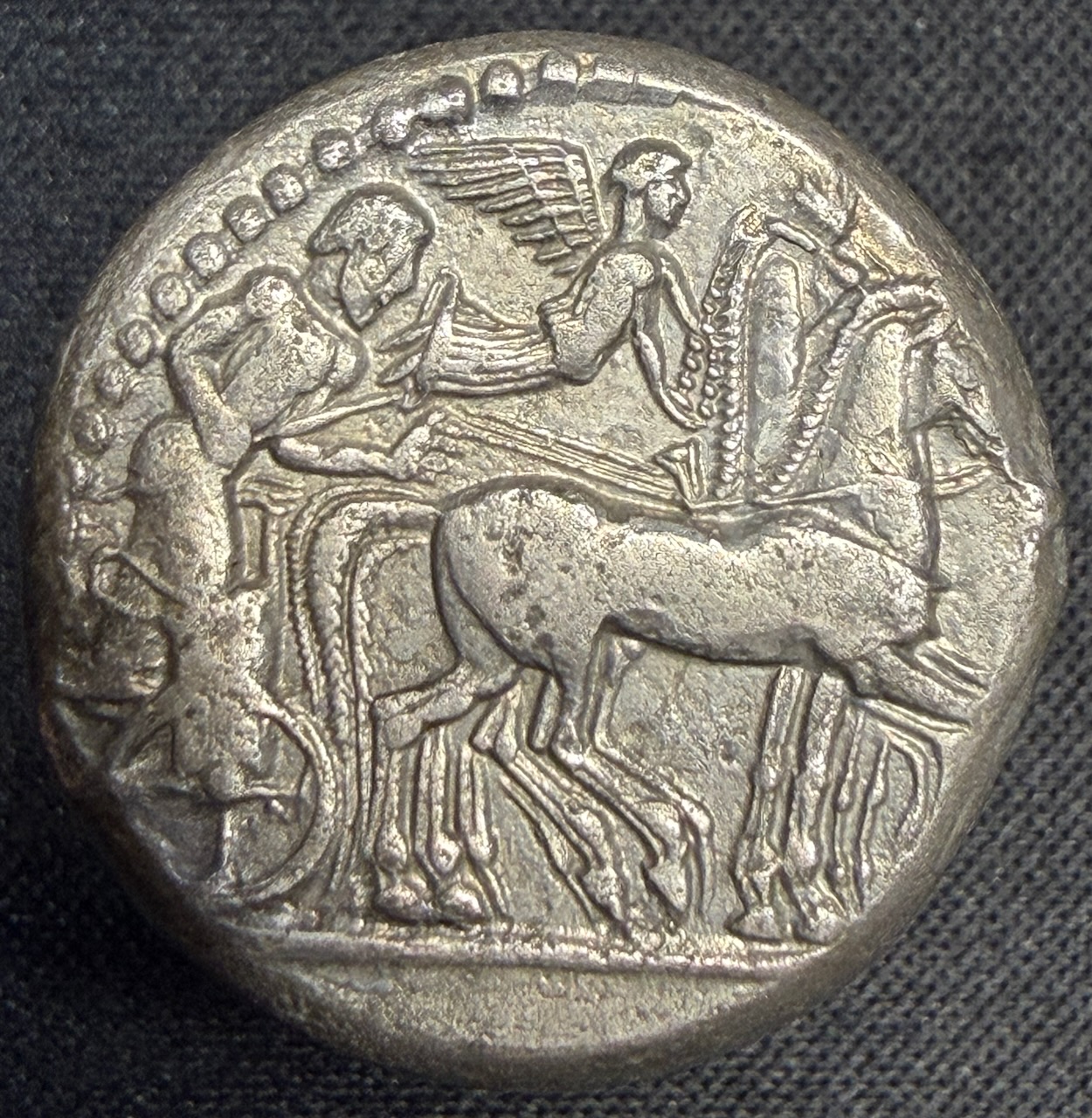
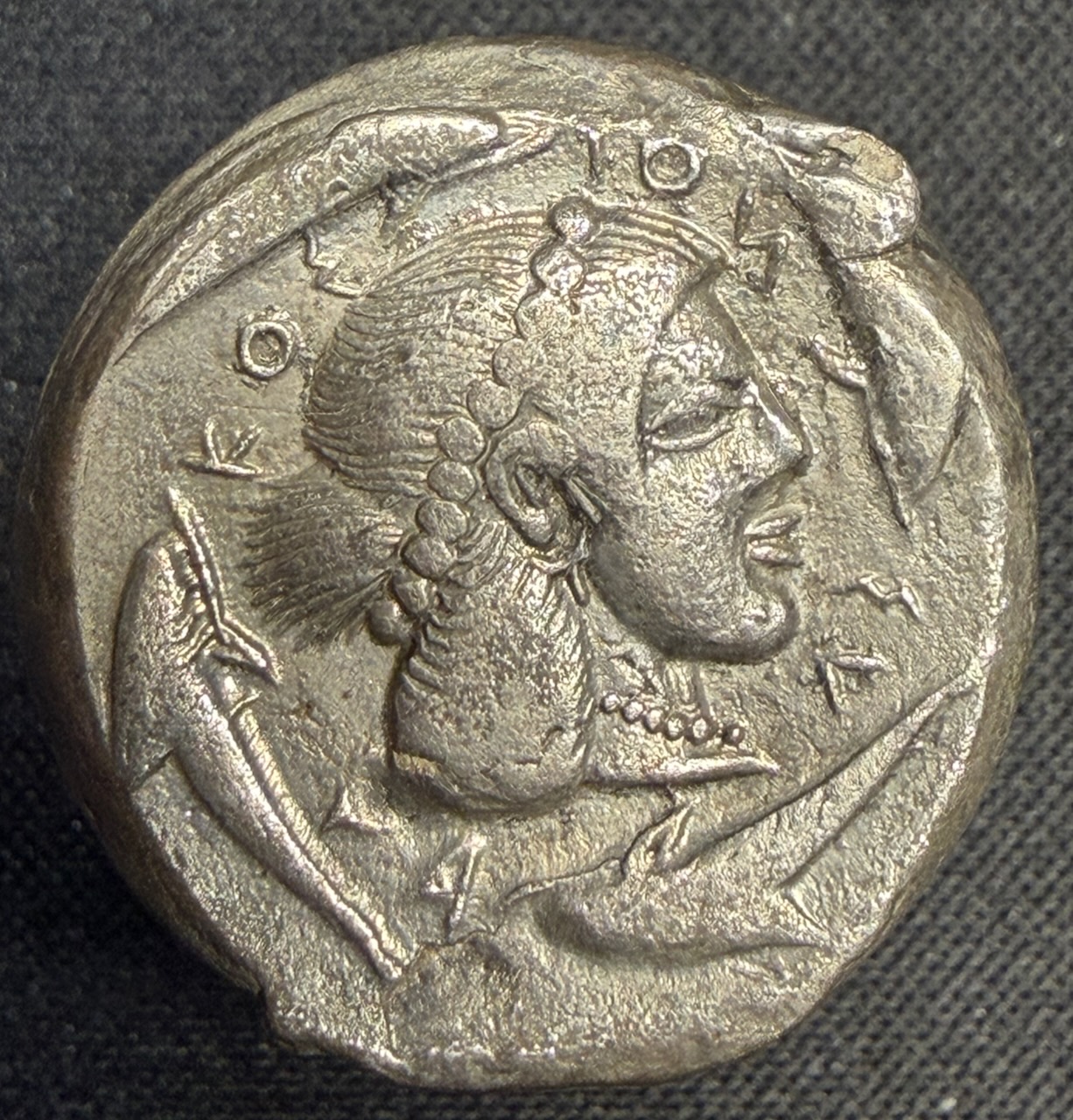
Current: Sicily, Syracuse. Deinomenid Tyranny (485–466 BC), struck under Hieron I, c. 475–470 BC. AR tetradrachm. Quadriga right, Nike above / head of Arethusa right, four dolphins around. Boehringer series XIIb, 320 (V156/R214); SNG ANS 104.
Obverse: Charioteer driving walking quadriga right, holding kentron and reins; Nike flying right above, crowning the horses
Reverse: Head of Arethusa right, hair bound with beaded taenia (fillet), wearing necklace and earring; four dolphins swimming around; legend around
Primary reference: Boehringer 320 (V156/R214)
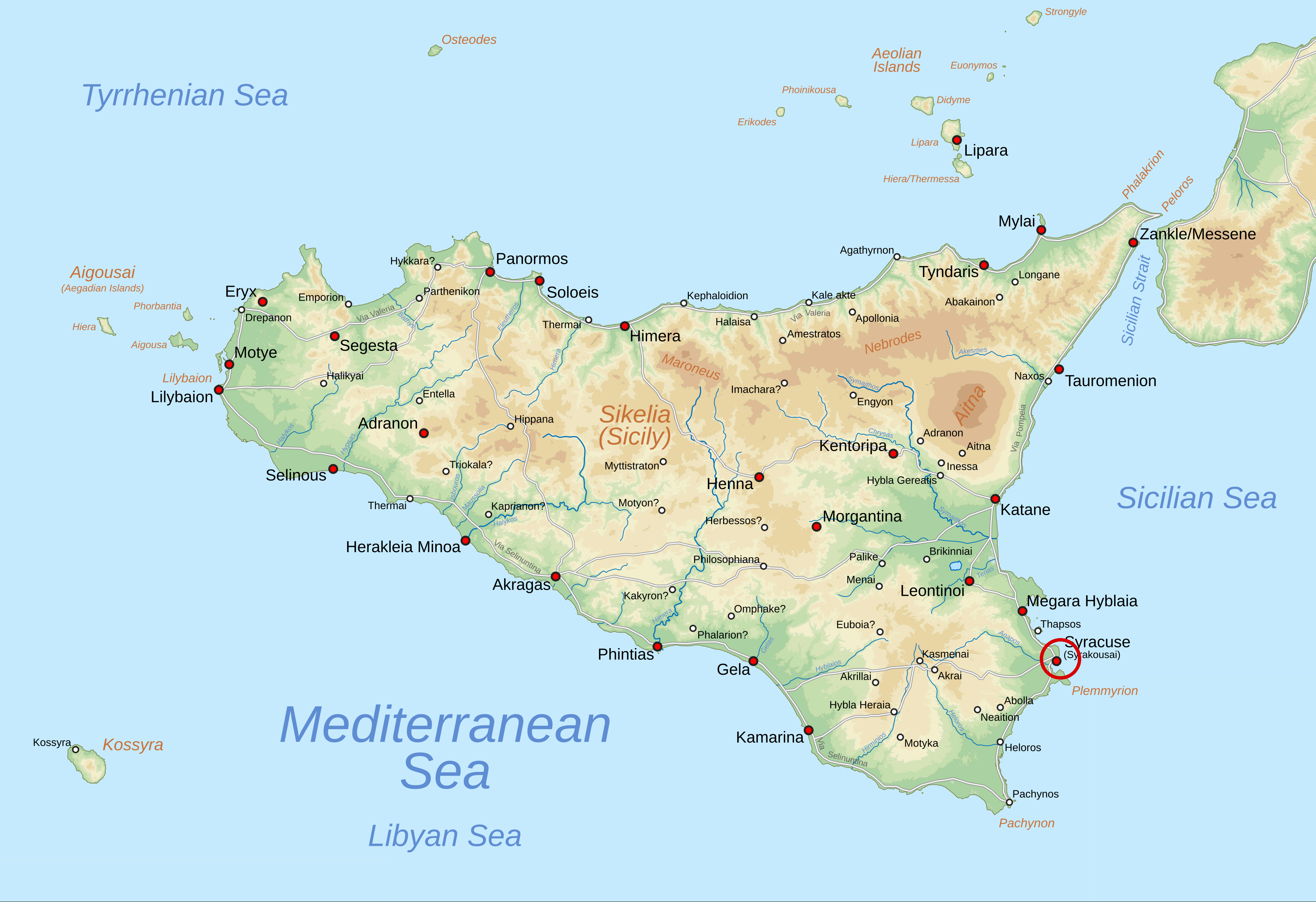
Ancient Sicily, with the Greek cities of the coasts and the native peoples of the interior. Syracuse (Syracusae) — circled in red — sits on the southeast coast, its heart the island of Ortygia with the spring of Arethusa, whose head this coin carries. Under the Deinomenid tyrants the city ruled the Greek east of the island; Akragas (Agrigentum), its great rival and this collection’s Punic-occupation quarter-shekel mint, lies on the south coast to the west.
“Map of ancient Sicily” by Tomisti (Wikimedia Commons), File:Ancient Sicily map en.svg, licensed CC BY-SA 4.0; cities and roads based on the Digital Atlas of the Roman Empire (DARE) and Pleiades; topographic base © OpenMapTiles, © OpenStreetMap contributors (https://commons.wikimedia.org/wiki/File:Ancient_Sicily_map_en.svg; license: https://creativecommons.org/licenses/by-sa/4.0/). Modified by JSB Coins: rasterized from SVG to PNG, and a red circle added to mark Syracuse. This derivative is shared under the same CC BY-SA 4.0 license.
This tetradrachm is the money of Syracuse at the moment the city became the greatest power of the Greek West — struck under Hieron I, victor of Cumae, patron of Pindar and Aeschylus, in the decade when Syracusan silver set the artistic standard for the whole Greek world. One side carries the four-horse chariot of aristocratic victory; the other, the nymph of the city’s own freshwater spring, ringed by dolphins.
Graphic: JSB Coins (CC0); dates follow Diodorus and standard chronologies.
In 485 BC Gelon, tyrant of Gela and head of the Deinomenid family, seized Syracuse and made it his capital. Five years later he crushed the Carthaginian invasion of Sicily at Himera (480 BC) — a victory the Greeks ranked beside Salamis, won in the same year — and Syracuse emerged as the dominant city of the West, enriched by indemnity, spoils, and empire. Gelon died in 478 BC and was succeeded by his brother Hieron I (478–466 BC), under whom this coin was struck. Hieron’s reign is one of the most brilliant of the tyrannies: in 474 BC his fleet broke Etruscan sea power at Cumae in the Bay of Naples (a victory commemorated by dedications at Delphi and by Pindar); he founded the new city of Aitna beneath the volcano; and his court drew the great poets of the age — Pindar and Bacchylides wrote victory odes for his horses and chariots, Simonides was his counselor, and Aeschylus produced plays for him in Sicily. The tyranny fell in 466 BC, a few years after this coin was struck, when Hieron’s brother Thrasyboulos was expelled and Syracuse became a democracy.
The quadriga is the emblem of the tyrants’ proudest boast: victory in the chariot races of the great panhellenic games. Deinomenid horses won at Delphi and Olympia — Hieron’s Pythian victory of 470 BC is the occasion of Pindar’s first Pythian ode — and the walking four-horse chariot, with Nike flying above to crown the team, translated those victories into the city’s money. It is at once an aristocratic advertisement and a civic one: the games victories legitimized the tyranny before the whole Greek world.
The head of Arethusa on the other side is Syracuse itself. Arethusa was the nymph of the freshwater spring that rises, improbably, on the island of Ortygia at the heart of the city, a few yards from the sea. The myth told that the river-god Alpheios of Olympia pursued her under the Ionian Sea to Sicily, where she rose as the spring — a story that bound the western colony to old Greece. The four dolphins circling her head are the sea around Ortygia; the legend names the coin’s authority: ΣΥΡΑΚΟΣΙΟΝ, “of the Syracusans” — the civic ethnic, notably, even under the tyranny.
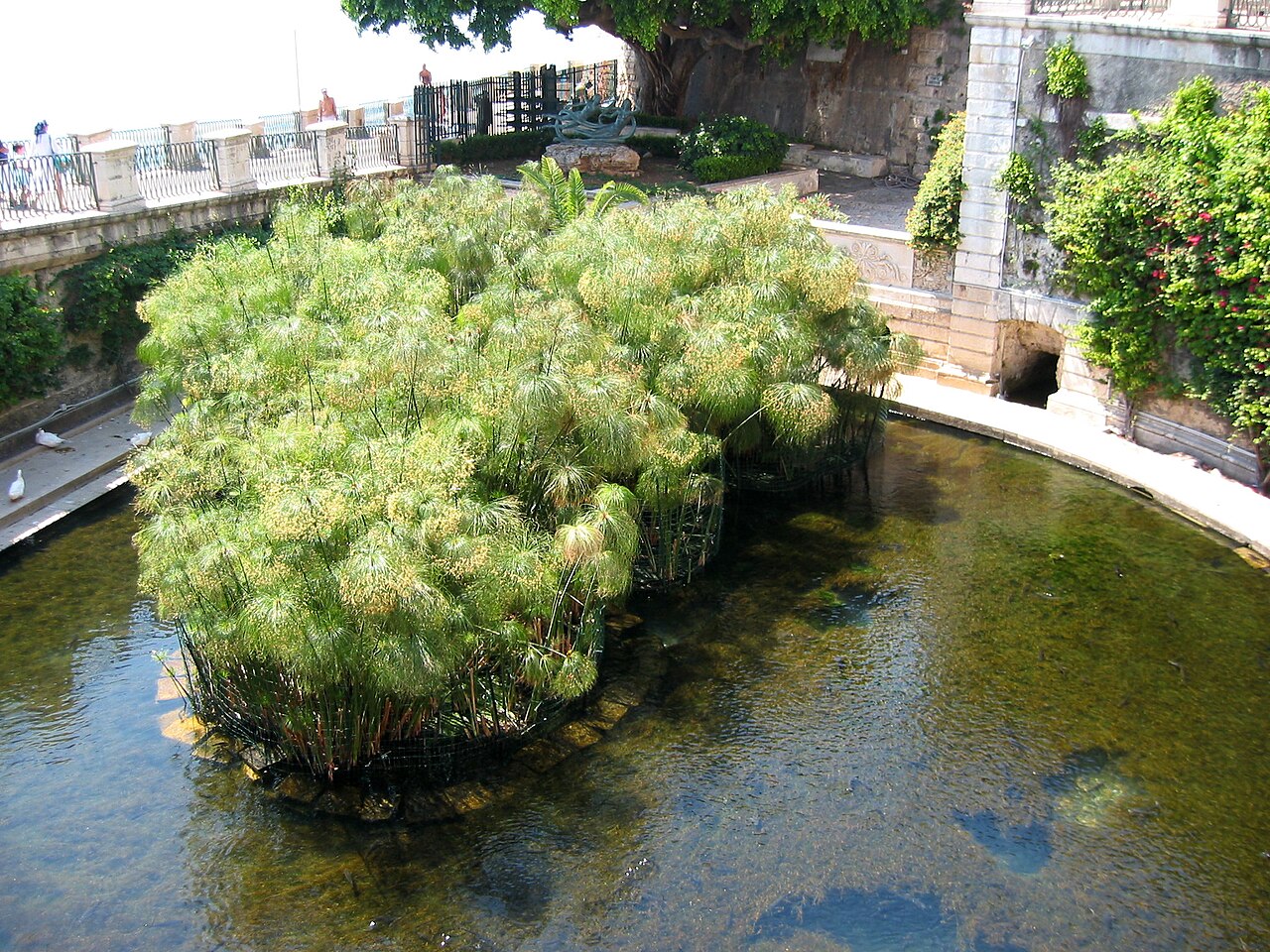
Photo: Rollopack, Wikimedia Commons, licensed CC BY-SA 3.0, reproduced unmodified.
The early silver of Syracuse is organized by Erich Boehringer’s 1929 die corpus, which arranged the tetradrachms of c. 510–450 BC into a near-continuous sequence of obverse and reverse dies. This coin’s earlier tag carries the full attribution: Boehringer 320, dies V156/R214, series XIIb, placed c. 475–470 BC under Hieron I. That precision — a specific pair of hand-cut dies, datable to a half-decade — is what a great die study makes possible, and it is worth preserving and verifying against the plates. Boehringer’s relative sequence is universally used, though the absolute dates attached to his groups have been debated at the margins by later scholarship.
Syracusan tetradrachms were struck on the Attic standard (c. 17.2 g) in enormous quantity from the wealth of the Deinomenid empire — Himera’s indemnity alone was reported at 2,000 talents — and they were the dominant currency of Greek Sicily. Syracusan power eventually reached across the strait into Magna Graecia as well: a century after this coin, Dionysius I sacked the Achaean city of Kaulonia (389 BC), whose Apollo-and-stag nomos represents the Italian Greeks in this collection. The coinage’s prestige matched its volume: within a generation of this coin, Syracusan die-engravers were producing what are widely regarded as the most beautiful coins ever struck, and even this earlier, more austere phase shows the workshop tradition that made it possible.
The quadriga/Arethusa tetradrachm is one of the canonical Greek coin types, and the Deinomenid issues are its heroic phase: the money of Himera and Cumae, of Pindar’s odes and Aeschylus’ Sicilian seasons. A die-attributed example ties a physical object to a specific moment of that world — a Syracuse at the height of its first golden age. The same mint’s later history under monarchy is represented in this collection by the bronze of King Agathokles, struck a century and a half after this coin, where the civic legend “of the Syracusans” has given way to a king’s name and title; the tyranny’s earlier phase may be represented by the collection’s second quadriga tetradrachm, tag-dated to Gelon (485–478 BC) but awaiting a die study.
The die attribution is E. Boehringer, Die Münzen von Syrakus (1929), no. 320 (V156/R214), series XIIb, as recorded on the earlier dealer’s printed tag, with SNG ANS 104 as the parallel reference; both should be confirmed against the plates. Historical frame: Herodotus 7.153–167 (Gelon and Himera); Diodorus Siculus 11 (the Deinomenids, Cumae, the fall of the tyranny); Pindar, Olympian 1 and Pythian 1–3 (Hieron’s victories and court). The reported Himera indemnity is Diodorus’ (11.26; Book 11 is linked in the references). The spring of Arethusa in the Roman age: Cicero, Verrines 2.4.117–118. Later debate over Boehringer’s absolute chronology is noted in the standard handbooks (Kraay, Archaic and Classical Greek Coins).
Attic-standard tetradrachm (c. 17.2 g; this specimen 17.08 g per the earlier dealer's printed tag). The earlier printed tag carries a full die attribution — Boehringer series XIIb, no. 320, obverse die V156 / reverse die R214 — placing the coin precisely within Boehringer's arrangement of the Deinomenid coinage; the die pair should be confirmed against the plates when possible. The quadriga/Arethusa pairing is the defining type of Syracusan silver for over two centuries; within the Deinomenid period the series is arranged almost year-by-year by Boehringer's die study, though his absolute dates carry some scholarly debate at the margins.
John's Ancient Coin Collection · Type · syracuse-deinomenid-tetradrachm
Image credits for this coin — photographs, maps and graphics used on this page