Type · aspendos-warrior-triskeles-stater
Current: Pamphylia, Aspendos, AR stater, c. 465–430 BC (dealer: 460–420 BC). Hoplite warrior advancing right with spear and shield / triskeles of human legs. Sear (Greek) 5381–5382; SNG von Aulock 4477 ff.
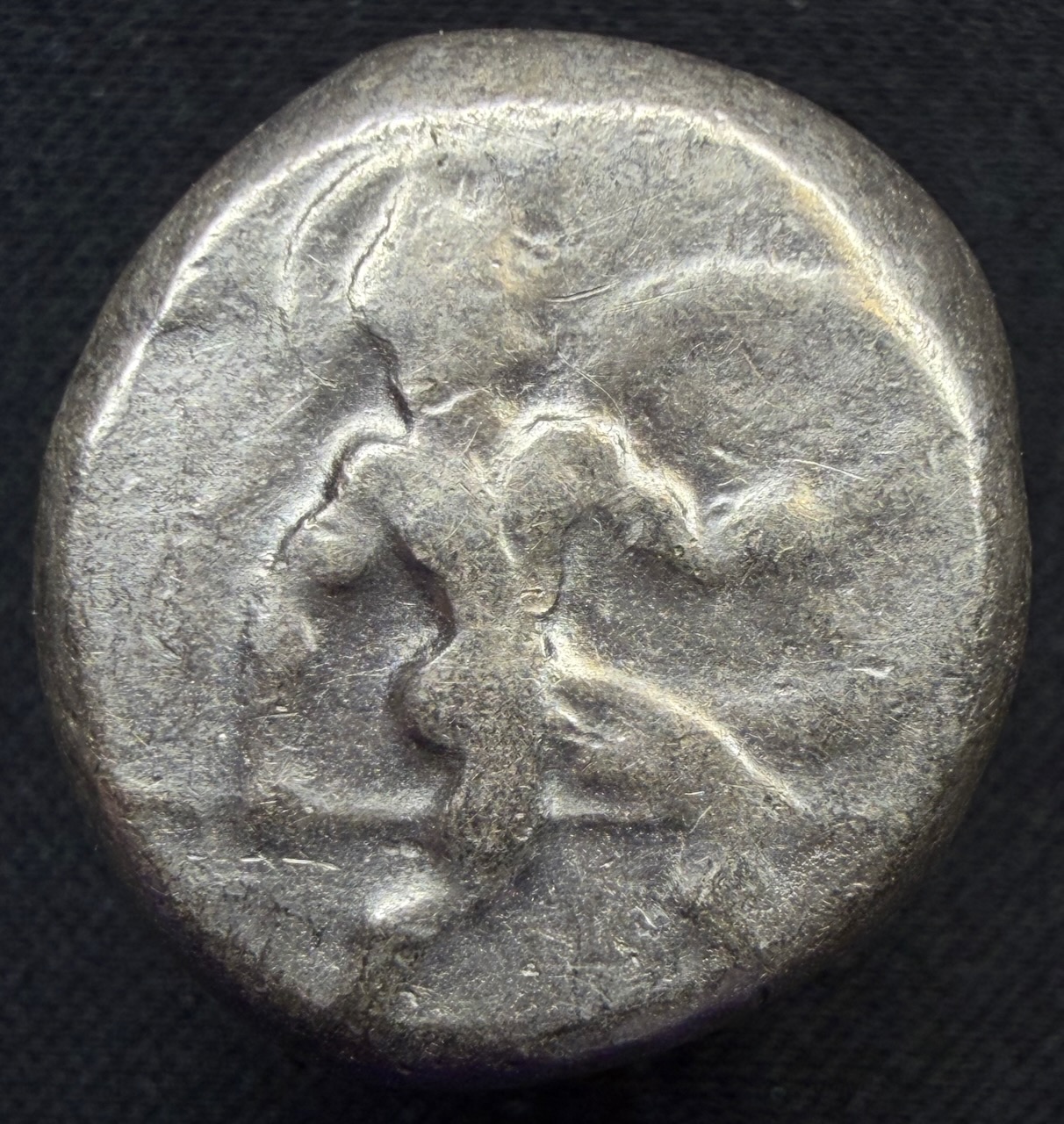
Obverse: Nude hoplite warrior advancing right, holding a spear in his raised right hand and a round shield on his left arm. (On worn specimens the helmet and shield device are indistinct.)
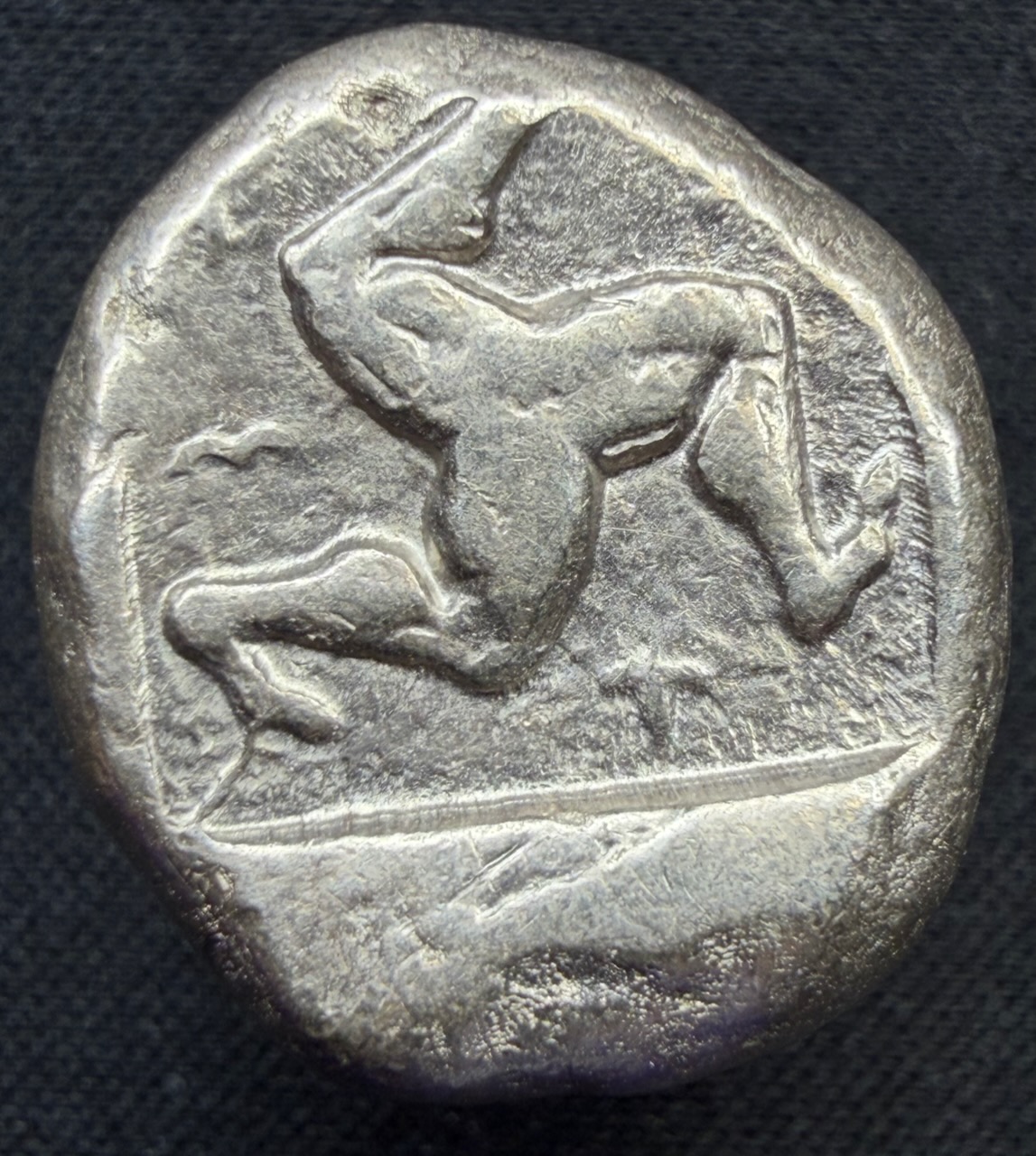
Reverse: Triskeles of three bent human legs revolving (running), joined at the center, within a dotted border / shallow incuse square; small symbol(s) in the field on some dies.
Primary reference: Sear (Greek) 5381–5382
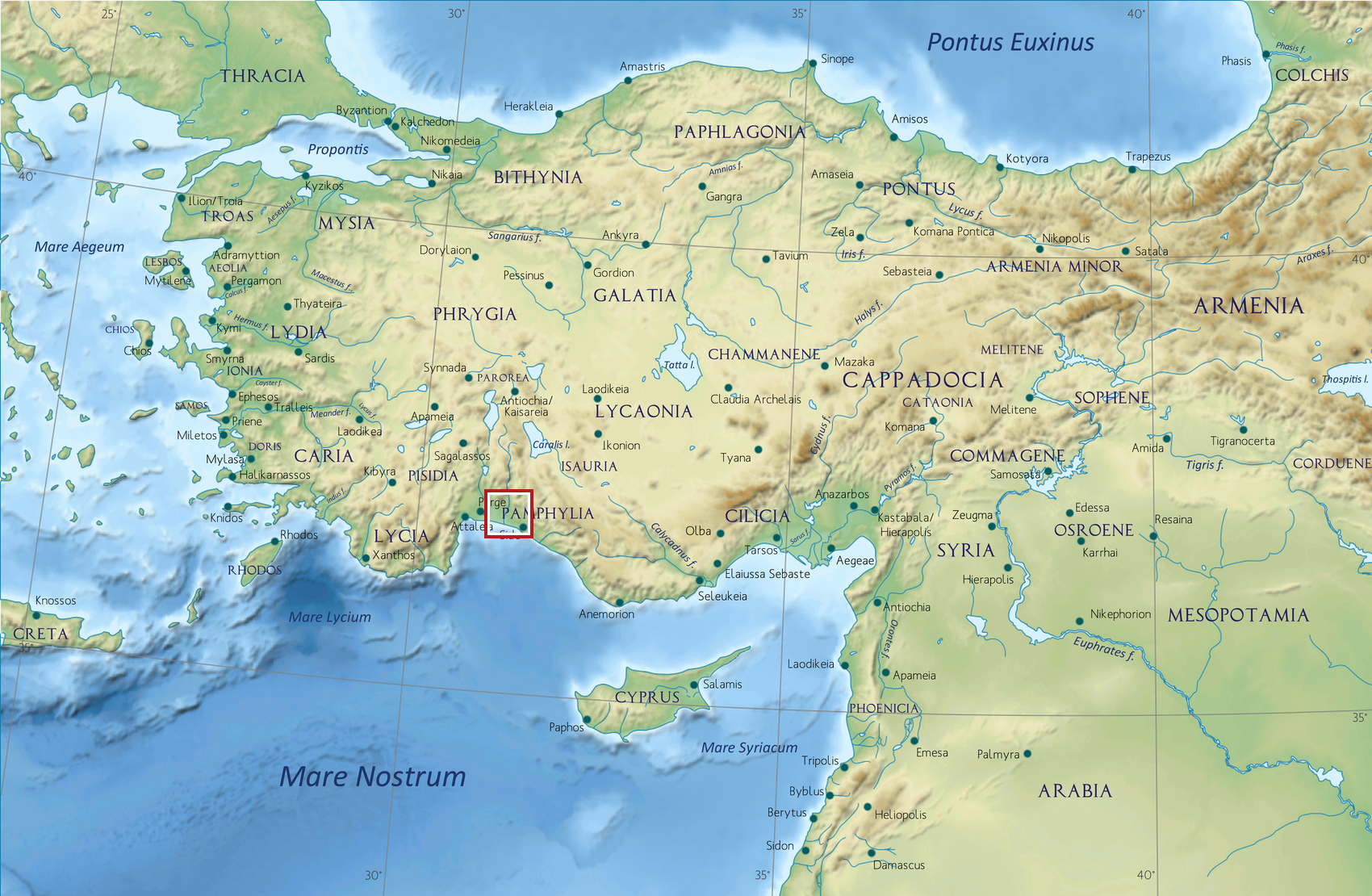
Asia Minor in the Greco-Roman period; Aspendos is indicated by the red square. The city lies in Pamphylia, the narrow coastal plain on the south coast of Anatolia between Lycia (west) and Cilicia (east), set back from the sea on the river Eurymedon (modern Köprüçay). Its position on a navigable river a short way inland gave it both a defensible site and access to Mediterranean trade, and made it one of the most prolific mints of the region. (Aspendos is not separately labelled on the base map; the square marks its known site on the Eurymedon, between Perge to the west and Side to the east.)
Base map by Caliniuc (Wikimedia Commons), “Asia Minor in the Greco-Roman period (332 BC – 395 AD) — general map — regions and main settlements,” File:Asia Minor in the Greco-Roman period - general map - regions and main settlements.jpg, licensed CC BY-SA 4.0 (https://commons.wikimedia.org/wiki/File:Asia_Minor_in_the_Greco-Roman_period_-general_map-_regions_and_main_settlements.jpg; license: https://creativecommons.org/licenses/by-sa/4.0/). Modified by JSB Coins: a red square has been added to mark the position of Aspendos (otherwise unlabelled on the base map). This derivative is shared under the same CC BY-SA 4.0 license.
This stater belongs to the first great silver coinage of Aspendos, a wealthy Greek-Anatolian city of the Pamphylian plain, struck in the decades when southern Asia Minor was contested ground between the Persian Empire and the rising naval power of Athens. Its two images — an armed warrior and a whirling triskeles of human legs — would define the city’s coinage for generations and remain among the most recognizable types of the Greek south coast.
Graphic: JSB Coins, 2026 (CC0).
Pamphylia was a small country: a fertile coastal plain on the south shore of Anatolia, hemmed between Lycia to the west, Cilicia to the east, and the wall of the Taurus mountains to the north. Its very name — from Greek pamphylos, “of all tribes” — advertises a mixed population of Greek settlers and native Anatolians, and the local Greek dialect (Pamphylian) was an idiosyncratic one, heavily marked by contact with Anatolian languages.
Aspendos lay on the river Eurymedon (the modern Köprüçay), a short distance inland, where the river was navigable up to the city. That setting gave Aspendos a defensible inland site together with maritime access, and the city grew rich on the trade of the plain — grain, horses, and salt are all associated with it in antiquity. By the fifth century BC it was among the most important and most prolific minting cities of the region.
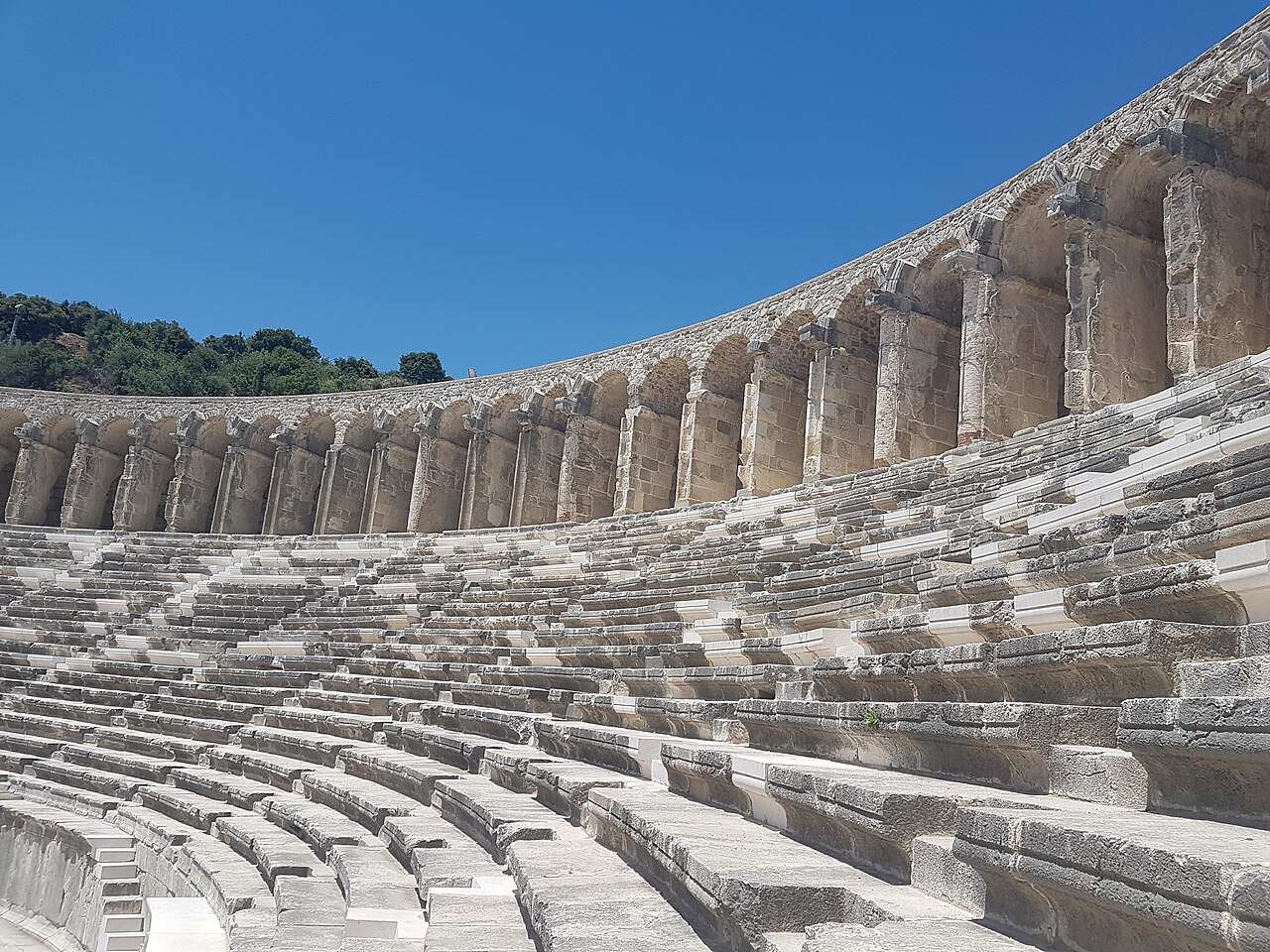
Photo: Lee Vilenski, CC BY-SA 4.0 (Wikimedia Commons); reproduced unmodified.
In the historical period Pamphylia fell within the Achaemenid Persian Empire; Darius I counted it among the lands of his first tribute district. But the south coast became a frontier of the long struggle between Persia and the Greeks. At some point around 466 BC the Athenian general Cimon won a celebrated double victory over the Persians, on land and at sea, at the mouth of the Eurymedon — at the very doorstep of Aspendos — and for a time the cities of the coast were drawn into the Athenian-led Delian League. As Athenian power waned toward the end of the Peloponnesian War, Persia recovered its hold. This warrior / triskeles coinage was struck across precisely this unsettled period, and a martial obverse type is fitting for a city whose people were famous as soldiers: Pamphylians and Aspendians appear repeatedly in the ancient record as mercenaries and light troops.
The obverse shows a nude warrior — conventionally read as a hoplite — striding to the right, spear poised and a round shield carried on the left arm. The martial figure suits both the period and the reputation of Pamphylian fighting men, though precisely whom (if anyone) the warrior was meant to represent is not recorded.
The reverse carries the triskeles: three bent human legs joined at a central hub and revolving like the spokes of a wheel, set within a dotted border or shallow incuse square. The triskeles was the lasting civic badge of Aspendos, retained on the city’s coinage for centuries. Its meaning is genuinely contested and is best left open: it has been explained as a solar or cosmic symbol, as an apotropaic device of motion and power, and as a purely local emblem; the same three-legged figure also served as the badge of other communities (most famously Sicily and, in a winged form, Lycia), which complicates any single reading. What is clear is its function as an instantly legible mark of the issuing city.
The warrior / triskeles staters are conventionally placed first in the sequence of Aspendian silver. They were struck on the Persic standard — the stater of roughly 10.7–11 grams that governed money along the Persian-controlled coast and eased exchange with Cyprus, the Levant, and the wider eastern Mediterranean, as well as the payment of mercenaries. In the later fifth and fourth centuries this type gave way to the famous and far more common “two wrestlers / slinger” staters, which add the full city ethnic in the Pamphylian dialect, ΕΣΤϜΕΔΙΙΥΣ (“of the Aspendians”). The present type belongs to the earlier, scarcer phase, before the ethnic became standard — a coin from the formative period of the city’s monetary identity.
Within the early phase the sequence is now reasonably clear: the triskeles-alone staters (this type — thick, compact flans in the archaic manner) come first, followed by a variety with a lion worked through the triskeles legs, and then the wrestlers/slinger series on broader, thinner flans. Most dies of the triskeles-alone type carry a few Greek letters beside the legs — ΕΣ-Τ and similar groupings — already abbreviating the Pamphylian ethnic that the later coinage spells out in full; letter positions vary from die to die (SNG France 3, nos. 1–11 collect the variants).
A market note bears on any modern specimen: the type was a genuine rarity before a hoard began to reach the market around 2018 (published pre-hoard collections held only a handful each — 27 in SNG Copenhagen, 11 in SNG France 3, 8 in the BMC). The hoard made examples obtainable, but nearly all known specimens, hoard coins included, show areas of flat striking; well-struck pieces remain rare at any price.
A note on dating and attribution: the absolute chronology of Aspendian coinage is not firmly fixed, and reputable sources variously assign the warrior / triskeles staters to c. 500–460, c. 465–430, or (as on this coin’s dealer tag) 460–420 BC. The catalogue numbers cited here (Sear, SNG von Aulock, SNG France 3) should be treated as the standard reference frame rather than as a settled die-by-die attribution.
Historical sources: Herodotus, Histories (Pamphylia in the Persian tribute lists); Thucydides and Plutarch, Cimon 12–13 (the battle of the Eurymedon, c. 466 BC; Plutarch is linked in the references).
Numismatic references: D. Sear, Greek Coins and Their Values, vol. 2, nos. 5381–5382; SNG von Aulock (Pamphylia), 4477 ff.; SNG France 3 (Pamphylie), 1–11; SNG Copenhagen, Pamphylia; W. Esty, “Triskeles” (augustuscoins.com, with the type sequence, Sear/SNG concordance, and the c. 2018 hoard); J. D. Grainger, The Cities of Pamphylia (2009); M. Markowitz, “Coins of Ancient Greek Pamphylia,” CoinWeek (2021). Weight standard, type sequence, and the contested points above are drawn from these works; quantitative claims have been limited to what they support.
Struck on the Persic weight standard, the stater running roughly 10.7–11.0 g (this specimen 10.77 g per the dealer tag). This warrior / triskeles series is the earliest substantial silver coinage of Aspendos and is conventionally the FIRST of the city's stater types, preceding the long-lived "two wrestlers / slinger" staters (c. 420/400–330 BC) that carry the full Pamphylian ethnic ΕΣΤϜΕΔΙΙΥΣ. Several points are genuinely unsettled and should not be stated as fact: (1) the absolute dating — dealers and catalogues variously give c. 500–460, c. 465–430, or 460–420 BC, and the start of Aspendian coinage is not fixed; (2) the meaning of the triskeles, the city's enduring civic badge, for which no single interpretation (solar emblem, apotropaic device, or local symbol) is agreed; (3) the precise Sear number — the dealer tag reads "S.5382," while the warrior/triskeles type is commonly cited as Sear (Greek) 5381, so the two adjacent numbers should be checked against Sear directly. The Sear frame is now partly clarified: 5381 is the triskeles-alone type with the letters ΕΣ-Τ (the abbreviation of the Pamphylian ethnic ΕΣΤϜΕΔΙΙΥΣ), and 5383 is the later variety with a lion through the triskeles legs; the tag's 5382 is presumably a subvariety of the triskeles-alone group, still to be confirmed in Sear vol. 2. Market note: the type was rare and expensive before a hoard began to be dispersed c. 2018 (per W. Esty's census: SNG Copenhagen 27, SNG France 11, BMC 8, SNG von Aulock 7 pre-hoard specimens of the triskeles-alone type); most known examples, hoard coins included, are weakly struck in places, so a well-centered aXF example is a strong one for the type.
John's Ancient Coin Collection · Type · aspendos-warrior-triskeles-stater
Image credits for this coin — photographs, maps and graphics used on this page

.jpg)