Type · trajan-decius-antioch-eagle-tetradrachm
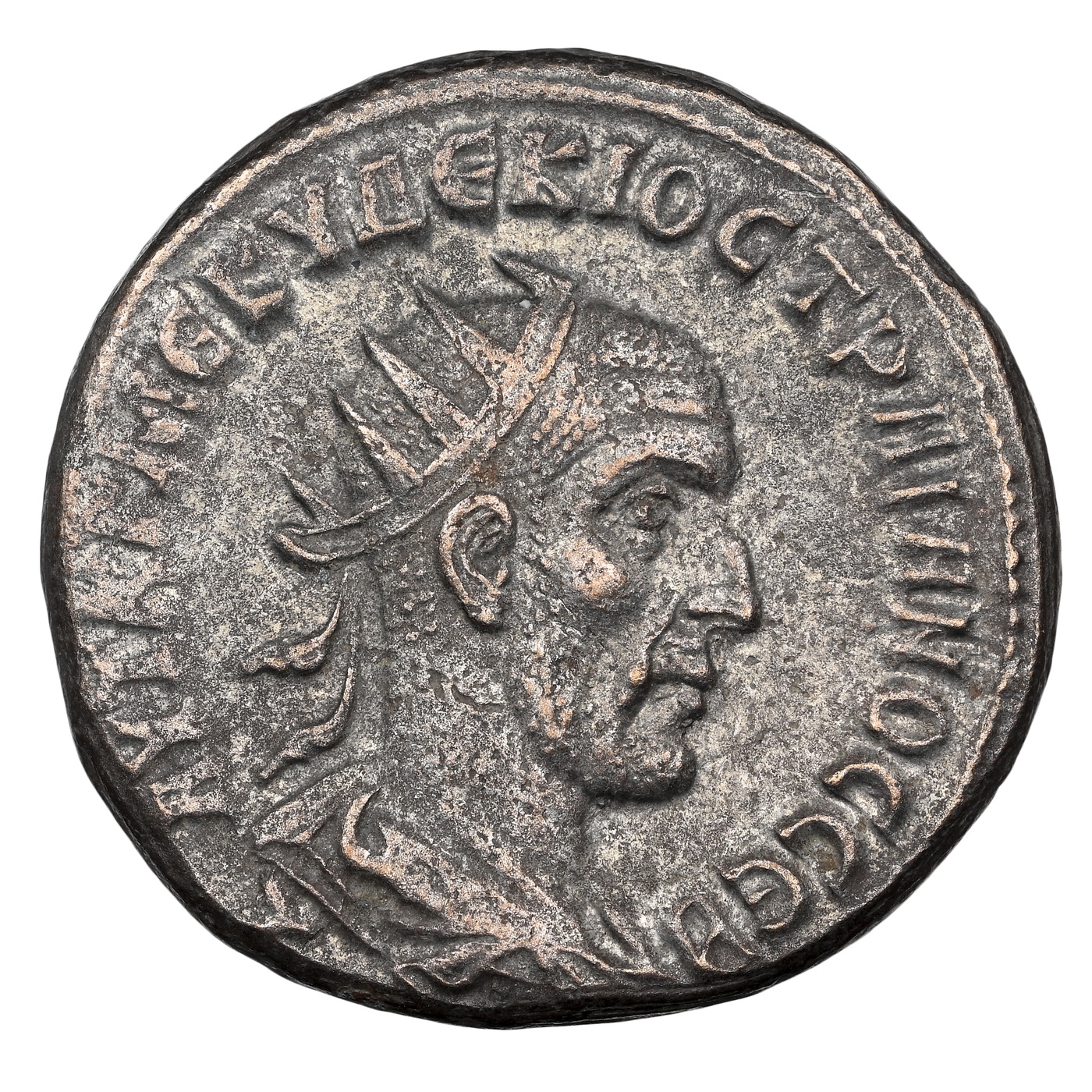
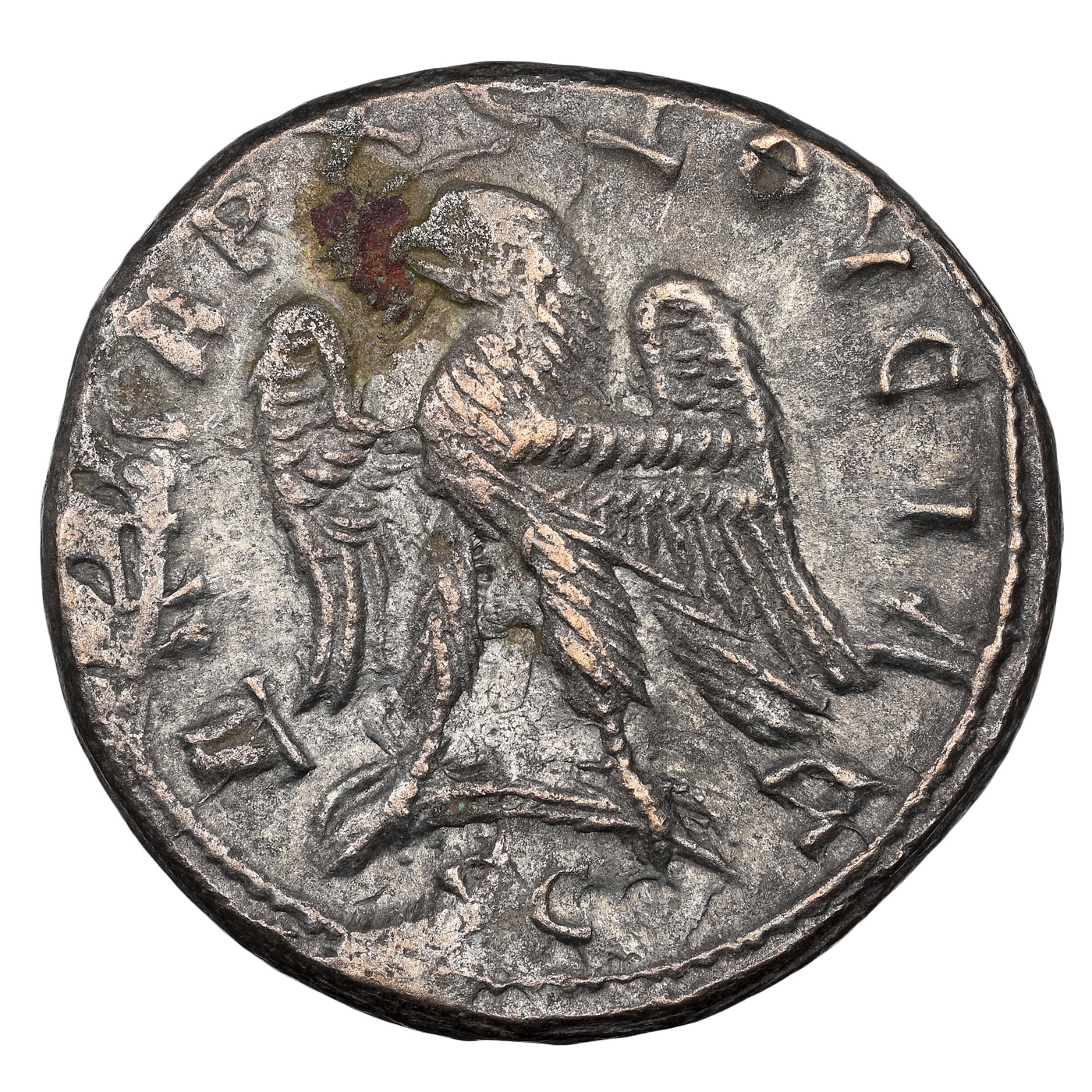
Current: Roman Provincial, Syria (Seleucis and Pieria), Antioch. Trajan Decius, AD 249–251. BI tetradrachm, RPC's group 2, officina 6 (Ϛ below the bust), AD 249–251 (the house: c. 249–250). Radiate, draped and cuirassed bust seen from behind / eagle left on a palm, wreath in beak, S C below. RPC IX 1664; Prieur 546; McAlee 1120f.
Obverse: Radiate, draped and cuirassed bust of Trajan Decius right, seen from behind; the officina numeral Ϛ (6) below the bust
Reverse: Eagle standing left on a palm branch, wings spread, wreath in its beak; S C below
Primary reference: Prieur 546
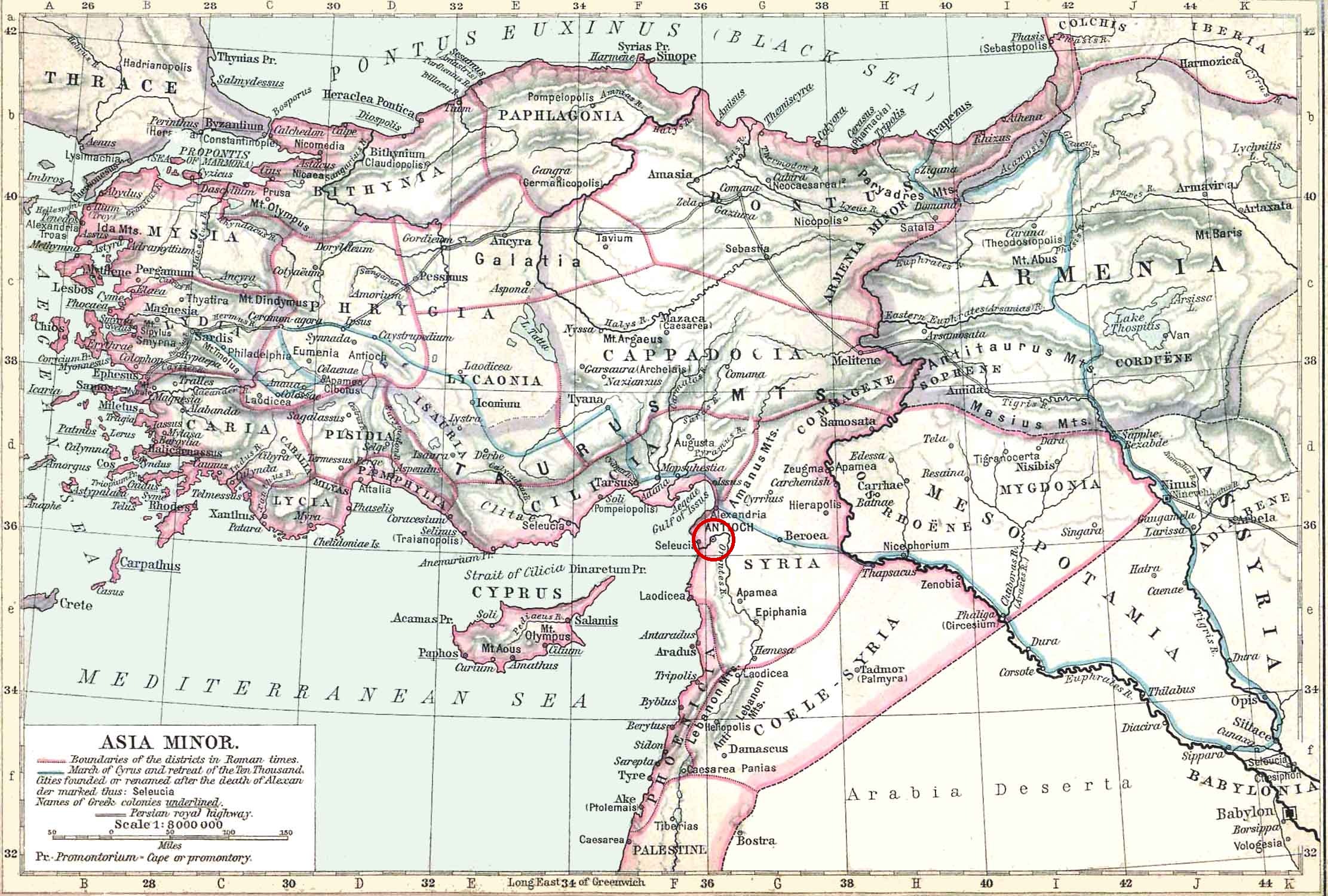
Asia Minor and the Roman East on William R. Shepherd’s plate of 1923. Antioch — circled in red — lies in the lower right, where the Orontes meets the sea; the Syria inset below shows it closer. The same mint struck the collection’s Philip I tetradrachm a year before this coin, and the Nero tetradrachm two centuries earlier.
“Asia Minor under the Greeks and Romans” from William R. Shepherd, The Historical Atlas (1923), via Wikimedia Commons, File:Asia minor-Shepherd 1923.JPG (https://commons.wikimedia.org/wiki/File:Asia_minor-Shepherd_1923.JPG). Public domain (author died 1934). Modified by JSB Coins: a red circle added to mark Antioch (the same marked copy used for the collection’s Nero and Philip I tetradrachms). The Syria inset is a crop of the same plate, reproduced unmodified.
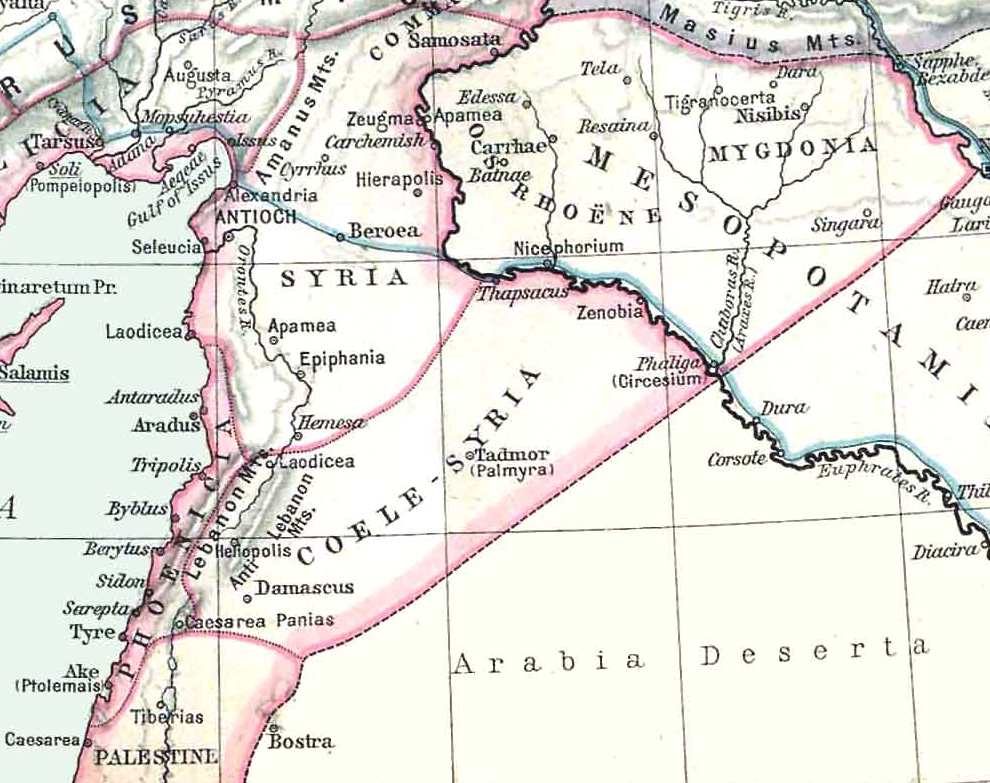
The Syria corner of the same Shepherd plate. Antioch sits at top left, on the Orontes above its port Seleucia. Decius never came here; the mint struck for him in his absence, in seven numbered workshops, while he fought on the Danube.
Decius is the first Roman emperor to die in battle against a foreign enemy, and the first to order every inhabitant of the empire to sacrifice to the gods and get a certificate for it. He reigned two years. This tetradrachm of Antioch, struck in the sixth workshop of the mint, is the ordinary large silver of his reign in the East — a grey billon coin with his radiate bust on one side and the city’s eagle on the other — and it fills a name the emperors want card had listed as missing since July.
Graphic: JSB Coins, 2026 (CC0).
Gaius Messius Quintus Decius was a senator from Sirmium in Pannonia, a consul and, the later sources say, city prefect under Philip, who sent him in 248 to bring the mutinous Danube armies back into order. He did it too well: the troops proclaimed him, and in 249 he marched into Italy and defeated and killed Philip near Verona (Zos. 1.21–22). He took the name Trajan — TRAIANVS DECIVS on the Latin coins, ΤΡΑΙΑΝΟϹ ΔΕΚΙΟϹ here — as a programme, the promise of a return to the age of the good emperors. The programme had three parts that we know of: a war against the Goths, who under Cniva had crossed the Danube into Moesia and Thrace; a coinage honouring the deified emperors of the past, the Divi series of antoniniani; and the edict.
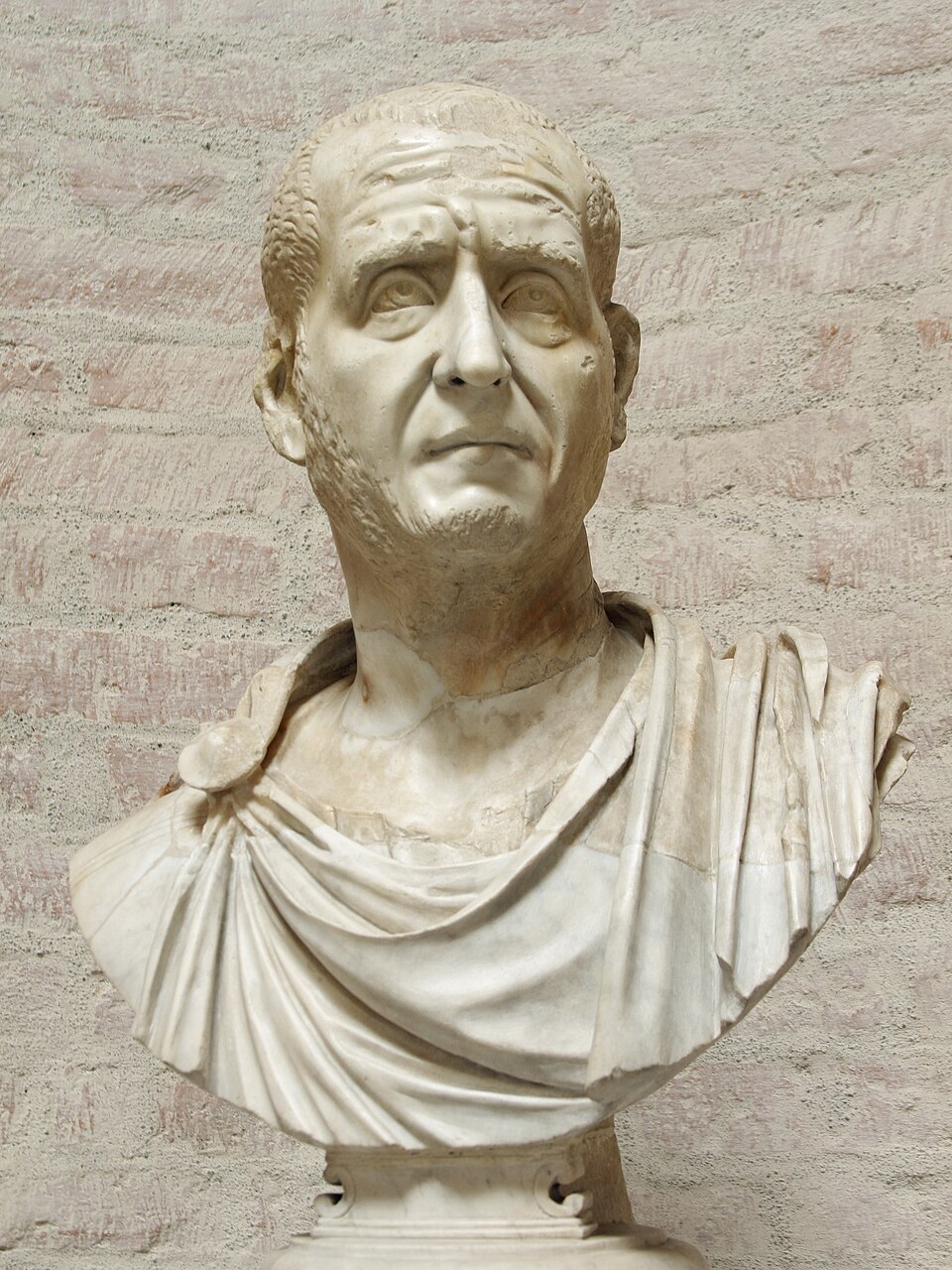
Photo: José Luiz Bernardes Ribeiro, Wikimedia Commons, licensed CC BY-SA 4.0; reproduced unmodified.
Late in 249 or early in 250 Decius ordered that everyone in the empire should sacrifice to the gods, taste the sacrificial meat, and swear that they had always done so, before a local commission, and receive a certificate — a libellus — to prove it. The text of the edict is lost; what survive are the certificates, more than forty of them on papyrus from Egypt, and the Christian reaction. The edict does not mention Christians, and whether it was aimed at them or was a general act of loyalty for a new reign in a frightened time is a question the modern literature has argued both ways; what the Church experienced was the first persecution that reached everywhere at once. Eusebius preserves Dionysius of Alexandria’s account of the panic and the martyrs in that city, and notes that in Alexandria the violence had begun a year before the edict (Hist. eccl. 6.40–41); he records Origen’s torture in the stocks at Caesarea (6.39). Cyprian, bishop of Carthage, wrote after it was over about the Christians who “ran to the market-place of their own accord” to sacrifice, and about the ones who bought a certificate without sacrificing and thought that was different (De lapsis 8, 27). Lactantius, fifty years later, calls Decius “an accursed wild beast” and takes his death as God’s answer (De mortibus persecutorum 4). Those are the sources; they are all Christian, and they are the reason the name Decius is remembered at all.
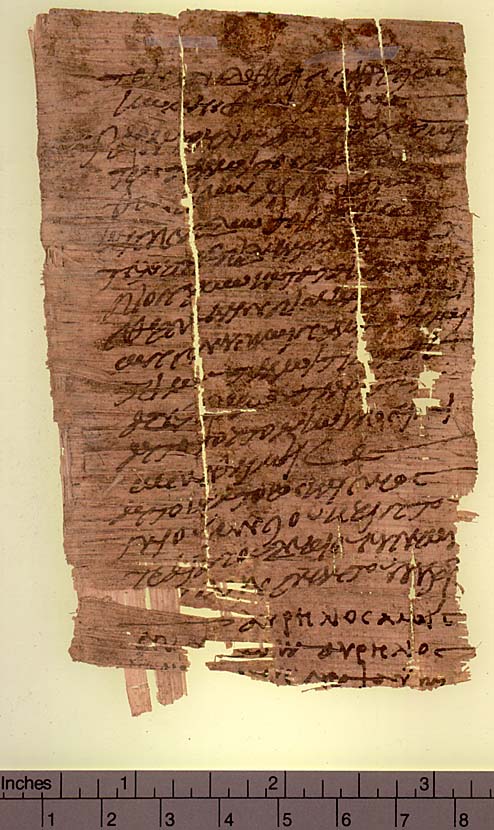
Photo: public domain (Wikimedia Commons); reproduced unmodified.
The Gothic war went badly and then catastrophically. In the summer of 251, in the marshes near Abrittus in Moesia, Cniva’s Goths trapped the Roman army; Decius’s elder son Herennius Etruscus was killed by an arrow, and Decius himself, telling his men that the loss of one soldier meant nothing to the republic, went on and was killed with most of his army. His body was never found (Zos. 1.23; Lactantius 4). No emperor had died in battle against a foreign enemy before. The plague that followed, which Cyprian described and which now carries his name, and the collapse of the frontiers in the 250s, are the world the next coins in this timeline belong to.
Antioch struck for Decius in the pattern the mint had settled into under the Philips: a Greek obverse legend with the emperor’s full titles, the radiate bust seen from behind, the eagle reverse with the tribunician-power formula and the S C that Antioch’s coinage had carried since Augustus. What is new is the numeral under the bust: the mint was now organised in seven officinae and each marked its work, so that this coin can be assigned to the sixth workshop and to RPC’s second group of the reign. RPC records seven specimens of this variety, which is a count of what ten museum collections and the trade happen to hold, not of what Antioch struck: Hekster and Manders, reviewing the project in 2022, warn that RPC catalogues types rather than coins and that its specimen tallies overrepresent attractive coins and well-collected regions, so only hoards could say how common the sixth workshop’s Decius really is. The eagle here stands on a palm branch and faces left; on the Philip I coin of the year before it stands on a line and faces right — the small changes by which the issues are told apart. The Nero tetradrachm shows where the eagle came from, and how much silver it had lost in two hundred years.
It had not much longer to lose. The eastern tetradrachm coinage ended in 253, under Trebonianus Gallus and Volusian, the reign after this one: Prieur’s corpus stops there, Kropp puts the end of production across the region in the mid-third century, and Neapolis in Samaria, the one mint he studies closely, struck its last coins in that same year. Antioch, as Hekster and Manders note, moved from its heavily debased tetradrachms to the antoninianus, the radiate coin of the Rome mint, and the provincial silver of Syria was over. This coin is two years from the end of a series that had run since the first century BC.
Ancient: Zosimus 1.21–23; Eusebius, Ecclesiastical History 6.39–41; Cyprian, De lapsis 8 and 27; Lactantius, De mortibus persecutorum 4 — all linked above in the standard English translations. Numismatic: RPC IX 1664 (online, with photographs); M. and K. Prieur, Syro-Phoenician Tetradrachms (2000), no. 546; R. McAlee, The Coins of Roman Antioch (2007), no. 1120f, the last two cited by number. RPC IX, for 249–254, has been in print since 2016, one of the two spans of the provincial coinage fully published; on what its specimen counts can and cannot say, and on Antioch’s turn to the antoninianus: O. Hekster and E. Manders, ‘Coinage in the Roman Provinces’, JRS 112 (2022); the end of the eastern tetradrachm in 253: A. J. M. Kropp, ‘A Roman altar on Mount Gerizim’, JRA 34 (2021) — both read in full, in my Science library and linked in the references.
THE OFFICINA. The Ϛ (stigma, 6) under the bust is the workshop numeral: Antioch's tetradrachms under Decius were struck by seven numbered officinae, and RPC IX groups the issues by the form of the bust and legend; this is group 2, officina 6, with seven specimens in RPC's census. The house dates it c. 249–250; RPC gives no narrower date than the reign, so the card keeps 249–251. THE LEGEND has an oddity: ΤΡΑΙΑΝΟϹ ΔΕΚΙΟϹ puts 'Trajan' before 'Decius', the order Decius himself chose when he took the great emperor's name — the Latin coins say TRAIANVS DECIVS too. THE METAL is billon; RPC's average for the issue is 10.76 g on 27 mm (the house measured this flan at 25 mm). NO WEIGHT is recorded for this collection's specimen — no figure on the older-style NGC label, none from the house. THE HOUSE ESSAY that came with the lot states as fact that Christian writers blamed the Cyprian plague on the persecution and that Decius struck 'the largest officially minted Roman coin, the double sestertius'; the first is Cyprian's and Lactantius's polemic and is presented as such on this page; the second is about the Rome mint's bronze and is left to a page that holds one.
John's Ancient Coin Collection · Type · trajan-decius-antioch-eagle-tetradrachm
Where the mints are — every mint in the collection on a modern map
Image credits for this coin — photographs, maps and graphics used on this page

_-_Glyptothek_-_Munich_-_Germany_2017.jpg)
