Type · philip-i-antioch-eagle-tetradrachm
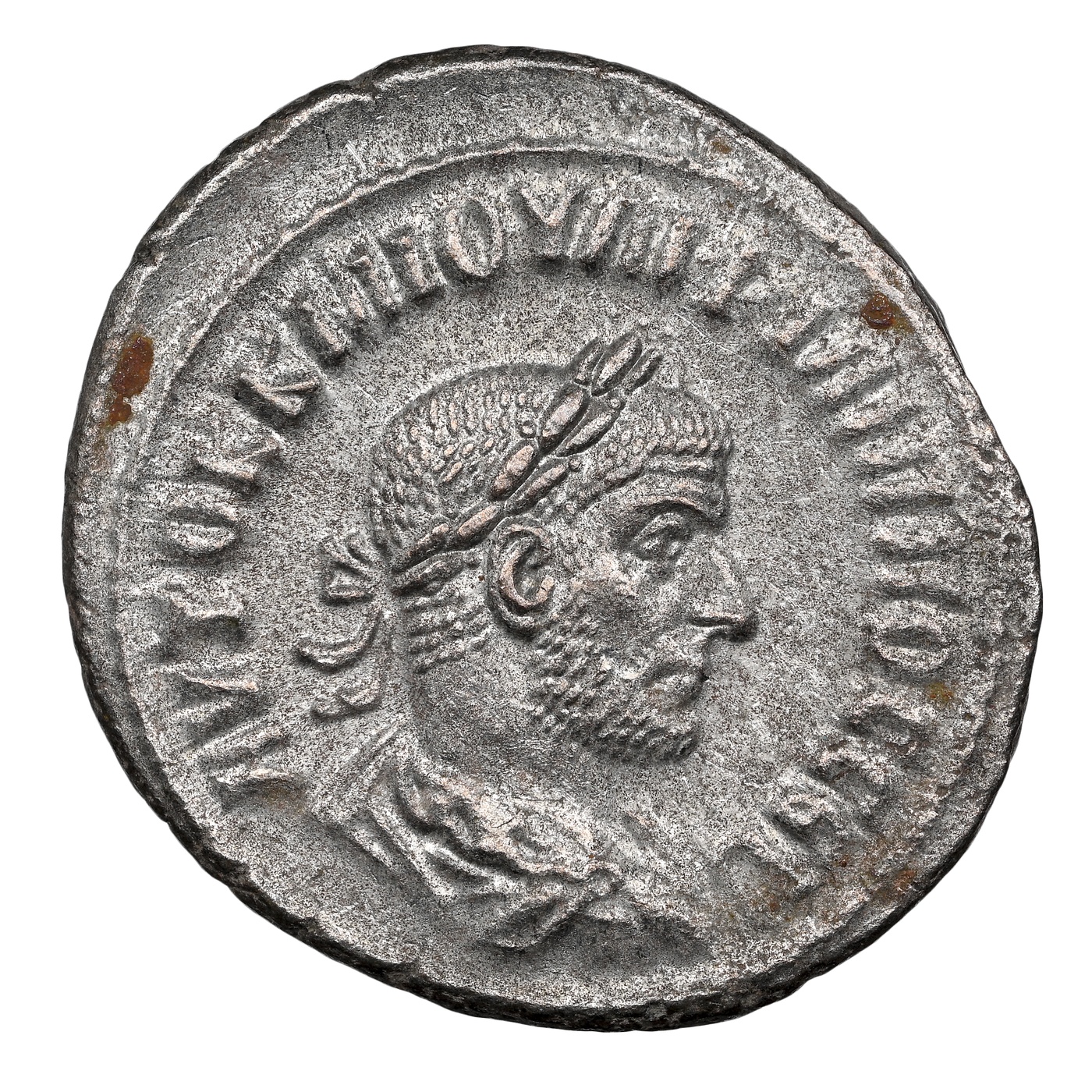
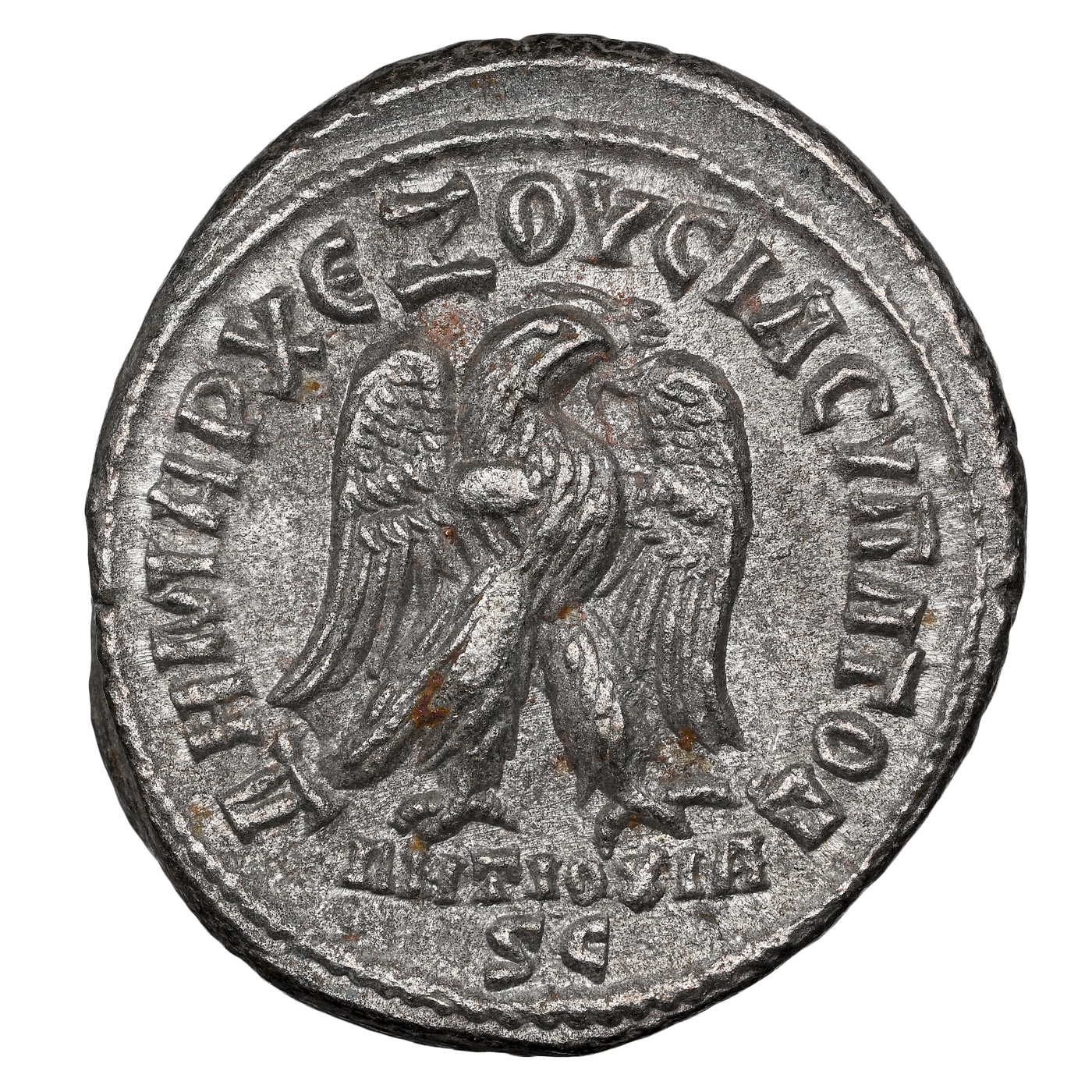
Current: Roman Provincial, Syria (Seleucis and Pieria), Antioch. Philip I, AD 244–249. BI tetradrachm, the COS IV (ΥΠΑΤΟ Δ) issue, AD 248/249. Laureate, draped and cuirassed bust seen from behind / eagle right on a line, wreath in beak, ANTIOXIA and S C below. RPC VIII (online) 2621; Prieur 445; McAlee 934.
Superseded: Heritage's lot description (Select Auction 232638, lot 63062) cites Prieur 474 and calls the bust 'Philip II' — the son's issue with the identical legends. NGC's label and the portrait say Philip I; see notes and the specimen page for the evidence.
Obverse: Laureate, draped and cuirassed bust of Philip I right, seen from behind
Reverse: Eagle standing right on a ground line, wings spread, wreath in its beak; ANTIOXIA above S C in the exergue
Primary reference: Prieur 445
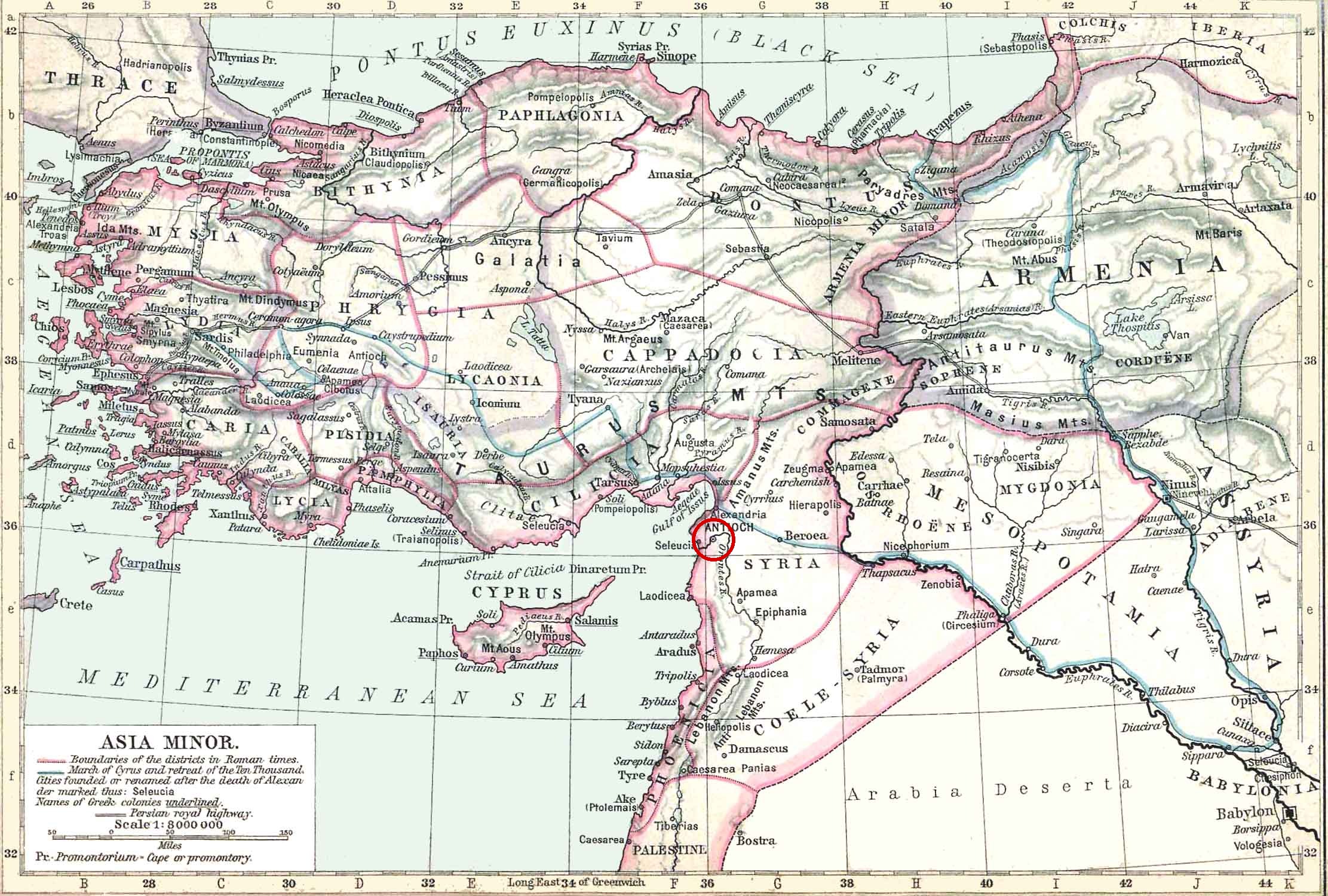
Asia Minor and the Roman East under the Greeks and Romans, from William R. Shepherd’s Historical Atlas (1923). Antioch — circled in red — lies in the lower right of the map, in the northwest corner of Syria where the Orontes meets the Mediterranean; see the Syria inset below. The same mint struck this collection’s Nero eagle tetradrachm two centuries earlier and the Elagabalus octassarion a generation before this coin.
“Asia Minor under the Greeks and Romans” from William R. Shepherd, The Historical Atlas (1923), via Wikimedia Commons, File:Asia minor-Shepherd 1923.JPG (https://commons.wikimedia.org/wiki/File:Asia_minor-Shepherd_1923.JPG). Public domain (author died 1934). Modified by JSB Coins: a red circle added to mark Antioch (the same marked copy used for the collection’s Nero tetradrachm). The Syria inset is a crop of the same plate, reproduced unmodified.
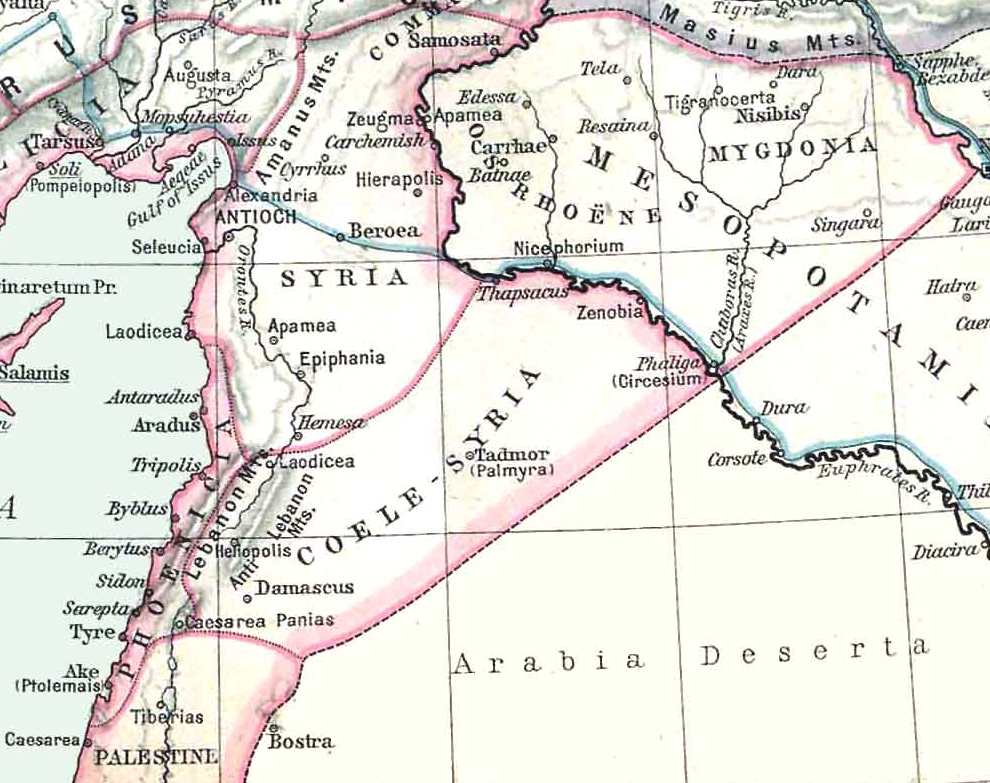
The Syria corner of the same Shepherd plate. Antioch sits at top left, on the Orontes just inland from its port Seleucia — the pairing that gives the district its ancient name, Seleucis and Pieria. Philip’s own birthplace, Shahba in the Hauran south of Damascus, which he refounded as Philippopolis, lies off the bottom edge.
This is a tetradrachm of Antioch struck in the last year of Philip the Arab, and it came to me under two names. The NGC holder says Philip I. The auction description, keyed to Prieur 474, says the bust is Philip II — the emperor’s son, made Augustus at ten and killed at eleven or twelve. Both issues carry exactly the same Greek on both faces, so the words cannot tell them apart; only the face can, and the face on this coin is a grown man’s. The specimen page sets out how that was settled. This page is about the man and the coin.
Graphic: JSB Coins, 2026 (CC0).
Marcus Julius Philippus came from Shahba in the Hauran, the basalt country south of Damascus — an Arab from the Roman province of Arabia, which is what the nickname means and all it means. He rose through the equestrian career to be Praetorian prefect under the boy emperor Gordian III, and in the winter of 243/4, on the Persian front, Gordian died and Philip took the purple. Zosimus tells it as murder: the prefect starving the army of supply, the soldiers turning on the emperor, Philip’s hand behind it (Zos. 1.18–19). The other tradition has Gordian killed in battle with the Persians, which is what Shapur’s own inscription at Naqsh-e Rustam claims. What is not disputed is what Philip did next: he bought peace from Shapur — Zosimus says with a great sum, and Shapur says five hundred thousand denarii — and marched home to Rome to have his position confirmed (Zos. 1.19). The collection already holds Gordian’s SECVRITAS antoninianus and the son’s PRINCIPI IVVENT antoninianus, so this coin closes a family.
Philip’s reign of five years is remembered for one thing above all. In April 248 Rome turned a thousand years old, counting from Romulus, and Philip celebrated the Secular Games — the ludi saeculares — with a display of animals collected by Gordian for a Persian triumph that never happened. The mint at Rome struck the SAECVLARES AVGG coinage in his name, his wife’s and his son’s, with the animals of the games on the reverses: a lion, a stag, an antelope, a hippopotamus, the she-wolf and twins. That coinage was struck the same year as this tetradrachm.
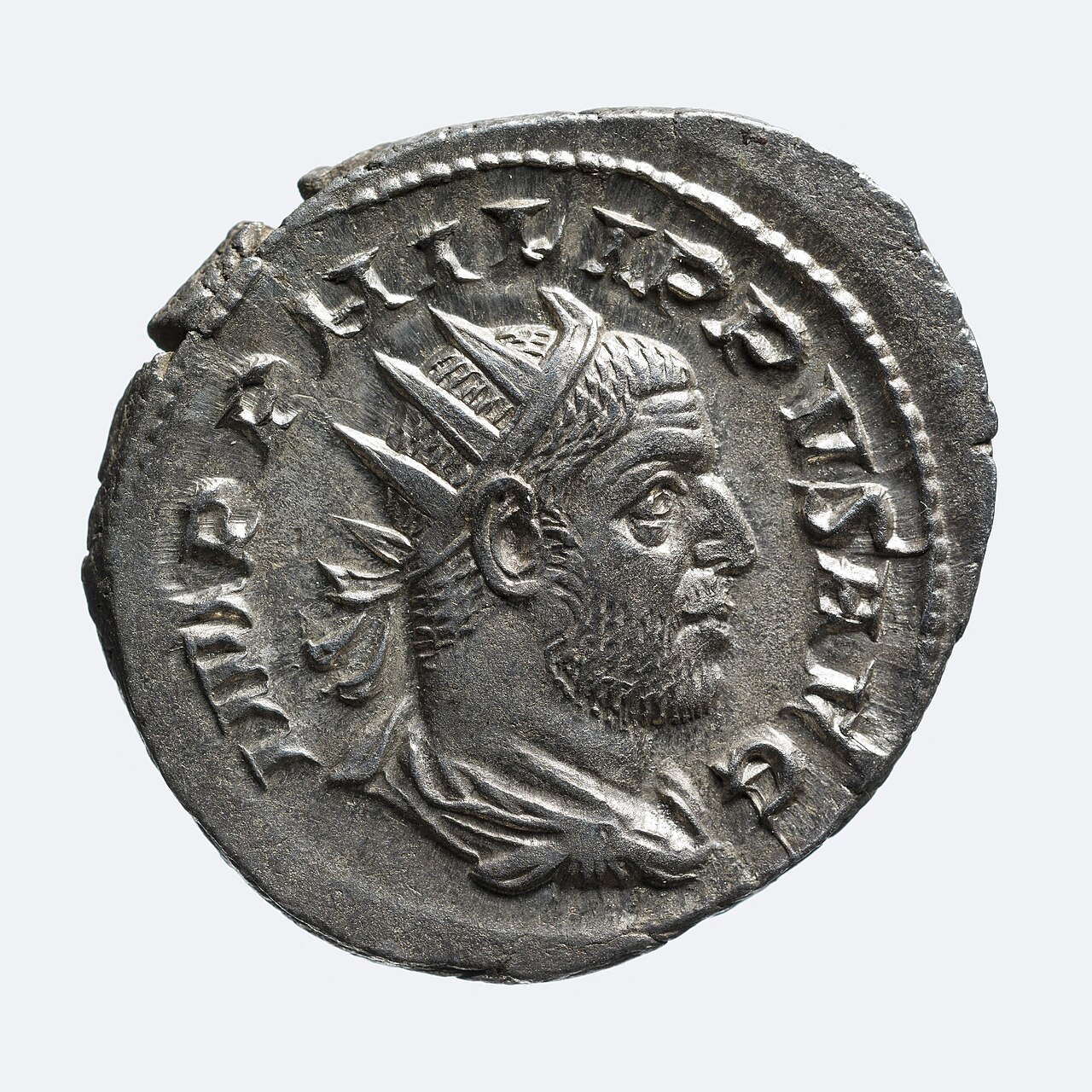
Photo: Paris Musées collections, CC0 (Wikimedia Commons); reproduced unmodified.
It did not last. In 248 and 249 the frontiers rose: Pacatian on the Danube, Jotapian in the East, and then the senator Decius, sent by Philip to restore order in Moesia, was proclaimed emperor by the troops he had been sent to command. Philip marched north and met him near Verona in the late summer of 249, and was killed; the son was killed in Rome by the Praetorians when the news arrived (Zos. 1.20–22). The next Antioch tetradrachms in this collection are Decius’s.
Antioch’s eagle tetradrachm was the large silver of the Roman East for three centuries. The collection’s Nero tetradrachm of AD 62/3 is the early form, good silver on the Attic weight; by the 240s the coin had become what the catalogues call billon, silver so debased that the metal is a grey alloy, and the design had settled into the standard third-century pattern seen here: the emperor’s bust with a Greek legend giving his titles, an eagle with a wreath in its beak, ΔΗΜΑΡΧ ΕΞΟΥϹΙΑϹ (“holder of the tribunician power”) with the consulship count, the city’s name ANTIOXIA and the letters S C — senatus consulto, borrowed from the Roman bronze, a formula that had been on Antioch’s coins since Augustus. The same eagle had been struck for the cities of Mesopotamia a generation earlier — the collection’s Carrhae tetradrachm of Caracalla is one — and under the Philips Antioch began organising its work into numbered officinae, the workshop numerals that appear under the busts of the Decius issues and which this Philip issue does not yet carry.
The son’s number on the father’s coin is less surprising once the provincial coinage of the reign is counted. Hekster and Manders, reviewing RPC Online in 2022, tabulate 3,083 provincial coin types for Philip’s five years, more than Trajan’s nineteen years produced, and only 1,338 of them, 43 per cent, show the emperor himself; 1,634, 53 per cent, show Philip II or Otacilia Severa. No other reign in their table puts the family ahead of the emperor. They read it as the visibility a wife and an uncontested heir were given on local coin, and it means that across the cities of the East the boy’s face was on more coin types than his father’s. Antioch struck the same legends for both, so a cataloguer working from the words had nothing to choose between them. The same review notes where the series was going: Antioch’s tetradrachm, by now heavily debased, gave way to the antoninianus, and the eastern tetradrachm coinage as a whole stopped in 253, two reigns after this coin. RPC itself, they warn, counts types and not coins, and its specimen tallies come from ten museum collections and the trade, so its average weight for this issue is a fair guide to the standard and no guide to how many were struck.
The reverse legend is the odd thing about the type. ΥΠΑΤΟ Δ says “consul for the fourth time”, and Philip I was consul three times, in 245, 247 and 248. RPC dates the ΥΠΑΤΟ Δ issue to about 248; the trade dates it to 249, the last year, as an anticipation of a consulship the emperor did not live to hold. I record both and do not choose. What the legend does do, unhelpfully, is appear identically on the son’s coins of the same issue — which is how the father’s coin came to be sold under the son’s number.
Ancient: Zosimus 1.18–22 (Gordian’s death, the Persian peace, the revolts and Verona), in the 1814 translation on tertullian.org, linked above; the Res Gestae Divi Saporis for the Persian version of 244 (cited from the standard editions, not linked). Numismatic: RPC VIII (online) 2621 and 2652 — the two Antioch issues with these legends, father and son — with their specimen photographs; M. and K. Prieur, Syro-Phoenician Tetradrachms (2000), no. 445; R. McAlee, The Coins of Roman Antioch (2007), no. 934, both cited by number. The Secular Games coinage: the Paris Musées antoninianus reproduced above. The reign’s provincial coinage by the numbers, and the end of the Antioch tetradrachm: O. Hekster and E. Manders, ‘Coinage in the Roman Provinces’, JRS 112 (2022); Antioch’s place among the tetradrachm mints: A. J. M. Kropp, ‘A Roman altar on Mount Gerizim’, JRA 34 (2021) — both read in full, in my Science library and linked in the references.
FATHER OR SON — SETTLED AS THE FATHER, and the reasoning is kept because the legends cannot settle it. Philip I and Philip II share the obverse legend ΑΥΤΟΚ Κ Μ ΙΟΥΛΙ ΦΙΛΙΠΠΟϹ ϹΕΒ on the Antioch tetradrachms of 248–249, both issues use the bust seen from behind, and both read ΥΠΑΤΟ Δ on the reverse: RPC VIII 2621 (Philip I, Prieur 445, McAlee 934) and RPC VIII 2652 (Philip II, Prieur 474, McAlee 1042) differ ONLY in the portrait. Heritage's description of this specimen cites Prieur 474 and says 'bust of Philip II'; NGC's label says Philip I. The portrait decides it: Philip II was about eleven or twelve in 248/249 and his Antioch busts are a beardless boy (RPC's Berlin specimen of 2652 shows him so), whereas this coin has the father's mature face — the short cropped beard, heavy jaw, long straight nose and thick neck — and matches RPC's Berlin specimens of 2621 feature for feature. The same slip appeared in Heritage's August sale 232632, where lot 61058 was titled Philip I but was Prieur 474 (Philip II); the emperors want card recorded it then. THE DATE. ΥΠΑΤΟ Δ is 'consul for the fourth time', but Philip I held only three consulships (245, 247, 248); RPC places the issue c. 248 and the trade puts it in 249, the last year of the reign. Whether Antioch was anticipating a consulship never taken up, or counting differently, I leave open. THE METAL. 'BI' — billon: the Antioch tetradrachm of the 240s was a debased silver, and RPC's average for this issue is 12.12 g on a 27 mm flan. NO WEIGHT is recorded for this collection's specimen — the NGC label of this older style carries none and the house gave none.
John's Ancient Coin Collection · Type · philip-i-antioch-eagle-tetradrachm
Where the mints are — every mint in the collection on a modern map
Image credits for this coin — photographs, maps and graphics used on this page