Type · panticapaeum-pan-griffin-bronze
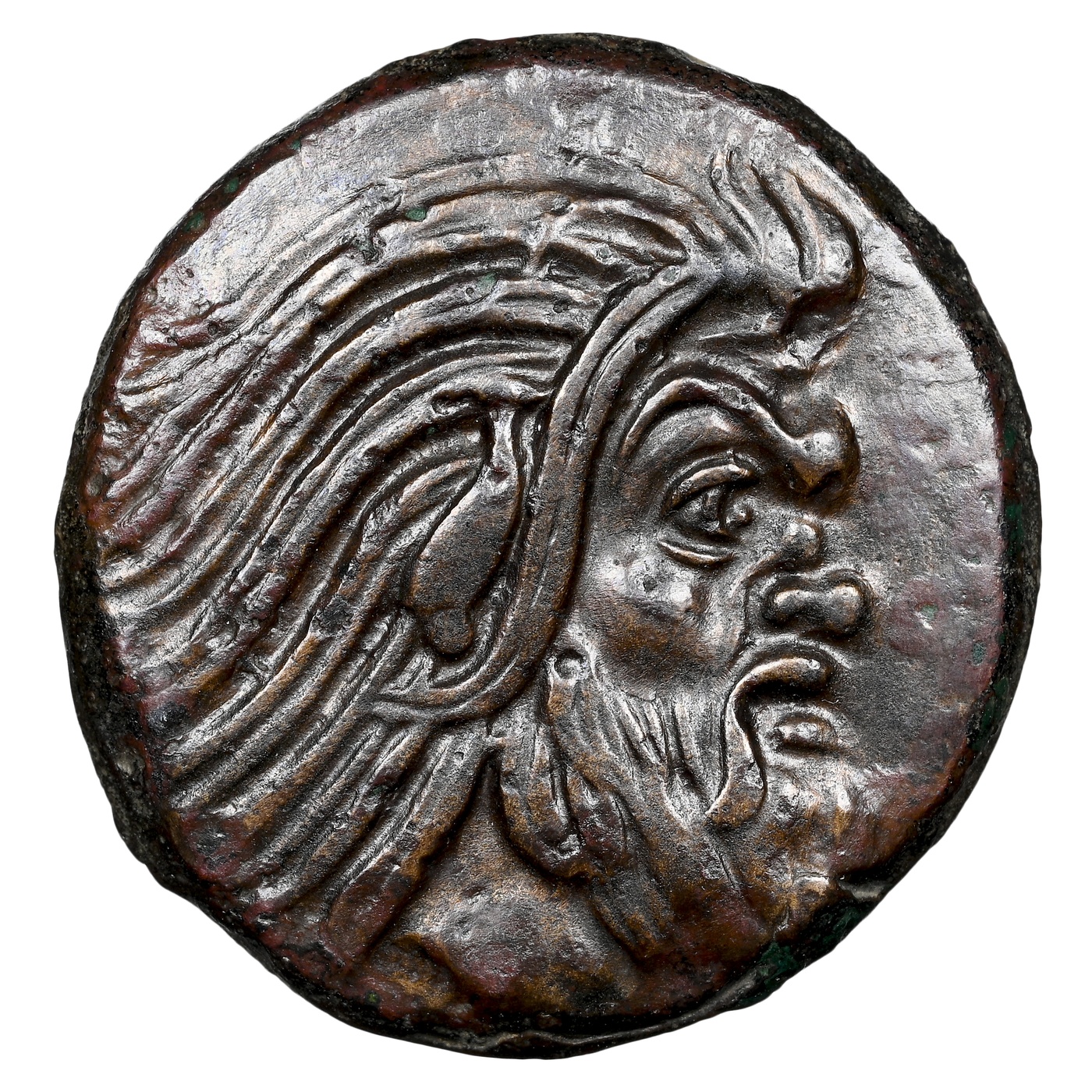
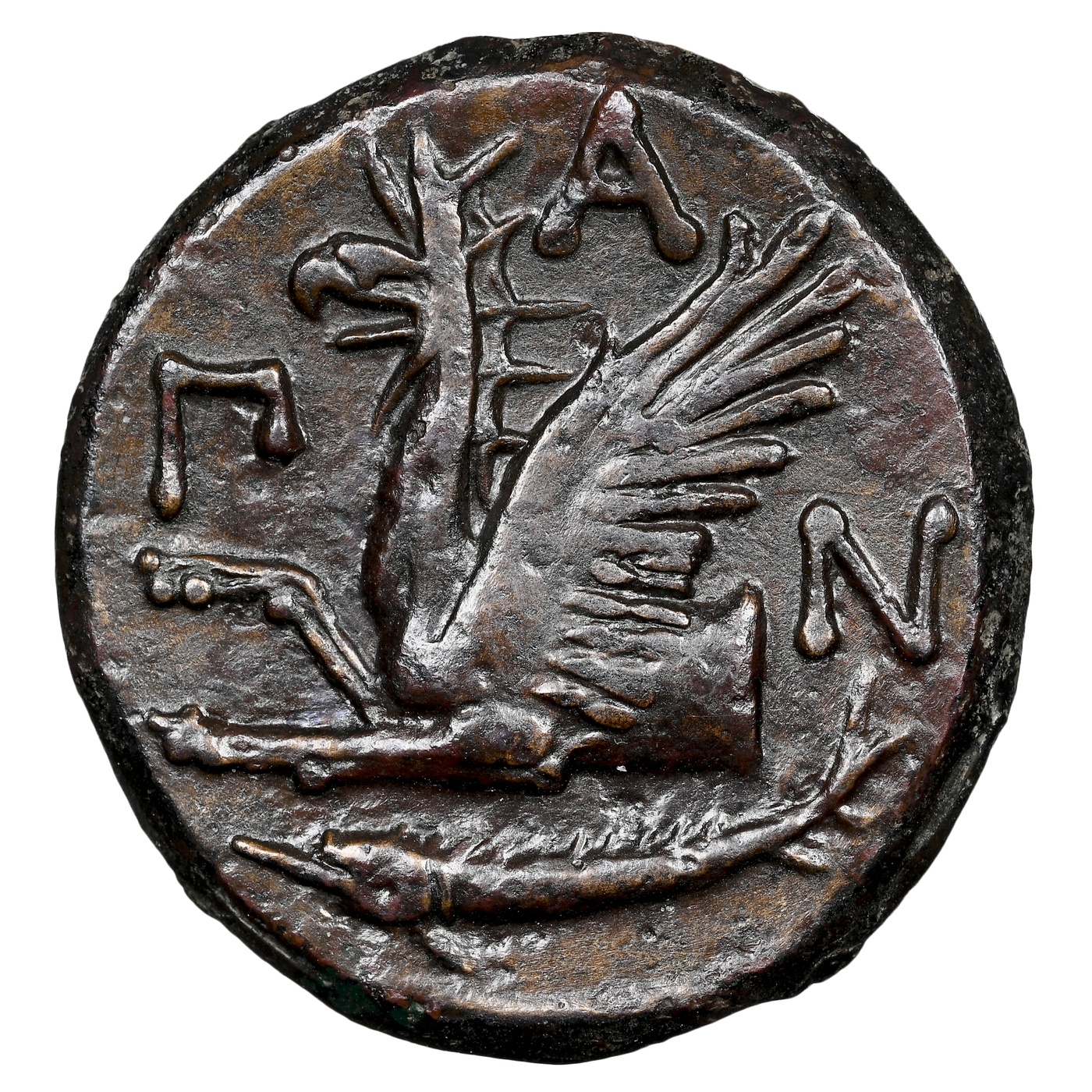
Current: Cimmerian Bosporus, Panticapaeum, AE unit (22 mm), c. 310–304/3 BC (MacDonald 69; Anokhin 1023; SNG BM Black Sea 869–871). Head of bearded Pan right / Π-A-N, forepart of griffin left, sturgeon left below.
Obverse: Head of bearded Pan right: the hair in long combed waves swept back from the brow, a small horn hidden in it and a pointed animal ear at the side; heavy brow, snub nose, open mouth, the beard in thick pointed locks. Traditionally called Pan; a strong school reads it as a satyr — see the essay.
Reverse: Forepart of a griffin to the left, the right forepaw raised, the wing spread upward in a fan of feathers, the beak open; below, a sturgeon swimming left. The letters Π, A and N stand one at each side of the design — Π left, A above, N right.
Primary reference: MacDonald 69
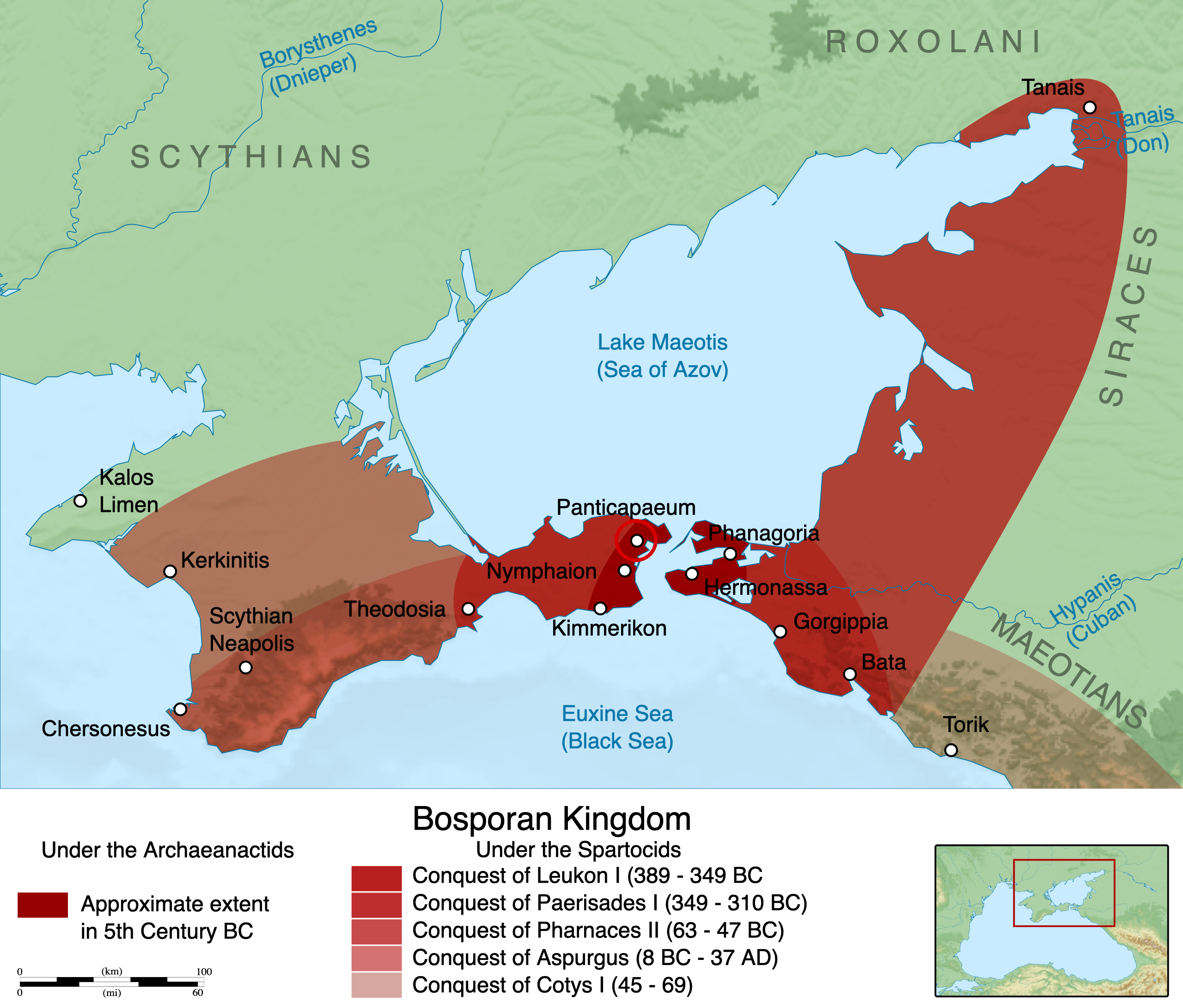
The Bosporan kingdom, the two shores of the Kerch strait that the Greeks called the Cimmerian Bosporus. Panticapaeum — ringed in red — sits on the Crimean side where the strait is narrowest, with Lake Maeotis (the Sea of Azov) opening behind it; Phanagoria faces it across the water on the Taman side. The reds show the kingdom’s growth: the fifth-century core under the Archaeanactids, then the conquests of Leukon I and Pairisades I, the two Spartocids who built the grain trade this coin paid for, and the later additions under Pharnaces II and the Roman-era kings, which belong to a different story. The coin was struck in the generation after Pairisades I, when the kingdom was the size of the two darker reds.
“Bosporan Kingdom growth map-en.svg” — Sémhur (original map), English version by Morningstar1814, Wikimedia Commons, https://commons.wikimedia.org/wiki/File:Bosporan_Kingdom_growth_map-en.svg (file: https://upload.wikimedia.org/wikipedia/commons/b/b7/Bosporan_Kingdom_growth_map-en.svg), licensed CC BY-SA 4.0. Modified by me: rasterised at 2560 px, and a red ring added to mark Panticapaeum. Downloaded 10 October 2026.
This is the coin by which everyone knows Panticapaeum. The head is the one the Greek north coast is famous for: a bearded, snub-nosed face with the hair pulled back in long combed waves, a small horn lost in it and a pointed animal ear at the side — a creature of the wild, cut in deeper relief than most Greek bronze ever attempts. On the other side a griffin rears up over a sturgeon, and three letters stand round it: Π, A, N. They are the beginning of the city’s name, ΠΑΝΤΙΚΑΠΑΙΤΩΝ, “of the Panticapaeans”, and they are also, read on their own, the name of the god Pan. A Greek holding this coin saw the city’s name and the god’s face at once, and the die-cutter meant him to. It is a canting type — a visual pun on a name — of the same family as the seal of Phokaia or the rose of Rhodes, and one of the best of them.
Whether the face really is Pan is another matter, and the question has a history of its own, which I come to below. What is not in doubt is the quality. The gold staters of Panticapaeum with this same head are among the most admired coins ever struck in the Greek world, and the bronze was cut by the same workshop in the same decades. It is the only place I know where an ordinary bronze carries the full ambition of a city’s gold.
Panticapaeum stood on the European side of the strait the Greeks called the Cimmerian Bosporus — the Kerch strait, the narrow throat between the Black Sea and the Sea of Azov — on the site of the modern Kerch. It was a colony of Miletos, founded in the first half of the sixth century BC, and like most of the Milesian foundations on the Black Sea it began as a trading post among non-Greek peoples: Scythians on the steppe behind it, Maeotians and Sindians across the water. By the fifth century it had become the head of a league of the Greek towns on both shores of the strait, ruled first by a family called the Archaeanactids and then, from 438/7 BC, by a dynasty that Diodorus (12.31.1) introduces with a man named Spartokos — a Thracian name — whose descendants held the Bosporus for three hundred years. They called themselves archons to the Greeks and kings to the barbarians, and the modern books call the state they ran the Bosporan kingdom.
Its business was grain. The black-earth hinterland of the Crimea and the Kuban grew more wheat than the Greek world could eat, and the Spartocids sold it. Demosthenes, arguing in 355 BC against a law that would have stripped Leukon I of his Athenian privileges, tells the jury what the Bosporus was worth to them: about four hundred thousand medimnoi a year came to Athens from Leukon’s ports, “not less than all that comes from the other markets put together”, and Leukon let Athenian ships load first and free of his export toll (Against Leptines 29–33). Four hundred thousand medimnoi is on the order of sixteen thousand tons. The owls that paid for it went north past Byzantion and came back as bread. Leukon ruled from 389 to 349 BC; Diodorus (16.31.6) records his death and the forty-year reign of his son Pairisades I that followed, and under those two the kingdom reached the size the map shows.
The date matters here because the best current dating puts the type into a single, well-recorded reign. David MacDonald, whose 2005 handbook is the standard English guide to the series, places this bronze at c. 310–304/3 BC. Pairisades I died in 311/10, and Diodorus (20.22–26) tells what happened next in more detail than we have for almost any other Greek city of the period: his three sons fought for the throne. The eldest, Satyros II, held Panticapaeum and marched against the youngest, Eumelos, who had the backing of a Sarmatian king; Satyros won the battle and died of a wound at the siege that followed; the middle brother Prytanis took up the war and lost it; Eumelos killed what was left of both their families and ruled alone. Diodorus then gives him an unexpectedly good press. He cleared the Black Sea of the pirates of its eastern coast, took in the people of Kallatis when Lysimachos besieged their city and settled them on his own land, and made himself the patron of the Greek cities of the Pontus, until he died in a chariot accident after five years and five months (20.25). If MacDonald’s dating holds, this coin is Eumelos’s money, struck while he was buying the Greek world’s good opinion. I say “if”: the older catalogues give only “fourth century BC”, the dealers say 325–310 or 310–303, and the sequence of the Bosporan bronzes rests on hoards and overstrikes rather than on anything written on the coins. The decade is MacDonald’s; the century is everyone’s.
The auction trade calls the head Pan, and the letters on the reverse are the reason: the pun only works if the face is the god whose name they spell. That reading goes back to the nineteenth-century catalogues and the British Museum still prints it. But the Russian numismatists who know this coinage best have long read the head as a satyr, not Pan. A. N. Zograph made the case in his 1951 corpus, and V. A. Anokhin followed him; MacDonald reports their view and does not dismiss it. The argument is partly iconographic — Pan should have a goat’s horns and often a goat’s face, while the Panticapaeum head has the snub nose, the pointed ear and the shaggy beard of the satyrs on Attic pottery — and partly historical: the first Bosporan coins with this head appear in the early fourth century, under a Spartocid ruler named Satyros I (died 389 BC), so a satyr could be a second pun, on the ruler’s name rather than the city’s, and a dynastic badge adopted by his heirs. NGC’s own label on this coin hedges — “Pan or Silenus(?)” — which is honest. I have written “Pan” in the attribution because that is how the type is catalogued and searched, but I do not think the question is closed, and the satyr reading has the better scholars behind it.
The griffin is the beast Herodotus put at the edge of the Scythian world: in the far north, beyond the Issedones, lived the one-eyed Arimaspians, who stole gold from the griffins that guarded it (3.116; 4.13; 4.27). The Scythian goldwork from the burial mounds around Panticapaeum is full of griffins, and the Greeks of the Bosporus, who sat at the door of that gold, took the creature as their own. On this coin it is drawn as a lion-bodied monster with the beaked head and spread wing of the Near Eastern type — the same animal that Teos had made its badge two centuries earlier on the far side of the Black Sea, though the Teian griffin sits and this one rears.
The sturgeon under it is the other half of the economy. The strait and the Sea of Azov behind it were the richest fishery in the Greek world. Herodotus (4.53) already knew the great boneless fish of the Dnieper that were salted for export, the antakaioi; Strabo (7.3.18) describes them being dug out of the ice of the frozen Maeotis “about the size of dolphins”, and places the largest catches of fish for salting at the river mouths on the kingdom’s Asian shore (11.2.4). Polybius (4.38) lists salt fish beside cattle, slaves, honey and wax as the things the Pontus sent the Greeks in exchange for oil and wine. Grain in the hold and sturgeon in the barrels: the two reverse types of this coin are a freight manifest. The city struck a real sturgeon, not a generic fish — the long snout, the row of bony scutes along the back and the lobed tail are all there on a good example.
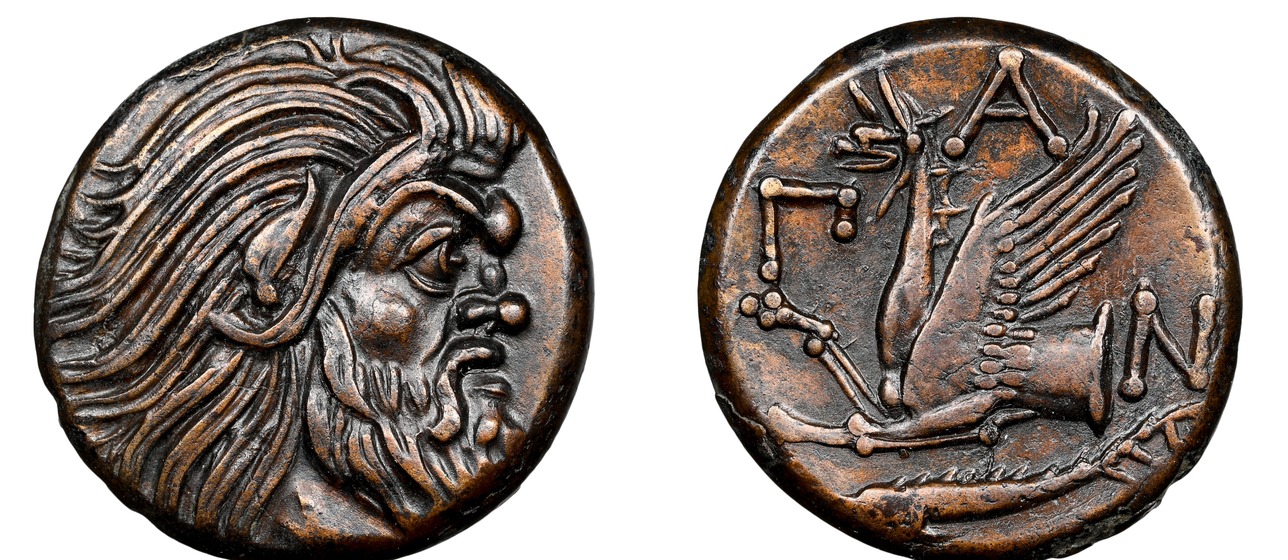
Image: NGC PhotoVision (NGCcoin.com) via Heritage Auctions (HA.com), Select Auction 232641, lot 62033; the two frames set side by side, the credit strip trimmed, nothing else changed.
Because the face is Classical Greek engraving at full stretch on a coin an ordinary collector can own. The gold staters are beyond me; the bronze is the same artists working in a cheaper metal, and on the better dies the modelling of the brow and beard is as good as anything on the gold. It also closes a gap on the map. This collection had nothing from the north coast of the Black Sea, and nothing from the grain trade’s supplying end — I had the Athenian owls that bought the wheat and the Byzantion siglos that tolled it, and now I have the coin of the city that sold it.
Catalogues: D. MacDonald, An Introduction to the History and Coinage of the Kingdom of the Bosporus (Classical Numismatic Studies 5, 2005), no. 69; V. A. Anokhin, Monetnoe delo Bospora (Kiev 1986), no. 111, and Antichnye monety Severnogo Prichernomor’ya (Kiev 2011), no. 1023; SNG British Museum IX, The Black Sea (1993), 869–871. On the Pan/satyr question: A. N. Zograph, Antichnye monety (1951; English translation Ancient Coinage, BAR Supplementary Series 33, 1977), and MacDonald’s discussion of it — both cited from the secondary literature, since I have not had the books in hand. Ancient authors: Demosthenes, Against Leptines 29–33 (the grain); Diodorus Siculus 12.31.1 (Spartokos), 16.31.6 (Leukon’s death), 20.22–26 (the war of succession and Eumelos); Herodotus 3.116, 4.13, 4.27 (the gold-guarding griffins) and 4.53 (the antakaioi); Strabo 7.3.18 and 11.2.4 (the fishery); Polybius 4.38 (the Pontic exports). The identification of Strabo’s antakaioi with the sturgeon follows the Loeb editor’s note to 7.3.18. Where the dating is given as c. 310–304/3 BC it is MacDonald’s; where a claim is hedged above it is because I could not source it better.
A heavy bronze of about 20–22 mm and 6–7.5 g; the British Museum's three and the Heritage lots of autumn 2026 sit in that band, and this collection's example is at the top of it at 7.44 g. The denomination has no secure ancient name — the catalogues call it a unit, or an obol by analogy — and MacDonald arranges the Bosporan bronzes by size class rather than by name. Two numbering systems circulate for Anokhin: the 1986 corpus (this type no. 111) and the 2011 regional corpus (no. 1023, the number NGC and Heritage print); they describe the same coin. Dating is not settled: MacDonald gives c. 310–304/3 BC, dealers often say 325–310 or 310–303, and the older museum cataloguing is content with '4th century BC'. The obverse head is called Pan in the auction trade and a satyr by the Russian school, and the two readings carry different histories — see the essay.
John's Ancient Coin Collection · Type · panticapaeum-pan-griffin-bronze
Where the mints are — every mint in the collection on a modern map
Image credits for this coin — photographs, maps and graphics used on this page